Specifications
Arquebus
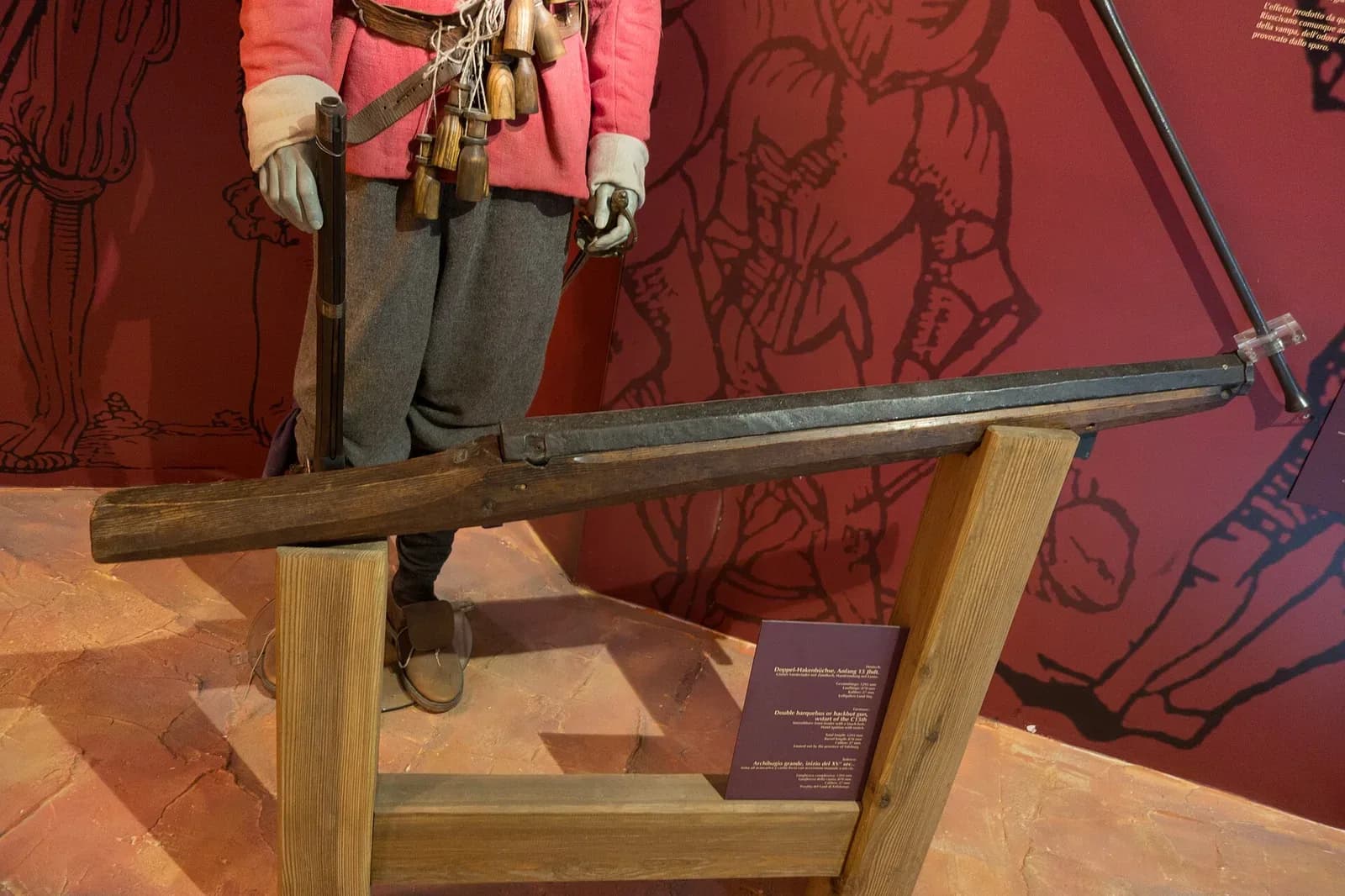
A rare double-barreled arquebus from Austria — a specialized variant combining two barrels to increase firepower without lengthening the weapon.
Thomas Quine (CC BY 2.0)
| Manufacturer | |
|---|---|
| Made By | |
| Designer | Ottoman Empire |
| Origin | Europe |
| Specifications | |
| Caliber | 0.45 to 0.75 inches |
| Action | matchlock |
| Weight | 8 to 15 pounds |
| Production | |
| Designed | 1465 |
| Variants | |
| |
| Service Use | |
Spanish forcesOttoman EmpireJanissariesHungarian forcesJapanese forcesPortuguese forcesMing dynastySafavid IranMamluk Sultanate | |
Arquebus: The Gun That Ended the Age of Knights
Firearms encyclopedia article
From The Boise Gun Club Handbook
Overviewedit
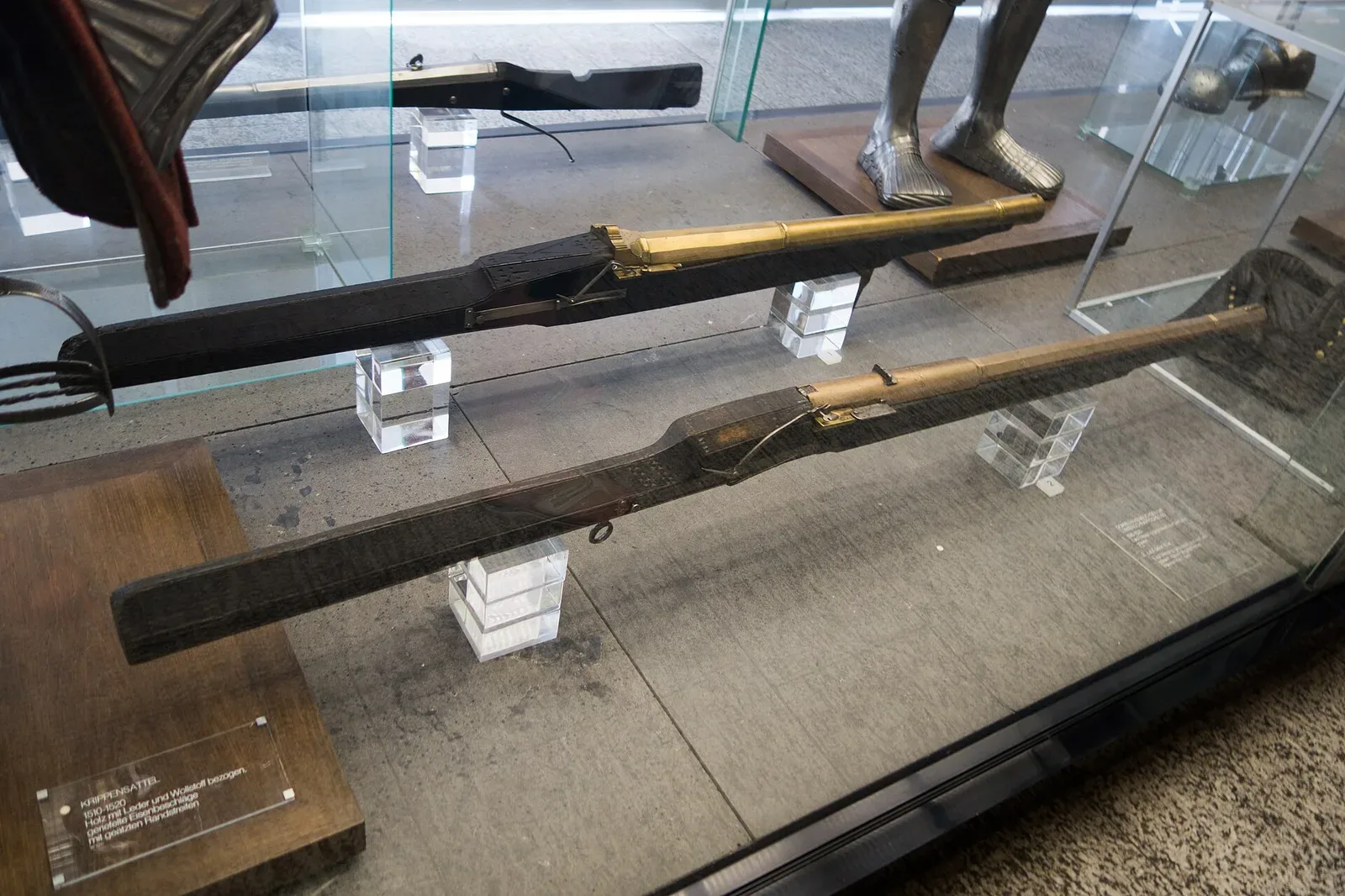
The arquebus was the first widely fielded shoulder-fired firearm with a trigger mechanism -- a smoothbore matchlock that appeared on European battlefields in the late 15th century and spread across the globe within a generation. It was not elegant. It was slow to load, unreliable in rain, and demanded weeks of repetitive drill before a soldier could run through its 28-step firing sequence without thinking.
None of that mattered. The arquebus hit harder than any bow, punched through plate armor that had taken centuries to perfect, and could be taught to a common laborer in a fraction of the time it took to train a longbowman.
It did not just change tactics. It dismantled the social order that medieval warfare had built. Knights became expensive liabilities. Foot soldiers became the decisive force on the battlefield. Professional standing armies replaced feudal levies. From the vineyards outside Cerignola in 1503 to the plains of Nagashino in 1575, the arquebus rewrote the rules of who could project power and how.
Understanding the arquebus means understanding the hinge point between medieval and modern warfare -- the moment when gunpowder stopped being a siege engineer's tool and became every infantryman's problem to solve.
Design Historyedit
From Fire Lance to Hook Gun
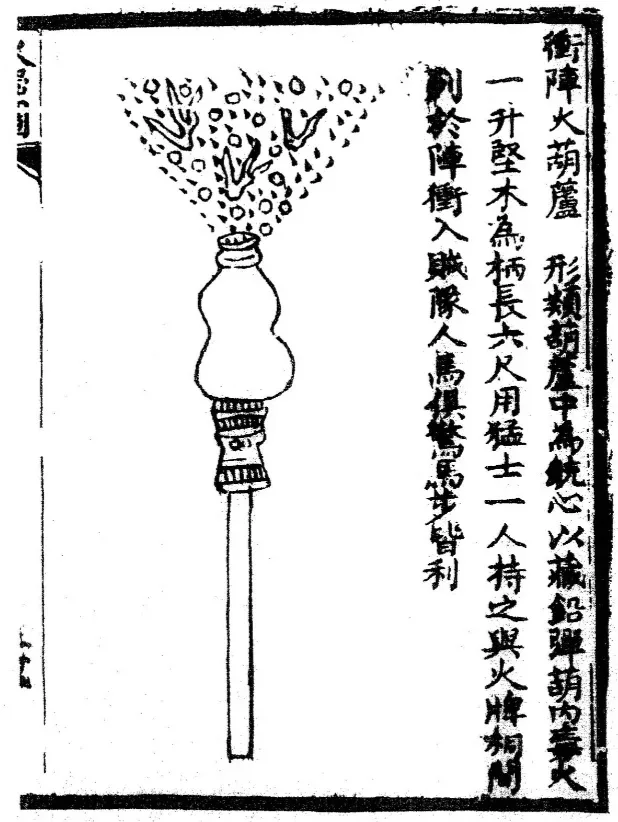
The arquebus did not appear from nowhere. Its ancestry runs through centuries of Chinese gunpowder experimentation. According to the Grokipedia source, the fire lance -- a bamboo tube packed with gunpowder and projectiles, attached to a spear -- was first documented around 950 CE during the Song-Liao wars, with battlefield use emerging in the 12th century during the Song-Jin wars. That device was less firearm than directed explosion, but it planted the conceptual seed: gunpowder as a propellant for a projectile, delivered by hand.
Europe's contribution in the 14th century was the pot-de-fer, a simple vase-shaped hand cannon that allowed an individual to handle a black powder charge and fire a projectile. These early handgonnes required one hand to aim and another to apply a burning coal or lit taper to the touch hole -- an arrangement that made anything resembling aimed fire nearly impossible.
The breakthrough that separated the arquebus from its predecessors was the matchlock mechanism. European records from 1411, including an illustration in the Vienna Codex Vindobonensis 3069, link the concept of a shoulder-fired gun with a serpentine lever for igniting the match. A battlefield example appears the same year: a handgonne recovered from the Tannenberg battlefield featuring a basic serpentine mechanism.
According to Grokipedia, the pivotal matchlock -- using a trigger to lower that serpentine arm holding a slow-burning match into the flash pan -- is believed to have been invented around 1465 in the Ottoman Empire, with European versions emerging by 1475.
The term itself tells part of the story. "Arquebus" derives from the Middle Dutch haakbus, literally "hook gun," referring to the hook-shaped projection on early models used to brace the weapon against a wall, wagon, or rest during firing. That hook wasn't decorative -- early arquebuses often exceeded 10 pounds, and unsupported aimed fire was simply not practical. The first attested use of a related term appears in 1364, when Bernabò Visconti, lord of Milan, recruited 70 archibuxoli -- likely denoting early hand cannons with hook supports -- into his forces.
By the 16th century, the term had traveled through Middle French harquebuse into English as "arquebus," entering the language around 1525 to 1535. Synonyms in English included "hackbut," "hagbut," and "caliver" -- the last referring specifically to a lighter, standardized-bore variant. These terms were used interchangeably across Europe for shoulder-fired matchlock firearms.
Refinement and the Road to a Shoulder Arm
Early arquebuses were essentially wall guns. Their weight confined them to fixed positions via the hook mount -- the arquebus à croc variant could weigh up to 60 pounds with a 5- to 6-foot barrel, deployed in defensive sieges from walls or wagon beds. Widespread handheld use had to wait for barrel and stock refinements in the 1470s that brought portable models down to 8 to 15 pounds.
By the 1450s, forces in Bohemia and Hungary were incorporating matchlocks into infantry equipment. Matthias Corvinus, the Hungarian king, experimented with the weapons to counter Ottoman incursions -- an early example of the competitive arms dynamic that would drive arquebus adoption across Europe and the Middle East simultaneously.
The stock evolved from rudimentary pole-like supports to more ergonomic shouldered forms by the 1470s, incorporating straight or pistol-grip configurations for standing or kneeling fire. The matchlock mechanism itself was refined with an enclosed flash pan featuring a hinged cover -- an early precursor to the frizzen -- to shield priming powder from wind and moisture. Bartolomeo Beretta's connection to the arquebus era is documented: in 1526, he sold barrels designed for handheld guns to the Republic of Venice, one of the earliest records linking a firearms dynasty to the arquebus trade.
By the early 16th century, the musket emerged as a heavier evolution of the arquebus -- often 16 to 20 pounds with a 5-foot barrel and a 2-ounce shot -- specifically engineered to penetrate plate armor and requiring a forked rest due to its recoil. The two weapons coexisted for decades, with "arquebus" denoting the lighter infantry arm and "musket" the armor-defeating heavy gun. By the 17th century, "musket" had broadened into a generic term for smoothbore shoulder firearms, as matchlock technology gave way to flintlock.
| Variant | Weight | Barrel Length | Primary Use |
|---|---|---|---|
| Arquebus à croc | Up to 60 lbs | 5-6 feet | Wall-mounted siege defense |
| Caliver | 8-12 lbs | ~4 ft 10 in | Standardized infantry |
| Petronel | 6-8 lbs | 2.5-3 feet | Cavalry carbine |
| Musket | 16-20 lbs | 5 feet | Armor penetration |
| Tanegashima | 7-10 lbs | 3-4 feet | Japanese adaptation |
Technical Characteristicsedit
Basic Specifications
The arquebus was a smoothbore firearm built around a wrought iron or occasionally bronze barrel, typically 30 to 40 inches in length, with a caliber ranging from 0.45 to 0.75 inches depending on the era and variant. The stock was crafted from dense hardwoods -- walnut or beech -- fitted with iron bands or pins to secure the barrel. Total weight for portable models ran 8 to 15 pounds.
| Specification | Value |
|---|---|
| Barrel Length | 30-40 inches |
| Caliber | 0.45-0.75 inches |
| Weight (Portable) | 8-15 pounds |
| Stock Material | Walnut or beech hardwood |
| Powder Charge | 50-100 grains black powder |
| Ball Weight | 0.5-1 ounce lead |
| Muzzle Energy | 1,300-1,750 joules |
| Effective Range | 50-100 yards |
| Rate of Fire | 1-3 shots per minute |
| Reload Time | 30-60 seconds |
The heart of the system was the matchlock mechanism: an S- or Z-shaped serpentine arm pivoted to a lock plate, clamping a slowly smoldering match cord treated with saltpeter for consistent burning. Pulling the trigger rotated the serpentine downward, dropping the glowing match into a primed pan of fine black powder, which flashed through a touch hole to detonate the main charge -- a 50- to 100-grain load of saltpeter, sulfur, and charcoal. Ammunition was spherical lead balls of 0.5 to 1 ounce, seated with wadding for a consistent fit.
Performance and Limitations
Effective range for reliable aimed fire on man-sized targets ran 50 to 100 yards. Muzzle energy for a typical .60-caliber load measured 1,300 to 1,750 joules -- compared to roughly 80 to 100 joules for a longbow arrow or 100 to 200 joules for a crossbow bolt. Hit rates at 50 meters ran 10 to 20 percent; at 100 meters, accuracy dropped to around 2 percent, owing to the smoothbore design, powder inconsistencies, and barrel fouling.
| Weapon Type | Range Comparison | Energy Comparison |
|---|---|---|
| Arquebus | 50-100 yards effective | 1,300-1,750 joules |
| Longbow | 200+ yards maximum | 80-100 joules |
| Crossbow | 100-150 yards effective | 100-200 joules |
Reload time for a trained soldier ran 30 to 60 seconds under ideal conditions, yielding roughly 1 to 3 shots per minute. Factors like damp powder, a fouled barrel, or an extinguished match cord could push that figure to 60 seconds or beyond. For context, a trained longbowman could loose 6 to 10 arrows per minute.
Loading Procedure
The loading process was not casual. According to Jacob de Gheyn II's 1607 drill manual The Exercise of Armes for Calivres, Muskettes, and Pikes, the procedure encompassed up to 28 distinct steps. Soldiers poured a measured charge down the muzzle, seated a lead ball on a lubricated wad, rammed it home, primed the pan with fine powder, closed the pan cover, ensured both ends of the match cord were lit, inserted the cord into the serpentine jaws, and then held that configuration steady while waiting for the order to fire. A "flash in the pan" -- the priming charge igniting without communicating to the main charge -- was a constant hazard. Barrel bursts from overloaded powder or defective iron barrels were not unheard of.
The matchlock's central vulnerability was weather. Rain could extinguish the slow match or dampen the powder, rendering the weapon inert. Bows and crossbows, by contrast, remained functional in adverse conditions with only minor adjustments. This limitation shadowed the arquebus throughout its operational life and was a primary driver of the eventual transition to flintlock mechanisms in the 17th century.
Key Variants
- Arquebus à croc: Heavy wall-mounting variant, up to 60 pounds with a 5- to 6-foot barrel, used in defensive sieges
- Caliver: Lighter standardized model with a uniform bore diameter, approximately 4 feet 10 inches of barrel, enabling use without a rest
- Petronel: Compact cavalry carbine, 2.5 to 3 feet with a curved buttplate for cheek-firing from horseback
- Musket: Heavier evolution, 16 to 20 pounds, 5-foot barrel, 2-ounce shot, specifically engineered to defeat plate armor
- Tanegashima: Japanese matchlock adaptation introduced in 1543, featuring ornate stocks and lighter construction for ashigaru foot soldiers
Combat & Field Useedit
Cerignola and the Birth of Modern Infantry Tactics
The first major battle decided by small arms fire was Cerignola, fought on April 21, 1503, in southern Italy. Spanish forces under Gonzalo Fernández de Córdoba positioned roughly 1,000 arquebusiers behind a defensive ditch lined with stakes along a vineyard slope. When French and Swiss pike columns advanced, the arquebusiers unleashed volleys that broke the attack's momentum entirely. The Spanish then counterattacked into the disrupted formation. Naples went to Spain. The age of the armored knight charging into infantry was effectively over.
Cerignola demonstrated a principle that would define the next 150 years of European warfare: entrenched, disciplined arquebusiers, protected from cavalry and melee by terrain or pike screens, could defeat forces several times their size.
The arquebus did not make knights obsolete by outranging them or outrunning them -- it made their armor irrelevant.
Lead balls at 50 meters could deform or penetrate 1 to 2 mm of steel plate. The investment in a full harness of plate armor, which had been the definitive military advantage for centuries, became a liability.
The Spanish Tercio and Pike-and-Shot Doctrine
The weapon that won at Cerignola needed a system to make it reliable in open battle. The answer was the Spanish tercio -- a combined-arms formation that typically comprised around 3,000 men divided roughly evenly between pikemen and arquebusiers. The pikemen formed a dense central block, ten or more ranks deep, providing an impenetrable hedge against cavalry charges and melee assaults. The arquebusiers flanked them, delivering fire while sheltered from direct engagement.
This 1:1 pike-to-shot ratio was not static. Over time, the ratio shifted toward more gunners as arquebusiers demonstrated their value and reload times improved through drill. But the core logic -- protect the shooters until they can fire, then exploit the disruption -- governed European infantry doctrine through the mid-17th century.
Volley fire addressed the arquebus's central tactical problem: a single rank of guns that fired and then spent a minute reloading was a gap in your defensive line. Ottoman Janissaries employed an early form of countermarch volley at the Battle of Mohács in 1526, where successive ranks fired to maintain continuous pressure on Hungarian forces, contributing to the rout of the Hungarian army under Suleiman the Magnificent. Whether this constitutes a formalized countermarch or sequential firing remains debated -- the Grokipedia source notes the evidence is limited.
The formalized countermarch drill was codified by Prince Maurice of Nassau of the Dutch Republic in the 1590s. Maurice trained infantry in linear ranks to advance, fire by platoon, wheel to reload, and return to position -- a system that turned the arquebus's slow reload from a vulnerability into a managed rotation. His reforms influenced European armies through the Eighty Years' War and beyond, and represent one of the most significant tactical innovations of the gunpowder era.
At Nagashino in 1575, Japan's Oda Nobunaga deployed approximately 3,000 arquebusiers in three rotating ranks, each firing on command before falling back to reload. The result was continuous fire that shattered repeated Takeda cavalry charges. Nagashino is often cited as the Asian parallel to Cerignola -- a single battle that demonstrated the decisive superiority of disciplined firearm volleys over traditional mounted assault.
| Battle | Year | Arquebusiers | Key Innovation | Outcome |
|---|---|---|---|---|
| Cerignola | 1503 | ~1,000 Spanish | Defensive positioning | Spanish victory |
| Mohács | 1526 | Janissary corps | Early volley fire | Ottoman victory |
| Nagashino | 1575 | 3,000 Japanese | Three-rank rotation | Oda victory |
| Ridaniya | 1517 | Mamluk units | Combined with artillery | Ottoman victory |
Global Spread and Adaptation
The arquebus spread through two main vectors: military conquest and commercial trade, often simultaneously operated by the same powers.
The Ottoman Empire standardized the arquebus by 1465 and integrated it into Janissary units in substantial numbers through the early 1500s. The Janissary corps expanded from approximately 12,800 equipped troops in 1567 to over 37,600 by 1609, reflecting the weapon's centrality to Ottoman military power.
The Mamluk Sultanate in Egypt adopted arquebuses around 1500, influenced by Ottoman practice. Sultan Qansuh al-Ghawri formed a dedicated arquebusier unit around 1510, though the Mamluk cavalry elite's disdain for firearms limited full integration. At the Battle of Ridaniya in 1517, Mamluk arquebuses proved ineffective against Ottoman field artillery, contributing to their decisive defeat and the sultanate's fall.
Safavid Iran began producing tufang -- matchlock muskets comparable to the arquebus -- in the 1510s after their cavalry-heavy army suffered a crushing defeat from Ottoman firearms at the Battle of Chaldiran in 1514. Post-battle reforms integrated tufang alongside mounted forces, and Safavid gunsmiths refined the design into lighter weapons suited to Persian warfare.
Portuguese maritime expansion carried the arquebus to Southeast Asia beginning with the capture of Malacca in 1511. The technology moved rapidly from there: Vietnamese forces adopted Portuguese-style arquebuses in the mid-16th century; Portuguese fighters in Siam transitioned to musketeer service for King Chairacha in the 1540s. In Java, the indigenous Bedil Jawa -- a long-barreled matchlock arquebus -- was developed in the early 16th century and was even exported to China, where it was known as Zua Wa Chong.
Portuguese traders brought matchlock arquebuses to the Ming dynasty as early as 1523, when imperial forces captured such weapons from European vessels near Ningbo. By the 1540s, Ming production of niao chong -- "bird guns," lightweight matchlocks used initially for hunting -- was underway, blending European mechanisms with Chinese barrel-making expertise. Domestic production was established by the 1550s.
The Japanese adoption in 1543 is among the most documented technology transfers in firearms history. Portuguese sailors, shipwrecked on Tanegashima Island, traded two matchlocks to local lord Tokitaka. He reverse-engineered and produced copies within a year. The tanegashima spread rapidly through the Sengoku period, transforming infantry tactics and culminating at Nagashino 32 years later with the most decisive demonstration of coordinated arquebus fire in Asian history.
| Empire/Region | Adoption Period | Local Name | Key Adaptations |
|---|---|---|---|
| Ottoman Empire | 1465+ | Tüfek | Janissary integration |
| Ming China | 1540s+ | Niao chong ("bird gun") | Lightweight hunting variant |
| Japan | 1543+ | Tanegashima | Ornate stocks, lighter build |
| Safavid Iran | 1510s+ | Tufang | Post-Chaldiran reforms |
| Portuguese Empire | 1511+ | Arquebus | Maritime expansion vector |
In the Americas, Portuguese and Spanish forces used arquebuses against indigenous opponents who had no comparable ranged technology and no armor capable of stopping a lead ball. The psychological effect alone -- the sound, the smoke, the flash -- was documented as a decisive factor in early engagements, compounding the weapon's physical lethality.
The Weather Problem and the Limits of the Matchlock
For all its advantages, the arquebus carried a fundamental vulnerability that no amount of drilling could solve: rain. The slow match cord, which had to remain lit throughout an engagement, extinguished in wet conditions. The open flash pan was susceptible to moisture. The Grokipedia source references battles like Villalar where rain contributed to firearm failures. Commanders had to plan around weather in a way that bowmen never did.
This was not a minor inconvenience. It shaped deployment decisions, influenced fortress and field fortification design, and ultimately drove the development of the flintlock mechanism in the 17th century. The flintlock's enclosed ignition system -- striking a frizzen to generate sparks rather than relying on a burning cord -- offered substantially better reliability in wet conditions. By the 1690s, European armies had largely transitioned to flintlocks, and the matchlock arquebus passed out of frontline service.
Legacy & Influenceedit
Social and Military Transformation
The arquebus did not just change how wars were fought -- it changed who could fight them and why. The decline of heavy cavalry as the decisive battlefield force is directly traceable to the arquebus era. When a common soldier with a few weeks of training could kill a knight whose armor represented years of craft and decades of income, the feudal military hierarchy became economically indefensible. Professional standing armies -- paid, drilled, and equipped by centralized states -- replaced the feudal levy system across Europe during the 16th century. The arquebus was not the only cause of that shift, but it was the clearest accelerant.
The pike-and-shot formation that the arquebus necessitated became the template for European infantry organization through the Thirty Years' War. Prince Maurice of Nassau's countermarch drills influenced armies from the Dutch Republic to Sweden, where Gustavus Adolphus built on the same principles in the early 17th century. The linear infantry tactics of the 18th century -- shallow ranks, coordinated volleys, bayonet charges -- are the direct descendants of the arquebus-era experiments in combining firepower with melee.
Modern Connections and Archaeological Evidence
The word "arquebuse" entered French liqueur history through an unlikely route. The Arquebuse de l'Hermitage liqueur was formulated in 1857 by Marist Brother Emmanuel at the Hermitage Monastery in France using 33 macerated plants; it was originally a tonic for treating arquebus gunshot wounds. The name has outlasted the weapon by centuries.
Archaeological evidence continues to refine the historical picture. The Mary Rose, a Tudor warship that sank in 1545, yielded several matchlock arquebuses during its recovery in the 1980s, with ongoing analysis in the 2020s confirming their role in 16th-century naval warfare. Excavations in Japan have uncovered 16th-century tanegashima components, documenting the weapon's localized production following the 1543 introduction.
Modern replicas, produced since the 1970s by companies such as Davide Pedersoli & C. under the Armi Sport group, use period-accurate wrought iron barrels and walnut stocks and appear regularly in historical reenactments. In the United States, the ATF classifies black powder muzzleloaders as antiques, exempting them from federal licensing requirements. Ballistic tests on replicas have validated muzzle energies of 1,300 to 1,750 joules for typical .60-caliber loads, consistent with historical accounts of the weapon's lethality at 50 to 100 meters.
Original arquebuses command significant collector value. Well-preserved 16th- to 17th-century examples have sold at auction for $5,000 for basic iron matchlocks to $50,000 for ornate German or Italian wheellock variants, according to Rock Island Auction Company sales data cited in the Grokipedia source. The Metropolitan Museum of Art holds 15th-century German handgonnes, including a 1475 matchlock with engraved brass fittings, illustrating the weapon's transitional form from hackbuts to mature arquebus design.
The technological chain from arquebus to modern rifle is direct: matchlock to flintlock, flintlock to percussion cap, percussion cap to self-contained cartridge. Each step solved a problem the previous mechanism couldn't -- weather reliability, ignition speed, reload time -- but the fundamental architecture of a shouldered smoothbore firing a lead ball propelled by a metered powder charge was set in the 15th century and didn't change in its essentials for 200 years.
The BGC Takeedit
What strikes me most about the arquebus is how much it asks of the person using it. Twenty-eight steps. A lit cord you're managing the whole time. Rain as an existential threat. Hit rates that, by modern standards, look like a miss machine. And yet it broke the medieval world.
That tells you something important about what actually matters in a weapon system. > The arquebus wasn't accurate. It wasn't fast. It wasn't reliable in bad weather. But it hit harder than anything infantry had ever carried, it was trainable in weeks rather than years, and it made expensive armor worthless. In a fight, three out of four beats none out of four.
People sometimes romanticize the longbow as the superior technology the arquebus displaced. That's backwards. The longbow was extraordinary -- but it required a lifetime to master and a specific body type to draw effectively. England's yeoman archers were a finite resource that took decades to grow. An arquebus company could be assembled from peasants in a season. That asymmetry in human capital is what actually ended the longbow's era, not some marginal range or accuracy debate.
The countermarch volley is the tactical idea from this period that I keep coming back to. > Maurice of Nassau figured out that a slow-firing weapon in the hands of disciplined, rotating ranks is effectively a continuous-fire weapon. That insight -- that system design can compensate for individual weapon limitations -- is still how military small arms doctrine works. The arquebus didn't win battles by itself. It won battles because someone figured out how to organize people around its constraints.
For a weapon that looked, by any individual metric, like a step down from what came before, it managed to permanently reshape every military on Earth within about a century of widespread adoption. That's not a small thing.
Referencesedit
- https://warfarehistorynetwork.com/article/the-arquebus/
- https://en.wikipedia.org/wiki/Arquebus
- https://www.youtube.com/watch?v=YkDcN6JxRMA
Last Updated: February 27, 2026
- Gls Guns(Sumner, IA)
- Bi-mart - Yakima (Fruitvale Ave)(Yakima, WA)
- New Philly Sportsman Specialities(New Philadelphia, OH)
- R&R Sports & Outdoors(Brandon, FL)
Loading comments...