Details
Wheellock
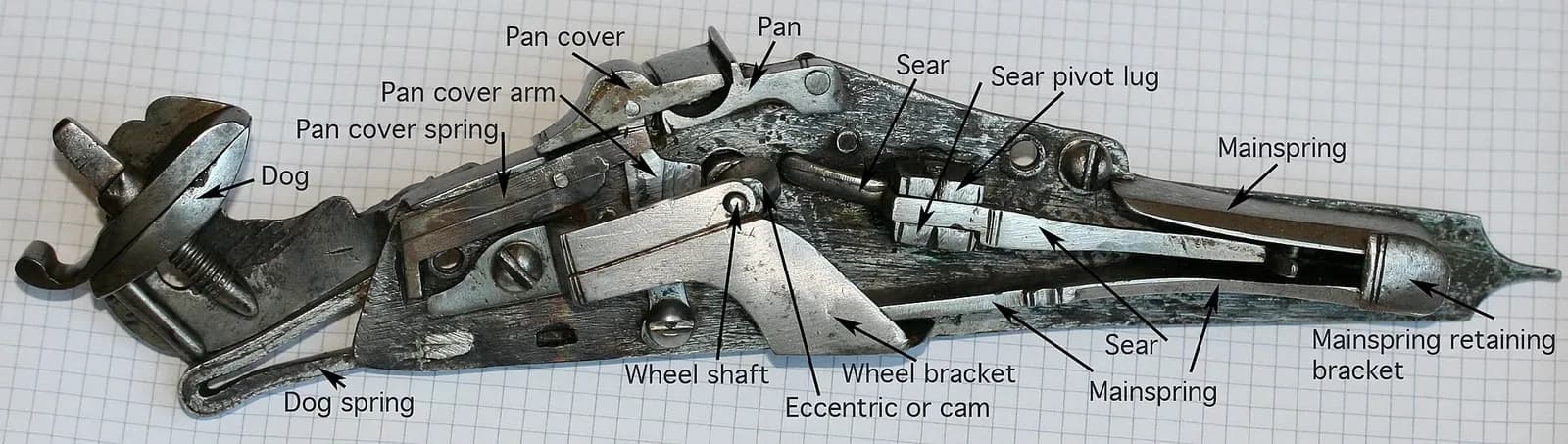
Interior wheellock mechanism from a 1580s puffer — the steel wheel and mainspring visible, revealing how friction against pyrite generated sparks.
| Origins | |
|---|---|
| Invented | Early 16th century |
| Country | Germany (Nuremberg) |
| Timeline | |
| Era | Early 16th century to late 17th century |
| Replaced By | Flintlock |
| Impact | |
| Significance | The first self-igniting firearm mechanism that eliminated the need for external flame, enabling concealed and ready-to-fire personal weapons that transformed cavalry warfare and political security |
Wheellock: The First Self-Igniting Firearm
Firearms encyclopedia article
From The Boise Gun Club Handbook
Overviewedit
The wheellock — also written wheel-lock or wheel lock — is a friction-wheel ignition mechanism that generates sparks to fire a gun. It was the first self-igniting firearm ever built.
The wheellock was the first self-igniting firearm ever built. Before it existed, every firearm on earth required an external flame to operate.
Before it existed, every firearm on earth required an external flame to operate. After it, a shooter could load a gun, set the mechanism, tuck it under a coat, and fire it hours later with a single trigger pull. That shift changed what firearms were, what they could be used for, and who could use them.
Developed in Europe around 1500, the wheellock ran alongside several competing ignition systems before fading from primary use by the late 17th century:
- Matchlock (in use since the 1410s)
- Snaplock (1540s)
- Snaphance (1560s)
- Flintlock (1610s)
It was never cheap, never simple, and never particularly common among rank-and-file soldiers — but for cavalry, officers, hunters, bodyguards, and anyone else who needed a gun ready to fire at a moment's notice, nothing else came close for over a century.
Development Historyedit
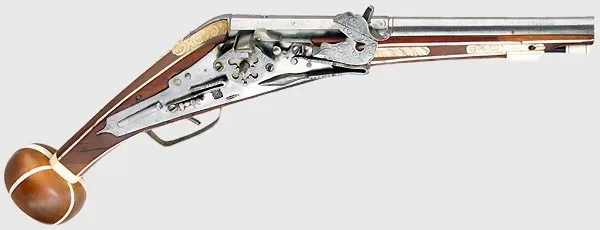
The exact origin of the wheellock is genuinely contested among historians, and the sources don't resolve it cleanly.
Origins and Early Documentation
The mechanism is generally believed to have been invented in the early 16th century, with Nuremberg, Germany cited as the most likely place of origin. The Löffelholz Codex, a book of German inventions by Martin Löffelholz, a citizen of Nuremberg, is dated 1505 and contains drawings of what appear to be wheellock mechanisms — including a pocket-sized tinder igniter that is effectively the same concept applied to fire-starting rather than shooting.
A 1507 entry in the Codex Hyppolite records that a Czech castle servant named Gaspar was sent to Germany to purchase a "firestone rifle" for delivery to Ferrara, Italy — and at that period, "firestone" almost certainly refers to a wheellock, since true flintlocks weren't developed until the second half of the 16th century.
| Date | Event | Source/Evidence |
|---|---|---|
| 1480 | Mönchsbüchse (Monk's gun) - friction ignition prototype | Dresden Armoury |
| 1478-1517 | Leonardo da Vinci drawings in Codice Atlantico | Codice Atlantico |
| 1505 | Löffelholz Codex contains wheellock drawings | Martin Löffelholz, Nuremberg |
| 1507 | First documented purchase of "firestone rifle" | Codex Hyppolite |
| 1517 | Emperor Maximilian I bans wheellocks | Holy Roman Empire decree |
| 1520 | First common use in Germany | Victoria and Albert Museum |
| 1520s-1530s | Italian states implement wheellock bans | Various Italian decrees |
Then there's Leonardo da Vinci. Drawings of a wheellock mechanism appear in Leonardo's Codice Atlantico, though the codex was written and drawn between 1478 and 1517, so pinning down when exactly those drawings were made is impossible. His design is notably different from the mechanisms that became standard — he used a spiral spring where most production wheellocks used a leaf spring — which has led some historians to argue he was improving on an existing design rather than inventing from scratch.
Other sources point to a Nuremberg gunsmith named Johann Kiefus and a date of 1517, though that's considered questionable even in the sources that cite it. According to a 1983 paper in Technology and Culture by Foley, Rowley, Cassidy, and Logan, Leonardo's connection to the wheellock involves the milling process as well as the ignition mechanism itself.
One possible parallel development worth noting: the Mönchsbüchse (Monk's gun) held in the Dresden Armoury is dated around 1480 and uses a rough steel plate that is pulled against pyrite to generate sparks — no rotating wheel, but the same basic principle of friction between pyrite and steel. Whether it represents a direct ancestor of the wheellock or a parallel dead end is still debated.
Government Response and Adoption
What the sources agree on is the timeline of adoption. By 1507, someone in Central Europe was purchasing one. By 1517, they were common enough that Emperor Maximilian I of the Holy Roman Empire felt the need to ban them — specifically banning "die selbschlagenden hanndtpuchsen, die sich selbszundten" ("these self-percussive handguns which are self-igniting") between November 1 and 3, 1517, first in Austria and then throughout the Empire.
Several Italian states followed with their own bans in the 1520s and 1530s. The fact that governments were banning them within two decades of their first documented appearance tells you something about how quickly they spread and how threatening authorities found them.
First common use in Germany is placed at around 1520, according to the Victoria and Albert Museum, which holds a mid-17th-century Brescian wheellock mechanism in its collection. By the Thirty Years' War (1618–1648), wheellock pistols were standard issue for cavalry and officers on both sides of the conflict.
How It Worksedit
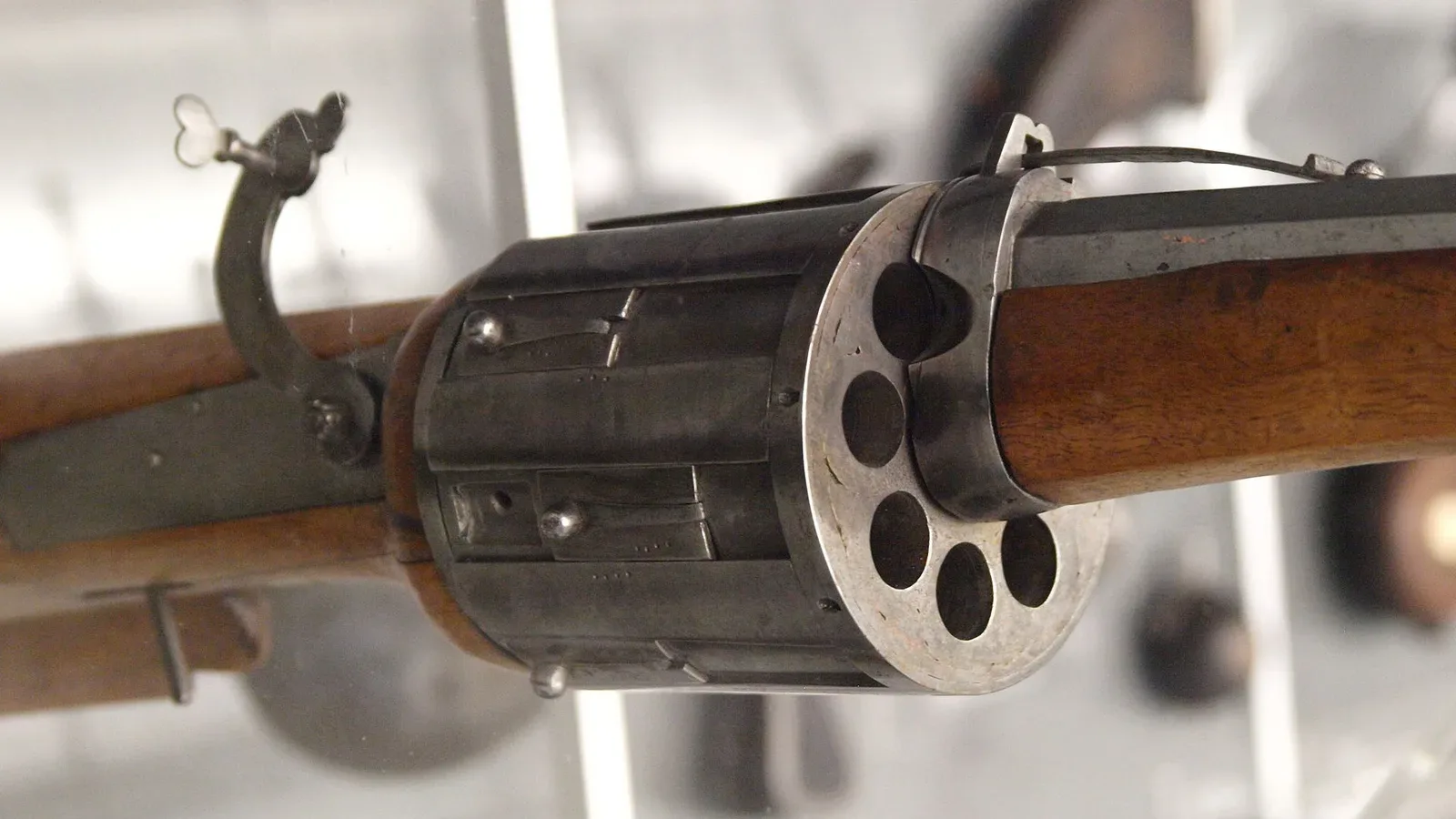
The closest modern analogy is a Zippo lighter — and it's not a loose analogy. A toothed steel wheel spins against a sparking material to ignite fuel. The wheellock does exactly that, just with more moving parts and a gun attached.
Core Components
The key components are the wheel, the dog, the pan, and the sear:
| Component | Function | Material/Construction |
|---|---|---|
| Wheel | Friction surface, spins against pyrite | Hardened steel disc with V-shaped grooves |
| Dog | Holds pyrite, applies pressure to wheel | Spring-loaded arm with vise-like jaws |
| Pan | Contains priming powder | Steel receptacle with sliding cover |
| Sear | Locks wheel in wound position | Z-shaped lever, pivots at center |
| Mainspring | Provides rotational force | Heavy V-spring connected by chain |
| Spanner | Winds the mechanism | Purpose-built wrench for square shaft |
The wheel is a hardened steel disc with V-shaped grooves cut around its circumference, providing a friction surface. The upper segment projects through a slot in the base of the priming pan. The wheel is connected via a short chain — described in Wikipedia's source as similar to a short piece of bicycle chain — to a heavy V-spring inside the lockplate.
When you wind the mechanism using a spanner (a purpose-built wrench that fits the square-section shaft of the wheel), you're tensioning that mainspring. About half to three-quarters of a revolution is enough. A sear — a Z-shaped lever pivoting at its center — drops into a blind hole on the inside of the wheel and locks it in place. You hear a click. The spring is set.
The dog is the spring-loaded arm on the outside of the lockplate. Iron pyrite (fool's gold — flint won't work because it's too hard and would destroy the wheel's grooves) is clamped in vise-like jaws at the dog's swinging end. With the wheel wound and locked, you prime the pan with powder, close the pan cover, and pull the dog back so the pyrite rests on top of the closed pan cover under spring pressure.
Firing Sequence
Wheellock firing sequence from winding to discharge
Pulling the trigger withdraws a secondary sear, which releases the main sear arm from the wheel's blind hole. The mainspring, under tremendous tension, pulls the chain, spinning the wheel at high speed. As the wheel rotates, the eccentric cam on its shaft simultaneously pushes the pan cover open — and this sequencing is critical. If the pyrite contacted a stationary wheel, it would jam. The built-in delay from the sliding pan cover means the pyrite drops onto an already-spinning wheel. Sparks ignite the priming powder in the pan. That flash travels through the vent — a small hole in the barrel's breech — and ignites the main powder charge. The gun fires.
The whole sequence from trigger pull to discharge is nearly instantaneous under normal conditions, though the total process of loading, winding, priming, and readying the piece took around a minute.
One practical detail worth noting: contemporary illustrations often show wheellock pistols held at roughly a 45-degree angle from horizontal rather than vertical. This kept the priming powder seated against the vent and reduced the chance of a misfire — what shooters of the era called a "flash in the pan." The flintlock didn't require this because its sparks fell vertically onto the pan.
Impact on Warfare and Societyedit
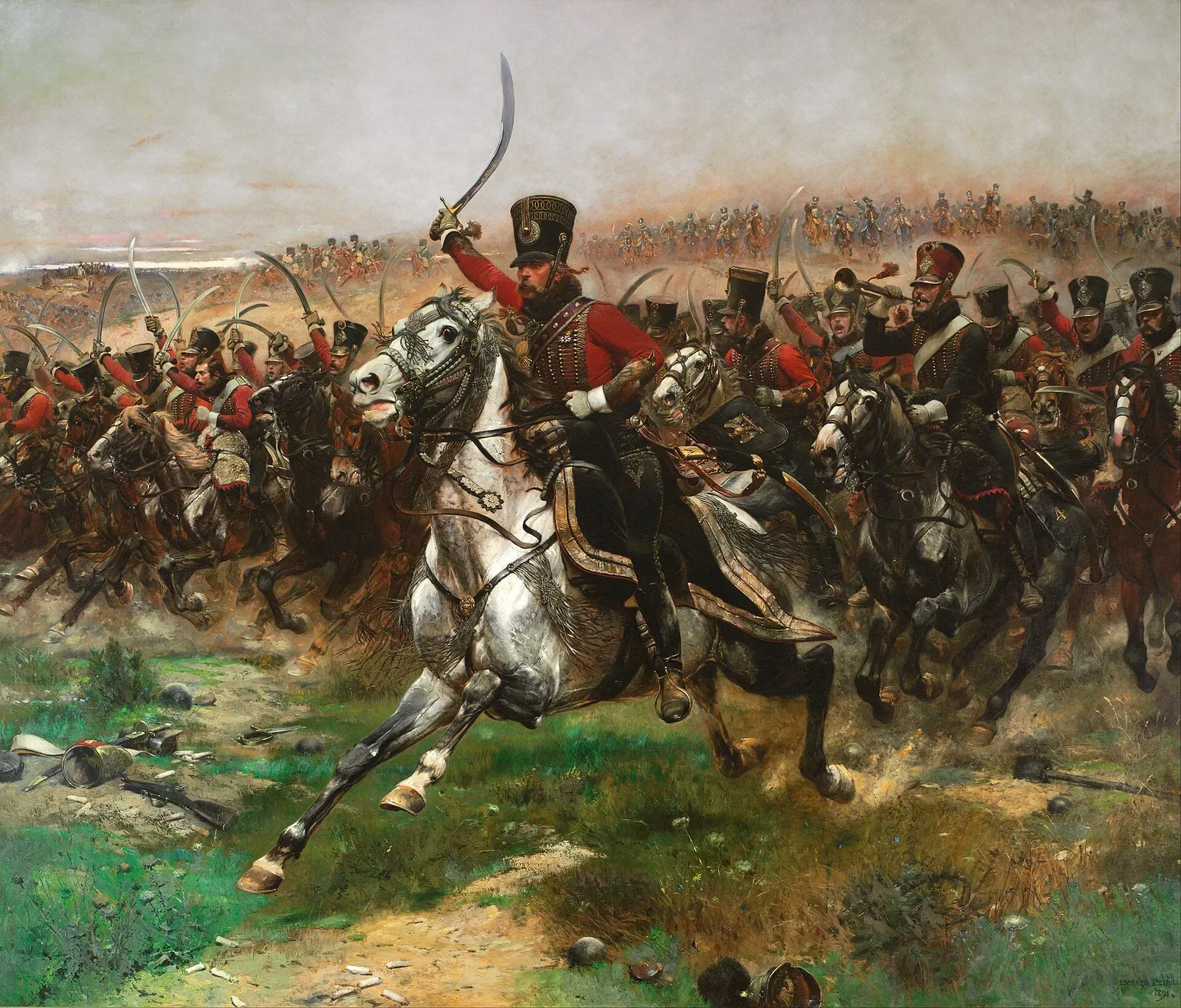
The matchlock had a fundamental problem that no amount of engineering could fix:
- Required a burning cord of slow match to operate
- Match had to be kept lit, dry, and away from powder simultaneously
- Couldn't be concealed under clothing
- Couldn't be holstered ready to fire
- Glowing coal was visible at night
- Smell was detectable
- Hazardous around loose powder
The wheellock eliminated every one of those problems. A loaded, wound wheellock could sit in a holster for hours with the pan cover closed, protecting the priming powder from the elements, with no flame required. When needed, you drew it and fired.
| Feature | Matchlock | Wheellock |
|---|---|---|
| Ignition | Requires burning slow match | Self-igniting mechanism |
| Weather resistance | Poor - match must stay lit and dry | Good - pan cover protects priming |
| Concealability | None - visible glowing coal | Excellent - no external flame |
| Ready time | Immediate if match lit | Instant after winding |
| Cavalry use | Impractical | Standard for officers |
| Night operations | Compromised by visible match | Fully covert |
| Cost | Low | High - complex mechanism |
According to the Cap and Ball source, the wheellock's arrival was the point when "the horse soldier, law enforcement, and of course criminals found their firearm."
The wheellock's arrival was the point when "the horse soldier, law enforcement, and of course criminals found their firearm."
That's not an overstatement. Cavalry could carry loaded pistols in saddle holsters. Officers didn't have to fuss with match cord in the middle of a fight. Hunters could stalk game without the slow match spooking animals or needing constant attention.
Political Consequences
But the same features that made the wheellock useful for cavalry made it dangerous for heads of state. As historian Lisa Jardine documents in The Awful End of William the Silent (2005), the wheellock's small size, concealability, and immediate readiness made it the weapon of choice for political assassination. Francis, Duke of Guise was killed with one. William the Silent of the Netherlands was assassinated in 1584 — shot with a wheellock pistol, the first documented assassination of a head of state with a handgun.
Jardine also argues that a stray wheellock pistol shot may have triggered the St. Bartholomew's Day Massacre of French Huguenots in 1572, though that claim carries a citation-needed flag in the Wikipedia source.
The response from governments was swift and instructive. Maximilian I's 1517 ban was among the first gun control laws in European history specifically targeting a class of firearm based on its concealability and ease of use rather than its lethality. The Hungarian king Vladislav II had issued a broader arms-carrying decree in 1514 following a peasant revolt, though that law didn't specifically target wheellocks. The pattern was clear: the more useful a firearm became for the individual, the more threatening it became to established order.
Military Applications
Militarily, the wheellock's impact was real but uneven. It was never mass-produced for infantry — the cost and mechanical complexity made that impractical. Wheellock pistols were used extensively by cavalry during the Thirty Years' War on both sides, and specialized units including royal bodyguards were equipped with them.
The Landeszeughaus (arsenal) in Graz, Austria — the best-preserved armoury collection of its type — holds over 3,000 wheellock examples, many produced in small batches for specific military units. Some Austrian military muskets from the second half of the 17th century were built with hybrid wheellock-matchlock mechanisms, allowing the soldier to use the more reliable wheellock ignition when possible and fall back to the matchlock if the wheellock fouled or failed.
For ordinary infantry throughout this period, the matchlock remained standard. The wheellock was the sidearm of those who could afford it — which meant it became inseparable from the culture of the European nobility and officer class, and from the artisans who supplied them.
Modern Relevanceedit
Transition to Flintlock
By around 1650, the flintlock was beginning to displace the wheellock, and by the late 17th century the transition was essentially complete for new production. The flintlock was cheaper to make, simpler to maintain, and didn't require a separate spanner to operate. For armies equipping thousands of soldiers, those advantages mattered enormously.
The wheellock didn't disappear overnight, though. High-quality wheellocks from Germanic workshops actually had faster lock times than many flintlocks — because the sparks were generated directly in the pan rather than falling from a frizzen — and Germanic gunsmiths continued producing them into the 18th century for hunters and collectors who prioritized ignition speed and reliability over economy.
According to Rock Island Auction Company, wheellock firearms remained in active use for over 200 years total.
Contemporary Collecting and Use
Today, surviving wheellocks occupy a specific and well-documented niche in art history as much as firearms history. Because they were the arms of the elite, they attracted the finest craftsmen in Europe — stonemasons, engravers, goldsmiths, and gunsmiths collaborated on single pieces that were as much sculpture as weapon. The V&A describes some examples as being finely chiseled even on their interiors, designed to be disassembled and reassembled as a display of craftsmanship.
Collections appear in major art museums worldwide, including the Metropolitan Museum of Art. In August 2024, a royal presentation wheellock from King Louis XIII of France's Cabinet d'Armes — one of the earliest additions to the French monarch's collection — sold at Rock Island Auction Company for $881,250, setting a world record for a wheellock firearm at auction.
Small numbers of black powder enthusiasts and historical reenactors still shoot wheellocks today.
The BGC Takeedit
The wheellock is one of those technologies that looks like a footnote until you actually think about what it changed. The matchlock gave people guns. The wheellock gave people concealed guns — loaded, ready, and invisible under a coat.
The matchlock gave people guns. The wheellock gave people concealed guns — loaded, ready, and invisible under a coat. That's not an incremental improvement. That's a different category of threat.
That's not an incremental improvement. That's a different category of threat to anyone who depended on being able to see trouble coming.
Governments understood this immediately. Maximilian I banned it within roughly two decades of its first documented appearance. The fact that those bans didn't work — and couldn't work — is its own lesson. Once a technology exists that gives individuals a meaningful capability, you can issue all the decrees you want. The wheellock spread anyway.
What I find genuinely interesting is the economic filtering effect. The matchlock armed armies. The wheellock armed elites. That created a 150-year gap where the best personal firearm technology was structurally inaccessible to most people — not by law (though law tried), but by price. The flintlock eventually closed that gap by being cheap enough to produce at scale. The pattern of a sophisticated technology being exclusive until a simpler version democratizes it is one that repeats throughout firearms history, and the wheellock-to-flintlock transition is one of the earliest clear examples of it.
Also worth saying: the Zippo comparison isn't just a fun analogy. It's the same engineering principle, separated by four centuries. Sometimes the right solution stays right for a very long time.
Referencesedit
- https://en.wikipedia.org/wiki/Wheellock
- https://www.rockislandauction.com/riac-blog/what-is-a-wheellock
- https://capandball.com/the-wheel-lock-part-i-the-birth-of-the-wheel-lock/
- https://collections.vam.ac.uk/item/O96906/wheel-lock-mechanism-unknown/
- https://www.standingwellback.com/development-of-mechanical-explosive-initiators-in-the-early-16th-century/
- https://www.jstor.org/stable/3104759
Last Updated: February 27, 2026
- Gls Guns(Sumner, IA)
- Bi-mart - Yakima (Fruitvale Ave)(Yakima, WA)
- New Philly Sportsman Specialities(New Philadelphia, OH)
- R&R Sports & Outdoors(Brandon, FL)
Loading comments...