Specifications
SIG Sauer P220 & P210

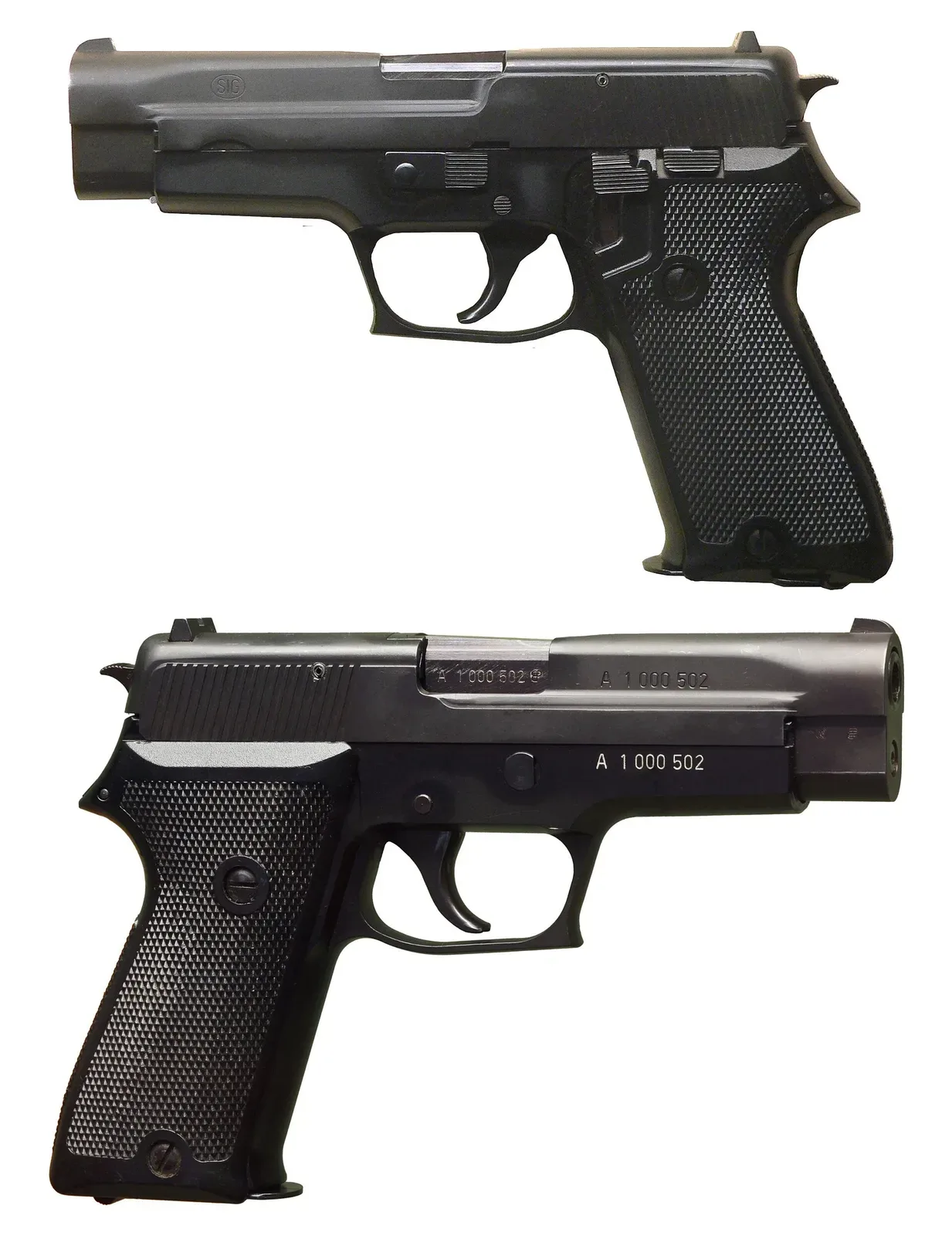
The P220 in Swiss military service — this two-view display shows why SIG's design became the standard for numerous armed forces worldwide.
Rama (CC BY-SA 2.0 fr)
| Manufacturer | |
|---|---|
| Made By | SIG Sauer |
| Designer | SIG (Swiss Industrial Company) |
| Origin | Switzerland/Germany/USA |
| Specifications | |
| Caliber | .45 ACP / 9mm ParabellumAlso: 10mm Auto, .357 SIG, 9mm Parabellum |
| Action | da sa |
| Capacity | 8+1 (.45 ACP), 8+1 (9mm P210) |
| Barrel | 4.4" (P220), 4.8" (P210) |
| Length | 7.7" (P220), 8.5" (P210) |
| Weight | 30.4 oz (P220), 37.4 oz (P210) |
| Feed | Single-stack detachable magazine |
| Sights | 3-dot combat (P220), Adjustable target (P210) |
| Performance | |
| Eff. Range | 50 yards |
| Muzzle Vel. | 830 fps (.45 ACP), 1180 fps (9mm) |
| Production | |
| Designed | 1937 (P210), 1975 (P220) |
| In Production | 1949 (P210), 1975 (P220) |
| Produced | Over 1 million (P220 series) |
| Unit Cost | $1,200-2,500 (P220), $1,400-2,000 (P210) |
| Variants | |
| |
| Service Use | |
Swiss Armed ForcesDanish MilitaryU.S. Law Enforcement | |
| Cultural Note | |
| Foundation of SIG Sauer's modern pistol lineup and reputation | |
| Related Firearms | |
| |
SIG Sauer P220 & P210 - The Foundation Pistols
Firearms encyclopedia article
From The Boise Gun Club Handbook
Quick Statsedit
| Specification | P210 | P220 |
|---|---|---|
| Manufacturer | SIG Sauer | SIG Sauer |
| Type | Semi-automatic pistol | Semi-automatic pistol |
| Caliber(s) | 9mm Parabellum | .45 ACP, 10mm Auto, .357 SIG, 9mm |
| Capacity | 8+1 | 8+1 (.45 ACP), 10+1 (9mm) |
| Barrel Length | 4.8" | 4.4" |
| Overall Length | 8.5" | 7.7" |
| Weight (unloaded) | 37.4 oz | 30.4 oz |
| Action Type | Single-action | DA/SA |
| Year Introduced | 1949 (Switzerland), 2017 (US) | 1975 |
The Pistols That Built SIG's Reputationedit
You can trace SIG Sauer's entire reputation back to two pistols—the P210 and P220. The P210 came first in 1949, built by Swiss craftsmen who cared more about precision than profit margins.
The P220 followed in 1975 as SIG's practical answer to military and police contracts worldwide.
The P210 still delivers accuracy that embarrasses pistols costing twice as much, while the P220 spawned the entire P-series family that dominates duty holsters worldwide.
These aren't just historical curiosities. Both pistols are heavier than modern alternatives, but that weight soaks up recoil nicely.
How the P210 Started It Alledit
The Swiss Military Requirement
Swiss military wanted to ditch their Lugers in the late 1930s, so SIG engineer Charles Petter got to work on something better. His solution was radical—put the slide inside the frame rails instead of outside them.
Petter's Revolutionary Design
Sounds backwards, but it creates lockup so tight you can practically watch groups shrink.
Put the slide inside the frame rails instead of outside them. Sounds backwards, but it creates lockup so tight you can practically watch groups shrink.
The Swiss adopted it as the Pistole 49, and word spread fast among competitive shooters. Here was a service pistol that shot like a target gun straight out of the box. Production ran until 2006 in Switzerland, with SIG bringing it back to life in New Hampshire starting in 2017.
The P210's journey from military requirement to precision shooting legend
That single-action trigger and manual safety made it less practical for duty work, but nobody cared when they saw what it could do on paper targets.
The P220 Changes Everythingedit
The German Partnership
SIG partnered with J.P. Sauer & Sohn in Germany during the 1970s to crack international markets. The P220 was their first real success—a DA/SA pistol that could compete with established players like Smith & Wesson and Colt.
Unlike the P210's precision-at-any-cost approach, the P220 balanced Swiss engineering with practical manufacturing. It had to work reliably in holsters, not just on shooting benches. The formula worked so well that every SIG pistol since then uses the same basic operating system.
American Market Entry
When SIGARMS opened in New Hampshire in 1985, the P220 became their flagship for American shooters.
How the P220 became the foundation for SIG's global success
What Makes Them Differentedit
Engineering Approaches
The P210's slide-in-frame design is what sets it apart from every other pistol. Most manufacturers put the slide outside the frame because it's cheaper and easier to machine. SIG went the hard route, requiring tolerances that would make a Swiss watchmaker proud.
Design philosophy differences between the precision P210 and practical P220
Shared Design Elements
The P220 uses conventional slide-on-frame construction but applies the same attention to fit and finish. Both pistols use single-stack magazines, which keeps them slim but limits capacity compared to modern double-stack designs.
Both have external hammers you can see and feel—no striker-fired mystery about whether you're cocked and ready.
Variants Worth Knowingedit
P210 Model Lineup
| P210 Variants | Key Features |
|---|---|
| Standard | Current US production model |
| Target | Adjustable trigger system |
| Carry | Shortened barrel for concealment |
| Legend | Premium finish and engraving |
| Swiss Military/Commercial | Dozens of variants (1949-2006) |
P220 Family Tree
| P220 Variants | Calibers | Special Features |
|---|---|---|
| Full-size | .45 ACP, 10mm, .357 SIG | Standard duty configuration |
| Compact/Carry | .45 ACP, 9mm | Reduced size for CCW |
| Elite Series | Multiple | Upgraded triggers, sights |
| Legion | Multiple | Enhanced everything package |
| Match Elite | .45 ACP | Competition-focused |
| 10mm Hunter | 10mm | Optimized for outdoor use |
The 10mm P220 deserves special mention. It's one of the few production pistols handling full-power 10mm loads without complaint:
- One of the few production pistols handling full-power 10mm loads
- Available in multiple barrel lengths
- Enhanced recoil management for powerful cartridge
- Preferred by hunters and outdoorsmen
Real-World Performanceedit
Accuracy Characteristics
The P210 will shoot 2-inch groups at 50 yards if you do your part.
The P210 will shoot 2-inch groups at 50 yards if you do your part. That's not marketing fluff—it's what happens when you build a pistol like a precision instrument.
That's not marketing fluff—it's what happens when you build a pistol like a precision instrument. The single-action trigger breaks clean as a glass rod, and that slide-in-frame lockup eliminates any slop in the system.
| Performance Comparison | P210 | P220 |
|---|---|---|
| Accuracy at 25 yards | 1-2 inches | 3-4 inches |
| Accuracy at 50 yards | 2 inches | N/A (not tested) |
| Trigger Type | Single-action (crisp) | DA/SA (long first pull) |
| Break-in Period | Minimal | 200-300 rounds |
| Weight Benefit | Recoil absorption | Moderate recoil control |
| Frame Material | Steel | Aluminum |
Reliability and Handling
The P220 delivers solid 3-4 inch groups at 25 yards, which is plenty accurate for any practical use. Some examples have feeding hiccups during break-in, but they smooth out after a few hundred rounds.
The DA/SA trigger takes practice—that first double-action pull is long and heavy, then you're into crisp single-action for follow-ups. The P220's aluminum frame keeps it reasonable, though it'll never be mistaken for a lightweight carry gun.
Who Uses Themedit
Military and Law Enforcement
The Swiss military carried P210s for decades, along with Danish forces and various Swiss police units. Competitive shooters still seek out original Swiss-made examples for their accuracy potential.
Civilian and Competition Use
The P220 found homes in American law enforcement and with serious shooters who wanted something different from the usual Glock/1911 choices. While the SEALs eventually adopted the P226, it was built on the P220's foundation.
The BGC Takeedit
These pistols represent SIG at their finest—before cost-cutting and market pressures started creeping in.
The P210 is still the most accurate production pistol you can buy, period. If you want to see what your shooting potential really is, this pistol will show you.
Yes, it's expensive and old-fashioned, but if you want to see what your shooting potential really is, this pistol will show you.
The P220 makes more practical sense for most shooters. It's reliable, accurate enough for any realistic use, and available in serious calibers like 10mm and .45 ACP.
The DA/SA system isn't fashionable anymore, but it works if you put in practice time.
The DA/SA system isn't fashionable anymore, but it works if you put in practice time. Both pistols feel substantial in ways that modern polymer guns don't. They're tools built by people who understood that sometimes good enough isn't good enough. If you want to understand why SIG built their reputation on precision, start with these two.
- Gls Guns(Sumner, IA)
- Bi-mart - Yakima (Fruitvale Ave)(Yakima, WA)
- New Philly Sportsman Specialities(New Philadelphia, OH)
- R&R Sports & Outdoors(Brandon, FL)
Loading comments...