Quick Reference
Skeet Shooting

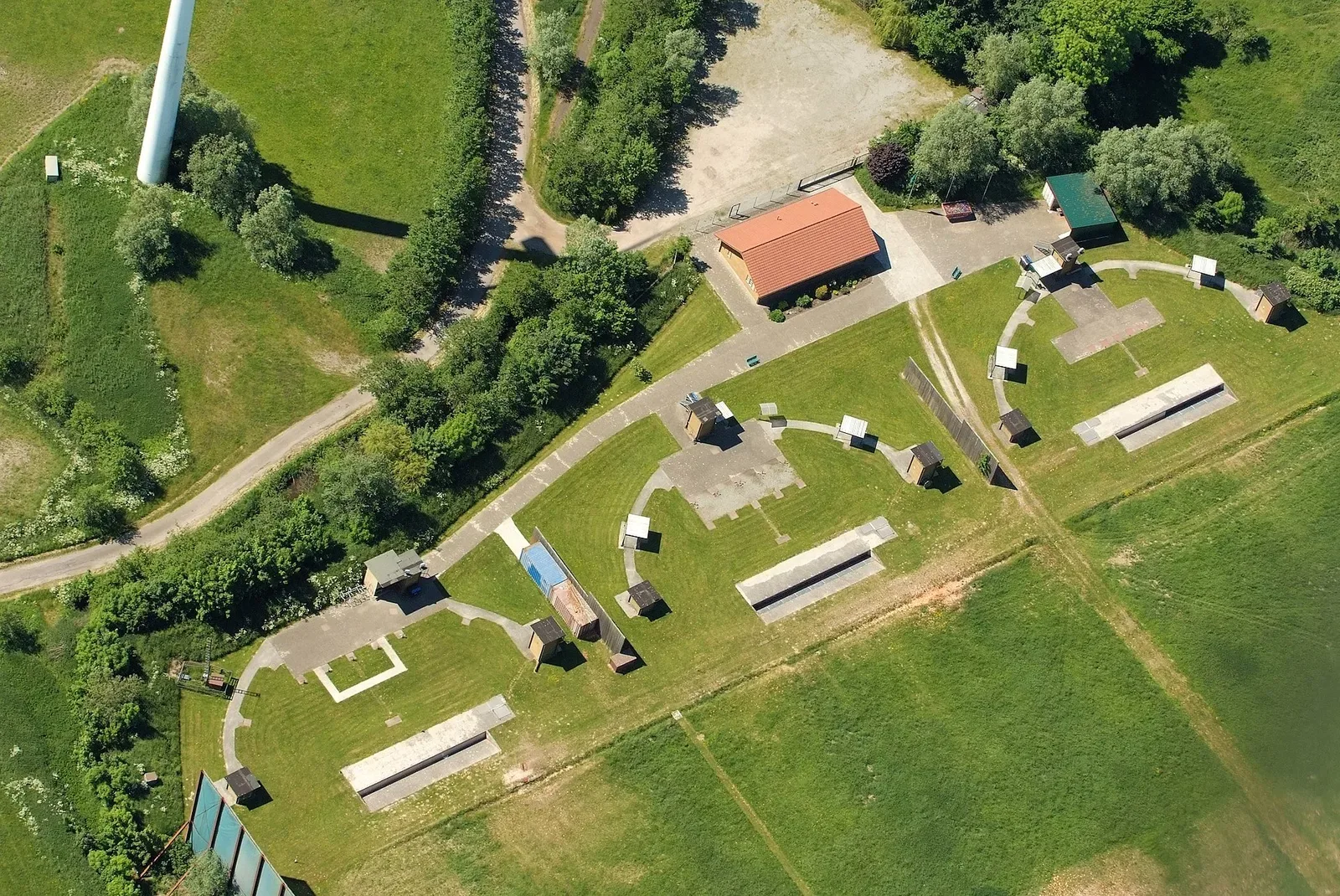
Aerial view of a skeet range in Cuxhaven, Germany — the eight-station layout and trap house positions are clearly visible from above, illustrating the sport's geometric field design.
Martina Nolte (CC BY-SA 3.0 de)
| Time & Effort | |
|---|---|
Read Time | 11 min read |
Equipment Needed | |
| |
| Prerequisites | |
| |
Safety | |
| |
Key Takeaways | |
| |
Organization | |
| National Skeet Shooting Association (NSSA) | |
| Divisions | |
American Skeet (12, 20, 28, .410 bore)International SkeetSport SkeetSkeet DoublesSmall Gauge SkeetTube Set Competition | |
Related Topics | |
| |
Skeet Shooting
Handbook article
From The Boise Gun Club Handbook
Skeet is the geometry problem of shotgun sports -- eight stations, crossing targets at precise angles, and the same 25-shot sequence every time. Your consistency is the only variable that matters.
The sport separates thinkers from reactors. Unlike trap's straightaway shots or sporting clays' random chaos, skeet demands exact footwork and timing as you work through a half-circle course. Break targets that cross at identical angles every round, but master eight different shooting positions to do it.
How Skeet Worksedit
Origins and Development
Charles Davis invented this in 1915 because he wanted hunting practice without live pigeons. Originally called "shooting around the clock," the sport started as a full circle until neighbors got tired of shot raining on their property. The half-circle design we use today solved that problem -- and the name "skeet" comes from Scandinavian for "shoot."
Field Layout and Mechanics
Every round follows the same pattern: 25 targets from eight stations arranged in a semi-circle. Two trap houses throw clay birds that cross 18 feet high at a point 20 yards from each house. The high house on the left launches targets 10 feet up. The low house on the right throws them 3.5 feet high.
You move through stations 1-8 shooting predetermined singles and doubles. The sequence never changes -- been the same for decades.
Standard skeet field layout showing the eight shooting stations and target flight paths
What changes is your ability to read the angles and maintain consistent gun mounting.
Modern skeet scores have gone through the roof compared to the 1990s. A perfect 25-straight used to be rare enough to draw crowds. Now it's table stakes at major competitions.
Variations You'll Seeedit
American Skeet runs the show in the US -- standard 25-target format with no delay after you call "pull." Four gauges: 12, 20, 28, and .410 bore. NSSA governs this version.
International Skeet throws faster targets with up to three seconds of random delay after your call. You start with the gun at hip level instead of mounted. Used in Olympics and world competitions through ISSF.
Sport Skeet mixes skeet stations with sporting clays rules. Instead of standard targets, you'll see rabbits, chandelles, and battue clays. NSCA runs these events.
| Format | Governing Body | Target Speed | Gun Position | Delay | Gauges |
|---|---|---|---|---|---|
| American Skeet | NSSA | Standard | Pre-mounted | None | 12, 20, 28, .410 |
| International Skeet | ISSF | Faster | Hip level | 0-3 seconds | 12 gauge only |
| Sport Skeet | NSCA | Variable | Pre-mounted | None | Multiple |
Most shooters start with 12-gauge American Skeet, then progress to small bores that demand more precise shot placement. The tube set format -- all four gauges shot in succession -- represents the ultimate equipment test. You need identical gun mounting across different recoil impulses and shot charges.
Equipment That Worksedit

Essential Safety Gear
Start with safety gear and a reliable shotgun before buying fancy accessories. A used Remington 1100 or 11-87 that's digested 50,000 rounds will serve you better than a cheap over/under that won't cycle consistently.
Shotgun Selection
Semi-autos dominate recreational shooting -- Remington 1100s, Benelli Montefeltros, Beretta A400s. Over/unders let you run different chokes per barrel for doubles, but cost more upfront. Budget $800-1500 for decent used guns, $2000-4000 for competition-grade equipment.
| Equipment Category | Budget Option | Mid-Range | Competition Grade | Price Range |
|---|---|---|---|---|
| Semi-Auto Shotgun | Used Remington 1100 | Benelli Montefeltro | Beretta A400 | $800-4000 |
| Over/Under | Used Beretta 686 | Browning Citori | Perazzi MX | $1200-8000+ |
| Ammunition | AA, Gun Club | Federal Top Gun | Gold Medal | $8-18/box |
| Chokes | Factory tubes | Aftermarket sets | Custom fitted | $50-300 |
| Eye Protection | Basic clear | Tinted yellow/orange | Prescription sport | $15-200 |
Ammunition and Accessories
Standard 1-1/8 ounce loads with #9 shot work for most shooters. Budget options like AA, STS, or Gun Club run $8-12 per box. Competition loads like Federal Gold Medal cost $12-18 but deliver more consistent patterns. You'll burn through 10,000+ rounds annually if you get serious.
- Chokes: Skeet or Improved Cylinder handles most shots
- Modified choke helps on long crossers at stations 2 and 6
- Don't overthink this -- your gun mounting matters more than choke selection
Eye protection is mandatory -- yellow or orange lenses enhance target visibility against most backgrounds. Slim-profile hearing protection avoids interference with your stock. Shooting vests provide shell storage and consistent gun mounting reference points.
The Rules Nobody Explains Welledit
Standard 25-Target Sequence
Each round follows an identical 25-target sequence. Stations 1, 2, 6, and 7 shoot singles from both houses plus simultaneous doubles. Stations 3, 4, and 5 shoot singles only. Station 8 shoots singles from both houses.
The option target -- the 25th shot -- gets shot at the first station where you missed. Break all 24 targets and you shoot the option as a second high house target from Station 8.
| Station | High House | Low House | Double | Total Targets |
|---|---|---|---|---|
| 1 | Single | Single | High-Low | 3 |
| 2 | Single | Single | High-Low | 3 |
| 3 | Single | Single | None | 2 |
| 4 | Single | Single | None | 2 |
| 5 | Single | Single | None | 2 |
| 6 | Single | Single | Low-High | 3 |
| 7 | Single | Single | Low-High | 3 |
| 8 | Single | Single | None | 2 |
| Option | First miss location or Station 8 High | 1 | ||
| Total | 25 |
Scoring and Timing
Scoring is brutal in its simplicity: visible pieces must break off for a hit. Powder puffs don't count. The referee's call is final. One point per target, maximum 25.
You get 5 seconds from target appearance to shoot singles. Doubles allow reasonable time between shots. Gun starts at shoulder in American Skeet, hip position for International. No practice mounts or false calls.
Common Station Challenges
Station 8 trips up newcomers -- those targets cross close and fast. Station 4's straight-away shots look easy but demand perfect timing. These two positions separate recreational shooters from competitors.
Getting Started Without Looking Lostedit
Find clubs through the NSSA directory or ask at local gun stores. Most clubs welcome newcomers during practice sessions. Call ahead -- many require safety orientations for first-timers.
Watch a few rounds before shooting to understand squad rotation and etiquette. Skeet runs on a five-shooter system that maintains steady pace. No excessive conversation between stations. Load only when it's your turn.
Keep guns pointed skyward when moving.
Recommended progression path for new skeet shooters
Consider lessons from certified instructors before forming bad habits. Skeet demands specific footwork and gun mounting that differs from hunting or trap shooting. Many clubs offer loaner guns and basic instruction for reasonable fees.
First competition tips:
- Register early -- popular events fill fast
- Entry fees run $25-40 per event
- Bring cash for food and incidentals
- Arrive early for equipment checks and squad assignments
Expect to feel rushed initially. Competitive squads move faster than practice rounds, and scorekeeping pressure affects most newcomers.
Focus on your shooting routine instead of worrying about scores. A 15-20 is respectable for registered competition debut.
What It Actually Costsedit
Casual skeet shooting stays relatively affordable compared to other competitive sports. Practice sessions cost $20-30 including range fees and ammunition. However, serious competitors often shoot 200+ rounds monthly plus travel to tournaments.
| Shooter Level | Annual Ammunition | Range Fees | Travel | Equipment | Total Annual |
|---|---|---|---|---|---|
| Casual | $400-600 | $200-300 | $100-200 | $100-200 | $800-1200 |
| League | $800-1200 | $400-600 | $300-500 | $300-500 | $1800-2800 |
| Competitive | $2000-4000 | $800-1200 | $1000-3000 | $500-2000 | $4300-10200 |
| Elite | $4000-6000 | $1200-2000 | $2000-5000 | $1000-3000 | $8200-16000 |
Cost Breakdown by Level
Ammunition represents your biggest ongoing expense. Competition loads cost $12-18 per box, and dedicated shooters consume cases monthly. Buying in bulk or reloading cuts costs significantly -- but reloading setup requires $300-500 upfront investment.
Hidden Expenses
- Travel and lodging for major tournaments ($200-500 per event)
- Gunsmithing and maintenance ($200-500 annually)
- Coaching sessions ($75-150 each)
- Entry fees for multiple concurrent classes
Where to Shootedit
The NSSA club directory lists over 600 member clubs searchable by location. Many trap clubs offer skeet, though dedicated facilities provide better target quality and instruction. Look for clubs with active leagues rather than occasional tournament-only operations.
State associations coordinate regional events and maintain current club information. Texas, California, and Florida have dozens of active clubs. Rural areas may require significant travel for regular competition.
Online communities like ClayBusters forum provide local information, ride-sharing arrangements, and equipment advice. Many shooters travel together to major events, splitting costs and providing mutual coaching.
Governing Organizationsedit
NSSA runs American Skeet -- sanctions registered tournaments, maintains classifications, publishes rules. Annual membership ($45) provides tournament eligibility and Clay Target Nation magazine access.
NSCA governs sporting clays and Sport Skeet variants. Cross-training between disciplines benefits most shooters.
ISSF handles international competition including Olympics. SCTP develops youth programs for high school students. USA Shooting manages Olympic development and national team selection.
Skeet rewards consistent technique over flashy equipment or natural talent. The targets are identical every round -- your improvement depends entirely on developing repeatable gun mounting and timing.
If you enjoy precision challenges and don't mind repetitive practice, skeet develops shotgun skills that transfer to hunting and other shooting sports better than any other clay target game.
This content is for educational purposes and does not constitute shooting instruction. Always follow range safety rules and local regulations.
See Alsoedit
- Trap Shooting - Similar clay target sport with different target presentations
- Sporting Clays - More varied clay target sport using multiple target types
- Find Events
Last Updated: January 28, 2026
Loading comments...