Organization Info
NSSA
National Skeet Shooting Association

| Overview | |
|---|---|
Founded | 1928 |
Headquarters | San Antonio, TX |
Disciplines | skeet shooting |
Membership | |
Cost | varies by level; check mynssa.nssa-nsca.org for current rates |
Links | |
| mynssa.nssa-nsca.org | |
National Skeet Shooting Association (NSSA)
Reference article
From The Boise Gun Club Handbook
The National Skeet Shooting Association (NSSA) is the primary governing and sanctioning body for competitive skeet shooting in the United States. Founded in 1928 and headquartered in San Antonio, Texas, it operates as a Texas nonprofit corporation owned and operated by its members. With approximately 15,000 members and more than 700 affiliated clubs, it is the largest organization in the world dedicated solely to skeet shooting.
History & Foundingedit
Origins in Hunting Practice
Skeet shooting didn't start as a competitive sport -- it started as a solution to a practical problem.
In the early 1900s, urbanization was pulling people away from rural land, game populations were shrinking, and hunting seasons were getting shorter. Hunters who wanted to stay sharp between seasons needed somewhere to practice, and trap shooting wasn't cutting it -- it didn't replicate the crossing and incoming shots a field hunter actually faces.
The Davis Innovation
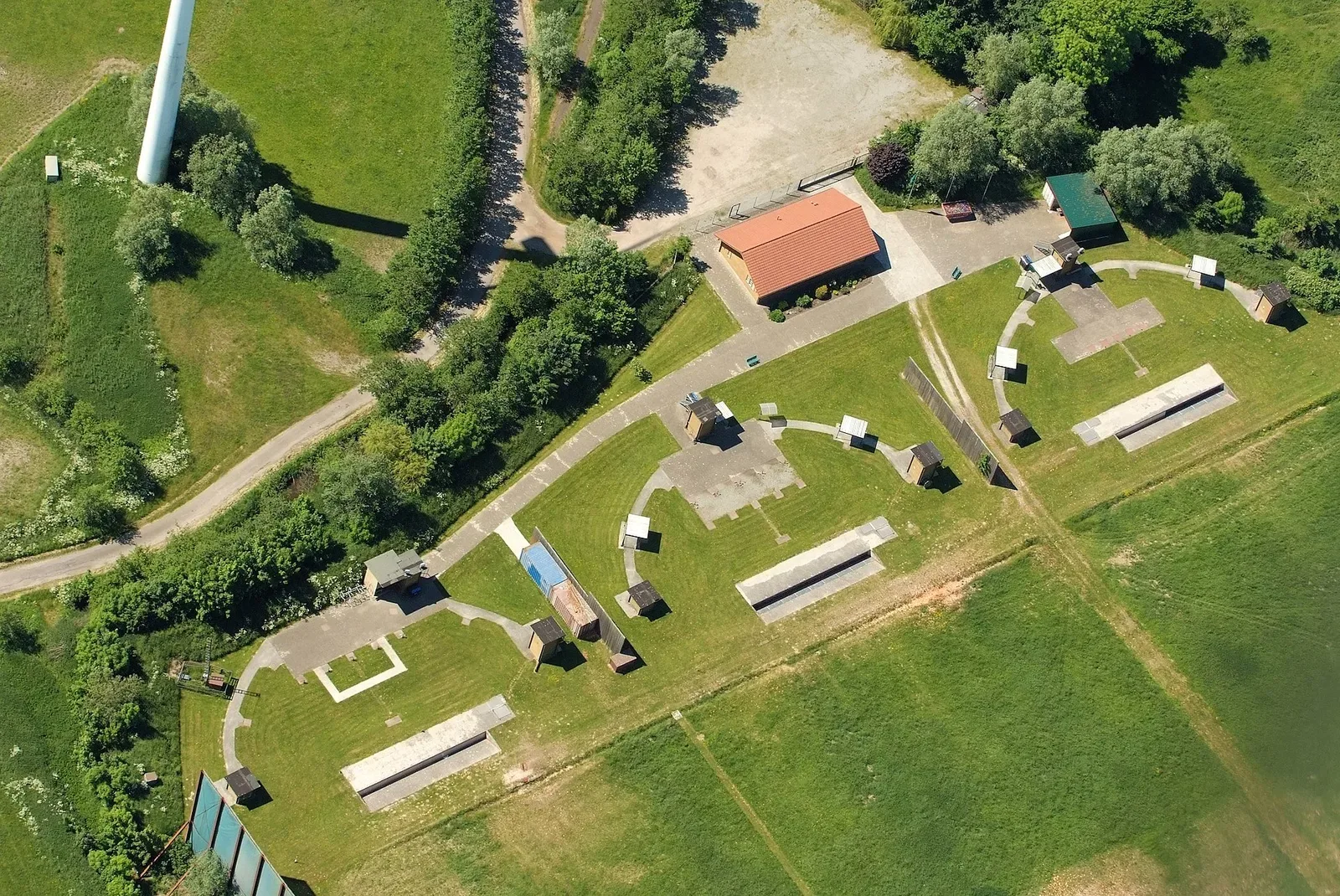
In 1920, Charles Davis of Andover, Massachusetts -- a dog kennel owner and serious hunter -- set out to fix that. He designed a circular field with 12 shooting stations arranged around a 50-yard diameter, with a single trap at the 12 o'clock position. Shooters rotated through each station and fired two shots per position plus one from the center, burning through a full box of 25 shells.
He called it Shooting Around the Clock, and it replicated nearly every angle a hunter would see in the field. The field worked well until a neighbor started complaining about shot falling on his property. Davis cut the circle in half and added a second trap at the opposite end -- and that modified layout became the modern skeet field.
The game caught on fast. A national naming contest in 1926 produced the name skeet, derived from the Scandinavian word for "shoot," and that same year the first National Skeet Championships were held.
Formal Organization
The NSSA was formally organized shortly after, in 1928. The organization was incorporated as a Texas nonprofit membership corporation on March 26, 1984, formalizing a governance structure that had operated informally for decades.
Olympic Development
Skeet's trajectory toward Olympic competition was a long road. The sport was demonstrated at the 1968 Mexico City Olympics and was added as a full medal event at the 1968 and 1972 Games, though the format used internationally (International Skeet, also called Olympic Skeet or FITASC) differs from the American Skeet format the NSSA governs domestically. The NSSA played a role in the sport's development through that period, though international competitive skeet now falls under USA Shooting for Olympic purposes.
Evolution of skeet from hunting practice to organized sport
Mission & Purposeedit
The NSSA's stated purpose is to foster amateur sports competition in shotgun target shooting -- specifically skeet -- at the national and international level. In practice, that means sanctioning tournaments, maintaining classification systems, setting rules, and running the sport's marquee events.
Beyond competition, the NSSA pitches skeet as a hunting prep tool, which is historically accurate -- it's literally how the sport was invented. Affiliated clubs are required to enforce safety regulations and have access to certified instructors, making the club network a reasonable entry point for new shooters who want structured instruction rather than YouTube tutorials.
Programs & Competitionsedit
Championship Events
The World Skeet Shooting Championship, held annually at the National Shooting Complex in San Antonio, is the NSSA's flagship event. It draws competitors from across the country and internationally, and it's one of the larger clay target shooting events on the calendar.
Alongside it, the NSSA annually hosts:
- World Vintage Skeet Championship -- for shooters using older, pre-defined equipment
- Junior World Skeet Championship -- youth competition with age-based divisions
- International World Skeet Championship -- covering the international format rules
| Event | Format | Location | Participants |
|---|---|---|---|
| World Skeet Shooting Championship | Multi-gauge, All classes | San Antonio, TX | National/International |
| World Vintage Skeet Championship | Pre-defined equipment only | San Antonio, TX | Vintage equipment shooters |
| Junior World Skeet Championship | Age-based divisions | San Antonio, TX | Youth competitors |
| International World Skeet Championship | International format rules | San Antonio, TX | International format shooters |
Classification System
Below the World Championship level, the NSSA sanctions regional and state shoots through its affiliated club network. Member clubs run their own local fun shoots and registered tournaments throughout the year.
The classification system sorts competitors by ability -- AAA, AA, A, B, C, and D classes -- so you're generally shooting against people close to your skill level rather than getting smoked by a former national champion in your first registered shoot.
| Classification | Skill Level | Target Audience |
|---|---|---|
| AAA | Expert | Top-tier competitors |
| AA | Advanced | Experienced shooters |
| A | Intermediate-Advanced | Regular competitors |
| B | Intermediate | Developing shooters |
| C | Novice-Intermediate | Learning competitors |
| D | Beginner | New shooters |
Multi-Gauge Format
The NSSA governs American Skeet across four gauges: 12-gauge, 20-gauge, 28-gauge, and .410 bore. Competitors can enter individual gauge events or the All-Around, which combines scores across all four.
This multi-gauge structure gives the sport considerably more depth than a single-gun discipline and rewards shooters who invest time across different platforms.
| Gauge | Bore Diameter | Competition Role |
|---|---|---|
| 12-gauge | .729" | Primary competition gauge |
| 20-gauge | .615" | Popular intermediate option |
| 28-gauge | .550" | Skilled shooter favorite |
| .410 bore | .410" | Most challenging gauge |
Membership & Benefitsedit
Membership Requirements
NSSA membership is open to anyone. You don't have to be a competitor -- plenty of members shoot recreationally through affiliated clubs without ever entering a registered tournament. That said, if you want your scores to count in sanctioned competition, membership is required.
Publications and Services
Membership includes a subscription to Clay Target Nation (CTN), the official magazine of both the NSSA and the National Sporting Clays Association (NSCA). It covers event results, gear, and instruction and is distributed monthly.
Members also get access to the NSSA's classification and records system, which tracks individual averages over time. For competitive shooters, your classification follows you -- it's how the NSSA ensures you're competing in the right class rather than sandbagging or getting consistently outclassed.
| Membership Benefit | Details | Value |
|---|---|---|
| Competition Access | Required for registered shoots | Essential for competitors |
| Clay Target Nation Magazine | Monthly publication (shared with NSCA) | Industry coverage |
| Classification Tracking | Official average and records system | Skill progression |
| Club Network Access | 700+ affiliated clubs nationwide | Geographic coverage |
| Instructor Access | Certified instruction at member clubs | Learning support |
Club Network
Affiliated clubs number over 700 across all 50 states and several foreign countries. The club finder on the NSSA website is functional and updated regularly, which matters if you're trying to locate somewhere to shoot within a reasonable drive.
Notable Achievementsedit
The NSSA has operated continuously since 1928, which puts it among the longer-running shooting sports organizations in the country. Running a sport through the Depression, World War II, and decades of shifting attitudes toward shooting sports isn't nothing.
The World Skeet Shooting Championship at the National Shooting Complex has grown into one of the largest annual clay target events in the world by participation numbers. The multi-gauge format and classification system the NSSA developed have been broadly adopted as the template for how recreational clay target sports organize competitive access across skill levels.
The 1976 Montreal Olympics represented a high-water mark for NSSA-adjacent visibility, as the sport had by then developed an international competitive tier -- though the relationship between American Skeet rules and the Olympic format had already begun to diverge.
The NSSA also maintains a Hall of Fame at the National Shooting Complex, recognizing competitors, contributors, and figures who shaped the sport.
Structure & Governanceedit
The NSSA is a member-owned nonprofit. Governance runs through a Board of Directors made up of volunteer member representatives drawn from geographic regions, affiliated clubs, and the industry. The Board and an Executive Committee set policy and direction, and they employ an Executive Director to handle day-to-day operations and staff management.
| Governance Level | Composition | Role |
|---|---|---|
| Board of Directors | Regional/club representatives + industry | Policy and direction |
| Executive Committee | Board subset | Operational oversight |
| Executive Director | Paid professional | Day-to-day management |
| Staff | Employed personnel | Operations execution |
The full governance structure -- including meeting requirements, officer roles, election procedures, and major event policies -- is codified in the NSSA Bylaws, which are publicly available through the organization's website. The Texas nonprofit corporate charter dates to March 26, 1984.
This structure is common for shooting sports governing bodies: volunteer governance with paid professional staff underneath. It keeps costs lower than a fully staffed executive model, but it also means the quality of leadership can vary significantly depending on who shows up to serve. That's a feature and a bug.
Relationship to Other Organizationsedit
The NSSA's most direct organizational relationship is with the National Sporting Clays Association (NSCA), which was founded in 1989 as a division of the NSSA. The NSCA governs sporting clays competition in the United States and has grown into the largest sporting clays organization in the world. Both organizations share the National Shooting Complex, staff infrastructure, and the Clay Target Nation publication. They operate under a combined web presence at nssa-nsca.org, though each maintains its own membership rolls, governance structure, and rulebooks.
Organizational relationships in clay target sports
For Olympic-format shooting, the NSSA is not the relevant body. USA Shooting governs U.S. participation in international and Olympic clay target events, including Olympic Skeet and Olympic Trap. The formats differ enough that a strong American Skeet competitor and a strong Olympic Skeet competitor aren't necessarily interchangeable -- the target presentations, speeds, and hold points diverge in meaningful ways.
The NSSA has a working relationship with the National Shooting Sports Foundation (NSSF), which has promoted skeet through the affiliated club network as part of broader efforts to grow participation in shooting sports.
The Amateur Trapshooting Association (ATA) governs trap shooting domestically and is a peer organization -- separate sport, similar structure, occasional overlap in membership at clubs that run both disciplines.
The BGC Takeedit
Membership Decision
Worth joining? If you're shooting skeet at any affiliated club with even a passing interest in competition, yes -- the membership cost is low enough that it's a non-decision. Your scores get recorded, your classification gets tracked, and you can shoot in sanctioned events anywhere in the country.
If you're purely recreational and shooting at a private club that doesn't run registered shoots, you can function fine without it, though the club itself needs to be affiliated.
Target Demographics
Who benefits most? Competitive shooters, obviously -- the classification system and sanctioned tournament access are the core value. But the club infrastructure is genuinely useful for newer shooters.
A certified NSSA instructor at an affiliated club is a better first lesson than figuring it out alone, and the safety enforcement standards at member clubs are consistent.
Known Issues
Criticisms worth knowing: The NSSA's membership numbers -- roughly 15,000 -- are modest for a national governing body, and the organization has faced the same headwinds as most traditional shooting sports: demographic aging, competition for recreational time and dollars, and the ongoing challenge of making the sport accessible to new shooters who don't already have a connection to it.
The multi-gauge format is genuinely fun and adds depth, but it also means a fully equipped competitive shooter is buying into four different guns and four different ammunition budgets -- that's a real barrier that the sport hasn't fully solved. The NSSA's overlap with the NSCA through shared infrastructure is mostly a practical efficiency, but it can blur the organizational identity for outsiders trying to figure out which membership they actually need.
The answer is: they're separate memberships for separate sports, even if the building and the magazine are the same.
Final Assessment
The NSSA is a functional, long-running governing body that does what it's supposed to do -- runs the sport, tracks records, hosts the championship, and maintains the club network.
It doesn't punch above its weight in terms of political influence or public profile, but that's not really what it's for. If skeet is your sport, the NSSA is the organization. There isn't a competing option.
Referencesedit
- NSSA About Us page: https://mynssa.nssa-nsca.org/about-us/
- NSSA-NSCA combined homepage: https://nssa-nsca.org/
- NSSA History of Skeet: https://nssansca.nssa-nsca.org/index.php/nssa-skeet-shooting/about-nssa/skeet-history/
- Shooting Sports USA, Early History of the NSSA: https://www.ssusa.org/content/early-history-of-the-national-skeet-shooting-association/
- CAHSS Shooting Sports Organizations & Programs: https://cahss.org/hunting-and-shooting-overview/shooting-sports-organizations-programs/
- NSSA LinkedIn profile: https://www.linkedin.com/company/national-skeet-shooting-association
Last Updated: February 24, 2026
- Quail Creek Plantation(Okeechobee, FL)
- 2aHawaii(Honolulu, HI)
- Boston Firearms(Everett, MA)
- Safeshoot(Kingston, NY)
Loading comments...