Details
Assault Rifle
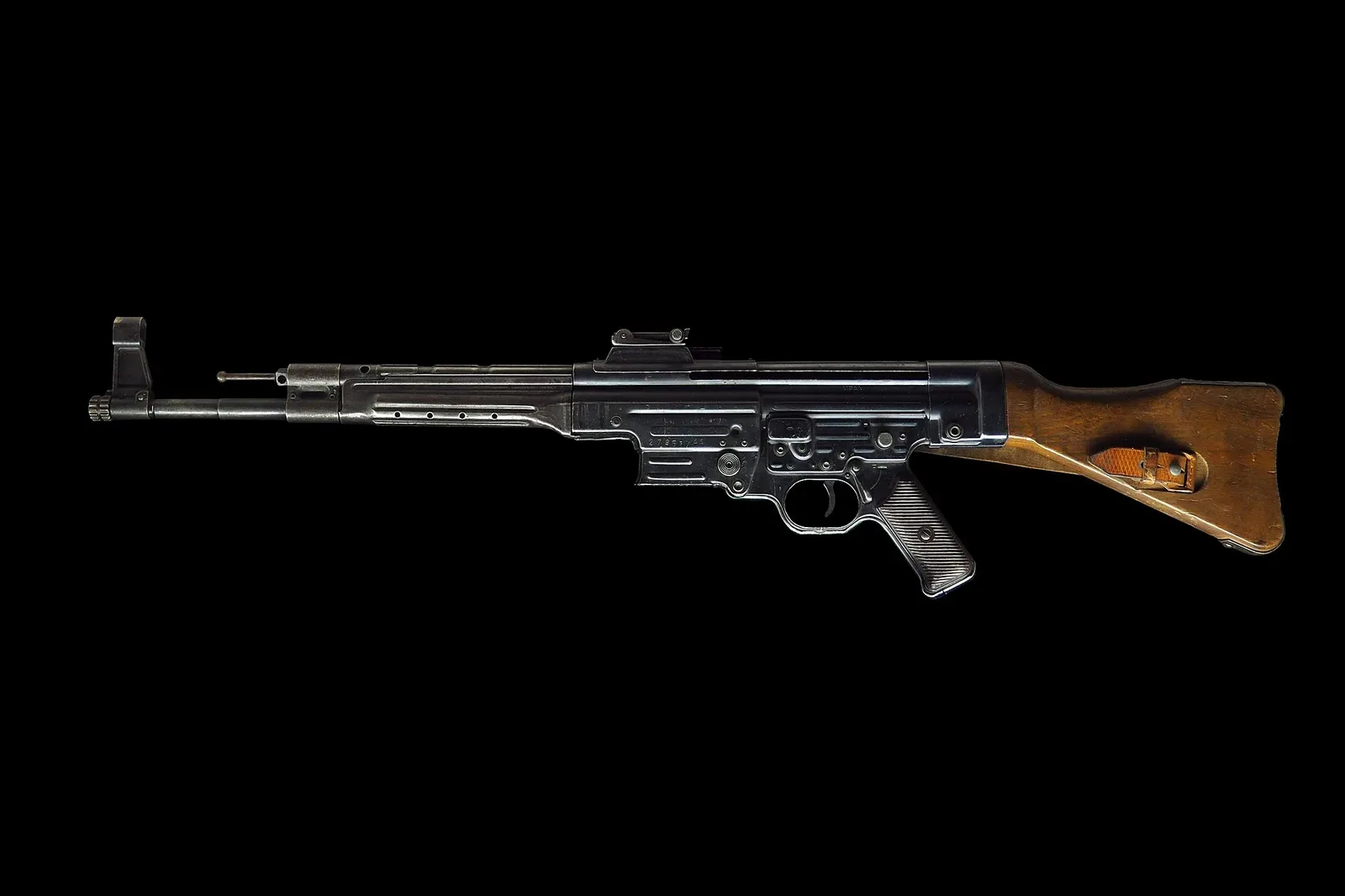
The Sturmgewehr 44 — Nazi Germany's first true assault rifle, combining rifle power with submachine gun rate of fire in 7.92×33mm Kurz.
| Origins | |
|---|---|
| Invented | 1938-1943 |
| Inventor | Hugo Schmeisser (C. G. Haenel design group) |
| Country | Germany |
| Timeline | |
| Era | World War II and Cold War |
| Impact | |
| Significance | A select-fire rifle using an intermediate cartridge that permanently changed infantry combat tactics by combining the range of rifles with the controllability of submachine guns. |
Assault Rifle: The Weapon That Rewrote Infantry Combat
Firearms encyclopedia article
From The Boise Gun Club Handbook
Overviewedit
An assault rifle is a select-fire rifle that uses an intermediate-power cartridge and feeds from a detachable magazine. That definition sounds simple enough, but it describes a category of weapon that took roughly a century of industrial warfare to produce—and whose adoption permanently changed how infantry fights.
According to the U.S. Army's own definition, a firearm has to clear four requirements to earn the designation:
- Selective fire capability (semi-automatic and automatic)
- Intermediate cartridge (between pistol and full rifle power)
- Detachable box magazine
- Effective range of at least 300 metres
| Requirement | True Assault Rifle | Semi-Auto "Assault Weapon" | Battle Rifle |
|---|---|---|---|
| Selective Fire | ✓ Full-auto capability | ✗ Semi-auto only | ✓ Usually |
| Intermediate Cartridge | ✓ 5.56mm, 7.62×39mm | ✓ Same cartridge | ✗ Full-power (7.62×51mm) |
| Detachable Magazine | ✓ Standard | ✓ Standard | ✓ Standard |
| 300m+ Range | ✓ Effective | ✓ Effective | ✓ Extended range |
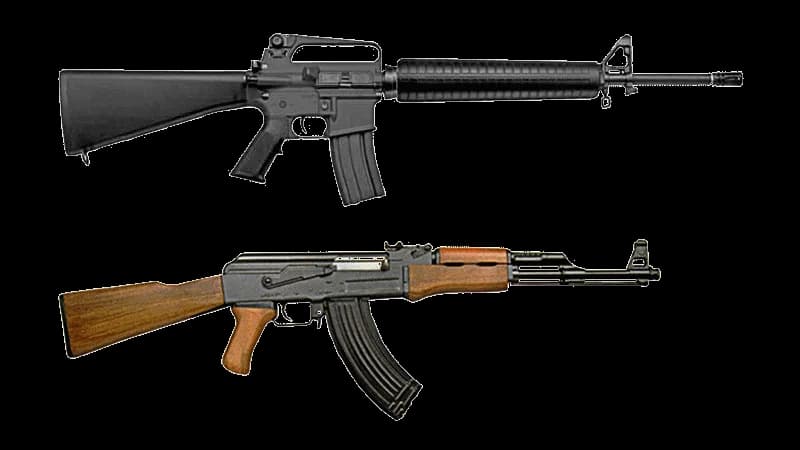
| Examples | AK-47, M16, StG 44 | AR-15, AK-pattern clones | FN FAL, M14 |
Under that strict standard, a semi-automatic AR-15 is not an assault rifle. Neither is an FN FAL, which fires the full-power 7.62×51mm NATO round. The distinction matters—and the confusion between "assault rifle" and "assault weapon" has generated considerable political noise, particularly in the United States, where selective-fire rifles have been legally classified as machine guns and tightly regulated since 1934 under the National Firearms Act and since 1986 under the Firearm Owners Protection Act.
What matters historically is how we got here—and why the assault rifle concept, once proven on the Eastern Front in 1943, spread to every major army on earth within a generation.
Development Historyedit
The Problem That Needed Solving
By the late 19th century, smokeless powder and jacketed bullets had produced rifle cartridges theoretically lethal beyond 2,000 metres. That was a range no infantryman could actually use with open sights—at that distance, a man-sized target disappears behind the front sight blade. The practical result was that militaries built their infantry rifles around a capability their soldiers could rarely exploit.
In early 1918, a German officer named Hauptmann Piderit, part of the Gewehrprüfungskommission (Small Arms Examination Committee) of the German General Staff, submitted a paper making exactly this argument.
Firefights rarely exceeded 800 metres—roughly half the theoretical range of the standard 7.92×57mm Mauser round. A shorter, lighter cartridge would save materials, let soldiers carry more ammunition, and allow controllable automatic fire.
The German Army showed no interest. The tactical reality Piderit identified didn't go away. By the time Germany invaded the Soviet Union in 1941, German infantry commanders were watching Red Army units equipped with PPSh-41 submachine guns dominate close-range engagements, while German bolt-action Kar 98k rifles were too slow to respond. The gap between what rifles could theoretically do and what soldiers actually needed had become a tactical liability.
The Intermediate Cartridge
In April 1938, the German Heereswaffenamt (HWA) commissioned ammunition maker Polte of Magdeburg to develop an intermediate round. The solution was the 7.92×33mm Kurz—the same 7.92mm bullet as the standard Mauser cartridge, but in a case shortened from 57mm to 33mm. Less powder, lower velocity, less recoil. The bullet traveled at 685 m/s compared to the Kar 98k's 760 m/s, which cost range and terminal energy at distance. But it meant a soldier could actually control automatic fire, and it was deadly enough at the ranges where fighting actually happened.
At the same time, the HWA contracted C. G. Haenel of Suhl—whose design group was headed by Hugo Schmeisser—and Walther to each produce a prototype weapon chambered for the new round. Both were designated Maschinenkarabiner 42, differentiated as the MKb 42(H) and MKb 42(W). The Haenel design won out, and its descendants became the MP 43, MP 44, and finally the Sturmgewehr 44.
The Bureaucratic Fight
Getting the StG 44 into service was as much a political problem as an engineering one. Adolf Hitler initially opposed the entire program.
- Germany lacked industrial capacity to replace 12 million existing Kar 98k rifles
- Introducing a new cartridge would strain already-stressed logistics
- The weapon was re-designated as MP 43 to avoid Hitler's attention
To keep the program alive, the Waffenamt (Armament Office) re-designated the MKb 42(H) as the Maschinenpistole 43 (MP 43)—deliberately billing it as an upgrade to existing submachine guns to avoid Hitler's scrutiny. The name temporarily worked.
Hitler found out anyway on 6 February 1943, when an early production MP 43 was presented to him alongside Colonel Friedrich Kittel. He was annoyed. Minister of Armaments Albert Speer followed up with a telegram demanding termination of the machine carbine project. Production continued anyway, in limited numbers.
| Designation | Date | Status | Monthly Production Target |
|---|---|---|---|
| MKb 42(H) | 1942 | Prototype phase | — |
| MP 43 | Feb 1943 | Limited production | — |
| MP 44 | Apr 1944 | Full production | 30,000 |
| StG 44 | Oct 1944 | Final designation | 30,000 |
What changed Hitler's mind was the soldiers themselves. According to the sources, sometime in 1943 Hitler was decorating three generals for service on the Eastern Front and allowed each to make a request. All three asked for the same thing: production and issue of the MP 43. After reviewing field reports, Hitler reversed course and on 2 October 1943 ordered monthly production of 30,000 guns alongside the 7.92×33mm Kurz cartridge.
The weapon was redesignated Maschinenpistole 44 (MP 44) in April 1944, then received its final name around 16–22 October 1944: the Sturmgewehr 44 (StG 44), or "Assault Rifle 44." According to Johnston and Nelson, the term was coined by General Erich Jaschke and accepted by Hitler. The name change served two purposes: it differentiated the new rifle from the MP 38 and MP 40 submachine guns (which fired 9mm pistol rounds) and described the weapon's actual combat role more accurately.
By the war's end, 425,977 StG 44 variants had been produced across four plants:
| Manufacturer | Location | Units Produced | Percentage |
|---|---|---|---|
| C.G. Haenel | Suhl | 185,000 | 43.4% |
| Plant Erfurt | Erfurt | 104,000 | 24.4% |
| Steyr-Daimler-Puch | Steyr | 80,000 | 18.8% |
| Sauer & Sohn | Suhl | 55,000 | 12.9% |
| Total Produced | — | 425,977 | 100% |
That figure fell well short of the 1.5 million ordered and was nowhere near the 4 million planned.
Key milestones in assault rifle development from concept to global adoption
The Soviet Response
On July 15, 1943, a captured StG (at that point still the MKb 42(H)) was demonstrated before the People's Commissariat of Arms of the USSR. The Soviets were impressed. They were watching their own troops get outgunned by a weapon that bridged the range gap between their bolt-action Mosin–Nagants and their short-range PPSh-41 submachine guns.
The Soviet Technical Council met in July 1943 and concluded that the German 7.92mm intermediate cartridge represented an important development. A first prototype 7.62×39mm M43 round was created a month later, using the same design method as the 7.92 Kurz—taking their standard rifle caliber (7.62mm) and putting it in a shorter case. The 7.62×39mm M43 cartridge was verifiably influenced by the German round, per the Wikipedia source on the StG 44.
The cartridge first appeared in the semi-automatic SKS carbine, then in the AK-47. Hugo Schmeisser, captured after the war, was put to work by the Soviets at the Izhmash factory in Izhevsk until 1952. The extent of his direct contribution to the AK-47 remains unclear—the AK used a rotating bolt mechanism quite different from the StG 44's tilting bolt—but the conceptual debt is undeniable. As the M16 Rifle Case Study prepared for the President's Blue Ribbon Defense Panel noted:
| Nation | Intermediate Cartridge | Inspired By | First Rifle |
|---|---|---|---|
| Germany | 7.92×33mm Kurz | Combat analysis | StG 44 |
| Soviet Union | 7.62×39mm M43 | Captured StG 44 | SKS → AK-47 |
| United States | 5.56×45mm | Vietnam experience | M16 |
Used in quantity against the Soviets at Stalingrad, the German Sturmgewehr made a deep impression on the Russians. They copied the ballistics of the cartridge while improving the configuration and improving the weapon.
The American Detour
The United States took the longest route to the assault rifle. Post-WWII, American Army studies of combat produced findings nearly identical to the Germans'—most firefights at close range, area fire more common than aimed shots—but senior commanders drew different conclusions. They wanted a single powerful .30-caliber cartridge that could serve both the new automatic rifle and the new general-purpose machine gun in concurrent development.
The result was the 7.62×51mm NATO cartridge and the M14 rifle, essentially an improved M1 Garand with a 20-round magazine. The M14 could fire on automatic, but the 7.62mm NATO round made it nearly uncontrollable on that setting. Most soldiers kept it on semi-automatic. Meanwhile, the FN FAL and Heckler & Koch G3, both firing the same 7.62×51mm round, became the standard rifles for most NATO allies during the Cold War.
The collision between the M14 and the AK-47 in Vietnam forced the issue. Battlefield reports indicated the M14 was uncontrollable in full-auto and that soldiers couldn't carry enough ammunition to maintain fire superiority. In 1957, General Willard G. Wyman of U.S. Continental Army Command had requested a .223-caliber (5.56mm) select-fire rifle weighing 2.7 kg loaded. Civilian engineer Eugene Stoner developed the AR-15 to meet those requirements, bringing it to Fort Benning trials in 1958. Testing showed it superior to the M14 at all but extreme distances, lighter, and more controllable.
The Army resisted anyway. In January 1963, Secretary of Defense Robert McNamara concluded the AR-15 was the superior system and ordered a halt to M14 production. After modifications—most notably relocating the charging handle from under the carrying handle to the rear of the receiver—the rifle was adopted as the M16. By 1968 it had become the standard U.S. infantry weapon.
The M16 had early problems. It didn't respond well to wet and dirty conditions and jammed in combat before modifications addressed the issues. After those fixes, it proved durable enough to become the longest continuously serving rifle in American military history.
How It Worksedit
Three mechanical characteristics define the assault rifle as a category.
Selective Fire Mechanism
Selective fire means the shooter can switch between semi-automatic (one round per trigger pull) and automatic (continuous fire while the trigger is held, until the magazine is empty). In practice, most assault rifle doctrine calls for semi-automatic as the default, with automatic reserved for specific tactical situations—the Germans issued exactly this guidance for the StG 44, directing soldiers to use fully automatic only in emergencies and in short bursts of two or three rounds.
The Intermediate Cartridge Innovation
The intermediate cartridge is the core innovation. A pistol round like the 9mm lacks range and penetrating power beyond 50–100 metres. A full-power rifle cartridge like the 7.92×57mm Mauser or 7.62×51mm NATO generates recoil that makes automatic fire difficult to control and produces a heavier weapon. The intermediate cartridge—7.92×33mm Kurz, 7.62×39mm, 5.56×45mm NATO—sits between those poles.
| Cartridge Type | Velocity | Effective Range | Recoil | Example |
|---|---|---|---|---|
| Pistol | ~350 m/s | 50-100m | Low | 9mm Parabellum |
| Intermediate | 600-900 m/s | 300-500m | Moderate | 7.62×39mm, 5.56×45mm |
| Full Rifle | 800-950 m/s | 800m+ | High | 7.62×51mm NATO |
Lower recoil impulse allows controllable automatic fire, lighter ammunition means soldiers can carry more rounds, and the reduction in power still leaves the cartridge effective at the ranges where infantry combat actually happens.
The detachable box magazine enables rapid reloading. The StG 44 used a 30-round box magazine. The AK-47 used a 30-round curved magazine to accommodate the tapered 7.62×39mm round. The M16 standardized on 20-round and later 30-round magazines. The ability to drop an empty magazine and seat a fresh one in seconds—rather than loading rounds individually—directly enabled the higher consumption rate that automatic fire demands.
Gas Operation Systems
Gas operation drives all three of the historically significant designs. When a round fires, propellant gas bleeds from the barrel and drives a piston or bolt carrier rearward, ejecting the spent case and chambering a fresh round. The StG 44 used a long-stroke gas piston with a tilting bolt. The AK-47 used a long-stroke piston with a rotating bolt. The M16 used a direct impingement system—gas routed directly into the bolt carrier group—which contributed to its early reliability problems in Vietnam before the design was refined.
Gas-operated assault rifle firing cycle showing selective fire mechanism
Impact on Warfare & Societyedit
Tactical Doctrine Rewritten
Before the assault rifle, a typical infantry squad was built around a mix: bolt-action rifles for aimed fire at distance, submachine guns for close-range volume of fire, and a machine gun as the squad's primary automatic weapon.
| Weapon Type | Role | Effective Range | Rate of Fire | Ammo Capacity |
|---|---|---|---|---|
| Bolt-Action Rifle | Precision | 800m+ | 10-15 rpm | 5-10 rounds |
| Submachine Gun | Close combat | <100m | 500+ rpm | 20-32 rounds |
| Machine Gun | Suppression | 1000m+ | 600+ rpm | Belt-fed |
| Assault Rifle | Universal | 300-500m | 600+ rpm | 20-30 rounds |
The machine gun provided suppression; rifles provided precision. Soldiers with submachine guns covered the gaps.
The assault rifle collapsed that structure into a single weapon.
A properly trained soldier with an StG 44 could engage targets at longer ranges than with an MP 40, was far more useful than the Kar 98k in close combat, and could provide covering fire comparable to a light machine gun.
The tactical flexibility this created was significant enough that German commanders on the Eastern Front requested it by name.
That flexibility didn't come without trade-offs. The StG 44's 30-round magazine meant higher ammunition consumption, and Germany's logistics were already strained. The planned 400 million rounds per month of 7.92×33mm Kurz from February 1944 onward proved completely unrealistic; actual production in February 1945 was reduced to 110 million rounds.
Global Proliferation
The numbers here tell the story without embellishment. As of 2004, of an estimated 500 million firearms worldwide, approximately 100 million belonged to the Kalashnikov family—with three-quarters of those being AK-47s. More AK-type weapons have been produced than all other assault rifles combined. The AK-47 was widely supplied or sold to Soviet-allied nations, and blueprints were shared with several countries, with China's Type 56 being the most notable result.
The M16 platform followed a similar, if smaller, trajectory. It was adopted by numerous U.S. allies, and the 5.56×45mm NATO cartridge—standardized when the Belgian SS109 round was chosen under STANAG 4172 in October 1980—became the NATO standard and, per the assault rifle Wikipedia article, "the standard assault-rifle cartridge in much of the world."
The Name Problem
The political baggage attached to the term "assault rifle" is worth addressing plainly. In the United States, the phrase has been applied to semi-automatic civilian firearms that share cosmetic features with military rifles but lack selective-fire capability. Under the U.S. Army's own definition, a semi-automatic AR-15 is not an assault rifle. It lacks the selective-fire function that defines the category.
This conflation has real consequences for policy debates. The National Firearms Act of 1934 and the Firearm Owners Protection Act of 1986 tightly restrict civilian ownership of actual selective-fire weapons. What various state and federal "assault weapon" laws have regulated are semi-automatic firearms—a legally and mechanically distinct category. The sources describe this conflation as incorrect and a misapplication of the term.
The StG 44 as Living History
StG 44s manufactured in 1943–1945 have appeared in conflicts ranging from the Lebanese Civil War to the Ogaden War to the Syrian Civil War. In August 2012, the Syrian Al-Tawhid Brigade posted video showing a cache they claimed included 5,000 StG 44 rifles captured from a weapons depot in Aleppo. Photos later showed rebels using them in combat. In September 2013, a photo emerged of a Syrian rebel operating a StG 44 connected to a makeshift remote weapon station controlled by a wired joystick. A gun designed in 1938–1943 was being used in active combat eight decades later—wired to a video camera and a monitor.
Yugoslav units carried StG 44s until the 1980s, when the remaining rifles were transferred to Territorial Defense reserves or sold to regimes in the Middle East and Africa. East Germany kept them in service with the designation MPi.44 until replacing them with domestic AK-47 variants. The Volkspolizei used them until approximately 1962.
Modern Relevanceedit
By the end of the 20th century, assault rifles had replaced full-powered rifles and submachine guns as the standard infantry weapon in most of the world's armies. The two dominant lineages—AK and AR—between them account for the vast majority of service rifles currently fielded.
Continued Evolution
The trend toward smaller calibers that the StG 44 initiated continued through the Cold War. The Soviets introduced the AK-74 chambered in 5.45×39mm in 1974, unveiled publicly in 1977, in direct response to the M16's 5.56mm cartridge. In March 1970, the U.S. had recommended all NATO forces adopt the 5.56×45mm cartridge; the Belgian SS109 round was eventually standardized in October 1980. The adoption of these smaller, faster rounds by both superpowers confirmed the trajectory the StG 44 had set.
Evolution and proliferation of assault rifle designs from the original StG 44
The bullpup configuration—magazine behind the trigger group, allowing a shorter overall length with the same barrel—offered one answer to the trade-off between compact size and adequate barrel length. Austria's Steyr AUG (1977), France's FAMAS (1978), Britain's SA80 (1985), and Israel's Tavor TAR-21 (late 1990s) all pursued this approach. By the turn of the century, bullpup assault rifles had achieved widespread acceptance across dozens of militaries.
Next Generation Developments
The United States military has been transitioning from the M16 to the M4 carbine—essentially an M16 with a shorter barrel suited to urban environments and vehicle operations. The M4 accepts some accuracy trade-offs at distance in exchange for greater maneuverability in confined spaces.
The U.S. Army has more recently been pursuing the Next Generation Squad Weapon program, partly motivated by concerns about the 5.56mm round's performance against body armor at extended ranges—an echo of the same range-versus-weight-versus-lethality argument that produced the intermediate cartridge concept in the first place. The wheel turns.
The BGC Takeedit
This section represents editorial opinion, not sourced fact.
The assault rifle is probably the clearest example in firearms history of technology being driven by the gap between doctrine and reality. Armies spent decades insisting that long-range rifle accuracy was the defining infantry skill, and they built their weapons and training around that belief. Combat kept telling them otherwise—that most fighting happened inside 400 metres, that volume of fire mattered as much as precision, that controllable automatic capability was worth the trade-off in range and terminal energy.
The assault rifle didn't create that tactical reality. It finally acknowledged it.
What's striking about the StG 44's story is how many times it nearly didn't happen. Hitler killed the program repeatedly. Bureaucrats hid it under a different name. Logistics officers pointed out, correctly, that introducing a new cartridge mid-war was a supply nightmare. All of those objections were reasonable. The weapon was still right.
The Soviet and American paths to the assault rifle are instructive in different ways. The Soviets saw the StG 44 in combat, recognized it immediately for what it was, and within months had their engineers working on an equivalent cartridge. They got the AK-47 into service by the early 1950s. The Americans saw the same evidence, ran the same studies, reached the same conclusions—and then spent fifteen years arguing about it until Vietnam forced the issue. That's not a knock on American engineers; the AR-15 is a genuinely excellent design. It's a reminder that the hardest part of adopting the right tool is usually institutional, not technical.
The political confusion around the term "assault rifle" in American public discourse is worth naming directly: most of what gets called an assault rifle in news coverage and legislation is a semi-automatic firearm. The actual thing—selective fire, intermediate cartridge, detachable magazine—has been tightly regulated for civilian ownership in the U.S. since 1986. Conflating the two categories doesn't clarify the policy debate. It just makes it louder.
The assault rifle's 80-year run as the dominant infantry weapon shows no sign of ending. Every attempt to replace it—caseless ammunition, flechette rounds, various exotic mechanisms—has run into the same wall: the gas-operated, intermediate-cartridge, magazine-fed select-fire rifle is a remarkably well-calibrated solution to a well-defined problem. Hugo Schmeisser got the fundamentals right in 1943. That's a long time for any engineering solution to hold.
Referencesedit
- Gls Guns(Sumner, IA)
- Bi-mart - Yakima (Fruitvale Ave)(Yakima, WA)
- New Philly Sportsman Specialities(New Philadelphia, OH)
- R&R Sports & Outdoors(Brandon, FL)
Loading comments...