State Details
Tennessee

Overview | |
|---|---|
State | Tennessee (TN) |
Capital | Nashville |
Statehood | 1796 |
Population | 7,126,489 |
Gun Ownership | 48.4% |
Active FFLs | 1,311 |
Carry Laws | |
Constitutional Carry | Yes (2021) |
Open Carry | Yes |
CCW Permit Available | Yes |
Permit Reciprocity | 36+ states |
Self-Defense | |
Castle Doctrine | Yes |
Stand Your Ground | Yes |
Duty to Retreat | No |
Regulations | |
State Preemption | Yes |
Red Flag / ERPO | No |
Waiting Period | None |
Universal BGC | No |
NFA Items | Yes |
Assault Weapons Ban | No |
Magazine Limit | None |
Firearms Freedom Act | Yes |
Key Legislation | |
| |
Notable Manufacturers | |
| |
Tennessee Firearms History: From Longrifles to Constitutional Carry
Reference article
From The Boise Gun Club Handbook
Updated August 15, 2026. The law moved twice since this article was written. The $200 making and transfer tax on suppressors, SBRs, SBSs and AOWs was eliminated effective January 1, 2026 by the One Big Beautiful Bill Act. Then on August 5, 2026 a federal court in Silencer Shop Foundation v. ATF struck down the NFA registration and approval requirements for those same items, and that injunction took effect August 13. It covers only the plaintiffs, their members and their customers. Living in a plaintiff state does not make you covered. Machine guns and destructive devices are unchanged. Read the current guide: NFA Items in 2026: What Actually Changed.
Overviewedit
Tennessee has one of the most layered firearms histories of any state in the union. It sits at the intersection of the frontier era, the Civil War's western theater, and the modern American gun rights movement -- and it has the receipts for all three. The state produced legendary marksmen, hosted significant weapons manufacturing, saw some of the bloodiest fighting of the 1860s, and in 2021 joined the growing list of constitutional carry states.
This isn't a state that came to gun culture late. Tennessee was built on it. From the Overmountain Men who carried longrifles over the Appalachians in 1780 to Barrett Firearms Manufacturing shipping .50-caliber rifles out of Murfreesboro today, the through-line is unbroken.
Understanding Tennessee's relationship with firearms means understanding how the state itself was shaped -- by the frontier, by war, by politics, and by the people who moved through it.
Colonial & Frontier Eraedit
Early Trade and Settlement
The firearms story in Tennessee begins before the state existed. When James Needham and Gabriel Arthur crossed the Appalachians in 1673 to establish trade with the Cherokee in eastern Tennessee, they brought flintlock trade guns -- the opening chapter of a firearms exchange that would define the next century. French traders operating out of French Lick (present-day Nashville) ran competing trade networks, and both European powers used guns as the primary currency of alliance with Native nations.
The Cherokee, Chickasaw, and Shawnee people inhabiting Tennessee's river valleys became increasingly dependent on European firearms through the early 18th century. By the time Sir Alexander Cummings negotiated the first formal English-Cherokee treaty in 1730, guns had already displaced traditional weapons in both hunting and warfare across most of the region.
The colonial fur trade ran on powder and ball as much as it ran on pelts.
| Region | Primary Settlements | Rifle Traditions | Key Conflicts |
|---|---|---|---|
| East Tennessee | Watauga, Nolichucky, Holston valleys | Pennsylvania longrifle variants | Cherokee Wars (1776-1794) |
| Middle Tennessee | French Lick (Nashville) | Mixed European influences | Creek conflicts, frontier defense |
| West Tennessee | Memphis area | Later settlement period | Chickasaw trade relations |
The Longrifle Culture
The first permanent European settlers -- men like William Bean, who built his cabin on Boone's Creek near the Watauga River around 1769 -- brought the Pennsylvania longrifle with them. These early settlers came predominantly from Pennsylvania, Virginia, and the Carolinas, and they carried the rifle-making traditions of those regions.
The longrifle wasn't just a tool in the Tennessee backcountry -- it was infrastructure.
A family without a working rifle in 1770s Tennessee didn't eat reliably and couldn't defend itself.
The Watauga Association, formed in 1772 as one of the first written self-governing compacts in North America, existed in large part because the settlers were beyond the reach of organized colonial government -- and therefore had to be their own defense. That meant an armed populace was a political necessity, not just a personal preference.
When the Cherokee allied with the British and launched coordinated attacks on eastern Tennessee settlements in 1776, including the Battle of Island Flats, it was armed settler-militias under men like John Sevier that repelled them and then counter-invaded Cherokee territory.
Sevier, who would later become Tennessee's first governor, built his reputation specifically on firearms proficiency and tactical command of irregular riflemen. His campaigns against the Cherokee through the late 1770s and 1780s were the crucible that forged Tennessee's first military identity -- light infantry, long rifles, individual marksmanship over European line tactics.
Kings Mountain and Military Identity
The most consequential single firearms engagement of the pre-statehood period happened at Kings Mountain on October 7, 1780. The Overmountain Men -- roughly 1,000 militia volunteers from the Watauga, Nolichucky, and Holston River settlements -- crossed the mountains in response to British Major Patrick Ferguson's threat to burn their settlements. Ferguson commanded roughly 900 Loyalist militia at Kings Mountain, South Carolina.
The Overmountain Men, including significant contingents under Sevier and Isaac Shelby, surrounded the hill and used their longrifles to devastating effect in a one-hour engagement that killed Ferguson, killed or wounded roughly 400 of his men, and captured the rest. It was fought entirely by American militia, no Continental regulars present, and historians consider it a turning point of the Southern campaign.
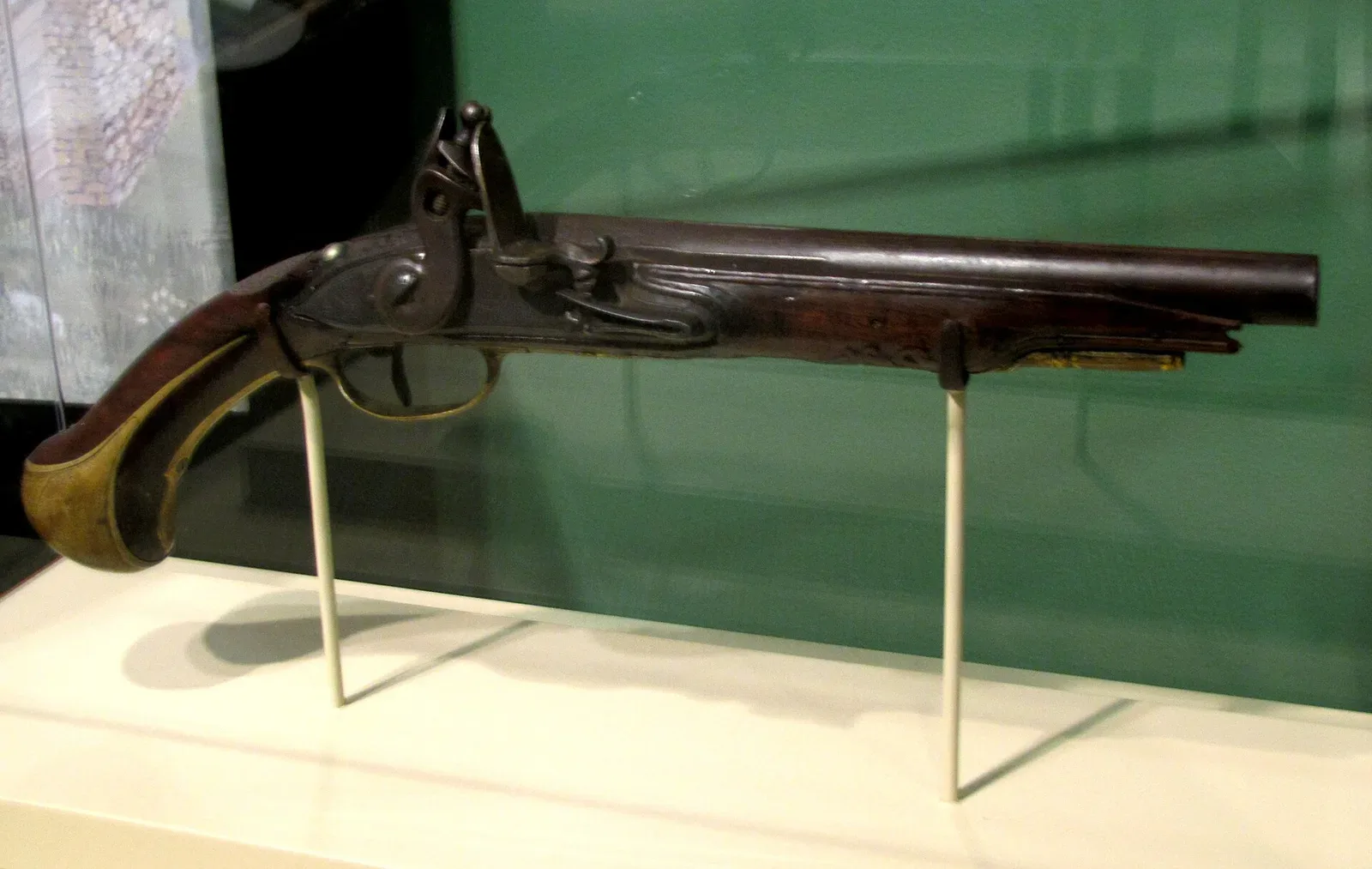
The longrifle itself was evolving during this period, and Tennessee gunsmiths were part of that evolution. A 1978 Tennessee Division of Archaeology survey identified gunmaking activity across Sullivan, Washington, Greene, Hawkins, and Knox counties dating to the late 18th century. East Tennessee longrifles developed their own regional characteristics -- slightly heavier stocks, different patch box designs, and decorative details reflecting the German and Scots-Irish craftsmen who settled the area. These weren't Pennsylvania rifles with a different address; they were a distinct regional variant.
Key events establishing Tennessee's early firearms culture
19th Century: Statehood, Expansion & the Civil Waredit
Early Statehood and Legal Precedent
Tennessee achieved statehood in 1796, the sixteenth state admitted to the union. The state's constitution included a right-to-bear-arms provision, and Tennessee courts were among the first in the nation to actually test what that meant.
In Aymette v. State (1840), the Tennessee Supreme Court addressed whether a state law prohibiting the concealed carry of a Bowie knife violated the state constitution's arms guarantee. The court upheld the law, but its reasoning was significant: it held that the right to bear arms protected weapons suitable for the common defense -- specifically military-type arms -- rather than concealed weapons used primarily for personal brawls. This placed Tennessee among the first states to produce substantive judicial interpretation of an arms-bearing right, decades before federal courts seriously engaged the question.
Jackson and Frontier Politics
Andrew Jackson, born near the Tennessee-North Carolina border in 1767 and deeply identified with Tennessee throughout his life, brought the state's frontier firearms culture onto the national stage. Jackson was an accomplished duelist -- he fought somewhere between 13 and 103 duels depending on how liberally you count -- and was famously shot in the chest during his 1806 duel with Charles Dickinson, carrying that bullet for the rest of his life.
His campaigns against the Creek Nation at the Battle of Horseshoe Bend in 1814 and against the British at the Battle of New Orleans in January 1815 were both heavily reliant on Tennessee riflemen whose marksmanship had been formed on the frontier.
David Crockett -- born in Limestone, Tennessee in 1786 -- represents the other pole of the Tennessee gunfighter mythology. Where Jackson was a commander and politician who used firearms as instruments of power, Crockett was a hunter first. He was genuinely one of the most skilled marksmen on the Tennessee frontier, winning shooting competitions regularly as a young man and sustaining Jackson's army during the Creek Wars primarily by hunting game for rations rather than by fighting.
He represented Lawrence County and then Gibson County in the Tennessee legislature and later served three terms in Congress, where his frontier persona was both authentic and politically cultivated. Crockett's firearms -- particularly his rifle "Betsy" and a later rifle sometimes called "Pretty Betsy" -- became objects of near-mythological status. Several rifles have been attributed to him with varying degrees of credibility.
He was killed at the Alamo on March 6, 1836, at age 49, having spent less than three months in Texas. He was a Tennessean.
Commercial Gunmaking
Tennessee's commercial gunmaking expanded significantly through the 1820s-1840s. Nashville developed as a hub for gunsmiths serving both the civilian market and state militia requirements. The Tennessee State Armory, established to supply the militia, operated in Nashville and processed significant quantities of arms during the Mexican-American War period, when Tennessee was called on to provide volunteers -- earning the state its enduring nickname, "The Volunteer State," when 30,000 Tennesseans answered a call for 3,000 men in 1846.
Civil War Manufacturing and Battles
The Civil War hit Tennessee harder than almost any other state. It was the last state to secede (June 8, 1861) and the first to be readmitted (July 24, 1866). More Civil War battles were fought in Tennessee than in any state except Virginia. The state was effectively split -- East Tennessee was heavily Unionist, Middle and West Tennessee more Confederate -- and that split produced both Confederate and Union military manufacturing within the same borders.
The Confederate government established an arsenal and ordnance depot at Nashville, and the city's existing industrial capacity was repurposed for war production. Memphis served as a major Confederate logistics hub until its fall in June 1862.
The Confederacy's Nashville operations produced small arms, accoutrements, and ordnance until General Don Carlos Buell's Union forces occupied the city in February 1862 -- the first Confederate state capital to fall. After the Union occupation, Tennessee's manufacturing capacity was redirected. The Federal Arsenal at Nashville became a significant Union supply depot for the western campaigns.
| Battle | Date | Location | Significance | Casualties |
|---|---|---|---|---|
| Shiloh | April 1862 | Hardin County | First major western theater battle | 23,746 total |
| Stones River | Dec 1862-Jan 1863 | Murfreesboro | Strategic Union victory | 24,645 total |
| Chickamauga | September 1863 | Georgia border | Confederate tactical victory | 34,624 total |
| Chattanooga | November 1863 | Hamilton County | Union breakthrough | 12,485 total |
| Franklin | November 30, 1864 | Williamson County | "Gettysburg of the West" | 9,500 Confederate |
The battles of Shiloh (April 1862), Stones River/Murfreesboro (December 1862-January 1863), Chickamauga (September 1863), Chattanooga (November 1863), and the Franklin-Nashville Campaign (November-December 1864) collectively made Tennessee the most fought-over ground in the western theater.
The Battle of Franklin on November 30, 1864 -- sometimes called the "Gettysburg of the West" -- saw Confederate General John Bell Hood's Army of Tennessee launch a massive frontal assault against Union positions. Roughly 9,500 Confederate casualties in five hours of fighting. The massed infantry assault against entrenched defenders armed with rifled muskets demonstrated, bloodily, the tactical obsolescence of Napoleonic assault tactics against mid-19th century firearms technology.
Sam Houston, Tennessee-born (1793, Rockbridge County, Virginia, but raised in Blount County, Tennessee) and governor of Tennessee before relocating to Texas, represents another thread of the Tennessee-to-frontier pipeline that carried Tennessee's firearms culture westward.
20th Century: Wars, Industry & Regulationedit
Alvin C. York and WWI
Tennessee's most decorated soldier of the 20th century -- and arguably in American history -- was Sergeant York, born in Pall Mall, Fentress County in 1887. York's October 8, 1918 action in the Meuse-Argonne offensive in France resulted in the capture of 132 German prisoners and the silencing of 35 machine guns, largely through York's extraordinary rifle and pistol marksmanship. He used an M1917 Enfield rifle and a Colt M1911 pistol.
For this, he received the Medal of Honor, the French Croix de Guerre, and numerous other decorations from allied nations. York's story became a template for the Tennessee marksman mythology -- rural, self-taught, religiously grounded, and genuinely skilled. The 1941 film Sergeant York starring Gary Cooper was one of the highest-grossing films of that year and reinforced the cultural image of the Tennessee rifleman on a national scale.
York himself remained in Pall Mall until his death in 1964, and the Sergeant York Historic Area is maintained there today.
WWII and Industrial Expansion
Camp Forrest, established near Tullahoma in 1940, became one of the largest Army training installations in the United States during World War II, processing hundreds of thousands of soldiers. Arnold Air Force Base near Tullahoma (established as Arnold Engineering Development Center in 1950) developed into the nation's primary aerospace and propulsion testing facility -- a different kind of weapons technology, but one rooted in the same federal defense investment that shaped the state's military-industrial footprint.
The Oak Ridge complex, established in 1942 as part of the Manhattan Project, was the primary site for uranium enrichment for the first atomic bombs. While not firearms in any conventional sense, Oak Ridge represented the single largest wartime weapons manufacturing operation in Tennessee's history -- and it was built in eighteen months in a rural East Tennessee valley, employing 75,000 people at peak operation.
Post-War Regulations
On the regulatory side, Tennessee moved largely in step with federal law through most of the 20th century. The state enacted its own version of weapons restrictions following the Gun Control Act of 1968, and local jurisdictions -- particularly Memphis and Nashville -- periodically pursued additional ordinances. Tennessee law for most of the post-war period required a permit to carry handguns, either concealed or openly.
The Tennessee Firearms Association (TFA), founded in 1995, became the primary state-level gun rights advocacy organization and would prove influential in shaping legislation over the following three decades.
Modern Era (2000–Present)edit
Constitutional Carry Movement
Tennessee's modern firearms policy history is a consistent arc toward expanded carry rights and reduced state-level restrictions, driven by Republican legislative dominance that became near-total after 2010.
The state's concealed carry permit system, established under Tennessee Code Annotated § 39-17-1351, had been in place since 1996.
| Year | Legislation | Governor | Key Provisions |
|---|---|---|---|
| 1996 | Concealed Carry | Don Sundquist | Permit required for concealed carry |
| 2009 | Restaurant Carry | Phil Bredesen | Carry in establishments serving alcohol (with permit) |
| 2014 | Enhanced Permits | Bill Haslam | Additional training for broader reciprocity |
| 2021 | Constitutional Carry | Bill Lee | Permitless carry for eligible residents 21+ |
In 2021, under Governor Bill Lee, the legislature passed Senate Bill 765 / House Bill 786, establishing constitutional carry -- permitless carry of a handgun, concealed or openly, for any Tennessee resident 21 or older who is legally allowed to possess a firearm. The bill was signed April 8, 2021, taking effect July 1, 2021. It also lowered the age for permitless carry to 18 for active-duty military personnel.
The permit system was retained as optional -- Tennesseans who want a carry permit for reciprocity purposes in other states can still obtain one. Tennessee's enhanced handgun carry permit, which requires additional training, is recognized by a larger number of states than the standard permit.
Tennessee's path to constitutional carry and response to recent events
Covenant School Impact
In 2023, Tennessee's legislature faced unusual pressure after the Covenant School shooting in Nashville on March 27, 2023, in which a shooter killed three nine-year-old children and three adults at a private Christian elementary school. The event prompted a rare public debate within the state's Republican legislative majority about firearms policy. The legislature ultimately did not pass gun control legislation, though Governor Lee signed an executive order directing the Tennessee Bureau of Investigation to strengthen background check data sharing.
The debate produced one of the more unusual legislative episodes in recent Tennessee history: three Democratic lawmakers (Justin Jones, Justin Pearson, and Gloria Johnson) led protests from the House floor on April 3, 2023. The Republican majority voted to expel Jones and Pearson -- both Black men -- while Johnson, who is white, survived the expulsion vote by a single vote. Both Jones and Pearson were subsequently reappointed to their seats by their respective county governments and then re-elected. The episode drew national attention and polarized an already charged debate.
Current Policy Status
Tennessee currently has no state assault weapons ban, no magazine capacity limits, no red flag law, no universal background check requirement beyond federal law, and no waiting period for firearm purchases. It is consistently ranked among the most permissive states for firearms ownership and carry.
Notable Figures & Manufacturersedit
Barrett Firearms Manufacturing
Barrett Firearms Manufacturing is Tennessee's most significant modern firearms manufacturer and one of the most consequential in American military history. Ronnie Barrett founded the company in Murfreesboro in 1982, driven by his desire to build a semi-automatic rifle chambered in .50 BMG. He had no formal gunsmithing training -- he was a photographer who taught himself the engineering.
The resulting Model 82 entered production in the mid-1980s and was adopted by the U.S. military as the M107 Long Range Sniper Rifle. The Barrett M82/M107 has seen combat in every major U.S. military operation since the Gulf War. It's been used for counter-materiel work, EOD operations, and long-range sniper engagements.
The Barrett M82A1 set the platform for a family of .50-caliber rifles that also includes the bolt-action M95 and M99, and the MRAD in various calibers. Barrett's facility in Murfreesboro employs several hundred people and exports to dozens of allied militaries.
When California passed legislation restricting .50-caliber rifles in 2004, Ronnie Barrett announced that Barrett Firearms would no longer sell to or service California law enforcement agencies -- a position the company maintains. It was one of the first high-profile manufacturer boycotts of a restrictive jurisdiction and influenced similar policies by other manufacturers in subsequent years.
Historical Military Figures
Alvin York -- discussed above in the 20th century section -- is Tennessee's most decorated military figure and the state's most famous marksman in the modern historical record. The Sergeant York Historic Area in Pall Mall is maintained by the state.
John Sevier (1745-1815), Tennessee's first governor and the dominant military-political figure of the frontier era, built his career entirely on armed conflict -- against the Cherokee, against the British at Kings Mountain, and in the political struggles of early statehood. He served six terms as governor.
Andrew Jackson (1767-1845) -- though born near the Carolina border, thoroughly identified with Tennessee. His dueling history alone fills books. His military campaigns defined the early 19th century American approach to irregular warfare. His presidency (1829-1837) bore the stamp of frontier individualism that Tennessee's rifle culture had produced.
David Crockett (1786-1836) -- Limestone, Tennessee. Hunter, militia soldier, state legislator, Congressman, Alamo defender. His autobiography, published in 1834, is one of the most widely read accounts of frontier life and frontier firearms culture ever written by an American.
Traditional Gunmakers
On the manufacturing side, Tennessee's tradition of independent gunsmiths runs from the East Tennessee longrifle makers of the late 18th century through numerous small-batch contemporary custom shops. The Tennessee Division of Archaeology's survey identified active gunmakers in at least a dozen counties during the 1770-1850 period, producing distinctive regional longrifle variants with identifiable stylistic characteristics separate from Pennsylvania or Kentucky work.
Current Legal Landscapeedit
Carry Laws
Tennessee's current firearms laws are among the most permissive in the southeastern United States. Here's where things actually stand:
Constitutional Carry: In effect since July 1, 2021. Residents 21 and older (18 for active-duty military) who can legally possess a firearm may carry a handgun -- concealed or openly -- without a permit.
Enhanced Handgun Carry Permit: Available for those who want state-issued documentation for reciprocity purposes. Requires an 8-hour safety course and live-fire qualification. Recognized by 40+ states.
Long Gun Open Carry: No permit required. There is no state law prohibiting open carry of rifles or shotguns.
NFA and Special Items
NFA Items: Tennessee allows ownership of all NFA items that are legal under federal law -- suppressors, short-barreled rifles, short-barreled shotguns, machine guns (pre-1986 transferable). Suppressors are particularly popular; Tennessee has one of the higher per-capita suppressor registration counts in the country, consistent with its hunting culture.
| NFA Item Type | Tennessee Legal | Federal Requirements | Typical Wait Time |
|---|---|---|---|
| Suppressors | Yes | $0 tax stamp, Form 4 | 6-12 months |
| Short Barreled Rifles | Yes | $0 tax stamp, Form 1/4 | 4-8 months |
| Short Barreled Shotguns | Yes | $0 tax stamp, Form 1/4 | 4-8 months |
| Machine Guns | Yes (pre-1986) | $200 tax stamp, Form 4 | 6-12 months |
Background Checks: Tennessee participates in the federal NICS system. The state does not impose additional point-of-sale requirements beyond federal law.
Preemption: TCA § 39-17-1314 establishes state preemption of local firearms ordinances. Cities and counties cannot enact gun regulations stricter than state law. This has been tested -- Memphis and Nashville have both attempted local ordinances that were subsequently challenged or struck down under preemption.
Prohibited Locations: Standard list:
- Courthouses and government buildings with security checkpoints
- K-12 schools and school events
- Bars and establishments that post legal prohibition notices
- Certain government meetings and official proceedings
Red Flag / ERPO: Tennessee does not have an extreme risk protection order law. Governor Lee's 2023 executive order following the Covenant School shooting directed increased mental health records reporting to NICS but did not create a red flag mechanism.
Dealer Requirements: Licensed dealers must conduct NICS checks. Private sales between individuals are not required to go through a dealer or background check system under Tennessee or federal law for non-NFA items.
Legal Processes
Restoration of Rights: Tennessee has a process for restoration of firearms rights for certain convicted felons, governed by TCA § 39-17-1307 and related statutes, depending on offense classification and time elapsed.
The state's overall regulatory posture reflects its political composition: a Republican legislative supermajority, a largely rural gun-owning electorate, and a tradition of treating firearms ownership as a given rather than a privilege requiring justification.
The BGC Takeedit
Tennessee is about as gun-normal as it gets in the American South -- which is to say, firearms are woven into everyday life in a way that people who didn't grow up here sometimes find jarring and people who did grow up here don't think about much.
East Tennessee is the deep end of the pool. Knox County, Blount County, and the surrounding counties have a hunting and shooting culture that runs back generations, and you'll see that reflected in everything from the density of gun shops to the number of trucks with rifle racks in school parking lots during deer season. The longrifle tradition is genuinely remembered there -- not as a museum piece but as a point of regional pride.
Middle Tennessee is more mixed, partly because Nashville has grown into a major metro area with a demographic profile that's shifted noticeably since 2010. Nashville proper leans blue and has attempted local firearms ordinances that keep running into the preemption wall. But step outside Davidson County and you're back in deeply gun-normal territory almost immediately. Murfreesboro -- home of Barrett Firearms -- is a good illustration: a mid-sized city with a significant gun industry presence and a population that largely views that as a point of civic pride.
West Tennessee -- the Memphis end -- is the complicated part. Memphis has some of the highest violent crime rates in the country, and firearms policy debates there have a different texture than in Knoxville or Cookeville.
Local officials have wanted more tools to address gun violence; the Republican legislature has been disinclined to provide them in the form of additional restrictions. That tension has been a persistent feature of Tennessee firearms politics for two decades.
The Covenant School shooting in 2023 was genuinely different in how it landed in Tennessee. It wasn't that gun owners became anti-gun -- they didn't. But there was a period of real discomfort, even among committed Second Amendment supporters, about what the political response should be. The legislature's decision to expel the two Democratic lawmakers who led protests rather than pass any legislation told you exactly where the political calculus landed. Whether that was the right call is the kind of thing reasonable Tennesseans disagree about at family dinners.
For gun owners visiting or relocating to Tennessee: you're going to be fine. Carry is easy, ranges are plentiful, gun shops are everywhere, suppressors are common, and the culture is welcoming if you're not obnoxious about it. The permit system is still worth getting for reciprocity purposes if you travel at all. The enhanced permit's training requirement is not burdensome -- eight hours and a live-fire qual -- and opens up a lot of states that won't honor permitless carry recognition.
The one thing to watch in Tennessee's legal landscape is the ongoing tension between state preemption and urban local governments. Nashville and Memphis are going to keep trying things, the state legislature is going to keep swatting them down, and the courts are going to keep sorting it out. That dynamic isn't going away.
Referencesedit
- Tennessee Division of Archaeology, A Preliminary Survey of Historic Period Gunmaking in Tennessee, Report of Investigations No. 8 (1978). https://www.tn.gov/content/dam/tn/environment/archaeology/documents/report-investigations/arch_roi08_gunmaking.pdf
- Aymette v. State, 21 Tenn. (2 Hum.) 154 (1840).
- Tennessee Code Annotated § 39-17-1307 -- Unlawful carrying or possession of a weapon.
- Tennessee Code Annotated § 39-17-1314 -- State preemption of firearms regulation.
- Tennessee Code Annotated § 39-17-1351 -- Handgun carry permits.
- Senate Bill 765 / House Bill 786 (2021) -- Constitutional carry legislation, signed April 8, 2021.
- John R. Finger, Tennessee Frontiers: Three Regions in Transition (Bloomington: Indiana University Press, 2001).
- Robert V. Remini, Andrew Jackson and His Indian Wars (New York: Viking, 2001).
- David Crockett, A Narrative of the Life of David Crockett of the State of Tennessee (Philadelphia: E.L. Carey and A. Hart, 1834).
- John Mack Faragher, Daniel Boone: The Life and Legend of an American Pioneer (New York: Henry Holt, 1992).
- Vanderbilt University, Tennessee History timeline. https://my.vanderbilt.edu/tennesseehistory/tennessee-history/
- Ian de Silva, "David Crockett: Son of Tennessee, King of the Wild Frontier," American Hunter, May 14, 2020. https://www.americanhunter.org/content/david-crockett-son-of-tennessee-king-of-the-wild-frontier/
- Barrett Firearms Manufacturing, corporate history. https://barrett.net
- Tennessee Bureau of Investigation, NICS reporting and firearm background check data.
- U.S. Army Center of Military History, Sergeant Alvin C. York, Medal of Honor citation and action report, October 8, 1918.
- Tennessee Secretary of State, A History of Tennessee, Tennessee Blue Book 2007-2008. https://publications.tnsosfiles.com/pub/blue_book/07-08/41-A%20History%20of%20Tennessee.pdf
Last Updated: February 24, 2026
- Quail Creek Plantation(Okeechobee, FL)
- 2aHawaii(Honolulu, HI)
- Boston Firearms(Everett, MA)
- Safeshoot(Kingston, NY)
Loading comments...