Details
Treaty of Versailles Arms Restrictions
German heavy gun being dismantled under Versailles arms restrictions—the treaty mandated destruction of German weapons as enforcement of its military limitations clauses.
| Battle Details | |
|---|---|
| Date | June 28, 1919 |
| Location | Paris Peace Conference |
| Belligerents | Allied Powers vs Germany |
| Result | Treaty enforcement weakened by Allied disagreement and German evasion; disarmament provisions largely abandoned by 1938 |
| Legacy | |
| Firearms Significance | First systematic international attempt to dismantle an entire industrial military machine through treaty enforcement, demonstrating that seizing hardware without eliminating manufacturing expertise and knowledge cannot prevent rearmament. |
Treaty of Versailles Arms Restrictions (1919)
Firearms encyclopedia article
From The Boise Gun Club Handbook
Overviewedit
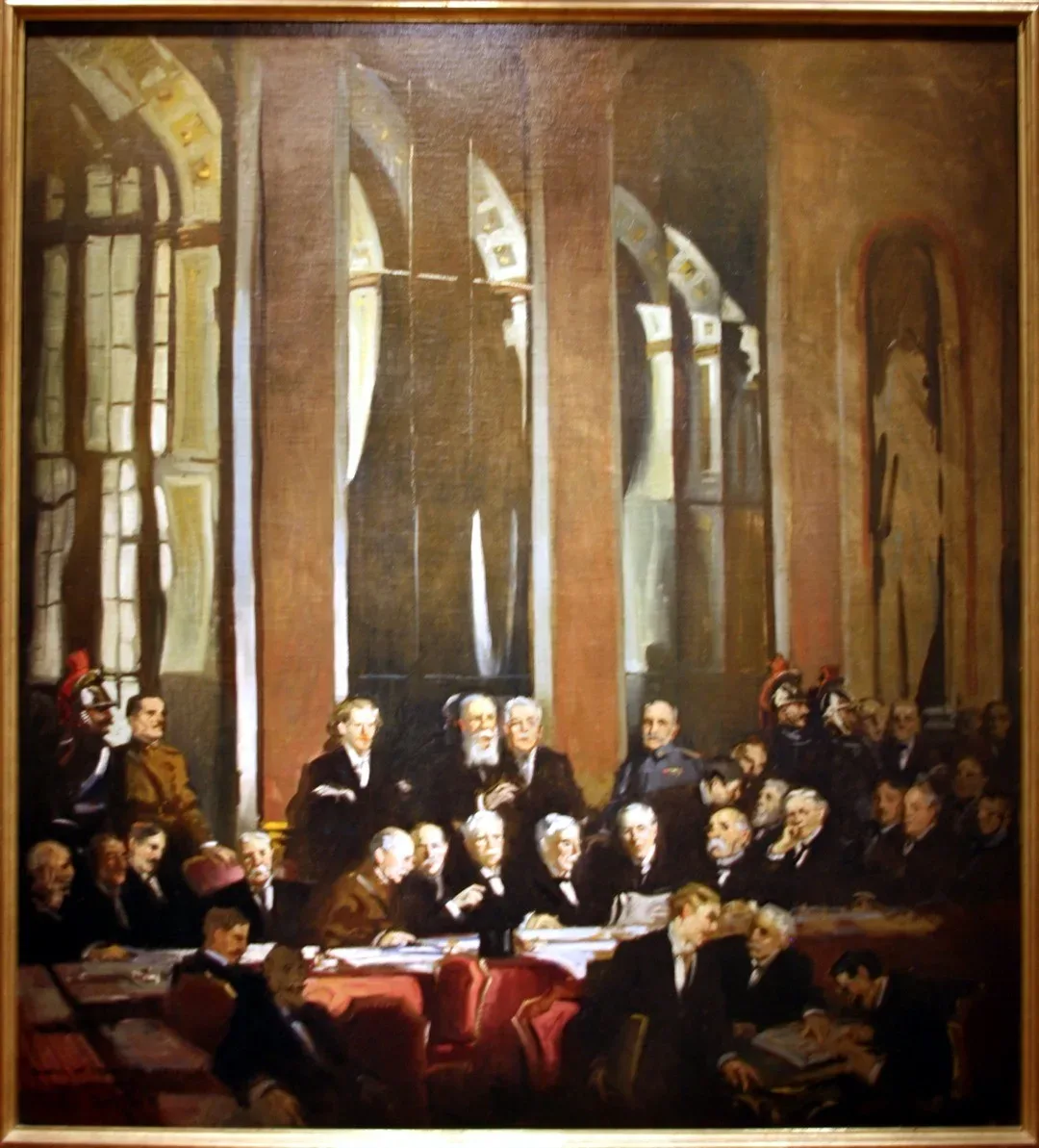
On June 28, 1919, the Allied powers handed Germany a document that attempted something no treaty had ever tried at that scale: the systematic, contractually enforced dismantling of an industrial military machine down to its last rifle and cartridge case. Part V of the Treaty of Versailles—Articles 159 through 213—covered military, naval, and air clauses, and it didn't just cap army size.
It dictated which factories could make weapons, who could own them, how many rounds per gun could be stockpiled in a fortress, and whether a university shooting club was allowed to let students handle firearms.
For the history of firearms development, the treaty represents a singular moment: the first time a great power's entire arms industry was placed under external supervision and ordered to contract by international decree. What followed—the compliance, the evasion, the Allied disagreements, and the eventual collapse of enforcement—shaped the weapons that fought World War II and echoed through every arms control debate that came after.
Background & Contextedit
The war that ended in November 1918 had consumed roughly 17 million lives and demonstrated what industrialized firepower could do when two modern economies pointed their full production capacity at each other. By the time the armistice came, Germany's war industry was still largely intact.
Per the Wikipedia article on German disarmament, Germany's production of propellant had increased twenty-fold between 1914 and 1918 under the Hindenburg Program, and the chemical firms that supplied explosives had pooled their resources through an arrangement called the Interessengemeinschaft (IG) in 1916—an agreement that presumed a German victory would give them a postwar monopoly on high-explosives production.
Post-War Industrial Capacity
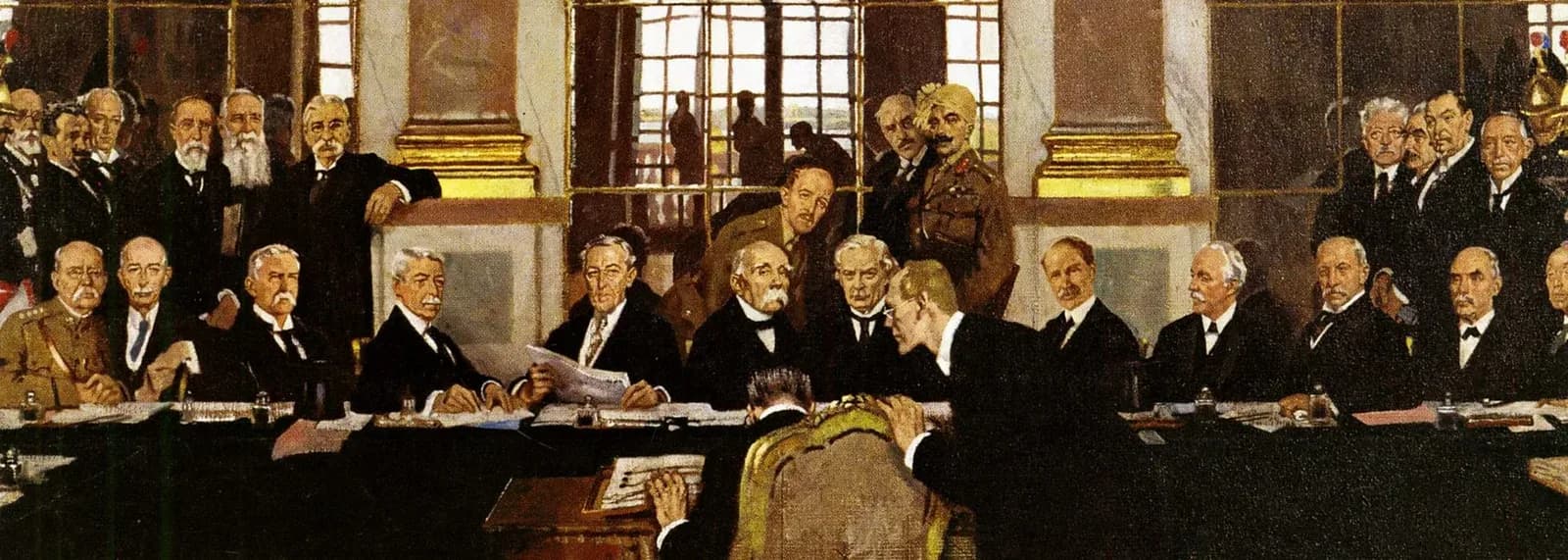
The Paris Peace Conference opened in 1919 with the Allied leadership—particularly French Premier Georges Clemenceau—determined to ensure Germany could never again pose a military threat. According to Britannica, Clemenceau and the rest of the Big Four structured the military clauses with that explicit goal.
The preamble to Part V stated that Germany's disarmament was intended "to render possible the initiation of a general limitation of the armaments of all nations"—a diplomatic framing that implied the victors would eventually disarm too. They didn't.
Allied Peace Conference Strategy
Germany received the final treaty text on May 7, 1919, and signed it, after formal objections, on June 28. Germans called it a Diktat—a dictated peace—and complained it violated the spirit of Woodrow Wilson's Fourteen Points. Per Britannica, they were not entirely wrong on the spirit, though they were in no position to negotiate.
Key milestones in the Treaty of Versailles arms control regime
Forces & Weaponsedit
To understand what the treaty dismantled, you need a sense of what Germany actually had. The figures delivered to the Inter-Allied Commissions of Control, cited by the German Chancellor in a March 16, 1935 speech and recorded in the Paris Peace Conference documents, are staggering:
| Category | Quantity Surrendered |
|---|---|
| Artillery | 59,897 cannon and heavy-gun barrels |
| Machine Guns | 130,558 units |
| Small Arms | 6,007,000 guns and carbines |
| Mine Throwers | 31,470 units and barrels |
| Small Arms Ammunition | 491,000,000 rounds |
| Grenades | 16,550,000 hand and gun grenades |
| Aircraft | 15,714 pursuit and bombing planes |
| Flame Throwers | 1,072 units |
| Shell Casings | 335,000 tons |
| Communications | 212,000 telephones |
| Protective Equipment | 174,000 gas masks |
Those numbers reflect only what was turned over. Germany entered the peace with an arms manufacturing infrastructure that the Allied planners considered just as dangerous as the hardware itself.
Every chemical factory must be regarded as a potential arsenal — a reasonable assessment given firms' wartime role in explosive supply chains.
Every chemical factory, per the Allied position expressed in 1919 according to the German disarmament Wikipedia article, was considered a potential weapons source. Firms like those that would merge to form I.G. Farben in 1925 had spent the war supplying sulphuric acid and nitrogen compounds to explosive manufacturers.
The Inter-Allied Military Control Commission (IAMCC) was the enforcement body. Its Armaments Sub-commission was run by British Major-General Francis Bingham, described in the German disarmament source as "a staunch advocate of the destruction of German armaments, which he considered a matter of urgency." The commission published what became known as the "Blue Book"—a list of prohibited war material that ultimately grew expansive enough to include uniforms, pants, backpacks, jackets, tents, cooking utensils, and vehicles the German government argued were needed for basic economic activity.
The Battleedit
The actual fight over the treaty's arms clauses wasn't fought with guns. It was fought with inspection schedules, legal definitions, diplomatic cables, and bad faith on multiple sides.
Military Restrictions
Article 160 set the headline number: the German Army could not exceed 100,000 men total, including officers, after March 31, 1920. It had to be reduced to 200,000 within three months of the treaty taking effect, then cut again on a quarterly schedule fixed by Allied military experts. Officers could total no more than 4,000.
The Great German General Staff was dissolved and forbidden from reconstituting "in any form." Compulsory military service was abolished under Article 173—the army could only be filled by voluntary enlistment, with non-commissioned officers serving minimum twelve-year terms.
| Article | Key Restriction | Details |
|---|---|---|
| 160 | Army Size Cap | Maximum 100,000 men total (4,000 officers max) |
| 168 | Manufacturing Control | Arms production only in Allied-approved factories |
| 170 | Trade Ban | No import/export of arms or war material |
| 171 | Specific Weapons Ban | Tanks, armored cars, poison gas prohibited |
| 172 | Technology Disclosure | All explosive/toxic manufacturing methods revealed |
| 173 | Service Structure | Conscription abolished, voluntary enlistment only |
| 177 | Civilian Restrictions | Universities, clubs forbidden military instruction |
Industrial Controls
Article 168 took aim at the manufacturing base. Arms and war material could only be produced in factories whose locations were communicated to and approved by the Allied powers, who retained the right to restrict their number. All other factories for manufacture, storage, or design of arms had to close within three months. Arsenals not used as approved munitions depots were shut down and their personnel dismissed.
Article 170 closed the trade routes: no importing or exporting of arms, munitions, or war material of any kind. Article 171 went further, specifically banning the manufacture and importation of armored cars, tanks, poison gas, and related materials—the weapons that had defined the industrial character of the war just fought. Article 172 required Germany to disclose the nature and manufacturing methods of all explosives and toxic substances used during the war.
The ammunition caps in fortifications were specified down to the round: per Article 167, a maximum of 1,500 rounds per gun for pieces 10.5 cm caliber and under, and 500 rounds per piece for larger calibers. Article 177 reached into civilian life in a way that's worth noting for anyone tracing the history of arms policy. It forbade educational establishments, universities, veterans' associations, shooting clubs, and touring clubs from occupying themselves with any military matters. Specifically, they were "forbidden to instruct or exercise their members, or to allow them to be instructed or exercised, in the profession or use of arms."
Enforcement Challenges
Enforcement ran into trouble almost immediately—and the trouble came from two directions at once. First, the Germans engaged in systematic non-compliance:
- Germans dragged feet on compliance and began quiet evasion
- By 1923, clandestine weapons production and military training underway
- French intelligence estimated Germany could mobilize over 2 million men
- Significantly exceeded the 100,000 treaty limit through police and Freikorps
Second, the Allies disagreed with each other about what disarmament was actually supposed to accomplish.
| Allied Position | Key Arguments | Strategic Goal |
|---|---|---|
| French | "Moral disarmament" required | Dismantle German military culture entirely |
| British | Hardware limits sufficient | Maintain German strength against Bolshevism |
| Enforcement Reality | Disagreement undermined IAMCC | Inconsistent application of restrictions |
Allied Disagreements
France wanted what it called "moral disarmament"—not just the removal of hardware, but the dismantling of German military culture and ambition. The French position, per the Wikipedia source, held that "German discipline, order, and nationalism" were threats that the armistice hadn't resolved, and that any German objection to disarmament proved the militarist spirit remained intact. Britain took a narrower view: destroy the hardware, cap the army, and get back to managing the more pressing concerns of Bolshevik Russia and Anglo-American rivalry.
Sir Maurice Hankey complained that overly strict enforcement would "deprive Germany of the physical force required to resist external attack." Sir Henry Wilson put the British position starkly in February 1919, arguing Germany needed to be "sufficiently strong to be no temptation to the French."
You may strip Germany of her colonies, reduce her armaments to a mere police force and her navy to that of a fifth-rate power; all the same in the end if she feels that she has been unjustly treated in the peace of 1919 she will find means of exacting retribution. — Lloyd George, Fontainebleau Memorandum
That tension between French and British enforcement philosophies, per Andrew Webster's chapter in Peacemaking and International Order after the First World War (Cambridge University Press, 2023), "shaped the work of the IAMCC, hindered the shared understandings necessary to develop a stable disarmament order, and limited the capacity of the League in the later 1920s to broaden disarmament agreements."
Germany was admitted to the League of Nations on September 8, 1926. Per the Paris Peace Conference documents, this was a significant threshold—under Article 164, the armament limits were supposed to remain in force after admission until the League Council modified them. The Council never did. By 1938, per Britannica, only the territorial settlement articles of the treaty remained in practical effect.
Adolf Hitler remilitarized the Rhineland in 1936—a direct treaty violation—and the Allies did nothing. The rearmament didn't wait for Hitler. Per the German disarmament Wikipedia article, clandestine rearmament began on "a small, secret, and informal basis shortly after the treaty was signed"—using glider clubs to train pilots, sporting clubs to practice infantry tactics, and front companies like MEFO to acquire forbidden weapons. It expanded openly and massively after the Nazi Party came to power in 1933.
Firearms Significanceedit
The Treaty of Versailles arms clauses matter to the history of firearms for several reasons that go beyond the raw numbers of hardware surrendered. First, the treaty demonstrated that you can seize or destroy physical arms stockpiles without eliminating the knowledge and industrial base that produced them.
Germany's chemical and manufacturing capacity survived the war substantially intact. The engineers, metallurgists, and production specialists who had built the Mauser Gewehr 98, the MG 08, and the artillery systems of the Western Front didn't disappear when the factories closed. What the Versailles inspection regime couldn't inventory or destroy was expertise—and expertise is what rebuilt the Wehrmacht's arsenal in the 1930s.
Industrial Base Preservation
Second, the restrictions forced German weapons designers to work within tight constraints for over a decade. This had a paradoxical effect: some of the engineering that produced the weapons of WWII—the MG 34, the general-purpose machine gun concept, smaller and more portable infantry weapons—emerged from designers working around treaty limits, exploring what could be done with the equipment and calibers the treaty allowed, or what could be developed secretly in ways the IAMCC couldn't easily detect.
Engineering Under Constraints
Third, the specific prohibition on tanks and armored vehicles in Article 171 pushed German armor doctrine underground and then, when the restrictions collapsed, out into the open with enormous speed. Germany had virtually no legal armored vehicle development between 1919 and 1933. When that prohibition was abandoned, it was abandoned entirely and at a run.
How treaty restrictions failed to prevent German rearmament
Dual-Use Technology Problems
The Blue Book's broad definition of war material—stretching to include field telephones, gas masks, and eventually pants—illustrated a problem that every arms control regime since has struggled with: the dual-use nature of industrial and military technology. A chemical plant making dyes is also a chemical plant that could make propellants. A sporting rifle is also a military-pattern rifle. Drawing a clean line between civilian and military production in a modern industrial economy turned out to be harder than the treaty authors anticipated, and the definitions they settled on were contested from the first day of enforcement.
The $33 billion in reparations (assessed in 1921, per Britannica) layered on top of the arms restrictions created an economic environment in which German resentment of the settlement hardened into political fuel. Many historians, per Britannica, argue that "the combination of a harsh treaty and subsequent lax enforcement of its provisions paved the way for the upsurge of German militarism in the 1930s." The arms clauses were both too strict to be accepted and too inconsistently enforced to actually hold.
The BGC Takeedit
The Versailles arms clauses are the clearest historical example of what happens when an arms control regime is designed without a durable enforcement mechanism or a shared theory of what success looks like. The French and British couldn't agree on whether the goal was destroying hardware or changing culture.
That argument wasn't just philosophical—it meant the IAMCC was working against itself from the start, with inspectors who held fundamentally different ideas about when their job was done. The result was an enforcement effort that was strict enough to humiliate Germany and fuel resentment, but inconsistent enough to let the actual rearmament proceed.
The hardware numbers are genuinely impressive—6 million rifles handed over, half a billion rounds of ammunition. But Lloyd George saw the problem clearly in 1919, and the next twenty years proved him right. Stripping a country of its weapons while leaving its industrial base, its expertise, its officer corps (many of whom rotated through the Reichswehr's 4,000-officer ceiling in short tours and then went into the reserve of trained military professionals), and its wounded national pride intact doesn't produce disarmament.
The question every arms control negotiation eventually runs into: what happens on the day the other side decides the paper isn't worth following anymore?
It produces a delay. For anyone thinking about what arms control can and can't accomplish, the Versailles experiment is the dataset. Treaty language that lacks consistent enforcement, agreed definitions, and—crucially—buy-in from the country being restricted doesn't hold. Germany's rearmament began before the ink was dry.
They got their answer in 1936 when Hitler marched into the Rhineland and nobody moved to stop him.
Referencesedit
- https://history.state.gov/historicaldocuments/frus1919Parisv13/ch14subsubch2
- https://avalon.law.yale.edu/imt/partv.asp
- https://www.britannica.com/event/Treaty-of-Versailles-1919/German-reparations-and-military-limitations
- https://alphahistory.com/worldwar1/treaty-of-versailles-military-restrictions-1919/
- https://en.wikipedia.org/wiki/German_disarmament
- https://nuremberg.law.harvard.edu/documents/2399-part-v-of-the-versailles?mode=text
- https://www.cambridge.org/core/books/peacemaking-and-international-order-after-the-first-world-war/treaty-of-versailles-german-disarmament-and-the-international-order-of-the-1920s/7A94F77269E4FF7A12A3CD196A521FC7
Last Updated: February 27, 2026
- Gls Guns(Sumner, IA)
- Bi-mart - Yakima (Fruitvale Ave)(Yakima, WA)
- New Philly Sportsman Specialities(New Philadelphia, OH)
- R&R Sports & Outdoors(Brandon, FL)
Loading comments...