Details
Slow Match
Slow match burning — the low, controllable flame that made hand-cannon ignition reliable enough to outcompete the crossbow by 1400.
| Origins | |
|---|---|
| Invented | 14th century |
| Country | Europe |
| Timeline | |
| Era | Medieval to Early Modern (14th-18th centuries) |
| Replaced By | Flintlock and percussion cap ignition systems |
| Impact | |
| Significance | A chemically treated cord that enabled the matchlock musket and dominated infantry warfare for roughly three centuries by providing a practical, affordable ignition method. |
Slow Match: The Burning Cord That Launched the Age of Firearms
Firearms encyclopedia article
From The Boise Gun Club Handbook
Overviewedit
Slow match — also called match cord — is a chemically treated length of cord or twine designed to burn slowly, consistently, and without an open flame. For roughly three centuries, it was the ignition technology that made firearms work. You held a glowing tip of smoldering rope close to a powder charge, and that was it. That was the state of the art.
The cord was most commonly made from hemp or flax, soaked in a solution of potassium nitrate (saltpeter) and dried. The result burned at approximately 1 foot (305 mm) per hour — slow enough to last through a battle, hot enough at around 270–300°C to reliably ignite black powder. According to the Wikipedia article on slow match, the British Army estimated that a single soldier on guard duty could burn through an entire mile of cord over the course of a year.
That number gives you a feel for just how central this technology was to military operations — it wasn't exotic equipment, it was a consumable, like ammunition.
| Specification | Value |
|---|---|
| Burn Rate | ~1 foot (305mm) per hour |
| Operating Temperature | 270-300°C |
| Annual Consumption | ~1 mile per soldier (British Army estimate) |
| Primary Materials | Hemp, flax (cotton in modern reproductions) |
| Chemical Treatment | Potassium nitrate (saltpeter) solution |
| Applications | Matchlock muskets, cannon, shells, petards, rock blasting |
Slow match was suitable for:
- Matchlock muskets
- Cannon ignition
- Artillery shells
- Petards (explosive devices)
- Rock drilling and blasting operations
Before primer compounds, before percussion caps, before the flintlock's self-contained spark — there was a man with a glowing piece of rope.
Development Historyedit
Early Manual Ignition (1326-1400)
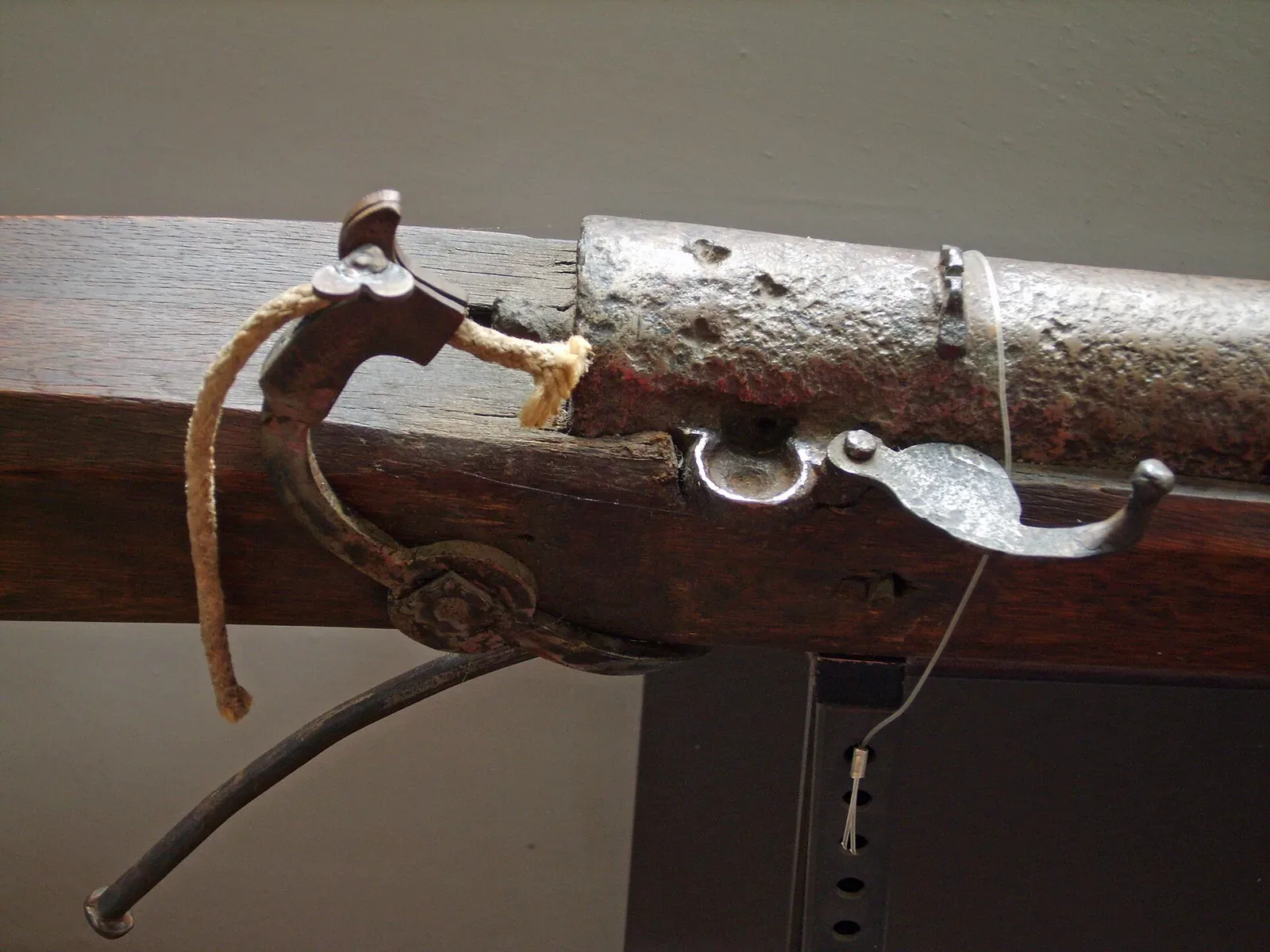
The first firearms appeared in China during the 12th century and spread to Europe, where by the 14th century gunpowder weapons were being used on the battlefield. Those earliest guns — the hand cannons and handgonnes that became common around AD 1400 — were fired by a simple method: a soldier physically applied a burning heat source to a touch hole drilled into the breech, igniting the powder charge by hand. Per the Tastes of History source, that heat source was a handheld burning match applied manually to the vent hole, requiring one hand and guaranteeing poor accuracy.
The Tinderlock Era (1410-1530)
According to research posted on the Ethnographic Arms & Armour forums by arms historian Michael Trömner, match cord appears to have come into use during the course of the 14th century. The two earliest pictorial representations of a gun — the Christ Church and Holkham manuscripts by Walter de Milemete, dated 1326–1327 — may depict a longer, thicker substance resembling match cord clamped in a linstock, though the identification is not definitive.
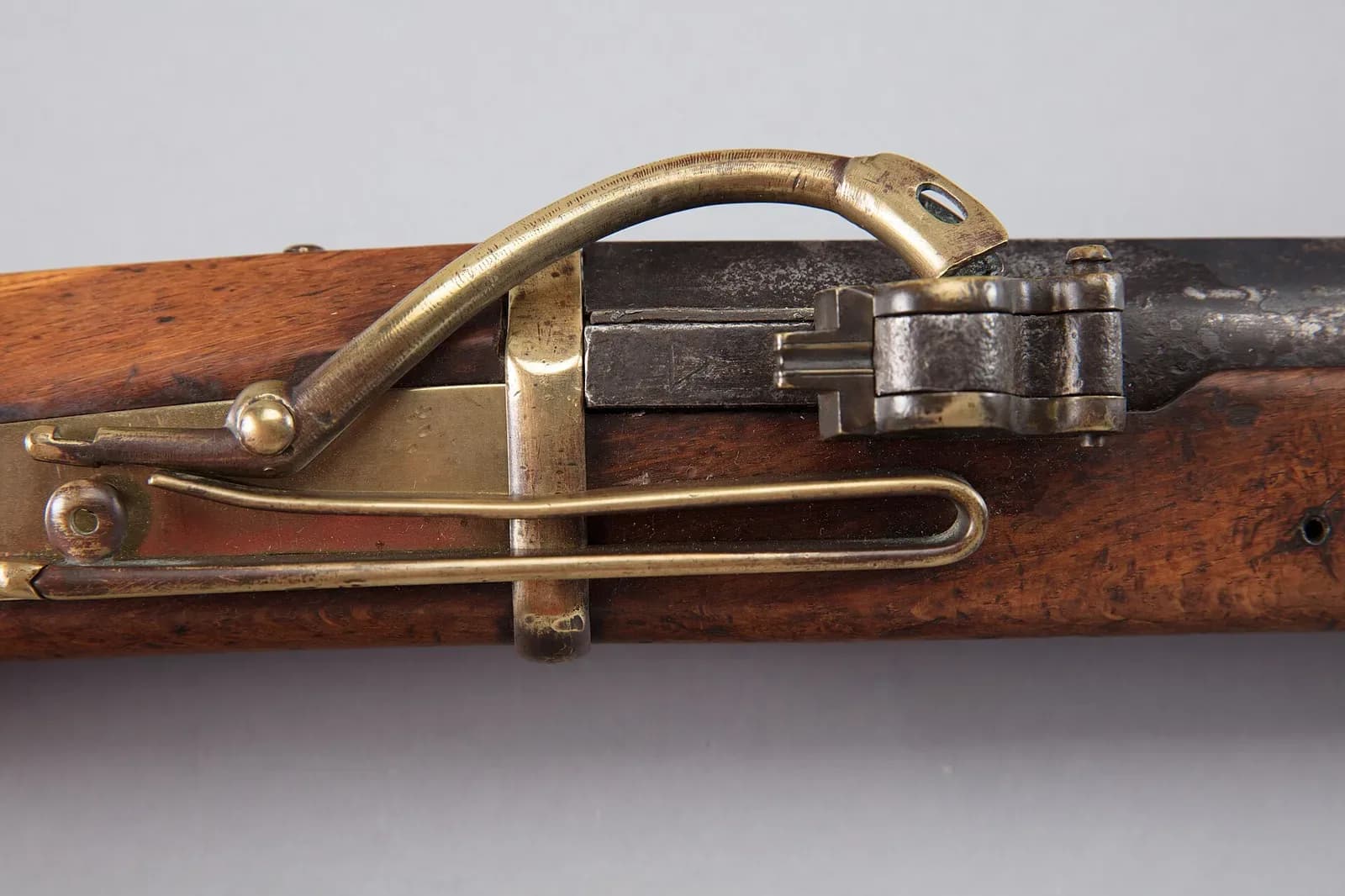
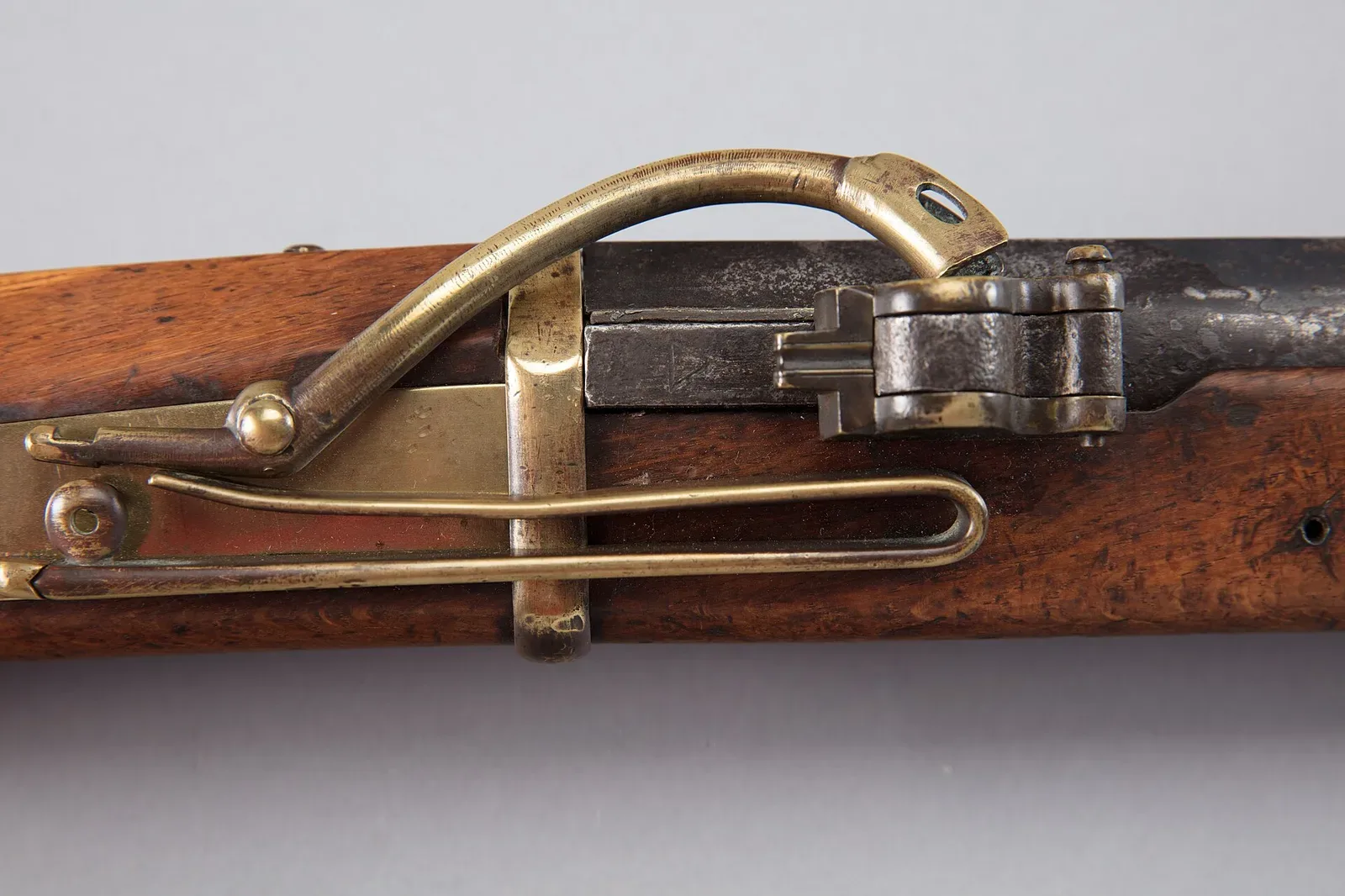
The arquebus emerged between the 15th and 16th centuries as the first meaningful step forward. It added a shoulder stock, a priming pan, and the matchlock mechanism — a hinged arm called a serpentine that held the burning cord and could be pivoted down onto the priming pan by pressing a lever, and later a proper trigger. This freed up both hands and gave the shooter a steadier platform. The arquebus was first used in the mid-1400s, according to the Revolutionary War Journal source, with the musket appearing roughly a century later.
Here is where the history gets interesting, and somewhat overlooked: per Trömner's research, from approximately 1410 to 1530, match cord was too thick to fit into the tiny serpentine jaws of early arquebuses. The cord during this period measured roughly 2 cm in diameter — far too large for the delicate early lock mechanisms. Artwork from Diebold Schilling's Berne Chronicle (1483) and tapestries depicting the Battle of Pavia (1525) show arquebusiers carrying the thick match cord wound around their arm or held in the hand, using it not to directly fire the weapon but to ignite a separate small piece of tinder fixed in the serpentine. Trömner argues these earliest mechanisms should technically be called "tinderlocks" rather than matchlocks.
By roughly the mid-16th century, match cord diameter had reduced to approximately 10–15 mm, and serpentines had been widened enough to grip the cord directly.
| Period | Technology | Match Cord Diameter | Ignition Method |
|---|---|---|---|
| 1326-1400 | Hand cannons | Unknown | Direct manual application |
| 1410-1530 | Early arquebuses | ~2 cm | Tinder ignition ("tinderlock") |
| 1530-1600 | Mature matchlock | 10-15 mm | Direct serpentine grip |
| 1600-1730 | Peak usage | 10-15 mm | Standardized drill procedures |
| 1730+ | Decline/specialty use | Variable | Artillery backup only |
Production Methods and Global Variations
The 16th-century Italian military treatise "Il Vallo" (1521), written by Gianbattista della Valle da Venafro, describes the production method of the period: boil the cord in lye, add saltpeter, then beat it on a stone with a wooden mallet and dry it in the shade. That three-step process — alkaline treatment, nitrate saturation, controlled drying — is the foundation of every formula that followed.
In Japan, according to the Wikipedia source, match cord took a different form entirely: braided strands of bark from the Japanese cypress rather than hemp or flax. The technology arrived later and left later — matchlock firearms remained in use in Japan until the early 1900s.
Three-century evolution from manual ignition to self-contained firing mechanisms
How It Worksedit
Chemical Composition
The chemistry behind slow match is straightforward. A porous vegetable fiber cord — hemp being historically preferred, though flax, cotton, and even manila have been used — absorbs a nitrate solution during soaking. Potassium nitrate (KNO₃) was the most widely used treatment, per both the Wikipedia and PyroGuide sources. It functions as an oxidizer: when the cord burns, the embedded nitrate supplies oxygen to sustain combustion even when atmospheric oxygen is limited, which is why the match can smolder in relatively still air and resist casual interruption.
| Chemical Treatment | Properties | Field Reliability |
|---|---|---|
| Potassium Nitrate (KNO₃) | Optimal oxidizer, stable | Excellent - preferred historically |
| Sodium Nitrate (NaNO₃) | Hygroscopic (absorbs moisture) | Poor - unreliable in field conditions |
| Lead Acetate | Effective but toxic | Not recommended - health hazards |
Sodium nitrate (NaNO₃) was also used historically but is hygroscopic — it absorbs moisture from the air — making it less reliable in field conditions. Lead acetate appears in some historical records as well, though the PyroGuide source notes it is not recommended due to significant toxicity problems in both production and handling.
The PyroGuide source documents that burn rate varies between 20 and 150 cm per hour depending on manufacture — a wide range that reflects how much variables like nitrate concentration, cord density, and drying method affect the final product. A higher concentration of nitrate speeds combustion; too high and the match "spits" rather than smoldering cleanly. The All4Shooters source, drawing on 16th-century reenactment expertise, notes the match must burn at a minimum of 270–300°C to reliably ignite black powder.
Production process and combustion chemistry of slow match
Battlefield Management
In practical battlefield use, a matchlock soldier typically kept both ends of the cord lit. The reason was functional:
- Flash from the priming pan could extinguish the firing end
- Glowing tip revealed position during night operations
- Rain or humidity could extinguish the match
- Powder could be dampened enough to prevent ignition
- Required continuous tending and couldn't be extinguished between engagements
A linstock — a forked wooden staff — was typically carried to hold the unused end of the cord clear of the ground, keeping it out of wet grass or mud. When the match was too far from the serpentine to be easily managed, the soldier wound the slack around his left arm or hand.
The match had to be continuously tended. It could not be extinguished between engagements if another shot might be needed. During the reload cycle, the match was removed from the serpentine to prevent accidental ignition of the fresh powder charge — a real hazard noted in multiple sources. At night, the glowing tip betrayed a soldier's position. In rain or high humidity, the match could be extinguished or the powder dampened enough to prevent ignition entirely.
Supply and Logistics
The Wapenhandelinghe, the famous 1607 drill manual by Jacob de Gheyn, depicts individual soldiers (musketeers and calivermen) carrying what was called their "man's portion" (Mannportion) of match cord — small bundles of approximately two to three meters laid in loops, per Trömner's research on surviving examples. Larger armory bundles measured roughly 35–40 meters of cord looped into packages about 80 cm long.
Slow match was produced by rural populations and purchased by armories measured by weight, often in quantities literally measured in tons.
Impact on Warfare & Societyedit
Tactical Revolution
Slow match enabled the matchlock musket, and the matchlock musket reshaped armies. The arquebus and then the musket displaced the crossbow and the pike as the primary infantry weapon across Europe. The key was not accuracy — matchlock muskets were notoriously inaccurate — but volume, simplicity, and the psychological and physical impact of the weapon.
The Revolutionary War Journal source records that the arquebus weighed approximately eleven pounds and fired a roughly .66 caliber ball held against the chest. The later musket was far larger — twenty pounds or more, fired from the shoulder on a forked rest, with a bore measured in gauge rather than caliber. Neither was a precision instrument.
| Weapon Type | Weight | Caliber/Gauge | Accuracy at 100 yards |
|---|---|---|---|
| Arquebus | ~11 lbs | .66 caliber | Not documented |
| Matchlock Musket | 20+ lbs | Measured in gauge | 53% hit rate |
| British Musket (1811) | Variable | Smoothbore | 53% (100yd), 30% (200yd), 23% (300yd) |
A British officer's 1811 test of a smoothbore musket showed it hit a target 53% of the time at 100 yards, 30% at 200 yards, and 23% at 300 yards. But massed infantry volley fire didn't require individual accuracy — it required that enough balls were in the air at once.
Limitations Shape Strategy
The matchlock's limitations shaped tactics as directly as its capabilities did. Because the match had to be kept burning, soldiers could not remain concealed indefinitely. Night operations were complicated by the glowing tip. Rain threatened the entire unit's ability to fire.
The Revolutionary War Journal source records Captain John Smith describing the matchlock's power over native populations in the New World — "the very smoke will be sufficient to afright them" — while also noting that the powder had to be carefully protected from moisture, matches extinguished in rain, and barrels fouled quickly. Smith himself suffered serious burns when his powder pouch accidentally ignited.
The logistical burden of slow match was substantial. The British Army's estimate of a mile of cord per soldier per year — cited in the Wikipedia source — means that supplying a regiment of several hundred men required a continuous supply chain for what was essentially treated rope. Armories maintained tons of the material. The surviving large bundles at Churburg and Coburg, and the Stockholm Armémuseum bundle documented by Trömner at 3.4 kg for an estimated 10 meters of cord, give a physical sense of what this supply looked like at scale.
The matchlock dominated because it was affordable, not because it was good.
Economic and Technological Transition
Despite the wheellock's development in the first quarter of the 16th century — a mechanism that eliminated the burning match entirely by using a spring-loaded steel wheel against iron pyrite — the matchlock persisted. The reason, as the All4Shooters source notes plainly, is that it was simple, effective, and cheap. The wheellock was twice the cost, mechanically complex, and required a small spanner wrench to wind the spring — lose the wrench, lose the weapon. Mass armies of the 16th and 17th centuries could not afford wheellock weapons for every infantryman. The matchlock could be built by any competent smith and repaired in the field.
The snaplock appeared after 1540 and had limited impact on match cord use — per the Wikipedia source, snaplocks were generally considered a peasant's weapon. The snaphance arrived in the 1560s, the true flintlock around 1610. Match cord remained the primary military ignition technology until roughly 1630, when the flintlock began its rise to prominence. Residual matchlock use in Europe continued until approximately 1730, when surviving drill instructions still referenced matchlock service procedures.
Even once the flintlock had displaced the matchlock for infantry use, slow match didn't disappear entirely. According to the Wikipedia source, the Royal Navy continued to deploy it as a backup ignition source for artillery through the end of the flintlock era. Artillery cannon required reliable ignition under conditions that could challenge a flintlock mechanism, and a linstock with burning match cord was a proven fallback that never mechanically failed.
Modern Relevanceedit
Slow match still exists, though the applications are narrow. Modern-day match cord used with replica matchlock firearms is sometimes made from cotton cord rather than hemp, per the Wikipedia source, due to legal complications around growing hemp plants in certain jurisdictions.
For fireworks and other pyrotechnic applications, slow match has largely been replaced by tubed black match (quick match) or punk, both of which offer faster and more controllable burn rates for modern use cases. The PyroGuide source notes that slow match can still serve as a reliable long-delay fuse, and that it can be made to burn without emitting sparks — a useful property in applications where a spark-free burn is needed.
The historical reenactment community maintains active knowledge of slow match production and use. Organizations like Italy's Compagnia delle Bande Nere, focused on 16th-century historical reenactment, document period production methods and continue to make and use slow match with replica matchlock muskets. The All4Shooters source provides a detailed breakdown of modern production methods drawn from both period treatises and contemporary experimentation, noting that soaking cord in a 4% potassium nitrate solution for half an hour — without boiling — produces reliable results with a burn rate suitable for reenactment use.
For collectors and arms historians, surviving original slow match is extraordinarily rare. Trömner's research identifies the major surviving collections at Churburg, Coburg, the Vienna Arsenal (Heeresgeschichtliches Museum Wien), and the Stockholm Armémuseum. A leather slow match pouch recovered from the intertidal zone at Medmerry, West Sussex was the subject of a Historic England conservation report (Research Report 60/2018) and is now held in the collection of the National Museum of the Royal Navy — a small artifact representing a technology that shaped three centuries of warfare.
The BGC Takeedit
Slow match doesn't get the attention it deserves in firearms history because it's not glamorous. It's rope. Treated rope. And yet the entire matchlock era — roughly three centuries of warfare, conquest, and the displacement of medieval combat — runs on that rope.
What I find genuinely interesting about slow match is how it illustrates the gap between "works" and "works well." By any objective measure, slow match was a terrible ignition system. It had to be kept burning at all times. Rain killed it. Night operations were compromised by a glowing tip you couldn't hide. The logistical tail — miles of cord per soldier per year — was absurd. And yet it dominated infantry weaponry for 200-plus years because the alternatives were either too expensive (wheellock), too unreliable (early flintlock variants), or simply nonexistent.
Field durability and cost of manufacture tend to beat theoretical elegance every time.
The wheellock was more reliable in bad weather. Nobody could afford to equip an army with it. The matchlock was finicky, dangerous, logistically burdensome, and thoroughly dominant for two centuries.
The other thing worth appreciating is the level of skill this technology demanded from the men who used it. A matchlock musketeer wasn't just a guy who pointed and pulled a trigger. He was managing a burning fuse, tending both ends, keeping it clear of his powder, adjusting its length in the serpentine, protecting it in rain, reloading a muzzle-loader under fire, and doing all of this under the stress of combat. The drill manuals of the period — de Gheyn's Wapenhandelinghe among them — ran to dozens of steps for a single firing sequence. Slow match was the most primitive piece of that system, and in some ways the most demanding to manage correctly.
It's easy to look at a matchlock and think "primitive." It's more accurate to look at one and think "that worked, under conditions nobody would voluntarily choose, for three hundred years."
Referencesedit
- https://en.wikipedia.org/wiki/Slow_match
- https://web.archive.org/web/20221007080435/https://pyrodata.com/PyroGuide/index.php%5Etitle=Slow_match.htm
- https://www.tastesofhistory.co.uk/post/about-history-guns-n-bullets
- https://www.all4shooters.com/en/shooting/culture/the-slow-match/
- http://www.vikingsword.com/vb/showthread.php?t=15668
- https://revolutionarywarjournal.com/matchlocks-flintlocks-firelocks-that-tamed-a-new-world-claimed-an-american-revolution/
Last Updated: February 27, 2026
- Gls Guns(Sumner, IA)
- Bi-mart - Yakima (Fruitvale Ave)(Yakima, WA)
- New Philly Sportsman Specialities(New Philadelphia, OH)
- R&R Sports & Outdoors(Brandon, FL)
Loading comments...