Details
Mikhail Timofeyevich Kalashnikov

Kalashnikov (right) with Eugene Stoner, designer of the AR-15 — the only documented meeting between history's two most influential rifle designers.
| Biography | |
|---|---|
| Born | November 10, 1919, Kurya, Altai Krai, Russia |
| Died | December 23, 2013, Izhevsk, Russia |
| Nationality | Soviet and Russian |
| Legacy | |
| Known For | Designer of the AK-47 assault rifle and approximately 150 models of small arms |
| Key Innovation | The AK-47 (Avtomat Kalashnikova model 1947), a gas-operated selective-fire rifle chambered in 7.62×39mm that combined simplicity, durability, and reliability for mass production and field use |
Mikhail Kalashnikov: Designer of the AK-47
Firearms encyclopedia article
From The Boise Gun Club Handbook
Overviewedit
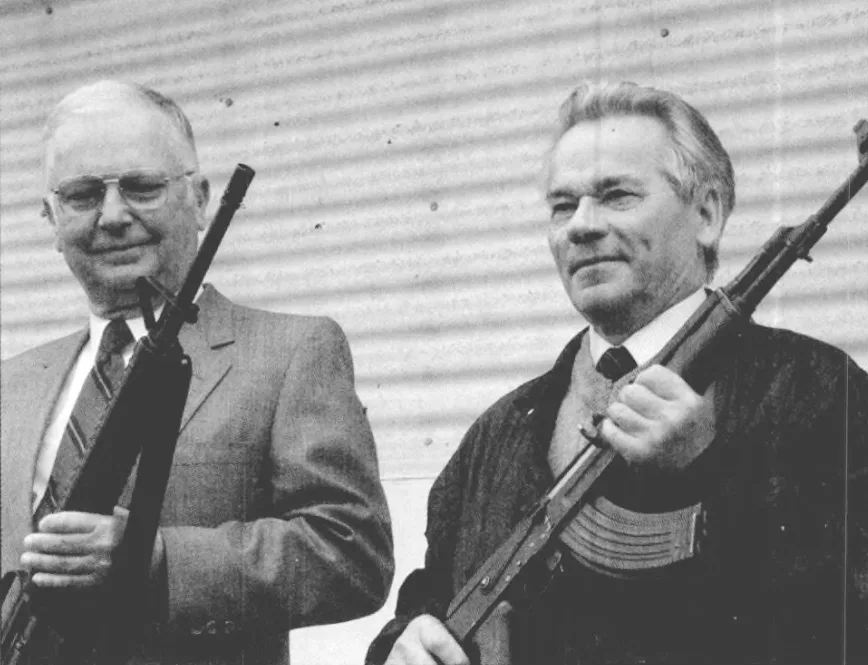
Mikhail Timofeyevich Kalashnikov (November 10, 1919 – December 23, 2013) was a Soviet and Russian lieutenant general, military engineer, and small arms designer. He is responsible for one of the most consequential engineering decisions in the history of warfare: the AK-47, formally the Avtomat Kalashnikova model 1947.
| Specification | Details |
|---|---|
| Full Name | Mikhail Timofeyevich Kalashnikov |
| Birth | November 10, 1919, Kurya, Altai Krai |
| Death | December 23, 2013, Izhevsk (age 94) |
| Military Rank | Lieutenant General |
| Primary Achievement | AK-47 assault rifle |
| Production Scale | ~100 million units by 2009 |
| Global Reach | Used on every inhabited continent |
According to Wikipedia, the scale of production is staggering:
- Approximately 100 million AK-47s produced by 2009
- Roughly half were counterfeit copies
- Most widely distributed assault rifle in history
- Depicted on four national flags or coats of arms
- Used on every inhabited continent
It has been used by armies, guerrilla movements, terrorists, and hunters on every inhabited continent.
Kalashnikov described himself as a self-taught tinkerer who combined innate mechanical aptitude with close observation of what soldiers actually needed in the field.
That combination produced a weapon so simple and so durable that it outran every institutional attempt to contain or control it. He lived long enough to watch his creation become the defining symbol of 20th-century armed conflict — and to spend his final months questioning whether that was something he could answer for.
Early Life & Backgroundedit
Peasant Origins and Deportation
Kalashnikov was born in the village of Kurya, in what is now Altai Krai, Russia, as the seventeenth of nineteen children. His parents, Timofey and Aleksandra Kalashnikov, were peasants. In 1930, the Soviet state labeled the family kulaks — a designation that meant their property was confiscated and most of the family was deported to the village of Nizhnyaya Mokhovaya in Tomsk Oblast. The father died the same year as the deportation.
The exile had one unintended consequence that shaped everything that followed. Forced to supplement farming with hunting, the family relied on firearms for food, and the young Mikhail began using his father's rifle regularly in his teens.
He continued hunting until just before his death at 94. That early, practical relationship with firearms — learning them as tools with a specific job to do, not as objects of abstraction — never left him.
As a youth, Kalashnikov nearly died from illness at age six. He was drawn to machinery of all kinds but also wrote poetry and dreamed of a literary career. He eventually wrote six books and composed poetry throughout his life. After finishing seventh grade, he hiked nearly 1,000 kilometers back to Kurya from the exile settlement with his stepfather's permission, found work as a mechanic at a tractor station, and caught the attention of a Communist Party organizer embedded in the factory. That organizer redirected him to a nearby weapons design bureau, where he worked as a tester of fitted rifle stocks — his first formal contact with the weapons industry.
Military Service and Innovation
In 1938, Kalashnikov was conscripted into the Red Army. His mechanical aptitude got him assigned as a tank mechanic, and he eventually rose to tank commander. Even during training, he was inventing:
- Inertial counter for tank gun shots fired
- Running-time meter for tank engines
- Received wrist watch from Georgy Zhukov for innovations
He served on T-34s of the 24th Tank Regiment, 12th Tank Division, stationed in Stryi. The regiment retreated after the Battle of Brody in June 1941. In October 1941, Kalashnikov was seriously wounded at the Battle of Bryansk — pulled from a burning tank by his comrades, according to the Widener's account — and spent months hospitalized, not returning to active duty until April 1942.
Key Contributionsedit
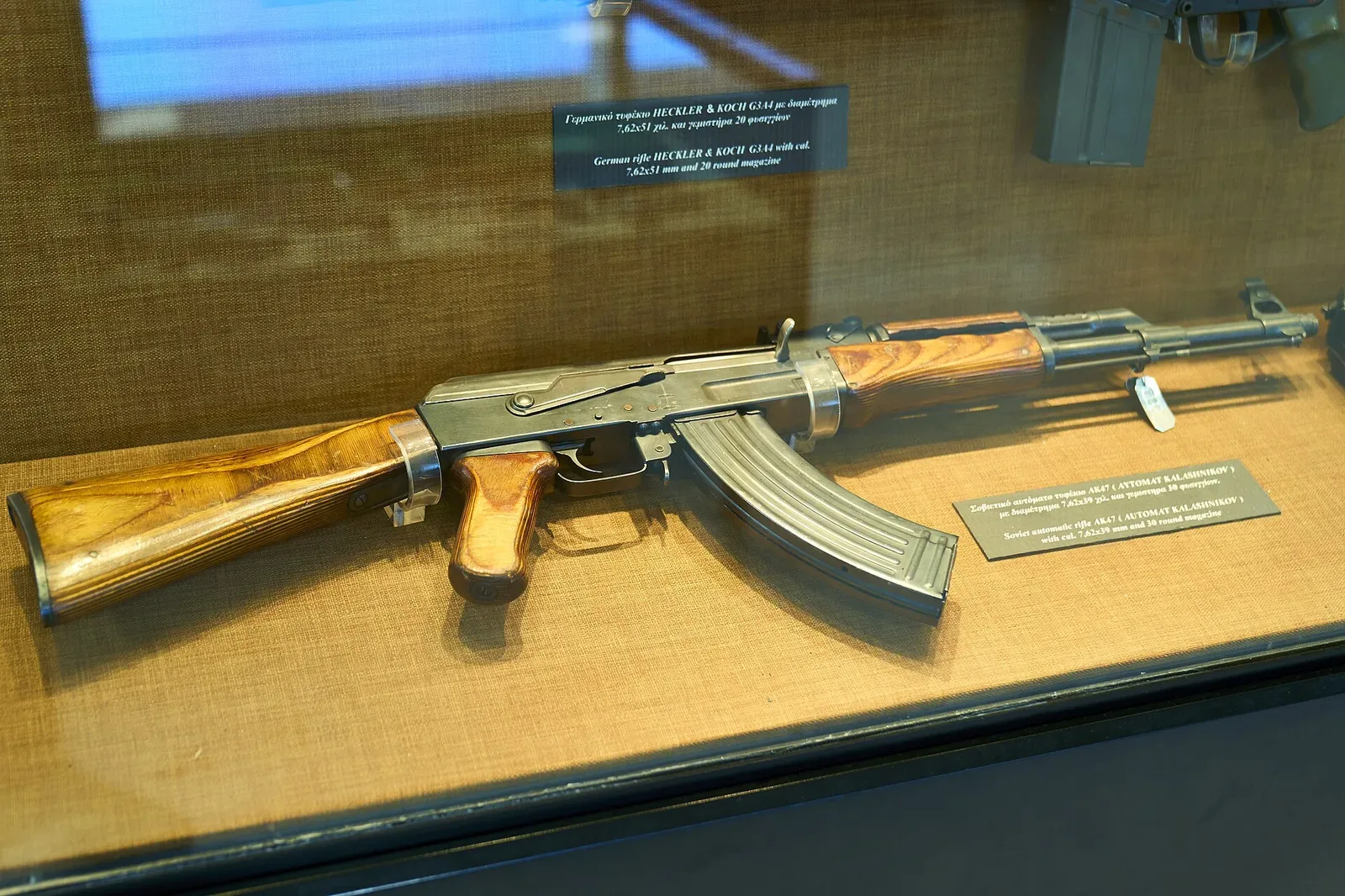
Hospital Inspiration
The hospitalization that nearly killed him became the incubator for everything that followed. Lying in recovery, Kalashnikov overheard soldiers in adjacent beds complaining about their rifles — weapons that jammed, that failed in the mud and cold of the Eastern Front, that couldn't match the firepower of German infantry.
Why did Soviet soldiers sometimes share a single rifle between two or three men while Germans carried automatics?
He began sketching. By the time he was discharged, he had the outline of a design philosophy:
- Simple enough for cheap mass production
- Rugged enough to function in any environment
- Reliable enough for minimal training requirements
Early Designs and Competition
His first design, a submachine gun built during his convalescence in 1942, was not accepted for service. But it got him noticed. From 1942 onward, he was assigned to the Central Scientific-developmental Firing Range for Rifle Firearms of the Chief Artillery Directorate of the Red Army — a formal posting that gave him access to resources and positioned him inside the Soviet military's design apparatus.
In 1944, he designed a gas-operated carbine chambered for the new 7.62×39mm cartridge. The design was influenced by the M1 Garand and lost the competition to the Simonov carbine, which was eventually adopted as the SKS. That defeat wasn't wasted.
The 1944 carbine became the direct mechanical foundation for his competition entry in 1946, which he submitted under the alias "Mikhtim" — derived from the first syllables of his given name and patronymic.
His winning entry from that competition was refined into the AK-47, finalized in 1947. According to Wikipedia, he competed against two far more experienced designers — Vasily Degtyaryov and Georgy Shpagin — both of whom ultimately acknowledged the superiority of his design. Kalashnikov credited Alexandr Zaitsev and Vladimir Deikin as his primary collaborators during those years.
In March 1948, Kalashnikov was sent to Izhevsk to oversee the production of the first experimental batch. Per the IMDB biographical notes, 1,500 rifles were manufactured at the Motozavod plant, passed military tests, and the AK-47 was formally adopted as the standard-issue rifle of the Soviet Army in September 1949.
The design's core strengths were straightforward: the gas-operated action cycled reliably across a wider range of fouling and temperature conditions than competing designs; the parts tolerances were intentionally loose enough that dirt and debris didn't seize the action; and the whole assembly could be fieldstripped and reassembled by a soldier with minimal instruction. It was not, by most accounts, the most accurate rifle of its era. It was the most forgiving.
The AK Family of Weapons
Kalashnikov didn't stop at the AK-47. Over the following decades, he evolved the platform into a family of weapons:
| Weapon System | Year | Key Features | Purpose |
|---|---|---|---|
| AK-47 | 1947 | Milled steel receiver, 7.62×39mm | Standard assault rifle |
| AKM | 1959 | Stamped steel receiver, lighter | Cost-reduced variant |
| RPK | 1960s | Heavy barrel, bipod | Squad automatic weapon |
| PK | 1960s | Belt-fed, 7.62×54mmR | General-purpose machine gun |
| AK-74 | 1974 | 5.45×39mm cartridge | Modern assault rifle |
The AKM (Avtomat Kalashnikova Modernizirovannyy), brought into service in 1959, used a stamped steel receiver instead of the AK-47's milled steel receiver, making it lighter and significantly cheaper to manufacture. It also incorporated a reshaped stock and a muzzle compensator.
The RPK (Ruchnoy Pulemyot Kalashnikova), a squad automatic weapon variant developed from the AKM.
The PK machine gun (Pulemyot Kalashnikova), a general-purpose belt-fed machine gun chambered in 7.62×54mmR — the old Mosin–Nagant cartridge — designed for sustained fire from a tripod or bipod.
The AK-74, chambered in the smaller 5.45×39mm cartridge, which became the Soviet Army's standard rifle in the late Cold War period.
During his career, he designed approximately 150 models of small arms in total, according to Wikipedia and the crime fiction blog account of journalist BJ Wolf's meeting with him.
By the time his career wound down, Kalashnikov held a Doctor of Technical Sciences degree (awarded 1971) and was a member of 16 academies.
Impact on Firearms Developmentedit
Revolutionary Design Philosophy
The AK-47's place in the history of small arms is difficult to overstate without sliding into cliché, so it's worth being specific about what it actually changed.
Before the AK-47, the tension in military rifle design was between power and volume of fire. Bolt-action rifles were accurate and reliable but slow. Submachine guns fired pistol-caliber ammunition fast but lacked range and terminal effect at combat distances. The German Sturmgewehr 44 — which Kalashnikov studied and which influenced the design environment he was working in — demonstrated that an intermediate-caliber, selective-fire weapon could split the difference. The AK-47 was the Soviet answer to that same problem, and it arrived at a solution that proved more durable than any of its contemporaries.
Manufacturing Innovation
The AKM's introduction of the stamped-receiver construction influenced how military rifles were manufactured globally. Stamping was faster and cheaper than milling, and the cost reduction is part of why the AK platform spread so far, so fast.
| Design Philosophy | Pre-AK Era | AK-47 Innovation |
|---|---|---|
| Manufacturing | Expensive milled receivers | Cheap stamped construction |
| Reliability | Tight tolerances | Loose tolerances for dirt/debris |
| Training | Extensive maintenance required | Minimal instruction needed |
| Production | Limited factory output | Mass production capability |
| Patents | Restricted licensing | No patent protection (1947-1997) |
According to Wikipedia, Izhmash — the official Russian manufacturer — did not patent the weapon until 1997, meaning that for nearly five decades, any nation or factory with the tooling could produce copies without legal consequence. By 2006, Izhmash accounted for only 10% of global AK production.
Geopolitical Consequences
The platform's proliferation reshaped geopolitics as much as it reshaped infantry tactics. The Soviet Union exported Kalashnikov's rifles in enormous quantities during the Cold War, arming proxy forces from Southeast Asia to sub-Saharan Africa.
The AK-47 functioned less as a specific firearm than as a global symbol — of revolution, of insurgency, of the Cold War's distributed violence.
Four countries — East Timor, Mozambique, Zimbabwe, and Burkina Faso — incorporated the AK into their national flags or coats of arms, according to the Widener's account. The rifle became standard infantry equipment for 106 countries.
By the time of his death, Kalashnikov's weapon had become so ubiquitous that it functioned less as a specific firearm than as a global symbol — of revolution, of insurgency, of the Cold War's distributed violence. That ubiquity came directly from design decisions made in a hospital ward between 1941 and 1942: keep it simple, keep it cheap, make it work when nothing else does.
It's also worth noting what the AK-47 forced in response. The U.S. military's eventual adoption of the M16 and its 5.56×45mm cartridge was partly a reaction to the AK's influence on battlefield doctrine. The debates about stopping power, reliability, and cartridge selection that still run through the American shooting community today have roots in the Cold War confrontation between these two design philosophies.
Later Life & Legacyedit
Soviet Recognition and Rewards
From 1949 onward, Kalashnikov lived and worked in Izhevsk, the capital of Udmurtia, which remained his home for the rest of his life. The Soviet state rewarded him with honors across his career:
| Award | Year | Significance |
|---|---|---|
| Stalin Prize | 1949 | Recognition for AK-47 |
| Order of the Red Star | 1949 | Military achievement |
| Hero of Socialist Labour | 1958, 1976 | Highest civilian honor (twice) |
| Lenin Prize | 1964 | Scientific/technical achievement |
| Order of Lenin | Multiple | Awarded three times |
| Hero of Russian Federation | 2009 | Post-Soviet recognition |
What the state did not provide was royalties. Patents in the Soviet Union belonged to the state, meaning Kalashnikov received no financial compensation from the production of a weapon manufactured by the hundreds of millions.
Post-Soviet Commercialization
In the post-Soviet era, his family attempted to capitalize on the name through licensing. His grandson Igor ran a German company, Marken Marketing International, that produced merchandise under the Kalashnikov brand — including vodka, umbrellas, and knives. The title to the AK-47 trademark belonged to Kalashnikov's family until April 4, 2016, when the Kalashnikov Concern won a lawsuit to invalidate the family's trademark registration.
On his 90th birthday in 2009, President Dmitry Medvedev named him a Hero of the Russian Federation and praised him for creating "the brand every Russian is proud of." In 2012, Izhevsk State Technical University was renamed in his honor. On September 19, 2017 — nearly four years after his death — a nine-meter monument was unveiled in Moscow's Garden Ring. An activist who attempted to display a sign reading "a creator of weapons is a creator of death" at the unveiling was arrested.
Final Reckoning
The recognition was real, but so was the internal conflict. For most of his public life, Kalashnikov deflected moral responsibility with a consistent line: the weapon was designed for defense of the Motherland; the fault for its misuse lay with politicians and criminals, not designers. "I sleep well," he told reporters. "It's the politicians who are to blame for failing to come to an agreement and resorting to violence."
That position held until very near the end. Hospitalized in November 2013, Kalashnikov died on December 23, 2013, of a gastric hemorrhage, at age 94. He was buried at the Federal Military Memorial Cemetery.
In January 2014, the Russian newspaper Izvestia published a letter Kalashnikov had written six months before his death to Patriarch Kirill of the Russian Orthodox Church. In it, he described "spiritual pain" and a question he could not resolve:
If my rifle claimed people's lives, then can it be that I — a Christian and an Orthodox believer — was to blame for their deaths?
The patriarch responded that the Church "has a well-defined position when the weapon is defense of the Motherland" and absolved the designer.
Whether that absolution settled anything is a question Kalashnikov took with him. His son Victor (1942–2018) also became a prominent small arms designer. The companies Izhmash and Izhevsk Mechanical Plant were merged and formally renamed the Kalashnikov Concern in 2013, the same year Mikhail died.
The BGC Takeedit
The thing about Kalashnikov that gets lost in the political arguments is how straightforward his actual engineering insight was. He didn't invent the intermediate cartridge, he didn't invent the gas-operated action, and he wasn't even the first to the intermediate-caliber selective-fire rifle — the Germans beat him to that concept with the Sturmgewehr 44. What he did was synthesize those existing ideas into something a poorly trained conscript could run in Siberian mud without a gunsmith nearby. That's not a small achievement. That's the whole ballgame in military small arms design.
The irony that he never made a meaningful dime off it is worth sitting with. In a market economy, the man who designed the most-produced firearm in human history would have died extraordinarily wealthy. Instead he licensed his name to vodka and umbrellas to get by. The Soviet system that funded his work also swallowed every cent of its commercial value.
The deathbed letter is the part that stays with me. He spent decades giving the "I sleep fine" answer, and maybe he believed it. But at 93, lying in a hospital in Izhevsk — the same city where he'd watched the first 1,500 rifles roll off the line in 1948 — he apparently stopped believing it. That doesn't make him a villain. It makes him a man who lived long enough to fully reckon with what he'd made. Most of us don't have to do that. He did.
The historical verdict is messier than either side of the debate wants it to be. The AK-47 genuinely helped the Soviet Union field an effective infantry rifle when they needed one. It also ended up in the hands of every proxy war, terror organization, and civil conflict of the second half of the 20th century, and that happened specifically because Izhmash didn't patent it for fifty years and the Soviet state exported it without restriction. The design itself isn't the whole story. The decisions around the design — who got it, at what cost, with what controls — that's where the body count actually comes from.
Kalashnikov knew that. He just took a long time to say it out loud.
Referencesedit
- https://en.wikipedia.org/wiki/Mikhail_Kalashnikov
- https://www.imdb.com/name/nm6173934/bio/
- https://www.wideners.com/blog/mikhail-kalashnikov/
- https://crimefictionbook.com/2015/08/11/ak-47-inventor-kalashnikov/
- https://vocal.media/journal/a-killing-machine
- https://ethw.org/Mikhail_Kalashnikov
Last Updated: February 27, 2026
- Gls Guns(Sumner, IA)
- Bi-mart - Yakima (Fruitvale Ave)(Yakima, WA)
- New Philly Sportsman Specialities(New Philadelphia, OH)
- R&R Sports & Outdoors(Brandon, FL)
Loading comments...