State Details
Arizona
Overview | |
|---|---|
State | Arizona (AZ) |
Capital | Phoenix |
Statehood | 1912 |
Population | 7,431,344 |
Gun Ownership | 46.3% |
Active FFLs | 1,951 |
Carry Laws | |
Constitutional Carry | Yes (2010) |
Open Carry | Yes |
CCW Permit Available | Yes |
Permit Reciprocity | 37+ states |
Self-Defense | |
Castle Doctrine | Yes |
Stand Your Ground | Yes |
Duty to Retreat | No |
Regulations | |
State Preemption | Yes |
Red Flag / ERPO | No |
Waiting Period | None |
Universal BGC | No |
NFA Items | Yes |
Assault Weapons Ban | No |
Magazine Limit | None |
Firearms Freedom Act | Yes |
Key Legislation | |
| |
Notable Manufacturers | |
| |
Arizona Firearms History: From Territorial Law to Constitutional Carry
Reference article
From The Boise Gun Club Handbook
Overviewedit
Arizona sits at a crossroads of American firearms history that doesn't fit neatly into either the "Wild West mythology" or the modern gun-rights narrative — it's more complicated and more interesting than either.
The same territory that gave us Tombstone's carry ordinances, which were stricter than anything on Arizona's books today, eventually became one of the first states to pass constitutional carry legislation in the modern era.
That arc — from frontier gun control enforced at gunpoint to a state where you can carry concealed without a permit — runs through 150 years of Apache conflicts, border wars, silver booms, military installations, and some of the most contentious gun debates in recent American history.
Arizona entered the Union as the 48th state on February 14, 1912, the last of the contiguous states. But its firearms story starts long before statehood, in the contested ground between Spanish colonial territory, Mexican jurisdiction, Apache sovereignty, and American expansion. Understanding Arizona's gun culture today requires knowing that history — not as romanticized backdrop, but as the actual sequence of events that shaped how Arizonans think about weapons, self-reliance, and the government's role in regulating either.
Territorial Era: Spanish, Mexican, and Early American Firearmsedit
Spanish and Mexican Period (1700s–1848)
Before Americans arrived in force, the region that would become Arizona was Tohono O'odham, Navajo, Hopi, and Apache country, interrupted by a thin layer of Spanish colonial presence concentrated along the Santa Cruz River valley. Spanish missionaries and soldiers brought flintlock muskets and escopetas into the region beginning in the late 1600s, establishing presidios like Tubac (1752) and Tucson (1775) specifically to defend against Apache raids. These weren't symbolic garrisons — the Apache were effective, aggressive fighters who understood terrain and mobility in ways the Spanish presidio system never fully countered.
When Mexico assumed control after independence in 1821, the firearms situation didn't improve. Mexican federal authority over the region was thin, the presidios were chronically underfunded, and Apache raiding expanded rather than contracted through the 1820s and 1830s. The practical effect was that civilian settlers in what is now southern Arizona had to be armed and competent with those arms as a basic condition of survival — not as ideology, but as fact.
| Year | Event | Firearms Impact |
|---|---|---|
| 1752 | Presidio of Tubac established | Spanish flintlock muskets introduced |
| 1775 | Presidio of Tucson founded | Defensive firearms concentration |
| 1848 | Treaty of Guadalupe Hidalgo | U.S. military firearms (Model 1841 rifles) |
| 1853 | Gadsden Purchase | Expanded American jurisdiction |
| 1857 | Butterfield Overland Mail | Sharps carbines for stage protection |
| 1861 | Bascom Affair | Triggers decade of Apache warfare |
Early American Control and the Civil War
The Treaty of Guadalupe Hidalgo in 1848 transferred most of what is now Arizona to the United States following the Mexican-American War, and the Gadsden Purchase of 1853 added the southern strip including Tucson and the future site of Tombstone. American military presence arrived in the form of dragoons and infantry equipped with Model 1841 rifles and Colt revolvers, beginning the long U.S. Army campaign that would define the region's next four decades.
The Butterfield Overland Mail route, which ran through southern Arizona beginning in 1857, brought civilian traffic — and civilian firearms — through Apache Pass and across the desert. Stage drivers and passengers were expected to be armed. The company issued Sharps carbines to drivers and shotgun messengers as standard equipment. This wasn't a policy choice reflecting political philosophy; it was a logistics solution to a real threat.
The Bascom Affair of 1861, in which Lieutenant George Bascom wrongly accused Cochise of raiding and the resulting confrontation killed men on both sides, set off a decade of intensified Apache warfare that made armed travel through the territory a practical requirement rather than a cultural affinity.
When the Civil War pulled most U.S. Army units east in 1861, Arizona was left largely undefended by federal forces. The Confederate Territory of Arizona was briefly proclaimed, and Confederate forces under Lieutenant Colonel John Baylor occupied Tucson in 1862. The Battle of Picacho Peak on April 15, 1862 — fought between Confederate pickets and a Union cavalry patrol from the California Column under Captain William McCleave — is often cited as the westernmost land engagement of the Civil War on Arizona soil. The California Column eventually swept Confederate forces from the territory, but the episode left a population that had learned not to count on distant governments for protection.
19th Century: Silver, Cowboys, and the Gun Laws Nobody Remembersedit
The Apache Wars and Military Presence
Post-Civil War Arizona Territory was shaped by two overlapping forces: the ongoing Apache wars and the silver and copper mining boom that drew tens of thousands of people into previously empty desert. Both forces meant firearms were everywhere and the question was never whether people were armed but how armed presence would be managed in growing towns.
Fort Huachuca, established in March 1877 in the Huachuca Mountains near the Mexican border, became the operational center for the final campaigns against Geronimo and the Chiricahua Apache. The Buffalo Soldiers of the 10th Cavalry Regiment were stationed there beginning in 1877, and their role in pursuing Geronimo across the Sonoran Desert is one of the least-told chapters in Arizona's military history. The fort issued Springfield Model 1873 trapdoor carbines and later Krag-Jørgensen rifles to its troopers. Geronimo's final surrender to General Nelson Miles at Skeleton Canyon on September 4, 1886 ended the Apache Wars and removed the primary military justification for the territory's ubiquitous armed state — though ranching and border concerns filled the gap quickly enough.
Tombstone and the O.K. Corral
The silver strike at Tombstone in 1877 by Ed Schieffelin created the boomtown context for the event that would define Arizona's firearms mythology for the next century. By 1881, Tombstone had grown from nothing to over 7,000 people, with saloons, newspapers, a church, an opera house — and a municipal gun ordinance that most people who invoke Tombstone's name have never read.
Tombstone Ordinance No. 9, passed in 1880, prohibited the carrying of deadly weapons within the town limits. Visitors were required to check firearms at a hotel or with a law officer upon entering town, receiving a token in exchange — essentially a coat check for your revolver. The ordinance applied to both concealed and open carry. City Marshal Virgil Earp and his brothers were, in the simplest terms, the enforcement mechanism for a gun control law when they walked toward the vacant lot near the O.K. Corral on October 26, 1881.
The confrontation that followed — lasting roughly 30 seconds, firing approximately 30 shots at a distance of about six feet — killed Billy Clanton, Tom McLaury, and Frank McLaury. The Earps and Doc Holliday were arrested on murder charges, tried before Judge Wells Spicer, and eventually acquitted in December 1881. The legal aftermath was almost as violent as the gunfight itself: Morgan Earp was assassinated in March 1882, Virgil Earp was ambushed and permanently maimed, and Wyatt Earp's subsequent Vendetta Ride through Cochise County left several more men dead.
What the O.K. Corral story actually illustrates is more nuanced than either gun-rights advocates or gun-control advocates typically acknowledge.
UCLA law professor Adam Winkler, in his book Gunfight, notes that Tombstone's ordinance was stricter than anything currently on Arizona's books — you cannot be required to disarm upon entering a town in Arizona today. But historian Joyce Lee Malcolm and the California Rifle and Pistol Association have pushed back on the "Old West gun control" narrative, arguing that enforcement of Tombstone's ordinance was selective and politically motivated, tied as much to the Earps' economic and political rivalries with the Cowboy faction as to public safety.
Both observations are correct and not mutually exclusive. The ordinance existed and was enforced — selectively. The gunfight happened because of a gun law — and also because of money, power, cattle rustling, and personal grudges. The lesson for Arizona firearms history isn't that the Old West was either a gun-control paradise or a libertarian utopia. It was a contested space where armed men negotiated the terms of civic order in real time, with lethal consequences.
Range Wars and Territorial Law Enforcement
Elsewhere in the territory, the Pleasant Valley War of 1886–1892 between the Graham and Tewksbury families in Tonto Basin is estimated to have killed between 20 and 50 men over a sheep-versus-cattle dispute that escalated into an ongoing family feud. It produced no famous lawmen, no Hollywood films, and no memorable quotations — just dead bodies and the practical demonstration that absent effective law enforcement, firearms disputes resolved themselves through attrition.
The Arizona Rangers were established by the territorial legislature in 1901 to address exactly that kind of lawlessness, particularly along the border. Modeled loosely on the Texas Rangers, the force never exceeded 26 men but operated with Winchester Model 1895 rifles and Colt Single Action Army revolvers, pursuing cattle rustlers, smugglers, and violent criminals across southern Arizona until the force was disbanded in 1909. Their legacy feeds directly into Arizona's persistent cultural identification with the armed citizen-lawman archetype.
20th Century: Wars, the National Guard, and the Regulatory Turnedit
Statehood and Constitutional Framework
Arizona achieved statehood on February 14, 1912, and its first state constitution included a right to bear arms provision in Article II, Section 26: "The right of the individual citizen to bear arms in defense of himself or the State shall not be impaired, but nothing in this section shall be construed as authorizing individuals to carry concealed weapons." That final clause — explicitly allowing regulation of concealed carry — was in the original text, reflecting a territorial-era consensus that open carry was essentially unrestricted while concealed carry was a different matter.
World War II Military Expansion
World War I drew Arizona National Guard units into federal service, and Camp Funston in Kansas received significant numbers of Arizona draftees. The 158th Infantry Regiment, recruited largely from Arizona, trained with Springfield Model 1903 rifles before shipping to France. The regiment would later distinguish itself in the Pacific theater during World War II.
The interwar period saw Fort Huachuca nearly shuttered as army downsizing eliminated most frontier posts, but the installation survived and would prove critical. When the United States entered World War II, Fort Huachuca was reactivated as the training center for the 92nd Infantry Division — the Buffalo Soldiers of the modern era — and the 93rd Infantry Division. At its wartime peak, Fort Huachuca held over 30,000 troops. The Women's Army Corps also trained there. The fort's role as the primary training installation for Black soldiers during the war, in a segregated Army, is a significant and underexamined piece of Arizona military history.
Davis-Monthan Air Force Base in Tucson, established as a municipal airport in 1919 and transferred to Army Air Corps control in 1927, became one of the most important aviation installations in the country during World War II. After the war, it became the home of Strategic Air Command bomber units and today hosts the 309th Aerospace Maintenance and Regeneration Group — the aircraft boneyard — as well as active flying units. The base has been a continuous economic and cultural presence in Tucson for nearly a century.
Luke Air Force Base, established in 1941 northwest of Phoenix and named for Frank Luke — the Arizona-born World War I ace who was the first aviator to receive the Medal of Honor — has trained more fighter pilots than any other installation in the world. The base's presence shaped the culture of the West Valley suburbs and remains one of the largest employers in the Phoenix metropolitan area.
Postwar Growth and Political Development
On the civilian side, Arizona's postwar population boom brought a new demographic to the state: retirees and migrants from other states who brought varied firearms attitudes with them. Phoenix grew from roughly 65,000 people in 1940 to over 400,000 by 1960, pulling in populations from across the country. The National Rifle Association established significant membership in the state during this period, and Arizona consistently sent pro-gun voices to Congress.
Barry Goldwater — Phoenix native, U.S. Senator from 1953 to 1987 (with a gap for his 1964 presidential run), and one of the founding intellectual fathers of the modern conservative movement — was an avid shooter and firearms collector. His personal collection included historic Colt revolvers and custom rifles. Goldwater's 1964 presidential campaign, built around individual liberty and skepticism of federal power, helped establish the political framework in which gun rights became a central conservative issue nationally. His influence on Arizona's political culture cannot be overstated; he essentially defined the state's dominant political identity for a generation.
The Federal Firearms Act of 1938 and then the Gun Control Act of 1968 — passed following the assassinations of Robert Kennedy and Martin Luther King Jr. — imposed federal licensing requirements on dealers and prohibited certain categories of persons from purchasing firearms. Arizona complied with federal law but did not layer additional state restrictions on top, a pattern that would continue and accelerate in subsequent decades.
Modern Era (2000–Present)edit
Constitutional Carry Achievement
The modern chapter of Arizona firearms history is defined by a consistent legislative push toward expansion of gun rights, punctuated by one of the most traumatic mass shooting events in recent American history.
In 2010, Governor Jan Brewer signed Senate Bill 1108, making Arizona the third state in the nation — after Alaska (2003) and Vermont (which never required permits in the first place) — to allow concealed carry without a permit for residents 21 and older who are legally allowed to possess firearms. The law eliminated the requirement for a concealed carry permit (CCW) while preserving the voluntary permit system for those who wanted reciprocity in other states. Open carry had been legal without a permit in Arizona since statehood. The 2010 law effectively unified those standards: if you can legally own a firearm in Arizona, you can carry it.
Key milestones in Arizona's path to constitutional carry and aftermath
The Giffords Shooting and National Response
Less than a year later, on January 8, 2011, a gunman opened fire at a Safeway parking lot in Tucson during a constituent meeting hosted by Representative Gabrielle Giffords.
Jared Lee Loughner killed six people, including Chief U.S. District Court Judge John Roll, and wounded 13 others, including Giffords, who sustained a severe traumatic brain injury. The shooting prompted immediate national calls for stricter gun laws, particularly around high-capacity magazines — Loughner used a Glock 19 with a 33-round extended magazine.
Arizona's legislative response was essentially nothing. The state legislature passed no new firearms restrictions in the wake of the shooting. Gabrielle Giffords and her husband, Mark Kelly — a former Navy combat aviator and NASA astronaut — founded Americans for Responsible Solutions (later renamed Giffords) in 2013, which became one of the most prominent gun-control advocacy organizations in the country. The irony of one of the most high-profile gun-violence survivors in American history coming from the state with some of the least restrictive gun laws in the country was not lost on anyone.
In 2013, Kelly attempted to purchase an AR-15 at a Tucson gun store — Diamondback Police Supply — as a demonstration of what he characterized as inadequate background check processes. The dealer, recognizing Kelly, declined the sale. The episode became a flashpoint in the national debate over universal background checks.
Legislative Responses and Federal Relations
Arizona has maintained and expanded preemption law — the principle that state law supersedes local ordinances on firearms — since 1969, with significant strengthening in 2000 under A.R.S. § 13-3108. The 2000 revision added teeth by allowing individuals to sue municipalities that passed ordinances stricter than state law and recover attorney's fees. Cities including Tucson and Tempe have periodically attempted to pass local restrictions, and the preemption statute has consistently overridden those efforts. In 2016, Tucson passed a resolution directing police to destroy confiscated firearms rather than sell them — a practice the state later moved to prohibit, requiring law enforcement agencies to sell or transfer surrendered firearms.
The Giffords Law Center and allied organizations have pushed for universal background check ballot initiatives in Arizona, most recently in the form of proposed legislation and initiative campaigns that have not cleared the legislature. Arizona does not require background checks for private party transfers — sales at gun shows or between individuals proceed without a federal NICS check unless a licensed dealer is involved.
Arizona also passed legislation in 2021 — HB 2111, the Second Amendment Firearm Freedom Act — declaring that Arizona-made firearms, ammunition, and accessories are not subject to federal regulation. The law reflects the Firearms Freedom Act model legislation that originated in Montana in 2009. Federal courts have consistently held such laws to be unenforceable against federal statutes under the Supremacy Clause, and the law is largely symbolic, but it signals where the state legislature's center of gravity sits.
In 2022, the U.S. Supreme Court's decision in New York State Rifle & Pistol Association v. Bruen — which struck down New York's "proper cause" requirement for concealed carry permits and established a historical-tradition test for firearms regulations — was largely academic for Arizona, which had already eliminated permit requirements for carry entirely. Arizona gun-rights advocates cited Bruen as validating the constitutional carry framework that Arizona had adopted twelve years earlier.
Notable Figures & Manufacturersedit
Historical Figures
Wyatt Earp is the unavoidable name in Arizona firearms history, though his actual biography is more complicated than the legend. Earp carried a Colt Single Action Army in .45 Colt — specifically, according to some accounts, a long-barreled variant sometimes called the "Buntline Special," though the historical evidence for that specific weapon is disputed by historians. His post-Tombstone career took him to Colorado, Idaho, and eventually California, where he died in Los Angeles in 1929. The mythology attached to his name shaped how generations of Americans understood the relationship between firearms, law enforcement, and justice.
Doc Holliday — John Henry Holliday — was a Georgian-born dentist and gambler who carried a nickel-plated Colt Model 1877 (the "Lightning") in .38 caliber and a 10-gauge shotgun at the O.K. Corral. Holliday died of tuberculosis in Glenwood Springs, Colorado in 1887, but his Arizona association remains definitive in the public imagination.
Barry Goldwater deserves separate mention as a firearms figure beyond his political career. He was a serious competitive shooter and a student of firearms history, and his advocacy for gun rights was grounded in personal practice rather than political calculation. His Conscience of a Conservative (1960) established individual rights, including arms, as central to the conservative philosophy he was articulating.
Contemporary Political Voices
Gabrielle Giffords and Mark Kelly represent the most prominent contemporary Arizona voices on the gun-control side of the debate. Their organization, headquartered in Washington but rooted in their Arizona experience, has focused particularly on background check legislation and red flag laws at both state and federal levels. Kelly was elected to the U.S. Senate from Arizona in 2020.
Manufacturing and Industry
On the manufacturing side, Ruger has maintained a significant Arizona presence. Sturm, Ruger & Co. opened a manufacturing facility in Prescott, Arizona in 1986, producing revolvers and later expanding to other product lines. The Prescott facility employs several hundred people and manufactures a significant portion of Ruger's revolver production. Prescott's Ruger plant is one of the more substantial domestic firearms manufacturing operations in the Southwest.
Colt's Manufacturing has had intermittent Arizona connections through distribution and certain production arrangements, though its primary manufacturing remains in Hartford, Connecticut.
O.F. Mossberg & Sons operates a facility in Eagle Pass, but more relevant to Arizona is the company's extensive dealer and distribution network in the state, where its pump-action shotguns have been a staple of ranch and home defense configurations for decades.
Arizona has also developed a cluster of custom and semi-custom pistol shops, particularly in the Tucson and Phoenix corridors. Nighthawk Custom, while headquartered in Arkansas, has significant Arizona customer base and dealer relationships. Several custom 1911 smiths operate in the Phoenix metropolitan area serving competitive shooters in the IPSC and IDPA circuits. The Ben Avery Shooting Facility north of Phoenix, operated by the Arizona Game and Fish Department on 1,650 acres, is one of the largest publicly accessible shooting ranges in the United States and hosts major competitive events.
Current Legal Landscapeedit
Carry Laws
Arizona operates under one of the least restrictive state-level firearms frameworks in the country. Here is where the law actually stands:
Constitutional Carry: Since 2010, anyone 21 or older who can legally possess a firearm may carry it concealed without a permit. Those 18–20 may open carry. No permit, no training requirement, no registration.
Voluntary CCW Permit: Arizona still issues Concealed Weapons Permits under A.R.S. § 13-3112 for those who want reciprocity recognition in other states. The permit requires a safety training course and a background check. Arizona has reciprocity agreements with a substantial number of other states.
Open Carry: Fully legal statewide without permit or restriction for adults legally allowed to possess firearms. Arizona has no brandishing statute per se, though threatening display of a weapon is addressed under assault statutes.
| Carry Type | Age Requirement | Permit Required | Training Required |
|---|---|---|---|
| Open Carry | 18+ | No | No |
| Concealed Carry | 21+ | No | No |
| Voluntary CCW Permit | 21+ | Yes (for reciprocity) | Yes (safety course) |
| Vehicle Carry | 21+ | No | No |
Regulatory Framework
Preemption: A.R.S. § 13-3108 prohibits cities, counties, and municipalities from enacting any ordinance, rule, or policy relating to firearms that is more restrictive than state law. Violations expose the jurisdiction to civil liability and attorney's fees.
Background Checks: Required for purchases through Federal Firearms Licensees (FFLs). Private party transfers — including gun show sales between individuals — do not require a background check under Arizona or federal law.
NFA Items: Arizona allows ownership of suppressors, short-barreled rifles, short-barreled shotguns, machine guns (pre-1986), and destructive devices in compliance with federal NFA requirements. No additional state restrictions.
Red Flag Laws: Arizona does not have an Extreme Risk Protection Order (ERPO) statute as of early 2026. Multiple attempts to pass red flag legislation in the state legislature have failed. Following the Uvalde shooting in 2022, Governor Doug Ducey declined to call a special session to address gun legislation.
Stand Your Ground: Arizona's A.R.S. § 13-405 does not impose a duty to retreat before using deadly force in a place where a person has a legal right to be, consistent with Stand Your Ground doctrine.
Safe Storage: No state-mandated safe storage requirement for firearms in the home.
Age Restrictions: Federal minimum ages apply — 18 for long guns from an FFL, 21 for handguns from an FFL. Private party sales are not age-restricted by state law beyond federal prohibitions.
Prohibited Locations
Despite broad carry rights, firearms are prohibited in specific locations under state law, including:
- Polling places during elections
- Nuclear generating stations
- School grounds (federal Gun-Free School Zones Act)
- Posted bars and restaurants (establishment discretion)
Bars and restaurants that serve alcohol are not per se prohibited, but individual establishments may post prohibiting signage under A.R.S. § 4-229.
The BGC Takeedit
Arizona is one of the most gun-friendly states in the country by any objective measure, and it didn't get that way by accident. The state's legal framework reflects a genuine cultural consensus — not a fringe position — that individual firearms ownership and carry is a normal, unremarkable part of daily life.
When constitutional carry passed in 2010, it wasn't controversial in the way the same legislation would have been in, say, Virginia or Colorado. It passed with broad bipartisan support because it matched what Arizonans already believed and largely already did.
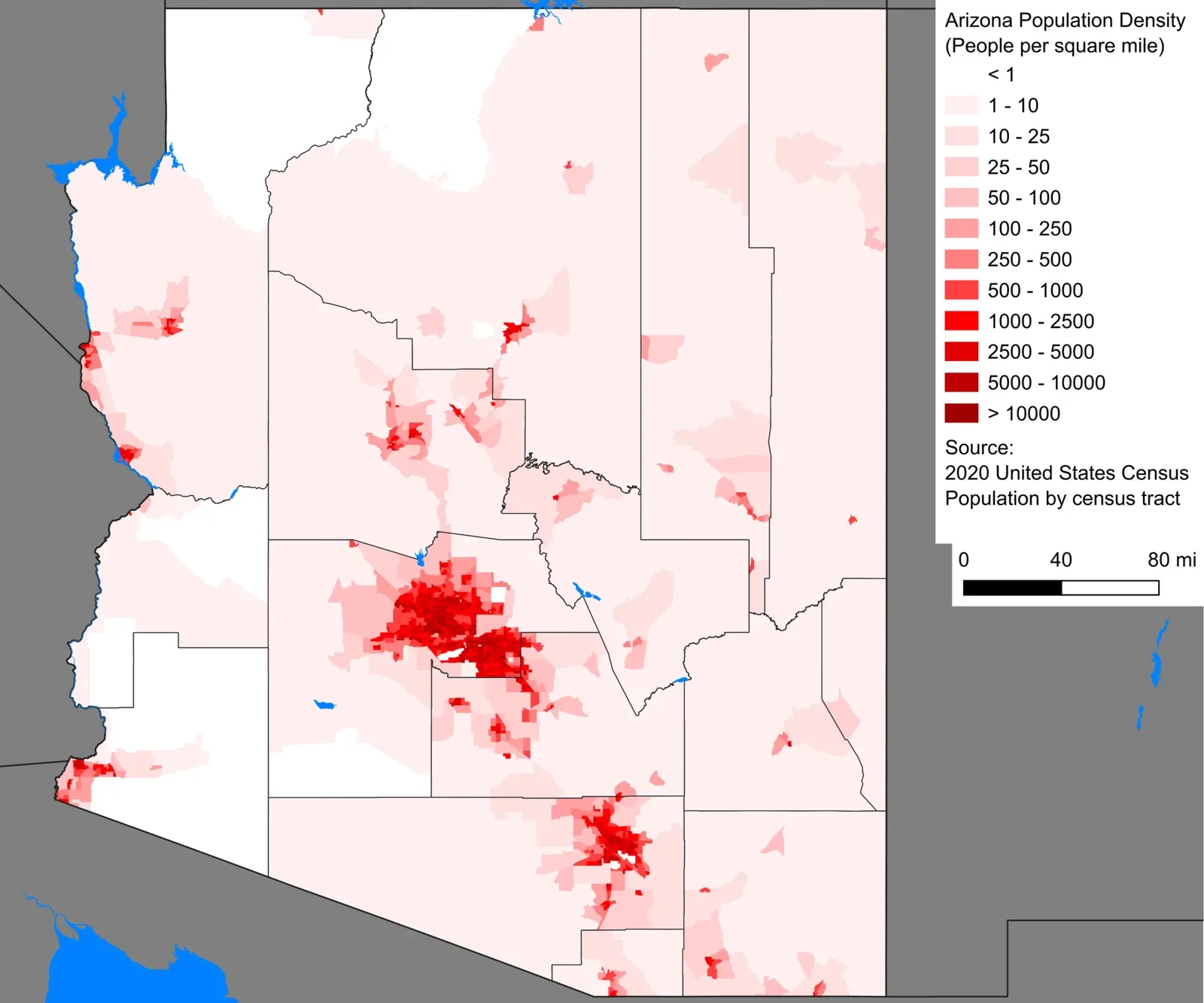
The interesting tension in Arizona's firearms culture isn't between gun owners and non-gun owners — gun ownership is simply assumed across much of the state, particularly outside the Tucson and Tempe-Scottsdale-Phoenix urban cores. The real tension is between the old-line rural and ranching gun culture that defines places like Cochise County, Yavapai County, and the White Mountains, and the imported coastal attitudes that have arrived with the state's explosive population growth. The Phoenix metro area added roughly 400,000 people in the 2010s, and not all of them came from gun-friendly states.
The Giffords shooting is a wound that hasn't fully healed in Arizona, particularly in Tucson. It created two of the most prominent gun-control advocates in the country from Arizona's own political class, and it forced a real conversation about whether the state's essentially unlimited carry environment contributed to the conditions that made the shooting possible. The answer the legislature arrived at — nothing needs to change — is defensible on the merits, since Loughner obtained his firearm legally and no carry restriction would have affected his ability to bring a weapon to a parking lot. But the political optics of doing nothing after six people died at a constituent event represent a real cost that Arizona gun-rights advocates absorbed and decided was worth paying.
For gun owners looking to relocate or visit, Arizona is genuinely permissive in ways that matter practically. You can carry in your car without a permit. You can carry on foot without a permit. You can buy a firearm through a private party without a background check. The Ben Avery range gives you 1,650 acres of public shooting opportunity. Gun stores are plentiful and generally staffed by people who know what they're selling.
The complications are real too. The state's rapid urbanization is changing the political math — Maricopa County, once reliably Republican, has become a genuine swing jurisdiction. The state legislature remains solidly Republican and pro-gun rights, but the margins are tighter than they were twenty years ago, and ballot initiative campaigns targeting private party background checks have come closer to passing with each cycle.
Arizona's firearms history tracks a consistent line from the Spanish presidios defending against Apache raids, through the Earp brothers enforcing a gun ordinance that was stricter than today's law, through Goldwater's individual-rights conservatism, to constitutional carry and the Giffords Foundation. It's a state that has never been simple about guns, even when it looks simple from the outside.
Referencesedit
- Winkler, Adam. Gunfight: The Battle Over the Right to Bear Arms in America. W.W. Norton, 2011.
- Marks, Paula Mitchell. And Die in the West: The Story of the O.K. Corral Gunfight. University of Oklahoma Press, 1989.
- Trimble, Marshall. Arizona: A Panoramic History of a Frontier State. Doubleday, 1977.
- Arizona Revised Statutes, Title 13, Chapter 31 (Weapons and Explosives).
- Arizona Revised Statutes, § 13-3108 (Preemption of Firearms Regulation).
- Arizona Revised Statutes, § 13-3112 (Concealed Weapons Permit).
- Arizona Secretary of State. Senate Bill 1108 (2010), signed April 16, 2010.
- Arizona Secretary of State. HB 2111 (2021), Second Amendment Firearm Freedom Act.
- New York State Rifle & Pistol Association, Inc. v. Bruen, 597 U.S. 1 (2022).
- Faulk, Odie B. Tombstone: Myth and Reality. Oxford University Press, 1972.
- Roberts, Gary L. Doc Holliday: The Life and Legend. Wiley, 2006.
- Sheridan, Thomas E. Arizona: A History. University of Arizona Press, 1995 (revised 2012).
- Smithsonian Magazine. "Gun Control Is as Old as the Old West." 2013.
- Giffords Law Center to Prevent Gun Violence. Arizona State Law Summary, 2025.
- Arizona Game and Fish Department. Ben Avery Shooting Facility information.
- Sturm, Ruger & Co. Prescott, Arizona facility operational history.
- National Shooting Sports Foundation. Firearms Industry Economic Impact Report, 2024.
Last Updated: February 24, 2026
- Quail Creek Plantation(Okeechobee, FL)
- 2aHawaii(Honolulu, HI)
- Boston Firearms(Everett, MA)
- Safeshoot(Kingston, NY)
Loading comments...