Details
Battle of Crécy
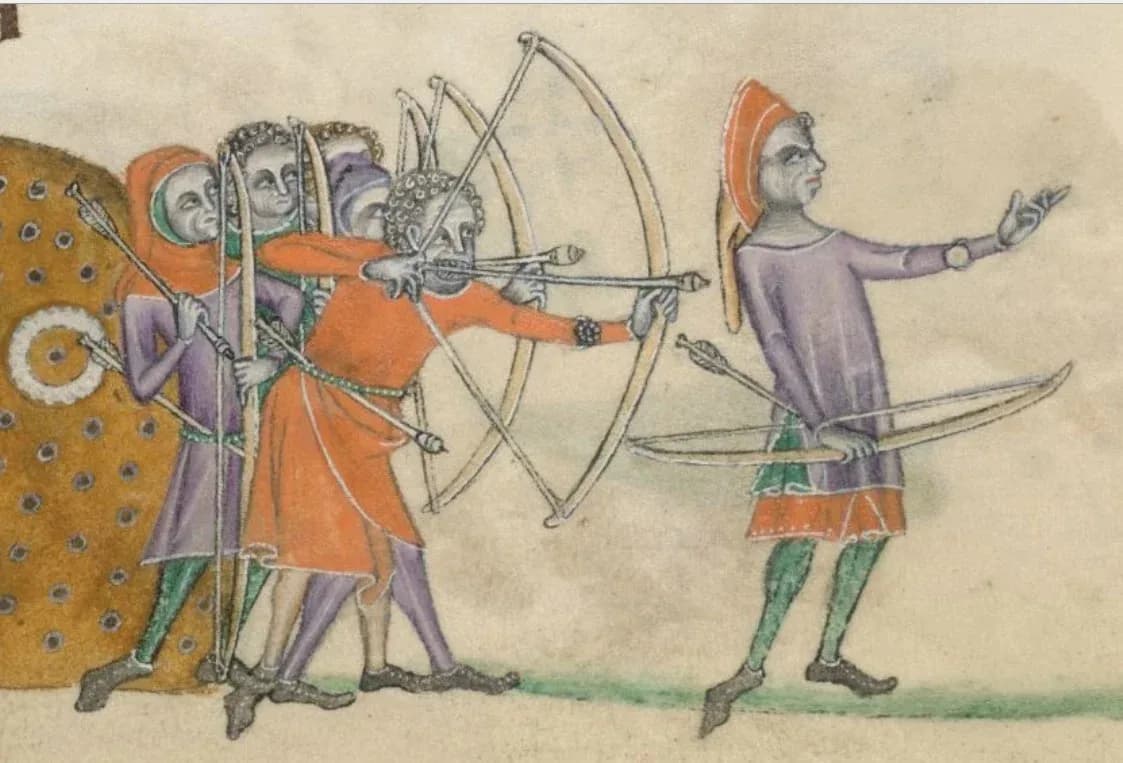
Battle of Crécy tactical map (1346) — English archers positioned on the ridge withstanding successive French cavalry charges without order or coordination.
| Battle Details | |
|---|---|
| Date | 26 August 1346 |
| Location | Crécy-en-Ponthieu, Picardy, northern France |
| Belligerents | England vs France |
| Result | English victory; French army defeated with catastrophic casualties |
| Legacy | |
| Firearms Significance | One of the earliest documented uses of gunpowder weapons in a Western European field battle, while demonstrating the dominance of the longbow through superior rate of fire over more powerful individual weapons. |
Battle of Crécy (1346)
Firearms encyclopedia article
From The Boise Gun Club Handbook
Overviewedit
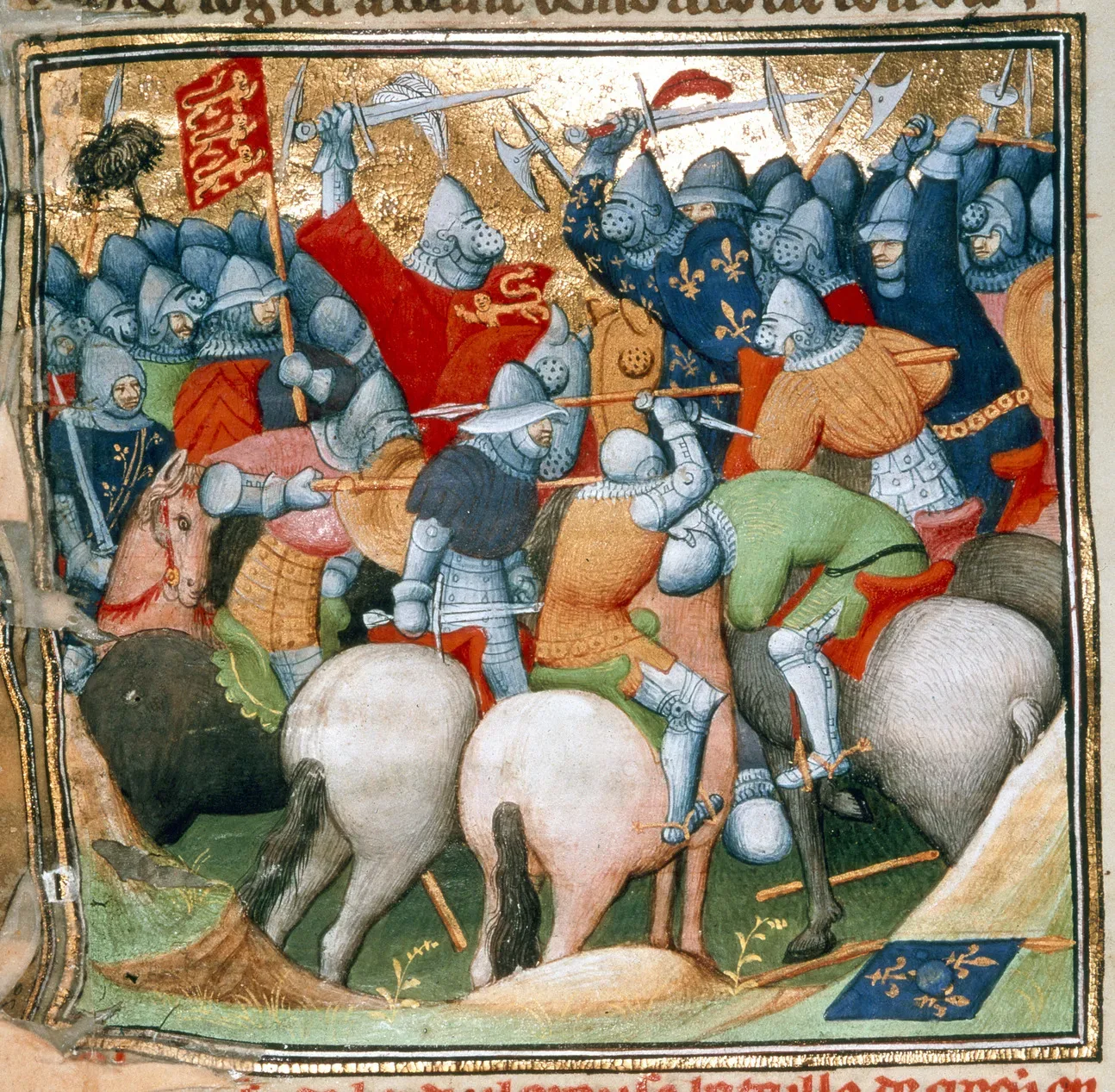
The Battle of Crécy was fought on 26 August 1346 near Crécy-en-Ponthieu in Picardy, northern France. An English army commanded by King Edward III defeated a French force under King Philip VI that substantially outnumbered it. The French launched repeated cavalry charges against a prepared English defensive position and were broken every time — primarily by massed fire from English and Welsh longbowmen — suffering catastrophic casualties while English losses remained minimal.
From a firearms history standpoint, Crécy sits at a hinge point. It is one of the earliest documented uses of gunpowder weapons in a Western European field battle. The longbow that dominated the day would itself be rendered obsolete within another century. And the tactical lessons on rate of fire, standoff range, and the vulnerability of armored cavalry to massed projectiles echo forward through every era of firearms development that followed.
According to modern historian Joseph Dahmus, Crécy belongs among the seven decisive battles of the Middle Ages. According to Andrew Ayton, it was "unprecedented" and represented "a devastating military humiliation" for the French.
Jonathan Sumption called it "a political catastrophe for the French Crown."
Background & Contextedit
The Hundred Years' War Opens
The conflict that produced Crécy had been building since 1337, when Philip VI's Great Council declared that Edward III's French landholdings were forfeit on the grounds that Edward had failed his obligations as a vassal. This opened the Hundred Years' War, which would ultimately run 116 years.
The 1346 Campaign
The immediate trigger for the 1346 campaign was a French offensive in Gascony. A French army numbering between 15,000 and 20,000 men, commanded by John, Duke of Normandy, besieged the strategically vital town of Aiguillon in the spring of 1346. Henry, Earl of Derby — the English commander in the region — sent an urgent appeal for relief to Edward.
Edward was contractually required to respond; his agreement with Lancaster stated that if Lancaster were attacked by overwhelming numbers, Edward "shall rescue him in one way or another."
Edward's response was not a direct march to Gascony. He assembled more than 700 vessels — described as the largest English fleet to that date — and launched an invasion of Normandy, intending to draw French forces away from the south by threatening the heart of France itself.
March to Battle
The English landed at Saint-Vaast-la-Hougue on 12 July 1346, achieving complete strategic surprise. They burned a path through some of the richest land in France. Caen, the cultural and administrative capital of northwestern Normandy, was stormed on 26 July and looted for five days, with more than 5,000 French soldiers and civilians killed. The English then marched toward the Seine and eventually encamped at Poissy, burning villages to within 2 miles of Paris.
Philip assembled a substantial army — some 8,000 men-at-arms, 6,000 crossbowmen, and a large but indeterminate number of infantry levies — and maneuvered to trap Edward between the Seine and the Somme. The French carried out a scorched-earth policy along Edward's line of march, stripping the countryside of food. Edward's army was ragged, hungry, and stretched thin when it forced a crossing of the Blanchetaque ford on 24 August, routing a 3,500-man French blocking force in a sharp fight.
Edward received word shortly after that the allied Flemish army, which he had hoped would reinforce him, had abandoned its expedition. He was on his own.
With his army briefly clear of pursuit, Edward chose a defensive position he knew well — the hillside near Crécy-en-Ponthieu lay in territory Edward had inherited from his mother, and it has been suggested the position had long been identified as a suitable place to give battle.
Forces & Weaponsedit
English Forces and Equipment
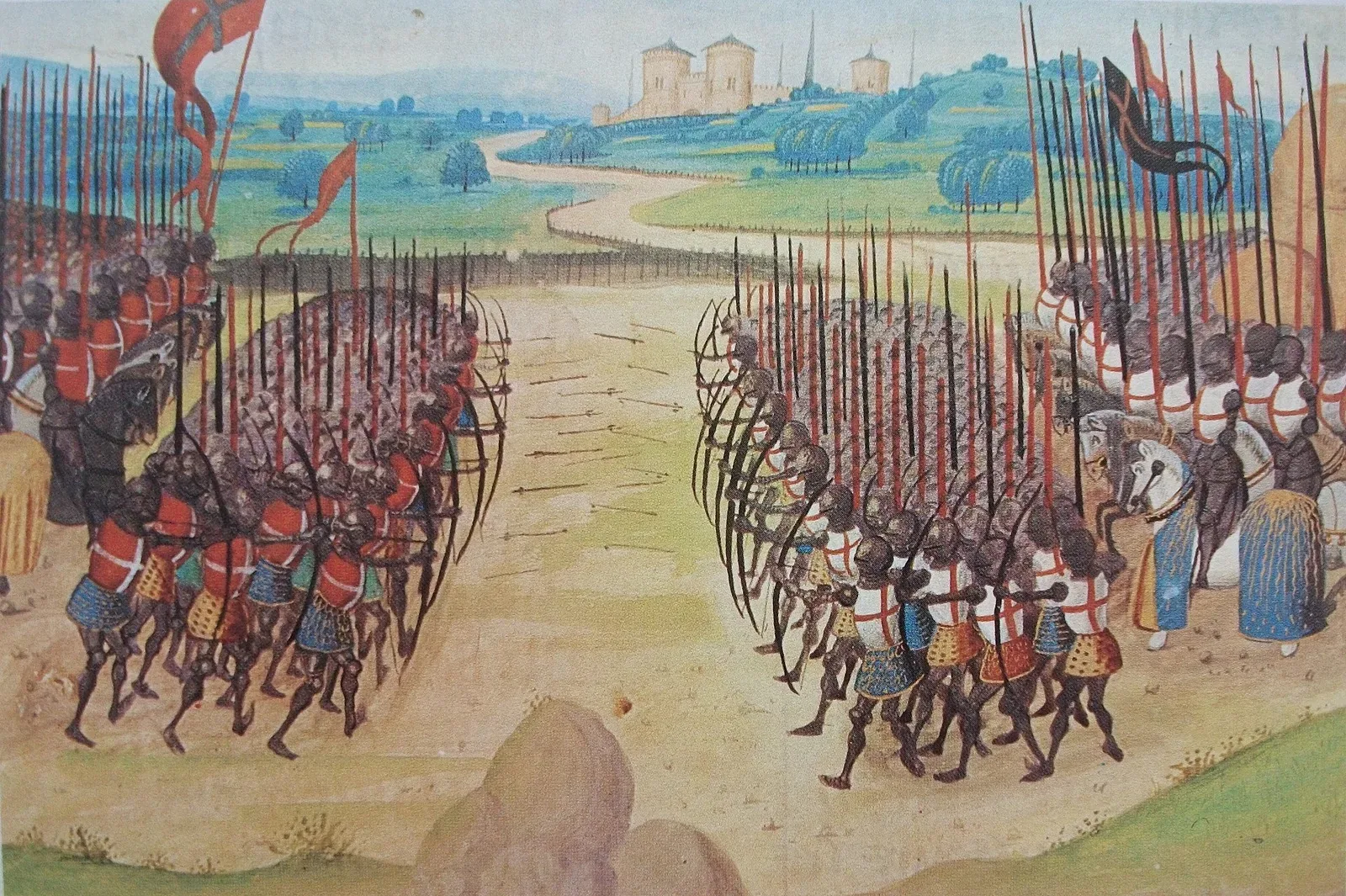
Modern estimates of the English force range from 7,000 to 15,000. Andrew Ayton suggests approximately 14,000: 2,500 men-at-arms, 5,000 longbowmen, 3,000 hobelars (light cavalry and mounted archers), and 3,500 spearmen. Clifford Rogers places the figure at 15,000, with 7,000 longbowmen. Jonathan Sumption, working from the carrying capacity of the original transport fleet, estimates 7,000 to 10,000. Up to a thousand of the men were convicted felons serving in exchange for a promised pardon.
The army was almost entirely English and Welsh, with perhaps 150 foreign soldiers total — a handful of disaffected Normans and German mercenaries.
| Army Component | English Force | French Force |
|---|---|---|
| Men-at-Arms | 2,500 (dismounted) | ~8,000 (mounted) |
| Archers/Crossbowmen | 5,000-7,000 longbowmen | 2,000-6,000 Genoese crossbowmen |
| Light Cavalry | 3,000 hobelars | Unknown |
| Infantry | 3,500 spearmen | Large but unknown |
| Total Estimated | 7,000-15,000 | 20,000-40,000 |
| Nationality | English/Welsh | French/Genoese mercenaries |
The Longbow System
The English longbow was the weapon that decided the day. It was unique to English and Welsh soldiers, took up to ten years to master, and could discharge up to ten arrows per minute at ranges well over 300 metres. The bow was constructed from yew, exploiting the wood's natural properties: the dense heartwood on the belly of the bow resisted compression, while the sapwood on the back handled tension.
Arrows were approximately 30 inches long, fletched for stability, and tipped with bodkin points — elongated pyramidal heads designed specifically for armor penetration. A 2017 computer analysis by Warsaw University of Technology found that heavy bodkin arrows could penetrate typical plate armor of the period at 225 metres, with penetration increasing at closer ranges or against lower-quality armor.
Each archer carried one quiver of 24 arrows as standard. On the morning of the battle they were each issued two additional quivers, for a total of 72 arrows per man — sufficient for roughly fifteen minutes of sustained maximum-rate fire. Modern historians estimate that half a million arrows may have been shot during the battle in total, with archers venturing forward during pauses to retrieve spent shafts.
| Weapon | Rate of Fire | Effective Range | Armor Penetration | Reload Method |
|---|---|---|---|---|
| English Longbow | 10 arrows/minute | 300+ metres | 225m vs plate armor | Draw and release |
| Genoese Crossbow | 2 bolts/minute | ~200 metres | Superior per shot | Stirrup cocking |
| Bombards | ~1 shot/several minutes | Unknown | Unknown | Muzzle loading |
| Ribauldequins | Multiple projectiles | Short range | Variable | Manual ignition |
Early Gunpowder Weapons
The English also fielded gunpowder weapons — their exact number and mix are uncertain from contemporary sources, but types identified include:
- Small guns firing lead balls
- Ribauldequins firing metal arrows or grapeshot
- Bombards — an early form of cannon firing metal balls 80 to 90 millimetres in diameter
- Stone cannonballs (found on battlefield in 1850)
Several iron balls consistent with bombard ammunition have since been recovered from the battlefield. Contemporary accounts differ on what effect, if any, these weapons had on casualties, but they appear to have contributed to the disorder in the French ranks.
The men-at-arms on both sides wore quilted gambesons under mail armor covering the body and limbs, supplemented by varying amounts of plate armor depending on wealth and experience. Heads were protected by bascinets — open-faced iron or steel helmets with attached mail protecting the throat, neck, and shoulders, and a moveable visor. English men-at-arms fought dismounted at Crécy.
French Forces and Equipment
The exact size of the French force is uncertain — the financial records from the campaign are lost. Contemporary chroniclers produced estimates ranging from 72,000 to 120,000, figures historians regard as exaggerated. According to modern estimates, the core was approximately 8,000 mounted men-at-arms, supported by two to six thousand Genoese mercenary crossbowmen recruited through the city of Genoa, and a large but unknown number of common infantry. Clifford Rogers estimates the French force was "at least twice as large as the English, and perhaps as much as three times."
The Genoese crossbowmen were professional soldiers, and in normal conditions they operated behind pavises — very large shields, each sheltering three crossbowmen, carried by dedicated bearers. A trained crossbowman could fire approximately twice per minute to an effective range of about 200 metres. The crossbow was more powerful than the longbow on a shot-for-shot basis, but its rate of fire was less than a quarter of the longbow's, and that gap proved decisive.
French men-at-arms were mounted on entirely unarmored horses and carried ash lances approximately 4 metres long, tipped with iron. Their horses' vulnerability to arrows was a critical tactical weakness that Edward's deployment was specifically designed to exploit.
The Battleedit
English Deployment
Edward deployed his army on the hillside before dawn on 26 August, anchoring his left flank against the village of Wadicourt and his right against Crécy and the River Maye, making the position difficult to outflank. While waiting, the English dug pits in front of their lines to disorder cavalry and positioned their gunpowder weapons.
The army was organized into three "battles" (divisions). Edward's sixteen-year-old son, Edward, Prince of Wales — later known as the Black Prince — commanded the vanguard with 800 men-at-arms, 2,000 archers, and 1,000 foot soldiers including Welsh spearmen. The Earl of Arundel commanded a second division to his left with 800 men-at-arms and 1,200 archers. Edward III held the reserve with 700 men-at-arms and 2,000 archers, positioned at a windmill on the highest point of the ridge. The baggage train was circled and fortified to the rear as a rallying point.
Many of the longbowmen were concealed in small woods or lay down in ripe wheat. Each division placed men-at-arms on foot in the center, spearmen immediately behind, and longbowmen on the flanks and in a skirmish line to the front. The army had been in position since dawn — rested, fed, and at high morale after routing a French detachment two days prior at Blanchetaque.
French Arrival and Decision to Attack
The French army arrived from Abbeville around midday. French scouts who reconnoitered the English position advised Philip to encamp and attack the following day when his men were rested and consolidated. Philip agreed — but the mass of French knights, arrogant, competitive, and contemptuous of delay, kept pressing forward.
Whether Philip ultimately chose to attack or simply lost control of his army is unclear from contemporary sources. The absence of the Constable of France — captured at Caen weeks earlier — left a critical gap in French command authority at exactly the wrong moment.
Philip's plan was sound in theory: use the Genoese crossbowmen to soften the English infantry from long range, then send the mounted men-at-arms in to break the disordered formations. Modern historians have described this as a practical approach with a proven track record against other armies. What went wrong was execution — and physics.
The Archery Exchange
Late in the afternoon the French moved forward, unfurling the oriflamme — France's sacred battle banner, whose display signaled that no prisoners would be taken. A sudden rainstorm broke over the field. English archers de-strung their bows to protect the strings; the Genoese crossbowmen, according to some contemporary accounts, could not protect their strings as effectively, though modern historians dispute this. What is not disputed is the result.
The Genoese advanced without their pavises, which were still in the French baggage. They shot perhaps two hasty volleys. The longbowmen outranged them and returned fire at a rate more than three times greater. The mud slowed crossbow reloading — the weapon's stirrup had to be pressed into the ground to cock it. The Genoese were routed rapidly, suffering uncertain but apparently light casualties as they fled back through the oncoming French cavalry.
The French knights, interpreting the retreat as cowardice or treachery, began cutting down their own crossbowmen. Count Charles of Alençon, Philip's brother, led the mounted men-at-arms forward through the chaos of fleeing Italians. The leading French battle was already in disorder before it closed with the English.
| Battle Phase | Time | French Action | English Response | Outcome |
|---|---|---|---|---|
| Archery Duel | Late afternoon | Genoese advance without pavises | Longbowmen hold fire until 80m | Genoese routed |
| First Charge | Evening | Alençon leads cavalry uphill | Sustained arrow storm | French repulsed, Alençon killed |
| Subsequent Charges | Into night | Multiple cavalry waves | Black Prince pressed but holds | All French charges fail |
| Final Phase | Near midnight | Philip abandons field | English hold position | French army disperses |
| Next Morning | Dawn | Late arrivals attack | English cavalry pursuit | Remaining French scattered |
The Cavalry Charges
Alençon's division charged uphill through the retreating Genoese, through the pits the English had dug, and into a sustained storm of arrows. The longbowmen held their fire until range closed to roughly 80 metres — the point at which bodkin arrows had a reasonable chance of penetrating French armor. The horses, entirely unarmored, were killed and wounded in large numbers. Disabled horses fell and threw their riders; wounded horses fled across the hillside in panic; fallen men and animals accumulated on the slope, complicating every subsequent charge.
Alençon was killed. His division was beaten back. Fresh French cavalry moved into position and charged again, now advancing over the bodies of the previous wave. According to Ayton and Preston, "long mounds of fallen warhorses and men" added significantly to the difficulties facing each successive formation. Still they came.
At one point the Black Prince was reportedly beaten to his knees, and his standard-bearer was said to have stood on the fallen banner to prevent its capture. Edward III sent a detachment from his reserve to steady his son's division.
The charges continued after dark — how many exactly is disputed by contemporary sources, but the fighting extended well into the night. King John of Bohemia, blind, famously had his horse's bridle tied to those of two attendants so he could charge into the fight; all three were dragged from their horses and killed. Philip himself had two horses killed under him and was wounded by an arrow in the jaw. The bearer of the oriflamme was struck down, and the sacred banner was captured. Around midnight Philip abandoned the field. The battle petered out as the French army dispersed into the darkness.
The next morning, substantial French forces were still arriving on the battlefield, unaware of the previous night's outcome. English men-at-arms, now remounted, charged them and pursued them for miles. A few wounded or stunned Frenchmen were pulled from heaps of dead and taken prisoner — the first prisoners of the battle, since Edward had apparently ordered none be taken during the fight itself, unwilling to divert men to guard captives while outnumbered.
Casualties and Aftermath
The losses were extraordinarily asymmetrical. English deaths were reported as forty in a post-battle roll call, though some modern historians suggest the actual figure may have been closer to three hundred. To date, only two Englishmen killed at Crécy have been positively identified.
On the French side, English heralds counted 1,542 noble men-at-arms' bodies after the battle. More than 2,200 heraldic coats were taken as war booty. The dead included:
- King John of Bohemia (blind king who charged tied to attendants)
- Count Charles of Alençon (Philip's brother, led first charge)
- Nine princes
- Ten counts
- One duke
- One archbishop
- One bishop
No count was made of the common infantry — their equipment was not worth looting — but casualties among them were also described as heavy. Jean Le Bel estimated total French dead at 15,000–16,000. Froissart wrote 30,000 killed or captured. Alfred Burne estimated 10,000 infantry as "a pure guess," for a total of around 12,000 French dead. Britannica cites French losses at approximately 14,000 of 35,000 engaged.
| Side | Noble Deaths | Total Estimated Dead | Identified Dead | Sources |
|---|---|---|---|---|
| English | 2 identified | 40-300 | Richard de Beaumont, others unknown | Post-battle roll call |
| French | 1,542 counted nobles | 10,000-16,000 total | King John of Bohemia, Count Charles of Alençon, 9 princes, 10 counts | English heralds, chroniclers |
| Ratio | ~770:1 nobles | ~40:1 total | Unprecedented asymmetry | Multiple sources |
Firearms Significanceedit
The Longbow's Tactical Lessons
Crécy confirmed the longbow as the dominant projectile weapon of Western European warfare and demonstrated, with brutal clarity, the tactical principles that would govern ranged weapons for centuries afterward:
- Rate of fire trumps individual shot power
- Standoff range provides tactical advantage
- Volume of projectiles creates area denial
- Sustained logistics enable volume of fire
The crossbow was the more powerful weapon shot for shot. The Genoese crossbowmen were professionals. They lost anyway — decisively, almost without landing a meaningful blow — because they could manage roughly two shots per minute against an opponent who could sustain ten.
The side that can deliver more rounds on target in a given window of time has an enormous structural advantage, and Crécy demonstrated this more visibly than almost any battle before it.
That arithmetic doesn't change when you substitute matchlock muskets for crossbows, or repeating rifles for longbows.
The bodkin-point arrow was, in a meaningful sense, an armor-piercing projectile. The 2017 Warsaw University of Technology analysis established that it could penetrate contemporary plate armor at 225 metres under the right conditions. Edward's archers were issued 72 arrows each — a deliberate logistics decision that recognized sustained volume of fire as a force multiplier. Modern historians estimate half a million arrows flew at Crécy. That is not archery as sport or hunting. That is area denial by projectile saturation.
The longbow also imposed profound force structure implications. It required up to ten years to master, which meant you couldn't simply decide to field a longbow army when war threatened — you had to grow one over generations through continuous training. England did exactly this, requiring practice by statute. That institutional commitment to a specific weapons system, maintained across decades, is something every military planner since has had to reckon with.
Gunpowder's Quiet Debut
The other track at Crécy points toward the future in a more direct line. The English deployed gunpowder weapons on the battlefield — bombards, ribauldequins, and small guns firing lead balls — and iron cannonballs consistent with their ammunition have been recovered from the site. Contemporary sources disagree on whether they did much damage. Modern historians tend to conclude their psychological effect on French horses and formation cohesion may have mattered more than their physical casualties.
This is how early firearms almost always enter the record. They don't win battles outright. They unsettle. They add a new layer of chaos to an already chaotic situation. The Crécy guns were primitive enough that a later English source describes them as one type among several "gunpowder weapons, in unknown numbers" — the chroniclers weren't even sure exactly what they were looking at. But the iron balls are there in the ground. The weapons were present. And within another century, artillery would close the loop: according to multiple sources, the Battle of Castillon in 1453 — the battle that effectively ended the Hundred Years' War — was the first engagement in which field artillery played a decisive role.
The arc from Crécy's experimental bombards to Castillon's battle-winning guns runs through a hundred years of incremental development, and Crécy is where it starts.
The Conditional Revolution
Crécy is often cited as the battle that ended the age of chivalry — that proved the armored knight on horseback was obsolete. The EBSCO research source pushes back on this interpretation, arguing that the feudal system was already in decline for political, economic, and social reasons before 1346, and that the longbow's success was "a symptom more than a result." Newly centralizing governments were acquiring the administrative capacity to field and pay professional infantry; the social structures that had made mounted nobility the default military force were already eroding.
What Crécy actually demonstrated was conditional: disciplined infantry with high-volume ranged weapons, holding prepared ground on terrain that neutralized cavalry's mobility advantage, could stop a mounted force cold. That condition — "holding prepared ground" — matters. The longbow was fundamentally a defensive weapon. An archer carrying a six-foot bow could not carry much else, and the weapon was essentially useless in offensive operations or broken terrain. Crécy confirmed the longbow's ceiling as clearly as it confirmed its floor.
The same conditional logic would apply to early firearms. The arquebus, the musket, the rifle — each was decisive in specific tactical contexts and vulnerable in others. The story from Crécy forward is not a clean line from bow to gun, but a series of overlapping transitions in which the conditions of effectiveness shift with each new weapon, each new countermeasure, each new tactical doctrine.
Crécy's legacy echoed at Poitiers in 1356 and Agincourt in 1415, both English victories achieved by the same fundamental formula: dismounted men-at-arms anchoring a line, longbowmen on the flanks, prepared terrain, French cavalry charges that accomplished nothing except dying. The French had seventy years to figure out a counter and largely failed to do so before gunpowder made the question moot.
The BGC Takeedit
What gets me about Crécy, from a shooter's perspective, is how clearly it illustrates something that ranges and competitions hammer into you from day one: the gun — or the bow, or the crossbow — doesn't win by itself. The system wins.
The Genoese crossbowmen were using a technically superior weapon. Higher muzzle energy, better penetration per shot. If you put a single Genoese crossbowman against a single English longbowman in a duel, the crossbow probably wins at medium range. But that's not what happened at Crécy. What happened was that the French sent their crossbowmen into a sustained firefight without their pavises, without their ammunition resupply, against opponents who had more arrows than they could shoot, on ground that the English had chosen and prepared.
Before a single bolt or arrow flew, the Genoese were already compromised by logistics failures.
Rate of fire beats raw power when the volumes get high enough. Logistics wins before tactics even starts. Position and preparation matter as much as the weapon itself.
Every one of those principles is still being argued about in tactical forums today — whether we're talking about semi-auto versus bolt action, suppressor regulations, or magazine capacity. The arguments sound modern. They're medieval.
The gunpowder weapons at Crécy are the other thing worth sitting with. Nobody at the time knew they were watching the opening act. The bombards probably didn't kill many Frenchmen. But they were there, they made noise, they spooked horses, and somebody made the logistical decision to haul them across northern France on a forced march. Edward's staff thought they were worth bringing. Eighty years later, field artillery is decisive. The people who figured that out were paying attention to Crécy.
History doesn't move in straight lines, but it does move. Crécy is one of those places where you can see the direction it was heading.
Referencesedit
- https://en.wikipedia.org/wiki/Battle_of_Cr%C3%A9cy
- https://www.britannica.com/event/Battle-of-Crecy
- https://www.britishbattles.com/one-hundred-years-war/battle-of-crecy/
- https://www.ebsco.com/research-starters/history/battle-crecy
- https://www.history.com/articles/hundred-years-war
- https://scalar.usc.edu/works/eng-283e-our-premodern-epics/the-battle-of-crcy--anthony-ortiz
- https://www.historyhit.com/crucial-battles-of-the-100-years-war/
Last Updated: February 27, 2026
- Gls Guns(Sumner, IA)
- Bi-mart - Yakima (Fruitvale Ave)(Yakima, WA)
- New Philly Sportsman Specialities(New Philadelphia, OH)
- R&R Sports & Outdoors(Brandon, FL)
Loading comments...