Details
Eli Whitney

Eli Whitney as depicted on a 1940 U.S. postage stamp — the standard biographical portrait used to commemorate the inventor across American culture.
| Biography | |
|---|---|
| Born | 1765, Westborough, Massachusetts |
| Died | 1825 |
| Nationality | American |
| Legacy | |
| Known For | Securing government funding and establishing the institutional framework for interchangeable parts manufacturing in firearms; inventor of the cotton gin |
| Key Innovation | Promoted interchangeable parts manufacturing system and established the Whitney Armory to demonstrate systematic production of muskets with standardized components |
Eli Whitney: The Man Who Sold Washington on Interchangeable Parts
Firearms encyclopedia article
From The Boise Gun Club Handbook
Overviewedit
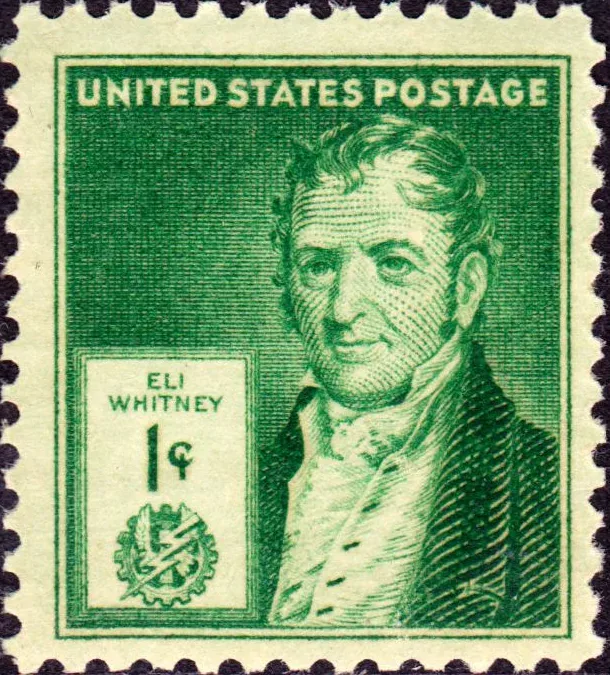
Eli Whitney occupies a strange place in the history of firearms. He is credited with a manufacturing revolution he may never have actually achieved, celebrated for a congressional demonstration that was almost certainly rigged, and remembered primarily for a concept—interchangeable parts—that other men arguably perfected before and after him.
None of that makes his role in the story smaller. Whitney did something arguably harder than inventing: he sold an idea to a government that desperately needed it, got funded to build the infrastructure around it, and set the institutional wheels in motion that eventually made mass production of firearms—and nearly everything else—possible in America.
Whitney didn't invent interchangeable parts, and he didn't fully implement it. But he made it America's ambition.
His life sits at a hinge point in the 800-year story of firearms development. For most of that history, every gun was a handmade object, unique to the smith who built it, unrepairable in the field without that same smith's knowledge. Whitney, working at the end of the 18th century, helped establish the alternative: a system where parts were made to a standard, assembled by workers who didn't need to understand the whole weapon, and repaired by swapping components rather than rebuilding from scratch.
Early Life & Backgroundedit
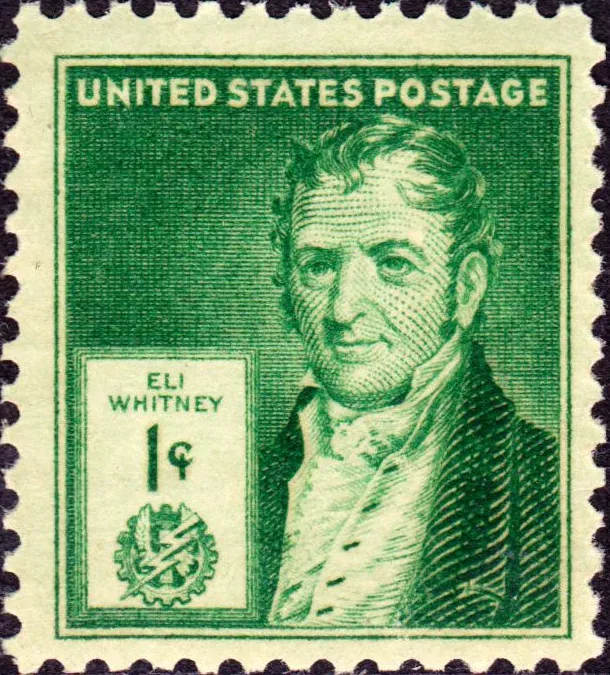
Whitney was born in Westborough, Massachusetts in 1765. According to the Eli Whitney Museum, he graduated from Yale College in 1792, then traveled south to Georgia. There he observed enslaved workers performing the labor-intensive process of removing seeds from cotton fiber by hand.
The Cotton Gin Years
In response, Whitney invented a machine to automate that work: the cotton gin. He received a patent for it in 1794. The machine worked, spread fast, and made Whitney famous—but not wealthy.
| Year | Event | Impact |
|---|---|---|
| 1765 | Born in Westborough, Massachusetts | - |
| 1792 | Graduated from Yale College | Traveled south to Georgia |
| 1794 | Patent granted for cotton gin | Fame but not wealth |
| 1795 | Cotton gin factory fire | Financial ruin, seeking new opportunities |
From Fame to Financial Ruin
Other manufacturers copied the design almost immediately, patent infringement suits produced little financial return, and a fire destroyed the cotton gin factory he had built in New Haven in 1795. Per the Eli Whitney Museum, mismanagement compounded the legal losses, and Whitney found himself well-known but broke, looking for the next opportunity.
The cotton gin's downstream consequences were enormous and brutal. Per the museum, it contributed directly to a boom in cotton agriculture and the violent expansion of plantation slavery across the South. By the mid-1800s cotton composed over half of all U.S. exports. Whitney built the machine that made that economy viable. He would spend the rest of his working life in a different industry—but the two chapters of his career would end up shaping the same national catastrophe from opposite ends.
Key Contributionsedit
The 1798 Contract
In 1797, Congress appropriated funds to prepare the country for a potential war with France. Per History.com, it also voted a large sum for new weapons. The young government lacked the manufacturing capacity to arm itself quickly—skilled gunsmiths produced each weapon by hand, one at a time, with no two guns exactly alike. Congress voted $800,000 for the purchase of cannon and small arms, and the army specifically wanted guns that could be repaired quickly after battle—something the existing craft system made nearly impossible.
| Contract Details | Whitney's 1798 Agreement |
|---|---|
| Contract Value | Part of $800,000 Congressional appropriation |
| Quantity | 10,000 muskets |
| Timeline | 28 months (less than 2 years) |
| Whitney's Experience | Zero muskets previously manufactured |
| Government Need | Threefold increase in ready soldiers |
| Key Requirement | Battlefield-repairable weapons |
Whitney saw the opening. Per History.com, in mid-1798 he secured a government contract to produce 10,000 muskets within less than two years. It was one of the 28-month contracts let to private manufacturers as the government scrambled to arm a threefold increase in ready soldiers. Whitney had never made a musket. That detail appears not to have come up.
Building the System
Rather than immediately trying to produce guns, Whitney spent his contract period doing something different. He built a factory, acquired machinery, trained a workforce, and developed a repeatable assembly process. Per the Eli Whitney Museum, he established his Whitney Armory at a site on the Mill River between New Haven and Hamden, Connecticut. The goal was a system where unskilled laborers operating purpose-built machines could produce parts to a precise standard—parts that would fit any assembly of the same type without custom fitting by a master craftsman.
Timeline of Whitney's government contracts and key milestones
This concept already had a name and a history before Whitney touched it. Per the Wikipedia article on interchangeable parts, French General Jean-Baptiste Vaquette de Gribeauval had promoted standardized weapons through the Système Gribeauval as early as 1765. His protégé Honoré Blanc (referred to in some sources as Honoré LeBlanc) had by around 1778 begun producing firearms with interchangeable flintlock mechanisms, and demonstrated the principle before a committee of scientists.
In 1785, Thomas Jefferson—then serving as U.S. Ambassador to France—witnessed Blanc's work and tried unsuccessfully to persuade him to move to America. Jefferson then wrote to the Secretary of War urging adoption of the concept, and worked to fund its development when he returned home. Whitney even received what was almost certainly a French pamphlet on arm manufacturing techniques—probably Blanc's work—from the Secretary of the Treasury roughly ten months into his contract. He was operating with full awareness that the idea had predecessors.
The 1801 Demonstration
By January 1801, Whitney had delivered zero of his promised muskets and was called to Washington to explain himself. What happened next became one of the most-repeated stories in American manufacturing history—and one of the most disputed.
Per History.com, Whitney staged a demonstration before a group that included outgoing President John Adams and President-elect Thomas Jefferson. He brought a supply of musket parts, seemingly selected them at random, and assembled working firearms in front of the assembled officials. He built ten guns containing the same parts, disassembled them, placed the components in a mixed pile, and with help reassembled all the firearms before Congress.
The performance was a sensation. Congress was captivated—but it was later proven that Whitney's demonstration was staged.
The problem: per History.com, it was later proven that Whitney's demonstration was staged. He had marked the parts beforehand, and they were not truly interchangeable. Historians Merritt Roe Smith and Robert B. Gordon have since determined that Whitney never actually achieved interchangeable parts manufacturing. The parts in his demonstration were handmade by skilled workers and pre-selected—the opposite of what he was claiming to have systematized.
None of that stopped the political outcome. Whitney received continued federal support, renewed credibility, and more time to complete a contract he was already years behind on.
Delivering the Muskets
Whitney was not able to deliver even the first 500 muskets until September 26, 1801. The full 10,000-musket contract was completed eight years late. The JSTOR source confirms the contract was not actually completed until January 23, 1809. Per History.com, when they finally arrived, the muskets were judged to be of superior quality.
| Actual Delivery Timeline | Whitney's Performance |
|---|---|
| Contract Signed | 1798 |
| First 500 Muskets | September 26, 1801 (3+ years late) |
| Contract Completion | January 23, 1809 (8 years late) |
| Quality Assessment | Superior quality |
| Follow-on Contract | 15,000 muskets (1812) |
| Final Billing Example | 500 muskets for $6,500 (1823) |
That judgment, combined with the onset of the War of 1812, earned Whitney a follow-on contract. In 1812 he was awarded a contract to produce 15,000 muskets, with several other government contracts following. In 1823, Whitney invoiced Secretary of War John C. Calhoun for a shipment of 500 muskets delivered to the U.S. War Department, billing $6,500. This transaction and others like it helped establish interchangeable parts as a manufacturing standard recognized at the federal level.
Impact on Firearms Developmentedit
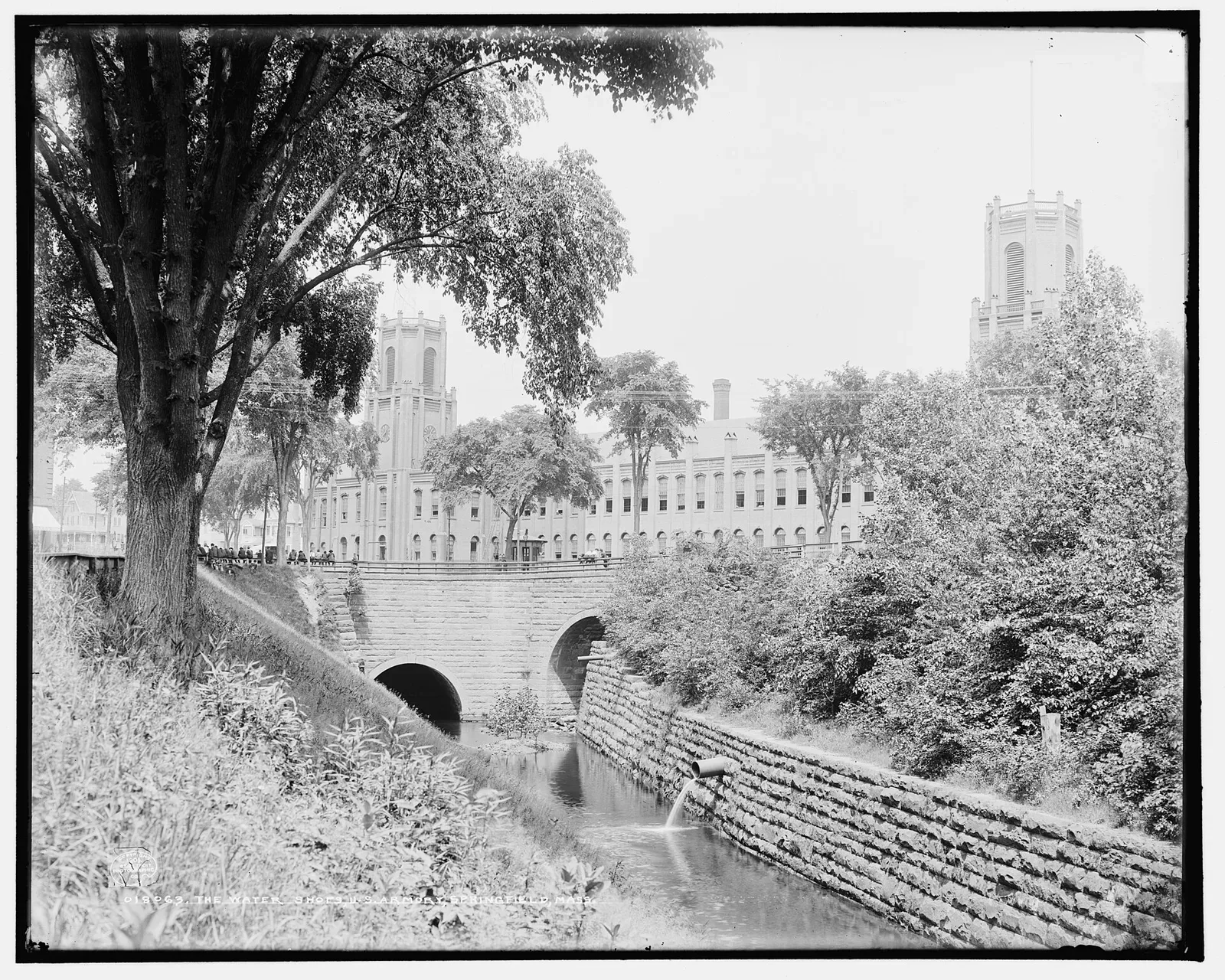
Whitney's Technical Reality
The honest accounting of Whitney's technical contributions is complicated. Per the Eli Whitney Museum, his plan to use interchangeable parts was not a total success in his lifetime. The Wikipedia article on interchangeable parts is more direct: historians Smith and Gordon concluded he never achieved it at all during his tenure.
True mass production using interchangeable parts was first achieved in 1803 by Marc Isambard Brunel at Portsmouth Block Mills in England, manufacturing pulley blocks for the Royal Navy—with no connection to Whitney's work.
The True Pioneers
In America, the crucial technical steps came from other men. Simeon North created one of the world's first true milling machines for metal shaping, with his machine coming online around 1816. By before 1832, both North and John Hall could mass-produce firearms with moving parts using rough-forged components, milled to near-correct size, then filed to gauge by hand with filing jigs. Eli Terry had already demonstrated interchangeable parts in wooden clock components as early as 1800, without government funding.
| Pioneer | Achievement | Date | Location |
|---|---|---|---|
| Jean-Baptiste de Gribeauval | Système Gribeauval (standardized weapons) | 1765 | France |
| Honoré Blanc | Interchangeable flintlock mechanisms | ~1778 | France |
| Marc Isambard Brunel | First true mass production | 1803 | Portsmouth Block Mills, England |
| Eli Terry | Interchangeable wooden clock parts | 1800 | America |
| Simeon North | First true milling machine for metal | ~1816 | America |
| John Hall | Mass-produced firearms with moving parts | Before 1832 | America |
Evolution of interchangeable parts from French origins through American implementation
Whitney's Real Contribution
What Whitney contributed was different from technical invention. His methods—combined with U.S. government approval and funding of them—constituted a watershed that caught the attention of businessmen across the country. He was an effective evangelist for an idea: more and more companies and armories began implementing interchangeable parts during the 1800s as a direct result of the institutional momentum Whitney helped generate.
Per the Eli Whitney Museum, laborers moved between the Whitney Armory and other Connecticut factories like Simeon North's Armory in Middletown, carrying techniques and ideas with them. The ecosystem of knowledge transfer was real, even if Whitney's own technical achievement was overstated.
Birth of the American System
What gradually followed was the American System of Manufacturing—the use of powered, specially designed machines to produce interchangeable parts, assembled by unskilled labor at reduced cost and increased volume. U.S. manufacturers shifted from skilled craftsmen using hand tools to semiskilled laborers operating machines. This shift, combined with standardization, produced what historians call the Machine Age by 1880, and its effects spread from firearms to:
- Clocks (Eli Terry, 1800)
- Sewing machines
- Reapers
- Bicycles
- Typewriters
- Automobiles (via Henry M. Leland)
Per Alfred P. Sloan, writing in his management memoir My Years with General Motors, even he knew little about this history beyond a vague sense that Henry M. Leland had brought interchangeable parts into automobile manufacturing—"and it has been called to my attention that Eli Whitney, long before, had started the development of interchangeable parts in connection with the manufacture of guns, a fact which suggests a line of descent from Whitney to Leland to the automobile industry."
That line of descent—from 18th-century French musket-making through Whitney's armory to Ford's assembly line—is the real measure of what the period produced, regardless of who deserves precise credit at each step.
Later Life & Legacyedit
Death and Succession
Eli Whitney died in 1825. Per the Eli Whitney Museum, after his death his nephews, son, and later owners of the Whitney Armory site continued pursuing his legacy of industrial innovation until the last factory on the property closed in 1979—over 150 years after his death. It was Whitney's family's arms company that achieved true interchangeable parts manufacturing, completing the work he had been credited with during his lifetime.
The Cotton Gin's Dark Legacy
The cotton gin's legacy proved darker. Whitney's two major contributions—the cotton gin and the promotion of interchangeable machine parts—set the agricultural South and the industrial North on a political collision course. The gin made plantation slavery more economically entrenched; the armory work helped build the manufacturing capacity that would eventually arm the Union. Whitney didn't live to see either consequence fully realized. He died nearly four decades before the Civil War.
Historical Revision
Historian Charles Fitch, writing in 1882, credited Whitney with successfully executing a firearms contract with interchangeable parts using the American System. That version of events held for decades. It wasn't until historians Smith and Gordon examined the primary record more carefully that the picture was revised—Whitney had shaped the narrative of interchangeable parts more than the physical reality of them, at least during his own lifetime.
The concept of interchangeability itself predates Whitney by centuries: evidence of standardized, interchangeable ship components has been traced to Carthage during the First Punic War, with recovered vessels bearing assembly markings akin to "tab A into slot B." Whitney was neither the origin of the idea nor its perfection. He was something else: the man who convinced the U.S. government to fund the infrastructure needed to make it real, and whose armory became a proving ground—imperfect, overhyped, but genuinely consequential—for what American manufacturing would eventually become.
The BGC Takeedit
Whitney is one of those historical figures who gets flattened into a legend and loses something in the process. The textbook version—cotton gin inventor pivots to muskets, invents interchangeable parts, changes everything—skips over the parts that make the story actually interesting.
The man missed his delivery deadline by eight years. His famous congressional demonstration was almost certainly a con. Historians who dug into the physical evidence of his guns concluded he didn't achieve what he claimed to have achieved.
And yet the institutional outcome was real: Congress standardized military equipment, federal money flowed into armory development, and the technical knowledge moved through the Connecticut manufacturing community until someone—probably Simeon North, maybe John Hall—actually cracked the problem.
Whitney matters not because he solved the problem, but because he got the problem funded. That's an underrated skill in any era.
There's something worth sitting with in that. Whitney didn't invent interchangeable parts, didn't perfect them, and arguably faked his proof of concept. But he secured the government contract, built the factory, trained the workforce, and kept the program alive long enough for the idea to take root. In a different era we'd call that project management or institutional entrepreneurship. In 1801 it looked like genius.
What I find most striking is the cotton gin angle. The same man whose musket work pointed toward industrial mass production also built the machine that locked the South into an agrarian slave economy for another six decades. He didn't intend to set up the Civil War, obviously. But the two inventions pulled the country's economies in opposite directions hard enough that the collision eventually became inevitable. That's a hell of a legacy for one guy from Westborough, Massachusetts.
For the shooter and the history reader both: Whitney matters not because he solved the problem, but because he got the problem funded. That's an underrated skill in any era.
Referencesedit
- https://www.technicalassent.com/insight/what-eli-whitneys-1798-gun-making-contract-can-teach-us
- https://www.raabcollection.com/eli-whitney-autograph/eli-whitney-signed-us-government-buys-muskets-eli-whitney
- https://en.wikipedia.org/wiki/Interchangeable_parts
- https://www.history.com/articles/interchangeable-parts
- https://www.eliwhitney.org/eli-whitney-and-whitney-armory
- https://www.jstor.org/stable/3101392
- https://www.profound-deming.com/blog-1/standardization-amp-the-american-system
Last Updated: February 27, 2026
- Gls Guns(Sumner, IA)
- Bi-mart - Yakima (Fruitvale Ave)(Yakima, WA)
- New Philly Sportsman Specialities(New Philadelphia, OH)
- R&R Sports & Outdoors(Brandon, FL)
Loading comments...