Specifications
Fire Lance

The earliest known depiction of a fire lance, from a 10th-century Dunhuang manuscript — contemporaneous with the weapon's emergence in Song Dynasty China.
Unknown authorUnknown author (Public domain)
| Manufacturer | |
|---|---|
| Made By | |
| Origin | China |
| Specifications | |
| Caliber | |
| Action | single action |
| Production | |
| Designed | 950 |
| Variants | |
| |
| Service Use | |
Song dynastyJin dynastyYuan forcesMiddle EastEuropean knightsJapanese samurai | |
Fire Lance: The Gunpowder Weapon That Started Everything
Firearms encyclopedia article
From The Boise Gun Club Handbook
Overviewedit

The fire lance (火槍, huǒ qiāng) is the earliest identifiable ancestor of every firearm in existence today. It started as an almost embarrassingly simple idea—a bamboo tube packed with gunpowder lashed to the head of a spear—and over roughly 150 years of continuous warfare, it evolved into something that would eventually render the spear itself obsolete. According to Emory University historian Tonio Andrade, by A.D. 1150 Song soldiers were deploying bamboo and wood proto-guns that functioned essentially as flamethrowers, and the weapon's trajectory from there ran directly to the hand cannon and beyond.
The fire lance matters not because it was a particularly effective weapon on its own terms, but because it represents the moment human beings first figured out how to channel gunpowder's force through a tube and point it at something.
That insight is the foundation of every rifle, pistol, and cannon that followed.
Design Historyedit
Early Gunpowder Applications
Gunpowder itself arrived in Chinese military hands well before the fire lance. The Wujing Zongyao (武經總要), a military manual compiled in 1044 CE, records the first documented gunpowder formula and describes its large-scale production. Early military applications were incendiary: gunpowder packed into paper or bamboo parcels attached to arrows, or mixed with scrap iron and hurled by catapult.
The compound was called huǒ yào—"fire medicine"—and the Song dynasty's imperial court actively rewarded soldiers and inventors who brought new applications forward, which according to the official History of Song "brought about a great number of cases of people presenting technology and techniques."
The First Fire Lances
Key developmental milestones in fire lance evolution from concept to hand cannon
The fire lance emerged from that environment of sponsored experimentation. Per the Kiddle Encyclopedia and corroborating sources, the first signs of fire lances appear in China around 950 CE, though confirmed battlefield use doesn't come until 1132. The original design was straightforward: a bamboo tube holding gunpowder and a slow-burning fuse, secured to a traditional polearm. When ignited, it discharged flame and burning debris toward the spear tip—functioning somewhere between a flamethrower and a pyrotechnic surprise.
The weapon evolved in two parallel directions. The first was payload. By the late 1100s, makers were stuffing iron pellets and broken pottery shards into the tubes alongside the powder. These fragments—called co-viatives because they were swept along by the discharge rather than propelled by gas pressure against a sealed bore—turned the fire lance into something combining heat with flying debris. The second direction was material. Bamboo gave way to paper (the Jin dynasty developed multi-layered paper barrels robust enough to be reused, according to the History of Jin), and paper eventually gave way to metal.
| Period | Material | Key Innovation | Source |
|---|---|---|---|
| 950 CE | Bamboo | Basic tube + gunpowder + fuse | First appearance |
| 1132 CE | Bamboo/Wood | Confirmed battlefield use | Siege of De'an |
| Late 1100s | Bamboo/Paper | Co-viative projectiles (pellets/shards) | Multiple sources |
| 1232 CE | Multi-layer Paper | Reusable barrels | History of Jin |
| 1259 CE | Paper/Early Metal | Occluding pellet wad (first "bullet") | History of Song |
| 1276 CE | Metal (Bronze/Iron) | True hand cannon emergence | Transition complete |
Evolution Toward True Firearms
The critical design threshold came in 1259. According to the History of Song, a "fire-emitting lance" (突火槍) appeared that was stuffed with a pellet wad (子窠) that occluded the barrel entirely.
Once the fire goes off it completely spews the rear pellet wad forth, and the sound is like a bomb that can be heard for five hundred or more paces. — History of Song, 1259
This is significant because a projectile that seals the bore creates gas pressure and is propelled by it—which is precisely what distinguishes a gun from a flamethrower. Historians recognize this as possibly the first recorded use of a true bullet, depending on how that term is defined.
By 1276, fire lances had metal barrels. The spear component was progressively de-emphasized and eventually dropped. What remained—a metal tube that propelled a projectile using confined gas expansion—was the hand cannon. As one source summarizes it, fire lances transformed from "bamboo- (or wood- or paper-) barreled firearm to the metal-barreled firearm" as smiths learned to cast bronze and iron tubes strong enough to handle the pressure. The character for lance or spear (槍) carried forward into modern Chinese as the word for firearm, a linguistic artifact of this transition.
Technical Characteristicsedit
Basic Design Parameters
The early fire lance had the following fundamental characteristics:
- No moving parts
- No lock mechanism
- No stock
- No sights
- Effective range: ~3 meters
- Mostly single-shot capability
Most were single-shot. Some versions were built to fire twice. The History of Jin describes the Jin dynasty's improved paper-barrel version from around 1232: constructed from multiple layers of paper, filled with a mixture of charcoal, iron pieces, sulfur, and additional compounds, it produced flames shooting out more than ten feet while leaving the tube intact for reuse—a meaningful improvement over the disposable bamboo originals.
| Specification | Early Fire Lance (1132) | Late Fire Lance (1259) | Metal Eruptor (1276) |
|---|---|---|---|
| Barrel Material | Bamboo | Paper (multi-layer) | Bronze/Iron |
| Effective Range | ~3 meters | ~3 meters | 3-10 meters |
| Shots per Use | 1 (disposable) | 1-2 (reusable) | Multiple |
| Projectile Type | Flame + debris | Pellets + flame | Lead pellets |
| Propulsion Method | Open discharge | Sealed bore pressure | Gas expansion |
| Weight | Light (bamboo) | Moderate | Heavy (metal) |
Projectile Development
As pellets and ceramic shards were added to the charge, the weapon's effect broadened from pure flame projection to a combination of thermal and fragmentation injury. These co-viative projectiles were not ballistically controlled—they scattered with the discharge rather than flying along a defined trajectory—but at arm's reach, that distinction didn't matter much.
Advanced Variants
Later developments moved toward what the sources call eruptors: metal-barreled tubes, some mounted on frames, designed to discharge lead pellets or other projectiles. The History of Song records that in 1257, an arsenal in Jiankang Prefecture manufactured 333 "fire emitting tubes" (突火筒), suggesting the weapon had achieved enough institutional standardization to be tracked in an inventory. By the 1270s, Song cavalrymen were using fire lances as mounted weapons, as evidenced by an account of a Song-Yuan battle in which two fire-lance-armed Song cavalrymen engaged a Chinese officer serving under Bayan of the Baarin.
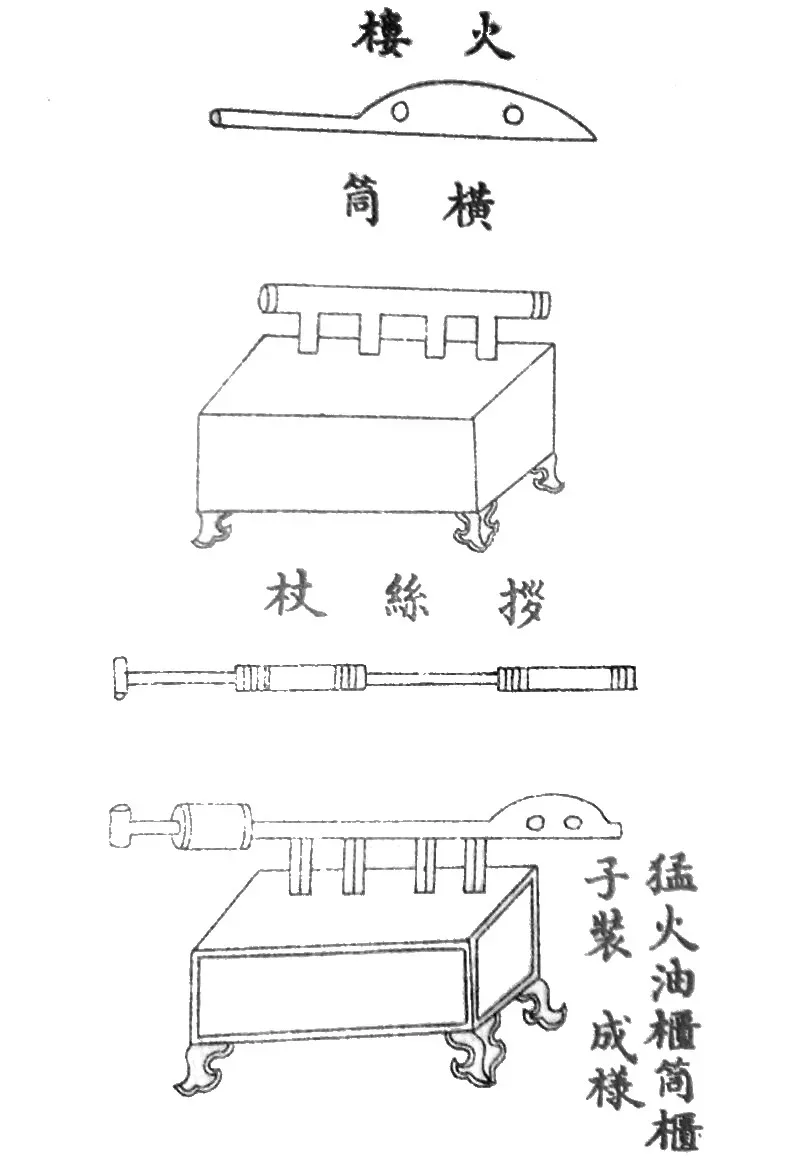
The Huolongjing (火龍經), compiled in the mid-14th century by Jiao Yu, illustrates a range of fire lance derivatives including a double-barreled version designed so that firing the first barrel would automatically ignite the second, and a "phalanx-charging fire gourd" that discharged lead pellets. A "divine moving phalanx-breaking fierce-fire sword-shield" combined fire lances with a shield, intended to break enemy formations at close quarters.
Combat & Field Useedit

The Siege of De'an (1132)
The first confirmed battlefield employment of the fire lance was during the siege of De'an in 1132—modern Anlu, Hubei Province—when Song dynasty defenders used them against Jin dynasty forces attacking with wooden siege towers called "sky bridges." The account survives in enough detail to be instructive.
As the sky bridges stalled short of the walls, Song soldiers emerged and attacked with fire lances alongside striking lances and hooked sickles. The porters operating the base of the siege towers were driven back, and Jin commander Li Heng eventually lifted the siege with severe casualties.
The siege of De'an also produced a notable shift in terminology. The History of Song's account describes the fire lance's gunpowder charge using the new phrase "fire bomb medicine" (火炮藥) rather than simply "fire medicine." Historian Peter Lorge suggests this "bomb powder" may have been corned gunpowder—a more potent formulation achieved by granulating the powder rather than using it as a fine meal—which would represent a meaningful leap in the weapon's destructive capability.
| Year | Battle/Event | Forces | Fire Lance Role | Outcome |
|---|---|---|---|---|
| 1132 | Siege of De'an | Song vs Jin | Anti-siege tower defense | Jin retreat |
| 1163 | Wei Sheng's Campaign | Song mobile units | War-cart mounted platforms | Combined arms success |
| 1233 | Night Assault | Jin vs Mongol | 450 fire lancers offensive | Mongol camp routed |
| 1268-73 | Xiangyang-Fancheng | Song naval relief | Close combat breakthrough | Temporary blockade break |
| 1257 | Li Zengbo Inspection | Song garrison | Standard inventory item | Understocked |
| 1396 | European Use | Knights | Mounted fire lance | Adoption confirmed |
Tactical Integration
In 1163, Song commander Wei Sheng constructed several hundred "at-your-desire-war-carts" (如意戰車) fitted with fire lances protruding from protective side coverings. These served as mobile defensive platforms for trebuchets hurling fire bombs—an early integration of gunpowder weapons into combined-arms tactics.
Mongol Conflicts
The Jin dynasty adopted fire lances aggressively and, by some accounts, improved on them. In 1233, a Jin officer named Pucha Guannu led 450 fire lancers in a night assault on a Mongol encampment and reportedly routed it. According to the sources, Mongol soldiers feared the fire lance specifically, even while holding other Jin weapons in lower regard—a meaningful detail given that the Mongol war machine was otherwise consuming everything in its path.
During the prolonged Mongol-Song Wars, fire lances appeared alongside bombs, crossbows, and eventually early cannons in engagements including the naval battle near the besieged twin cities of Xiangyang and Fancheng (1268–1273). A Song relief force broke through a Mongol naval blockade using fire lances, fire bombs, and large axes, fighting hand to hand on vessels where "they were up to the ankles in blood" according to the Mongol record.
In 1257, Song official Li Zengbo was dispatched to inspect frontier arsenals and found conditions alarming. His inspection of one garrison turned up "no more than 85 iron bomb-shells, large and small, 95 fire-arrows, and 105 fire-lances"—which he described as woefully inadequate for even a hundred men to defend against a serious attack. His account survives as evidence that fire lances had become standard enough to be counted in garrison inventories, even if actual stockpiles were often depleted.
Global Spread
Beyond China, fire lances spread with the Mongol conquests:
- Middle East adoption by 1280
- European knight usage by 1396
- Japanese samurai adoption in 1400s
- European naval use until 1660
- Last combat use: Storming of Bristol (1643)
In Europe, a version called the Tronck (also fire-trunk or bomba) used wooden tubes fitted with fireworks and shot at the end of a pole. A Tronck was recovered from the sunken Spanish vessel La Trinidad Valencera, and a reconstruction tested in 1988 caused several components to ignite simultaneously. England continued issuing them to ships as late as 1660.
Legacy & Influenceedit
The Conceptual Breakthrough
The fire lance sits at the hinge point of the entire history of firearms. Everything before it—fire arrows, bombs, flamethrowers—used gunpowder as an incendiary or area-effect explosive. The fire lance was the first attempt to channel that energy directionally through a tube. That concept, once established, did not stop developing.
The transition from co-viative debris to occluding projectiles between 1132 and 1259 represents the conceptual leap from flamethrower to gun. Once a wad of pellets sealed the bore and was driven forward by gas pressure, the physics of firearms were in place. Metal barrels replaced bamboo to contain higher pressures. The spear was discarded as superfluous. The eruptor emerged, and from the eruptor came the hand cannon.
The technological lineage from fire lance to modern firearms and geographic spread
Archaeological Evidence
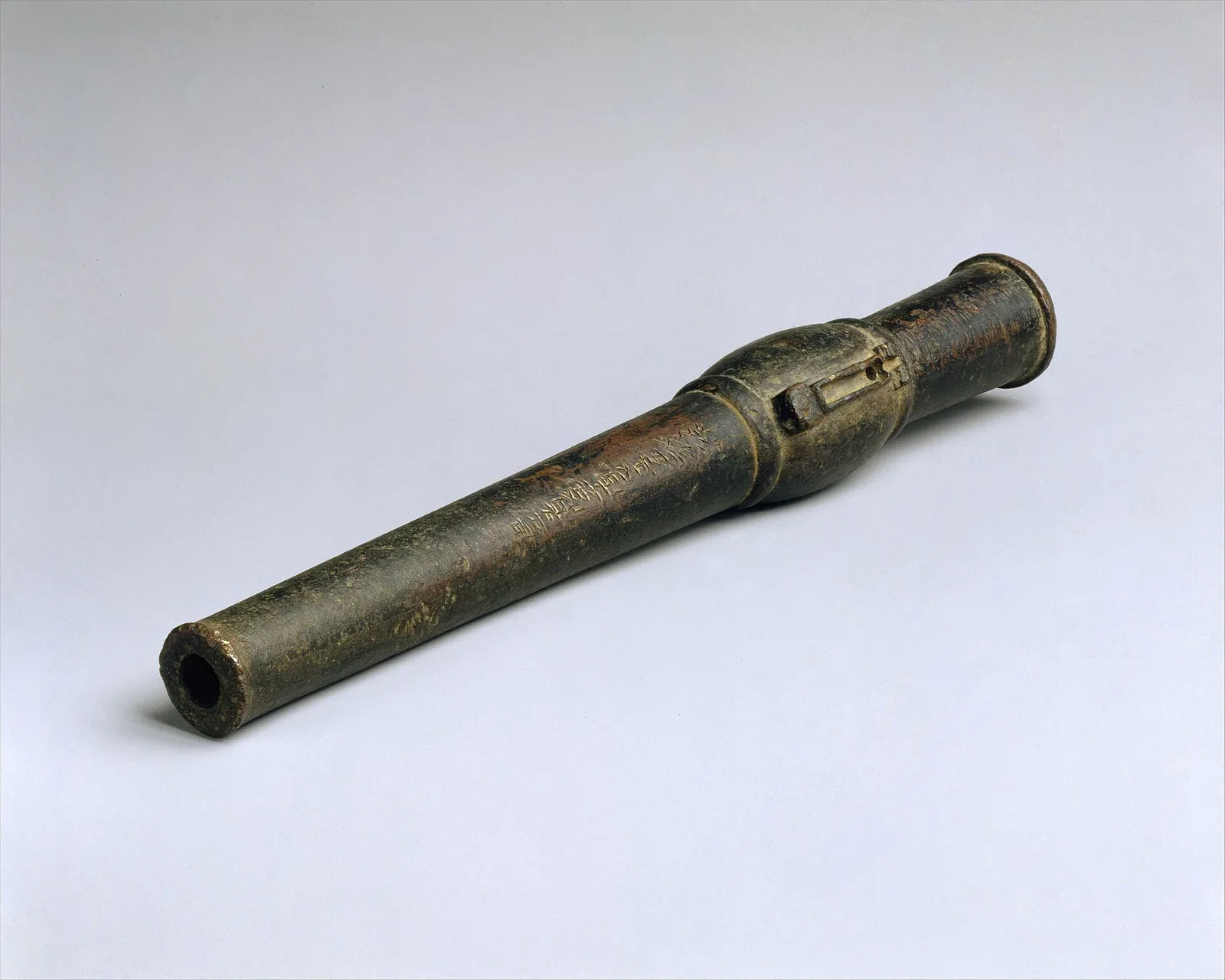
Archaeological evidence confirms this lineage. The Xanadu Gun, discovered in the ruins of Kublai Khan's summer palace and dated by inscription to 1298, is a bronze hand cannon measuring 34.7 cm and weighing 6.2 kg—bearing a serial number that indicates gun production had already become systematized. The Heilongjiang hand cannon, discovered in 1970 and believed used by Yuan forces against a Mongol rebellion in 1287, weighs 3.5 kg with a 2.5 cm bore. Both weapons are direct descendants of the fire lance's metal-barreled descendants.
As Tonio Andrade notes, the boundary between a late fire lance and an early hand cannon is genuinely blurry.
What a gun looked like then is blurry by our standards. Even the Xanadu gun may have been more like a fire lance than what we think of as a gun. — Tonio Andrade
The Wubei Zhi, written by Ming dynasty scholar Mao Yuanyi in 1628, describes Song trebuchets as "fire trebuchets" because they projected fire lances and fire bombs, and calls them "the ancestors of the cannon"—an assessment that holds up.
Westward Technology Transfer
Gunpowder technology spread westward through Mongol conquest and trade. Arab scholars compiled and transmitted Chinese incendiary formulas. European monks were copying gunpowder recipes into Latin manuscripts by the late 1200s, and the first known European illustration of a cannon appeared in 1326. The chain runs from a bamboo tube lashed to a Song dynasty spear all the way to every firearm manufactured since.
The Ming dynasty Huolongjing preserves the most detailed surviving record of fire lance variants and their descendants, illustrating the full spectrum from simple bamboo tubes through complex multi-shot designs, eruptors, and early cannons. The Chinese language preserved the connection in its own way: the character 槍, meaning spear or lance, became and remains the standard Mandarin word for gun.
The BGC Takeedit
Most people who pick up a rifle, carry a concealed handgun, or compete at the range have never thought about a bamboo tube in 12th-century China. They should.
The fire lance is the proof of concept for every firearm that followed. Not because it worked brilliantly—it didn't, not by any modern standard. Three meters of effective range, single-shot, and you're still holding a spear. That's a rough Tuesday at the range.
But the idea it proved was everything: you can channel an explosive through a tube and direct its force at a target. That's it. That's the whole game.
What strikes me about the fire lance's history is how fast it developed under pressure. The Song dynasty was fighting for survival against the Khitan Liao, the Jurchen Jin, and eventually the Mongols—and they kept innovating because the alternative was extinction. Li Zengbo's inspection report from 1257, complaining about garrison arsenals stocked with barely enough fire lances for a hundred men, reads like a frustrated armorer anywhere at any time. The technology was there. The procurement was a mess. Some things don't change.
The part that tends to get lost in the "China invented gunpowder" summary is how incremental and contested the development actually was. There wasn't a moment when someone invented the gun. There was a bamboo tube, then a longer bamboo tube, then pellets stuffed in alongside the powder, then pellets that sealed the bore, then paper barrels, then metal. Each step was driven by someone in a siege or a field engagement looking for a few more feet of reach or a little more destructive effect. The 1259 pellet wad that historians mark as possibly the first bullet wasn't an invention in a laboratory—it was a field modification that someone figured out worked better.
Every shooter handling a modern firearm is at the end of that chain. Worth knowing where it started.
Referencesedit
- https://en.wikipedia.org/wiki/Gunpowder_weapons_in_the_Song_dynasty
- https://archaeology.org/issues/may-june-2020/collection/fire-lances-cannons/weapons-of-the-ancient-world/
- https://afe.easia.columbia.edu/songdynasty-module/tech-gunpowder.html
- https://n1outdoors.com/history-of-gunpowder/
- https://kids.kiddle.co/Fire_lance
Last Updated: February 27, 2026
- Gls Guns(Sumner, IA)
- Bi-mart - Yakima (Fruitvale Ave)(Yakima, WA)
- New Philly Sportsman Specialities(New Philadelphia, OH)
- R&R Sports & Outdoors(Brandon, FL)
Loading comments...