Specifications
Hand Cannon

A Chinese hand cannon (chong) from the Met collection — among the earliest surviving firearms, representing 14th-century gunpowder weapon evolution.
This file was donated to Wikimedia Commons as part of a project by the Metropolitan Museum of Art. S (CC0)
| Manufacturer | |
|---|---|
| Made By | |
| Origin | China |
| Specifications | |
| Caliber | |
| Action | single action |
| Weight | 35 pounds |
| Production | |
| Designed | 13th century |
| Variants | |
| |
Hand Cannon
Firearms encyclopedia article
From The Boise Gun Club Handbook
Overviewedit
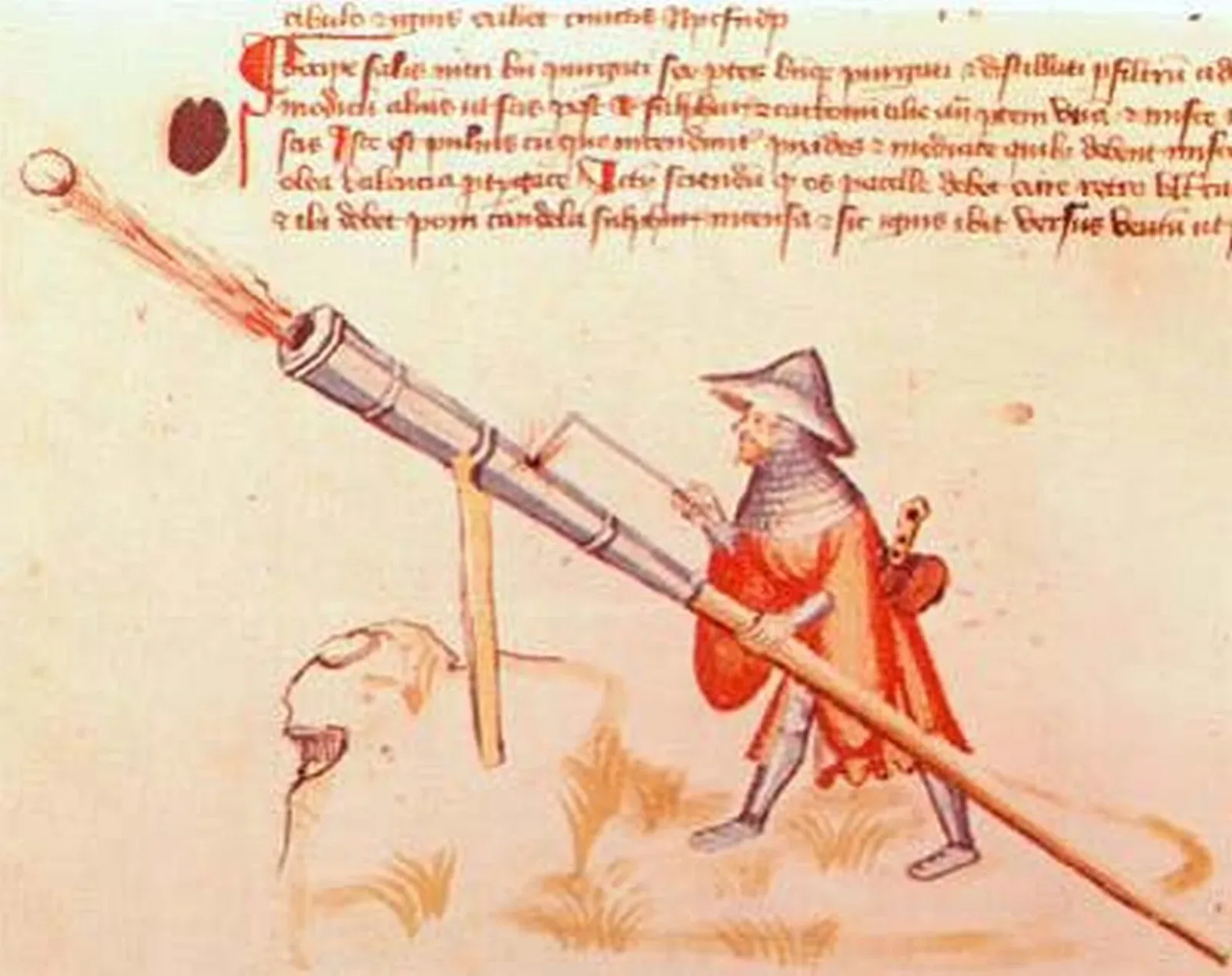
The hand cannon — also called a handgonne or gonne — holds a straightforward claim in firearms history: it was the first one. Not the first practical one, not the first effective one. The first. A metal barrel, a touch hole, a charge of gunpowder, and whatever you could stuff down the muzzle. That's it. No trigger, no lock, no stock in the early versions. Just a tube that made something come out the other end very fast.
According to Wikipedia's entry on the hand cannon, it is the oldest type of small arms and the most mechanically simple form of metal barrel firearm ever made. It evolved from the fire lance — a bamboo or metal tube packed with gunpowder used as a spewing, burning weapon — and crossed the line into true firearm territory when the barrel became metal, the projectile occluded the bore, and the explosion was used to propel rather than just spray.
That distinction sounds academic until you realize it set the template for every gun built in the 700 years since.
The hand cannon was in widespread use in China by the 13th century. It reached Europe by the early 14th century, and by the end of the 15th century it had evolved into the arquebus — the first firearm with a trigger — and the medieval period of warfare had effectively ended.
Design Historyedit
Chinese Origins
The hand cannon didn't appear from nowhere. Its ancestor, the fire lance, shows up in Chinese records in 1259 as a "fire-emitting lance" (tūhuǒqiāng) made from a large bamboo tube stuffed with a pellet wad. According to the History of Song, once ignited, it "completely spews the rear pellet wad forth, and the sound is like a bomb that can be heard for five hundred or more paces." That pellet wad — which unlike earlier shrapnel actually occluded the barrel — is arguably the first true bullet in recorded history, depending on how you define the term.
From there, fire lances transitioned from bamboo to metal barrels to handle the increasing explosive pressure of improving gunpowder formulas. A branching family of "erupting" weapons emerged in the late 12th and early 13th centuries, ranging from poison-gas tubes to weapons firing lead pellets. The metal-barreled hand cannon was the branch that stuck.
The earliest artistic depiction of what might be a hand cannon appears among the Dazu Rock Carvings, dated to 1128. That claim is contested — scholars including Liu Xu and Benjamin Avichai Katz Sinvany have argued the figure may depict a wind spirit releasing air from a bag rather than a cannon firing. Stephen Haw examined the same sculpture and concluded it was a cannon based on its grouping with other weapon-bearing figures. The debate hasn't been settled definitively, which means the 1128 date should be treated as a possibility rather than a certainty.
Global Spread
What isn't contested: Yuan dynasty Jurchen troops deployed hand cannons in 1287 to suppress a rebellion by the Mongol prince Nayan, with the History of Yuan recording that the cannons of Li Ting's soldiers "caused great damage" and created "such confusion that the enemy soldiers attacked and killed each other." The hand cannons were used again in 1288, with Li Ting's gun-soldiers (chòngzú) carrying the weapons on their backs. That 1288 engagement also marks the first recorded use of the term chòng — written with the metal radical — specifically for metal-barrel firearms, distinguishing them from fire lances and signal tubes.
The oldest surviving hand cannon bearing an actual production date is the Xanadu Gun, inscribed with an era date corresponding to 1298. The Heilongjiang hand cannon is placed a decade earlier at 1288 based on contextual evidence from the Li Ting campaign, but it bears no inscription. Both represent the earliest physical evidence of the technology.
In Europe, the trajectory is well-documented from the 1320s forward. The earliest reliable evidence of cannons in Europe appears in a 1326 register from the municipality of Florence, with production evidence dating to 1327. The first recorded use of gunpowder weapons in a European engagement occurred in 1331, when two mounted German knights attacked Cividale del Friuli with gunpowder weapons. By 1338, hand cannons were in widespread use in France. The first English-language source specifically describing a handheld firearm dates to 1473.
In the Middle East, the timeline is murkier and more contested. The historian Ahmad Y. al-Hassan has argued that 14th-century Arabic manuscripts describe Mamluk forces using hand cannons against the Mongols at the Battle of Ain Jalut in 1260, but other historians place hand cannon use in the Islamic world no earlier than the 14th century. An Arabic text dated 1320–1350 describes a weapon called a midfa that uses gunpowder to shoot projectiles from a tube — some scholars classify this as a hand cannon, others dispute it. According to Joseph Needham, the term midfa originally referred to the tube of a naphtha projector, then transitioned through fire lance usage before eventually applying to the hand cannon. Tonio Andrade dates textual cannon references in Middle Eastern sources to the 1360s. Per Paul E.J. Hammer, the Mamluks certainly used cannons by 1342.
The technology spread broadly through Southeast Asia as well. Đại Việt soldiers used hand cannons by at least 1390, when they employed them to kill the Champa king Che Bong Nga. The Joseon kingdom in Korea began producing cannons by 1377 after acquiring gunpowder knowledge from China by 1372. Japan presents a notable exception: despite awareness of gunpowder warfare from the Mongol invasions of the 13th century, Japan did not acquire a cannon until a monk brought one from China in 1510, and firearms were not produced domestically until the Portuguese introduced matchlocks — known as tanegashima — in 1543.
European Evolution
The European hand cannon evolved through several distinct forms. Early socket-handgonnes used brass or bronze and were relatively straightforward to produce, though manufacturing was inconsistent enough to cause loading complications. Per American Rifleman's coverage of the type, there were three basic configurations: a small cannon inserted into a socket built into the firearm, a cannon cradled and banded to a wooden tiller, and later designs with shaped shoulder stocks. The tiller — a straight wooden handle rather than a shaped stock — was the earliest arrangement and offered minimal control.
The critical mechanical evolution came when gunsmiths moved the touchhole from the top of the barrel to the side and added a flash pan — a small reservoir for priming powder mounted adjacent to the touchhole. Early flash pans had leather covers; later versions used hinged metal lids to keep the priming charge dry and prevent premature ignition. These features, along with improvements in corned powder (granulated gunpowder that delivered more consistent ignition and higher muzzle velocity), shot ammunition standardization, and the development of the shoulder stock, converged in late 15th-century Europe to produce the arquebus — the first firearm with a trigger mechanism. As NRA Media Editorial Director Mark Keefe noted in American Rifleman's coverage of the type, moving the touchhole to the side made the ignition process more practical, and attaching the match to a mechanical arm made it more practical still.
Key milestones in hand cannon development and spread
Technical Characteristicsedit
Physical Specifications
The hand cannon consists of three basic elements:
- A barrel (metal tube for containing the explosion)
- A handle or socket (for mounting and control)
- Sometimes a wooden tiller or stock (for shoulder bracing)
Surviving examples show considerable variation — some feature metal extensions as handles, others pure socket mounts for a separate wooden pole.
The Smithsonian's example, likely made in Germany around 1390, weighs approximately 35 pounds, measures about 40 inches in length and 3 inches at its widest point, with a barrel bore of approximately 1 inch. That gives you a sense of scale: this is not a weapon anyone was drawing from a holster.
Performance Testing
The Loshult gun, a mid-14th century Swedish example weighing 10 kg (22 lbs), was replicated and tested in 1999 by a group of British and Danish researchers. Testing with four period-accurate gunpowder formulations produced the following results:
| Projectile Type | Weight | Velocity | Range |
|---|---|---|---|
| Arrows | 1.88 kg | 63–87 m/s (210–290 ft/s) | 205–360 m (673–1,180 ft) |
| Lead balls | 184 g | 110–142 m/s (360–470 ft/s) | 630 m avg (2,070 ft) |
Those numbers aren't impressive by any modern standard, but lead balls significantly outranged arrows from the same weapon — and 630 meters of effective range from a 14th-century weapon is not nothing.
Projectiles varied widely. Early hand cannons fired rocks, pebbles, arrows, and whatever else was available. Stone balls became the preferred standardized ammunition, then iron balls from the late 14th century onward. The shift to iron balls coincided with improvements in barrel quality — earlier barrels couldn't reliably handle the pressures that iron projectiles demanded.
Operation and Ignition
Ignition required either a second person or a fixed rest. Per the Wikipedia source, the gunner could place the weapon on a rest and manage ignition with one free hand, but illustrations commonly show two-person crews: one aiming, one applying a hot coal, smoldering wood, red-hot iron rod, or slow match to the touchhole. The EBSCO source notes that early handguns were sometimes braced against the middle of the user's chest, which, predictably, resulted in broken breastbones. The hook gun — which used a metal projection to catch on a wall or wagon and absorb recoil — was an early practical solution to this problem, and the hook design appears to have been widely used in the Hussite Wars (1419–1434).
Accuracy was poor by any measure. The Smithsonian describes early hand cannons as "extremely inaccurate due to the volatility of gunpowder, imperfections during the manufacturing of the gun itself, and weight of their solid iron barrels." What they lacked in precision they compensated for in psychological impact — the noise, smoke, and sheer unpredictability of gunpowder weapons had a disproportionate effect on men and horses who had never encountered them.
Combat & Field Useedit
Early Military Applications
The hand cannon's earliest documented military use comes from 1287–1288 China, where Li Ting's forces deployed them against Mongol cavalry with enough effectiveness that the History of Yuan specifically noted the confusion and friendly-fire casualties they caused among the enemy. The weapon's ability to frighten horses — animals with no frame of reference for explosive noise — was a tactical advantage entirely separate from its lethality.
Defensive Tactics
In Europe, the hand cannon found its first practical niche as a defensive weapon. Walls provided a stable firing platform that compensated for the weapon's weight and the two-person ignition requirement. Many designs incorporated a hook specifically to catch on battlements and absorb recoil. The Smithsonian's example features exactly this kind of hook. Per the American Rifleman coverage, "hand cannons could be used defensively within fortifications, and many designs had built-in hooks that would latch onto a defensive wall to brace the gun for firing."
Offensively, the primary tactical role of the handgunner was to fire into enemy formations. As American Rifleman noted, this produced both literal casualties and psychological disruption — and the psychological component arguably mattered more in the early decades of the weapon's use in Europe, when opponents had little experience with gunpowder weapons.
The Hussite Innovation
The Hussite Wars of 1419–1434 represent one of the most important early case studies in hand cannon tactics. Hussite commander Jan Žižka developed the Wagenburg — a defensive formation of wagons carrying gunners and cannons, using the wagons themselves as mobile field fortifications. Per the EBSCO source, men on horseback presented large targets for the inaccurate weapons of the period, and the combination of noise and smoke panicked cavalry even when projectiles missed.
The Wagenburg proved effective enough that German forces attempted to replicate it, and the hook guns used by Hussites spread into Germany — where the German term for them is considered the etymological root of the word "harquebus."
The adoption of hand cannons reshaped military organization in ways that went beyond battlefield tactics. The Smithsonian notes that as hand cannons became more widespread in Europe, "the adoption of advanced weaponry required specially trained soldiers to use them, gradually replacing the medieval practice of minimally trained peasant armies." Rulers began investing in standing professional armies and in the science of weapons production — institutional changes that contributed to the broader political and cultural shifts of the Renaissance period.
In Southeast Asia, the weapon's battlefield debut at Đại Việt in 1390 was decisive enough to kill an opposing king. A Chinese observer in 1413 noted Javanese use of hand cannons for ceremonial purposes during Zheng He's voyage — evidence that within roughly a century of the weapon's introduction, it had already moved from purely military applications into cultural ritual.
The hand cannon's tactical limitations were real and well-documented. Slow reloading, weather sensitivity, inconsistent ignition, and the need for two operators all constrained its effectiveness. These weren't fatal flaws so much as engineering problems that the next two centuries of development systematically solved.
Legacy & Influenceedit
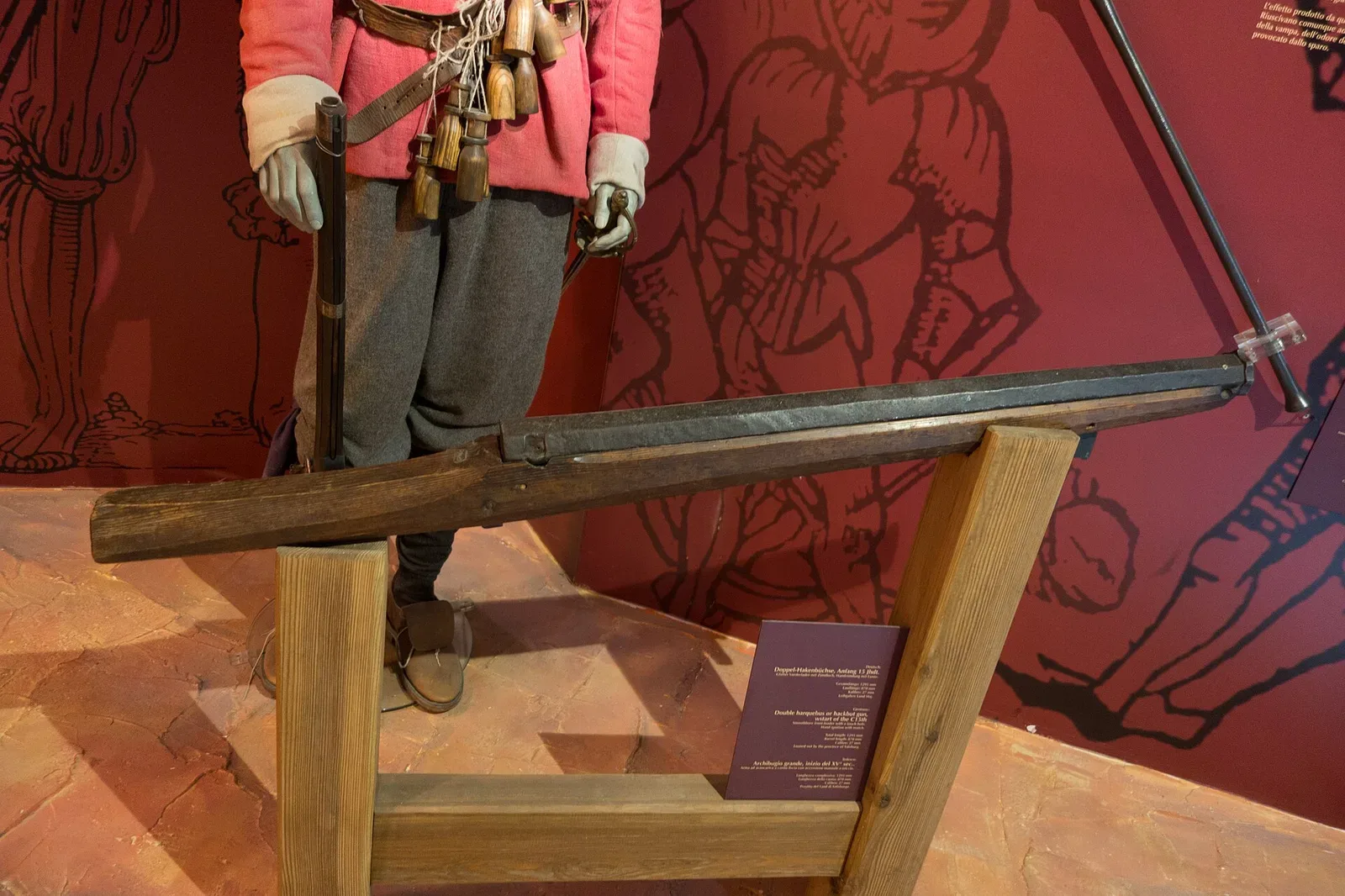
Every firearm that exists today traces its mechanical lineage through the hand cannon. That's not rhetorical — it's a direct line of development.
Per American Rifleman, the direct sequence runs: hand cannon → arquebus (with trigger) → matchlock (with mechanical ignition) → and the subsequent lock mechanisms that followed across the 16th through 19th centuries. Each step solved a specific problem that the hand cannon exposed — ignition reliability, accuracy, reloading speed, weather resistance — without changing the fundamental principle of a controlled explosion propelling a projectile through a metal tube.
The flash pan became the priming system for matchlocks, wheellocks, and flintlocks. The side-mounted touchhole became the basis for the lock mechanism. The shaped wooden stock, borrowed from the crossbow tradition, became the template for rifle and musket stocks. The trigger, first added in the arquebus, has appeared on every production firearm since.
The social legacy is equally significant. The hand cannon and its descendants destabilized the military economics of feudal Europe. Plate armor — extraordinarily expensive and the product of decades of metallurgical refinement — became unreliable protection against a weapon that cost a fraction as much and could be operated by a trained commoner. As the Smithsonian observes, "not even the most expensive or well-made armor could ensure a soldier's safety" once practical firearms proliferated. The armored knight's monopoly on battlefield effectiveness eroded through the 15th century and effectively ended by the 16th.
The Spanish Square — the dominant infantry formation of the early 16th century — combined harquebusiers and pikemen in mutual support, a doctrine made necessary by the arquebus's slow reload time. The solution to that problem, the matchlock's improved rate of fire and Maurice of Nassau's 42-step loading drill, transformed infantry tactics across Europe by the early 17th century. None of that happens without the hand cannon as the starting point.
Japan presents a counterpoint worth noting. Despite Mongol invasions in the 13th century exposing Japanese forces to gunpowder weapons, Japan did not produce domestic firearms until 1543 — when Portuguese traders introduced the matchlock, bypassing the hand cannon developmental stage entirely. The Japanese ōdzutsu, or hand cannon, was eventually adopted but never drove the same military-institutional transformation that European hand cannons did. The art of firing it has survived as the Ko-budō martial art form ōdzutsu-jutsu.
In the Islamic world, the hand cannon's adoption was uneven and sometimes actively resisted. The EBSCO source notes that Mamluk antagonism toward early riflemen in their infantry is documented, and the refusal of Safavid Qizilbash forces to use firearms contributed directly to the Safavid rout at the Battle of Chaldiran in 1514 — a battle that demonstrated, brutally, the cost of ideological resistance to gunpowder technology.
The hand cannon's defining characteristic — mechanical simplicity — is also its most historically important attribute. There was no proprietary mechanism to reverse-engineer, no complex tooling required, and no specialized metallurgy beyond what existing bronze and iron casting traditions already supported. Once the concept spread, it spread fast and it stayed. Seven hundred years later, the underlying principle hasn't changed.
The BGC Takeedit
What strikes me most about the hand cannon, every time I look at one, is how ugly the path from that iron tube to a modern rifle actually is. We tend to tell the story of firearms development as a clean linear progression — fire lance to hand cannon to arquebus to musket to rifle — and the technology does follow that line. But the people using these things were operating half-blind, with inconsistent powder, no standardized projectiles, a two-person crew, and a very real chance of the thing detonating in their hands. The metallurgy was inconsistent. The ignition was weather-dependent. The accuracy was, by any modern measure, terrible.
And yet it worked. Not because the hand cannon was a particularly good weapon by the standards of its time — the longbow outperformed it in accuracy, rate of fire, and reliability for decades after its introduction — but because it was good enough and it pointed at something the longbow couldn't reach. The psychological effect on horses and men who had never experienced an explosion was real and tactically significant. The armor-penetration capability, crude as it was, addressed a problem that no amount of archery skill could fully solve. And the scalability was obvious: you didn't need 20 years of training to hand a man a tube and show him how to touch a match to a hole.
The hand cannon is the proof of concept. Every trigger you've ever pulled traces back to someone deciding that the problems with this clumsy, heavy, unreliable iron tube were worth solving rather than abandoning. That's the actual legacy — not the weapon itself, but the decision to keep working on it.
Referencesedit
- Wikipedia: Hand Cannon — https://en.wikipedia.org/wiki/Hand_cannon
- Smithsonian National Museum of American History: "The hand cannon: A very early (and heavy) firearm" — https://americanhistory.si.edu/explore/stories/hand-cannon-very-early-and-heavy-firearm
- American Rifleman: "I Have This Old Gun: Medieval Hand Cannon" — https://www.americanrifleman.org/content/i-have-this-old-gun-medieval-hand-cannon/
- EBSCO Research Starters: "Handarms and Firearms" — https://www.ebsco.com/research-starters/history/handarms-and-firearms
Last Updated: February 27, 2026
- Gls Guns(Sumner, IA)
- Bi-mart - Yakima (Fruitvale Ave)(Yakima, WA)
- New Philly Sportsman Specialities(New Philadelphia, OH)
- R&R Sports & Outdoors(Brandon, FL)
Loading comments...