Details
Snaphaunce Lock

Interior wheellock mechanism (c. 1580) — the rotating steel wheel and spring-driven sear system that snaphaunce makers would later simplify and refine.
| Origins | |
|---|---|
| Invented | Late 1550s |
| Country | Origin claims spread across Spain, Holland, Germany, Scotland, and Sweden — no single country can be attributed with certainty |
| Timeline | |
| Era | 16th and 17th centuries |
| Replaced By | Flintlock |
| Impact | |
| Significance | A mechanical bridge between the wheellock and flintlock that combined on-demand spark generation with greater simplicity and affordability, becoming the dominant cavalry sidearm across Western Europe before being superseded by the true flintlock around 1680 |
Snaphaunce Lock: The Bridge Between Wheellock and Flintlock
Firearms encyclopedia article
From The Boise Gun Club Handbook
Overviewedit
The snaphaunce lock — also spelled snaphance — sits at one of the most consequential junctions in the history of firearms ignition. It arrived in the late 1550s as a direct mechanical improvement over the snaplock, drew on the automatic pan-cover concept pioneered by the wheellock, and laid the groundwork for the flintlock that would go on to dominate warfare for the better part of two centuries. It was never the final answer, but it was exactly the right answer for its moment.
At its core, the snaphaunce drives a piece of flint — held in a spring-loaded clamp on a bent lever called the cock — forward against a curved steel plate positioned above a priming pan. The resulting shower of sparks ignites the priming powder, which flashes through the touch hole into the main charge and fires the gun. The mechanism shared the same fundamental physics as the flintlock that followed it, but with one critical structural difference that would ultimately determine its fate.
According to the Wikipedia article on the snaphance, the name itself is Dutch in origin — derived from Snaphaan, roughly meaning "pecking rooster" — a reference both to the mechanism's darting downward action and the beak-shaped cock that holds the flint. The word traveled through European languages and picked up new meanings along the way:
- Dutch Snaphaan — "pecking rooster" (original mechanism reference)
- German Schnapphahn — mounted highwayman (criminal association)
- French chenapan — rogue or scoundrel (general lawlessness)
The weapon was associated, at least in the popular imagination, with the sort of person who needed a fast, concealable firearm.
Development Historyedit
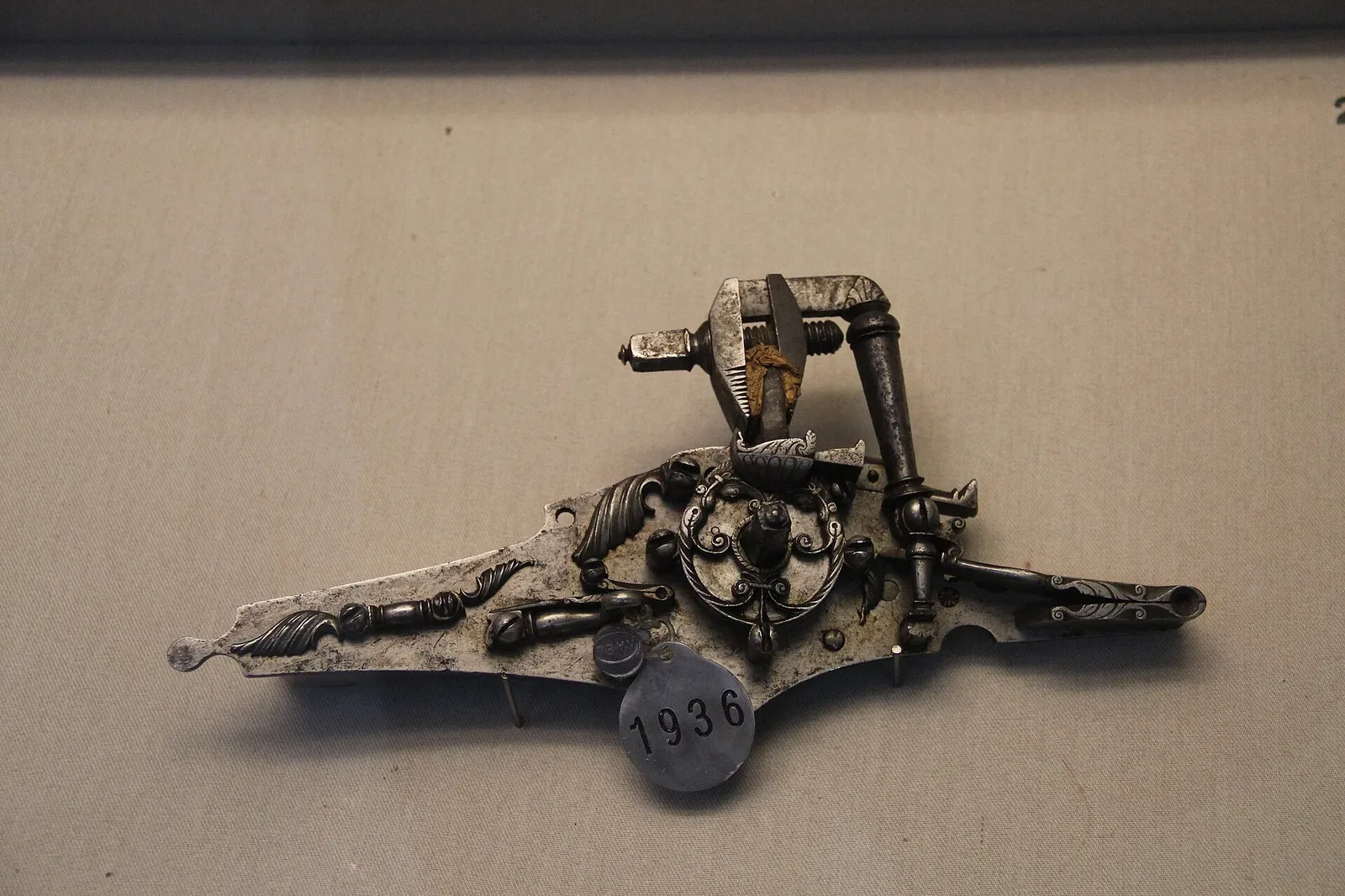
Origins and Early Development
Before the snaphaunce, infantrymen primarily relied on the matchlock — a system that required a lit slow-burning match to be held near the touch hole. It worked, but managing an open flame while handling loose gunpowder was as dangerous as it sounds. The wheellock solved the open-flame problem by using a serrated spinning wheel against a piece of iron pyrite to generate sparks on demand, but it was expensive, mechanically complex, and sensitive to dirt and fouling.
Per the National Institute of Justice's archived Firearms Examiner Training material, the wheellock was crafted by highly skilled artisans at a level of precision uncommon for the manufacturing techniques of the period — which is exactly why it never became a true infantry weapon.
The snaphaunce offered a third path. According to Wikipedia's snaphance entry, it first appeared in the late 1550s, with origin claims spread across Spain, Holland, Germany, Scotland, and Sweden — and no single country can be attributed with certainty.
The snaphaunce offered the wheellock's on-demand spark generation combined with something closer to the matchlock's mechanical simplicity.
What it delivered was the wheellock's on-demand spark generation combined with something closer to the matchlock's mechanical simplicity. The NIJ training material describes it plainly: for little more than the expense of fabricating a spring matchlock, nations could arm troops with a simple, flint-fired musket or pistol.
| Lock Type | Time Period | Key Features | Cost (circa 1645) | Primary Users |
|---|---|---|---|---|
| Matchlock | 1400s-1600s | Lit slow match, simple mechanism | 10 shillings | Infantry standard |
| Wheellock | 1500s-1600s | Spinning serrated wheel, pyrite | 3 pounds/pair | Wealthy cavalry |
| Snaphaunce | 1550s-1680s | Flint on steel, auto pan cover | 15 shillings | Cavalry officers |
| Flintlock | 1620s-1840s | Combined frizzen, simplified | 15 shillings | Universal adoption |
Mechanical Innovations
The mechanism's defining innovation over the earlier snaplock was an automatically opening pan cover. The snaplock had a manually operated pan cover — the shooter had to remember to open it before firing, much like the matchlock. The snaphaunce eliminated that step: as the cock fell forward, the pan cover moved aside automatically, exposing the priming powder to the incoming sparks at exactly the right instant. This kept the powder dry during carry and removed a manual step under the stress of combat or a fast-moving cavalry engagement.
The steel — the curved striking plate the flint hit — was mounted on an arm that moved independently of the pan cover, which is where the snaphaunce diverged from what would eventually become the true flintlock. A lateral sear mechanism inside the lock connected the trigger to the cock, similar to the wheellock's internal geometry. Later versions added various safety mechanisms to prevent accidental discharge, a real concern: Richard Hakluyt's Voyages records the death of one of Thomas Cavendish's crew during his circumnavigation in the 1580s from an accidental snaphaunce discharge on the coast of Ecuador.
Regional Variants
The snaphaunce developed in parallel with — but separately from — the miquelet lock, a related flint-ignition design that followed its own evolutionary path toward the mature flintlock.
Timeline showing the snaphaunce's place in firearms evolution
How It Worksedit
Basic Operating Sequence
The operating sequence is straightforward once you understand the parts. The flint is clamped in the jaws of the cock, a bent lever under tension from a strong mainspring. When the trigger is pulled, the cock swings forward and the flint's edge strikes the steel — a hardened curved plate positioned above the pan. That impact shaves off white-hot steel particles that function as sparks, which fall into the flash pan holding a small charge of fine priming powder. The resulting flash travels through the touch hole drilled in the barrel wall and ignites the main powder charge behind the ball.
Operating sequence of the snaphaunce lock mechanism
The Pan Cover Mechanism
The automatic pan cover is mechanically linked so that as the cock travels forward, the cover sweeps aside just in time to expose the priming powder to the falling sparks. The steel itself is at the end of an arm that pivots independently — this is the mechanical detail that separates the snaphaunce from the true flintlock.
Snaphaunce vs. Flintlock Design
In the flintlock, the steel and the pan cover are combined into a single L-shaped part called the frizzen. When the flint strikes the frizzen, that single component simultaneously produces the sparks and rotates up and out of the way to expose the pan — one part doing two jobs. The NIJ training material identifies this combined frizzen as the defining improvement that separates the flintlock from the snaphaunce.
The snaphaunce's separate steel and pan cover created a practical problem that the flintlock solved elegantly. As Wikipedia notes, the flintlock could be carried at half-cock with the frizzen closed — meaning the flint sat in close proximity to the steel and could be easily adjusted to strike square. The snaphaunce had no true half-cock position with the steel engaged; the cock was either at full-cock or rested down in a position that prevented the steel from being brought into firing position. Aligning the flint precisely was harder as a result.
The manual workaround for a snaphaunce's safety was to physically move the steel forward out of the cock's path — if the cock accidentally released, it would swing through without striking anything. Functional, but inelegant.
Key mechanical difference between snaphaunce and flintlock designs
Impact on Warfare & Societyedit
Military Adoption Patterns
The snaphaunce entered military use at a moment when cavalry was rethinking how it fought. A mounted soldier needed a weapon he could carry loaded and discharge quickly — ideally without a lit match that wind and rain could extinguish at the worst possible moment. Pistols were the natural fit, and the snaphaunce pistol became the cavalry officer's sidearm across much of Western Europe through the 16th and into the 17th century.
James Turner's Pallas Armata, written in the 1630s, documented the geographic divide in lock preference across European armies at the time:
The French use locks with half bends (snaphaunces), and so do for the most part the English and Scots; the Germans rore or wheel-locks; the Hollanders make use of both. — James Turner, Pallas Armata, 1630s
| Region/Nation | Lock Preference (1630s) | Source | Notes |
|---|---|---|---|
| France | Snaphaunce (half bends) | Turner's Pallas Armata | Led transition to flintlock ~1620 |
| England & Scotland | Snaphaunce | Turner's Pallas Armata | Developed English lock variant |
| German States | Wheellock | Turner's Pallas Armata | Superior craftsmanship tradition |
| Holland | Both systems | Turner's Pallas Armata | Pragmatic mixed adoption |
| New England Colonies | Snaphaunce | Colonial records | Dominant until mid-1600s |
That's a useful snapshot — the snaphaunce had become the dominant choice for France, Britain, and Scotland, while German forces clung to the wheellock that their craftsmen knew how to build.
Cost and Production Factors
What kept the snaphaunce from replacing the matchlock for infantry was a combination of cost and complexity — though cost became less of a barrier as production scaled. By 1645, a matchlock musket cost 10 shillings in Britain compared to 15 shillings for a flintlock musket, per Wikipedia's sourced figures. That 50 percent premium was real money when you were equipping regiments.
Flintlocks were still dramatically cheaper than wheellocks, though: Royal Armoury purchase records from 1631 show wheellock pistols going for 3 pounds per pair against 2 pounds per pair for flintlocks.
Colonial American Experience
The snaphaunce also made a significant mark in the American colonies. According to Wikipedia, it dominated the New England gun market until the middle of the 17th century. Its decline there was sharp enough to trigger legislative action:
- Virginia — outlawed snaphaunce by late 17th century
- Massachusetts — legislated against obsolete mechanism
- Connecticut — banned unreliable snaphaunce locks
Association with Outlaws
Beyond formal military use, the snaphaunce's relative affordability and compact form made it the preferred weapon of people operating outside the law. The German linguistic drift of Schnapphahn toward "mounted highwayman" wasn't accidental — a fast-drawing pistol that didn't require a lit match was exactly what someone stopping coaches on a road needed. The weapon's association with brigands and outlaws became embedded enough in European languages to reshape the meaning of the word itself.
The Scanian Wars Connection
During the Second Northern and Scanian Wars, the term took on a specifically political dimension. In the province of Scania — recently annexed by Sweden from Denmark — pro-Danish guerrilla fighters were called Snapphanar, named for the lock type associated with their smallbore rifles. When the Royal Armoury in Stockholm inventoried captured arms after the Swedish conquest of the former Danish provinces of Skåne, Halland, and Blekinge in the 1670s, they described the locks on those guerrilla weapons as snapphanelås — snaphance locks. The term appears in that context in Stockholm's Royal Armoury inventories as early as 1730, according to Wikipedia.
English Variant Development
The English developed their own regional variant. The English snaphance lock became one of the most distinctive national interpretations of the mechanism. Research cited in the Muzzleloading Forum indicates that only approximately 80 English snaphaunce muskets, pistols, and detached locks are known to have survived worldwide — not counting excavated, converted, or incomplete examples. Modern testing of the surviving examples has demonstrated the English snaphance to be a fast and reliable mechanism, suggesting it was a genuine competitor to both the matchlock and the wheellock during the 16th century.
European Transition to Flintlock
In the broader European picture, France led the transition away from the snaphaunce. According to Wikipedia, the snaphaunce was replaced there by the true flintlock — with its combined steel and pan cover — starting around 1620. England moved in parallel, with the hybrid English lock replacing the snaphaunce from roughly the same date. Both the flintlock and the English lock were cheaper and mechanically simpler than the snaphaunce, which effectively closed the argument. By about 1680, the snaphaunce was broadly superseded across Western Europe, though it lingered in specific contexts: Wikipedia notes it was still occasionally issued to reinforcements for Portugal for the British Army during the War of the Spanish Succession in 1703, and remained in use in parts of Northern Italy until the 1750s.
Modern Relevanceedit
The snaphaunce survives today almost entirely in museum collections, historical research, and the hands of muzzleloading enthusiasts who reconstruct 16th and 17th century firearms. As a mechanism, it has no practical modern application — the percussion cap ended the flintlock era, and everything that came after made even the flintlock a curiosity. But the snaphaunce matters in another way: it is one of the clearest case studies in how firearms technology actually advances.
The progression from matchlock to wheellock to snaphaunce to flintlock wasn't a clean series of inventions by single inventors in single countries. It was a parallel, competitive, overlapping process across multiple nations, with regional variants developing simultaneously and different military establishments adopting different solutions based on their own manufacturing capabilities, tactical priorities, and economics. The snaphaunce won cavalry and lost infantry. It spread across three continents. It outlasted its welcome in some places and got legislated out of existence in others.
| Survival Category | Quantity | Condition Notes | Significance |
|---|---|---|---|
| English Snaphaunce Muskets | ~80 worldwide | Excludes excavated/converted | Extremely rare collector items |
| Museum Collections | Major holdings | Various conditions | Primary research specimens |
| Reproduction Arms | Active production | Functional replicas | Living history & research |
| Archaeological Finds | Undocumented | Fragmentary | Historical context evidence |
Surviving Examples
For collectors, original snaphaunce pieces — particularly English examples — are exceptionally rare. The roughly 80 known surviving English snaphaunce arms represent a category of artifact with essentially no new supply entering the market.
Historical Significance
For researchers, the mechanism sits at a well-documented inflection point where cost, metallurgy, and battlefield necessity pushed firearms technology toward the standardized flintlock that would carry armies through the 17th and 18th centuries.
For anyone building a mental map of how we got from a hand cannon to a modern semi-automatic pistol, the snaphaunce is one of the places where the path got decisively narrower — where competing solutions got sorted out by the market, the battlefield, and eventually the legislature.
The BGC Takeedit
What strikes me about the snaphaunce, looking back at it, is how much it resembles a lot of intermediate technology — it solved the right problem at the right time and then got leapfrogged by a simpler solution that did the same job more elegantly. The wheellock was the expensive specialist's tool. The matchlock was the cheap workhorse that everyone hated in the rain. The snaphaunce threaded that needle, got cavalry through a transition period that lasted the better part of a century, and then stepped aside for the flintlock.
The combined frizzen is such an obvious improvement in hindsight that it's almost funny the snaphaunce lasted as long as it did. But that's how this always goes — the 'obvious' improvement only looks obvious after someone figures it out.
Until then, gunsmiths across Europe were all building variations of a two-part system and presumably considering it perfectly normal.
The colonial American angle is interesting too. New England embraced the snaphaunce, depended on it, and then had to pass laws to force people off it when it became obsolete — which tells you something about how attached people get to the system they learned on, even when something better is available. That's not unique to the 17th century.
If you ever get a chance to handle a reproduction snaphaunce at a living history event or a muzzleloading match, do it. The lock cycle is satisfying in a way that's hard to describe — there's a mechanical directness to it that the wheellock's clockwork complexity doesn't have. You can follow every step of what's happening just by watching the parts move. That transparency is part of why it worked, and part of why it mattered.
Referencesedit
- https://en.wikipedia.org/wiki/Snaphance
- https://www.muzzleloadingforum.com/threads/the-english-snaphance-lock.109146/
- https://nij.ojp.gov/nij-hosted-online-training-courses/firearms-examiner-training/module-03/ignition-systems
- https://fuzzymonkies.weebly.com/snaphaunce-firearm.html
Last Updated: February 27, 2026
- Gls Guns(Sumner, IA)
- Bi-mart - Yakima (Fruitvale Ave)(Yakima, WA)
- New Philly Sportsman Specialities(New Philadelphia, OH)
- R&R Sports & Outdoors(Brandon, FL)
Loading comments...