Details
Marin le Bourgeoys
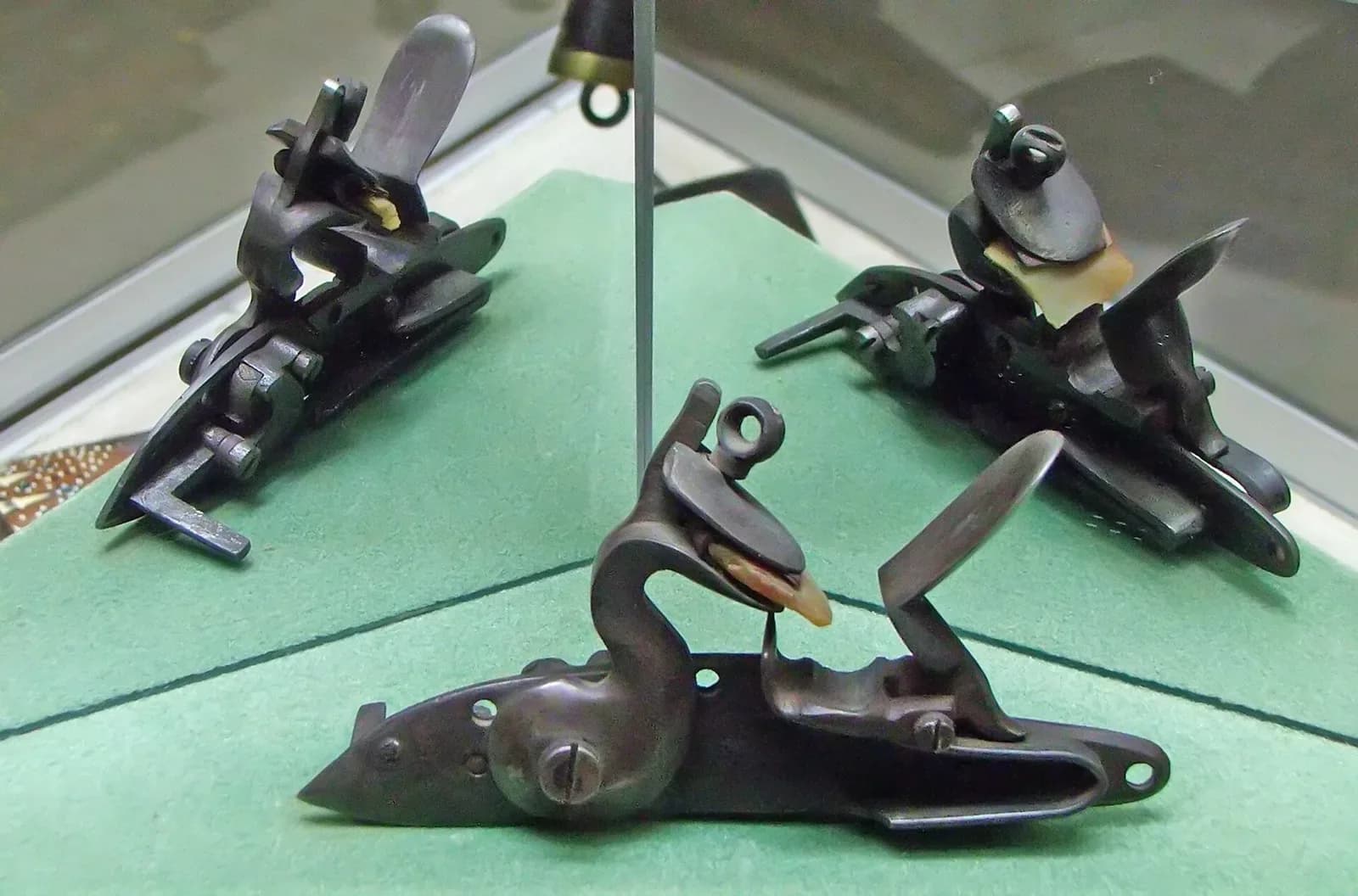
A flintlock mechanism photographed at New Zealand's Army Museum — the standardized design le Bourgeoys pioneered in early 17th-century France.
| Biography | |
|---|---|
| Born | c. 1550, Lisieux, Normandy, France |
| Died | 1634 |
| Nationality | French |
| Legacy | |
| Known For | Creating the standardized flintlock mechanism that became the dominant ignition system for firearms for over 200 years |
| Key Innovation | The true flintlock mechanism featuring a vertically acting sear, integrated internal components, and a half-cocked safety position, developed between 1610-1615 |
Marin le Bourgeoys: The Man Who Standardized the Flintlock
Firearms encyclopedia article
From The Boise Gun Club Handbook
Overviewedit
Marin le Bourgeoys (c. 1550–1634) was a French artist, gunsmith, and inventor who created what historians and firearms scholars now call the true flintlock — the ignition mechanism that would define firearms technology for more than two centuries. Working in the royal court of France, he synthesized earlier flintlock designs into a single, mechanically coherent system that was reliable enough to copy, cheap enough to produce at scale, and safe enough to hand a soldier.
His lock design spread across Europe within decades and remained the standard ignition system for military and civilian firearms until the 1840s, when the percussion lock finally replaced it.
If you've ever heard someone say "don't go off half-cocked" or "a flash in the pan," you're quoting the mechanical reality of the gun Marin le Bourgeoys built.
Early Life & Backgroundedit
Artisan Origins
Le Bourgeoys was born into a noted artisan family in Lisieux, in the Normandy region of France, around 1550. The sources suggest he was probably trained initially as a painter — which tracks, given that Normandy had a strong craft tradition and the boundary between fine art and mechanical art was considerably blurrier in 16th-century Europe than it is today.
He eventually built a reputation that crossed multiple disciplines. He was recognized as a painter, a luthier (instrument maker), a gunsmith, and an inventor — the kind of multi-skilled craftsman that the French royal court actively recruited.
| Year | Position/Achievement | Significance |
|---|---|---|
| c. 1550 | Born in Lisieux, Normandy | Raised in artisan family with craft tradition |
| 1598 | Appointed Valet de Chambre by Henry IV | Gained direct access to royal court |
| 1608 | Granted rooms in Grand Gallery of the Louvre | Workshop space for firearms, art, instruments |
Royal Court Appointment
In 1598, his abilities caught the attention of King Henry IV, who appointed him Valet de Chambre in the Royal Court. It was a title that carried real access — le Bourgeoys wasn't just a contracted supplier, he was embedded in the court itself.
By 1608, that access had expanded further. He was granted rooms in the Grand Gallery of the Louvre, where he produced artwork, firearms, air guns, crossbows, and movable globes. According to the DMG-Lib record of his work, one of those globes — made for Henry IV — mapped the movements of the sun, moon, and fixed stars. The man's range was genuinely unusual.
Key Contributionsedit
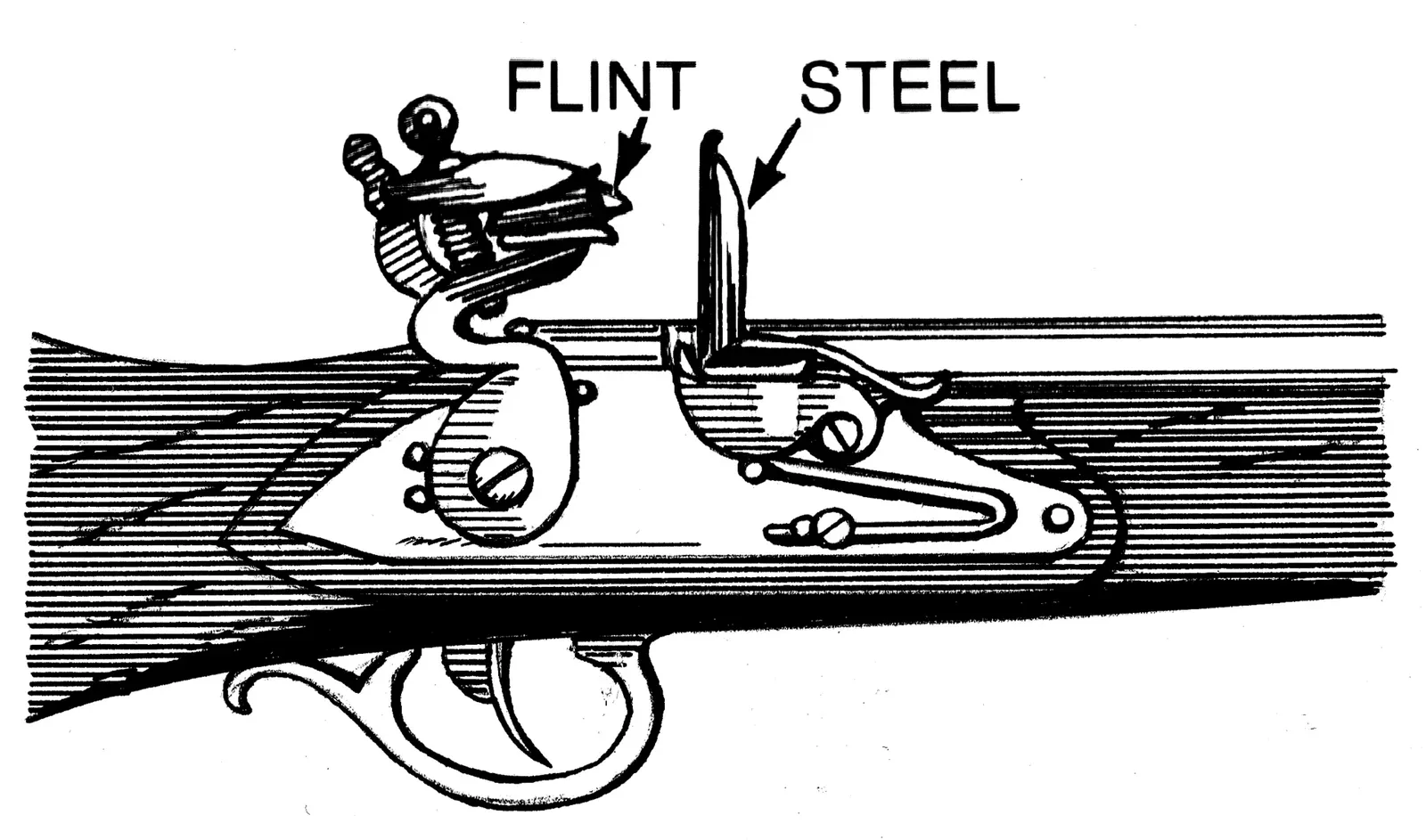
To understand what le Bourgeoys actually built, you need to understand what existed before him — and why it was a problem.
The Problem with Earlier Systems
By the late 16th century, firearms were being fired primarily by matchlock or wheellock mechanisms. The matchlock required a length of slow-burning match cord to be kept lit and ready at all times. Rain killed it. Darkness betrayed it — the glow of a burning match was visible at night, turning the shooter into a target. And the open flame created a constant accidental discharge risk severe enough that soldiers in matchlock formations had to stand with wide gaps between them, which is why pikemen existed at all — to fill those gaps and provide defense against cavalry.
The wheellock was more sophisticated but expensive and mechanically fragile. Neither system was a satisfying answer.
Preceding le Bourgeoys, there were several early flintlock variants:
- Snaplock - early flint-and-steel design
- Snaphance - separate steel and pan cover system
- Miquelet - strong mainspring mechanism
- Doglock - included safety catch feature
| Lock Type | Key Features | Limitations |
|---|---|---|
| Matchlock | Slow-burning match cord | Visible at night, fails in rain, fire hazard |
| Wheellock | Spring-wound mechanism | Expensive, mechanically fragile |
| Snaplock | Early flint-and-steel | Regional design, not standardized |
| Snaphance | Separate steel and pan cover | Complex mechanism |
| Miquelet | Strong mainspring | Limited to Spanish regions |
| Doglock | Safety catch feature | Horizontal sear design |
| True Flintlock | Vertical sear, integrated design | Reliable, cost-effective, standardized |
Each of these designs used flint striking steel to generate sparks rather than relying on a burning match. They were genuine improvements, but none of them achieved mechanical standardization. They were regional solutions, not universal ones.
Technical Innovation
Sometime between 1610 and 1615, le Bourgeoys produced what those earlier designs had not: a fully integrated, mechanically coherent flintlock. According to the Wikipedia article on the flintlock mechanism, the key technical element he added was a vertically acting sear. In earlier designs, the sear — the catch that held the mechanism ready to fire — passed through a hole in the lockplate to engage the cock from outside.
Le Bourgeoys redesigned it to act on an internal component called the tumbler, which was mounted on the same rotating shaft as the cock. This kept the entire critical mechanism inside the lock, where it was protected, and made the action of trigger to fire both more direct and more consistent. Per the Guinness World Records entry on the subject, he also combined and adapted earlier mechanisms so that the cock and trigger acted vertically instead of horizontally — a geometry that proved mechanically superior in practice.
The other defining feature of his design was the half-cocked position. From half-cock, the weapon could be safely loaded — powder poured into the pan, frizzen closed, hammer drawn to full cock — without risk of accidental discharge. Pulling the trigger from half-cock would not fire the gun. This was a direct safety improvement over earlier designs, and it became standard practice across European gunsmithing as other craftsmen copied his lock.
The flintlock firing sequence showing le Bourgeoys's integrated vertical sear system
Mechanical Operation
The flintlock mechanism itself worked like this: a piece of flint, clamped in the jaws of the hammer (or "cock"), struck a pivoting steel plate called the frizzen when the trigger released the sear. That impact simultaneously scraped a shower of hot steel fragments onto the flash pan and knocked the frizzen open, exposing the priming powder to those sparks. The powder ignited, and flame traveled through a touch hole into the barrel, setting off the main propellant charge.
The whole sequence happened in a fraction of a second. What made le Bourgeoys's version the one that stuck was not any single element — it was the integration. His design was the most efficient in terms of cost and reliability, which meant it was the one other gunsmiths copied. By the end of the 17th century, his true flintlock had replaced all competing variants as the dominant ignition system across Europe.
Impact on Firearms Developmentedit
The downstream consequences of le Bourgeoys's lock are hard to overstate.
Timeline of flintlock adoption and military significance
Military Transformation
On the battlefield, the flintlock changed how infantry formations worked. Soldiers no longer needed to maintain burning match cord, which eliminated the gaps between men in formation that the matchlock had forced. Tighter formations meant more concentrated volley fire.
Combined with the adoption of the bayonet, flintlock muskets allowed infantry to both deliver concentrated fire and form a defensive line against cavalry — eliminating the tactical role of the pikeman entirely.
| Production Center | Country | Monthly Output (1804) | Specialty |
|---|---|---|---|
| Brandon, Suffolk | England | 400,000+ flints | Military supply |
| Meusnes | France | Not specified | Civilian/military |
| Couffy | France | Not specified | Regional production |
Industrial Scale
Off the battlefield, the reliability and relative simplicity of the flintlock mechanism expanded the market for firearms broadly. According to the War History Online source, the design allowed a far greater variety of guns to be produced, which in turn accelerated development of the firearms industry in both Europe and North America. Pistols, fowling pieces, hunting rifles, military muskets — all of them ran on variations of le Bourgeoys's lock for the better part of 200 years.
The Brown Bess musket — Britain's standard military arm through much of the 18th century and into the Napoleonic Wars — used a flintlock. The firearms carried at Lexington and Concord were flintlocks. The rifles of the American frontier were flintlocks. The weapons of the Napoleonic Wars on both sides were overwhelmingly flintlocks. All of that runs through the lock geometry that le Bourgeoys worked out sometime in the early 1610s.
The flintlock also generated entire supporting industries. The gun flint trade became a substantial enterprise — according to the flintlock mechanism Wikipedia article, by 1804, the town of Brandon, Suffolk in England was supplying over 400,000 flints per month to the British military alone. France had its own production centers around Meusnes and Couffy. The scale of demand for something as simple as a shaped piece of flint illustrates how completely le Bourgeoys's design had penetrated military and civilian life.
Linguistic Legacy
The language survived too. Common phrases used today are all direct references to the mechanical operation of the flintlock musket:
- "Don't go off half-cocked" - referring to the safety position
- "A flash in the pan" - priming powder igniting without firing main charge
- "Lock, stock, and barrel" - the three main components of a flintlock musket
These phrases are so embedded in everyday speech that most people using them have no idea they're describing a 17th-century French gunsmith's firing mechanism.
Technological Succession
The flintlock's reign ended gradually rather than all at once. Percussion lock systems, which used a chemically primed cap rather than flint-and-steel, began displacing the flintlock in the early 19th century. By the 1840s, the transition was effectively complete in most military contexts.
| Technology | Dominant Period | Duration | Replacement |
|---|---|---|---|
| Matchlock | 1400s-1600s | ~200 years | Flintlock |
| Flintlock | 1610s-1840s | ~230 years | Percussion lock |
| Percussion Lock | 1840s-1870s | ~30 years | Metallic cartridge |
| Metallic Cartridge | 1870s-present | 150+ years | Still evolving |
The percussion lock itself then lasted only a few decades before being replaced by self-contained metallic cartridges. Le Bourgeoys's design had a run of roughly 230 years as the dominant ignition technology — the percussion lock that replaced it managed perhaps 50.
Later Life & Legacyedit
Continued Service
Le Bourgeoys continued in royal service through the reign of King Louis XIII, who succeeded Henry IV. The firearms he produced for Louis XIII were treated as objects of art — the king kept many in a private collection and gave others as diplomatic gifts to favored courtiers and distinguished visitors. A 17th-century French flintlock gun attributed to the workshop of Marin le Bourgeoys, made for Louis XIII and bearing the king's crowned monogram, survives as one of the earliest known firearms equipped with the flintlock mechanism.
He died in 1634, at roughly 83 or 84 years of age — a long life by any measure, and an extraordinary one by the standards of 17th-century France. He left behind a portfolio that spanned fine art, instrument making, mechanical invention, and court gunsmithing.
Historical Attribution
Credit for the true flintlock has not always been uniformly assigned. The Britannica entry notes the invention was "probably" by le Bourgeoys, and the Wikipedia flintlock mechanism article acknowledges that "its exact origins are not known." The historical consensus, however, consistently points to le Bourgeoys as the primary figure — the designer whose lock became the template everyone else followed.
That practical adoption is ultimately the more meaningful measure of attribution than any surviving patent or court document. A portrait medal of Marin le Bourgeoys dated 1633 — made just a year before his death — survives as one of the primary visual records of the man himself.
The BGC Takeedit
What gets lost when we talk about le Bourgeoys is how strange his position actually was. Here's a man working simultaneously as a fine artist, a musical instrument maker, an inventor of mechanical globes, and a court gunsmith — and he somehow produced the single most consequential advance in personal firearms ignition technology between the invention of gunpowder and the metallic cartridge. That's not a narrow specialist achieving incremental improvement. That's a generalist with enough mechanical intuition to see what the specialists had missed.
The vertically acting sear sounds like a minor engineering tweak. It wasn't. It moved the critical engagement point inside the lock, where it was protected from wear and contamination, and it gave the trigger a cleaner, more consistent break. Every other flintlock maker in Europe figured that out within a generation — which is exactly how good ideas propagate when they actually work.
Two hundred and thirty years is an almost incomprehensible run for any mechanical design. The AR-15 platform is approaching 70 years and people act like it's ancient.
Le Bourgeoys's lock geometry outlasted entire empires. It armed the armies that fought the Seven Years' War, the American Revolution, the Napoleonic Wars, and a dozen other conflicts that shaped the modern world. And it started with one court craftsman in Paris deciding there was a better way to connect a trigger to a hammer.
That's worth knowing.
Referencesedit
- https://en.wikipedia.org/wiki/Marin_le_Bourgeoys
- https://en.wikipedia.org/wiki/Flintlock_mechanism
- https://www.guinnessworldrecords.com/world-records/101309-first-true-flintlock-mechanism
- http://www.dmg-lib.org/dmglib/main/biogrViewer_content.jsp?id=24411004
- https://www.warhistoryonline.com/war-articles/flintlock-musket.html
- https://www.alamy.com/stock-image-this-17th-century-french-flintlock-gun-attributed-to-the-workshop-167906145.html
Last Updated: February 27, 2026
- Gls Guns(Sumner, IA)
- Bi-mart - Yakima (Fruitvale Ave)(Yakima, WA)
- New Philly Sportsman Specialities(New Philadelphia, OH)
- R&R Sports & Outdoors(Brandon, FL)
Loading comments...