Details
Hussite Wars
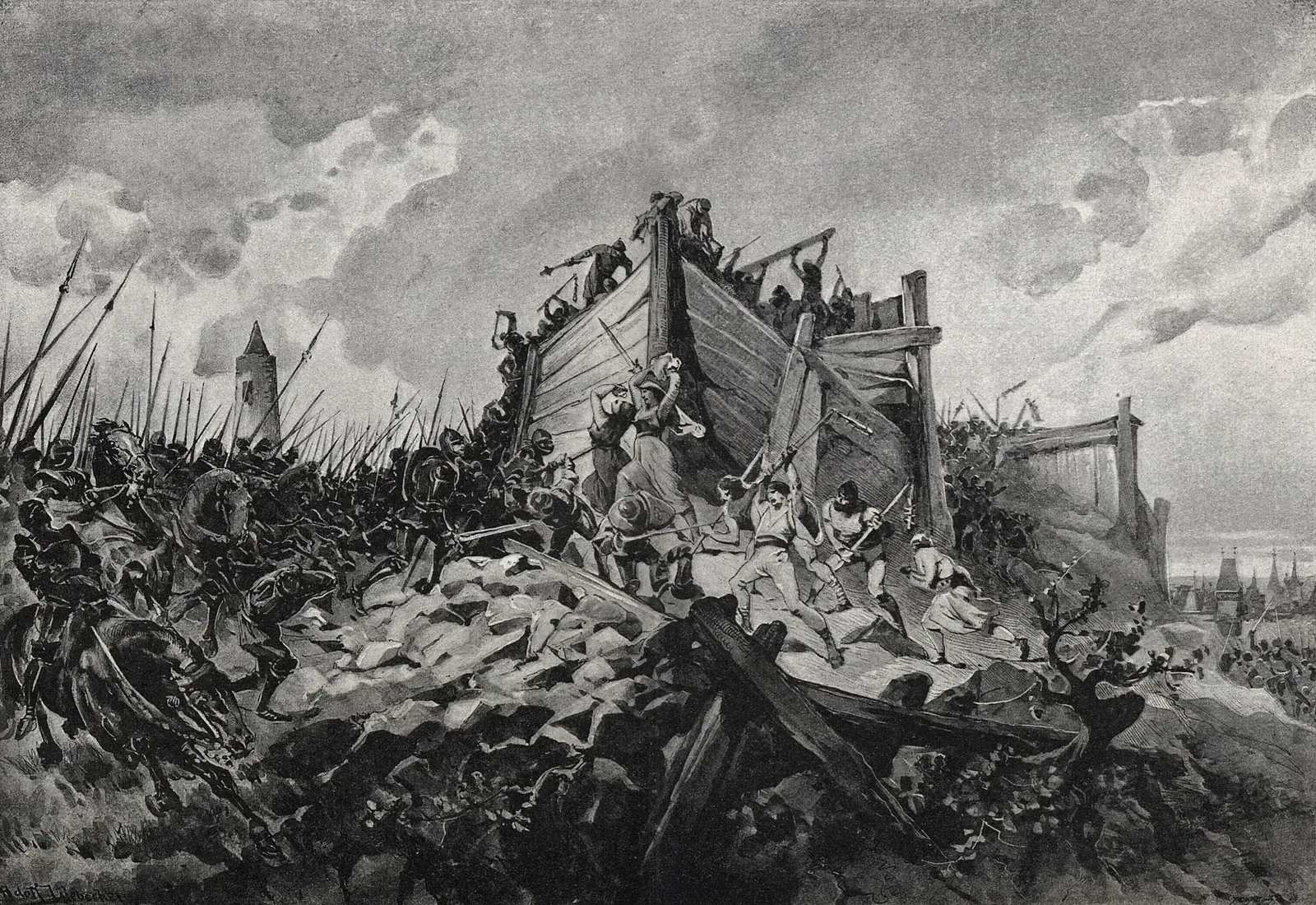
The Battle of Vítkov Hill (1420) — Žižka's first major victory, where outnumbered Hussites repelled a crusade army and established their military credibility.
| Battle Details | |
|---|---|
| Date | 1419–1434 |
| Location | Kingdom of Bohemia and surrounding territories |
| Belligerents | Hussites (Utraquists and Taborites) vs Holy Roman Emperor Sigismund, the Papacy, and a coalition of European monarchs |
| Result | Moderate Utraquist faction negotiated settlement; radical Taborites crushed at Battle of Lipany (30 May 1434); Basel Compacts signed 5 July 1436 |
| Legacy | |
| Firearms Significance | Hussites demonstrated that gunpowder weapons could be decisive in open field engagements when integrated into combined-arms tactics, transforming firearms from siege tools into field battle weapons and introducing the wagenburg formation that influenced European military doctrine. |
Hussite Wars (1419–1434): How Bohemian Peasants Rewrote the Rules of Gunpowder Warfare
Firearms encyclopedia article
From The Boise Gun Club Handbook
Overviewedit
The Hussite Wars — also called the Bohemian Wars or the Hussite Revolution — were a series of civil and religious conflicts fought between 1419 and 1434 in the Kingdom of Bohemia and surrounding territories. On one side: the Hussites, a reform movement drawn largely from Czech-speaking commoners, peasants, and minor nobility. On the other: the combined military weight of Holy Roman Emperor Sigismund, the Papacy, and a coalition of European monarchs who launched five separate crusades into Bohemia over the course of fifteen years. All five failed.
For the history of firearms, these wars are foundational. Not because of who won or lost — the moderate Utraquist faction eventually negotiated a settlement, the radical Taborites were crushed at the Battle of Lipany on 30 May 1434 — but because of how the Hussites fought.
The Hussites took early gunpowder weapons that military establishments across Europe still considered siege tools, put them in the hands of farmers and tradespeople, mounted them on purpose-built armored wagons, and built a combined-arms tactical system that was essentially unbeatable for the better part of a generation.
Two words in the modern English shooter's vocabulary — pistol and howitzer — trace directly back to these wars.
Background & Contextedit
Religious Reformation Begins
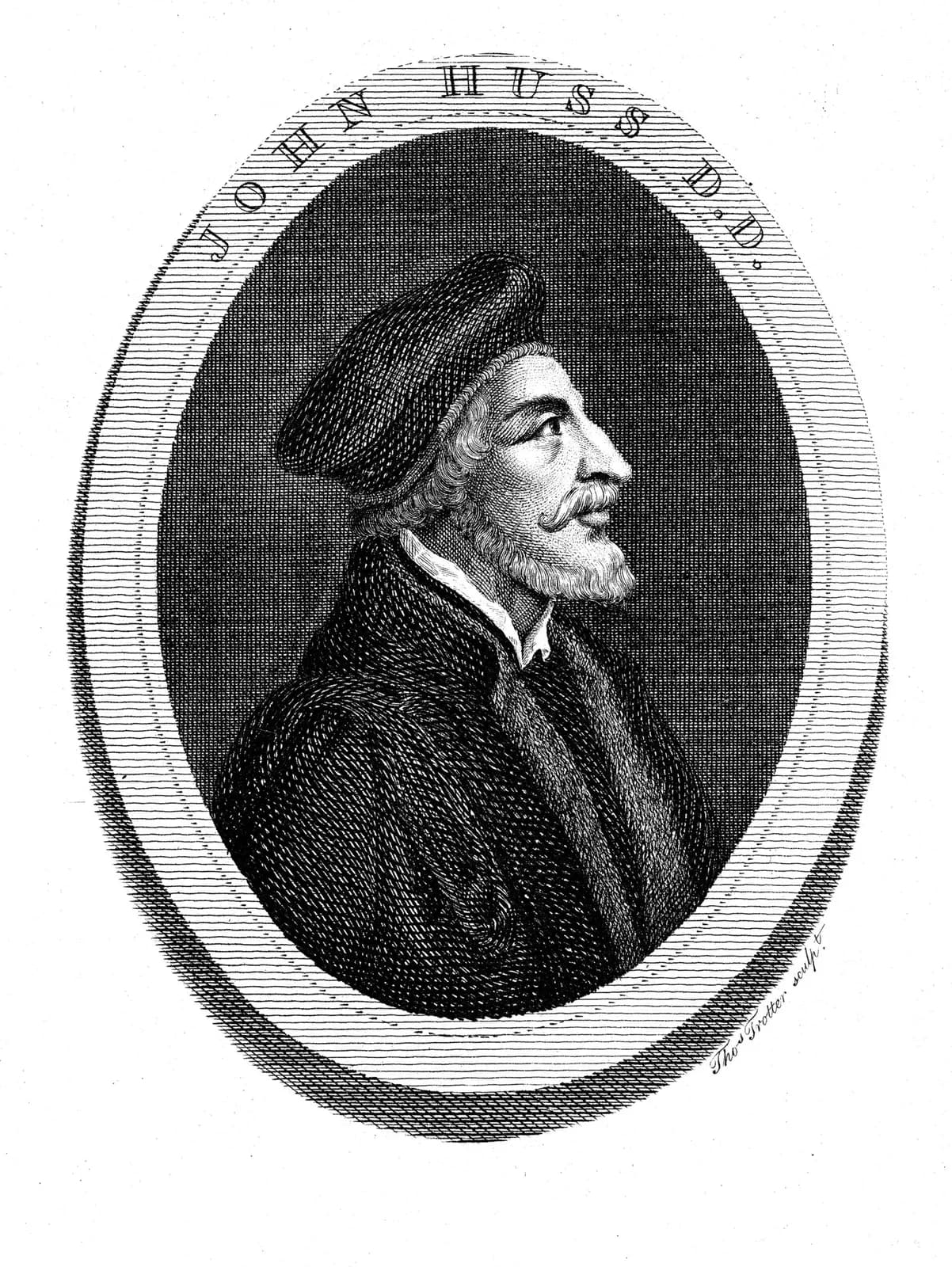
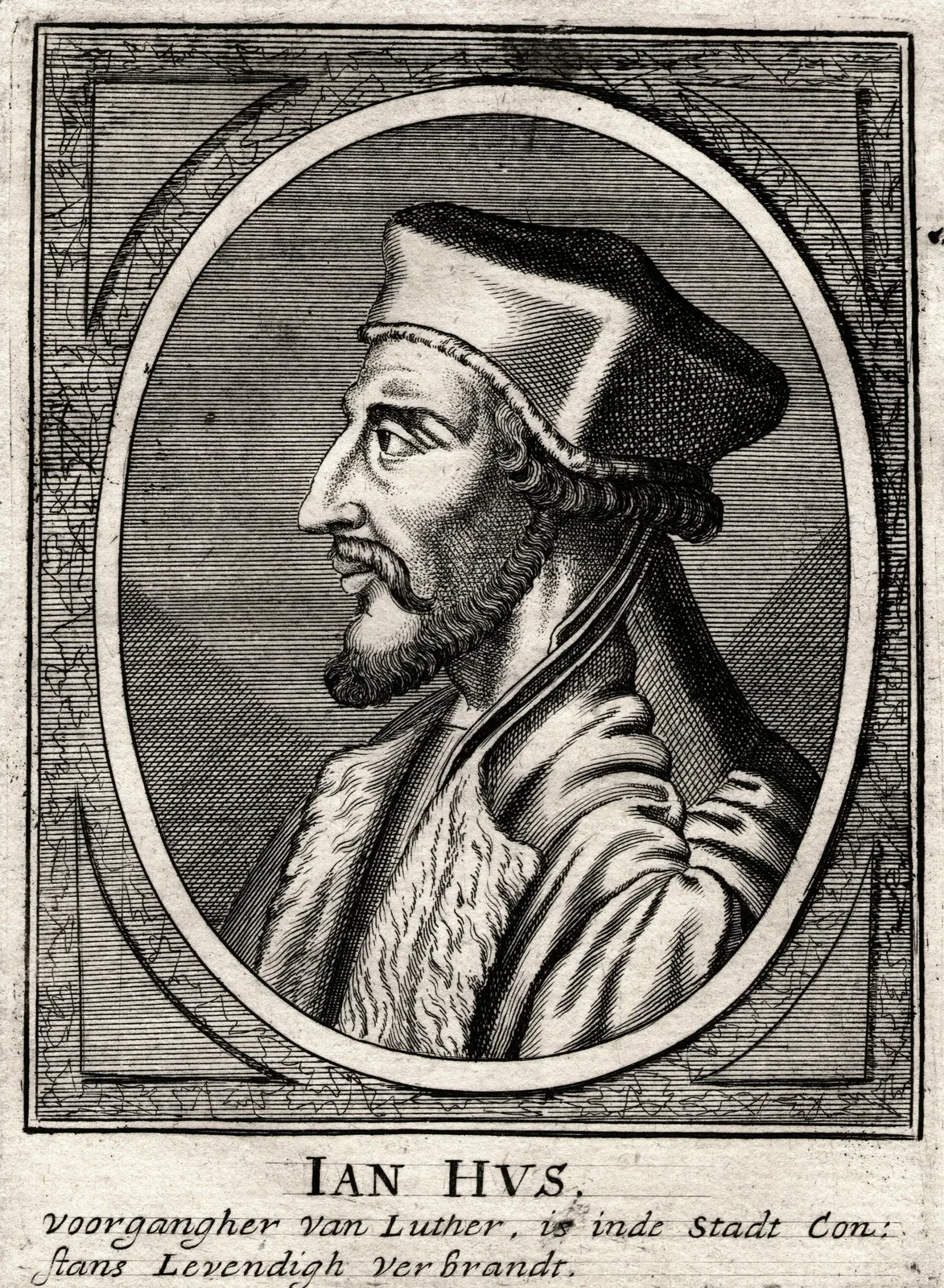
The spark was theological. Jan Hus, a Czech priest and scholar, spent years after 1402 denouncing what he saw as the corruption of the Catholic Church, drawing heavily on the reformist ideas of English theologian John Wycliffe. His preaching found a wide audience in Bohemia. The Church found it intolerable.
Timeline of events leading to the Hussite Wars
The Execution of Jan Hus
In 1414, Sigismund of Hungary convened the Council of Constance to address the ongoing Western Schism. Hus traveled to the Council under a safe-conduct guarantee from Sigismund, was imprisoned anyway, tried for heresy, and executed on 6 July 1415.
The Bohemian and Moravian nobility responded with the protestatio Bohemorum, a formal condemnation of the execution sent to the Council on 2 September 1415. Sigismund, who had effectively handed Hus over to his death, was furious. He sent threatening letters to Bohemia declaring he would drown all Wycliffites and Hussites.
The killing of Hus didn't suppress his movement — it radicalized it.
Factional Division
The Hussites divided into two broad camps almost immediately. The moderate faction, known as Utraquists or Calixtines, held to the doctrine of receiving communion in both bread and wine (sub utraque specie). The more radical faction, the Taborites, named after the town of Tábor that became their stronghold, rejected most Catholic ceremony and recognized only two sacraments: Baptism and Communion. Tábor was governed on a democratic basis with four elected captains, one of whom was Jan Žižka.
| Faction | Leadership | Location | Religious Position | Political Goals |
|---|---|---|---|---|
| Utraquists | Moderate nobles | Prague | Communion in both kinds | Reform within Catholic structure |
| Taborites | Jan Žižka, Prokop the Great | Tábor | Only Baptism & Communion | Democratic governance, radical reform |
| Catholics | Emperor Sigismund, Pope Martin V | Holy Roman Empire | Orthodox Catholic | Suppress heresy, restore royal authority |
The formal outbreak came on 30 July 1419, when a Hussite procession led by the priest Jan Želivský stormed the New Town Hall in Prague and threw the burgomaster, the town judge, and several councillors from the windows — the First Defenestration of Prague. King Wenceslaus IV died weeks later on 16 August 1419.
His brother Sigismund inherited the claim to the Bohemian crown, and with Pope Martin V issuing a bull on 17 March 1420 proclaiming a crusade "for the destruction of the Wycliffites, Hussites and all other heretics in Bohemia," the war was on.
Forces & Weaponsedit
Hussite Military Composition
The Hussite military was built from scratch out of unfavorable material. Their armies comprised primarily militiamen drawn from peasants and urban commoners — people with no prior military training, no aristocratic cavalry tradition, and no access to the expensive arms and armor that equipped a professional medieval knight.
Women served as infantry alongside men, usually armed with long-hafted flails or short polearms. Children were documented as serving as slingers within the wagon laager.
What the Hussites lacked in training and equipment, they partially compensated for through weapons selection. According to the Wikipedia source, crossbows and firearms became critical precisely because:
Those weapons didn't require extensive training, nor did their effectiveness rely on the operator's physical strength.
Early firearms were also relatively inexpensive — the Wikipedia source notes that the absence of guild monopolies and low training requirements kept prices down — and they had already proven effective against armored opponents in castle and town defenses before the wars began.
Firearms Arsenal
| Weapon | Czech Name | Type | Characteristics | Tactical Role |
|---|---|---|---|---|
| Hand cannon | Píšťala | Infantry firearm | Wooden stock, smooth-bore, metal bands | Individual marksman |
| Hook gun | Hákovnice | Heavy infantry | Metal hook for recoil control | Defensive positions |
| Light cannon | Tarasnice | Swivel gun | Equivalent to fauconneau | Anti-personnel |
| Howitzer | Houfnice | Artillery | Wide barrel, hoop-stave construction | Crowd dispersal |
| Mortar | Bombarda | Artillery | High-angle fire | Fortification assault |
| Cannon | Dělo | Artillery | Direct fire | Wall breaching |
The specific firearms fielded by the Hussites included:
- Píšťala — a handheld firearm, essentially a wooden stock attached to a smooth-bore barrel by metal bands with a simple ignition system. As calibers increased, gunsmiths added metal hooks to the barrel to hook over a gun loop and control recoil, earning the weapon the name "hook gun" or hákovnice in Czech.
- Hákovnice — a heavier infantry weapon than the píšťala.
- Tarasnice — equivalent to a fauconneau, a light swivel gun.
- Houfnice — a wide-barreled indirect-fire cannon constructed with hoop-and-stave construction, placed in its own wheeled cart. The name comes from the Czech houf, meaning "crowd," indicating its intended anti-personnel role.
- Bombarda — a mortar.
- Dělo — a cannon.
Infantry Weapons
The Hussite arsenal on the infantry side leaned heavily on the agricultural flail, repurposed as a weapon by driving iron spikes through the wooden head. The haft ran four to five feet long with a spiked head attached by a heavy two-link metal chain. Bohemian peasants accustomed to threshing grain for hours at a stretch could swing one of these all day. Other close-quarters weapons included improvised morning stars, bills, and — possibly for the first time in documented use — the aalspeiss or awlpike, a shafted weapon with a long thin metal spike and a rondel guard.
The Opposition
Opposing the Hussites across five crusades was the combined military establishment of late medieval Europe:
- Hungarian cavalry under Emperor Sigismund
- German knights from multiple duchies
- Papal mercenary forces
- Austrian and Saxon contingents
- Bavarian and Brandenburg troops
- Teutonic Order warriors
- English forces under Cardinal Henry Beaufort
These were well-equipped professional soldiers operating in the conventional mode of the era — heavy cavalry charges against infantry formations.
That conventional approach is exactly why they kept losing.
The Battleedit
Jan Žižka's Background
Jan Žižka — born around 1360 in Trocnov, Bohemia, to a minor noble family — was already an experienced professional soldier before the Hussite Wars began. He had served as royal huntsman to Wenceslaus IV, fought as a mercenary in border wars with Austria, and participated in the Battle of Grunwald in 1410 against the Teutonic Order alongside King Jagiełło of Poland. He was familiar with Polish and Lithuanian cavalry tactics, siege guns, field artillery, and battlewagons.
He had lost his right eye before the wars even started — reportedly roughhousing as a child.
The Wagenburg System
When the Hussite Wars began, Žižka brought that experience to bear on a fundamental tactical problem: how do you stop a charge by heavy cavalry when your army is mostly farmers?
His answer was the wagenburg — a formation of purpose-built armored war wagons, chained together wheel-to-wheel into a defensive perimeter that could take any shape the terrain demanded: oval, square, or rectangular. The wagons themselves were heavily reinforced with thick wooden planks on a rectangular base sitting roughly three-and-a-half feet off the ground.
Hanging planks, sometimes armor-plated, were suspended from the top on one side and pierced with loopholes for firearms and crossbow fire. A bottom-hinged door in the center swung down to form a wooden ramp into the interior. Additional hinged planking could be lowered below the wagon body to protect the wheels, also fitted with firing ports. Wooden mantlets slid between adjacent wagons to close gaps and present a continuous defensive face.
| Component | Specifications | Crew | Armament |
|---|---|---|---|
| War wagon | 3.5 ft height, armored planks | 20 soldiers | Loopholes for firearms/crossbows |
| Crew breakdown | Per wagon | 2 drivers, 2 handgunners | 6 crossbowmen, 8 infantry |
| Defensive features | Hanging planks, hinged doors | Bottom wheel protection | Sliding mantlets between wagons |
| Artillery support | Small cannons between wagons | Earthen mounds inside laager | Elevated fire positions |
Each wagon was manned by a crew of approximately twenty soldiers: two armed drivers, two handgunners, six crossbowmen, eight infantry armed with flails or polearms, and two shield bearers. Small cannons were positioned between wagons or on earthen mounds inside the laager to fire over the wagon walls. A defensive ditch was typically dug around the outer perimeter. Cavalry and draft animals were held in the interior.
Tactical Implementation
The tactical sequence was consistent and effective:
Standard Hussite tactical sequence using the wagenburg
Žižka would select elevated ground when possible, maximizing the defensive advantage and reducing the effectiveness of flat-trajectory enemy fire. His cavalry would sortie out to provoke an enemy attack, then withdraw into the wagon circle. As the attacking infantry and cavalry negotiated the terrain and approached the laager, handgunners and crossbowmen opened fire from behind cover. When the attackers were exhausted and their momentum broken, Hussite infantry pushed out from the gaps between wagons and cavalry swept from the flanks.
The concentrated fire of weapons that would have been scattered across an open field was instead focused through a fixed defensive perimeter — a fundamental tactical advantage that armored knights on horseback had no good answer for.
Early Battles
Žižka first demonstrated this system at the Battle of Sudoměř on 25 March 1420 — the first pitched battle of the Hussite Wars. His force was approximately 400 people, soldiers and non-combatants together, traveling in nine riders and twelve wagons. They were intercepted by an estimated 2,000 royalist cavalry — the Iron Lords.
Unable to secure high ground in the Otava River Valley, Žižka placed his infantry in a short, deep front flanked by a fishpond dam and marshy ground on one side, with his twelve wagons arrayed on the other sides to provide elevated crossbow and handgun fire. The royalist cavalry charged repeatedly, eventually dismounting for infantry assaults. Three wagons were severely damaged and the laager nearly breached — but the Hussites held. When darkness fell, confused royalist soldiers began killing each other in the dark, and the Iron Lords withdrew.
Over the following years, Žižka refined and extended the system. Through 1420 and most of 1421, the wagenburg was used defensively — a stationary wall against which enemy charges broke. The first mobile use came in November 1421 at the Battle of Žlutice, where Žižka used moving wagon columns to cover a retreat through Catholic encirclement at Vladař Hill.
A month later, in December 1421, the first engagement where firearms played the primary offensive role took place at the Battle of Kutná Hora. Late at night between 21 and 22 December, Žižka ordered a night attack against the enemy's main camp using a gradually advancing wagon wall. Instead of the usual pattern of wagon defense followed by infantry counterattack, the assault relied principally on ranged fire from the moving wagons. According to the Wikipedia source, "nighttime use of firearms proved extremely effective, not only practically but also psychologically."
The Five Crusades
| Crusade | Year | Key Battle | Outcome | Notable Features |
|---|---|---|---|---|
| First | 1420 | Vítkov Hill, Pankrác | Hussite victory | Nearly all Bohemia falls to Hussites |
| Second | 1421-22 | Německý Brod | Hussite victory | Žižka defeats Sigismund directly |
| Third | 1425 | None | Collapsed without engagement | Internal discord, allies withdraw |
| Fourth | 1427 | Aussig | Hussite victory | Continued tactical superiority |
| Fifth | 1431 | Domažlice | Crusaders flee | Broke upon seeing Hussite banners |
The five crusades launched against the Hussites followed a similar pattern of failure. The first crusade under Sigismund in 1420 was defeated at the Battle of Vítkov Hill in July, then again on 1 November 1420 near the village of Pankrác, after which nearly all Bohemia fell to the Hussites. The second crusade in 1421 ended when Žižka defeated Sigismund at the Battle of Německý Brod on 6 January 1422. The third crusade collapsed without a major engagement — the Poles and Lithuanians declined to fight their Czech neighbors, the Germans were paralyzed by internal discord, and King Eric VII of Denmark landed in Germany, thought better of it, and went home. The fourth crusade was defeated at the Battle of Aussig in June 1426, and the fifth — the largest — was routed at the Battle of Domažlice on 14 August 1431, where, according to the Wikipedia source, the crusading forces reportedly broke and fled upon seeing the Hussite banners and hearing their battle hymn.
Evolution Under Fire
Žižka himself died in October 1424 — not in battle, but from plague. His soldiers called themselves the Orphans in his absence. Command of the Taborites passed to Prokop the Great, who led the Hussite Spanilé jízdy ("glorious rides") — punitive raids into Silesia, Saxony, Hungary, Lusatia, and Meissen, designed to deter those territories from continuing to supply the crusades.
In 1433, a Hussite army of 7,000 men marched through Neumark into Prussia, captured Dirschau on the Vistula River, and eventually reached the Baltic Sea near Danzig — a symbolic demonstration that nothing on the continent could stop them.
Internal Collapse
The wars ended not through military defeat, but through internal fracture. In 1434, the moderate Utraquists and the radical Taborites went to war with each other. On 30 May 1434, at the Battle of Lipany, the Utraquists used the Hussites' own tactics against the Taborites — feigning retreat to draw them out of their wagenburg, then sending cavalry into the exposed formation.
Both Prokop the Great and Prokop the Lesser were killed in the fighting. The Taborite army was destroyed. On 5 July 1436, the Basel Compacts were formally signed at Jihlava, recognizing moderate Hussite practice while bringing Bohemia back under Sigismund and the Church.
Firearms Significanceedit
Tactical Revolution
The Hussite Wars sit at a specific hinge point in firearms history. Gunpowder weapons existed before 1419 — hand cannons and early artillery had been in use across Europe for decades. What the Hussites did was demonstrate, conclusively and repeatedly, that these weapons could be decisive in open field engagements when properly integrated into a combined-arms system. Before the wagenburg, firearms were siege tools. After Žižka, European commanders had evidence that they could anchor and win a field battle.
Linguistic Legacy
The linguistic legacy alone tells you something about how influential this episode was. The Czech píšťala — the handheld firearm that Hussite infantrymen carried — worked its way through German and French into English as pistol. The Czech houfnice — the wide-barreled anti-personnel cannon firing stone and iron shot into massed formations — became the English howitzer.
Etymology of modern firearms terms from Hussite weapons
These aren't obscure etymological curiosities. They're two of the most durable words in the modern firearms vocabulary, and both come directly from fifteen years of fighting in Bohemia.
Military Influence
The wagenburg itself had an immediate and measurable influence. According to the War History Network source, German acts of Parliament as early as the 1420s enacted ordinances to support the building and maintenance of armored battlewagons. The tactical model was being studied and copied within a decade of its first battlefield use.
The imitators never quite matched the results — the source attributes this to the fact that none of them had the discipline or national motivation of Žižka's troops — but the attempt itself confirms how seriously the rest of Europe took what they had seen.
Legal and Social Changes
The legal dimension is less discussed but arguably just as significant. The Wikipedia source notes that 1421 marked the first time in medieval European history that a legal obligation to bear arms was established not in service to a feudal lord or the church, but for national defense. The Čáslav diet that year formalized the duty of all inhabitants to respond to the call to arms of an elected provisional government.
That's a conceptual shift — from arms as a feudal obligation to arms as a civic one — that will echo forward through centuries of political philosophy.
Technical Innovation
Firearms design also evolved rapidly within the conflict itself. The hook-gun adaptation — adding a metal hook to the barrel to manage recoil and stabilize aim over a gun loop — was a direct response to battlefield experience. The houfnice went from a fixed emplacement to a wheeled cart-mounted piece.
The Wikipedia source notes that civilian possession of firearms became commonplace during the wars and remained so after 1434. The institutional memory of an armed citizenry outlasted the conflict that created it.
System Limitations
One honest caveat: the wagenburg had real limits, and contemporary sources were clear-eyed about them. The WordPress source summarizes it plainly — moving wagon columns were vulnerable to raids and ambushes; the wagenburg was highly exposed if attacked before it was fully established; it was vulnerable to artillery fire once set; and the entire system was poorly suited to offensive terrain that wasn't relatively open and flat.
Žižka won as consistently as he did partly because his enemies were tactically stubborn, repeatedly sending cavalry charges at a fortification that cavalry charges couldn't break. Had they adapted earlier, the outcome might have been different. They didn't adapt. That's a lesson in itself.
The BGC Takeedit
Here's what I keep coming back to when I think about the Hussite Wars: this was a peasant army — farmers, tradespeople, women, children — that held off the military establishment of an entire continent for fifteen years using guns that most of that establishment still considered siege equipment. Five crusades. Zero decisive Catholic victories in the field.
Žižka is genuinely one of the most interesting commanders in military history, and not just because he was blind. The man understood something that took European military doctrine another two centuries to fully absorb:
Firepower from a protected position beats shock from an exposed one, almost every time.
The wagenburg was his proof of concept. The Battle of Kutná Hora in December 1421 — a night attack using moving, firing wagon columns — reads less like a 15th-century battle and more like a preview of mobile fire-and-maneuver doctrine.
What strikes me most from a firearms perspective is the training angle. The Hussites adopted hand cannons specifically because they didn't require extensive training or physical strength to use effectively. That's not a dismissal of skilled marksmanship — it's a practical recognition that in a conflict where your army is whoever shows up, you field weapons that whoever shows up can operate. That logic didn't go away after 1434. It's been the logic behind every military small arm adoption since.
The pistol and howitzer etymology is a fun footnote until you sit with it for a minute. Two of the words we use constantly in firearms discussion today came from a religious uprising in 15th-century Bohemia. The weapons those words described were crude enough that their operators sometimes couldn't tell exactly who they were hitting in the dark — but they worked well enough to break five crusades. That's the origin story of modern field firearms, right there in the mud outside Tábor.
Referencesedit
- https://en.wikipedia.org/wiki/Hussite_Wars
- https://historynet.com/hussite-wars/
- https://warhistorynetwork.com/groups/medieval-military-history-c-500-c-1500/forum/topics/focus-on-tactics-the-one-eyed-general-and-the-development-of-wage
- https://swordsandarmor.wordpress.com/2010/03/24/hussite-wars/
- https://www.historyextra.com/period/medieval/jan-zizka-real-medieval/
Last Updated: February 27, 2026
- Gls Guns(Sumner, IA)
- Bi-mart - Yakima (Fruitvale Ave)(Yakima, WA)
- New Philly Sportsman Specialities(New Philadelphia, OH)
- R&R Sports & Outdoors(Brandon, FL)
Loading comments...