State Details
Kentucky

Overview | |
|---|---|
State | Kentucky (KY) |
Capital | Frankfort |
Statehood | 1792 |
Population | 4,526,154 |
Gun Ownership | 47.9% |
Active FFLs | 1,044 |
Carry Laws | |
Constitutional Carry | Yes (2019) |
Open Carry | Yes |
CCW Permit Available | Yes |
Permit Reciprocity | 36+ states |
Self-Defense | |
Castle Doctrine | Yes |
Stand Your Ground | Yes |
Duty to Retreat | No |
Regulations | |
State Preemption | Yes |
Red Flag / ERPO | No |
Waiting Period | None |
Universal BGC | No |
NFA Items | Yes |
Assault Weapons Ban | No |
Magazine Limit | None |
Key Legislation | |
| |
Notable Manufacturers | |
| |
Kentucky Firearms History
Reference article
From The Boise Gun Club Handbook
Overviewedit
Kentucky's relationship with firearms is older than the state itself. Before Kentucky became the 15th state in 1792, its territory was already synonymous with a specific rifle — a firearm so closely associated with the long hunters who used it in these dark hardwood forests that the name stuck permanently. That rifle wasn't manufactured here. It was carried here, used here, and made famous here.
From Daniel Boone pushing through the Cumberland Gap in 1769 to the Kentucky General Assembly passing Senate Bill 150 in 2019 to establish constitutional carry, firearms have been woven into the state's legal, cultural, and economic fabric in ways most states can't match. The Commonwealth has been a staging ground for frontier expansion, a contested border state in the Civil War, a host to federal ordnance operations, and today sits firmly in the pro-gun column of American politics.
This isn't a state where firearms are a hobby. They're a heritage.
Colonial & Frontier Eraedit
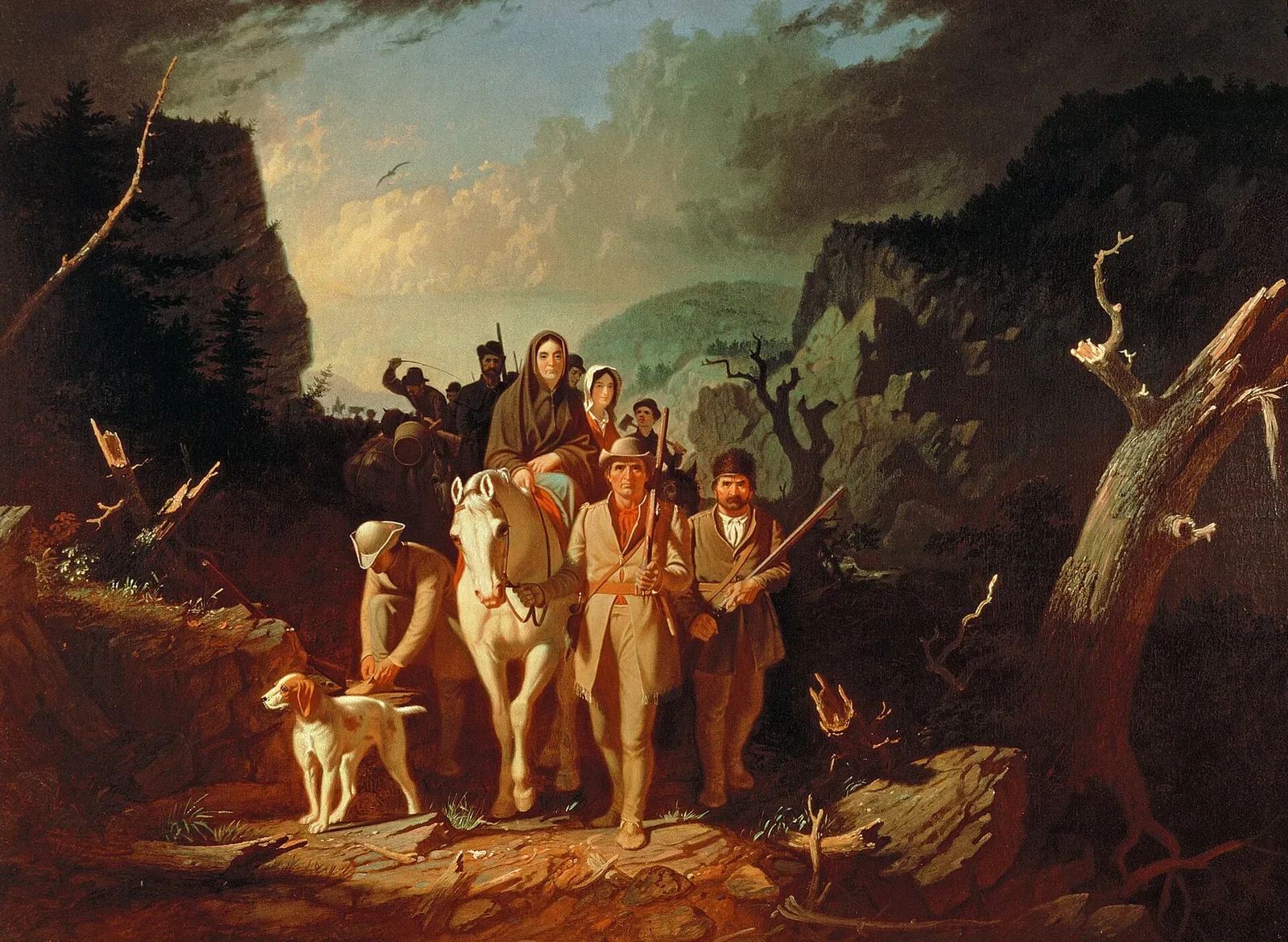
Early European Exploration
European entry into present-day Kentucky began in earnest in 1750, when Dr. Thomas Walker led a party of six through what he named the Cumberland Gap — commissioned by the Loyal Land Company of Virginia to survey westward territory. Walker's group found evidence of earlier European passage: names carved into trees, crosses scratched into bark. Whoever those earlier visitors were, they left no written record. Walker did.
Key events in Kentucky's frontier firearms era
The territory Walker entered wasn't empty or unclaimed. The Shawnee controlled the central and northern hunting grounds; the Cherokee held the Cumberland Gap corridor. Both nations used Kentucky not as a fixed settlement but as shared, carefully managed hunting ground — a distinction that white settlers would systematically misread as absence of ownership. The Shawnee and Cherokee had spent generations maintaining that land: burning undergrowth to improve pasture, maintaining salt licks to concentrate game, cutting game trails through the forest. When the Long Hunters arrived, they were walking into a functioning ecosystem someone else had built.
The Long Hunters Arrive
The Long Hunters — named for their months-long expeditions away from home — began pushing into Kentucky in the 1760s. The list included:
- Elisha Walden
- John Finley
- John Stuart
- the Skaggs brothers
- Anthony Bledsoe
- Daniel Boone
They came primarily for pelts. Buffalo, deer, and beaver hides commanded real money in eastern markets, and the Kentucky interior was stocked with all three.
The Pennsylvania Long Rifle
The rifle they carried was the Pennsylvania long rifle — developed in Lancaster, Pennsylvania in the 1730s by German and Swiss immigrant gunsmiths. It bore specifications that made it fundamentally different from the military muskets of the era:
- Barrel typically exceeding 40 inches
- Rifled with helical grooves for spin stabilization
- Effective to 200 yards in skilled hands
- Smaller bore (.36 to .50 caliber) than European muskets
- Stretched scarce lead and powder further
| Rifle Specification | Pennsylvania Long Rifle | Brown Bess Musket |
|---|---|---|
| Barrel Length | 40+ inches | 39-46 inches |
| Bore Size | .36-.50 caliber | .75 caliber |
| Rifling | Helical grooves | Smoothbore |
| Effective Range | 200 yards | 50-75 yards |
| Primary Use | Hunting, precision | Military volleys |
| Ammunition Economy | High (smaller bore) | Low (large bore) |
On the frontier, that economy mattered.
The name "Kentucky rifle" didn't come from where it was made. It came from where it was used and who used it. Boone carried one through the Cumberland Gap. The Long Hunters used them to work the interior for six months at a stretch. When the rifle's fame spread east — through Revolutionary War accounts, through the Battle of King's Mountain in 1780 — "Kentucky" was the word already attached to it.
Territorial Conflicts
Boone's 1769 expedition with John Stuart ended with a confrontation that illustrates exactly how those early years worked. A Shawnee party led by Captain Will Emery intercepted Boone and Stuart, confiscated months' worth of hides, and delivered a direct warning:
Now, brothers, go home and stay there. Don't come here anymore, for this is the Indians' hunting ground. — Captain Will Emery, Shawnee leader, to Daniel Boone, 1769
Boone and Stuart lost everything but their lives. They came back anyway.
The overhunting escalated fast. A creek in the interior became known as Stinking Creek because of the rotting carcasses left behind after hunters took hides and abandoned the rest. By 1775, Cherokee leader Dragging Canoe warned that Kentucky "would be dark and difficult to settle" and is credited with the phrase that has followed the state ever since — "dark and bloody ground." That warning proved accurate.
The following decade saw near-constant violent conflict between settlers and the Shawnee and Cherokee nations fighting to preserve what remained of their hunting territory.
The Proclamation of 1763 had theoretically restricted westward expansion past the Appalachians. Enforcement was essentially nonexistent, and the land companies operating out of Virginia and North Carolina had financial reasons to ignore it. The Transylvania Company, backed by Richard Henderson, hired Boone in 1775 to cut the Wilderness Road through the Cumberland Gap — connecting the eastern settlements to what would become the first permanent Kentucky settlements at Boonesborough and Harrodsburg. The rifle Boone carried was the same tool that fed him, protected him, and eventually made his name a shorthand for the American frontier.
19th Century: Statehood, Civil War & The Border State Problemedit
Early Statehood & Constitutional Protections
Kentucky entered the Union on June 1, 1792, carved out of Virginia's western territory. The state's constitution, drafted that year in Danville, included explicit firearms protections. The 1799 Kentucky Constitution — the second in the state's history — contained language in Section 28 stating that:
The right of the citizens to bear arms in defense of themselves and the State shall not be questioned. — Kentucky Constitution, Section 28, 1799
That's unusually direct for the era, and it set a tone the state has largely maintained.
Through the early 19th century, frontier conditions persisted across much of Kentucky's interior. Firearms remained working tools — for hunting, for dealing with the ongoing violence of the settlement period, and for the increasingly formalized militia structure the state maintained. The Kentucky Militia drew on the same tradition of marksmanship the Long Hunters had established, and that tradition showed up dramatically at the Battle of New Orleans in January 1815.
General Andrew Jackson's force included a substantial contingent of Kentucky and Tennessee riflemen whose long-range accuracy disrupted British formations attacking across open ground. British accounts of the battle specifically noted the effectiveness of Kentucky sharpshooters picking off officers and artillery crews at distances that left the redcoats unable to effectively return fire.
The War of 1812 also accelerated federal interest in standardized military arms. The Harpers Ferry Arsenal in Virginia had been producing the Model 1803 rifle — the first U.S. military rifle — since the early 1800s, and Kentucky troops were among its users. But the state's own gunsmithing tradition remained deeply local, with individual craftsmen operating throughout central and eastern Kentucky producing custom work rather than standardized production runs.
The Border State Dilemma
By mid-century, Kentucky occupied one of the most uncomfortable geographic and political positions in the country. It was a slave state that did not secede. When the Civil War began in 1861, Kentucky attempted to declare official neutrality — a position that lasted roughly five months before Confederate General Leonidas Polk moved troops into Columbus, Kentucky in September 1861, effectively ending any pretense of staying out of it.
The state supplied soldiers to both sides. Estimates put Kentucky's Union enlistment at roughly 90,000 men and Confederate at approximately 35,000 — but those numbers mask the reality that many Kentucky families were split directly down the middle.
| Civil War Service | Union Forces | Confederate Forces |
|---|---|---|
| Kentucky Enlistment | ~90,000 men | ~35,000 men |
| Notable Leaders | Ulysses S. Grant (staging) | John C. Breckinridge |
| Key Infrastructure | Louisville & Nashville Railroad | Contested territory |
| Strategic Assets | Frankfort Arsenal, Paducah | Columbus (briefly) |
| Political Status | Officially loyal | Sympathizers post-war |
John C. Breckinridge, Kentucky's former U.S. Senator and the sitting U.S. Vice President as recently as 1861, became a Confederate general. His counterpart Ulysses S. Grant, though not a Kentuckian by birth, used Paducah as a critical staging point for his early western campaigns after securing it in September 1861.
Louisville became a major Union logistics hub. The Louisville & Nashville Railroad was a strategic asset both sides fought to control throughout the war, as it was the primary supply line feeding Union forces moving into Tennessee. Arms, ammunition, and equipment flowed through Kentucky constantly — making the state's infrastructure as militarily significant as its men.
The Frankfort Arsenal — established in Frankfort along the Kentucky River — served as an ordnance storage and distribution point for Union forces operating in the western theater. While not a primary manufacturing facility on the scale of Springfield or Rock Island, it handled the logistical work of keeping western armies in ammunition and serviceable arms through much of the conflict.
Post-War Political Realignment
After the war, Kentucky's political alignment shifted in ways that shaped its firearms culture for generations. The state that had officially stayed in the Union became deeply Confederate in its sympathies by the 1870s and 1880s — part of what historians call the "Lost Cause" political realignment across border states. The practical effect was a political culture deeply skeptical of federal authority and strongly protective of individual rights, including firearms ownership.
The late 19th century also brought Kentucky its most notorious armed conflict — the Hatfield-McCoy feud, which straddled the Kentucky-West Virginia border along the Tug Fork of the Big Sandy River. The feud ran from roughly 1863 through 1891, involved multiple killings on both sides, and ended up requiring Kentucky Governor Simon Bolivar Buckner to request federal intervention in 1888. Whatever its origins in a Civil War-era killing and a disputed hog, it became a symbol of Appalachian firearms culture — both its deep-rootedness and its capacity for catastrophic misuse.
20th Century: Wars, Industry & Federal Regulationedit
World War I Infrastructure
Kentucky's military significance expanded dramatically with World War I. Camp Taylor, established near Louisville in 1917, became one of the largest Army training installations in the country — processing over 150,000 soldiers through its gates by the end of the war. F. Scott Fitzgerald was among the officers stationed there, though Kentucky's contribution to the war effort was measured more in infantry than literature.
The Frankfort Arsenal expanded its role in World War I as a repair and reconditioning facility for small arms, handling rifles and pistols moving through the logistics pipeline. Small arms manufacturing in Kentucky during this period was primarily commercial rather than military, with the state's contribution running more toward supplying trained soldiers than producing standardized weapons.
World War II Expansion
World War II brought a different scale of military infrastructure to Kentucky. Fort Knox — established as a permanent Army post in 1918 near Radcliff — became the home of U.S. Armored Forces training during the war and houses the U.S. Bullion Depository, where a significant portion of the nation's gold reserves are stored. The Fort Knox Small Arms range complex trained thousands of soldiers in basic and advanced marksmanship. Camp Breckinridge near Morganfield processed German and Italian prisoners of war while simultaneously training American troops.
| Military Installation | Established | Primary Function | Peak Capacity |
|---|---|---|---|
| Camp Taylor | 1917 | WWI training | 150,000+ soldiers |
| Fort Knox | 1918 | Armored Forces, bullion storage | Ongoing |
| Camp Breckinridge | WWII | Training, POW facility | Multiple thousands |
| Frankfort Arsenal | Civil War era | Ordnance storage/repair | Regional logistics |
| Louisville Ordnance Plant | WWII | Artillery shell production | Wartime production |
Louisville Ordnance Plant, operating during World War II, produced artillery shells and other ordnance components as part of the massive industrial mobilization that converted civilian manufacturing to war production. The Charlestown Powder Works just across the Indiana border served the regional ordnance network that Kentucky was part of.
Federal Regulation Response
The National Firearms Act of 1934 and the Gun Control Act of 1968 both applied to Kentucky as to every state, but their political reception here was notably cool. The GCA in particular — passed in the wake of the assassinations of Robert F. Kennedy and Martin Luther King Jr. — was viewed with deep suspicion across rural Kentucky, where federally licensed dealers had previously operated with minimal regulatory overhead. The requirement for Federal Firearms Licenses (FFLs), background information on buyers, and regulated transfer of handguns shifted the retail landscape but didn't meaningfully dampen gun ownership rates in the state.
Kentucky's sporting arms tradition ran strong through the 20th century. Deer hunting, turkey hunting, and squirrel hunting — the latter being far more culturally embedded in Kentucky than most states — kept firearms in active daily use across rural counties. The Kentucky Department of Fish & Wildlife Resources, established in its current form in 1944, managed the state's hunting seasons and licensing, and hunting remained a significant part of rural economic and social life through the entire century.
Modern Era (2000–Present)edit
The Heller Effect
The early 2000s were relatively quiet on the Kentucky legislative front, but the 2008 Supreme Court decision in District of Columbia v. Heller reframed the national conversation in ways that mattered here. Heller's affirmation of an individual right to keep and bear arms under the Second Amendment validated what Kentucky's own constitution had said since 1799 and what most Kentuckians had simply assumed was always true.
Evolution of Kentucky's modern firearms legislation
The legislative pace picked up noticeably in the 2010s. Kentucky passed HB 228 in 2012, strengthening existing preemption law and limiting local governments' ability to enact firearms regulations stricter than state law — a recurring issue in Louisville, which had periodically attempted to impose regulations that conflicted with state statutes.
Constitutional Carry Achievement
The most significant modern development came in 2019, when the Kentucky General Assembly passed Senate Bill 150, signed by Governor Matt Bevin on March 11, 2019. SB 150 established constitutional carry — the ability for any law-abiding Kentucky resident 21 or older to carry a concealed firearm without a permit. Kentucky became the 16th state to adopt permitless carry at the time.
The existing CCDW (Carrying Concealed Deadly Weapon) permit system remained in place voluntarily, since Kentucky permit holders enjoy reciprocity benefits in other states.
The 2021 legislative session extended constitutional carry to lawful residents who are 18 to 20 years old, aligning the concealed carry age with the existing open carry framework. House Bill 4 passed with substantial Republican majorities in both chambers.
Urban-Rural Political Divide
Louisville has been the site of the state's most prominent gun violence debates in the modern era. The April 2023 shooting at Old National Bank in downtown Louisville — in which a gunman killed five people — prompted renewed calls for state-level action on firearms regulations from Louisville Democrats and Governor Andy Beshear. The Republican-controlled legislature did not advance significant new restrictions in response, consistent with the pattern of the previous decade.
The political divide between Louisville's urban Democratic base and the rural Republican supermajority in Frankfort on firearms policy is probably the sharpest ongoing tension in Kentucky's gun culture.
Kentucky's CCDW permit system, administered through the Kentucky State Police, continues to process tens of thousands of permits annually even after constitutional carry removed the legal requirement. As of 2024, Kentucky has reciprocity agreements with 36 other states — making the voluntary permit worth maintaining for Kentuckians who travel regularly.
Notable Figures & Manufacturersedit
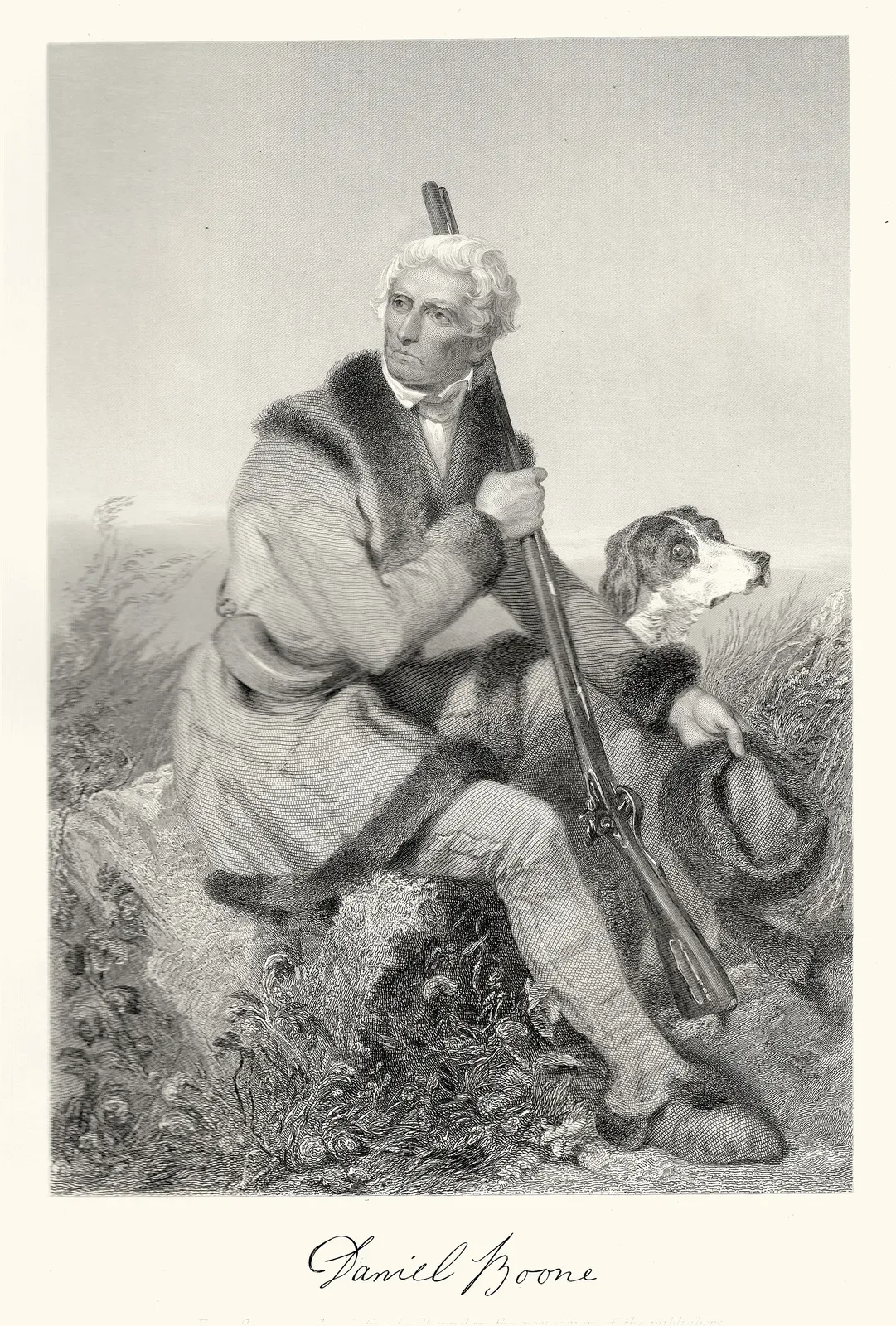
Kentucky firearms heritage: key figures and their connections
Daniel Boone (1734–1820) is the obvious starting point — not a manufacturer, but the human being most associated with the Kentucky rifle in the public imagination. Boone wasn't born in Kentucky; he was born in Berks County, Pennsylvania, and spent his adult life moving progressively westward, eventually dying in Missouri. But his years in Kentucky — cutting the Wilderness Road, founding Boonesborough, surviving multiple Shawnee captures — established the template for how Americans understood the rifle-bearing frontiersman.
Simon Kenton (1755–1836) is less famous than Boone but equally relevant to Kentucky's frontier firearms history. A scout, frontiersman, and militia officer, Kenton was present at numerous engagements during the settlement period, survived multiple captures by Shawnee warriors, and served in both the Revolutionary War and the War of 1812. His proficiency with the long rifle was legendary among contemporaries.
John Hunt Morgan (1825–1864) — "Morgan's Raiders" — represents a different chapter. Morgan's 2nd Kentucky Cavalry conducted some of the most aggressive cavalry raids of the Civil War, operating deep in Union-held territory with a combination of captured Union arms, Confederate-issued weapons, and whatever his men could requisition. His 1863 raid into Indiana and Ohio was the furthest north any Confederate force penetrated during the war.
On the manufacturing side, Gemtech, a suppressor manufacturer, operated facilities in Kentucky as part of its broader operations. Kentucky's modern firearms manufacturing footprint is smaller than neighboring states like Ohio or Tennessee but has a distinct custom and small-batch character.
Springfield Armory (the commercial entity, not the federal arsenal) has distributed through Kentucky dealers extensively, and the state has a strong network of custom gunsmiths — particularly in the rifle-building community. Eastern Kentucky's tradition of individual craftsman gunsmiths traces a direct line back to the long rifle era, even if the rifles being built today are chambered in 6.5 Creedmoor rather than .45 flintlock.
The Knob Creek Machine Gun Shoot in West Point, Kentucky hosts a twice-annual event that draws thousands of shooters and spectators from across the country for what is likely the largest public display of legally owned automatic weapons in the United States. The event has run since the 1980s and represents a very specific slice of Kentucky gun culture: enthusiastic, deeply knowledgeable, and unapologetically pro-NFA.
Current Legal Landscapeedit
Constitutional Framework
Kentucky's firearms laws as of 2025 are among the more permissive in the country, and that reflects both deliberate legislative action over the past 15 years and a baseline constitutional tradition going back to 1792.
| Kentucky Firearms Law | Status | Year Enacted | Key Provisions |
|---|---|---|---|
| Constitutional Carry | Active | 2019 (SB 150) | No permit required, 21+ residents |
| Constitutional Carry 18-20 | Active | 2021 (HB 4) | Extended to 18-20 year olds |
| Open Carry | Legal | Historical | No permit required statewide |
| CCDW Permit | Voluntary | Ongoing | 36-state reciprocity |
| State Preemption | Active | KRS 65.870 | Limits local restrictions |
| Castle Doctrine | Active | KRS 503.055 | Home/vehicle defense |
| Stand Your Ground | Active | 2006 | No duty to retreat |
| NFA Items | Legal | Federal compliance | SBRs, suppressors with ATF approval |
Current Permit System
The CCDW permit remains available through Kentucky State Police, requiring a safety course and background check and providing reciprocity benefits in 36 states. No assault weapons ban exists at the state level, and Kentucky has no red flag law. State preemption law prevents local governments from enacting stricter regulations than state statute.
Federal NICS checks apply to all FFL dealer sales. Kentucky does not require background checks for private transfers. Castle doctrine law allows use of deadly force against an intruder in a home or vehicle without a duty to retreat, and stand your ground provisions extend this no-duty-to-retreat principle outside the home.
Political Tensions
Louisville Metro has the highest firearms homicide rate in the state by raw numbers and has been the primary political pressure point for gun regulation advocates. The tension between Louisville's urban policy preferences and the legislature's rural Republican supermajority isn't going away — it's baked into Kentucky's political geography.
The BGC Takeedit
Kentucky is about as straightforward a gun state as you'll find east of the Mississippi. The constitutional tradition is genuine — going back to 1799, not invented as a political talking point in the 1990s. When Kentucky gun owners say their rights are embedded in their state's founding documents, they're not wrong.
The culture varies significantly by region, though. Eastern Kentucky's Appalachian counties have a deep, quiet relationship with firearms that's about subsistence hunting, family tradition, and a certain amount of geographic isolation. These are places where a .30-30 in a truck rack wasn't a statement — it was just Tuesday.
Western Kentucky runs more agricultural, with similar traditions but less of the Appalachian insularity. The Bluegrass region around Lexington and Frankfort is more mixed, with a strong sporting culture but also a larger professional class that's more ambivalent.
Louisville is the outlier. It's a city with a real gun violence problem — homicide rates that rival much larger metros — and a Democratic political establishment that wants to do something about it and largely can't, because the levers are in Frankfort and Frankfort isn't interested. That frustration is genuine on both sides: Louisville advocates who feel ignored and rural legislators who don't see why their constituents should absorb restrictions because of Louisville's crime patterns.
The Knob Creek Machine Gun Shoot tells you something honest about Kentucky gun culture: it's not performative. Those are people who have spent real money on legal NFA items, who know the regulatory framework inside and out, who maintain their gear meticulously, and who show up twice a year to enjoy it with ten thousand people who feel the same way. It's enthusiast culture at its most concentrated.
Constitutional carry passing in 2019 was less a sea change than a formalization. The law caught up to the practice more than it changed the practice.
For a gun owner considering Kentucky — whether visiting, moving, or just understanding the landscape — the summary is this: the law is permissive, the culture is deeply embedded, the political environment is stable in the pro-gun direction for the foreseeable future, and the Knob Creek Machine Gun Shoot is worth attending at least once in your life.
Referencesedit
- Kentucky Historical Society. "Kentucky's Long Hunters: Pelts, Profits, and the Push for Westward Expansion." history.ky.gov.
- Collins, Lewis. History of Kentucky. Henry Clay Press, 1968.
- Clark, Thomas D. Historic Maps of Kentucky. University of Kentucky Press, 1979.
- Hammon, Neal and Richard Taylor. Virginia's Western War, 1775–1786. Stackpole Books, 2002.
- Bogan, Dallas. "A Short History of the Kentucky Long Rifle." tngenweb.org.
- Kentucky General Assembly. Senate Bill 150 (2019). legislature.ky.gov.
- Kentucky General Assembly. House Bill 4 (2021). legislature.ky.gov.
- Kentucky General Assembly. KRS 65.870 — State Preemption of Firearms Regulation.
- Kentucky General Assembly. KRS 503.055 — Use of Defensive Force Regarding Dwelling, Residence, or Occupied Vehicle.
- Kentucky State Police. CCDW Annual Reports, 2019–2024. kentuckystatepolice.org.
- District of Columbia v. Heller, 554 U.S. 570 (2008). Supreme Court of the United States.
- Wikipedia. "History of Kentucky." en.wikipedia.org.
- Wikipedia. "Kentucky Rifle." en.wikipedia.org.
- Wikipedia. "Fort Knox." en.wikipedia.org.
- Wikipedia. "Hatfield–McCoy Feud." en.wikipedia.org.
- Wikipedia. "John Hunt Morgan." en.wikipedia.org.
- National Shooting Sports Foundation. State Firearms Laws Database, 2024.
Last Updated: February 24, 2026
- Quail Creek Plantation(Okeechobee, FL)
- 2aHawaii(Honolulu, HI)
- Boston Firearms(Everett, MA)
- Safeshoot(Kingston, NY)
Loading comments...