Details
Louis-Nicolas Flobert

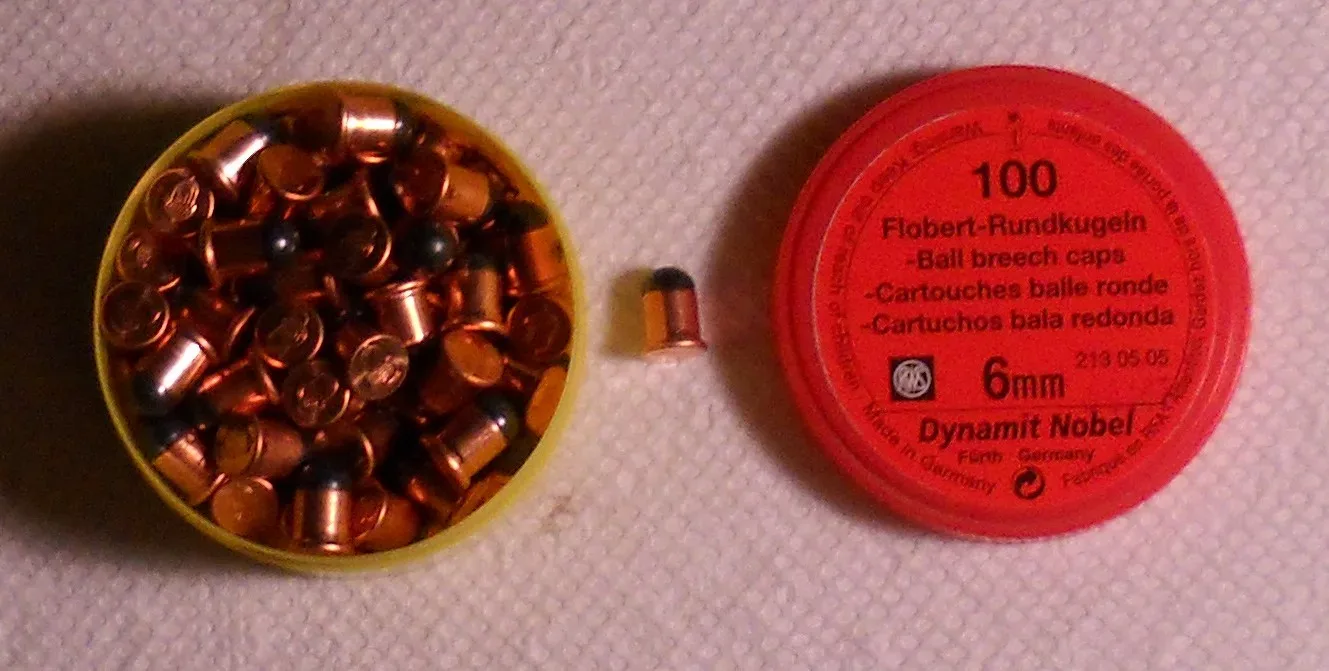
The .22 BB Cap — a direct descendant of Flobert's 1845 rimfire innovation, featuring the distinctive rim-mounted percussion that eliminated the need for a separate firing pin.
| Biography | |
|---|---|
| Born | 1819, Paris, France |
| Died | 1894, Gagny, France |
| Nationality | French |
| Legacy | |
| Known For | Inventor of the first metallic rimfire cartridge in 1845 and designer of parlor guns |
| Key Innovation | The 6mm Flobert cartridge (1845), a self-contained metallic rimfire cartridge combining a percussion cap, propellant, and projectile in a single brass case |
Louis-Nicolas Flobert (1819–1894)
Firearms encyclopedia article
From The Boise Gun Club Handbook
Overviewedit
Louis-Nicolas Flobert (1819–1894) was a French gunsmith and inventor who, in 1845, created the first metallic rimfire cartridge. That single act sits at the hinge point between two eras of firearms technology — the loose-powder, muzzle-loading world that had dominated for centuries, and the self-contained, breech-loading world that replaced it. Every rimfire round fired today, from the billions of .22 Long Rifle cartridges produced annually to the niche 9mm Flobert shotshells still sold to European farmers, traces a direct line back to Flobert's Paris workshop.
His contribution was not a flashier gun or a more powerful propellant. It was a packaging problem solved: how do you combine a primer, a propellant, and a projectile into one reliable, weatherproof unit?
| Before Flobert (Pre-1845) | After Flobert (1845+) |
|---|---|
| Separate primer, powder, projectile | Self-contained metallic cartridge |
| Muzzle-loading required | Breech-loading possible |
| Gas leakage common | Brass case seals breach |
| Complex loading process | Single cartridge insertion |
| Weather-sensitive components | Weatherproof metal package |
His contribution was not a flashier gun or a more powerful propellant. It was a packaging problem solved: how do you combine a primer, a propellant, and a projectile into one reliable, weatherproof unit that a breech-loading action can feed, chamber, and fire without the shooter touching loose powder or a separate cap? Flobert answered that question first.
Early Life & Backgroundedit
Flobert was born in 1819 in Paris, France. According to Grokipedia, he relocated to Paris around 1833 at approximately age 14 to begin an apprenticeship under established gunsmiths in the city's active firearms trade. One conflicting source places his birthplace as Villers-Cotterêts rather than Paris — the historical record on this point is thin, and sources do not agree.
Parisian Apprenticeship
What the sources do agree on: Paris in the 1830s was a hub of 19th-century European gunsmithing, and exposure to percussion lock innovations shaped Flobert's instincts toward compact, safe firearms suited to urban environments. Outdoor shooting was constrained by city regulations and physical space, so demand existed for something quieter and safer for confined settings. Flobert absorbed that context during his apprenticeship and built toward it.
Establishing His Workshop
By 1844, according to Grokipedia, he had established his own workshop in Paris — funded by savings accumulated during his years as an apprentice. He was in his mid-twenties, running his own shop, and within a year he would produce the cartridge that changed everything.
Key Contributionsedit
The Revolutionary Design
The 6mm Flobert Cartridge (1845)
The cartridge Flobert developed in 1845 — later designated the 6mm Flobert or .22 BB Cap (Bulleted Breech Cap) — was deceptively simple. It consisted of a percussion cap pressed into the rim of a small brass case, with a lead ball seated directly on top. No additional powder charge.
The priming compound itself was the propellant, and the resulting muzzle velocity ran somewhere in the range of 200–300 feet per second — quiet enough for a parlor, and incapable of punching through a wall.
Flobert's rimfire cartridge design and firing sequence
Before this, a "cartridge" was a cloth bag or rolled paper cylinder holding a pre-measured powder charge and a ball. You still needed a separate ignition source — either powder in a touch hole or an external percussion cap. Flobert's brass case combined ignition and projectile into one unit that could be loaded from the breech, not rammed down a barrel from the front.
The main technical advantage the Wikipedia source identifies is gas sealing: when fired, the brass case expands outward under pressure, pressing against the interior of the barrel and preventing hot gas from leaking back toward the shooter. That sealed breach was the mechanical prerequisite for reliable repeating arms. You cannot design a magazine-fed action around a cartridge that leaks gas unpredictably.
| Flobert Cartridge Specifications | 6mm Flobert | 9mm Flobert |
|---|---|---|
| Alternative Names | .22 BB Cap, Bulleted Breech Cap | Garden Gun cartridge |
| Propellant | Primer compound only | Primer compound only |
| Velocity | 200-300 fps | ~600 fps (shot loads) |
| Projectile | Single lead ball | 1/4-ounce #8 shot |
| Primary Use | Indoor parlor shooting | Pest control, barns |
| Current Manufacturers | Sellier & Bellot, Reed's | Fiocchi |
The Wikipedia source also notes this allowed roughly a ten-fold increase in rate of fire compared to muzzle-loaded weapons — a figure that makes the downstream military implications of self-contained cartridge design obvious, even if Flobert himself was focused on parlor shooting.
Purpose-Built Firearms
Parlor Guns
Flobert didn't just make the cartridge — he made the guns to shoot it. He called them parlor guns (pistolets de salon), and they were purpose-built for indoor target practice in homes with dedicated shooting parlors or in gallery ranges. Per the Wikipedia source, these were typically single-shot pistols with heavy barrels.
- Single-shot pistols with 4-6 inch barrels for close-range use
- Rifles with barrels up to 24 inches for 10-20 meter accuracy
- Simple falling-block or tip-up actions suited to low-pressure loads
- Friction-based closure systems rather than complex locking mechanisms
A circa 1855 example held by the Metropolitan Museum of Art — a breech-loading rimfire pistol in .22 caliber with gold inlays and ivory grips — illustrates the level of craftsmanship Flobert brought to this work. The Met describes it as "one of the finest signed examples of Flobert's work in existence."
These guns were marketed to affluent European families for recreational marksmanship, came cased with accessories like cleaning rods and spare ammunition, and represented Flobert's production through most of his career. His workshop output, per Grokipedia, ran into the hundreds of custom pieces — artisanal production, not industrial.
Scaling Up: Shot Loads
The 9mm Flobert Cartridge
Flobert also developed a larger variant, the 9mm Flobert, which accommodated shot loads rather than just a single ball. According to the Wikipedia source, 9mm Flobert smoothbore firearms remain in use across Europe today — primarily as garden guns used by farmers and gardeners for pest control at ranges under 15–20 yards. They're especially effective in barns and sheds because the shot load won't ricochet dangerously or punch holes in structure. Fiocchi produces a current 9mm Flobert load using a 1.75-inch brass shotshell firing 1/4-ounce #8 shot at 600 ft/s.
The 9mm Flobert variant occupies a niche in European firearms regulation: many member states classify dedicated Flobert firearms at lower regulatory thresholds due to their subsonic performance and minimal muzzle energy, making them accessible for pest control in countries with otherwise strict gun laws.
Impact on Firearms Developmentedit
Flobert's cartridge did not immediately scale into military or high-power sporting use — it wasn't designed for that. But the concept it demonstrated was immediately legible to every gunsmith who encountered it: self-contained metallic ammunition was clearly the future.
What Flobert proved was the principle. The metallic case that sealed at the breech, combined ignition and propellant, and fed reliably from a breech-loading action — that architecture became the standard.
Timeline showing Flobert's influence on modern ammunition
American Adoption and Improvement
Horace Smith and Daniel Wesson patented improvements to the Flobert-style cartridge in 1854, per Grokipedia, adding consistent primer distribution across the rim. That work produced the .22 Short, commercialized in 1857 for the Smith & Wesson Model 1 revolver — the first widespread rimfire adoption outside Europe, per the NRA Blog source. The .22 Short used black powder to propel a conical projectile, stepping up meaningfully from the primer-only Flobert loads.
From there the lineage is straightforward: the .22 Long arrived in 1871, and the .22 Long Rifle in 1887, per Grokipedia. The .22 Long Rifle became — and remains — one of the highest-volume cartridges manufactured globally, used for training, plinking, competitive shooting, and small game hunting.
| Rimfire Evolution Timeline | Year | Cartridge | Key Innovation |
|---|---|---|---|
| Flobert Original | 1845 | 6mm Flobert | First metallic rimfire |
| Smith & Wesson Patent | 1854 | Improved rimfire | Better primer distribution |
| Commercial Introduction | 1857 | .22 Short | Black powder addition |
| Extended Range | 1871 | .22 Long | Longer case, more powder |
| Modern Standard | 1887 | .22 Long Rifle | Still dominant today |
The NRA Blog notes that early rimfire rounds also scaled up into much larger calibers — .30, .32, .38, .41, .44, and even .58 — before the shift to smokeless powder made centerfire designs the standard for higher-powered applications.
Technical Limitations and Evolution
The Wikipedia source lays out the structural reason centerfire eventually dominated for anything requiring serious pressure:
- Higher pressure capability in centerfire designs
- Elimination of accidental discharge risk from dropped cartridges
- Complex manufacturing requirements for high-power applications
- Cost advantages of rimfire for low-pressure, high-volume production
Rimfire held on for small calibers where pressure demands are modest and cost of manufacture matters — .22 Long Rifle production economics depend on the simplicity of spinning priming compound into a case rim without a separate primer cup.
Later Life & Legacyedit
Continued Innovation
Flobert maintained his Paris workshop after 1845, continuing to produce low-powered parlor guns bearing his name and the inscription "Inventeur." Per Grokipedia, he exhibited his firearms at Parisian expositions throughout his career, promoting their utility for precision marksmanship in non-lethal contexts. He did not pursue widespread commercialization or licensing of his cartridge design abroad — a decision that left the downstream development of rimfire technology largely to American manufacturers.
His operations continued until health declined, per Grokipedia, with limited records detailing his activities in his final decades. He died in 1894 at Gagny, a commune near Paris, at age 74 or 75.
Modern Production
The cartridges and guns that carry his name outlasted him considerably. The .22 CB Cap — a slightly more powerful successor to the original BB Cap — was introduced in 1888, four years before his death. In Europe, both the BB Cap and CB Cap are still called 6mm Flobert and treated as the same cartridge family.
| Current Flobert Production | Manufacturer | Product | Market |
|---|---|---|---|
| Sellier & Bellot | 6mm Flobert loads | Europe | Target shooting |
| Fiocchi | 9mm Flobert shotshells | Europe | Pest control |
| Reed's Ammunition | 6mm conical/round ball | Specialty | Collectors/enthusiasts |
Sellier & Bellot currently manufactures 6mm Flobert loads; Fiocchi produces 9mm Flobert shotshells; Reed's Ammunition & Research makes conical-bullet and round-ball 6mm Flobert loads in 50-round packs. Flobert's name is still on the box.
Regulatory Complications
The conversion problem is the one area where his legacy gets complicated. Per the Wikipedia source, Flobert-chambered firearms are sometimes converted to fire more energetic cartridges — or full-power firearms are down-converted to Flobert spec to skirt regulations, then converted back. European law enforcement has flagged this as a concern. The Small Arms Survey documented that converted firearms — including Flobert-caliber conversions — comprised up to 70% of modified firearm seizures in some countries following 2015. Flobert didn't design his cartridge for that use case, but the regulatory accessibility of his caliber created an avenue for it.
A circa 1855 Flobert pistol sits in Gallery 375 at the Metropolitan Museum of Art in New York — steel, gold, ivory, and leather, 13 3/8 inches overall, 8 3/8-inch barrel, .22 caliber. It's a reminder that Flobert was, before anything else, a craftsman. The cartridge he invented changed firearms history. The guns he built to shoot it were beautiful.
The BGC Takeedit
Flobert is one of those inventors who doesn't get nearly enough credit because his invention looks simple in hindsight.
"A percussion cap with a bullet on top" — sure, when you say it that way, it sounds obvious. But nobody had done it before 1845, and the reason it mattered wasn't the parlor gun market. It was the proof of concept: you can put the primer, the propellant, and the projectile in one weatherproof metal package and load it from the breech. That's the idea that unlocked — excuse me, enabled — everything that came after.
The fact that he never aggressively commercialized or licensed the design internationally is either the great tragedy of his career or simply a reflection of his priorities. He was a craftsman making beautiful guns for affluent Parisians. Smith and Wesson saw the military and commercial potential and ran with it. Flobert apparently didn't chase that. Whether that's admirable or just a missed opportunity depends on what you think a gunsmith's job is.
What's hard to argue with: every .22 Long Rifle round fired today — and billions go downrange every year — exists because a Parisian gunsmith in his mid-twenties figured out how to put the primer and the bullet in the same brass case. That's a pretty good return on one afternoon's problem-solving.
Referencesedit
- https://en.wikipedia.org/wiki/Louis-Nicolas_Flobert
- https://www.metmuseum.org/art/collection/search/24936
- https://www.fieldandstream.com/stories/guns/ammo/gun-history-how-rimfire-ammo-words
- https://www.powdervalley.com/history-of-ammunition/the-history-of-rimfire-ammunition/
- https://www.nrablog.com/articles/2017/11/a-primer-about-rimfire-vs-centerfire-ammunition/
- https://en.wikipedia.org/wiki/Gallery_gun
- https://www.ssusa.org/content/parlor-gun-history/
Last Updated: February 27, 2026
- Gls Guns(Sumner, IA)
- Bi-mart - Yakima (Fruitvale Ave)(Yakima, WA)
- New Philly Sportsman Specialities(New Philadelphia, OH)
- R&R Sports & Outdoors(Brandon, FL)
Loading comments...