Details
Hiram Stevens Maxim

A contemporary caricature of Maxim from his lifetime — capturing the inventor's public persona during his most prolific years.
| Biography | |
|---|---|
| Born | 5 February 1840, Sangerville, Maine |
| Died | 24 November 1916, Streatham, London |
| Nationality | American-born British (naturalized British citizen 16 September 1899) |
| Legacy | |
| Known For | Inventor of the first truly automatic machine gun that harnessed recoil as a power source, eliminating the need for hand cranks or operator input beyond pulling the trigger |
| Key Innovation | The Maxim Gun (1882-1884): a short-recoil, toggle-locked action automatic machine gun that became the defining weapon of the 20th century |
Hiram Maxim: The Man Who Mechanized Death
Firearms encyclopedia article
From The Boise Gun Club Handbook
Overviewedit
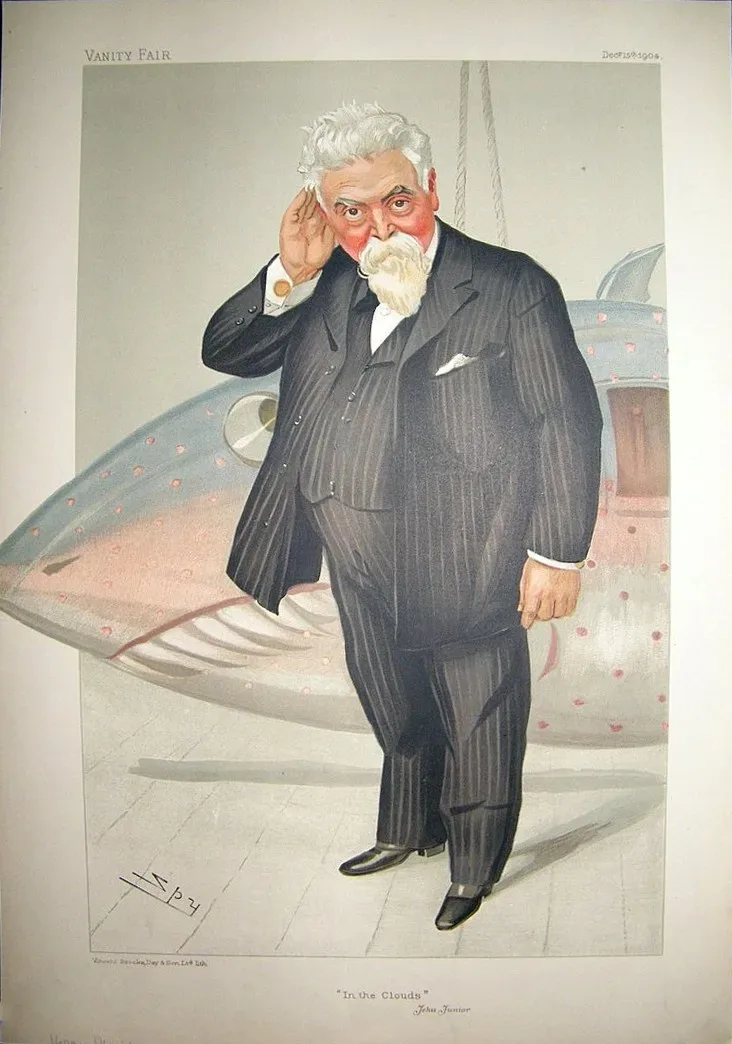
Hiram Stevens Maxim (5 February 1840 – 24 November 1916) was an American-born British inventor who, in the span of roughly thirteen months between 1882 and 1884, built the first truly automatic machine gun -- a weapon that did not require a hand crank, a team of operators, or any action from the shooter beyond holding the trigger. One cartridge fired, and the energy of that firing loaded the next. As long as the belt fed and the trigger stayed back, the gun kept shooting.
That single mechanical insight -- harnessing recoil energy as a power source -- split the history of small arms into before and after. Before Maxim, rapid-fire weapons were crew-served mechanical curiosities. After Maxim, the automatic machine gun became the defining weapon of the 20th century, shaping the tactics, casualties, and physical geography of every major land conflict from the Sudan to the Western Front and beyond.
Maxim himself never tried to sanitize what he had created. He referred to it, consistently, as a killing machine. He was right.
Early Life & Backgroundedit
Maxim was born in Sangerville, Maine, into a family of French Huguenot origin. His formal education amounted to fewer than five years of schooling. What filled the gap was hands-on work -- he apprenticed as a coachbuilder at 14, then moved to the machine works of his uncle, Levi Stevens, in Fitchburg, Massachusetts, where he worked as a draftsman.
| Period | Location | Occupation/Focus | Key Development |
|---|---|---|---|
| 1840–1854 | Sangerville, Maine | Childhood/Basic Education | < 5 years formal schooling |
| 1854–1860s | Fitchburg, Massachusetts | Coach builder apprentice, then draftsman | Mechanical intuition under Uncle Levi Stevens |
| Early 1870s | New York | Steam engineer | Gas lighting, steam launches, mechanical systems |
| 1876–1881 | New York | Chief Engineer, US Electric Lighting Co. | Carbon filaments, pressure regulators, first electric building |
| 1881 | Europe | Patent acquisition (official) | Never returned to live in US |
Mechanical Apprenticeship
From there he moved through instrument-making, gas engineering, and steam technology, accumulating the kind of mechanical intuition that no classroom teaches. He was, by his own account and by any objective measure, a chronic inventor -- someone who could not look at a mechanism without seeing how to improve it.
That quality made him invaluable and also maddening. When he redesigned Levi Stevens's gas generators, he kept improving the design after Stevens had already retooled the plant to build the previous version. Stevens fired him. The pattern -- brilliant improvement, commercial disruption, personal friction -- repeated throughout Maxim's career.
By the early 1870s he was in New York, building steam engines, meters, valves, and gas lighting systems, eventually lighting the Manhattan post office and hotels in Atlanta with gas. He also built a twenty-one-foot steam launch called The Flirt to take his son sailing on the Hudson. The man ran on steam in every sense of the word.
The Electrical Years
His pivot to electrical lighting began around 1876. By June 1878, New York financiers had formed the United States Electric Lighting Company to commercialize his work, and Maxim served as its chief engineer. He developed a method of manufacturing carbon filaments and a pressure regulator to equalize voltage across a circuit -- genuine contributions to early electrical technology.
In the fall of 1880, his company electrically lit the Equitable Life Assurance Building in New York, the first electrically lit building in the United States.
The Edison Rivalry
But the shadow of Thomas Edison was everywhere. Edison had applied for his first light bulb patent on October 5, 1878 -- Maxim had applied the day before. The courts upheld Edison's claim.
Maxim spent years convinced that Edison had out-lawyered rather than out-invented him, and the resentment became something close to an obsession. Edison, for his part, later called Maxim a "death-dealer" when the machine guns opened World War I. The mutual contempt was entirely sincere on both sides.
By 1881, Maxim's directors -- recognizing that their chief engineer was running a personal vendetta rather than a lighting company -- sent him to Europe on the pretext of buying foreign patents. He never came back to live in the United States.
Key Contributionsedit
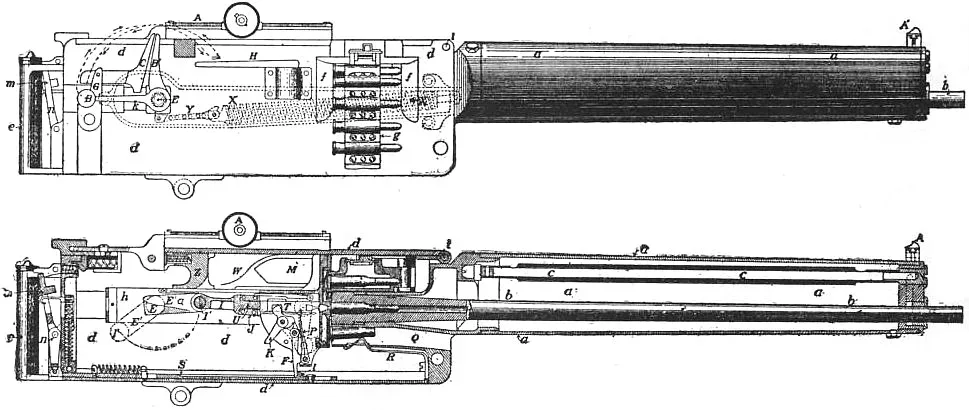
The Maxim Gun
In Vienna in 1882, an American acquaintance told Maxim:
Hang your chemistry and electricity! If you want to make a pile of money, invent something that will enable these Europeans to cut each other's throats with greater facility.
Maxim took it seriously. He rented workrooms at Hatton Gardens in London, finished his drawings in the fall of 1882, and built the first working model in thirteen months.
The mechanical logic came from two places. As a child, the recoil of a heavy rifle had knocked him down, and he remembered the wasted energy in that kick. More concretely, the gun resembled the kind of two-stroke steam engine he had been building for years -- gunpowder as the steam, the trigger as a valve gear, the breechblock as a piston.
What he built was a short-recoil operation, toggle-locked action. At the moment of firing, the bolt is locked to the barrel. Both recoil together for a short distance, then a toggle mechanism unlocks them. The bolt continues rearward, extracting and ejecting the spent case. A new cartridge advances from the belt, the bolt strips it into the chamber as it returns forward, re-locks, and fires. The operator holds the trigger. The gun does everything else.
This was categorically different from what came before. The Gatling gun (patented 1862) used ten barrels on a rotating axis, driven by a hand crank, with cartridges gravity-fed from a hopper above. Even a skilled crew running it flat-out was operating a mechanical device -- the shooter was the power source. The Nordenfeldt (1877) and the French mitrailleuse (1867) were variations on the same crank-driven concept. All of them were sensitive to operator error: crank too fast under stress, and the weapon jammed. Let the cartridges sit damp, and a delayed ignition would blow the breech open at exactly the wrong moment.
| Feature | Previous Technology (Gatling) | Maxim Innovation | Tactical Advantage |
|---|---|---|---|
| Power Source | Hand crank (human) | Recoil energy (automatic) | Single operator, no crew fatigue |
| Rate of Fire | 180 rpm (2 operators) | 500–666 rpm (1 operator) | 3x firepower with half the crew |
| Feed System | Gravity hopper (vertical) | Belt feed (lateral) | Continuous fire, no capacity limit |
| Cooling | Multiple barrels | Water jacket | Sustained fire capability |
| Jam Resistance | Crank speed dependent | Self-timing mechanism | Hangfires cannot jam action |
| Target Profile | Large crew standing | Single operator prone | Reduced vulnerability |
Maxim's gun eliminated the operator as a power source entirely. Because each cartridge had to fire before the next one advanced, even a hangfire couldn't jam the mechanism. The ammunition belt fed smoothly without the clumsy vertical gravity-feed arrangements. A single operator could run it lying close to the ground, presenting a far smaller target than any Gatling crew. According to the EBSCO source, his first prototype used a hydraulic rate-of-fire control that could be set anywhere from a single round per minute up to 500 rounds per minute, with some examples reaching 600 rpm. By the time the Engines of Our Ingenuity account describes it, the production gun was firing 666 rounds per minute.
In the spring of 1887, at the Steinfeld firing range near Vienna, Maxim demonstrated the gun before Emperor Franz Joseph. Dressed in top hat and morning coat, he sat on the rear leg of the gun's tripod and, in thirty seconds, stitched the emperor's initials -- FJ -- in .45-caliber rounds on a target a hundred yards out. 330 rounds in half a minute. The Nordenfeldt team had been cranking out 180 rounds per minute with two men. Franz Joseph was delighted. His officers were stunned. The Austrian Army still bought the Nordenfeldt -- the arms dealer Basil Zaharoff had gotten Maxim's gunner drunk the night before and sabotaged the gun's ammunition at other trials -- but the demonstration made clear to anyone watching that the era of crank-operated rapid-fire weapons was over.
Patent Strategy
Between 1883 and 1885, Maxim patented gas, recoil, and blowback methods of operation, covering all three major principles for automatic operation. He followed those with more than a dozen additional British patents through 1895, covering every variation on the recoil principle he could conceive -- a deliberate strategy to hold the commanding patent position the way Edison had held it in electrical lighting. He applied in every country he could reach, taking out dozens of U.S. patents alone. At his death he held 122 U.S. patents and 149 British patents across all his inventions.
| Patent Category | Years Active | Key Patents | Strategic Purpose |
|---|---|---|---|
| Automatic Operation | 1883–1885 | Gas, recoil, blowback methods | Control all major automatic principles |
| Mechanical Refinements | 1885–1895 | 12+ British recoil variations | Block competitors from patent workarounds |
| Global Coverage | 1883–1900 | Dozens of US patents, worldwide filing | Prevent foreign competition |
| Total Portfolio | Career | 122 US, 149 British patents | Comprehensive IP protection |
The gun contained 280 interchangeable parts, most of which had to be machined to tolerances not yet standard in England. Maxim wired his brother Hudson Maxim in America to hire Yankee mechanics and get on a boat. Hudson tooled up the assembly line at Crayford, Kent.
The Belt Feed
The ammunition belt feed deserves its own mention because it's easy to take for granted. Every previous rapid-fire weapon used a hopper, a magazine mounted above the action, or a drum -- all of which required gravity or mechanical indexing to deliver cartridges. All of them had failure modes tied to that delivery method. Maxim's belt-feed system presented cartridges laterally and continuously, with no gravity dependency and no fixed magazine capacity. You ran out of belt, you threaded a new one into the slot and kept going. According to the EBSCO source, belt feed is universally used in machine guns today.
Water Cooling
A barrel subjected to sustained automatic fire will overheat and eventually fail. Maxim's solution was to surround the barrel with a water cooling jacket -- a sealed sleeve through which water circulated, absorbing heat. The system added weight, but it allowed sustained fire that air-cooled weapons of the era simply could not sustain. The Gatling's multi-barrel design had been one solution to the heat problem; Maxim's water jacket was a more practical one for a single-barrel weapon.
Smokeless Powder and Cordite
Black powder produced two problems for automatic weapons: the smoke gave away the gun's position, and the residue fouled the action. Hiram and Hudson Maxim collaborated on a smokeless powder compound -- combining nitroglycerin and guncotton, using castor oil as a binder, and rolling the mixture into thin hollow tubes that would combust rapidly. British courts later recognized the compound as the first true cordite. The brothers subsequently quarreled over credit for it, and Hudson returned to the United States. They never spoke again. According to the Wikipedia source, a separate dispute over a smokeless powder patent -- issued under the name "H. Maxim" -- was the specific trigger for the permanent estrangement, with Hudson able to claim the patent was his.
Other Inventions
The machine gun tends to overshadow everything else Maxim built, which is a long list:
- First electric lights in a New York City building (late 1870s)
- First automatic fire sprinkler system
- Menthol pocket inhaler and steam inhaler for bronchitis
- Curling iron and apparatus for demagnetizing watches
- Magno-electric machines and ship anti-rolling devices
- Locomotive headlight (became Eastern seaboard standard)
He earned the accusation of prostituting his talents on quack nostrums -- a charge he found irritating given that inventing a machine for killing men was considered perfectly respectable.
Impact on Firearms Developmentedit
Colonial Proving Ground
The immediate military effect of the Maxim gun was felt first in colonial conflicts. Small detachments of European troops used it to control and suppress rebellions across Africa, India, and Egypt -- conflicts where the disparity in firepower was so extreme that the gun's effect on military tactics was not yet fully understood by European general staffs. The poet Hilaire Belloc captured the dynamic in a single couplet from The Modern Traveller (1898), written after Lord Kitchener's forces killed thousands of Dervishes at the Battle of Omdurman:
Whatever happens, we have got / The Maxim Gun, and they have not.
The Russo-Japanese War of 1904–05 was a clearer warning. According to the Engines of Our Ingenuity source, Maxim himself claimed that more than half the Japanese killed in that war died from Russian Maxim guns. The German Army read that number and began stockpiling machine guns.
Industrial War
By 1914, Germany had 12,500. By the armistice in 1918, they had 100,000.
| Army | Adoption Year | 1914 Inventory | 1918 Inventory | % Increase |
|---|---|---|---|---|
| British | 1891 | ~2,000 | ~15,000 | 650% |
| German | 1908 | 12,500 | 100,000 | 700% |
| American | 1915 | 0 | ~5,000 | N/A |
| Russian | 1895 | ~8,000 | ~25,000 | 200% |
The British Army officially adopted the Maxim in 1891. The U.S. Army waited until 1915 -- and according to the EBSCO source, entered World War I without a single machine gun in commission, a bureaucratic failure the Army's own historians have documented.
On the Western Front, the Maxim gun and its variants created the conditions for trench warfare. Emplaced machine guns with overlapping fields of fire made any frontal assault across open ground a mathematical death sentence. The effective range of machine gun fire in direct fire mode was approximately 1,000 meters; using plunging (arched) fire, it extended to roughly 1,800 meters. The volume of fire compensated for any inaccuracy at those ranges.
Technical Legacy
Until the development of the tank -- which was explicitly designed to be immune to machine gun fire -- the Maxim gun had effectively ended offensive ground warfare between comparable forces.
The Vickers machine gun, developed by Vickers from the Maxim design after Maxim resigned from the board in 1911, became the standard British machine gun and served through both World Wars. The famous Browning machine guns -- the U.S. Army standard for decades -- descended from John M. Browning's development of Maxim's gas-operation patents. Maxim had patented gas operation but done little development work on it himself; Browning took that principle and ran with it.
The Forgotten Weapons source puts the scope of Maxim's mechanical legacy plainly: the principles of his prototype have remained the basis for an estimated one hundred million automatic weapons built since.
Later Life & Legacyedit
The Vickers Years
After the Vickers buyout of Maxim-Nordenfeldt in 1896, Maxim remained on the board as a director but was increasingly removed from day-to-day operations. He became a naturalized British citizen on 16 September 1899, and was knighted -- the investiture conducted by King Edward VII at Marlborough House on 9 February 1901, after Queen Victoria died before she could confer the honor herself.
Aviation Experiments
He spent his later years on a series of projects that ranged from serious to eccentric. His 1894 steam-powered aircraft -- a biplane 126 feet long with a 104-foot wingspan, weighing three and a half tons and powered by two 360-horsepower naptha-fired steam engines -- ran on 1,800 feet of track at Baldwyn's Park in Bexley. On July 31, 1894, it lifted off the guide rails for roughly 600 feet before one of the restraining wheels snagged, damaging the propellers and frame.
Maxim walked away from it. He later acknowledged what the Wright brothers proved nine years afterward: that the real solution required a petrol internal combustion engine and a much smaller aircraft.
His amusement ride, the Captive Flying Machine -- a large spinning frame from which cars hung and swung outward simulating flight -- debuted at the Earl's Court exhibition in 1904. He found it creatively unsatisfying, calling it "simply a glorified merry-go-round," but his company built several more at The Crystal Palace and seaside resorts including Blackpool. The Blackpool version still operates at Blackpool Pleasure Beach and is now the oldest operating amusement ride in Europe, virtually unchanged from Maxim's original design.
Final Years
In 1911, he resigned from the Vickers board and became chairman of the newly formed Grahame-White, Blériot, and Maxim Company, capitalized at £200,000. He intended to produce military aircraft capable of dropping a 500-pound bomb, but failing health and financial difficulties prevented meaningful development.
By his later years Maxim was profoundly deaf -- his hearing destroyed by decades of exposure to his own guns. His son Hiram Percy Maxim invented the firearm suppressor, a fact the family apparently found grimly appropriate, since it arrived too late to help his father.
Maxim died at his home in Streatham, London, on 24 November 1916, at 76 -- the same year the Somme offensive, fought largely against machine guns, killed or wounded over one million men. He is buried at West Norwood Cemetery in south London, alongside his wife and his grandson, Lieutenant Colonel Maxim Joubert.
When he died, only a few British and American newspapers ran his obituary. There were, as one account notes, millions of other deaths to report -- most of them caused by his machine gun.
The BGC Takeedit
Hiram Maxim is one of the most consequential figures in the 800-year story of firearms, and also one of the most uncomfortable ones to write about cleanly. He didn't invent rapid fire -- the Gatling, the mitrailleuse, and the Nordenfeldt all got there first in crude form. What he invented was something more specific and more dangerous:
What he invented was something more specific and more dangerous: the first weapon that could sustain automatic fire without requiring a human being to supply the mechanical energy.
That distinction sounds technical. On the Western Front, it translated into something like four years of industrialized slaughter.
What makes Maxim interesting beyond the history of mechanisms is that he never pretended otherwise. He called it a killing machine. He warned commanders that only a barbarian would send men into its fire. They ignored him. That's not on Maxim -- generals have been ignoring tactical reality since long before 1884 -- but it does raise the uncomfortable question that follows every significant weapons development: does the inventor bear responsibility for how the invention gets used once the patent is filed?
Maxim seemed to think the answer was yes, at least in the sense that he accepted the weight of it. Whether that acceptance was genuine moral reckoning or a kind of performer's self-awareness is harder to say. He kept inventing. He kept selling. The checks cleared.
What's not in dispute is the mechanical legacy. Belt feed, short-recoil operation, water cooling, the toggle-lock breech -- these are not historical footnotes. They are the structural DNA of automatic weapons that are still in service right now. When you look at a modern machine gun, you are looking at Hiram Maxim's 1883 patent with 140 years of refinement on top of it. That's a longer run than almost any other mechanical concept in firearms history, and it's worth understanding how it happened and why.
Referencesedit
- https://en.wikipedia.org/wiki/Hiram_Maxim
- https://www.britannica.com/biography/Hiram-Maxim
- https://www.ebsco.com/research-starters/history/maxim-patents-his-machine-gun
- https://www.inventionandtech.com/content/man-behind-killing-machine-2
- https://www.forgottenweapons.com/maxim-prototype-the-first-practical-machine-gun/
- https://engines.egr.uh.edu/episode/694
Last Updated: February 27, 2026
- Gls Guns(Sumner, IA)
- Bi-mart - Yakima (Fruitvale Ave)(Yakima, WA)
- New Philly Sportsman Specialities(New Philadelphia, OH)
- R&R Sports & Outdoors(Brandon, FL)
Loading comments...