Details
Richard Jordan Gatling

Gatling's patent drawing illustrates the revolving battery principle — multiple barrels rotating past a fixed firing mechanism to achieve sustained rapid fire.
| Biography | |
|---|---|
| Born | September 12, 1818, Maney's Neck community, Hertford County, North Carolina |
| Died | February 26, 1903, New York City |
| Nationality | American |
| Legacy | |
| Known For | Inventor of the Gatling gun, the first machine gun to work safely and reliably enough to become a genuine military instrument |
| Key Innovation | The Gatling gun (Revolving Battery-Gun), patented November 4, 1862 as U.S. Patent No. 36,836, featuring rotating barrels that achieved sustained mechanical fire without overheating |
Richard Jordan Gatling (1818–1903)
Firearms encyclopedia article
From The Boise Gun Club Handbook
Overviewedit
Richard Jordan Gatling (September 12, 1818 – February 26, 1903) was an American inventor from rural North Carolina who, in 1862, received U.S. Patent No. 36,836 for a "Revolving Battery-Gun" — the weapon the world came to know simply as the Gatling gun. It was the first machine gun to work safely and reliably enough to become a genuine military instrument, and it arrived at a moment when metallurgy, precision manufacturing, and metallic cartridge technology were converging in ways that made sustained mechanical fire possible for the first time.
Gatling did not set out to build a killing machine. By his own account, he designed a weapon he hoped would make large armies unnecessary, thereby reducing the staggering death toll — much of it from disease, not bullets — that he watched accumulate at the start of the Civil War. Whether that logic was sincere or a useful sales argument is something historians have debated ever since.
Gatling's gun placed industrialized firepower on the battlefield, accelerated the development of automatic weapons, and established a mechanical principle that engineers were still drawing on nearly a century later.
What is not debatable is the result: the Gatling gun placed industrialized firepower on the battlefield, accelerated the development of automatic weapons, and established a mechanical principle that General Electric's engineers were still drawing on nearly a century later when they designed the M61 Vulcan cannon.
Early Life & Backgroundedit
Family Influence and Education
Gatling was born in a log cabin in the Maney's Neck community of Hertford County, North Carolina, and spent his early years on what would become a successful plantation. His father, Jordan Gatling, was himself an inventor — he patented a cotton planter and a rotary cultivator in 1835 — and the household ran on the assumption that mechanical problems had mechanical solutions.
Richard and his brothers attended Buckhorn Academy, a classical school run by a nearby church. For a time, the young Gatling clerked in the Murfreesboro law office of his uncle, Lewis M. Cooper.
Early Inventions and Setbacks
At seventeen, Gatling invented a screw propeller for steamboats. His father refused to allow the trip to Washington to file the patent. When he finally made the journey, he arrived to find that John Ericsson — later the designer of the Civil War ironclad Monitor — had beaten him to the patent office by a matter of months.
It was the first of several near-misses that characterized Gatling's early career and sharpened what became a lifelong instinct for moving fast once he had an idea worth protecting.
Business Ventures and Medical Training
He taught school briefly, opened a general merchandise store in 1840, and worked in the county clerk's office. By 1844, he had his first patent — a seed sower that planted in straight rows — and moved to St. Louis, Missouri, where he adapted the design into a wheat drill and began building a modest fortune selling manufacturing rights to local producers.
A severe smallpox attack during a marketing trip in 1845–1846 landed him in a Pittsburgh quarantine house for three months. He survived, and the experience pushed him toward medicine. He attended Indiana Medical College and then Ohio Medical College, receiving his M.D. in 1850 — though he never practiced. He was more interested in staying alive and in staying busy than in treating patients.
| Year | Age | Milestone |
|---|---|---|
| 1818 | 0 | Born in Hertford County, NC |
| 1835 | 17 | Invented steamboat screw propeller |
| 1840 | 22 | Opened general merchandise store |
| 1844 | 26 | First patent - seed sower |
| 1845-46 | 27-28 | Severe smallpox attack, Pittsburgh quarantine |
| 1850 | 32 | Received M.D. from Ohio Medical College |
| 1854 | 36 | Married Jemima Sanders |
Marriage and Social Position
By his mid-thirties, Gatling was successful enough to marry Jemima Sanders of Indianapolis on October 25, 1854. She was nineteen years his junior and the daughter of a prominent Indianapolis physician. Her older sister Zerelda was married to David Wallace, the governor of Indiana, which placed Gatling squarely inside the Indianapolis social and political establishment when the Civil War arrived.
Key Contributionsedit
The Design Philosophy
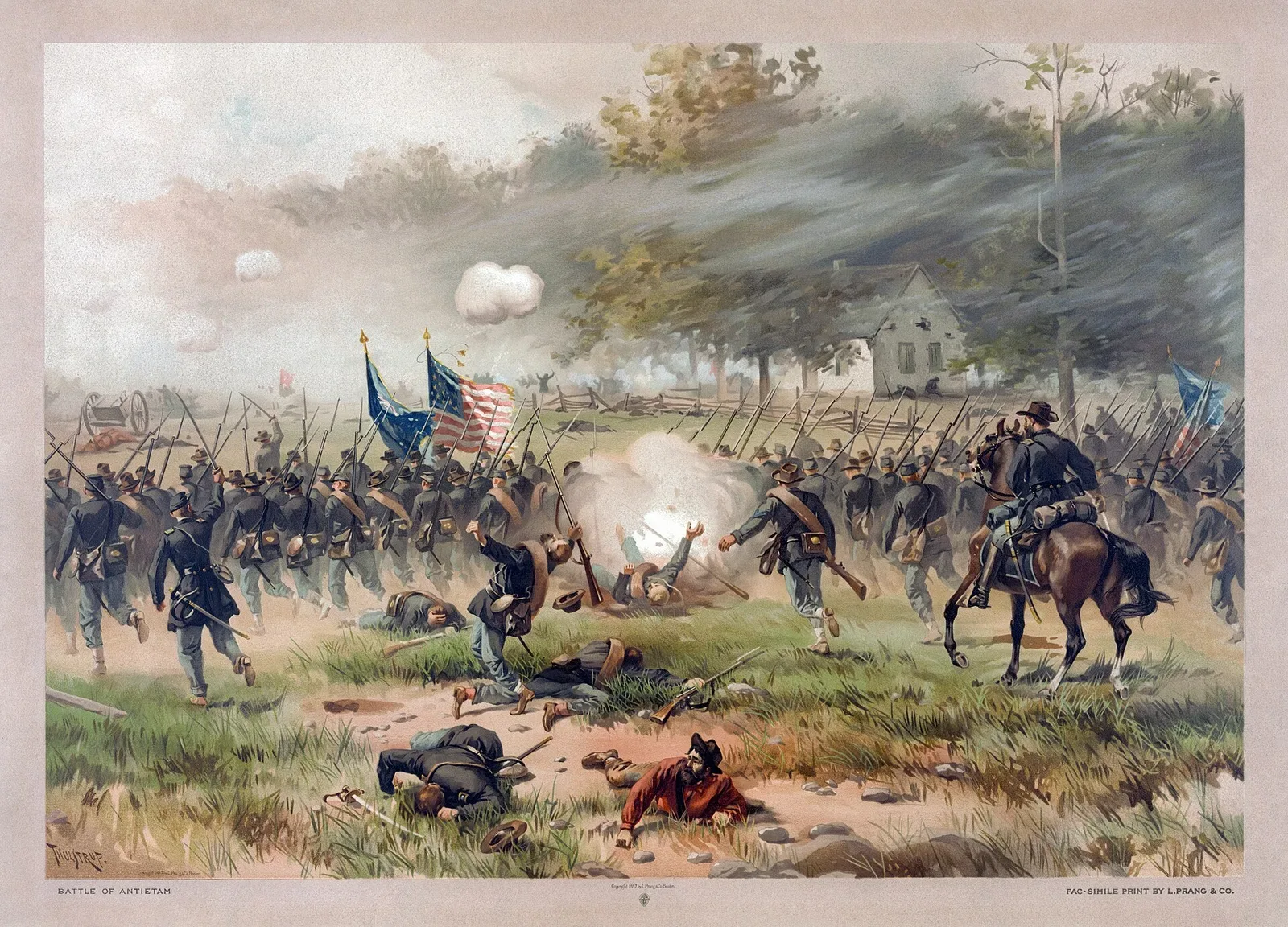
When the Civil War broke out in 1861, Gatling was living in Indianapolis. He watched troop departures and the return of the wounded almost daily and was struck by something that the casualty numbers confirmed: most soldiers were dying not from enemy fire but from the dysentery, typhoid, and exposure that followed large armies.
A gun efficient enough that one man could do the battle duty of a hundred would reduce the size of armies required, and fewer soldiers in the field meant fewer men dying of disease.
His reasoning, as he described it in an 1877 letter, was straightforward — a gun efficient enough that one man could do the battle duty of a hundred would reduce the size of armies required, and fewer soldiers in the field meant fewer men dying of disease.
The design he arrived at borrowed directly from his own agricultural work. Cartridges dropped from a hopper into firing chambers the same way seeds dropped from a hopper in his planter. Six metal barrels were arranged in a circle around a central axis; as the operator turned a hand crank, each barrel rotated through a load-fire-eject cycle in sequence.
No single barrel fired continuously, which meant no single barrel overheated. The result was sustained fire at rates that no single-barrel weapon could approach — up to 200 rounds per minute with the earliest paper-cartridge models, and higher still once metallic cartridges became standard.
Gatling Gun Operating Mechanism - Sequential Load-Fire-Eject Cycle
Patent and Early Production
Gatling demonstrated a working prototype publicly on the streets of Indianapolis in the spring of 1862. On November 4, 1862, he received U.S. Patent No. 36,836. The same year, he founded the Gatling Gun Company in Indianapolis to manufacture and market the weapon.
| Specification | Details |
|---|---|
| Patent Number | U.S. Patent No. 36,836 |
| Patent Date | November 4, 1862 |
| Barrel Configuration | 6 barrels in circular arrangement |
| Rate of Fire | Up to 200 rounds/minute (paper cartridge) |
| Operation | Hand-crank rotating mechanism |
| Key Innovation | Sequential load-fire-eject cycle prevents overheating |
| Manufacturing Partner | Colt's Patent Firearms Company (from 1866) |
The first six production guns were destroyed in a December 1862 factory fire — all built at Gatling's personal expense. He arranged for thirteen more to be manufactured at the Cincinnati Type Factory and pushed on.
Overcoming the Ager Problem
He was a tireless salesman; the historical record makes that clear. He wrote to President Lincoln in February 1864 explicitly distinguishing his weapon from the failed Ager "coffee-mill" gun that had soured Army Ordnance on multi-fire weapons: "I assure you, my invention is no 'coffee-mill gun' — but is an entirely different arm, and is entirely free from the accidents and objections raised against that arm."
To understand why Gatling struggled for Army adoption, it helps to know what the Army had already been burned by. On March 29, 1862 — eight months before Gatling received his patent — Colonel John W. Geary's Pennsylvania Volunteer Regiment deployed ten Ager coffee-mill guns along the Potomac near Harpers Ferry. The guns overheated, jammed, and frustrated the men operating them. Geary sent all ten straight back to Washington.
After that fiasco, Union ordnance officers had little appetite for untested repeating weapons regardless of how well they performed in controlled demonstrations. Gatling's genuine technical advances over the Ager design were difficult to communicate to men who had already been embarrassed once:
- Tapered bore for more precise breech alignment
- Improved reciprocal motion at the breech
- Separate firing chambers for each barrel rather than shared mechanism
- Sequential firing prevented overheating unlike single-barrel designs
Suspicion of Gatling's North Carolina origins didn't help. He was accused, without proof, of being a Copperhead — a Northern Confederate sympathizer. Federal agents reportedly claimed he was a member of the Knights of the Golden Circle, a pro-Confederate secret society. None of it was substantiated. Gatling was a Union supporter who had declined to offer his gun to the Confederate side, but the accusations were enough to complicate government sales during the war.
Civil War Deployment
The Gatling gun saw limited Civil War action, but it did see some. The New York Times purchased three guns and deployed them during the July 1863 draft riots, with the paper's owner and editor manning two of them to deter a mob threatening the building. Major General Benjamin Franklin Butler bought twelve guns from his personal funds — at $1,000 each — following a personal demonstration by Gatling.
Butler's guns were likely used during the siege of Petersburg, Virginia, which ran from June 1864 to April 1865. Admiral David Dixon Porter purchased one. The U.S. Government did not make an official purchase until 1866.
| Customer | Year | Quantity | Notes |
|---|---|---|---|
| New York Times | 1863 | 3 guns | Used during draft riots |
| General Butler | 1864 | 12 guns | Personal purchase at $1,000 each |
| Admiral Porter | 1864 | 1 gun | Personal purchase |
| U.S. Government | 1866 | 100 guns | First official military order |
Post-War Commercial Success
The Army's 1866 order for one hundred Gatling guns opened the commercial floodgates. Gatling arranged for Colt's Patent Firearms Company in Hartford, Connecticut, to manufacture the guns — a logical partnership, since Colt's precision machine tooling gave American weapons their reputation for consistency. In 1870, Gatling sold his patents to Colt outright, though he remained president of the Gatling Gun Company until it was fully absorbed by Colt in 1897 and continued as the gun's most effective salesman well into his later years.
Russia became the first European power to officially adopt the Gatling gun in 1867, placing a large order after Gatling spent several weeks there on a sales trip. By the time of the Russo-Turkish War of 1877–1878, Russia had at least 400 Gatlings in service; the Ottoman military, responding to Russian armament, had purchased 230 from an Austrian licensee. Britain bought a ten-barrel version in 1874; the Royal Navy followed with a .65-caliber model. The licensed British manufacturer, Sir William Armstrong and Co., supplied numerous additional nations.
| Country/Region | Adoption Year | Notable Details |
|---|---|---|
| Russia | 1867 | First European adopter, 400+ in service by 1877 |
| Ottoman Empire | ~1870 | 230 guns from Austrian licensee |
| Britain | 1874 | 10-barrel version, Royal Navy .65-caliber model |
| Other Nations | 1867-1890s | Argentina, Denmark, China, Egypt, France, Italy, Japan, Korea, Mexico, Morocco, Sweden, Turkey |
Gatling sold guns to Argentina, Denmark, China, Egypt, France, Italy, Japan, Korea, Mexico, Morocco, Sweden, Turkey, and others throughout the latter half of the nineteenth century.
Advanced Variants
In 1893, Gatling patented a version driven by an electric motor rather than a hand crank — U.S. Patent No. 502185. The ten-barrel model could achieve 3,000 rounds per minute. At the time, the technology to make practical military use of that rate of fire did not exist; the gun went unadopted. It would take the Cold War to produce aircraft fast enough and engagements brief enough to make that kind of sustained fire density tactically necessary.
His 1895 patent addressed a different problem: using gas pressure from the powder charge to rotate the barrels automatically, making the Gatling a true self-powered automatic weapon. No military force adopted the gas-powered model either. The Maxim gun — single-barreled, much lighter, genuinely automatic — had arrived by then, and armies were moving on.
Impact on Firearms Developmentedit
Technical Innovations
Gatling did not invent the concept of rapid fire. Multiple-barrel and repeating weapons had been attempted for centuries:
- James Puckle's "Portable Gun or Machine called a Defence" (1718)
- Leonardo da Vinci's multiple-barrel sketches
- Various hand-cranked volley guns of the 18th and early 19th centuries
What Gatling did was solve the manufacturing and engineering problems that had kept those concepts from becoming reliable combat weapons.
His technical improvements over the Ager gun were real: the tapered bore, the improved breech reciprocation, the use of separate firing chambers for each barrel rather than a shared mechanism. These weren't marketing claims. They were the engineering details that made the difference between a gun that overheated and jammed in its first engagement and one that performed consistently enough to be adopted by a dozen armies across three decades.
Industrial Timing
The timing mattered as much as the design. Gatling arrived when metallic cartridges were replacing paper, when Bessemer steel was enabling more precise manufacturing, and when machine tooling and interchangeable parts had made it possible to produce intricate mechanisms at scale. A weapon requiring the precision-fit rotating components of the Gatling gun could not have been manufactured profitably fifty years earlier. The gun and the industrial moment found each other.
Military Adoption Worldwide
The Gatling gun became the template for how modern armies thought about sustained fire. By the end of the nineteenth century it had been used in virtually every significant state-sponsored conflict across multiple continents. U.S. forces used Gatling guns in campaigns against Native Americans, including the Red River War beginning in 1874 and the pursuit of Chief Joseph and the Nez Perce in 1877.
British forces employed them against the Zulu in 1879 and during the suppression of the Urabi Revolt in Egypt in 1882.
| Conflict | Year | User | Details |
|---|---|---|---|
| Red River War | 1874+ | U.S. Forces | Against Native Americans |
| Nez Perce War | 1877 | U.S. Forces | Pursuit of Chief Joseph |
| Anglo-Zulu War | 1879 | British Forces | Colonial warfare |
| Urabi Revolt | 1882 | British Forces | Egypt suppression |
| Battle of Santiago | 1898 | U.S. Forces | 3 guns, 18,000 rounds in 8 minutes |
At the Battle of Santiago during the Spanish-American War in 1898, Lieutenant John Henry Parker used three Gatling guns offensively — leapfrogging them forward to support the assault — firing 18,000 rounds in the eight minutes of the San Juan Hill charge and helping repel two Spanish counterattacks.
The Gatling fire was 'the only sound which I ever heard any men cheer in battle.' - Theodore Roosevelt
Theodore Roosevelt, who was there, later wrote that the Gatling fire was "the only sound which I ever heard any men cheer in battle."
The gun was also used in ways that Gatling likely did not dwell on. British forces deployed Gatlings against the Ashanti in western Africa in 1873, and the weapon became a symbol — to those on the receiving end — of the technological disparity between European colonial powers and the peoples they were subjugating. Law enforcement agencies and state militias in the United States used Gatling guns against striking workers during the labor unrest of the 1870s through 1890s. The humanitarian argument Gatling made for his weapon was not how the weapon was actually used.
Modern Legacy
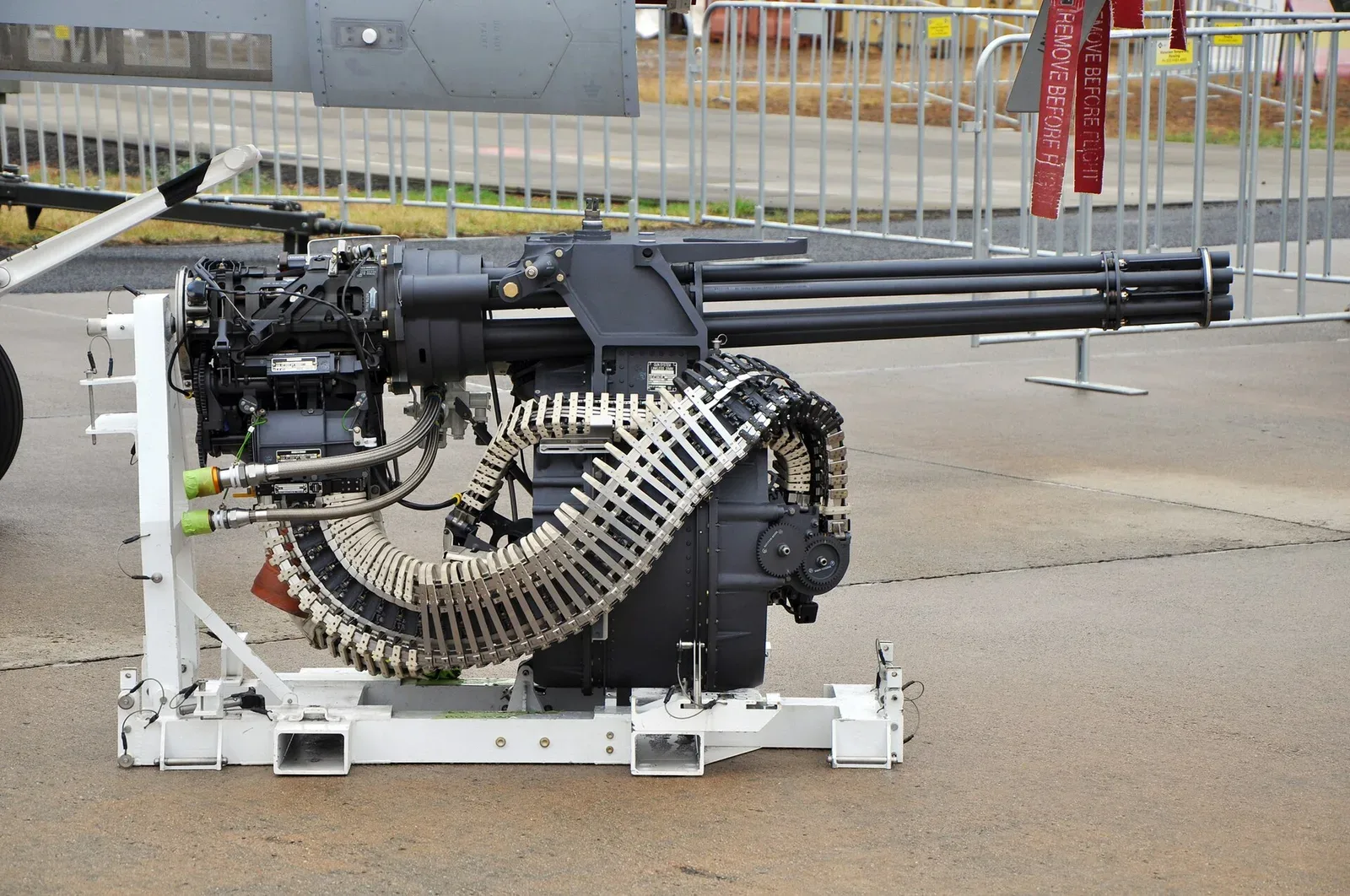
The single most consequential long-term impact may be the one Gatling never lived to see. When General Electric began work in the late 1950s on what became the M61 Vulcan cannon, its engineers pulled Gatling's original 1862 patents and built on them directly. The Vulcan — first produced in 1956 — and its descendants, scaled from 5.56mm to 37mm, form the backbone of U.S. aircraft, helicopter, and naval close-in weapons systems to this day.
Evolution from Civil War Innovation to Modern Weapons Systems
The Dillon Aero minigun, currently in service on American, British, and other allied helicopters and vehicles, is a direct mechanical descendant of the gun Gatling demonstrated on an Indianapolis street in the spring of 1862.
Later Life & Legacyedit
Diverse Inventions
Gatling accumulated 43 patents in his lifetime, covering a range that reads like the resume of a man who could not stop thinking: a steam plow (1857), a marine steam ram (1862), a motor-driven plow, improvements to toilets, bicycles, steam-cleaning of raw wool, and pneumatic power systems. His forty-third and final patent, issued in 1902, was for a motorized plow. He was elected first president of the American Association of Inventors and Manufacturers in 1891 and held the position for six years.
| Patent Category | Examples | Count |
|---|---|---|
| Agricultural | Steam plow (1857), motor-driven plow, motorized plow (1902) | ~15 |
| Military | Gatling gun variants, marine steam ram (1862) | ~8 |
| Industrial | Steam-cleaning wool, pneumatic power systems | ~10 |
| Consumer | Toilet improvements, bicycle enhancements | ~10 |
| Total Patents | 43 |
Financial Struggles
His financial history was erratic. He made and lost several fortunes through bad real estate investments, and by 1897 he and Jemima had sold their Hartford mansion and moved to St. Louis, where he attempted to form a new company to manufacture steam-powered tractors.
Death and Commemoration
His final days were spent in New York City, where he had gone to visit his daughter and to meet with his patent agency. According to historical records, he spent the last day of his life at the offices of Scientific American, which had covered him extensively over the years. He died at his daughter's home on February 26, 1903, and is interred at Crown Hill Cemetery in Indianapolis.
The U.S. Navy commemorated Gatling's contributions during World War II when the Fletcher-class destroyer DD-671 was christened USS Gatling.
Regret and Reflection
In the decades immediately following his death, Gatling's gun was an antique — declared obsolete by the U.S. Army in 1911, overtaken by the Maxim and the generations of recoil-operated automatic weapons that followed it into the trenches of World War I. The single-barrel automatic had won the argument, at least for a while. But the underlying problem Gatling had solved — how to sustain extremely high rates of fire without destroying a single barrel — reasserted itself in the jet age, when engagement windows shrank to fractions of a second and a weapon needed to deliver maximum rounds in minimum time. The rotating barrel principle came back, this time driven by electricity instead of a hand crank, and it has not left service since.
Toward the end of his life, Gatling reportedly expressed regret about his invention. He had seen the ferocity it enabled. The armies did not shrink; they grew. The wars did not shorten; the weapons his gun helped inspire made the next century's conflicts more mechanically lethal than any before them. The arithmetic he offered in 1877 — fewer soldiers, less disease, shorter wars — did not survive contact with how governments actually use overwhelming firepower once they have it.
The BGC Takeedit
Gatling is one of those figures who is easy to oversimplify in both directions. The "naive humanitarian who accidentally created mass death" framing is too soft, and the "cynical arms dealer hiding behind pacifist marketing" version doesn't hold up either. The man genuinely grew up in a culture of practical invention, genuinely watched soldiers die of dysentery, and genuinely believed efficiency in killing could translate to less killing overall. That's not cynicism — it's the kind of logical error that smart, technically-minded people make when they model human behavior the way they model mechanical systems.
What's worth sitting with is the 1893 electric gun. By that point, Gatling had seen his weapon used on Native Americans, on African tribes, on striking laborers. He knew exactly what it was for. And he patented a version that could fire 3,000 rounds per minute. That's not a man trying to walk anything back. Whatever ambivalence he felt in his final years, the work kept going.
Gatling solved a problem that nobody has found a better solution to in 160 years. That's a hell of a shelf life for any engineering idea.
The other thing worth noting is how little credit Gatling gets for the Vulcan and everything downstream from it. The average person knows the Gatling gun as a Civil War curiosity or a video game weapon. They don't know that the A-10's GAU-8 Avenger, the Phalanx close-in weapon system on Navy ships, and the miniguns on attack helicopters in every conflict since Vietnam all trace their mechanical DNA straight back to that 1862 patent. Gatling solved a problem that nobody has found a better solution to in 160 years. That's a hell of a shelf life for any engineering idea.
Referencesedit
- https://en.wikipedia.org/wiki/Richard_Jordan_Gatling
- https://www.dncr.nc.gov/blog/2023/12/01/richard-gatling-1818-1903-26
- https://www.history.com/articles/gatling-gun
- https://www.ncpedia.org/biography/gatling-richard-jordan
- https://www.historynet.com/mr-gatlings-game-changing-gun/
- https://www.ebsco.com/research-starters/history/richard-gatling
Last Updated: February 27, 2026
- Gls Guns(Sumner, IA)
- Bi-mart - Yakima (Fruitvale Ave)(Yakima, WA)
- New Philly Sportsman Specialities(New Philadelphia, OH)
- R&R Sports & Outdoors(Brandon, FL)
Loading comments...