Details
Hussite Wagenburg Tactics

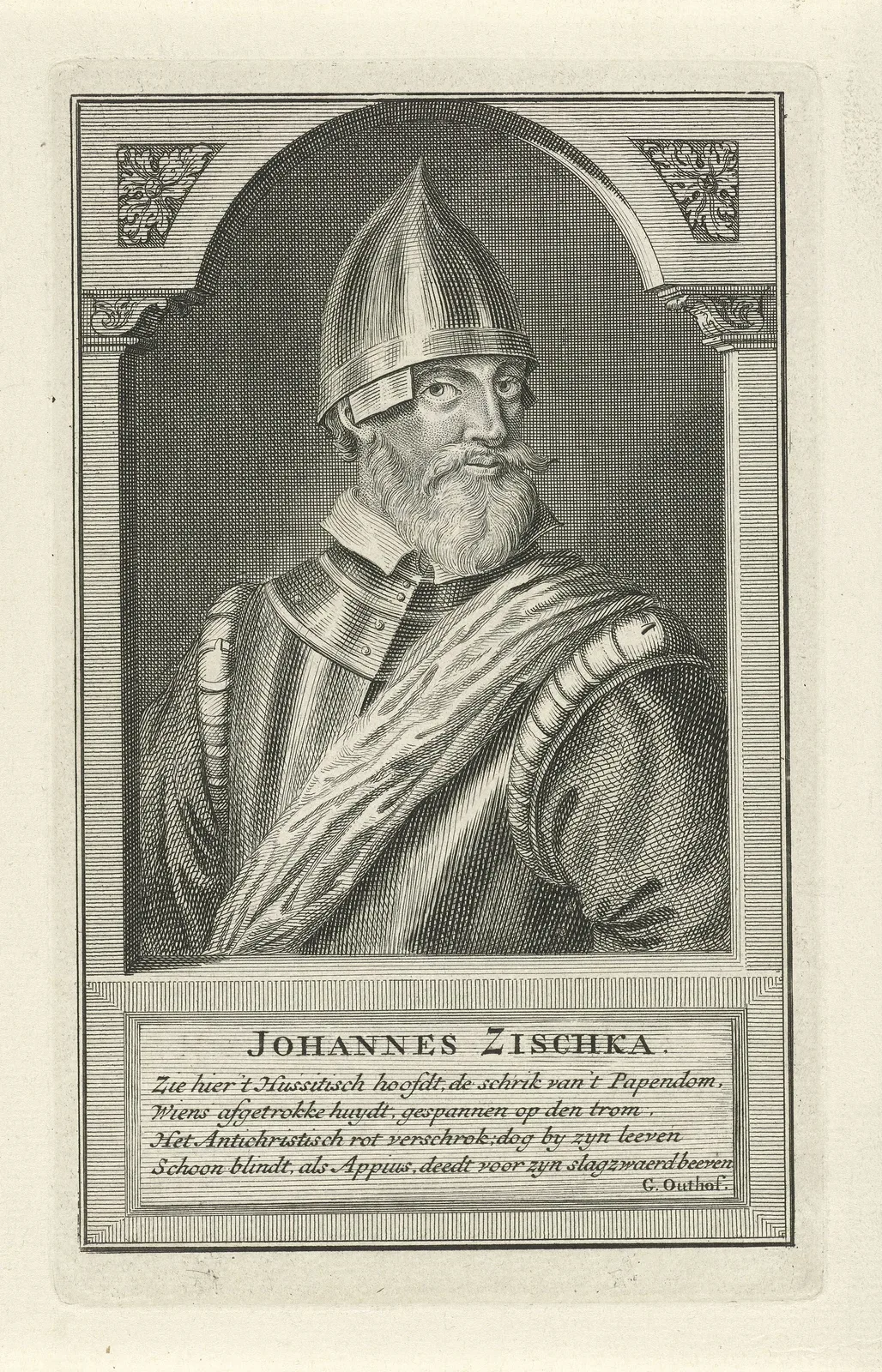
Jan Vilímek's 19th-century portrait of Žižka (c. 1360–1424), the one-eyed Hussite commander who revolutionized medieval warfare through wagon-fort tactics.
| Battle Details | |
|---|---|
| Date | 1420-1434 |
| Location | Bohemia |
| Belligerents | Hussite forces vs anti-Hussite crusades (Holy Roman Empire and Catholic forces) |
| Result | Hussite tactical system defeated five papally declared anti-Hussite crusades; system obsolescence came from pike-and-shot tactics and improved artillery by early 16th century |
| Legacy | |
| Firearms Significance | The Wagenburg was the first large-scale military system designed around integration of gunpowder weapons into coordinated combined-arms doctrine, giving early firearms a structural role in battle rather than merely siege applications. |
Wagenburg Tactics: The Mobile Fortress That Rewrote Medieval Warfare
Firearms encyclopedia article
From The Boise Gun Club Handbook
Overviewedit
Sometime around 1420, a nearly blind general named Jan Žižka looked at a column of farm wagons and saw a castle. What he built from that insight — the Wagenburg, or wagon fort — was one of the most tactically disruptive innovations in medieval military history. For roughly fifteen years, it made a peasant army from Bohemia effectively unbeatable in the field against the armored knights of Catholic Europe. More importantly for firearms history, the Wagenburg was the first large-scale military system designed around the integration of gunpowder weapons into a coordinated combined-arms doctrine.
The word Wagenburg is German for "wagon fortress." The Hussites themselves called it vozová hradba — "wagon wall." Whatever you call it, the concept was the same:
Chain your wagons together into a square or circle, put your guns behind the walls, and make your enemy come to you.
Background & Contextedit
Religious Origins
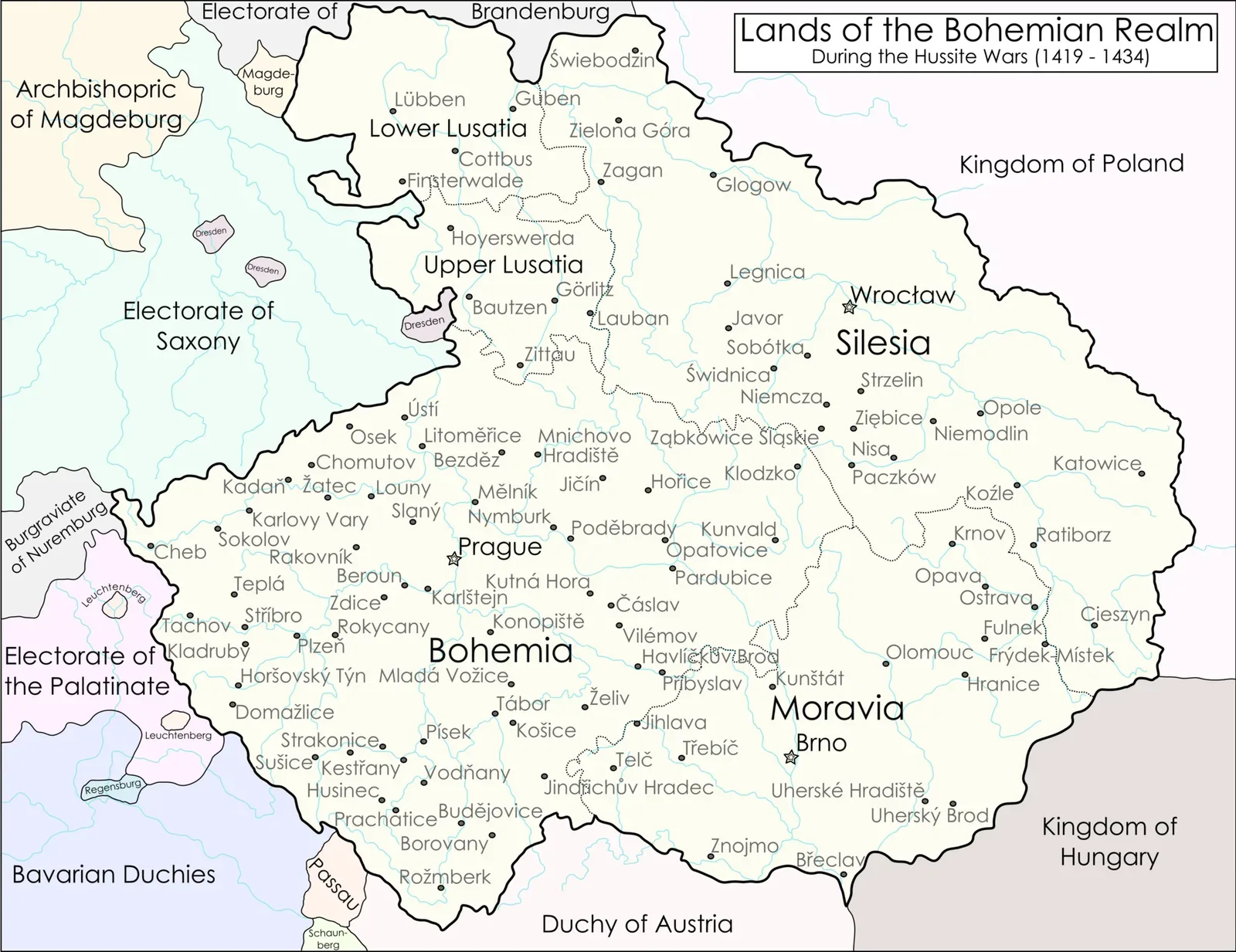
The Hussite Wars (1419–c.1434) began as a religious conflict. Jan Hus, a Czech theologian and rector of the University of Prague, had been advocating reform of the Catholic Church since at least 1402 — questioning papal authority, denouncing the sale of indulgences, and preaching in Czech rather than Latin so ordinary people could understand him. According to World History Encyclopedia, he was called to the Council of Constance in 1414 under a guarantee of safe passage, then imprisoned and burned at the stake in July 1415.
His colleague Jerome of Prague followed him to the stake a year later.
The Bohemian Response
The executions radicalized Hus's followers. On July 30, 1419, the priest Jan Želivský led a protest march through Prague that ended with seven town council members being thrown from an upper-story window — the First Defenestration of Prague. King Wenceslaus IV died shortly after, and his half-brother Sigismund of Hungary appealed to Pope Martin V for permission to launch a crusade against Bohemia's heretics.
The pope granted it in March 1420. What Sigismund got in return was fifteen years of losing.
The Hussites were not a professional army. They were primarily urban commoners and peasants — people who knew how to use a flail, a crossbow, and a wagon, but who had never been trained for the pitched battle tactics of medieval warfare. Their opponents were armored knights backed by the resources of the Holy Roman Empire. The gap in equipment and numbers was enormous. What closed that gap was Žižka.
Jan Žižka's Innovation
Jan Žižka (c.1360–1424) had lost one eye before the wars began and would lose the other during them, commanding his armies in total blindness in the final years of his life. According to World History Encyclopedia, he died in October 1424 from plague, still undefeated in battle. His tactical genius lay not in inventing entirely new tools, but in recognizing what the tools he already had could do when combined correctly.
As HistoryNet notes, European armies had used wagons for support and field fortification for at least a century before Žižka. What made his wagons different was that they were purpose-built for combat — manufactured to a common template, heavily reinforced, and fitted with side loopholes designed specifically to accommodate firearms and crossbows.
Forces & Weaponsedit
The Hussite army that developed and fielded the Wagenburg was, in military terms, a combined-arms force built around the limitations of its own troops and the specific vulnerabilities of its enemies.
Wagon Crew Composition
According to the Wikipedia source on wagon forts, each wagon carried a crew of 18 to 21 soldiers with specific roles:
| Role | Number | Primary Weapons | Function |
|---|---|---|---|
| Crossbowmen | 4-8 | Crossbows | Precision ranged fire |
| Handgunners | 2 | Píšťala (hand cannons) | Gunpowder weapons |
| Melee Infantry | 6-8 | Pikes, flails | Close combat, breach defense |
| Shield Carriers | 2 | Shields, melee weapons | Protection for crews |
| Drivers | 2 | Various | Vehicle operation |
| Total per wagon | 18-21 | Mixed arms | Combined operations |
World History Encyclopedia puts the crew at 20, including men and women — Hussite forces drew from the whole community. The sides of each wagon facing the enemy were thickly reinforced with wood and metal. The loopholes allowed crews to operate their ranged weapons from behind cover rather than standing exposed in the open field.
Gunpowder Weapons
The ranged weapons themselves are where the Wagenburg's significance to firearms history becomes direct. The Hussites deployed two distinct gunpowder weapons:
| Weapon | Czech Name | Type | Function | Modern Descendant |
|---|---|---|---|---|
| Houfnice | Houfnice | Artillery | Area bombardment, arcing fire | Howitzer |
| Hand Cannon | Píšťala | Personal firearm | Direct fire from loopholes | Pistol/Musket |
| Large Gun | — | Wagon-mounted cannon | Direct fire support | Field gun |
| Small Cannon | Tarasnice | Light artillery | Close support | Light cannon |
The houfnice was described by the Wikipedia source as a primitive form of a howitzer — and more than just described, it's the etymological root of the English word "howitzer." These were artillery pieces capable of arcing fire over the wagon walls into massed enemy formations. According to the JSTOR snippet cited in sources, full-sized Hussite field armies could include as many as 200 war wagons and 30 houfnice guns.
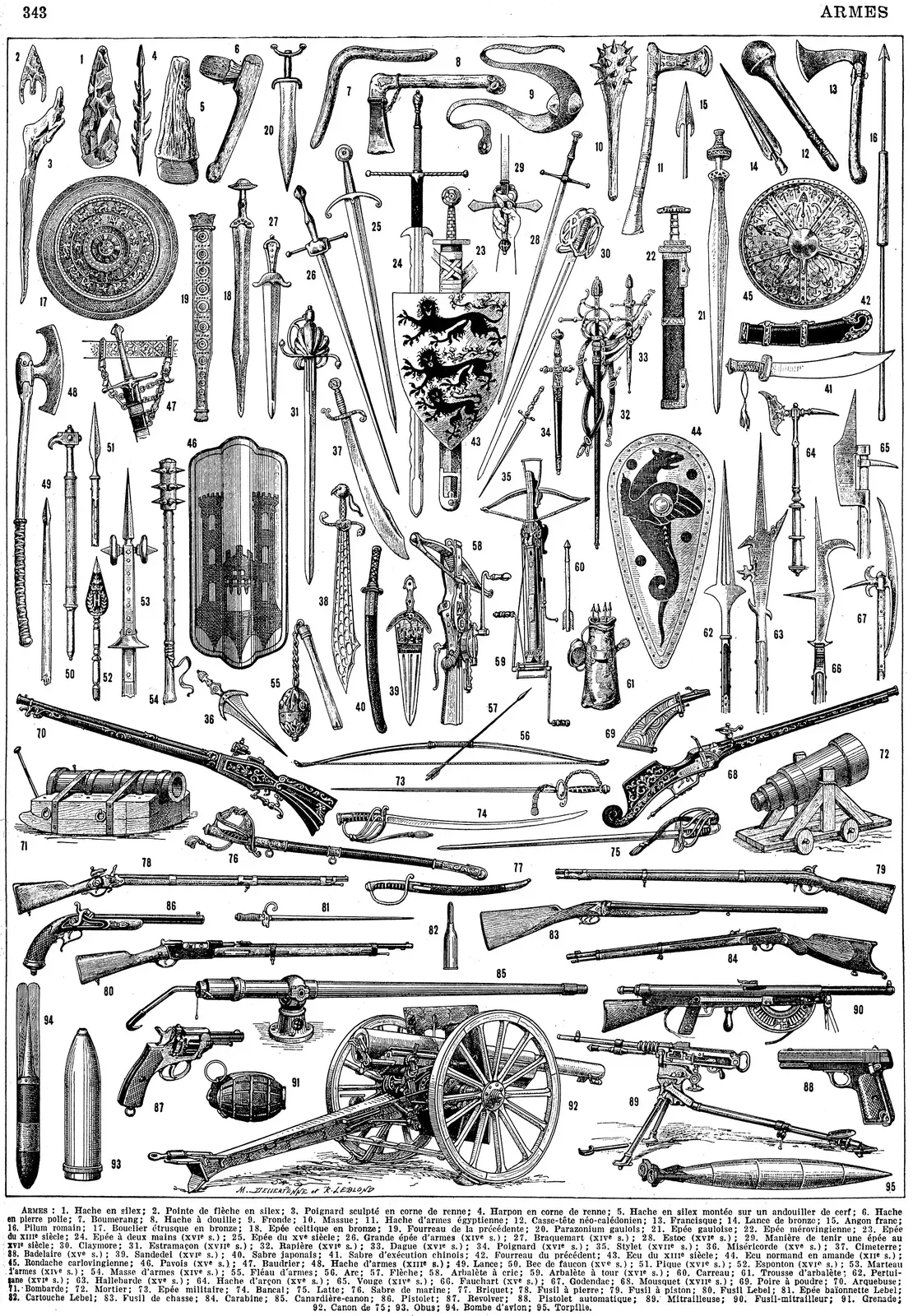
The píšťala was the Hussite term for their hand cannons. The Wikipedia source explains that the word means "pipe" or "fife" in Czech, referring to the weapon's shape, and notes that the word pistol may derive from this term. Two píšťala gunners rode in every wagon crew. These were not sidearms — they were early shoulder-fired or braced firearms, placing them squarely in the lineage of the handgonne tradition that would evolve over the next century into the arquebus and eventually the musket.
The Aristocratic Fury source provides specific equipment detail from a 1441 letter: Queen Elizabeth of Hungary, equipping war wagons after the Wagenburg model, specified that each wagon should carry four handguns, one large gun, one houfnice, and one tarasnice (a smaller cannon). This gives a concrete snapshot of how the weapons load evolved as the tactics spread.
Enemy Forces
The enemy the Wagenburg was designed to defeat was the armored heavy cavalry of the anti-Hussite crusades — mounted knights in full plate armor, backed by the social and military culture of feudal Europe. Armored knights were extraordinarily expensive to train, equip, and field. They were also, it turned out, catastrophically vulnerable to gunpowder weapons fired from behind cover, and nearly helpless once dismounted. The Hussite tactical system was built specifically to exploit both of those facts.
The Battleedit
The Wagenburg had a two-stage combat sequence that Žižka refined and repeated across multiple engagements.
Defensive Phase
When facing a numerically superior enemy, the Hussites would form their wagons into a square, join them with iron chains, and place artillery in the gaps between wagons and behind the formation. The houfnice would begin a barrage while the enemy was still at distance. As the enemy cavalry closed to charge the wagon walls, crossbowmen and handgunners would emerge through the loopholes and concentrate fire on the horses specifically — unhorsing knights rather than trying to penetrate their armor directly.
Dismounted knights in full plate were, as HistoryNet notes, ponderous and easy targets. The wagon walls themselves were essentially impenetrable to cavalry charges.
The two-stage Wagenburg combat sequence: defensive attrition followed by counterattack
Once the attacking force had been shredded and demoralized by concentrated fire, Žižka would order the infantry out of the wagons to attack the enemy's flanks and rear, pinning the survivors against the wagon walls. The cavalry — held inside the square during the defensive phase — would then emerge and pursue retreating enemies, turning a tactical defeat into a rout.
Major Engagements
This sequence played out at the Battle of Sudoměř on March 25, 1420 — according to World History Encyclopedia, Žižka's first use of the wagon innovation, where a Hussite force of roughly 400 defeated crusaders outnumbering them approximately 2,000 to 400. It played out again at the Battle of Kutna Hora in December 1421, where Žižka found himself surrounded and responded by forming the wagons into a column and driving them through Sigismund's encircling army under continuous fire from firearms, crossbows, and the houfnice.
| Battle | Date | Hussite Force | Enemy Force | Outcome | Key Innovation |
|---|---|---|---|---|---|
| Sudoměř | March 25, 1420 | ~400 | ~2,000 | Decisive Hussite victory | First use of wagon fort |
| Kutna Hora | December 1421 | Unknown | Larger force | Fighting withdrawal | Mobile wagon column |
| Tachov | 1427 | N/A | German forces | German defeat | Failed German copy attempt |
| Lipany | May 30, 1434 | Radical Hussites | Moderate Hussites + Catholics | Decisive defeat | Feigned retreat tactic |
The Hussites defeated five papally declared anti-Hussite crusades using this system, according to HistoryNet.
Tactical Vulnerabilities
The Wagenburg was not invincible, and its weaknesses were eventually identified and exploited. The Wikipedia source notes that the Battle of Tachov in 1427 saw anti-Hussite German forces defeated when they tried to use captured wagon fort tactics — they were unfamiliar with the system and it failed in their hands. But the same source records that the first lesson learned about defeating the Wagenburg was clear: prevent it from being erected, or trick the men inside into charging out prematurely. A feigned retreat could accomplish the latter.
That vulnerability ended the Hussite Wars.
On May 30, 1434, at the Battle of Lipany in central Bohemia, the moderate Utraquist faction of Hussites — who had accepted an invitation to negotiate with Sigismund and the Catholic Church — allied with Catholic loyalist forces against the radical Taborites commanded by Prokop the Bold (c.1380–1434), who had replaced Žižka after his death. Prokop's initial artillery barrage from the wagon forts appeared to force the opposing army into retreat. He opened the forts and sent his soldiers out to pursue.
The retreat was a feint. According to both HistoryNet and World History Encyclopedia, the Utraquist forces turned and attacked simultaneously with a cavalry force that had been held out of sight. Prokop was killed. The Taborites were massacred. Survivors were burned. The Hussite Wars effectively ended at Lipany — not because the Wagenburg failed as a system, but because its users were baited into abandoning it by someone who had previously fought under its doctrine and knew exactly how to defeat it.
Firearms Significanceedit
Before Žižka, gunpowder weapons in European warfare were siege tools — expensive, slow, and handled by specialists. They had appeared on battlefields in limited numbers but had not been integrated into a coherent tactical system that ordinary soldiers could train on and execute reliably.
The Wagenburg changed that. It gave early firearms a structural role in combined-arms battle doctrine: the handgunners and crossbowmen operated from protected positions with clear fields of fire, the artillery provided suppression and area denial at range, and the melee infantry served as the exploitation force once the guns had done their work.
Tactical Integration
If guns work best defending a castle, make mobile castles.
The Wagenburg also accelerated the geographic spread of firearms doctrine through a specific mechanism: the export of Czech mercenaries. After the Hussite Wars ended, thousands of veterans who had trained in Wagenburg tactics took employment with neighboring powers. According to the Wikipedia source, Hungary, Poland, and others hired these mercenaries specifically because of their tactical expertise. John Hunyadi, the Hungarian general who would spend the following decades fighting the Ottomans, studied Hussite tactics and applied them directly.
Geographic Spread
The Crusade of Varna in 1443–44 deployed 600 war wagons produced in Brașov under Czech supervision, according to the Aristocratic Fury source. The Czech captain commanding the formation, Jan Čapek, had fought under Žižka himself. The chain of transmission from Žižka's tactical innovations to the battlefields of the Balkans took roughly one generation.
The evolution and spread of wagon fort tactics across four centuries
Evolution and Obsolescence
Hunyadi's campaigns against the Ottomans also revealed the tactical ceiling of Wagenburg doctrine. The system was built around an aggressive enemy who would charge a static defensive position. The Ottomans, who by the 1440s were already familiar with the Wagenburg, simply declined to attack it. At the Battle of Melstica, according to the Aristocratic Fury source, Hunyadi tried to lure the Ottomans into attacking his wagon fort — they refused, knowing it was a death trap. At the Battle of Varna in 1444, Cardinal Julian Cesarini suggested forming a large Wagenburg, but the same problem applied: an enemy that wouldn't attack it would simply wait for the defenders to run out of supplies. The crusaders were forced into an offensive engagement and lost.
The Wagenburg's obsolescence on open European battlefields came from a different direction: the rise of pike-and-shot tactics. According to the Aristocratic Fury source, Landsknecht pikemen broke through a Bohemian Wagenburg at the Battle of Wenzenbach in 1504 during the War of the Succession of Landshut. In the pike-and-shot system, mobile infantry — pikemen protecting musketeers — could close the distance to a wagon fort under fire and breach it by force, something that armored cavalry had never been able to do. The wagons were also inherently vulnerable to artillery, which by the early 16th century was becoming more mobile and more widely fielded.
Hungary held onto the Wagenburg longer than other European powers, specifically because, as the Aristocratic Fury source explains, Hungarian military culture lacked the urban militia traditions and pikemen mercenary culture — the Swiss model, the Flemish model, the Landsknecht model — that made pike-and-shot feasible. There was no local pikemen class to replace the wagons with. At the Battle of Mohács in 1526, Hungary formed a Wagenburg but it couldn't stop the Ottoman assault against a numerically inferior army. It served as a last refuge rather than a decisive tactical system.
The Russians developed their own parallel variant, the guliai-gorod, a movable fortress used into the 16th century. The Cossacks used tabor formations on the march. The Voortrekkers in South Africa called theirs a laager and used it to decisive effect as late as the Battle of Blood River on December 16, 1838, where approximately 460 Voortrekkers repelled an attacking Zulu force estimated at 10,000–15,000. American settlers on the plains called it circling the wagons.
The underlying concept appeared in multiple forms across centuries and continents:
- Russian guliai-gorod (movable fortress, 16th century)
- Cossack tabor formations (mobile warfare)
- Voortrekker laager (Battle of Blood River, 1838)
- American settlers "circling the wagons" (Plains frontier)
What the Hussites did in the 1420s was not just invent a tactic. They built the first military system that treated early firearms as a primary weapon requiring specific tactical architecture to function effectively. Every combined-arms doctrine that followed — the integration of firearms into infantry formations, the relationship between cover and firepower, the use of suppression to enable maneuver — traces a line back through this chain.
The BGC Takeedit
Opinion — this is where I'll tell you what I actually think.
The Wagenburg doesn't get enough credit in the standard firearms history narrative, which tends to jump from the invention of gunpowder to the arquebus to the musket without explaining how anybody figured out what to do with guns in a real fight. Žižka figured that out. He looked at weapons that were slow, unreliable, and hard to aim accurately, and instead of asking them to win a battle by themselves, he built a system that used them the way they actually worked — from cover, at close-to-medium range, in volume, against specific targets (horses first, then dismounted knights).
The part that really sticks with me is the crew composition: 18 to 21 people per wagon, with only 2 handgunners. The guns weren't carrying the fight. They were one tool in a layered system that also included crossbows for accuracy, pike and flail for the breach, and cavalry for the pursuit. Nobody was betting the whole engagement on the firearms performing perfectly. That's tactically mature thinking — especially for a peasant army in 1420.
The end at Lipany is worth sitting with. The Wagenburg wasn't defeated by a better weapon or a superior tactic. It was defeated because the people inside it broke discipline — they saw what looked like a retreating enemy and chased it. The feigned retreat is one of the oldest tricks in warfare, and it worked on the people who had invented one of the most effective defensive systems in medieval history.
Doctrine only works if you trust it enough to stay in the wagon.
That's a lesson that doesn't age.
Referencesedit
- https://en.wikipedia.org/wiki/Wagon_fort
- https://historynet.com/hussite-wars/
- https://www.worldhistory.org/Hussite_Wars/
- https://aristocraticfury.substack.com/p/how-hungarians-used-wagenburg-tactics
- https://www.jstor.org/stable/48578536
- https://www.reddit.com/r/AskHistorians/comments/d0aapv/the_wagon_fort_tactics_used_by_the_hussites/
- https://warhistorynetwork.com/groups/medieval-military-history-c-500-c-1500/forum/topics/focus-on-tactics-the-one-eyed-general-and-the-development-of-wage
Last Updated: February 27, 2026
- Gls Guns(Sumner, IA)
- Bi-mart - Yakima (Fruitvale Ave)(Yakima, WA)
- New Philly Sportsman Specialities(New Philadelphia, OH)
- R&R Sports & Outdoors(Brandon, FL)
Loading comments...