Details
Walther P99

| Category | firearms |
|---|---|
| Last Updated | 3/25/2026 |
Walther P99
The pistol that pioneered features the industry spent two decades copying
From The Boise Gun Club Handbook
Quick Statsedit
| Attribute | 9×19mm | .40 S&W |
|---|---|---|
| Manufacturer | Carl Walther GmbH Sportwaffen | Carl Walther GmbH Sportwaffen |
| Designer | Horst Wesp | Horst Wesp |
| Action | Short recoil, locked breech | Short recoil, locked breech |
| Year Introduced | 1997 | 1997 |
| Production Ended | 2023 | 2023 |
| Barrel Length | 102 mm (4.0 in) | 106 mm (4.2 in) |
| Overall Length | 180 mm (7.1 in) | 184 mm (7.2 in) |
| Height | 135 mm (5.3 in) | 135 mm (5.3 in) |
| Width | 29 mm (1.1 in) | 32 mm (1.3 in) |
| Weight (unloaded) | 630 g (22 oz) | 655 g (23.1 oz) |
| Standard Capacity | 15 rounds | 12 rounds |
| Muzzle Velocity | 408 m/s (1,339 ft/s) | 344 m/s (1,129 ft/s) |
| Effective Range | 50 m (55 yd) | 50 m (55 yd) |
| Sights | Interchangeable 3-dot | Interchangeable 3-dot |
Overviewedit
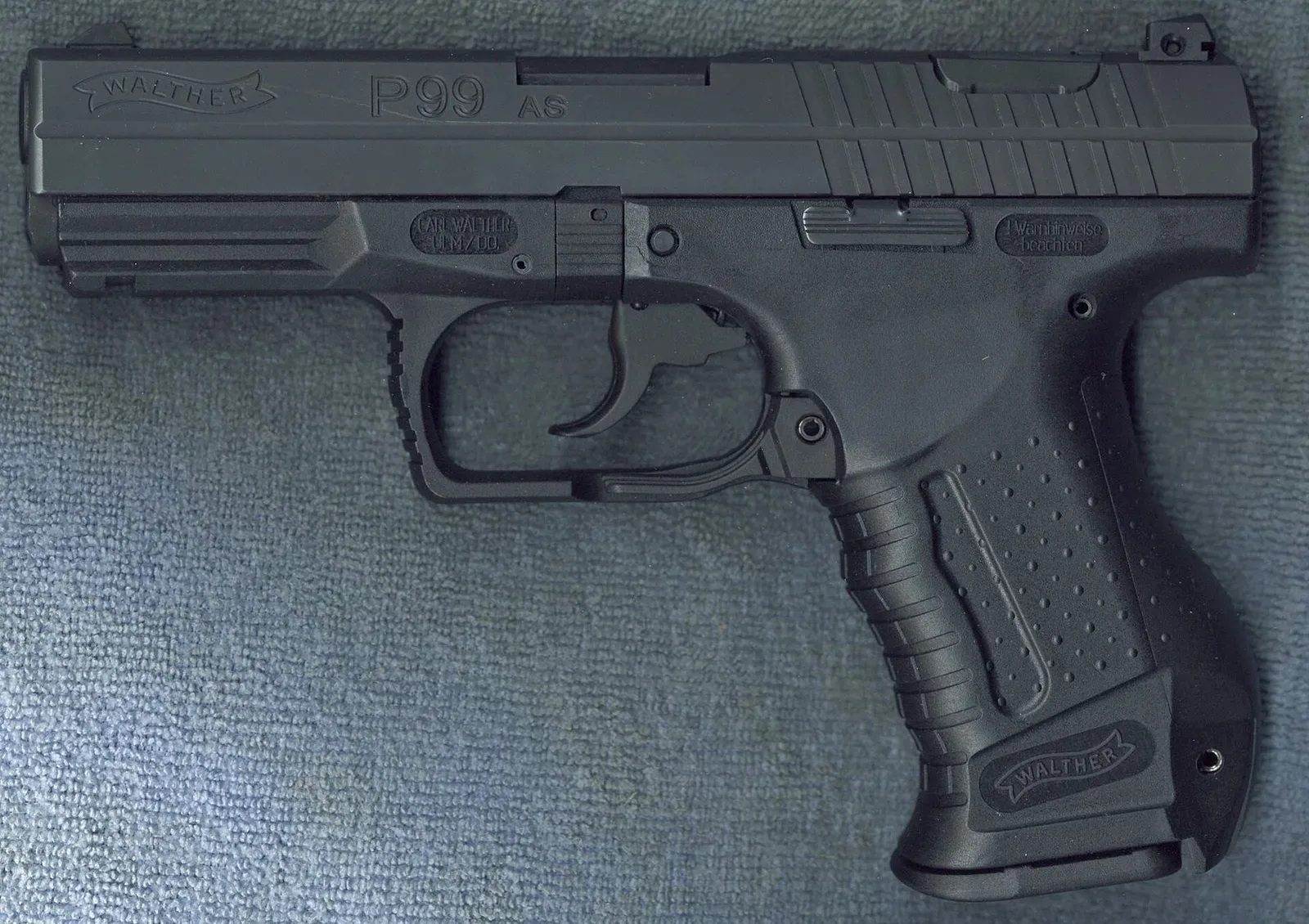
The Walther P99 is a short-recoil-operated, locked-breech semi-automatic pistol manufactured by Carl Walther GmbH Sportwaffen of Ulm, Germany. It uses a modified Browning cam-lock system adapted from the Browning Hi-Power and is chambered primarily in 9×19mm Parabellum, with additional variants in .40 S&W and 9×21mm IMI.
What set the P99 apart when it arrived in 1997 — and what still makes it unusual today — is its trigger system. It's a striker-fired pistol that behaves like a DA/SA hammer gun. You get a long, deliberate double-action first pull, crisp single-action follow-ups, and a decocker button recessed into the top of the slide. No other striker-fired service pistol on the market offered that combination, and very few have since.
The P99 served law enforcement agencies across Europe for over two decades before Walther announced its discontinuation in early 2023, releasing a limited P99 AS Final Edition to close out production. By that point, its design DNA had already migrated into the Walther PPQ and Walther PDP platforms that replaced it.
History & Developmentedit
Walther has been making firearms since 1886, when Carl Walther founded the company building rifles. Pistol production began in 1908. The company built its reputation on the PP (1929) and PPK (1931) series, followed by the P38 — the German military service pistol that replaced the P08 Luger under a contract with the Third Reich in 1938. After World War II, the company was rebuilt under Fritz Walther, Carl's son, and resumed P38 production for the West German Army in 1957.
By the late 1980s, Walther's service pistol lineup included the P5 (1977) and P88 (1988). Neither achieved wide adoption. Design work on a replacement began under Horst Wesp around 1993–1994, with the finished pistol unveiled in 1997. According to Wikipedia, the P99 was presented that year with series production commencing immediately as a direct replacement for both the P5 and P88.
The timing was deliberate. The early 1990s were a transitional moment in police sidearms — most European forces had moved to double-stack semi-autos, Glock had proven the polymer-framed striker-fired concept, and there was genuine demand for a pistol that combined polymer construction with a more traditional DA/SA manual of arms. The P99 was Walther's answer to all of it at once.
It achieved early pop-culture visibility when Pierce Brosnan carried it as James Bond starting with Tomorrow Never Dies in 1997, continuing through The World Is Not Enough (1999) and Die Another Day (2002). Daniel Craig briefly used it in Casino Royale (2006) before transitioning to the Walther PPK. The Bond connection generated significant awareness, though per Chuck Hawks' review, the pistol's sales in the American market were hampered by a steep initial price point — near $1,000 — driven partly by the dollar-to-mark exchange rate of the period and the original importer's markup.
Second-generation models appeared in 2004, eliminating the hooked "ski hump" trigger guard that caused comfort complaints, redesigning the slide for better purchase, and switching the proprietary accessory rail to a Weaver-type rail. Some 2005 models and all later production added an elongated magazine release. Second-generation guns also gained optional ambidextrous slide stop levers, replacing the left-side-only release of first-generation pistols.
Walther announced the end of P99 production in early 2023. The P99 AS Final Edition — a green-framed, engraved commemorative variant — was released that same year to mark the close of a 26-year production run.
Technical Specificationsedit
The P99 frame is molded from fiberglass-reinforced polymer. The slide and barrel are steel, treated with Tenifer — the same nitriding process used on Glock pistols. The Tenifer finish runs 0.04 to 0.05 mm deep, with a 64 Rockwell C hardness rating and 99% resistance to saltwater corrosion, meeting or exceeding stainless steel corrosion specs. Because the finish penetrates the metal rather than sitting on top of it, treated parts retain similar properties below the surface — relevant for a pistol that sees holster carry and perspiration exposure over years of service.
The pistol is available in four color configurations: black frame with black slide, black frame with titanium-coated slide, military olive-drab frame with black slide, and desert tan frame with black slide. Compact variants are only available in all black.
Operation centers on an internal striker rather than an external hammer. A red-painted striker tip protrudes visibly and palpably from the rear of the slide whenever the firearm is cocked, providing a tactile and visual cocking indicator. A loaded chamber indicator sits on the right side of the slide.
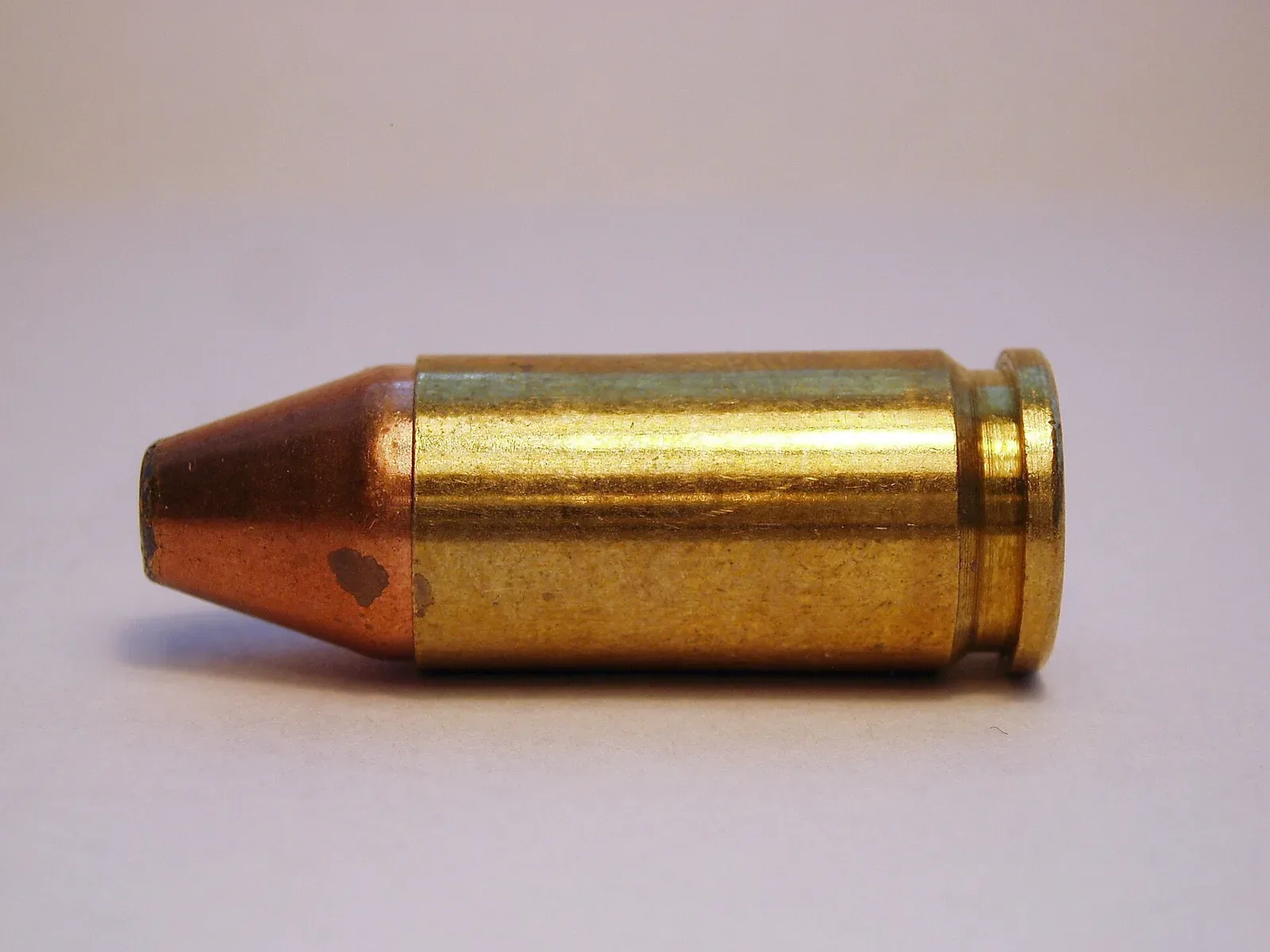
The magazine feeds from a staggered-column double-stack box. When the P99 was first introduced, 9mm magazines held 16 rounds and .40 S&W magazines held 12. These were later reduced to 15 and 11 respectively. Higher-capacity options — 17 and 20 rounds in 9mm — eventually became available. Walther also offers +2 baseplates that extend grip length by approximately 18 mm (0.7 in). According to Chuck Hawks' review, P99 magazines are subcontracted to Italian manufacturer Mec-Gar.
The dust cover rail is Weaver-type on second-generation and later guns (Picatinny MIL-STD-1913 on the P99Q variant). It accommodates tactical lights and laser sights. A factory suppressor kit is offered, consisting of a 117 mm (4.6 in) threaded barrel and a silencer rated to reduce the sound signature by 33 dB(A).
All 9mm P99s are entirely German-manufactured, bearing an "Eagle over N" proof mark from the German Proof House at Ulm, indicating the pistol was test-fired with a proof load. Some .40 S&W component manufacturing occurred under license by Smith & Wesson.
Trigger Systems
The trigger is where the P99 gets complicated — and interesting. There are three primary trigger configurations across the production run, plus the police-specific P99Q variant:
| Variant | Mode | Trigger Travel | Pull Weight | Notes |
|---|---|---|---|---|
| P99 AS (Anti-Stress) | DA (decocker active) | 14 mm (0.55 in) | ~8.5 lb (38 N) | Striker at rest, no pre-load |
| P99 AS (Anti-Stress) | Anti-Stress (first shot after racking) | 14 mm (0.55 in) | ~4.5 lb (20 N) | Long travel, light pull; two-stage feel |
| P99 AS (Anti-Stress) | SA (subsequent shots) | 8 mm (0.31 in) | ~4.5 lb (20 N) | Short reset, ~0.1 in |
| P99QA (Quick Action) | Consistent pull | ~8 mm (0.31 in) | ~8.5 lb (38 N) | Pre-loaded striker; Glock-style |
| P99DAO | DA only | ~14 mm (0.55 in) | ~8.5 lb (38 N) | Striker returns to rest after each shot |
| P99Q (Police) | Partially pre-loaded | ~13 mm (0.5 in) | ~7.2 lb (32 N) | German Police TR 2008 certified |
The Anti-Stress mode deserves particular explanation. When the slide is racked to chamber a round, the P99 AS places the striker in a cocked position but leaves the trigger in the forward (double-action) position. The first pull travels the full 14 mm, but most of that distance is light slack — similar in feel to a two-stage rifle trigger. Pressure increases noticeably near the end of travel to a crisp 4.5 lb break. All subsequent shots fire in standard single-action with approximately 8 mm of travel at the same 4.5 lb weight and a reset of roughly 0.1 inches.
A decocking button recessed into the top of the slide — forward of the rear sight — drops the striker safely from either SA or Anti-Stress mode back to full DA. This placement keeps the holster profile slimmer than side-mounted decocker designs, though it does require taking a hand off the pistol to actuate.
Second-strike capability is worth calling out specifically. If a round fails to fire, the P99 allows the shooter to pull through a full DA stroke again without cycling the slide — the only striker-fired service pistol with this ability. Most experienced shooters would default to a tap-rack drill anyway, but the option exists.
Ergonomics
Three interchangeable grip backstraps — small, medium, and large — are included with every P99. They are retained by a roll pin. The grip angle is 110 degrees. Molded-in depressions on both sides of the frame index the fingertips, and a palm swell on the backstrap resists lateral movement. The front strap has subtle horizontal serrations and finger grooves.
According to the Chuck Hawks review, these interchangeable backstraps were the first such feature on any polymer-framed pistol — a design element that has since been adopted across the industry.
The magazine release is a paddle design integrated into the rear of the trigger guard, running nearly the full length of the guard. Either index finger pushes down to drop the magazine, with no grip shift required. This was a deliberate departure from the Browning-style button release, prioritizing speed and ambidextrous use at the cost of familiarity for American shooters.
Variants & Modelsedit
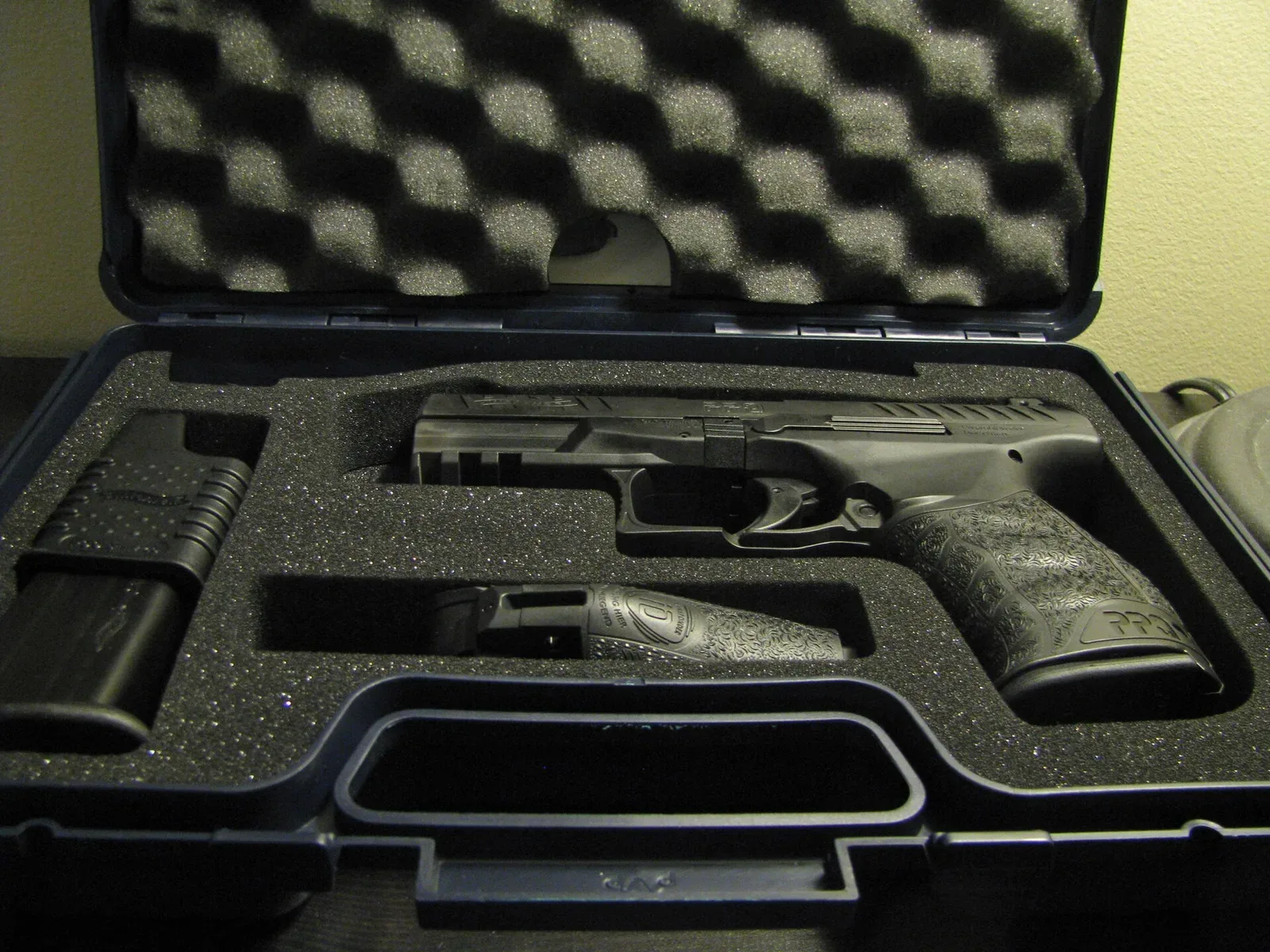
The P99 family spans factory variants, police-specific models, limited editions, and licensed foreign productions.
Factory Trigger Variants
P99 AS (Anti-Stress) is the primary variant from 2004 onward and the one most commonly encountered in the civilian market. It uses the full DA/SA striker system with decocker described above. The AS designation was applied retroactively to all pre-2004 P99s as well, since first-generation pistols operated on the same principle though they were not originally labeled as such.
P99QA (Quick Action) was announced in 2000 and discontinued in 2011. It uses a partially pre-cocked striker with a consistent pull throughout — functionally similar to the Glock Safe Action, though with slightly different geometry. The QA's decocker is smaller and semi-circular rather than the full rectangular button on the AS, because in the QA system the decocker is only intended for storage, not carry — the pistol cannot fire from the uncocked position without racking the slide. Development of the QA system directly led to the Walther PPQ, introduced in 2011.
P99DAO mirrors the earlier P990 Double-Action Only variant. The striker returns fully to its de-cocked position after each shot. Trigger pull and travel are consistent from first round to last — the choice of agencies wanting no single-action mode in service.
P99C (Compact) is available in all three trigger configurations. Per IMFDB, the P99C has a 3.5-inch barrel and 6.6-inch overall length, weighing 1.17 lb. It accepts full-size P99 magazines with an extended grip adaptor. Only available in all-black finish.
P99Q is a police-only variant built to German Police Technical Specifications (TR 2008), which require a first-shot pull of at least 6.7 lb, trigger travel of at least 10 mm, and trigger reset of at least 4 mm. It also mandates group accuracy of 16 cm (6.3 in) or better at 25 m with certified ammunition — approximately 22 MOA. The P99Q features an integrated MIL-STD-1913 Picatinny rail and is not available on the civilian market.
Licensed Foreign Variants
P99 RAD is manufactured under license by Fabryka Broni Radom in Poland. It features a redesigned grip with altered texture, extended ambidextrous slide and magazine releases, a MIL-STD-1913 Picatinny rail, and high-contrast 3-dot sights painted with afterglow paint. Available in DAO and QA trigger configurations, with optional tritium night sights. According to Wikipedia, many of the RAD's design changes were later incorporated into the PPQ and the P99Q.
Smith & Wesson SW99 is a joint venture in which Walther produces a modified receiver in Germany and Smith & Wesson fabricates slides and barrels in the United States. The SW99 was also available in .45 ACP — the only P99-platform pistol offered in that caliber.
Magnum Research MR Eagle used a Walther polymer frame with integral steel rails and Magnum Research-produced 416 stainless steel slides and 4140 CrMo steel barrels made in Pillager, Minnesota. Available as the MR9 (9×19mm) and MR40 (.40 S&W).
Limited Editions
| Edition | Year | Quantity | Notes |
|---|---|---|---|
| MI-6 | Late 1990s | Not specified | 007 serial prefix, HMSIS crest; Bond film tie-in |
| Year 2000 | 2000 | 2,000 | First-generation spec, millennium commemorative |
| P99 TA | 2002 | ~50 produced, <25 sold publicly | Baden-Württemberg police trial gun; ~10 imported to U.S. |
| P99 AS Final Edition | 2023 | Not specified | OD-green frame, "Final Edition" slide engraving, challenge coin |
Performance Characteristicsedit
The P99's short-recoil Browning-derived action functions consistently across the standard-pressure 9mm loadings it was designed around. Civilian and law enforcement users report thousands of rounds without stoppages as a routine experience. The Chuck Hawks review documented 150 rounds of mixed 115 gr and 147 gr 9mm with zero malfunctions, plus a subsequent session where steel-cased Russian ammunition produced two failures to fire — attributed to the ammunition, not the gun, because the second-strike capability fired both rounds on the follow-up pull.
The P99's barrel and slide use three mating surfaces during the recoil phase rather than the single flat surface common to most striker-fired designs. According to the Chuck Hawks review, this allows for a narrower, more angular slide contour and may contribute to the pistol's consistent lockup.
Recoil in 9mm is described consistently across sources as moderate and manageable. The grip geometry naturally directs recoil into the arm, and the short SA reset allows fast follow-up shots once the shooter is familiar with the trigger. The .40 S&W variant is a different story — multiple reviewers, including the Chuck Hawks piece, found it noticeably snappier and less pleasant to shoot, and recommend that caliber in a heavier platform.
The P99's Tenifer-treated slide handles sweat and holster wear well. Its 64 Rockwell C hardness and 99% saltwater corrosion resistance give it a durability profile well-suited to concealed carry and field use.
Recommended Loadings
| Load | Grain | Notes |
|---|---|---|
| FMJ (training) | 115 gr | Reliable cycling, standard for range use |
| FMJ (training) | 124 gr | Smooth recoil impulse; consistent reliability |
| FMJ (training) | 147 gr | Subsonic; cycles reliably with P99 recoil system |
| Federal HST | 124 gr +P | Recommended defensive load |
| Speer Gold Dot | 124 gr | Recommended defensive load |
| Winchester Ranger | 127 gr +P+ | Functions reliably; routine +P+ use not recommended for long-term wear |
| Hornady Critical Duty | 135 gr | Functions reliably |
The Alien Gear review notes that the P99 handles +P loads reliably but recommends against routine +P+ use for long-term wear. The Chuck Hawks review notes that Walther does not officially recommend +P ammunition in the P99, while also observing that the pistol's unusually stiff recoil spring should make out-of-battery incidents rare.
Strengthsedit
- Three distinct trigger modes (DA, AS, SA) — more operational flexibility than any other striker-fired service pistol
- Second-strike capability on dud primers; the only striker-fired pistol with this feature
- Tenifer finish rated 64 Rockwell C hardness and 99% saltwater corrosion resistance
- Paddle magazine release is fully ambidextrous and requires no grip shift
- Interchangeable backstraps in three sizes — the first polymer pistol to offer this feature
- Proven duty reliability documented across decades of European law enforcement use
- SA trigger reset of approximately 0.1 inches — among the shortest on any service pistol
- Tool-less field strip; four internal safeties
- Factory suppressor kit with 117 mm threaded barrel, rated for 33 dB(A) reduction
Weaknessesedit
- No factory optics-ready variant — slide-top decocker location blocks most red dot mounting solutions
- DA/SA/AS trigger system requires significant training time to run consistently under stress
- Grip texture is mild; can become slick in wet conditions or with gloves
- Aftermarket support is thin compared to Glock, M&P, and even the PPQ
- Production ended 2023; parts and magazine availability will decrease over time
- .40 S&W variant produces recoil most reviewers found unpleasant for extended sessions
- First-generation slide serrations are narrow and difficult to grip over a loaded magazine
- Estonian police replaced their P99Q pistols after two years due to reported malfunctions during training and duty use
- Slide is wider than competing 9mm pistols, making it thicker than a SIG P226 slide
Notable Usersedit
The P99 was adopted by law enforcement and military organizations across Europe and beyond. According to Wikipedia, current and former users include:
| Country | Organization |
|---|---|
| Finland | Finnish Defence Forces (designated PIST 2003); Finnish Police; Finnish Customs; Finnish Border Guard |
| Germany | North Rhine-Westphalia Police; Rhineland-Palatinate Police; Hamburg Police; Bremen Police; Schleswig-Holstein Police |
| Ireland | Garda Síochána (National Surveillance Unit, National Bureau of Criminal Investigation, Drugs and Organised Crime Bureau, Special Detective Unit, Emergency Response Unit) |
| Netherlands | National Police Corps |
| Poland | Polish Police |
| Portugal | Polícia de Segurança Pública; ASAE; GNR Special Operations Group |
| Malaysia | Royal Malaysian Police; Royal Malaysian Navy |
| North Macedonia | Special units |
| Serbia | Listed user |
| Spain | Guàrdia Urbana de Barcelona |
| Ukraine | Security Service of Ukraine |
| United Kingdom | Nottinghamshire Police (P990 DAO) |
| Canada | Service de police de la Ville de Montréal (former) |
| Estonia | Police and Border Guard Board (former; replaced after two years due to reported issues) |
The Finnish Defence Forces designation of PIST 2003 (Pistooli 2003) reflects the year of official adoption. The Netherlands National Police Corps adopted the P99Q in 2012. The Estonian Police and Border Guard began arming with the P99Q in 2014 as a replacement for the Makarov pistol, then began replacing the P99Q with a custom Glock 19 Gen 4 variant after reported malfunctions during training and duty use, with up to 1,000 P99Q pistols expected to remain in service during the transition.
The BGC Takeedit
The P99 is one of those guns that deserved more market success than it got, and the reasons it didn't sell in America are mostly cultural rather than mechanical.
American buyers in the late 1990s wanted either a DA/SA hammer gun — a SIG, an HK, a Beretta — or they wanted a Glock. The P99 was neither. It looked like a Glock but operated like a DA/SA, and the paddle magazine release spooked people who'd never tried one. Import pricing didn't help. When a first-generation P99 was landing near $1,000 at a time when a Glock 17 cost half that, the decision wasn't difficult for most buyers.
That's a shame, because the AS trigger is genuinely excellent. The double-action pull is lighter and smoother than any hammer-fired DA/SA service pistol — a consequence of the striker spring geometry compared to a conventional hammer mainspring. The single-action reset is around a tenth of an inch, which is shorter than most 1911s. And the second-strike capability is a real operational advantage that nobody else has figured out how to put in a striker-fired pistol.
The ergonomics hold up well even against modern competition. The three backstraps, the paddle release, the decocker-in-the-slide — these were genuinely forward-thinking in 1997. The PPQ and PDP that replaced the P99 are better in some ways (the PPQ trigger, optics cuts on the PDP), but neither offers the DA/SA capability. If that's your preference — and there are legitimate reasons to prefer a long, deliberate first pull on a duty gun — nothing else in the striker-fired world gives it to you.
The weaknesses are real. The grip texture is too smooth for wet-weather use without grip tape. The slide is thick. The .40 version is unpleasant to shoot and you should just skip it. And the discontinued status means the supply chain clock is running — magazines, holsters, and parts availability will only get tighter.
But if you find a second-generation P99 AS in good condition, buy it. It's a better handgun than its American sales history suggests, and it's about to become a legitimate collector piece now that the run is finished. The Final Edition is the obvious buy for the collector angle, but any clean AS-trigger example is worth owning for the trigger system alone.
See Alsoedit
- Walther PPQ — Successor platform derived from the P99QA's pre-set striker system; introduced 2011
- Walther PDP — Current production duty pistol; replaced the PPQ in the lineup
- Smith & Wesson SW99 — Licensed American variant with slides and barrels manufactured by S&W
- Walther P5 — One of the two pistols the P99 was designed to replace
- Walther P88 — The other pistol the P99 replaced
- Canik TP9 Series — Turkish-manufactured pistols drawing significant design influence from the P99
- Browning Hi-Power — Source of the cam-lock system adapted for the P99's action
Referencesedit
- https://en.wikipedia.org/wiki/Walther_P99
- https://aliengearholsters.com/blogs/news/walther-p99-review
- https://www.militaryfactory.com/smallarms/detail.php?smallarms_id=460
- https://loadoutroom.com/thearmsguide/walther-p99-german-standard/
- https://www.imfdb.org/wiki/Walther_P99
- https://chuckhawks.com/walther_P99.htm
- https://gunmagwarehouse.com/blog/the-walther-p99-an-underrated-legend/
Last Updated: March 30, 2026
- Gls Guns(Sumner, IA)
- Bi-mart - Yakima (Fruitvale Ave)(Yakima, WA)
- New Philly Sportsman Specialities(New Philadelphia, OH)
- R&R Sports & Outdoors(Brandon, FL)
No reviews yet
Be the first to review the Walther P99. Share your experience with the community.
Write the First ReviewLoading comments...