Specifications
AR-15 Platform

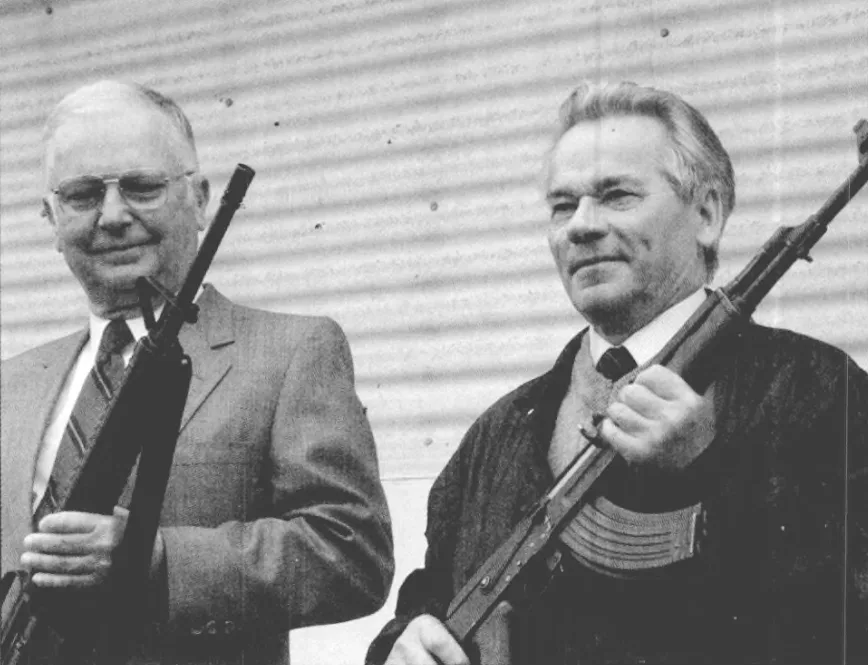
Stoner and Kalashnikov with their rifles — a rare Cold War moment between the American AR-15's designer and his Soviet counterpart.
(Photo by Sgt. Chris Lawson) (Public domain)
| Manufacturer | |
|---|---|
| Made By | Multiple manufacturers (Colt, Bushmaster, DPMS, Smith & Wesson, etc.) |
| Designer | Eugene Stoner |
| Origin | United States |
| Specifications | |
| Caliber | 5.56 NATO / .223 RemingtonAlso: .300 Blackout, 6.5 Grendel, 7.62x39mm, .350 Legend |
| Action | gas operated |
| Capacity | 30 rounds (standard) |
| Barrel | 16.0 inches (standard) |
| Length | 32.0 inches |
| Weight | 6.0 lbs (96 oz) unloaded |
| Feed | Detachable box magazine |
| Sights | Adjustable front post, rear aperture |
| Performance | |
| Muzzle Vel. | 3,100-3,200 fps (55gr projectile) |
| Production | |
| Designed | 1956 |
| In Production | 1963 |
| Produced | Over 20 million units |
| Variants | |
| |
| Service Use | |
U.S. Air Force (M16 variant)U.S. Military (M16 variant) | |
| Cultural Note | |
| America's most widely adopted civilian rifle system, fundamentally reshaping the American firearms market through standardized components and modular design philosophy | |
| Related Firearms | |
| |
AR-15 Platform
Firearms encyclopedia article
From The Boise Gun Club Handbook
The AR-15 is what happens when you take a design that works and let American ingenuity run wild with it. Over 20 million of these rifles are floating around out there, built by everyone from Colt to your buddy's cousin who started a company in his garage. Eugene Stoner sketched this thing out at ArmaLite back in 1956, and somehow we ended up with America's rifle.
This isn't just another gun—it's the most popular rifle platform in the country because it actually delivers on the promise of being whatever you need it to be. Home defense, competition, hunting, plinking—same basic rifle, different setup.
The numbers tell the story. Standard AR weighs about 6 pounds empty, feeds from 30-round magazines, and puts 55-grain bullets downrange at over 3,000 feet per second. Low recoil, decent accuracy out of the box, and parts everywhere you look. That's why it owns half the rifle market.
Specificationsedit
| Specification | Value |
|---|---|
| Caliber | 5.56 NATO / .223 Remington |
| Action | Gas-operated, rotating bolt |
| Capacity | 30 rounds (standard) |
| Barrel Length | 16.0 inches (standard) |
| Overall Length | 32.0 inches |
| Weight | 96 oz (6.0 lbs) unloaded |
| Feed System | Detachable box magazine |
| Sights | Adjustable front post, rear aperture |
| Twist Rate | 1:7 to 1:9 inches (common) |
| Muzzle Velocity | 3,100-3,200 fps (55gr projectile) |
How We Got Hereedit
Early Development
Eugene Stoner was trying to build a lightweight rifle that didn't beat the hell out of soldiers carrying it. His direct impingement gas system—where the gas comes straight back from the barrel to cycle the action—was cleaner on paper than reality, but it worked. ArmaLite went broke and sold the whole thing to Colt in 1959.
Key Milestones in AR-15 History
Military Adoption
The Air Force grabbed it first in 1962, calling it the M16. Then came Vietnam, where early versions had problems that got people killed—wrong powder, no cleaning kits, and promises that the rifle was "self-cleaning."
Took a few years to sort that mess out.
| Year | Milestone | Impact |
|---|---|---|
| 1956 | Eugene Stoner designs AR-10 at ArmaLite | Foundation for AR-15 platform |
| 1959 | ArmaLite sells rights to Colt | Commercial production begins |
| 1962 | Air Force adopts M16 | First military adoption |
| 1963 | Colt releases civilian AR-15 | Semi-auto market entry |
| 1970s | Patents expire | Market opens to competition |
| 1990s | M4 carbine standardized | Modern configuration established |
| 1997 | North Hollywood shootout | Law enforcement adoption surge |
Civilian Market Expansion
Colt started selling semi-auto versions to civilians in 1963, keeping the AR-15 name. When their patents expired in the '70s, everybody and their brother started making them. Bushmaster, DPMS, Smith & Wesson jumped in, then hundreds of smaller outfits. Now you can't swing a dead cat at a gun show without hitting an AR manufacturer.
How It Worksedit
Gas System Operation
Direct impingement sounds fancy, but it's simple—gas from the fired cartridge gets piped back to push the bolt carrier group rearward. No operating rod like an AK or M1A, which saves weight but dumps hot gas and carbon right into the action. The bolt rotates to unlock, yanks out the empty case, and a spring pushes everything forward to strip the next round from the magazine.
Direct Impingement Gas System Operation
Upper and Lower Design
The whole thing splits into upper and lower receivers made from aircraft aluminum. Lower holds your trigger, safety, magazine well, and stock. Upper gets the barrel, bolt, and charging handle.
Pop two pins and you can swap uppers faster than changing magazines—different calibers, barrel lengths, whatever you need.
Controls and Ergonomics
Controls make sense once you learn them. Safety goes from safe to fire with your trigger finger. Magazine release sits where your trigger finger can reach it. Bolt release is right there for your strong-hand thumb. Charging handle doesn't move when you shoot, so it won't smack you in the face like some rifles.
Standard triggers are nothing to write home about—usually 6 to 8 pounds of lawyer-friendly mush. But the aftermarket has that covered with everything from basic improvements to match-grade units that break like glass rods.
What You Can Buildedit
| Configuration | Barrel Length | Gas System | Weight | Best For |
|---|---|---|---|---|
| Carbine | 16" | Carbine | 6.0-6.5 lbs | General purpose, home defense |
| Mid-Length | 16" | Mid-length | 6.0-6.5 lbs | Balanced performance |
| Rifle | 20" | Rifle | 7.0-7.5 lbs | Precision, competition |
| Heavy Barrel | 16"-20" | Varies | 8.0-10 lbs | High-volume shooting |
| Pistol | 7"-12" | Pistol | 5.0-5.5 lbs | Portability, truck gun |
| Precision | 18"-24" | Rifle | 9.0-12 lbs | Long-range accuracy |
Standard Configurations
Carbine setups with 16-inch barrels dominate the market because they balance everything—light enough to carry, long enough to be legal, short enough for close quarters. Carbine gas systems are reliable but kind of harsh on parts.
Mid-length gas rifles use longer gas tubes, which means less pressure slamming the bolt around. Smoother shooting, easier on components, and generally more pleasant. Most serious builders go this route now.
20-inch rifle configurations squeeze every bit of performance out of 5.56 NATO. You'll see these at High Power matches where iron sights and full-power loads rule. Longer sight radius, higher velocity, but you're carrying a pool cue.
Specialized Builds
Heavy barrel models are for when you're going to put a lot of rounds through the thing fast. Benchrest guys and prairie dog hunters love them. They're heavy—8 to 10 pounds—but they'll shoot tiny groups all day long.
Pistol builds use short barrels and arm braces instead of stocks. Maximum portability with rifle performance, though you lose velocity and gain a lot of muzzle blast.
Popular for truck guns and backpack rifles.
Precision builds from shops like LaRue and JP can compete with purpose-built bolt guns. Match barrels, precision triggers, fancy stocks—and price tags to match. These aren't range toys.
Military and Law Enforcementedit
The M4 carbine became the military standard in the '90s with its 14.5-inch barrel and collapsible stock. Soldiers liked the shorter package, and civilians started copying the look with 16-inch barrels to stay legal.
Cops started carrying AR-15s after North Hollywood in 1997, when bank robbers in body armor made patrol pistols look pretty inadequate. Most departments buy semi-auto versions with these features:
- Semi-auto versions from Colt, FN, or Daniel Defense
- Enhanced safety features for department use
- Luminous or tritium night sights
- Department-specific markings and serial numbers
- Standardized accessories and mounting systems
Having the same manual of arms as military weapons helps with training, especially for cops with service backgrounds. Parts compatibility means department armorers can actually work on them without sending everything back to the factory.
What Civilians Do With Themedit
Defensive Applications
Home defense makes sense if you've got the space for it. 5.56 NATO hits hard enough to stop problems but fragments in drywall better than most pistol rounds—assuming you're using the right ammo.
Thirty rounds beats six, and follow-up shots are faster than any handgun.
Sporting Uses
Competition shooting covers everything from old-school Service Rifle with iron sights and 20-inch barrels to 3-Gun races with red dots and compensators. The platform works for precision at 600 yards or speed at 7 yards—just depends on how you set it up.
Training value is huge because ammo is relatively cheap and recoil won't beat you up. New shooters can learn fundamentals without developing a flinch, and experienced shooters can put thousands of rounds through them without surgery.
Small game hunting works great for varmints and predators where you need flat trajectory and minimal pelt damage. Some states now allow AR-15s for deer, especially in bigger calibers like 6.8 SPC or .300 Blackout.
Customization Culture
Customization is where things get expensive fast. Free-floating handguards, match triggers, muzzle brakes, optics, lights, lasers—the aftermarket will sell you anything you can imagine and plenty you can't.
You can build a rifle for any specific job without buying multiple guns.
Cultural Impactedit
The AR-15 became America's rifle whether politicians like it or not. Video games, movies, political debates—everybody knows what one looks like. It represents civilian ownership rights to some folks and assault weapons to others, but mostly it just represents a rifle that works.
The modular approach spread to pistols and shotguns too.
The modular approach spread to pistols and shotguns too. Everybody wants that Lego-block modularity now because it makes sense—buy once, modify as needed.
Market data shows ARs make up about half of all rifle sales in the US. That level of popularity drives innovation in manufacturing, materials, and design. Competition keeps prices reasonable and quality improving.
Known Issuesedit
Maintenance Requirements
Direct impingement dumps carbon and heat into the action, so these rifles need more cleaning than piston guns. Not a deal-breaker, just reality—especially if you're shooting suppressed or running cheap ammo.
Gas rings wear out, extractors break, and gas keys come loose if you shoot enough. All fixable with basic tools and YouTube University, but you need to stay on top of maintenance.
Common Failures
| Issue | Cause | Solution | Difficulty |
|---|---|---|---|
| Failure to Extract | Worn extractor, dirty chamber | Replace extractor, clean chamber | Easy |
| Short Stroking | Wrong buffer weight, gas leak | Adjust buffer, check gas system | Moderate |
| Over-gassing | Carbine gas with heavy bullets | Adjustable gas block, heavier buffer | Moderate |
| Bolt Override | Worn magazine, wrong buffer | Replace magazine, check buffer spring | Easy |
| Gas Key Loose | High round count, poor staking | Re-stake or replace bolt carrier | Advanced |
Configuration Problems
Early rifles had 1:12 twist rates that wouldn't stabilize anything heavier than 55 grains. Most modern barrels are 1:7 or 1:8, which handles heavy bullets fine but might over-stabilize light varmint loads.
Buffer weights and springs matter more than most people realize. Get the combination wrong and you'll have cycling issues, especially with different ammunition weights or gas system lengths.
The BGC Takeedit
The AR-15 succeeded because it actually works and you can fix it yourself. Unlike proprietary platforms where you're stuck with factory options, the AR-15 lets you build exactly what you need. Want a 3-pound trigger? No problem. Need a 20-inch barrel for prairie dogs? Easy.
Home defense setup with a red dot and light? Done.
I've watched shooters swap uppers at matches to go from .223 to .300 Blackout in under a minute.
The modularity isn't just marketing—it's practical. The AR-15 earned its popularity the old-fashioned way—by showing up and working when people needed it to.
Try that with a bolt gun or traditional semi-auto. Sure, they need more cleaning than an AK and the triggers aren't great from the factory. But when you can get decent complete rifles for under $500 and parts are everywhere, those complaints feel pretty minor.
See Alsoedit
- M16 Rifle
- AK-47 Platform
- Ruger Mini-14
- FN SCAR
- HK416
- R&R Sports & Outdoors(Brandon, FL)
- Gls Guns(Sumner, IA)
- Bi-mart - Yakima (Fruitvale Ave)(Yakima, WA)
- New Philly Sportsman Specialities(New Philadelphia, OH)
No reviews yet
Be the first to review the AR-15 Platform. Share your experience with the community.
Write the First ReviewLoading comments...