Specifications
M16 Rifle

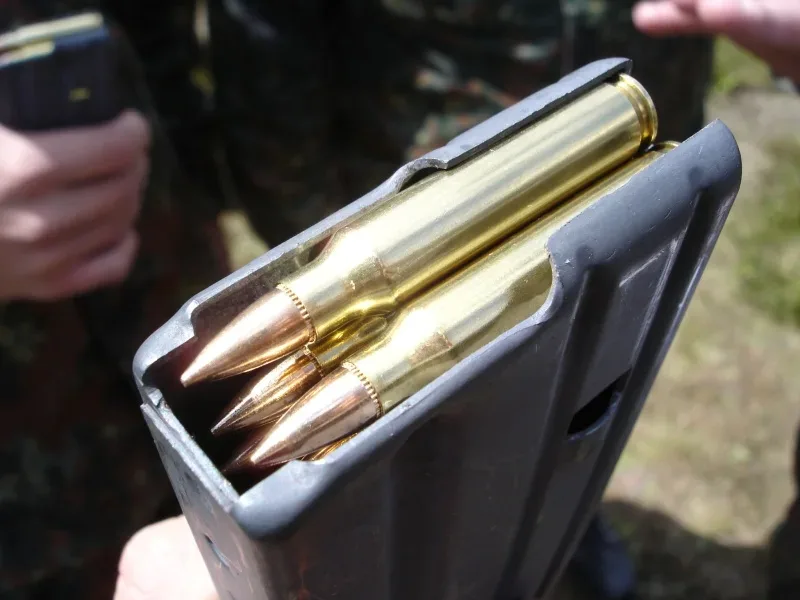
The 5.56×45mm NATO (right) compared to the 7.62×51mm NATO — showing why the smaller round enabled higher magazine capacity and reduced recoil in the M16.
Cannibalicious! at English Wikipedia (Public domain)
| Manufacturer | |
|---|---|
| Made By | Colt |
| Designer | Eugene Stoner |
| Origin | United States |
| Specifications | |
| Caliber | 5.56×45mm |
| Action | gas operated |
| Weight | 6.85 lb |
| Production | |
| Designed | 1957 |
| Variants | |
| |
| Service Use | |
United States militaryAir ForceMarine CorpsArmyArmy of the Republic of VietnamNATO countries80+ nations worldwide | |
M16 Rifle
Firearms encyclopedia article
From The Boise Gun Club Handbook
Overviewedit
The M16 — formally designated Rifle, Caliber 5.56 mm, M16 — is a family of gas-operated assault rifles adapted from the ArmaLite AR-15 for the United States military. It entered service in 1964 and has remained in continuous use ever since, making it the longest-serving rifle in U.S. military history. Approximately 8 million have been produced across all variants, and as of 2019 the rifle was in service with 15 NATO countries and more than 80 nations worldwide.
The M16's story is not a clean engineering triumph. It's a case study in what happens when bureaucratic inertia, institutional bias, and procurement shortcuts collide with the realities of combat.
The rifle that eventually emerged from that mess — and the 5.56×45mm cartridge it made standard — reshaped infantry doctrine globally and forced every major army on earth to reckon with the small-caliber, high-velocity concept.
Design Historyedit
The Road from AR-10 to AR-15
The roots of the M16 stretch back to a 1928 U.S. Army Caliber Board that fired tests at Aberdeen Proving Ground and recommended moving toward smaller-caliber ammunition — specifically around .27 inches. The Army ignored that recommendation for the next 35 years, insisting on what it called "full-sized" .30-caliber rounds.
After World War II, the military went looking for a single automatic rifle to replace the M1 Garand, M1/M2 carbines, M1918 Browning Automatic Rifle, M3 submachine gun, and Thompson. Early experiments with select-fire Garands went nowhere. The Korean War showed that the M2 carbine's .30 Carbine round was underpowered against a determined enemy.
The conclusion from American designers: what was needed was an intermediate cartridge — small-caliber, high-velocity.
Key milestones in M16 development from concept to adoption
Senior commanders, drawing on World War II and Korea, demanded instead a single powerful .30-caliber cartridge usable in both the new rifle and the general-purpose machine gun being developed concurrently. That insistence culminated in the 7.62×51mm NATO round and, ultimately, the M14 rifle — essentially an updated M1 Garand with a 20-round magazine and automatic capability.
ArmaLite entered the rifle competition late, submitting AR-10 prototypes to Springfield Armory in the fall of 1956. The AR-10 — designed by Eugene Stoner — was a genuinely novel piece of engineering. It used a straight-line barrel-and-stock arrangement that drove recoil directly rearward rather than upward, forged aluminum alloy receivers, and phenolic composite furniture. For a 7.62mm rifle, it was remarkably light at 6.85 lb empty. Initial testers at Springfield called it the best lightweight automatic rifle they had ever evaluated. The Army still chose the T44, which became the M14.
In 1957, General Willard G. Wyman, commanding the U.S. Continental Army Command, requested development of a .223-inch (5.56mm) select-fire rifle weighing 6 lb loaded with a 20-round magazine. The round had to penetrate a standard U.S. steel helmet at 500 yards while retaining supersonic velocity and matching or exceeding the wounding capability of the .30 Carbine. The result was a scaled-down AR-10 — the AR-15 — developed by Stoner alongside ArmaLite engineers L. James Sullivan and Robert Fremont, who worked with Remington on the cartridge case.
The finished round was a more powerful version of the .222 Remington, capable of pushing a 55-grain FMJ bullet to 3,250 feet per second from a 20-inch barrel.
The AR-15 was first publicly demonstrated by Stoner at Fort Benning in May 1957. Its smaller-caliber bullets destabilized and fragmented on impact — a wound ballistics characteristic that tests showed produced far more tissue damage than the heavier .30 rounds that typically passed straight through. Because the cartridge was so much lighter, a soldier could carry almost three times as much ammunition as with the M14. And because the recoil impulse was so much lower, the rifle could be controlled on fully automatic fire by the average soldier — something the M14 essentially could not.
| Year | Event | Significance |
|---|---|---|
| 1928 | U.S. Army Caliber Board recommends .27-inch ammunition | Army ignores recommendation for 35 years |
| 1956 | ArmaLite submits AR-10 prototypes | Army chooses T44 (M14) instead |
| 1957 | General Wyman requests 5.56mm rifle development | Leads to AR-15 creation |
| 1958 | Army test shows AR-15 squad effectiveness | 5-7 man AR-15 squad equals 11-man M14 squad |
| 1960 | General LeMay witnesses AR-15 demonstration | Air Force requests 80,000 rifles (denied) |
| 1962 | Air Force adopts AR-15, ARVN field testing begins | ARVN: zero broken parts in 80,000 rounds |
| 1963 | McNamara halts M14 production | AR-15 designated universal infantry weapon |
The Army Says No — Repeatedly
A 1958 Army test at its Combat Developments Experimentation Command compared the AR-15, M14, and Winchester's lightweight military rifle in simulated small-squad combat. The results showed a 5-to-7-man squad armed with AR-15s was as effective as an 11-man M14 squad. The study recommended adopting a lightweight rifle like the AR-15. The Army's response was to order full M14 production and declare that all rifles and machine guns had to use the same ammunition.
What broke the institutional logjam was a backyard barbecue. In July 1960, General Curtis LeMay — then Air Force Chief of Staff — watched a demonstration of the AR-15 on watermelons and immediately requested 80,000 rifles. General Maxwell D. Taylor, chairman of the Joint Chiefs, advised President Kennedy that two different calibers in the military simultaneously was unworkable, and the request was denied. But LeMay persisted.
In January 1962, the Air Force declared the AR-15 its standard model and ordered 8,500 rifles from Colt — which had purchased the production rights from ArmaLite in 1959 when the company ran out of money — along with 8.5 million rounds from Remington.
Simultaneously, the Defense Advanced Research Projects Agency shipped 1,000 AR-15s to the Army of the Republic of Vietnam for field testing. The ARVN soldiers fired 80,000 rounds in one test stage and reported zero broken parts. Over the entire test, only two replacement parts were issued for all 1,000 rifles. The report recommended the AR-15 as standard ARVN equipment. Admiral Harry Felt, Commander in Chief of Pacific Forces, rejected the recommendation on Army advice — logistics complications, he said.
Through 1962 and 1963 the U.S. military continued testing the AR-15. Positive evaluations emphasized its lightness, lethality, and reliability. The Army Materiel Command — home of the ordnance establishment — found poor accuracy and inadequate penetration at long range. What Secretary of the Army Cyrus Vance eventually uncovered, after ordering the Army Inspector General to investigate, was that those tests had been rigged: the Army had used hand-selected, match-grade M14s against off-the-shelf AR-15s, then cherry-picked only the results that reflected poorly on the AR-15.
In January 1963, Secretary of Defense Robert McNamara received reports that M14 production couldn't meet military needs and ordered it halted. He designated the AR-15 the universal infantry weapon. By late 1963, procurement had begun — 19,000 rifles for the Air Force and 85,000 for special Army units. McNamara made the Army the central procuring agency for all services, which gave the Army ordnance establishment exactly the leverage it needed to modify Stoner's design.
How the Army Broke the Rifle
What happened next is one of the more consequential procurement disasters in American military history, documented in detail by a congressional investigation and later by journalist James Fallows in a 1981 Atlantic account that remains the definitive lay history of the debacle.
The first modification was a "manual bolt closure" — what became the forward assist — allowing a soldier to force a cartridge into battery if it failed to seat. The Air Force, Marine Corps, Colt, and Stoner all objected. The Air Force noted that in three years of testing, they had recorded zero malfunctions that a bolt closure could have corrected. It added weight, complexity, and — by Stoner's own assessment — made a failure-to-feed situation worse, not better. Colonel Harold Yount, the Army procurement manager, later testified that the bolt closure was added not from any complaint or test result, but on "direction" from senior leadership. The implicit reasoning: the M1, M14, and carbine had all had "something for the soldier to push on."
The second change increased the barrel's rifling twist rate. The original AR-15 used a 1:14 twist. The Army changed it to 1:12 on the basis of Arctic testing that showed rounds could wobble at extreme cold temperatures. This made the bullet more stable in flight — and correspondingly less likely to yaw and fragment on impact, reducing the terminal effectiveness that had been the rifle's most significant tactical advantage.
The third and most consequential change was to the ammunition. The Army established a muzzle velocity specification of 3,250 feet per second — a figure that Stoner's original design, loaded with DuPont IMR 4475 stick powder, had never achieved in testing and was never designed to achieve. To hit that number, the Army switched to Olin Mathieson WC846 ball powder. Olin Mathieson had been the Army's ball powder supplier since World War II under sole-source contracts.
Stoner was not consulted. When a representative came to him after the decision was made to ask his opinion, Stoner told him he advised against the change. The representative said the decision was already final. Stoner replied:
"So now we both don't feel so good." — Eugene Stoner's response when told the Army had switched to ball powder without consulting him
The problem with ball powder was not the velocity number — on paper it worked. The problem was in how it burned. Ball powder burned longer and more slowly than IMR. It was still burning when the gas port opened, so combustion byproducts were blown directly into the gas tube and bolt carrier. It also left a chalky, lacquer-derived residue throughout the action. And it pushed the rifle's cyclic rate from the designed 750–800 rounds per minute up to over 1,000 — wrecking the timing of the entire operating cycle. Colt's own engineers fired M16s with both powder types in November 1965 and found that with IMR powder, essentially no rifles failed; with ball powder, roughly half did. December tests at Frankford Arsenal confirmed: IMR produced 3.2 malfunctions per 1,000 rounds; ball powder produced 18.5.
| Army Modification | Original Design | Army Change | Consequence |
|---|---|---|---|
| Forward Assist | No manual bolt closure needed | Added "bolt closure" mechanism | Increased weight, complexity; Stoner said it made failures worse |
| Barrel Rifling | 1:14 twist optimized for fragmentation | 1:12 twist for Arctic stability | Reduced bullet yaw and fragmentation effectiveness |
| Powder Type | DuPont IMR 4475 stick powder | Olin WC846 ball powder | Higher fouling, wrong timing, 18.5 vs 3.2 malfunctions per 1,000 rounds |
| Cleaning Requirements | Standard military maintenance | "No cleaning necessary" marketing | Rifles shipped without cleaning kits to humid jungle environment |
The Army's response was to allow Colt to use IMR powder for the acceptance tests — while shipping ball-powder ammunition to Vietnam. At least 330,000 rifles were delivered under this arrangement. The Ichord Committee later concluded that officials as senior as the Assistant Secretary of Defense for Installations and Logistics had knowingly accepted rifles that would fail in the field, calling the failure "borders on criminal negligence."
One final compounding factor: the Army accepted Colt's marketing claim that the M16's materials made cleaning essentially unnecessary. Rifles were issued to troops in Vietnam without cleaning kits or maintenance instructions, in a humid jungle environment that accelerated corrosion inside unlined steel chambers. The combination — dirty ball powder fouling an un-chromed bore in tropical humidity, cycling at the wrong rate, with no means of cleaning it — produced the disaster that followed.
The Congressional Reckoning and the M16A1
By mid-1967, enough soldiers had written home about their rifles, and enough parents had forwarded those letters to their congressmen, that the House Armed Services Committee convened an investigation. The subcommittee was chaired by Representative Richard Ichord of Missouri. The hearing record ran nearly 600 pages.
The letters entered into evidence were stark. One Marine wrote:
"We left with 72 men in our platoon and came back with 19. Believe it or not, you know what killed most of us? Our own rifle." — Marine letter to Congress, 1967
Investigators confirmed reports of dead soldiers found next to disassembled M16s — men who had been trying to clear their rifles when they were overrun.
The fixes that came out of the investigation were incorporated into the M16A1, standardized in February 1967:
- Chrome-plated bore and chamber to prevent corrosion and case extraction failures
- A closed "birdcage" flash suppressor replacing the original three-pronged design that snagged on vegetation
- A revised buffer assembly to slow the cyclic rate back toward design spec
- Reduced gas port diameter to compensate for ball powder's higher port pressure
- Mandatory issue of cleaning kits and dedicated maintenance instruction, including a comic-book-format manual illustrated by Will Eisner
- New WC844 powder introduced in 1970 to further reduce fouling
A 1968 Department of Army report found that 85 percent of troops in Vietnam preferred the M16 or its carbine variant for combat. In March 1970, the President's Blue Ribbon Defense Panel concluded that fielding the M16 instead of continuing with the M14 had saved approximately 20,000 American lives. In 1969, the M16A1 officially replaced the M14 as the U.S. military's standard service rifle.
Technical Characteristicsedit
The M16 is a lightweight, air-cooled, gas-operated, magazine-fed assault rifle with a rotating bolt. Receivers are 7075 aluminum alloy; the barrel, bolt, and bolt carrier are steel; handguards, pistol grip, and buttstock are polymer composites.
Operating System
Stoner's operating system is commonly — and incorrectly — described as "direct impingement." Per U.S. Patent 2,951,424, Stoner himself described it as "a true expanding gas system instead of the conventional impinging gas system." Propellant gases tapped from the barrel travel down a tube into the bolt carrier key, expand in a donut-shaped cavity inside the carrier, and drive the carrier rearward while the bolt — locked into the barrel extension — stays momentarily fixed.
The bolt's rear forms the piston head; the carrier's cavity is the piston sleeve. This internal piston arrangement is lighter and more compact than a conventional external piston, but it deposits combustion byproducts directly into the receiver, requiring more frequent and thorough lubrication and cleaning.
The system has no adjustable gas port, making it ammunition-specific — a design characteristic that contributed directly to the Vietnam-era failures when the powder type was changed without re-engineering the gas system.
Stoner's internal piston operating system - gas expansion drives the bolt carrier while bolt stays momentarily fixed
Straight-Line Recoil is central to the M16's handling. The recoil spring lives in the stock directly behind the action, in line with the bore. Recoil forces drive straight back rather than rotating the muzzle upward, which keeps the sight picture relatively stable during automatic fire and reduces shooter fatigue. The flash suppressor on current models also acts as a compensator.
Barrel and Ballistics
Barrel and rifling evolved across variants. Early M16s used a 1:14 twist (four grooves) adapted from the .222 Remington sporting cartridge. Combat experience showed bullets could yaw unpredictably at range, so the twist was changed to 1:12 (six grooves) on the M16A1, optimized for the M193 55-grain ball. The M16A2 moved to 1:7 to stabilize the heavier 62-grain NATO SS109/M855 projectile and the longer L110 tracer. All M16 variants use a 20-inch barrel.
Terminal Ballistics — the behavior of the 5.56mm bullet in tissue — was the source of both the rifle's greatest tactical asset and persistent controversy. At velocities above roughly 2,900 ft/s, the thin-jacketed M193 round fragmented into approximately a dozen pieces on impact, producing wounds dramatically out of proportion to its caliber. Photographs of those wounds remained classified into the 1980s. The fragmentation effect diminishes significantly beyond 200 meters or below about 2,500 ft/s muzzle velocity — a limitation that became more acute with the shorter-barreled M4 carbine.
The M16A2's M855 cartridge, with its steel-core 62-grain projectile, was designed to penetrate Soviet body armor at range. The trade-off was less consistent fragmentation against unarmored targets, a problem that generated persistent complaints — particularly from M4 users whose shorter 14.5-inch barrel already reduced muzzle velocity. The M855A1 Enhanced Performance Round, introduced in June 2010, was designed to restore consistent fragmentation across both barrel lengths while also improving accuracy and reducing lead content.
Variants and Evolution
| Variant | Adopted | Key Features | Barrel | Twist Rate | Fire Control |
|---|---|---|---|---|---|
| M16 (original) | 1964 | Air Force variant, no forward assist | 20" | 1:12 | Safe/Semi/Auto |
| M16A1 | 1967 | Forward assist, chrome bore, birdcage suppressor | 20" | 1:12 | Safe/Semi/Auto |
| M16A2 | 1983 | Heavy barrel, adjustable sights, case deflector | 20" | 1:7 | Safe/Semi/Burst |
| M16A3 | Limited | M16A2 with full-auto restored | 20" | 1:7 | Safe/Semi/Auto |
| M16A4 | 1997 | Flat-top rail, removable carry handle | 20" | 1:7 | Safe/Semi/Burst |
| M4 Carbine | 1994 | Shortened barrel, collapsible stock | 14.5" | 1:7 | Safe/Semi/Auto/Burst |
Variants across the M16 family share the same basic operating system but differ substantially in configuration. M16 (original) served as the Air Force variant with no forward assist, a three-prong "duckbill" flash suppressor, 1:12 twist, and safe/semi/auto trigger group. The XM16E1 / M16A1 added a forward assist, closed birdcage flash suppressor, chrome-lined bore and chamber, and revisions to gas port, buffer, and carrier finish, with standardization in February 1967 and production through 1982.
The M16A2 was a Marine Corps request, adopted in 1983 by Marines and 1986 by Army, featuring a heavier barrel profile forward of handguard, 1:7 twist for SS109/M855, fully adjustable rear sight, case deflector, three-round burst replacing full-auto, and round handguards with new DuPont Zytel polymer furniture.
The M16A3 represents the M16A2 configuration with full-auto trigger group restored, adopted in limited numbers by U.S. Navy SEALs and Seabees. The M16A4 was adopted July 1997 with a flat-top upper receiver with MIL-STD-1913 Picatinny rail, removable carry handle, and safe/semi/burst configuration, becoming the standard Marine Corps infantry rifle before Marines approved transition to M4 carbine in October 2015.
The M4 carbine — 14.5-inch barrel, collapsible stock — is the direct descendant of the M16 family and has largely replaced it in U.S. frontline units. In April 2022, the U.S. Army selected the SIG MCX SPEAR under the Next Generation Squad Weapon Program as the eventual successor to the M16/M4.
Magazines went from the original 20-round aluminum box to a 30-round bent design that began production in late 1967 and fully replaced the 20-rounder by the mid-1970s. The aluminum follower design caused feeding malfunctions due to tilting; this wasn't systematically addressed until the improved tan-follower magazine fielded in 2009, followed by the Enhanced Performance Magazine in July 2016, which the Army credited with a 300 percent reliability improvement in the M4.
The M16's magazine became the unofficial NATO STANAG magazine, now used across weapon systems throughout the Western alliance — though the STANAG 4179 standard was proposed in October 1980 and has never been formally ratified.
Combat & Field Useedit
Vietnam — Promise and Catastrophe
The first confrontations between the M14 and the AK-47 in Vietnam made the problem obvious. The M14 was uncontrollable on full-auto and too long and heavy for the dense jungle environment. Its wooden stock swelled in humidity and shifted the point of impact. NVA and Viet Cong fighters armed with AKMs — lighter, more compact, firing a lower-recoil 7.62×39mm Soviet round — could overwhelm American units through volume of fire even at close range.
Early AR-15s in the hands of Special Forces generated enthusiastic reports. Soldiers were reportedly paying several months' salary to acquire them on the black market. The Battle of Ia Drang in November 1965 — where elements of the Army's 5th and 7th Cavalry, roughly 1,000 men, repelled nearly three times their number in NVA veterans — served as an early demonstration of the AR-15/M16's potential in the right environment.
Then the ball powder hit Vietnam, and what followed was documented in congressional testimony, soldier letters, and eventually the press. Marines at the Battle of Hill 881 in April 1967 — a few miles northwest of Khe Sanh, where the 2nd and 3rd Battalions of the 3rd Marine Division were assaulting NVA positions — found their rifles seizing up under fire. Spent cases stuck in un-chromed chambers. Without cleaning kits they had never been issued, and without training on maintenance they had never received, there was no recovery. Investigators later confirmed that one Marine had been killed while running up and down his unit's line clearing jammed rifles — the only man in his squad who had a cleaning rod.
The M16A1 resolved the core mechanical failures, and reliability improved substantially. A 1968 Department of Army report found that 85 percent of troops preferred the M16 or its carbine variant. The rifle's light weight allowed soldiers to carry significantly more ammunition than with the M14 — a genuine tactical advantage that the 1970 Blue Ribbon Defense Panel credited with saving roughly 20,000 American lives.
| Conflict/Period | Weapon | Key Outcomes | Reliability Issues |
|---|---|---|---|
| Vietnam 1965-67 | M16/XM16E1 | Hill 881: rifles seizing under fire | Ball powder fouling, no cleaning kits, stuck cases |
| Vietnam 1968+ | M16A1 | 85% troop preference, 20K lives saved | Major mechanical issues resolved |
| Gulf War 1991 | M16A2 | Effective performance in desert conditions | Minimal reported issues |
| Iraq/Afghanistan 2003-15 | M16A4/M4 | 75% satisfaction, head shot effectiveness in Fallujah | Magazine failures primary cause of stoppages |
| Afghanistan 2010 | M16A4/M4 | 1 jam reported among 100 troops surveyed | "Moon dust" environment, minimal issues |
Post-Vietnam Through Iraq and Afghanistan
The M16A2 saw service through the Gulf War, the Balkans, and into the early years of Afghanistan and Iraq. A December 2006 Center for Naval Analyses survey of 2,608 troops returning from Iraq and Afghanistan found 75 percent of M16 users satisfied with the weapon and 71 percent confident in its reliability. Magazine failures — not the rifle's gas system — accounted for the majority of reported stoppages, a problem addressed by the improved magazine programs.
In Fallujah, Marines equipped with ACOG-sighted M16A4s achieved sufficient first-shot accuracy that an unusual number of insurgents were found with head wounds — enough to initially prompt questions about whether they had been executed rather than shot in combat.
The shorter M4 carbine introduced its own reliability questions. A 2002 USMC assessment found the M4 malfunctioned three times as often as the M16A4 under comparable conditions. The Marine Corps cited this — along with the M855's velocity-dependent fragmentation — as justification for retaining the full-length M16A4 long after the Army had transitioned to M4s. That changed in October 2015, when the Marine Corps commandant approved the M4 as the standard infantry weapon, moving M16A4s to support and non-infantry roles.
In early 2010, two journalists from The New York Times spent three months with infantry units in Afghanistan's Helmand Province — an environment of fine powdered sand soldiers called "moon dust" — and questioned around 100 troops who were engaged in daily combat. Only one reported a jam, after his M16 went into a canal. The Marine battalion weapons officer responsible for 350 M16s and 700 M4s reported no issues whatsoever.
Legacy & Influenceedit
The M16 settled, permanently, several arguments that had been running through military small arms development for decades. Small-caliber, high-velocity was not a compromise — it was an advantage. Aluminum and polymer weren't cheap substitutes for steel and wood — they were the appropriate materials.
Stamped and machined-to-tolerance parts weren't inferior to hand-fitted components — they were more consistent and far cheaper to produce at scale.
Global Standardization
The 5.56×45mm cartridge, standardized across NATO in October 1980 via STANAG 4172 in its Belgian SS109 form, became the dominant assault rifle cartridge worldwide. NATO's adoption was direct: the U.S. recommended the caliber to all NATO forces in March 1970, standardization tests ran from 1977, and the Belgian SS109 was chosen over the American M193 for its better penetration of steel helmets at 600 meters. NATO's ammunition standard pulled its magazine standard along — the M16's aluminum box became the template for the STANAG magazine used across dozens of weapon platforms today.
The rifle's influence radiated outward in every direction. The Soviet Union, watching the M16's performance in Vietnam, accelerated development of the AK-74 — a 5.45mm small-caliber, high-velocity rifle that acknowledged the principle Stoner had demonstrated, even while using a different mechanical approach. Every major military that examined the M16 concept subsequently developed or adopted small-caliber, high-velocity service rifles.
How M16 innovations influenced global small arms development
The Diemaco C7 and C8, standard issue for Canada, Denmark, the Netherlands, and Norway, are direct M16 derivatives. The British L85, French FAMAS, Israeli Galil, and German HK33 all represent different national responses to the same shift in infantry rifle philosophy that the M16 forced.
The M16's flat-top Picatinny rail, standardized on the M16A4, established the modular accessory architecture that defines every serious military and law enforcement rifle sold today. The ability to mount optics, lights, lasers, and grenade launchers on a common standardized rail — without gunsmithing, without permanently altering the firearm — changed what a service rifle could be.
Approximately 90 percent of the roughly 8 million M16s produced are still in operation worldwide. The rifle is in active service across conflicts on multiple continents simultaneously. Captured M16s have appeared in the hands of adversaries ranging from the Viet Cong — who stripped them from American dead — to Taliban forces using rifles originally supplied to the Afghan National Army.
Next Generation Transition
In April 2022, the U.S. Army selected the SIG MCX SPEAR as the winner of the Next Generation Squad Weapon Program — a rifle chambered in 6.8×51mm Common Cartridge, designed to defeat near-peer body armor at ranges the 5.56mm cannot. That program is, in a sense, the M16's legacy turned against it: the argument that intermediate-caliber, high-velocity is the optimum solution is now being contested by the same logic that unseated the .30-caliber in 1964.
The BGC Takeedit
The M16 is the most consequential American rifle since the M1 Garand, and its story deserves to be told straight — not as a triumph, not as a scandal, but as both simultaneously.
The underlying design was genuinely brilliant. Stoner built a rifle in the late 1950s that was lighter, more controllable, more reliable, and more lethal at practical combat ranges than anything the Army had. The ARVN test results — zero broken parts across 80,000 rounds, two replacement parts for 1,000 rifles — tell you what the AR-15 actually was before the Army got hold of it.
"A brilliant technical success in its early models, perverted by bureaucratic pressures into a weapon that betrayed its users in Vietnam." — James Fallows, The Atlantic, 1981
The powder switch is the kind of decision that looks minor on paper and catastrophic in practice. The Army changed ammunition types without retesting the rifle — in a weapon whose gas system timing is, as the Wikipedia source correctly notes, ammunition-specific because it has no adjustable gas port. Then it shipped that combination into combat while allowing Colt to use the original powder for acceptance tests. That's not an oversight. That's institutional negligence that got people killed, and the Ichord Committee said so in plain language.
The forward assist is a perfect artifact of how military procurement can go wrong. It was added not because any test showed it was needed, not because any field complaint called for it — but because previous Army rifles had always had something for the soldier to push on. It added weight and complexity to a design whose greatest virtue was simplicity and reliability. Stoner opposed it. The Air Force opposed it. It went on the rifle anyway, and it's still there today, largely because the Army couldn't admit that the original decision was wrong.
None of that diminishes what the M16 became after the A1 fixes. A rifle that earned 85 percent troop preference in Vietnam — after everything that happened in 1966 and 1967 — is a rifle that delivered when the mechanical problems were addressed. The platform proved adaptable enough to absorb 60 years of improvements and remain relevant. The M4 carbine that replaced it in frontline service is the same basic design with a shorter barrel and a collapsible stock. The STANAG magazine that came with it is on rifles worldwide. The operating concepts Stoner established are present in hundreds of derivative designs.
The M16 earned its place in history twice: once as an example of what sound engineering looks like, and once as an example of what happens when institutions prioritize internal politics over the soldiers carrying the equipment. Both lessons are worth keeping.
Referencesedit
- Wikipedia: M16 rifle — https://en.wikipedia.org/wiki/M16_rifle
- Marine Corps Association / Leatherneck: "This is My Rifle" — https://www.mca-marines.org/leatherneck/this-is-my-rifle-from-the-hill-fights-in-vietnam-to-today-the-history-of-the-m16/
- Encyclopaedia Britannica: M16 rifle — https://www.britannica.com/technology/M16-rifle
- NRA Museums: Colt M16 Semi Automatic Rifle — https://www.nramuseum.org/the-museum/the-galleries/wwii,-korea,-vietnam-and-beyond/case-67-modern-conflicts-vietnam-desert-storm/colt-m16-semi-automatic-rifle.aspx
- The Atlantic: "M-16: A Bureaucratic Horror Story" by James Fallows (June 1981) — https://www.theatlantic.com/magazine/archive/1981/06/m-16-a-bureaucratic-horror-story/545153/
Last Updated: February 27, 2026
- Gls Guns(Sumner, IA)
- Bi-mart - Yakima (Fruitvale Ave)(Yakima, WA)
- New Philly Sportsman Specialities(New Philadelphia, OH)
- R&R Sports & Outdoors(Brandon, FL)
Loading comments...