Specifications
Colt New Army & Navy Revolver

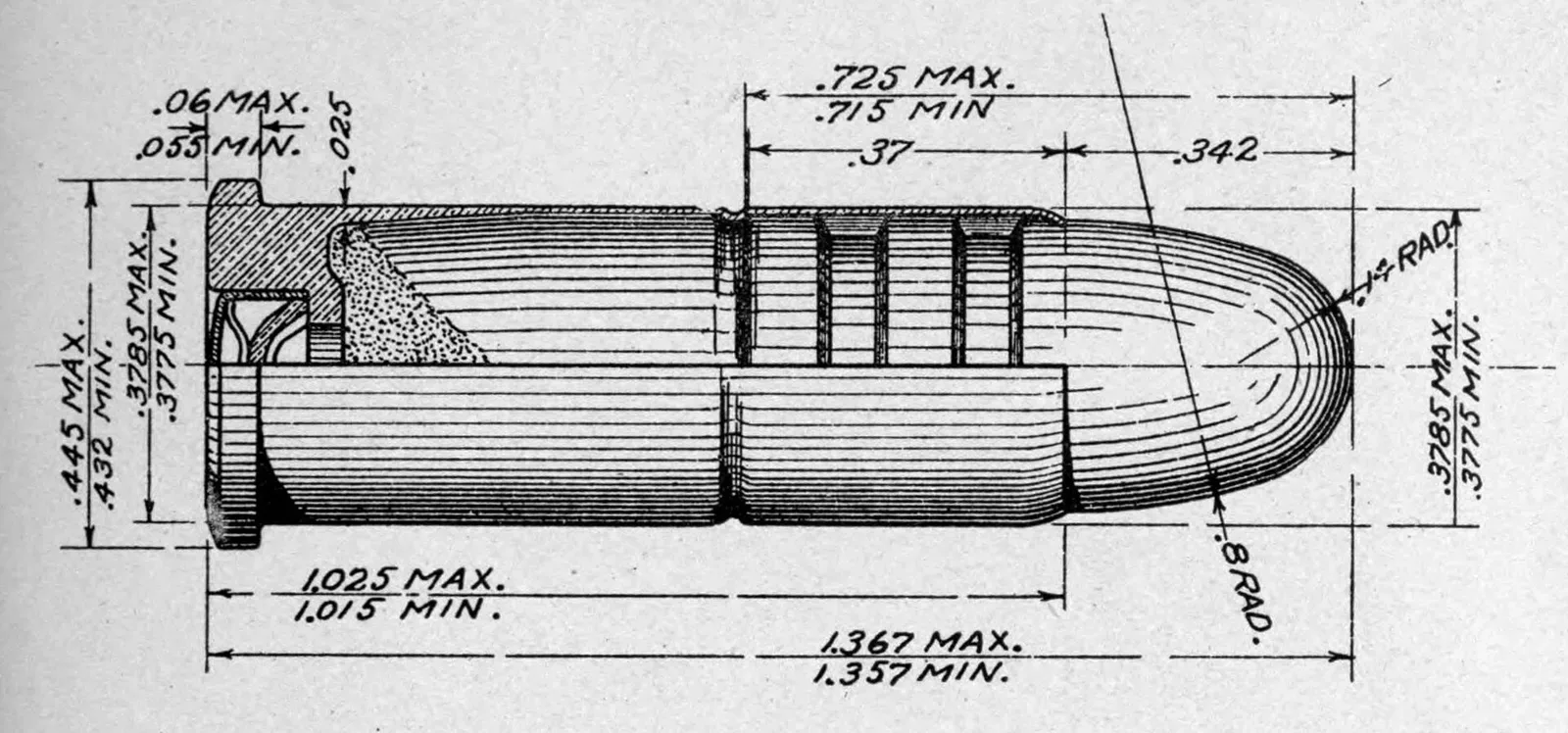
The .38 Long Colt ball cartridge — standard Army issue for the New Army & Navy revolver, featuring a 150-grain bullet and 28-grain black powder charge.
U.S. Army Ordnance Department (Public domain)
| Manufacturer | |
|---|---|
| Made By | Colt |
| Origin | United States |
| Specifications | |
| Caliber | .38 Long Colt |
| Action | double action |
| Weight | 2.07 lb |
| Production | |
| Designed | 1889 |
| Variants | |
| |
| Service Use | |
United States NavyUnited States ArmyUnited States Marine Corps | |
Colt New Army & Navy Revolver
Firearms encyclopedia article
From The Boise Gun Club Handbook
Overviewedit
The Colt New Army & Navy Revolver—most commonly identified by its M1892 model designation—holds a specific and consequential place in American military history: it was the first double-action revolver with a swing-out cylinder ever issued as standard equipment to the United States military. That's not a footnote.
Every double-action revolver you pick up today descends from the mechanical logic Colt put into production in 1889.
Colt manufactured approximately 291,000 of these revolvers between 1892 and 1907, chambered primarily in .38 Long Colt. The gun served across the Spanish-American War, the Philippine-American War, the Boxer Rebellion, and saw limited reissue during World War I. It was also the sidearm that exposed, painfully and in combat, the limits of underpowered cartridges against determined adversaries—a lesson that echoed through every U.S. military handgun procurement decision for the next century.
Design Historyedit
The lineage starts in 1889, when Colt introduced what the sources at Colt Fever describe as the world's first double-action, swing-out cylinder revolver. The U.S. Navy moved immediately, adopting it as the Navy Model of 1889. The U.S. Army followed three years later with a slightly upgraded version—the Model of 1892—which was formally given the designation "New Army and Navy."
The 1889 Original and Its Problems
The 1889 original had a significant mechanical problem that had to be fixed before the Army would commit. That first design used no locking notches on the exterior of the cylinder, instead relying entirely on the hand—the internal part that advances the cylinder—to hold each chamber aligned with the barrel during firing. When the action was at rest, the cylinder was free to rotate.
That meant a shooter could pull the trigger and strike a spent case instead of a live round. The U.S. Navy recognized this and recalled most of its 1889-issue guns for rebuilding to the double-notch cylinder standard used on the 1892. Commercial 1889 revolvers were not recalled, which is why they can still be identified today by the absence of those notches.
Development timeline showing rapid evolution driven by military feedback
Military Contracts and Serial Number Mysteries
The Army's initial 1892 purchase was 8,000 revolvers, covering serial numbers 1 through 8,000. After completing that contract, Colt began civilian production—skipping, for reasons that aren't documented in the sources, serial numbers 8,001 through 10,000, and starting civilian sales at serial number 10,001. That first civilian example, built from Army-inspected parts, was shipped to a Captain V. McNally of the U.S. Ordnance Department on December 29, 1892, according to factory records cited by Rock Island Auction.
| Model | Year | Key Features | Production Notes |
|---|---|---|---|
| M1889 | 1889 | First swing-out cylinder DA revolver | Navy adopted; no cylinder locking notches |
| M1892 | 1892 | Added cylinder locking notches | Army's first order: 8,000 units |
| M1894 | 1894 | Cylinder/trigger/hammer interlock | First smokeless powder military handgun |
| M1895 | 1895 | Five-groove bore vs Army's six-groove | Navy version of M1894 |
| M1896 | 1896 | Refined lockwork | Incremental improvements |
| M1901 | 1901 | Added lanyard ring | Some earlier guns retrofitted |
| M1903 | 1903 | Narrowed grip, .358" bore | Improved accuracy |
| M1905 | 1905 | Rounded butt, checkered grips | Marine Corps; only 926 produced |
Model Evolution Through Combat Feedback
What followed was a rapid succession of model refinements driven almost entirely by military feedback. Each improvement earned a new model number:
- Model 1892 — First production, 8,000 purchased by the Army
- Model 1894 — Added an interlock between the cylinder latch, trigger, and hammer to prevent firing unless the cylinder was fully closed. Also the first U.S. military handgun to use smokeless powder cartridges. Nearly all surviving M1892s were upgraded to this standard
- Model 1895 — The Navy's version of the 1894, distinguished by a five-groove bore versus the Army's six-groove barrels
- Model 1896 — Further lockwork refinements
- Model 1901 — Added a lanyard ring to the butt; some earlier guns were modified in military workshops to match
- Model 1903 — Narrowed grip and reduced bore diameter from .363 inches to .358 inches to improve accuracy
- Marine Corps Model 1905 — Virtually identical to the 1903, but fitted with special rounded-base butts, checkered walnut grips, and a 6-inch barrel. Only 926 were produced before manufacturing ended in 1907, with 125 of those earmarked for the civilian market
The commercial versions offered more variety than the military guns—barrels in 3-inch, 4.5-inch, and 6-inch lengths, finishes in blue or bright nickel, and calibers that eventually expanded to include .41 Long Colt and, late in production, .32-20 and .38 Special.
Technical Characteristicsedit
Core Specifications
| Specification | Military Standard | Commercial Options |
|---|---|---|
| Caliber | .38 Long Colt | .41 Long Colt, .32-20, .38 Special |
| Action | Double-action | Double-action |
| Capacity | 6 rounds | 6 rounds |
| Barrel Length | 6 inches | 3", 4.5", 6" |
| Weight | 2.07 lb (0.94 kg) | 2.07 lb (0.94 kg) |
| Overall Length | 11.5 inches | Varies by barrel |
| Muzzle Velocity | 780 ft/s | 780 ft/s |
| Sights | Rounded blade front, notch rear | Same |
| Finish | Blued | Blue or nickel |
| Grips | Smooth walnut | Checkered hard rubber w/Colt logo |
The Revolutionary Swing-Out Cylinder
The swing-out cylinder was the mechanical centerpiece. To open it, the shooter pulled back a catch on the left side of the frame behind the recoil shield—easily reached by the right thumb—then pushed the cylinder out sideways with the forefinger. Pressing the ejector rod activated a star extractor that cleared all six chambers simultaneously. It was a genuinely faster reloading system than any gate-loaded or top-break design then in service.
Swing-out cylinder operation - the mechanical innovation that defined all future DA revolvers
Design Flaws and Mechanical Issues
The cylinder rotated counter-clockwise—unique to this series within Colt's production history, and the source of a known structural problem. Counter-clockwise rotation under firing forces tended to push the cylinder out of alignment with the frame over time. This was compounded by lockwork that wasn't robust enough to maintain precise timing as parts wore. Colt addressed this in later designs by reversing to clockwise rotation, which the firing forces work with rather than against.
Design issues included:
- Counter-clockwise cylinder rotation (unique to this series)
- Cylinder pushed out of alignment by firing forces over time
- Side plate on right side of frame (reversed in later designs)
- Complex lockwork with scarce replacement parts
- Timing issues that couldn't be fully resolved
The side plate on these guns also sits on the right side of the frame—another feature reversed in all subsequent Colt double-action designs. The action itself is mechanically complex. According to Colt Fever, parts are scarce and few gunsmiths will attempt repairs. These are guns that reward careful handling and don't respond well to abuse—something that was probably true in the field as much as it is true now.
Combat & Field Useedit
Spanish-American War Success
The M1892 entered service just in time for the Spanish-American War of 1898, where it performed adequately in the conventional engagements of that conflict. The gun's most famous moment from that war involves a specific example recovered from the wreck of the USS Maine after it exploded in Havana Harbor.
That revolver was presented to Theodore Roosevelt, then serving as Assistant Secretary of the Navy. Roosevelt reportedly used it to rally his Rough Riders during the charge up San Juan Hill on July 1, 1898. The revolver was later displayed at Sagamore Hill—Roosevelt's home—stolen in 1963, recovered, stolen again in 1990, recovered again, and finally returned to Sagamore Hill on June 14, 2006.
The Philippine Disaster
The Philippines were a different story. Beginning in 1899, following the conclusion of the Spanish-American War and the outbreak of the Philippine-American War, combat reports started arriving that described a serious failure. U.S. troops fighting Moro guerrillas in the southern islands were encountering fighters who, through a combination of religious preparation and what the sources describe as drug use, could absorb multiple gunshot wounds from the .38 Long Colt and continue attacking until blood loss finally brought them down.
There were cases of soldiers emptying their revolvers into a charging Moro and still being cut down.
According to sources, the Army's response was immediate and pragmatic: they went back to the warehouses and pulled out Colt Single Action Army revolvers in .45 Colt. These guns were refurbished, their barrels cut from 7.5 inches to 5.5 inches, and rushed to the Philippines as emergency replacements. The reissued Single Actions, combined with Winchester Model 1897 pump-action 12-gauge shotguns, were reported to have resolved the immediate crisis.
| Conflict | Years | Performance | Outcome |
|---|---|---|---|
| Spanish-American War | 1898 | Adequate in conventional combat | Successful service |
| Philippine-American War | 1899-1902 | .38 Long Colt inadequate vs Moro fighters | Emergency reissue of .45 Colt SAA |
| Boxer Rebellion | 1900 | Limited service | Mixed results |
| World War I | 1917-1918 | Rear-echelon and Navy officers | Substitute standard only |
The Smithsonian Institution's record of the M1892 notes that formal complaints about the inadequacy of the .38 caliber cartridge came in from combat troops in 1902. Wikipedia's source on the M1892 places the first combat reports at 1899. Both dates reflect the same sustained problem over several years of fighting.
The Army formally replaced the M1892 with the M1909 New Service revolver as a stopgap, while the search for a permanent replacement produced the Colt M1911 semi-automatic pistol in .45 ACP. The chain from the Philippines to the 1911 is not subtle—it runs in a direct line through the failures of the .38 Long Colt.
World War I Emergency Service
When the United States entered World War I, surplus M1892 revolvers were inspected, refurbished as needed, and issued to rear-echelon Army troops and Navy officers as substitute standard sidearms. By that point the gun was already two decades old and had been out of primary service for nearly a decade, which says something about both the shortage of modern handguns and the M1892's basic durability.
Legacy & Influenceedit
Mechanical Innovation Legacy
The M1892's mechanical legacy is straightforward: the swing-out cylinder became the universal standard for double-action revolvers worldwide, and every such design since—Smith & Wesson, Ruger, Taurus, all of them—works from the same fundamental concept Colt put into production in 1889. The sources at Colt Fever state this plainly, and it's accurate.
The Cartridge Failure That Changed History
The cartridge failure in the Philippines is the other half of the legacy, and it's the more consequential one for military history. The .38 Long Colt's inadequacy didn't just end the M1892's service life—it drove a formal military investigation into terminal ballistics and stopping power that produced the Thompson-LaGarde Tests and ultimately set the Army's requirement for a .45 caliber semi-automatic pistol.
How the M1892's cartridge failure drove development of the M1911
The M1911 doesn't exist, at least not on the timeline it did, without the Philippines proving that small-bore handgun cartridges were inadequate for combat. Within Colt's own product line, the design lessons were absorbed directly. The counter-clockwise cylinder rotation was reversed. The side plate moved to the left. The lockwork was strengthened.
These corrections appeared in the Colt Army Special, which addressed the timing issues the M1892 series could never fully solve. The Officer's Model, a target-sighted variant built on the New Army & Navy frame and produced from 1904 to 1908, pointed toward Colt's later precision revolver lines.
Collector Interest and Rarity
For collectors, the M1892 series presents a layered landscape. The rarity gradient runs steep: a standard military 1892 that escaped the 1894 upgrade is uncommon, and sources estimate only around a dozen unaltered examples survive. A documented first-civilian-production example—serial number 10001—carried a pre-sale estimate of $7,500 to $11,000 at Rock Island Auction in 2024.
The serial numbering quirks, the assembly number confusion (factory assembly numbers were stamped on parts during manufacture and are frequently mistaken for serial numbers), and the variety of military inspection marks give collectors plenty of ground to work. The Theodore Roosevelt revolver—the one from the Maine, the one that went to San Juan Hill and was stolen twice—is back at Sagamore Hill. That particular gun has lived a more eventful life than most people.
The BGC Takeedit
The M1892 gets remembered mostly as the gun that failed in the Philippines, and that's fair. The .38 Long Colt was underpowered from the start—a black powder cartridge that didn't meaningfully improve when you switched it to smokeless. Chambering a military sidearm in it and then being surprised when it didn't reliably stop determined, adrenaline-flooded fighters is a procurement failure, not a gun failure.
But the mechanical story deserves equal attention. What Colt put into production in 1889 was genuinely new—a double-action swing-out cylinder at a time when the competition was still loading through a gate or breaking the frame in half. The U.S. military adopted it because it was, by the standards of 1892, a real advancement.
The M1892's real contribution to firearms history: it proved, in blood, that caliber selection matters more than mechanism elegance.
The problem is that advancements in one area (speed of reloading, action type) don't compensate for a cartridge that won't do the job. The Army learned that lesson the hard way in the Philippine jungle, and the M1911 is what they built from it. That's a legacy worth understanding.
Referencesedit
- Gls Guns(Sumner, IA)
- Bi-mart - Yakima (Fruitvale Ave)(Yakima, WA)
- New Philly Sportsman Specialities(New Philadelphia, OH)
- R&R Sports & Outdoors(Brandon, FL)
Loading comments...