Specifications
Heilongjiang Hand Cannon

A vase-shaped cannon from the 14th-century Ming Dynasty — the design that preceded the Heilongjiang hand cannon and represents a key evolutionary step in Chinese gunpowder weaponry.
Jiao Yu and Liu Ji (Public domain)
| Manufacturer | |
|---|---|
| Made By | Unknown |
| Origin | China |
| Specifications | |
| Caliber | 25.4 mm (1 inch) |
| Action | muzzle loading |
| Weight | 3.55 kg (7.83 pounds) |
| Production | |
| Designed | 1288 |
| Service Use | |
Yuan dynasty forces under Kublai Khan | |
Heilongjiang Hand Cannon: The World's Oldest Surviving Firearm
Firearms encyclopedia article
From The Boise Gun Club Handbook
Overviewedit
The Heilongjiang hand cannon is a cast-bronze, muzzle-loading firearm manufactured no later than 1288 CE during China's Yuan dynasty — and it is the oldest confirmed surviving firearm on Earth. It measures 34 centimeters (13.4 inches) in total length, weighs 3.55 kilograms (7.83 pounds), and was portable enough that soldiers could carry it on their backs.
This wasn't just a siege piece. It was an infantry weapon — representing the pivotal moment where explosive-propellant weapons crossed from concept into manufactured reality.
Its significance isn't just that it's old. It's that it represents a specific and pivotal moment in the 800-year arc of firearms development — the point where the idea of a metal-barreled, handheld, explosive-propellant weapon crossed from concept into manufactured reality.
Archaeological Discovery
The cannon was excavated in July 1970 from Banlachengzi village in Acheng District, Heilongjiang province in Manchuria — a region that, in the late 13th century, was the site of active armed conflict between Yuan imperial forces and a Mongol rebel prince. It currently resides at the Heilongjiang Provincial Museum in Harbin, China.
Design Historyedit
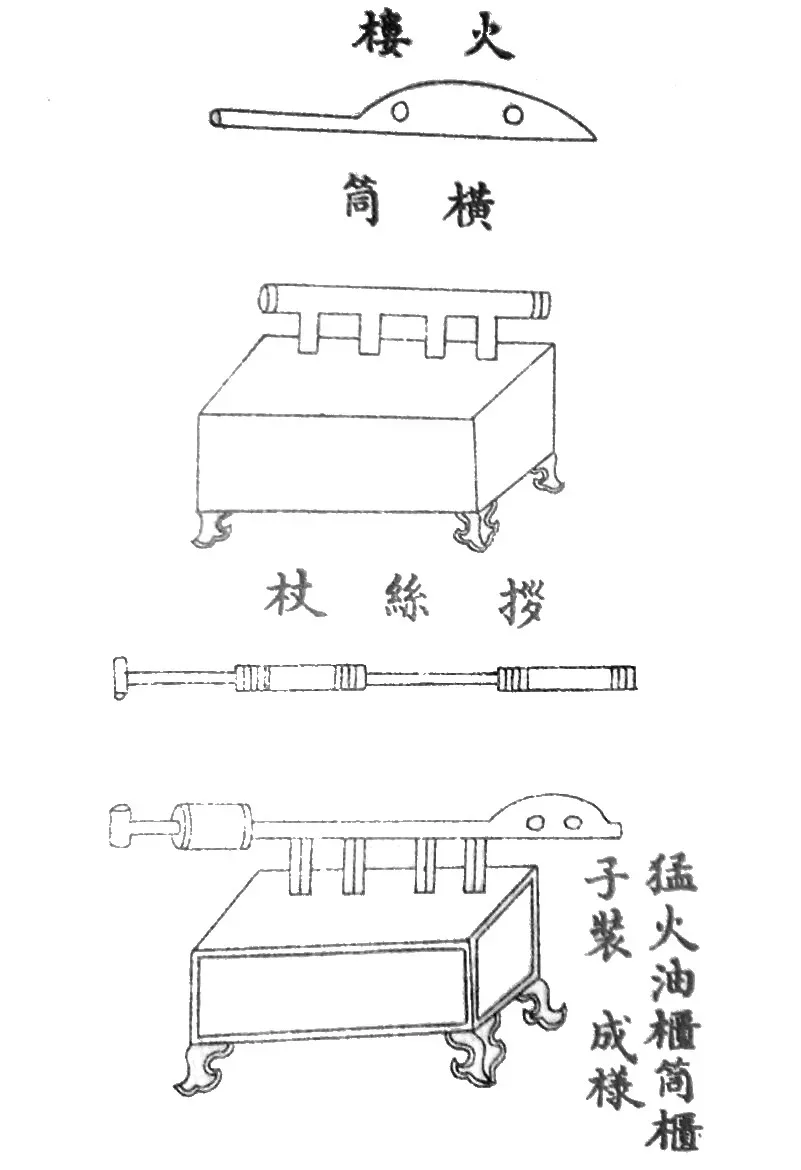
To understand what the Heilongjiang hand cannon is, you need to understand what came before it.
Gunpowder Origins
Gunpowder was invented in China during the 9th century CE, under the Tang dynasty, by Taoist alchemists who were, with some irony, looking for an elixir of immortality. The formula — saltpeter, sulfur, and charcoal — appears around 850 CE in an alchemical text called the Zhenyuan miaodao yaolüe.
Military applications followed within a few generations.
By the 10th through 12th centuries, under the Song dynasty, gunpowder had evolved into what historians call fire lances — spear-like devices with bamboo or metal tubes packed with powder that projected flames, shrapnel, and in some cases poison gases. The first recorded battlefield use of fire lances comes from the 1132 siege of De'an against the Jin dynasty.
A Song military compendium called the Wujing zongyao, compiled in 1044 CE, describes their construction in detail.
Fire Lance to Metal Cannon
The transition from fire lance to true metal-barreled firearm was gradual enough that the same Chinese term — huotong ("fire tube") — was used for both. A military text called the Xingjun Xuzhi, dated 1230, lists huotong among gunpowder weapons, but scholars debate whether that reference describes a fire lance, a proto-cannon, or something in between.
Timeline showing the progression from gunpowder invention to metal-barreled firearms
What isn't debated is the archaeological record. Hundreds of metal cannons and hand cannons from the 13th and 14th centuries have been excavated in China.
Archaeological Context
The oldest of the larger cannons is the Wuwei cannon, dated to 1227, discovered in Wuwei, Gansu — a 108.5-kilogram iron piece one meter long, likely from the Western Xia period. The earliest cannon bearing an inscribed manufacture date is a bronze piece dated 1298, inscribed in 'Phags-pa script.
| Artifact | Date | Location | Significance |
|---|---|---|---|
| Wuwei Cannon | 1227 CE | Wuwei, Gansu | Oldest large bronze cannon (108.5 kg, 1m long) |
| Heilongjiang Hand Cannon | ≈1288 CE | Banlachengzi, Heilongjiang | Oldest surviving handheld metal firearm |
| Xanadu Gun | 1298 CE | Various finds | Earliest cannon with inscribed date |
The Heilongjiang hand cannon sits between those two data points — after the Wuwei cannon, before the 1298 inscribed piece — and it is the only hand-portable metal-barreled firearm from that window confirmed to survive.
Archaeologist Wei Guozhong excavated the piece and published his findings in 1973 in an article titled "A Bronze Bombard Excavated at Banlachengzi in Acheng Xian in Heilongjiang Province" in the journal Reference Materials for History and Archaeology. It was Wei who first established the connection between the Banlachengzi find and the nearby battle sites of 1287–1288 — a connection that provides the artifact's contextual dating.
Technical Characteristicsedit
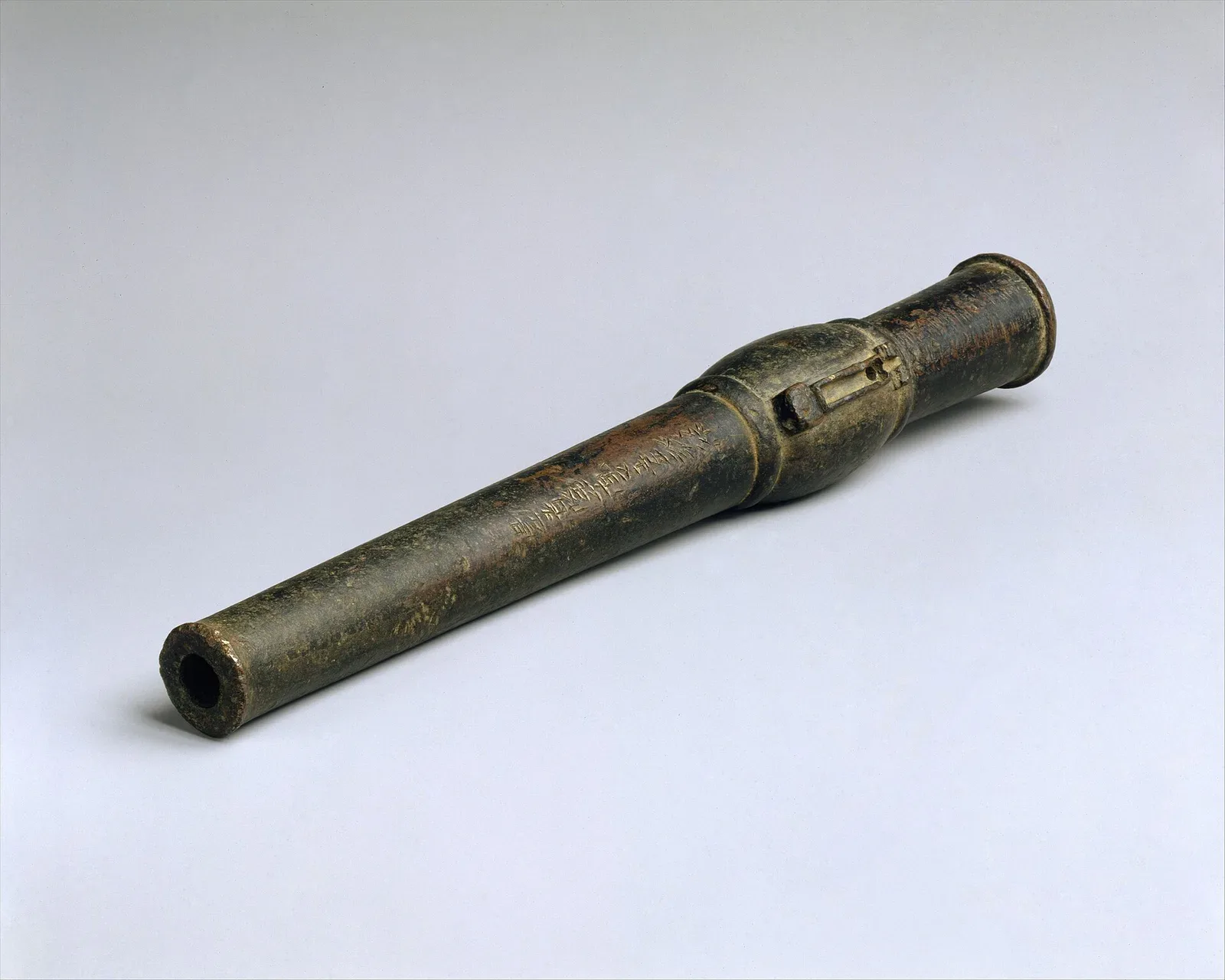
Construction Materials
The hand cannon is a unified cast-bronze structure with no seams — likely produced using a lost-wax or sand-casting process. Bronze was the practical choice for early firearms: it has the ductility to absorb explosive pressure without shattering, where iron alternatives of the period risked catastrophic failure under the same loads.
Functional Design
The design breaks into three functional sections from rear to front:
- Socket (rear): A trumpet-shaped socket at the very back accepted a wooden handle, making this a genuinely handheld weapon rather than a crew-served piece
- Powder chamber (yaoshi): A bulbous chamber with a diameter of 6.6 cm and proportionally thicker walls to contain the explosive force of the black powder charge. A small touch hole sits on top of this chamber for ignition
- Barrel: A narrower tube measuring 17.5 cm in length with an interior bore diameter of 25.4 mm (1 inch) — the portion that directed the projectile forward
| Component | Dimensions | Function |
|---|---|---|
| Socket (rear) | Trumpet-shaped | Accepts wooden handle for handheld operation |
| Powder chamber | 6.6 cm diameter, thicker walls | Contains explosive force, includes touch hole |
| Barrel | 17.5 cm length, 25.4 mm bore | Directs projectile forward |
| Overall | 34 cm total length, 3.55 kg weight | Complete handheld firearm system |
Total length: 34 cm. Total weight: 3.55 kg. The exterior bears no inscriptions or decorative elements — this was built for a job, not a display case.
Operating mechanism of the Heilongjiang hand cannon
Operational Limitations
The weapon was muzzle-loaded: black powder went in first, followed by wadding, followed by a projectile — pea gravel, ceramic shards, or similar loose shot. Ignition required applying a lit spill, hot wire, or ember to the touch hole. There was no lock, no trigger, no mechanical firing mechanism of any kind.
According to sources, the weapon typically required two operators — one to aim and brace, one to manage ignition — a detail that underscores both how primitive and how genuinely functional this technology was.
The bulbous chamber design represented a real engineering improvement over fire lances: by containing the powder charge in a closed chamber and narrowing into a barrel, it reduced gas leakage and directed explosive force more efficiently toward the projectile. That's the essential physics of every firearm ever built afterward, present in embryonic form right here.
Its limitations were equally fundamental. Single-shot capacity meant lengthy reloading under fire. No rifling and no sights made it inaccurate beyond close range. Reconstructions have confirmed it was primarily useful for close-quarters intimidation and area denial rather than precision engagement.
Combat & Field Useedit
The dating of the Heilongjiang hand cannon rests on a specific military event: the suppression of Nayan's rebellion in 1287–1288.
Historical Context
Nayan was a Mongol prince who allied with Kaidu in Central Asia and launched a rebellion in Manchuria against Kublai Khan's authority over the Yuan dynasty. Kublai personally commanded the forces sent to crush it. Marco Polo claimed Kublai's army numbered 460,000 men — the Yuanshi and modern historians put a more realistic figure in the tens of thousands.
| Event | Date | Commander | Weapon Designation | Tactical Effect |
|---|---|---|---|---|
| Nayan's Rebellion | 1287 | Li Ting | Hand cannons (huotong) | "Great damage" and enemy confusion |
| Follow-up Campaign | 1288 | Li Ting | Gun-soldiers (chongzu) | Established new military terminology |
A Jurchen commander named Li Ting served under Kublai during this campaign. In 1287, Li Ting led a contingent of soldiers equipped with portable hand cannons into Nayan's camp. The Yuanshi — the official history of the Yuan dynasty — records that the hand cannons "caused great damage" and created "such confusion that the enemy soldiers attacked and killed each other." The weapons were deployed again in early 1288, with Li Ting's troops described as chongzu — "gun-soldiers" — who carried the devices on their backs.
That passage in the Yuanshi also marks the first recorded use of the term chong for metal-barreled firearms, replacing the older and ambiguous huotong that had covered everything from fire lances to signal flares.
Tactical Innovation
The word stuck. It's a small linguistic detail with a large implication: by 1288, the Chinese military establishment recognized the metal-barreled hand cannon as a distinct enough weapon category to give it its own name.
The Banlachengzi excavation site aligns geographically with these battle locations — which is the primary basis for dating the cannon to no later than 1288. The cannon was found alongside Jurchen Jin dynasty-style bronze artifacts (a vase, a mirror, and a cooking pan), placing the deposit in a 13th-century archaeological layer. The Jin dynasty had collapsed in 1234, which sets the outer bound: nothing at the site could post-date the Jin stylistically if the Jin no longer existed after that year.
In tactical terms, the hand cannons gave Yuan infantry a psychological and physical edge against Nayan's cavalry-heavy rebel forces. The noise, flash, and close-range lethality disrupted formations in the forested, uneven terrain of Manchuria — terrain where Mongol cavalry's traditional advantages were already reduced. This represented something new in Mongol-Yuan military practice: supplementing archery and lance warfare with handheld explosive-projectile weapons in an infantry assault role.
Legacy & Influenceedit
Historian Joseph Needham, in his comprehensive study of Chinese military technology, described Wei Guozhong's find as something that "will long remain of capital importance, since it is the only metal-barrel hand-gun so far discovered which almost certainly belongs to the 13th century."
"Will long remain of capital importance, since it is the only metal-barrel hand-gun so far discovered which almost certainly belongs to the 13th century." — Joseph Needham
That assessment has held up through subsequent peer-reviewed analysis.
Global Impact
The Heilongjiang hand cannon predates the earliest confirmed European handgun — the Loshult gun from Sweden, dated to the 1320s–1330s CE — by several decades. That gap is not coincidental. The Mongol Empire's campaigns across Eurasia in the 13th century, and the subsequent establishment of Silk Road trade networks under Mongol administration, created the transmission pathways through which gunpowder technology moved from China into the Middle East and eventually into Europe.
By the 14th century, similar hand cannons were appearing in Eurasian contexts far from their origin point.
Technological Evolution
The lineage is traceable in artifacts. The Wuwei cannon (circa 1227) established that the Chinese were casting large bronze powder weapons in the early 13th century. The Heilongjiang hand cannon (no later than 1288) shows the technology scaled down to individual infantry carry. The 1298 Xanadu gun, inscribed with its date, shows continued Yuan-era production.
From there, the design thread runs through Ottoman and European handgonnes of the 15th century and into the recognizable firearms that followed. The Heilongjiang cannon's specific design contributions — the enclosed powder chamber, the narrowed barrel for directed propulsion, the handheld form factor — are not historical curiosities. They are the foundational architecture of every firearm built in the 736 years since.
The touch hole became the flintlock became the percussion cap became the centerfire primer. The muzzle-loaded barrel became the breech-loader became the self-contained cartridge. The single-shot handheld became the revolver became the semi-automatic.
Every step in that chain traces back to the moment someone in 13th-century China figured out that if you shaped the container right, you could turn an explosion into a directed projectile.
The hand cannon also demonstrated something that every military in history has had to relearn: a new weapons technology doesn't immediately replace what came before it. The fire lance — cheaper, lighter, easier to produce — continued in use in China until the 16th century, when the musket finally made it obsolete. New technology wins eventually. It just takes longer than the people who invented it usually expect.
The BGC Takeedit
Here's what gets me about this thing: it weighs less than eight pounds and it's 13 inches long. You could fit it in a day pack. And it is, by confirmed archaeological and historical record, the starting line of the entire story we're telling on this page.
Every argument you've ever had about caliber selection, trigger pull, sight radius, or suppressor legislation traces its conceptual DNA back to a Jurchen general in Manchuria in 1288 strapping a bronze tube to his soldiers' backs and walking them into an enemy camp.
You contain a rapid combustion event, you direct the expanding gas, you push a projectile through a tube. That's it. That's still it.
The physics hasn't changed. That's it. That's still it.
What I find genuinely underappreciated is how the Yuanshi describes its tactical effect: not just damage, but confusion so severe that enemy soldiers killed each other. That's the psychological dimension of firearms that people still underestimate. The noise, the flash, the smoke — at close range, against troops who had never encountered it — that was as much the weapon as the gravel it launched. Understanding that helps explain why this technology spread as fast as it did across Eurasia. It wasn't just that it was effective. It was that it was terrifying in a way that arrows and swords, however lethal, simply weren't.
The fact that this thing sat in the ground for nearly 700 years before Wei Guozhong dug it up in 1970 is its own kind of remarkable. We know it exists because an archaeologist made the connection between a bronze artifact and a passage in a dynasty's official history. That's a thin thread. There are almost certainly older pieces that didn't survive, or haven't been found yet. The Heilongjiang cannon may not be the first hand cannon ever made — it's the oldest one we have. That distinction matters, and it should make you appropriately humble about what we think we know about where this all started.
Referencesedit
- https://www.thevintagenews.com/2016/08/04/priority-heilongjiang-hand-cannon-manufactured-no-later-1288-worlds-oldest-surviving-firearm/
- https://en.wikipedia.org/wiki/Heilongjiang_hand_cannon
- https://www.reddit.com/r/Firearms/comments/1aplqme/the_heilongjiang_hand_cannon_the_oldest_surviving/
- https://www.thehistoryblog.com/archives/67580
- https://military-history.fandom.com/wiki/Heilongjiang_hand_cannon
Last Updated: February 27, 2026
- Gls Guns(Sumner, IA)
- Bi-mart - Yakima (Fruitvale Ave)(Yakima, WA)
- New Philly Sportsman Specialities(New Philadelphia, OH)
- R&R Sports & Outdoors(Brandon, FL)
Loading comments...