State Details
Idaho
Overview | |
|---|---|
State | Idaho (ID) |
Capital | Boise |
Statehood | 1890 |
Population | 1,939,033 |
Gun Ownership | 60.1% |
Active FFLs | 813 |
Carry Laws | |
Constitutional Carry | Yes (2016) |
Open Carry | Yes |
CCW Permit Available | Yes |
Permit Reciprocity | 38+ states |
Self-Defense | |
Castle Doctrine | Yes |
Stand Your Ground | Yes |
Duty to Retreat | No |
Regulations | |
State Preemption | Yes |
Red Flag / ERPO | No |
Waiting Period | None |
Universal BGC | No |
NFA Items | Yes |
Assault Weapons Ban | No |
Magazine Limit | None |
Firearms Freedom Act | Yes |
Key Legislation | |
| |
Notable Manufacturers | |
| |
Related Articles | |
Idaho Firearms History: From Territorial Trails to Constitutional Carry
Reference article
From The Boise Gun Club Handbook
Overviewedit
Idaho's relationship with firearms isn't a policy position — it's a geological feature. The Gem State was carved out of some of the most rugged terrain in North America, settled by people who couldn't afford to be unarmed, and shaped by conflicts that made the rifle and revolver as essential as a water source.
Idaho's relationship with firearms isn't a policy position — it's a geological feature.
From the fur trappers who worked the Snake River Plain in the 1820s through the Nez Perce War, the silver mining booms, two World Wars, and the modern constitutional carry movement, firearms have been woven into Idaho's identity at every stage.
Today Idaho sits at one end of the legislative spectrum on gun rights. The state constitution explicitly forbids registration, licensure, and confiscation of legal firearms. Permitless carry has been law since 2016. There are no magazine limits, no assault weapons restrictions, and no waiting periods. How Idaho got there isn't an accident — it's the product of a specific history that most states don't share.
Pre-Territorial Era: Fur Trade, Exploration, and the First Firearms in Idaho Countryedit
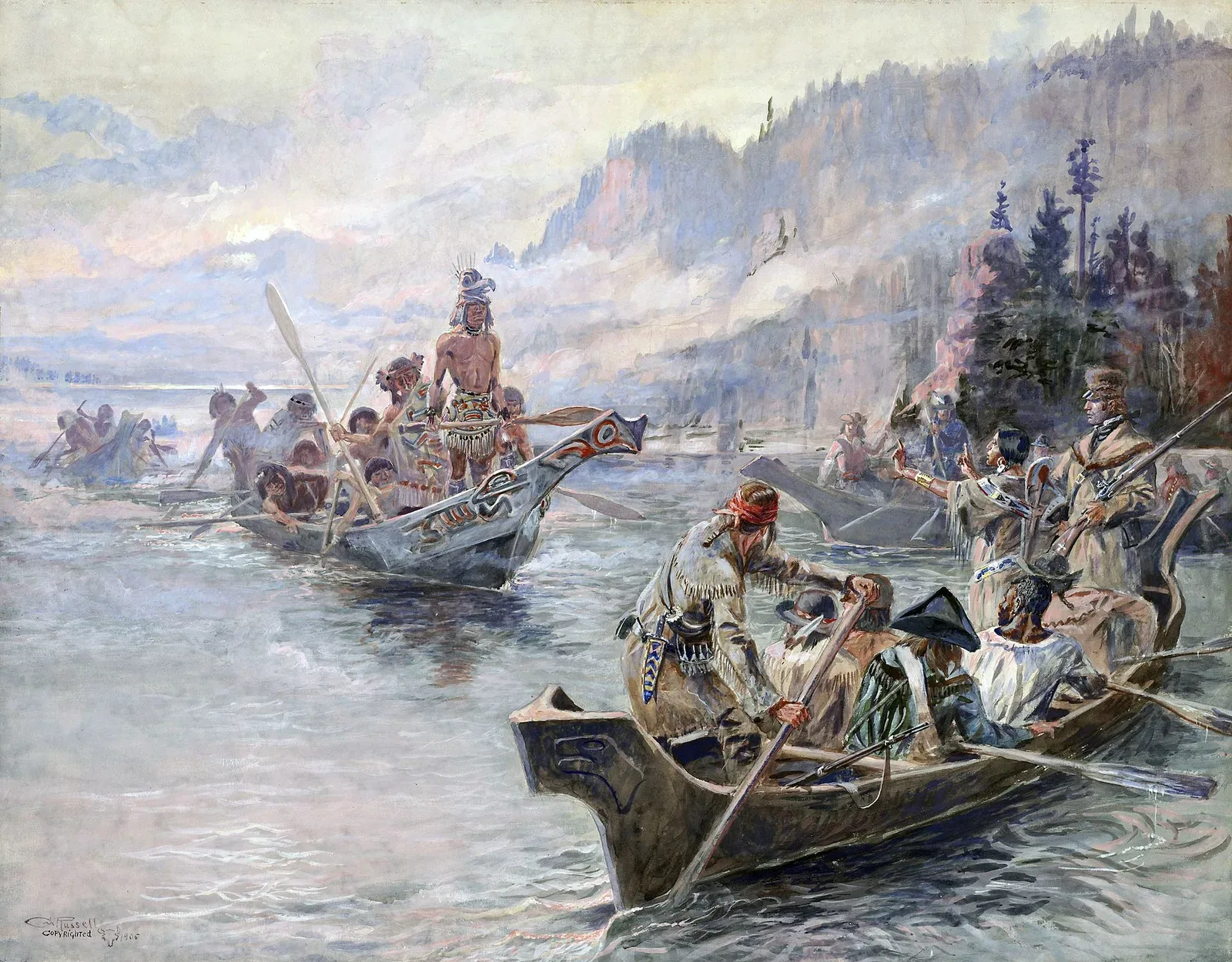
Lewis and Clark: The First Documented Firearms
The first non-Native firearms arrived in what is now Idaho with the Lewis and Clark Expedition in 1805. The Corps of Discovery crossed into present-day Idaho through the Lemhi Pass in August of that year, entering Shoshone territory. Their firearms included:
- Harpers Ferry Model 1803 flintlock rifles
- Model 1795 musket
- Girandoni air rifle for tribal diplomacy
The Shoshone, led by Chief Cameahwait, provided horses for the crossing of the Bitterroots in exchange for trade goods. The Girandoni air rifle in particular impressed tribal leaders and served a crucial diplomatic function alongside its practical utility.
Hudson's Bay Company and Trading Posts
Within two decades, the North West Company and later the Hudson's Bay Company had established trading posts in Idaho country. Fort Boise, established by the Hudson's Bay Company in 1834 near the confluence of the Boise and Snake Rivers, became a significant hub for the fur trade. Trappers working the region — including veterans of the Rocky Mountain Fur Company's rendezvous system — were universally armed with flintlock and later percussion cap rifles in the Hawken-style tradition.
These weren't showpieces. They were working tools for men who might go months without seeing another white face. Fort Hall, established by Nathaniel Wyeth in 1834 near present-day Pocatello and later sold to the Hudson's Bay Company, became another firearms trading node on the Oregon Trail.
Native American Access and the Oregon Trail
The Bannock, Shoshone, Nez Perce, and Coeur d'Alene peoples had varying access to firearms through the fur trade by the 1830s and 1840s. The Nez Perce in particular became skilled horsemen and — crucially — skilled marksmen, a fact that would matter enormously in 1877.
Emigrants passing through on their way to Oregon and California stopped at Fort Hall to resupply, repair equipment, and trade — and firearms were a constant part of that economy. By the 1840s and 1850s, the Oregon Trail was effectively a highway through southern Idaho, and every wagon train on it was armed.
Territorial Era: Gold, Violence, and the First Idaho Lawsedit
Gold Rush Boomtowns and Instant Lawlessness
Idaho Territory began on March 4, 1863, when President Abraham Lincoln signed the act creating it — a vast area carved out of what had been Washington Territory, driven largely by gold discoveries in the Clearwater River region in 1860 and the Boise Basin in 1862. The gold rush produced instant towns, instant lawlessness, and an immediate demand for firearms.
| Location | Established | Type | Significance |
|---|---|---|---|
| Lewiston | 1863 | Territorial Capital | First territorial legislature convened |
| Idaho City | 1862 | Mining Boomtown | Peak population ~7,000 during gold rush |
| Placerville | 1862 | Mining Town | Major Boise Basin gold producer |
| Centerville | 1862 | Mining Town | Part of Boise Basin complex |
| Pioneerville | 1863 | Mining Town | Early Boise Basin settlement |
Lewiston, the territorial capital, and the boomtowns of Idaho City, Placerville, Centerville, and Pioneerville in the Boise Basin attracted the full cast of frontier characters — miners, merchants, gamblers, and outlaws. Violence was common and law enforcement was scarce. The Idaho Territory's first legislature convened in 1863 and passed basic criminal statutes, but meaningful firearms regulation was functionally impossible to enforce across terrain that made large portions of the territory inaccessible for months at a time.
The Snake War and Military Response
The Shoshone-Bannock peoples in southern Idaho faced increasing pressure from both emigrants on the Oregon Trail and the expanding mining population. Conflicts escalated into what became known as the Snake War (1864–1868), one of the longest and costliest Indian Wars in the Pacific Northwest. The U.S. Army deployed forces from Fort Boise and Fort Hall to prosecute the campaign.
Brigadier General George Crook commanded operations during part of this conflict, employing tactics that relied heavily on the mobility of mounted infantry armed with Springfield rifles and later repeating arms. The Idaho Penitentiary, opened in 1872 in Boise, began processing convicted firearms offenders from the early territorial period — though the offenses in question were typically assault and murder rather than anything resembling modern regulatory violations. The concept of licensing or restricting firearms ownership simply did not exist in territorial Idaho.
By the late 1870s, the transcontinental railroad had bypassed Idaho to the south, but the Utah and Northern Railway pushed into southeastern Idaho by 1879, connecting the territory to broader markets and accelerating settlement. With settlement came the next major armed conflict on Idaho soil.
The Nez Perce War of 1877: Idaho's Defining Armed Conflictedit
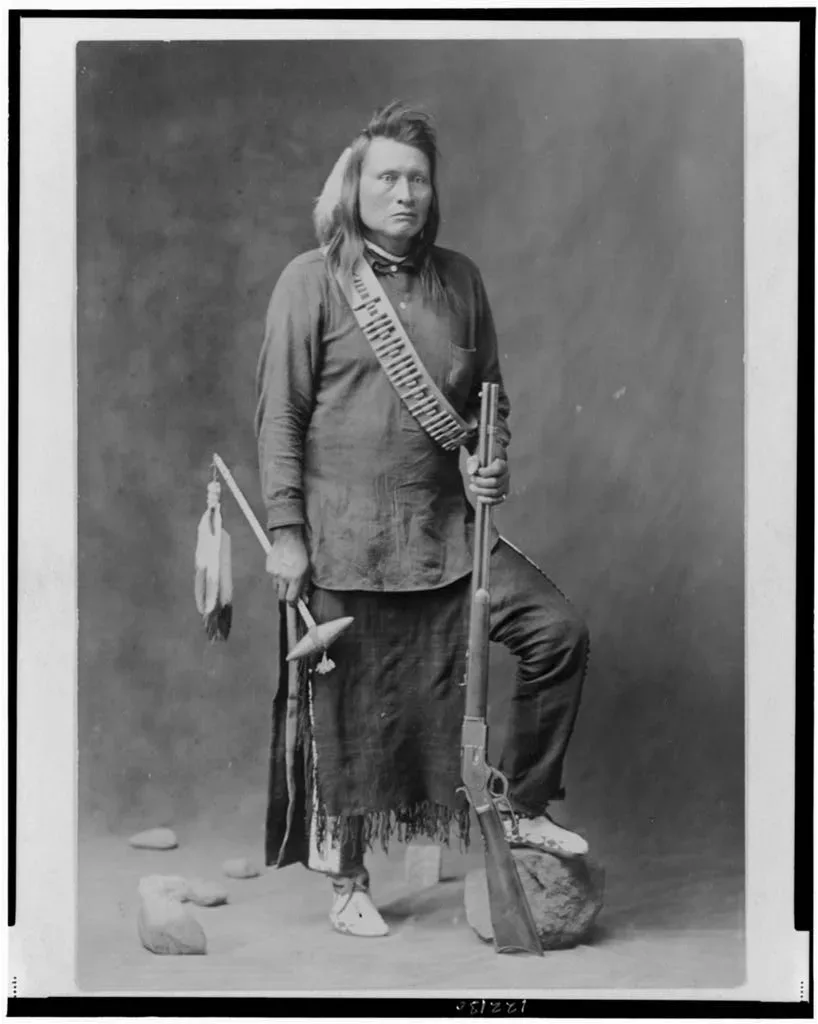
No single event in Idaho's firearms history carries more weight than the Nez Perce War of 1877. It began in June of that year when Chief Joseph (Hinmatóowyalahtq̓it), Looking Glass, Toohoolhoolzote, and White Bird led approximately 700 Nez Perce — roughly 200 of them warriors — on a 1,170-mile fighting retreat from the Wallowa Valley through Idaho, Wyoming, and Montana.
Timeline of early firearms introduction to Idaho country through exploration and fur trade
The tactical sophistication the Nez Perce displayed with firearms shocked U.S. Army officers accustomed to assuming technological superiority would be decisive. At the Battle of White Bird Canyon on June 17, 1877 — fought in present-day Idaho County — Nez Perce warriors armed with a mix of Winchester Model 1873 rifles, Henry repeating rifles, and various single-shot arms defeated a force of roughly 100 soldiers and volunteers under Captain David Perry, killing 34 soldiers at a cost of zero Nez Perce deaths. The Nez Perce used terrain masterfully, employed disciplined fire, and demonstrated marksmanship that multiple Army officers documented in their after-action reports.
| Battle | Date | Location | Nez Perce Leaders | U.S. Forces | Outcome |
|---|---|---|---|---|---|
| White Bird Canyon | June 17, 1877 | Idaho County | Looking Glass, White Bird | Capt. David Perry (~100 men) | Decisive Nez Perce victory |
| Battle of the Clearwater | July 11-12, 1877 | Near Kamiah | Chief Joseph, Looking Glass | Gen. O.O. Howard (~600 men) | Tactical Nez Perce withdrawal |
| Bear Paw | October 5, 1877 | Montana Territory | Chief Joseph | Col. Nelson Miles | Final U.S. victory, Nez Perce surrender |
The Battle of the Clearwater (July 11–12, 1877), fought near present-day Kamiah, involved General O.O. Howard's force of roughly 600 men engaging the Nez Perce in a two-day battle. The Nez Perce held their positions long enough to disengage and continue their retreat. The conflict ultimately ended in Montana at the Bear Paw on October 5, 1877, 40 miles short of the Canadian border.
The Nez Perce War tactical progression showing the 1,170-mile fighting retreat
The Nez Perce War permanently shaped how Idahoans thought about armed conflict and firearms capability. The lesson absorbed by the settler population wasn't abstract — it was that competent use of firearms by any determined group of people mattered more than assumed advantages.
The lesson absorbed by the settler population wasn't abstract — it was that competent use of firearms by any determined group of people mattered more than assumed advantages.
19th Century: Statehood, Mining Wars, and Early Regulationedit
Statehood and Constitutional Foundations
Idaho achieved statehood on July 3, 1890, entering the Union as the 43rd state. The state constitution adopted at the Idaho Constitutional Convention in 1889 included Article I, Section 11, guaranteeing the right to keep and bear arms — a provision that would be strengthened by amendment in subsequent decades.
The Coeur d'Alene Mining Wars
The 1890s in Idaho were defined largely by the Coeur d'Alene mining wars, a series of violent labor conflicts centered on the silver mining industry in Shoshone County. The first major confrontation came in 1892 when miners affiliated with the Miners' Union seized the Frisco Mine and used explosives and gunfire to drive out strikebreakers. Governor Norman Wiley declared martial law and requested federal troops, who deployed to the region and arrested union miners en masse.
The conflict resumed in 1899 when union miners blew up the Bunker Hill and Sullivan Mill in Wardner on April 29. Governor Frank Steunenberg again requested federal intervention — a decision that would cost him his life.
The Steunenberg Assassination and National Attention
On December 30, 1905, former Governor Frank Steunenberg was assassinated by a bomb wired to his front gate in Caldwell. The subsequent trial of Harry Orchard — who confessed to the bombing and implicated Western Federation of Miners leadership — became a national sensation. The defense attorney for WFM leader Big Bill Haywood was Clarence Darrow.
The prosecution was handled by James Hawley and William Borah, who would later become one of Idaho's most influential U.S. senators. Haywood was acquitted in 1907, but the trials put Idaho in the national spotlight and reinforced the state's awareness of how firearms and explosives figured into industrial-era labor violence.
The late 19th century also saw the establishment of the Idaho National Guard, organized formally following statehood and repeatedly deployed during the mining conflicts. Their armories in Boise, Lewiston, and Wallace stored military-grade firearms under state control — the closest thing to an Idaho arsenal in this period.
20th Century: Wars, Federal Influence, and the Roots of Modern Gun Politicsedit
World War I and Early Federal Regulation
Idaho's 20th-century firearms history runs along two parallel tracks: the state's contributions to American military efforts in two World Wars, and the growing tension between federal firearms regulation and Idaho's deeply held resistance to outside interference.
During World War I, Idaho's sons shipped out carrying Springfield Model 1903 rifles and later the Chauchat and Browning Automatic Rifle as American forces modernized. The state's agricultural economy provided food for the war effort, but Idaho also contributed manpower well above its population share. The Idaho National Guard's 41st Division, known as the Sunset Division, deployed to France.
Between the wars, the National Firearms Act of 1934 and the Federal Firearms Act of 1938 imposed the first significant federal firearms regulations — and neither sat particularly well in Idaho. The NFA's restrictions on machine guns, silencers, and short-barreled rifles were largely aimed at gangland violence in eastern cities, a world Idaho had little connection to. Compliance was technically required but enforcement in rural Idaho was effectively nonexistent for years.
World War II Military Installations
World War II brought significantly more direct impact. Farragut Naval Training Station, established in 1942 on Lake Pend Oreille in northern Idaho, became one of the largest naval training facilities in the country, processing over 293,000 sailors during the war. It was a strange fit — a massive naval base in a landlocked mountain state — but the remote location offered protected fresh water and isolation from coastal attack. Firearms training was conducted there at scale, and the base's influence on the surrounding region of Bonner County persisted long after the war ended.
The Mountain Home Air Force Base, established in 1943 in Elmore County, became a permanent installation and remains one of Idaho's most significant military facilities. The 366th Fighter Wing, based there, has maintained a continuous presence that ties the base to Idaho's firearms and military culture.
Post-War Federal Tensions and Ruby Ridge
The Gun Control Act of 1968 passed in the wake of the assassinations of Robert F. Kennedy and Martin Luther King Jr. and created the modern federal framework for firearms dealers, prohibited persons, and interstate transfers. In Idaho, the law was accepted as federal mandate but generated the kind of quiet resentment toward federal overreach that would simmer for decades.
The requirement for federally licensed dealers (FFLs) and the prohibition on certain classes of buyers were implemented, but the philosophical resistance to federal firearms authority was firmly planted. The 1970s and 1980s saw Idaho become a destination for a particular strain of American political thought — rural, self-reliant, deeply skeptical of federal authority, and heavily armed.
Ruby Ridge in 1992 became the flashpoint that crystallized these tensions nationally. The Randy Weaver standoff at Ruby Ridge in Boundary County — triggered initially by a federal undercharge related to sawed-off shotguns that Weaver had sold to an undercover Bureau of Alcohol, Tobacco and Firearms informant — resulted in the deaths of Weaver's son Samuel, his wife Vicki, and Deputy U.S. Marshal William Degan.
The subsequent Senate hearings, the $3.1 million settlement paid to the Weaver family, and the widespread perception that the government had overreached catastrophically made Ruby Ridge a foundational event in American gun-rights politics — and it happened in Idaho. Ruby Ridge directly energized the militia movement of the 1990s and contributed to the atmosphere that produced the Militia of Montana and similar organizations across the inland Northwest. Idaho's Kootenai, Bonner, and Boundary counties became associated with a specific brand of armed political dissent that drew national media attention throughout the decade.
Modern Era (2000–Present): Constitutional Carry and the Legislative Pushedit
The Foundation Years: 2014 Nullification and Campus Carry
The 21st century in Idaho has been characterized by a consistent legislative effort to roll back restrictions on firearms and codify protections against future regulation. Idaho hasn't been reactive to events so much as methodically building what amounts to one of the most permissive firearms legal environments in the country.
In 2014, the Idaho Legislature passed HB 69, which declared certain federal gun control measures unconstitutional and prohibited state resources from being used to enforce federal firearms laws that Idaho deemed unconstitutional. The bill was signed by Governor C.L. 'Butch' Otter and represented a de facto nullification stance — legally untested in federal court but politically significant as a statement of Idaho's posture toward federal authority.
Also in 2014, Idaho passed legislation allowing holders of an Enhanced Concealed Weapons License to carry concealed on public college and university campuses — a provision that made Idaho one of the first states to explicitly mandate campus carry access for qualified license holders. The law applied to buildings on public campuses but carved out dormitories and large entertainment venues with seating over 1,000.
| Year | Legislation | Governor | Key Provision |
|---|---|---|---|
| 2014 | HB 69 | C.L. 'Butch' Otter | Federal nullification stance |
| 2014 | Campus Carry Bill | C.L. 'Butch' Otter | Enhanced permit holders on public campuses |
| 2016 | SB 1389 | C.L. 'Butch' Otter | Constitutional carry (21+ in cities) |
| 2018 | Stand Your Ground | C.L. 'Butch' Otter | Codified no-duty-to-retreat |
| 2019 | HB 206 | Brad Little | Lowered permitless carry age to 18 |
| 2020 | Residency Removal | Brad Little | Extended permitless carry to all U.S. citizens |
| 2023 | Registry Prohibition | Brad Little | Banned government firearm registries |
Constitutional Carry Achievement: 2016
The most consequential single piece of legislation came in March 2016, when Governor Otter signed Senate Bill 1389, making Idaho the ninth constitutional carry state in the nation. The law, which took effect July 1, 2016, allowed Idahoans aged 21 and older — and active military members — to carry a concealed firearm within city limits without a permit. Outside city limits, permitless carry had already been legal for anyone 18 and older under existing law.
Systematic Expansion: 2018-2023
The legislature didn't stop there. In 2019, HB 206 lowered the permitless carry age to 18 within city limits and expanded the provision to cover any concealed weapon, not just handguns. A separate 2019 bill extended permitless carry to active military members regardless of age.
On July 1, 2020, Idaho completed the expansion by extending permitless concealed carry to all U.S. citizens — not just Idaho residents — removing the residency requirement entirely. At that point, any American citizen 18 or older could carry a concealed firearm in Idaho without a permit, without training, and without notifying anyone.
Idaho's systematic expansion of gun rights from 2014-2023
Stand-your-ground was formally codified in 2018 under Idaho Code § 19-202A, though defense attorneys and prosecutors had noted for years that jury instructions in Idaho homicide and battery cases already reflected a no-duty-to-retreat standard in practice. The 2018 legislation made it explicit.
In 2023, Idaho added a prohibition on government entities maintaining any registry of privately owned firearms or their owners — codified at Idaho Code § 18-3326A(2) — reinforcing the constitutional prohibition that had existed since the 1978 amendment to Article I, Section 11. The registry prohibition applies to state agencies, local governments, special districts, and their employees, with a narrow exception for records kept during active criminal investigations.
A parallel legal development worth noting: the Optional Enhanced Concealed Weapons License still exists and remains popular for practical reasons. The Enhanced license — which requires an 8-hour training course, live-fire qualification of at least 98 rounds, and instruction from a law enforcement officer or Idaho State Bar-certified attorney on Idaho firearms law — provides reciprocity with a broader set of states than the standard license. Delaware, Minnesota, Nevada, Washington, and Wisconsin recognize only Idaho's Enhanced permit. For Idahoans who travel frequently, the Enhanced license is worth the investment even though it's not legally required at home.
Notable Figures & Manufacturersedit
William Edgar Borah deserves mention here despite not being primarily a firearms figure. As Idaho's U.S. Senator from 1907 to 1940, William Borah shaped the political culture that made Idaho resistant to federal overreach in general — and that disposition eventually extended to firearms regulation. His advocacy for American isolationism and states' rights created a political template that Idaho politicians have followed in various forms ever since.
Randy Weaver is an unavoidable figure in Idaho firearms history, though his significance is political rather than commercial. The Ruby Ridge standoff he survived defined a generation of firearms-rights activism and remains a reference point in debates about federal law enforcement authority over firearms-related offenses.
Governor C.L. 'Butch' Otter (served 2007–2019) signed more significant pro-firearms legislation than any governor in Idaho history — the campus carry expansion, the constitutional carry bill, and the federal nullification bill among them. His tenure represents the political apex of Idaho's legislative firearms movement.
Senator Jim Risch, who served as Idaho's governor briefly in 2006 before moving to the U.S. Senate, has been a consistent advocate for concealed carry reciprocity at the federal level and has framed Idaho's gun culture accurately in the national debate — as rooted in genuine frontier self-reliance rather than political posturing.
On the manufacturing side, Idaho has not historically been home to major firearms manufacturers in the way that Connecticut, Massachusetts, or even Montana have been. The state's firearms economy has been concentrated in retail, gunsmiths, and the substantial aftermarket industry surrounding hunting and outdoor recreation.
Gemtech, based in Boise, is the most nationally recognized Idaho-origin firearms company. Founded in 1993, Gemtech became one of the larger suppressor manufacturers in the United States, supplying both civilian and military/law enforcement markets. Their suppressors were used by U.S. Special Operations forces and sold commercially through the standard NFA process. Gemtech was acquired by Smith & Wesson (now American Outdoor Brands) in 2017, though manufacturing operations continued in the Boise area for a period following the acquisition.
LWRC International has Idaho ties through its user base and distribution, though its manufacturing is Maryland-based. More relevant to Idaho's firearms identity is the dense ecosystem of custom gunsmiths and small-batch manufacturers serving the hunting and precision rifle communities — particularly in the panhandle region around Coeur d'Alene and the central mountains around McCall and Salmon.
The Civilian Marksmanship Program has maintained a presence in Idaho through affiliated clubs, and the Idaho State Rifle and Pistol Association has been the primary state-level organization coordinating with the NRA and driving legislative advocacy since the mid-20th century.
Current Legal Landscapeedit
Constitutional and Statutory Framework
Idaho's current firearms law is about as permissive as it gets under the federal floor. Here's what the law actually says as of 2026:
Constitutional Basis: Article I, Section 11 of the Idaho Constitution guarantees the right to keep and bear arms and explicitly states that no law shall impose licensure, registration, or special taxation on firearms or ammunition ownership, and that no law shall permit confiscation of firearms except those actually used in the commission of a felony.
Permitless Carry: Any U.S. citizen or active military member 18 or older may carry a concealed firearm without a permit. No training required. No registration. No notification.
Open Carry: Legal statewide without a permit. The firearm must be clearly visible.
Carry Laws and Licensing Options
| License Type | Training Required | Live Fire | Validity | Interstate Recognition |
|---|---|---|---|---|
| None (Permitless) | No | No | N/A | Limited |
| Standard CWL | Basic course | Yes | 5 years | Most states |
| Enhanced CWL | 8-hour course + legal instruction | 98+ rounds | 5 years | Broader recognition including DE, MN, NV, WA, WI |
Enhanced Concealed Weapons License: Still available through county sheriffs on a shall-issue basis. Requires 8-hour training course, 98-round live-fire qualification, and instruction on Idaho law. Valid for 5 years. Provides reciprocity with states that require training verification.
Standard Concealed Weapons License: Also available, with less stringent training requirements. Recognized by a slightly smaller set of states.
Prohibited Persons: Idaho's state law mirrors federal prohibitions:
- Convicted felons cannot possess firearms
- Persons under 18 need written parental permission
- Under-18 possession of handguns, sawed-off rifles/shotguns, or fully automatic weapons prohibited
Preemption: Complete state preemption under Idaho Code § 18-3302J. No city, county, or special district can regulate firearms ownership, possession, use, transportation, or carry beyond state law.
No Registry: Prohibited by both constitution and statute (Idaho Code § 18-3326A(2)).
Hardware Restrictions: Idaho has:
- No assault weapons ban
- No magazine capacity limits
- No bump stock prohibition
- No restrictions on personally made firearms
- No regulation of forced reset triggers
Ammunition: No restrictions on purchase or possession for adults. Selling certain ammunition to minors under 16 without parental consent is prohibited under Idaho Code § 18-3308, with exceptions for .22 caliber rimfire and shotgun shells.
Castle Doctrine/Stand-Your-Ground: Codified in 2018 under Idaho Code § 19-202A. No duty to retreat. Applies in any place a person has a legal right to be.
Hardware and NFA Items
| Item Category | Idaho Law | Federal Requirement | Additional State Restrictions |
|---|---|---|---|
| Machine Guns | Legal | NFA compliance | None |
| Suppressors | Legal | NFA compliance | None |
| Short-Barreled Rifles/Shotguns | Legal | NFA compliance | None |
| Destructive Devices | Legal | NFA compliance | None |
| Assault Weapons | Legal | Federal prohibited persons | None |
| High-Capacity Magazines | Legal | None | None |
| Bump Stocks | Legal | Federal ban (2019) | None |
NFA Items: Machine guns, suppressors, short-barreled rifles and shotguns, and destructive devices are legal in Idaho as long as the owner is in compliance with federal NFA regulations. Idaho does not impose additional state-level restrictions on these items.
Campus Carry: Enhanced Concealed Weapons License holders may carry on public college and university campuses, excluding dormitories and large entertainment venues over 1,000 seats.
Vehicles: A firearm can be transported in a vehicle if it is in plain view, disassembled, or unloaded. Concealed in a vehicle is covered by the permitless carry provision.
Federal-State Legal Tensions
Federal vs. State Tension: Idaho's 2014 nullification bill (HB 69) remains on the books, though its practical enforceability against federal law is legally untested. The law prohibits state agencies from using resources to enforce federal firearms laws that Idaho deems unconstitutional — a provision that has not yet produced a definitive court confrontation.
The BGC Takeedit
Idaho is about as close to the default factory setting on American gun culture as you're going to find in 2026.
Idaho is about as close to the default factory setting on American gun culture as you're going to find in 2026.
This isn't performative — it predates the modern culture war around guns by about 150 years. People here grew up with firearms as tools. Hunting season is a scheduling consideration in a way that people in other states find difficult to understand. School absences during deer season are quietly accommodated in ways that would generate news coverage elsewhere.
The Ruby Ridge legacy still matters here, and not just among the people who wear it on their sleeve. It's baked into the institutional suspicion of federal firearms enforcement that you'll find even among Idahoans who wouldn't describe themselves as political. When the ATF shows up in a conversation, people who've never heard of Randy Weaver have an instinctive reaction that traces back to that event and the decade of political fallout from it.
The legislative trajectory since 2014 reflects real constituent demand, not just NRA lobbying. Constitutional carry passed because Idaho's population genuinely wanted it — the political pressure ran from the grassroots up, not from organizations down. The same goes for campus carry and the registry prohibition. These aren't bills that got snuck through on procedural votes. They passed with comfortable margins in a legislature that was responding to a clear public preference.
The Everytown ranking that calls Idaho's gun laws the worst in the country is going to land differently depending on where you're standing. From inside Idaho, the framing doesn't resonate. The gun death rate figures Everytown cites are real — Idaho's rate of 16.3 per 100,000 exceeds the national average of 13.0 — but a significant portion of that figure is driven by firearm suicide rather than homicide, and that's a public health conversation Idaho hasn't found a comfortable way to have yet.
The state's political culture makes it genuinely difficult to address firearm suicide through the lens of firearms regulation without triggering the broader debate about gun rights, and so the issue tends to remain unaddressed at the legislative level.
For gun owners visiting or moving to Idaho: this is a place where you will be unremarkable. Open carry at the hardware store gets no looks. Talking about your carry setup at a diner counter is a normal conversation. Gun stores are busy, well-stocked, and staffed by people who actually know what they're selling.
The range culture is active — both formal competition through organizations like USPSA and IDPA clubs in the Treasure Valley and informal plinking on public lands in the national forests and BLM holdings that cover most of the state's interior. The one honest friction point is the gap between Idaho's very permissive laws and the patchwork of state recognition issues that affect Idahoans who travel.
The Enhanced Concealed Weapons License exists specifically to address this — and if you're going to carry when you cross state lines, getting the Enhanced license is the practical move regardless of what the law says about your rights. Idaho recognizes all other states' valid permits for non-residents carrying in Idaho. The reciprocity situation for Idahoans going out is more complicated, and the Enhanced permit solves most of it.
Bottom line: Idaho earned its gun culture the hard way — through geography, history, and genuine need. The laws reflect that culture, not the other way around.
Referencesedit
- Idaho State Constitution, Article I, Section 11 (as amended)
- Idaho Code § 18-3302 — Issuance of Licenses to Carry Concealed Weapons
- Idaho Code § 18-3302J — State Preemption of Local Firearms Laws
- Idaho Code § 18-3302K — Enhanced Concealed Weapons License
- Idaho Code § 18-3316 — Firearm Possession by Convicted Felons
- Idaho Code § 18-3326A — Prohibition on Firearms Registries (2023)
- Idaho Code § 19-202A — Stand-Your-Ground (2018)
- Idaho Code § 18-3308 — Ammunition Sales to Minors
- Idaho Senate Bill 1389 (2016) — Constitutional Carry
- Idaho House Bill 206 (2019) — Permitless Carry Expansion
- Idaho House Bill 69 (2014) — Federal Firearms Law Nullification
- Idaho House Bill 199 (2019) — Campus Carry Expansion
- NRA-ILA, Idaho State Gun Laws Summary (updated October 2025)
- Wikipedia, "Gun Laws in Idaho" (accessed 2026)
- U.S. Senate Judiciary Committee hearings on Ruby Ridge (1995)
- Josephy, Alvin M. Jr., The Nez Perce Indians and the Opening of the Northwest (1965)
- Wells, Merle W., Gold Camps and Silver Cities: Nineteenth-Century Mining in Central and Southern Idaho (1983)
- Fahey, John, The Inland Empire: Unfolding Years, 1879–1929 (1986)
- National Archives, Farragut Naval Training Station records
- USCCA, Idaho Concealed Carry Laws and Reciprocity Map (2026)
- Boise Gun Club, Idaho Gun Laws Complete Guide 2026
- Everytown Research & Policy, Idaho State Rankings (2026)
Last Updated: February 24, 2026
- Quail Creek Plantation(Okeechobee, FL)
- 2aHawaii(Honolulu, HI)
- Boston Firearms(Everett, MA)
- Safeshoot(Kingston, NY)
Loading comments...