Specifications
Winchester Model 1873

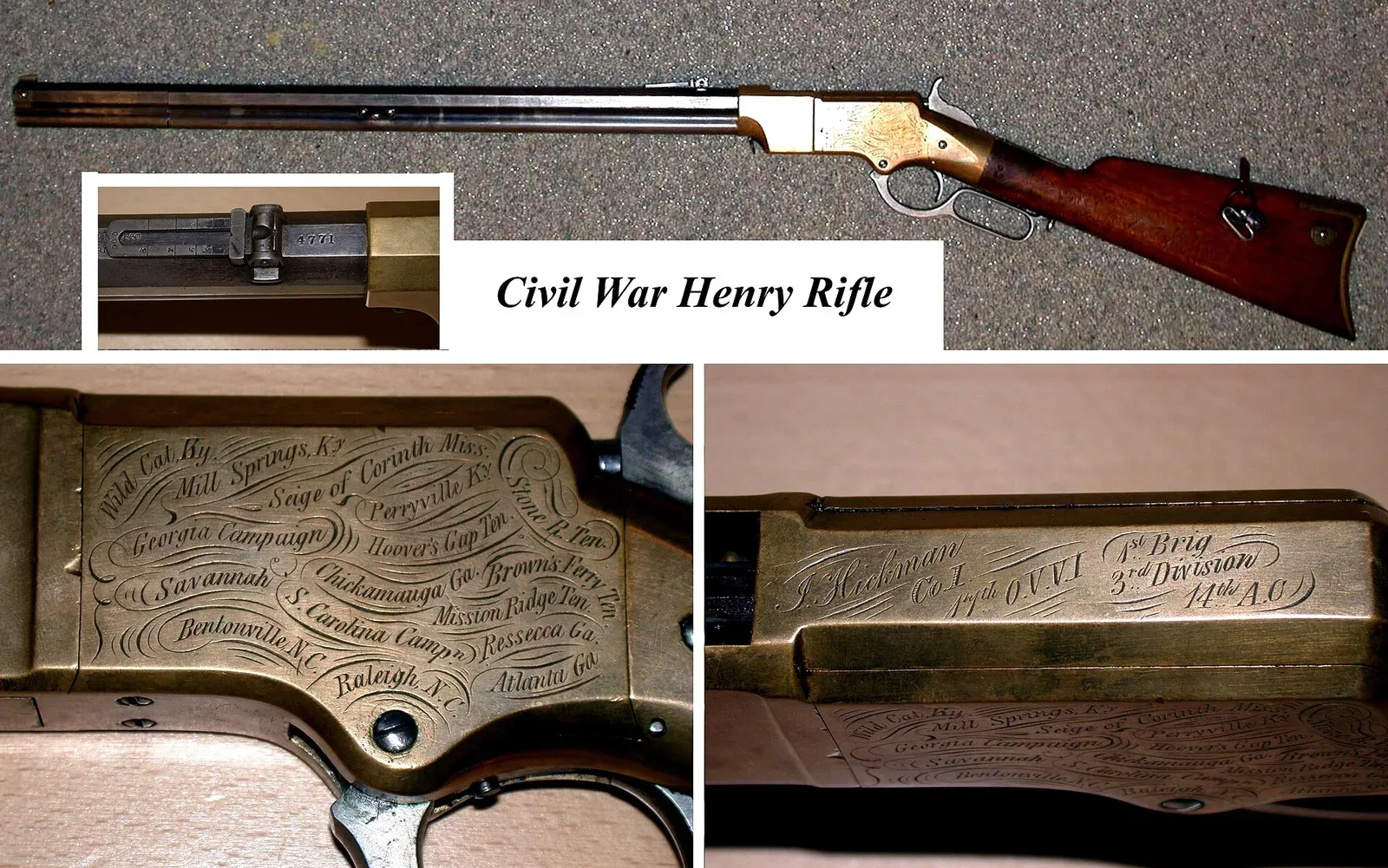
The 1860 Henry rifle — the .44 rimfire repeater that directly preceded the Winchester 1873 and established the lever-action design.
Hmaag (CC BY-SA 3.0)
| Manufacturer | |
|---|---|
| Made By | Winchester Repeating Arms Company |
| Origin | United States |
| Specifications | |
| Caliber | .44-40 Winchester, .38-40 Winchester, .32-20 Winchester, .22 rimfire |
| Action | lever action |
| Production | |
| Designed | 1873 |
| Variants | |
| |
| Service Use | |
Texas RangersBuffalo Bill CodyBilly the KidFrank JamesSitting BullKicking BearChief JosephColt Single Action Army usersQing EmpireSpanish-American War forcesBalkan Wars forces | |
Winchester Model 1873: The Gun That Won the West
Firearms encyclopedia article
From The Boise Gun Club Handbook
Overviewedit
The Winchester Model 1873 is a lever-action repeating rifle manufactured by the Winchester Repeating Arms Company from 1873 to 1923. It was chambered originally in the .44-40 Winchester centerfire cartridge — the first centerfire round Winchester produced — and was later offered in .38-40 and .32-20, both of which doubled as popular revolver cartridges. Over 720,000 were made during its production run.
Winchester marketed it as "The Gun That Won the West" — a slogan that, per Rock Island Auction Company, was actually coined in the early 20th century by Winchester engineer Edwin Pugsley, not on the frontier itself. The sentiment, though, wasn't wrong. The 1873 showed up in the saddlebags of cowboys, lawmen, outlaws, Army officers buying on their own dime, and Native American warriors who recognized a superior repeater when they saw one.
The Model 1873 'put the name Winchester on the map of the West, trotting along with the equally formidable Colt gun at the belt of the frontiersman.' — Ned Crossman, 1920
Writer Ned Crossman captured it plainly in 1920: the Model 1873 "put the name Winchester on the map of the West, trotting along with the equally formidable Colt gun at the belt of the frontiersman."
Design Historyedit
Early Innovations (1849-1860)
The 1873 didn't appear out of thin air. Its lineage runs back to 1849, when Walter Hunt of New York patented his Volition Repeating Rifle — a tubular-magazine, lever-operated design that fired "Rocket Ball" caseless ammunition. The rifle was too complex to manufacture reliably and the ammunition was underpowered, but two core ideas survived into the Winchester: the tubular magazine under the barrel and the lever that cycled the action.
Lewis Jennings bought Hunt's patents through Robbins & Lawrence and refined the design, producing a limited run in the early 1850s. Benjamin Tyler Henry worked as a gunsmith and foreman at Robbins & Lawrence during this period — his future contributions to the repeating rifle started taking shape in those machine shops.
In 1854, Horace Smith and Daniel Wesson form the Volcanic Repeating Arms Company, where they separated the lever's loading function from the trigger's firing function — the mechanical DNA of every lever-action that followed. Their Volcanic design still suffered from the Rocket Ball's weak ballistics. Smith and Wesson sold out in 1855 to a group led by Oliver Winchester, who reorganized the firm as the New Haven Arms Company in 1857 and hired Henry as plant manager.
Winchester Era Begins
Henry's assignment was to fix the ammunition problem. He developed a .44-caliber rimfire cartridge and redesigned the rifle around it. His 1860 patent produced the Henry rifle — a 16-shot repeater that earned the Confederate nickname "that damned Yankee rifle that they load on Sunday and shoot all week." The U.S. government purchased 1,731 Henry rifles, while another 9,000 entered circulation through private purchase.
After the Civil War, Oliver Winchester renamed the company Winchester Repeating Arms Company and in 1866 introduced the Model 1866 — the first rifle to carry the Winchester name. Factory superintendent Nelson King added a loading gate on the side of the frame and a wooden forearm that protected the shooter's hand from a hot barrel. The 1866 retained the .44 Henry rimfire cartridge and its bronze-alloy frame, earning the nickname "Yellow Boy."
The jump to the Winchester Model 1873 addressed two remaining weaknesses: the soft brass frame and the rimfire cartridge. Winchester replaced the bronze receiver with a steel frame — lighter and more durable — and introduced the .44-40 Winchester, a centerfire cartridge using a 40-grain powder charge compared to the 28-grain charge in the old .44 Henry rimfire. The result was improved muzzle velocity, a cartridge easier to reload in the field, and a case that didn't depend on a fragile copper rim for ignition. A sliding dust cover over the bolt also helped shield the action from the grit and weather of open-country use.
The toggle-link action carried over from the Henry design. Pushing the lever down extracted the spent case and lifted a fresh round; closing the lever chambered it and locked the toggle joint. It worked reliably for the cartridges of the era, though it would later prove the limiting factor when Winchester tried to move into higher-pressure rifle rounds.
Technical Characteristicsedit
Standard Configurations
The Winchester Model 1873 was produced in three standard configurations:
| Configuration | Barrel Length | Key Features | Primary Use |
|---|---|---|---|
| Rifle | 24 inches | Most common 19th century variant | General purpose hunting/defense |
| Carbine | 20 inches | Shorter, lighter weight | Mounted users, cavalry |
| Musket | 30 inches | Three barrel bands, bayonet stud, sling swivel | Military contracts (limited success) |
The musket variant found modest export success in South America but never landed a U.S. Army contract. The Army stuck with the single-shot Springfield .45-70 Government, skeptical of the 1873's smaller cartridge and wary of a standing policy against repeaters — the concern being that large magazines would encourage soldiers to burn through ammunition recklessly.
Winchester also built rifles to customer specification in configurations well outside the standard catalog. Barrels as short as 12 inches and as long as 32 inches were produced. Customers could order octagonal barrels, color case-hardened receivers, pistol grips, checkering, engraving, and silver or gold finish. As firearms author George Madis noted, most buyers wanted a working gun and most early production rifles saw hard use — special-order First Models are uncommon survivors.
Chamberings and Ballistics
The original chamberings were:
| Cartridge | Introduction Year | Bullet Weight | Approximate Velocity | Notes |
|---|---|---|---|---|
| .44-40 Winchester | 1873 | 200 grains | ~1,200 fps | Primary cartridge |
| .38-40 Winchester | 1880 | — | — | Revolver compatible |
| .32-20 Winchester | 1882 | — | — | Revolver compatible |
| .22 rimfire | 1884 | — | — | <20,000 produced, discontinued 1904 |
Per Hi-Lux Optics, production end date varies by source — approximately 1919 or 1923, with total production of 720,610 rifles.
One technical quirk worth noting: the bolt face doesn't fully reach the mouth of the chamber, leaving a visible gap at the rim. That's not a defect — it's a characteristic of the toggle-link geometry. The rifle was never going to win a bench-rest match, but it was accurate enough for hunting and combat at the ranges the era demanded, and it ran reliably in conditions that would choke a more finicky design.
The flat-nosed bullet profile on .44-40 cartridges wasn't accidental. In a tube magazine, a pointed bullet sits nose-to-primer with the round in front of it. Under recoil, that contact can detonate the next cartridge. The flat nose solved a dangerous problem while also aiding reliable feeding in revolvers chambered for the same round.
Combat & Field Useedit
The 1873's frontier reputation rested on three practical advantages: it fired quickly, it held a lot of rounds, and its cartridge worked in the revolvers most men were already carrying.
Frontier Law Enforcement
When Colt chambered the Single Action Army in .44-40 in 1877 — marketing it as the "Frontier Six-Shooter" — the pairing clicked immediately. Frank James, upon surrendering to Missouri Governor T.T. Crittenden in 1882, explained his choice of a Remington revolver and Winchester 1873 plainly:
The cartridges of one filled the chambers of the other. There is no confusion of ammunition here. When a man gets into a close, hot fight, with a dozen men shooting at him all at once, he must have his ammunition all of the same kind. — Frank James, 1882
That wasn't just outlaw logic — it was sound field doctrine. Texas Rangers like J.B. Gillett bought the 1873 out of their own pockets because it was the better tool, official Army issue be damned. William F. "Buffalo Bill" Cody wrote to Winchester in 1875:
I have tried and used nearly every kind of gun made in the United States, and for general hunting, or Indian fighting, I pronounce your improved Winchester the boss. — Buffalo Bill Cody, 1875
He backed that claim with an account of stopping a charging bear in the Black Hills with eleven rounds before it could close the distance. Winchester reprinted the letter in their 1875 catalog.
The 1873 was documented across the full spectrum of frontier violence. Billy the Kid is pictured with a Winchester '73 carbine in the only known photograph of him. The citizens of Coffeyville, Kansas used multiple Model 1873s when they turned back the Dalton Gang. Marshal Henry N. Brown of Caldwell, Kansas received an engraved Second Model 1873 from grateful townspeople in 1883 for his law enforcement work — then used that same rifle to attempt a bank robbery 16 months later, ending in his capture and death at the hands of a lynch mob. The 1873 didn't care who was pulling the lever.
Military and International Use
Native American warriors recognized the rifle's value early and acquired them whenever possible. Following the 1867 Wagon Box Fight near Fort Phil Kearny — where soldiers' Henry rifles demonstrated what repeating fire could do — the Lakota and their allies made a deliberate effort to obtain repeating rifles. Ballistic analysis of the Little Bighorn battlefield confirmed at least eight Winchester 1873 rifles among the Lakota, Northern Cheyenne, and Arapaho forces in June 1876, while Custer's 7th Cavalry carried single-shot Springfield carbines. Warriors documented to Sitting Bull, Kicking Bear, and Chief Joseph carried Winchester rifles, many personalized with brass trade tacks pressed into the stock and forearm.
The U.S. military's reluctance to adopt the 1873 meant that on the frontier, the tactical equation often favored whoever could source the rifle over the counter — soldier or not. Montana pioneer Granville Stuart wrote to Winchester that "If poor Custer's heroic band had been armed with these rifles, they would have covered the earth with dead Indians for 500 yards around." Whether that assessment was accurate is debatable, but it reflects how the rifle was regarded at the time.
Beyond the American frontier, the Winchester 1873 found its way into conflicts across several continents. The Qing Empire armed soldiers with the Model 1873 musket variant, photographic evidence of which dates to 1880. The rifle appeared in the hands of forces during the Spanish-American War, the Balkan Wars, and conflicts in Latin America including the War of the Pacific and the Acre War. Winchester repeaters of various models were versatile enough in the international arms market to show up wherever a government or irregular force could afford them.
Legacy & Influenceedit
Technical Evolution
The 1873's most direct descendant was the problem it couldn't solve. The toggle-link action — carried forward from the Henry through the Model 1866 and into the 1873 — was strong enough for handgun cartridges but couldn't handle the higher pressures of true rifle rounds like the .45-70. Winchester knew this, and in 1883 began working with John Moses Browning on a solution. Browning's Model 1886 replaced the toggle link with a vertically sliding locking-block action — a fundamentally stronger design that could handle the .45-70 Government, .45-90, and even the .50-110 Express. The 1886 broke the ceiling the 1873 couldn't breach.
Browning then scaled that action down for the Model 1892, which was chambered in the same low-pressure cartridges as the 1873 but ran a much stronger action at a similar price. Winchester sold the 1873 and 1892 concurrently for over two decades. The 1892 was the mechanically superior rifle; the 1873 survived on reputation and customer loyalty until production finally ended.
The "One of One Thousand" program, launched in 1875, deserves mention as an early example of tiered product marketing in the firearms industry. Winchester's testing process identified barrels with exceptional accuracy, fitted them with set triggers and premium wood, and sold them at $100 — roughly three times the standard rifle's price. Only approximately 136 of these were sold. A second tier, "One of One Hundred," produced only eight examples. The 1950 film Winchester '73 starring James Stewart centered on one of these rifles and sparked renewed collector interest in both grades. Universal Studios ran a search for surviving examples through sporting magazine ads and store posters to promote the film.
Modern Revival
In 2014, a weathered Model 1873 was found leaning against a juniper tree in Great Basin National Park in Nevada. It became known as the Forgotten Winchester — still loaded, apparently abandoned decades earlier by someone who never came back for it. The mystery generated significant media attention and the rifle was transferred to the Cody Firearms Museum for conservation.
Production resumed in 2013 when Winchester reintroduced the Model 1873, manufactured under license from Olin Corporation by the Miroku Corporation in Kōchi Prefecture, Japan. The reissue is available with 20- or 24-inch barrels in round or octagonal profiles, chambered in .357 Magnum/.38 Special, .44-40 Winchester, and .45 Colt — the last being a chambering the original was never offered in. Two modern safety additions were incorporated: a firing pin block that prevents forward movement unless the trigger is pulled, and a modified cartridge carrier that ejects spent cases away from the shooter. Italian maker Uberti has also produced reproductions, feeding demand from the Cowboy Action Shooting community.
The 1873's influence on that shooting sport is direct. Cowboy Action Shooting as a competitive discipline essentially built its rifle requirement around the 1873's profile — lever action, exposed hammer, pistol or straight grip, tube magazine. The rifle that frontiersmen carried for practical necessity became the rifle that competitors run today for the pleasure of it.
At auction, the market for original 1873s remains active. A two-digit serial number antique special-order First Model 1873 — serial number 19 — sold at Rock Island Auction Company in December 2025 for $82,250. The surviving One of One Hundred examples, of which only six are known, represent the upper end of Winchester 1873 collecting.
The BGC Takeedit
The 1873 is easy to romanticize because the romance was manufactured along with the rifle. Winchester's marketing team, dime novelists, and eventually Hollywood built a mythology around this gun that the gun itself mostly earned — but not entirely. The slogan came later. The rifle came first, and it succeeded because it solved real problems for real people in a genuinely dangerous environment.
What's worth understanding about the 1873 in the context of firearms history is what it represented at the transition point between single-shot 19th-century arms and the repeaters that defined 20th-century small arms development. It wasn't the strongest action. It wasn't the most accurate rifle. The bolt face gap tells you right there that this was an engineering compromise from the start. But it held more rounds than anything comparable, it ran the same cartridge your revolver did, it was reliable enough that a Texas Ranger could jam it with the wrong round, field-strip it with a knife under fire, and ride away — and it was affordable to the people who actually needed it.
Browning's 1886 made the 1873 mechanically obsolete almost immediately, and the 1892 replaced it at the same price point with a better action. The 1873 kept selling anyway for decades on the strength of its name and the loyalty of people who already trusted it. That's not nothing. That's what a well-executed product at the right moment in history actually looks like.
The modern reproductions — Miroku-made Winchesters and Uberti clones — are better guns mechanically than the originals. Safer, tighter, more consistent. But if you want to understand why the 1873 matters, you need to think about it as a 19th-century frontiersman would have: standing in a gun shop in 1876, looking at a rifle that holds fifteen rounds of ammunition that also fits your Colt, made of steel instead of brass, that you can buy for $50. The choice wasn't complicated.
Referencesedit
- https://en.wikipedia.org/wiki/Winchester_rifle
- https://www.winchesterguns.com/products/rifles/model-1873.html
- https://hi-luxoptics.com/blogs/history/the-gun-that-won-the-west
- https://www.rockislandauction.com/riac-blog/the-rifle-that-won-the-west-winchester-model-1873
- https://www.nramuseum.org/guns/the-galleries/the-american-west-1850-to-1900/case-18-hunting-and-military-arms-on-the-western-frontier/winchester-model-1873-lever-action-rifle.aspx
- https://www.turnbullrestoration.com/winchester-model-1873-history-and-development/
- https://www.uberti-usa.com/cartridge-rifles/1873-rifle-and-carbine
Last Updated: February 27, 2026
- Gls Guns(Sumner, IA)
- Bi-mart - Yakima (Fruitvale Ave)(Yakima, WA)
- New Philly Sportsman Specialities(New Philadelphia, OH)
- R&R Sports & Outdoors(Brandon, FL)
Loading comments...