State Details
Iowa

Overview | |
|---|---|
State | Iowa (IA) |
Capital | Des Moines |
Statehood | 1846 |
Population | 3,207,004 |
Gun Ownership | 43.6% |
Active FFLs | 989 |
Carry Laws | |
Constitutional Carry | Yes (2021) |
Open Carry | Yes |
CCW Permit Available | Yes |
Permit Reciprocity | 35+ states |
Self-Defense | |
Castle Doctrine | Yes |
Stand Your Ground | Yes |
Duty to Retreat | No |
Regulations | |
State Preemption | Yes |
Red Flag / ERPO | No |
Waiting Period | None |
Universal BGC | No |
NFA Items | Yes |
Assault Weapons Ban | No |
Magazine Limit | None |
Key Legislation | |
| |
Notable Manufacturers | |
| |
Iowa Firearms History: From Black Hawk's War to Constitutional Carry
Reference article
From The Boise Gun Club Handbook
Updated August 15, 2026. The law moved twice since this article was written. The $200 making and transfer tax on suppressors, SBRs, SBSs and AOWs was eliminated effective January 1, 2026 by the One Big Beautiful Bill Act. Then on August 5, 2026 a federal court in Silencer Shop Foundation v. ATF struck down the NFA registration and approval requirements for those same items, and that injunction took effect August 13. It covers only the plaintiffs, their members and their customers. Living in a plaintiff state does not make you covered. Machine guns and destructive devices are unchanged. Read the current guide: NFA Items in 2026: What Actually Changed.
Overviewedit
Iowa sits in an interesting position in the national firearms conversation -- a state that spent most of the 20th century under relatively moderate gun laws, then executed a hard pivot in the 2020s toward some of the most permissive carry laws in the Midwest. It's a place where duck hunting on the Mississippi flyway and deer season in the river bottoms have always been part of the culture, but where the legislative framework governing handguns and carry only caught up with that culture recently.
Iowa's firearms history doesn't feature famous arsenals or legendary gunmakers. What it does feature is a consistent thread of civilian gun ownership tied to agriculture, frontier settlement, Civil War service, and a stubborn streak of rural self-reliance that eventually pushed the legislature to act decisively in 2021 and 2022. Understanding how Iowa got from frontier territory to constitutional carry requires tracing that thread back to before statehood.
Pre-Statehood & Territorial Eraedit
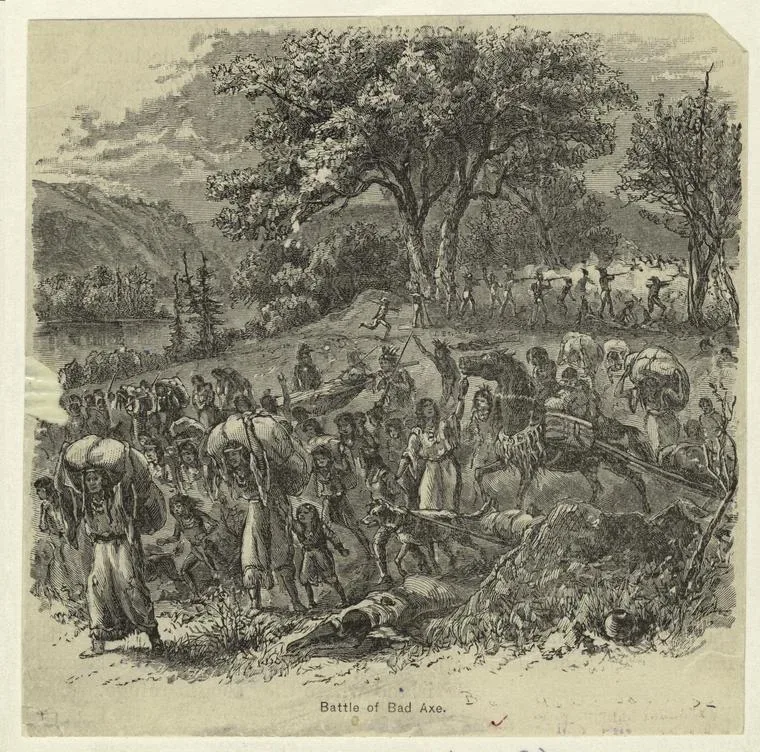
The Black Hawk War & Its Aftermath
Before Iowa was Iowa, the land west of the Mississippi was contested ground. The Black Hawk War of 1832 was the defining armed conflict of the pre-territorial period. Black Hawk, a Sauk leader, led a band of Sauk, Meskwaki, and allied peoples back across the Mississippi into what is now northwestern Illinois and southwestern Wisconsin, attempting to reclaim land ceded under the disputed Treaty of 1804. The war ended at the Battle of Bad Axe in August 1832, with U.S. Army regulars and Illinois militia forces -- many armed with the following weapons -- killing several hundred Sauk and Meskwaki, including women and children, as they attempted to cross back into Iowa:
- Model 1817 Common Rifle - Standard-issue for U.S. Army regulars
- Model 1816 musket - Used by Illinois militia forces
- Various civilian firearms brought by settlers
The immediate aftermath opened the Black Hawk Purchase -- a strip of land along the Mississippi's west bank -- to American settlement in 1833. Settlers moving into this territory brought the firearms of the era: Kentucky long rifles, smoothbore fowlers, and whatever military surplus they could acquire.
| Event | Date | Significance |
|---|---|---|
| Black Hawk War | 1832 | Defining armed conflict; opened territory to American settlement |
| Black Hawk Purchase | 1833 | Strip of land along Mississippi opened to settlers |
| Iowa Territory Organized | 1838 | Formal territorial status established |
| Meskwaki Pushed Out | 1845 | Allied tribe forced from Iowa |
| Iowa Statehood | 1846 | 29th state admitted to Union |
| Meskwaki Return | 1856 | Purchase land in Tama County (still exists today) |
Territorial Organization & Settlement
The Meskwaki (also called the Fox), who had allied with the U.S. during the Black Hawk War, were granted some protections but were eventually pushed out of Iowa in 1845, only to purchase land and return to Tama County in 1856 -- where the Meskwaki Settlement still exists today.
Iowa Territory was formally organized in 1838, and the territorial period through statehood in 1846 was characterized by rapid settlement along river corridors. The Des Moines River and Iowa River valleys filled with settlers from Ohio, Indiana, and Kentucky, most of whom were accustomed to keeping firearms as basic household tools. There were no significant territorial firearms regulations. Local militias organized informally, equipped with whatever the members brought from home.
The 1st Iowa Infantry traces its conceptual lineage to these territorial militia units, though it wouldn't be formally organized until the Civil War. The Iowa Territorial Militia had no standardized arms and relied entirely on private weapons and whatever federal surplus could be scrounged. This pattern -- the state depending on armed civilians to fill military roles -- would repeat itself dramatically in 1861.
19th Century: Statehood, Expansion & the Civil Waredit
Early Statehood & Frontier's End
Iowa achieved statehood on December 28, 1846, making it the 29th state. The original Iowa Constitution of 1846 contained no specific right to keep and bear arms -- an omission that would remain unremedied for 176 years. The framers apparently considered gun ownership too obvious to warrant constitutional protection, which was a common assumption in frontier states where firearms were practical necessities rather than political flashpoints.
The 1850s brought rapid population growth and the expansion of railroads into Iowa, which accelerated settlement of the interior. By the time Fort Dodge was established in 1850 as a military post on the upper Des Moines River, the frontier had effectively moved west of Iowa. The fort was decommissioned in 1853 -- Iowa's run as frontier territory was brief compared to states further west.
Civil War Service & Impact
The Civil War transformed Iowa's relationship with firearms and military service in ways that echoed for generations. Iowa contributed approximately 76,000 men to Union service -- an enormous number for a state with a total population of around 675,000 in 1860. The 1st Iowa Infantry was mustered into federal service in May 1861, seeing action at Wilson's Creek in Missouri in August 1861. Iowa eventually fielded 46 infantry regiments, 9 cavalry regiments, and 4 artillery batteries.
| Iowa Civil War Contribution | Numbers |
|---|---|
| Total Population (1860) | ~675,000 |
| Men in Union Service | ~76,000 |
| Infantry Regiments | 46 |
| Cavalry Regiments | 9 |
| Artillery Batteries | 4 |
| Primary Weapons | Springfield Model 1861, Austrian Lorenz rifles |
| Notable Engagements | Wilson's Creek (1861), Vicksburg (1863) |
Iowa soldiers were initially armed with a mix of weapons, including Austrian Lorenz rifles and obsolete smoothbore muskets before transitioning to Springfield Model 1861 rifles. The 27th Iowa Infantry and other later-organized regiments benefited from more standardized arms as federal production ramped up. Iowans served in the Western Theater under General William T. Sherman and with General Ulysses S. Grant at Vicksburg in 1863.
Post-War Veteran Culture
The war's end brought large numbers of veterans home to Iowa with military experience and, in some cases, military weapons. Springfield rifles, Colt revolvers, and Remington Army revolvers filtered into civilian hands through veterans keeping their sidearms or purchasing surplus. This influx of experienced shooters formed the backbone of Iowa's early civilian marksmanship culture.
The post-Civil War period saw Iowa's cities -- Des Moines, Davenport, Cedar Rapids, Dubuque -- grow substantially, but Iowa never developed the kind of concentrated urban industrial base that would later drive firearms manufacturing in states like Connecticut or Massachusetts. Iowa remained fundamentally agricultural, and its firearms culture reflected that: hunting, pest control, and self-reliance on isolated farmsteads rather than any particular manufacturing tradition.
The Meskwaki who returned to Tama County in 1856 occupied a unique legal space -- they purchased their land as private citizens rather than living on a federal reservation -- and maintained traditional practices including hunting, though increasing pressure from game laws and encroaching agriculture steadily reduced the land base they could practically use.
20th Century: Wars, Industry & Regulationedit
Agricultural Foundation & Conservation
Iowa entered the 20th century as one of the most productive agricultural states in the nation, and its firearms culture remained tightly bound to that identity. Hunting -- particularly pheasant, white-tailed deer, and waterfowl along the Mississippi flyway -- was deeply embedded in rural Iowa life. The Iowa State Conservation Commission, established in 1931, began managing game populations systematically, which institutionalized hunting as a regulated but culturally central activity.
World Wars & Industrial Production
Both World Wars drew heavily on Iowa's population. In World War I, Iowa contributed over 100,000 men to the military. Camp Dodge, near Johnston north of Des Moines, served as the primary mobilization and training facility for Iowa troops and continues to serve as the home of the Iowa National Guard today. During World War II, Camp Dodge again functioned as a processing and training center, while the Iowa Ordnance Plant in Middletown (Burlington area) manufactured artillery shells and propellants -- one of the more significant direct connections between Iowa and weapons production during the war years.
| Facility | Location | Period | Production |
|---|---|---|---|
| Camp Dodge | Johnston (near Des Moines) | WWI-Present | Training/mobilization center |
| Iowa Ordnance Plant | Middletown (Burlington area) | 1941-Present | Artillery shells, propellants |
| Peak WWII Employment | IAAAP | 1941-1945 | Thousands of workers |
| Current Operator | American Ordnance LLC | Present | GOCO facility |
The Iowa Army Ammunition Plant (IAAAP), later renamed from the Iowa Ordnance Plant, became the state's most significant contribution to military-industrial firearms history. Located near Middletown in Des Moines County along the Mississippi River, the plant has manufactured conventional ammunition for U.S. military use continuously since its establishment in 1941. At peak World War II production, it employed thousands of workers. The plant operated through Korea, Vietnam, and continues operating today under American Ordnance LLC as a government-owned, contractor-operated facility -- producing artillery propellants and ammunition components. It's not a civilian firearms manufacturer, but it's the most direct link between Iowa and large-scale weapons production.
Post-War Legislative Framework
On the civilian legislative side, Iowa's 20th-century firearms laws were relatively modest by contemporary standards. Iowa did not adopt a comprehensive concealed carry permit system until much later, operating under a discretionary "may issue" framework for most of the century that gave county sheriffs broad latitude to grant or deny carry permits. In practice, this meant rural counties often issued permits readily while more urban counties -- particularly Polk County (Des Moines) and Linn County (Cedar Rapids) -- were far more restrictive. The result was a patchwork system where your ability to legally carry a firearm depended substantially on your zip code.
The 1991 University of Iowa Shooting
The University of Iowa shooting marked a significant turning point in the state's public firearms debate. On November 1, 1991, Gang Lu, a physics doctoral student from China who had lost a prestigious dissertation prize, shot and killed five people on the University of Iowa campus -- including Christoph K. Goertz, Robert A. Smith, Linhua Shan, T. Anne Cleary, and Dwight R. Glennie -- before killing himself. A sixth victim, Miya Rodolfo-Sioson, survived but was permanently paralyzed. The shooting prompted immediate calls for gun control legislation in Iowa and nationally, though the major federal legislative response -- the Brady Handgun Violence Prevention Act -- didn't pass until 1993.
At the state level, the University of Iowa shooting contributed to ongoing debates about campus carry, mental health screening for firearms purchases, and permit requirements. Iowa maintained its discretionary permit system and handgun purchase permit requirements through the 1990s and 2000s, but pressure from gun rights advocates continued to build.
The Federal Assault Weapons Ban of 1994 applied to Iowa like all other states, restricting certain semi-automatic rifles and magazine capacities from 1994 until the ban's expiration in 2004. Iowa enacted no state-level assault weapons restrictions at the time of the ban or after its expiration, and has not done so since.
Modern Era (2000–Present)edit
The modern transformation of Iowa firearms law is one of the more dramatic state-level policy shifts in the country over a 15-year period -- from a restrictive discretionary permit system to constitutional carry with strict scrutiny constitutional protection.
The Shall Issue Transition (2011)
The first major shift came on January 1, 2011, when Iowa transitioned from a "may issue" to a "shall issue" concealed carry system under Iowa Code § 724.7. Under shall issue, the county sheriff is required to issue a permit to carry to any qualified applicant -- they can't simply decide they don't like you or that there isn't enough "good cause." Applicants had to be 21 or older and complete an approved firearms training course. This was a substantial change from the prior system, where getting a carry permit in Polk County had been effectively impossible for ordinary citizens for decades.
The shall-issue transition generated considerable debate. Supporters argued the old system was arbitrary and discriminatory -- wealthy or politically connected Iowans in urban counties could get permits while ordinary people couldn't. Critics predicted increased gun violence. The transition proceeded, and Iowa's shall-issue period lasted a decade before the next, larger shift.
| Iowa Firearms Law Evolution | Date | Change |
|---|---|---|
| Shall Issue Carry | January 1, 2011 | End of discretionary permits |
| Constitutional Carry | July 1, 2021 | No permit required |
| Permit-to-Acquire Eliminated | July 1, 2021 | Optional permit system |
| Stand Your Ground | 2021 | No duty to retreat |
| RKBA Amendment | November 2022 | Strict scrutiny protection |
| Anti-Registry Law | 2024 | Prohibits government gun registries |
Constitutional Carry Era (2021)
On July 1, 2021, Iowa became a constitutional carry state when House File 756 took effect. The law eliminated the permit requirement for carrying firearms -- open or concealed -- for both Iowa residents and non-residents. Any person legally allowed to possess a firearm could now carry it without obtaining a permit first. Iowa joined a growing number of states -- primarily in the South and Midwest -- that had adopted permitless carry in the years following District of Columbia v. Heller (2008) and McDonald v. City of Chicago (2010).
The constitutional carry law also eliminated the longstanding requirement for a permit to acquire a handgun, though the permit remains available as an optional mechanism that functions as a NICS-exempt purchase credential. The change was significant: Iowa's permit to acquire system, which had required Iowans to obtain sheriff approval before buying a handgun from a licensed dealer, had been in place for decades. Starting July 1, 2021, any eligible person could walk into a dealer, pass a standard NICS check, and buy a handgun without the additional permit step.
An Iowa poll from June 2021 found that 67 percent of Iowans opposed the permitless carry law -- a notable disconnect between the legislative action and apparent public opinion. That said, polling on firearms laws frequently shows support for generic "permit requirements" without voters having detailed knowledge of how permit systems actually function, so the number should be read with some caution. What's clear is that the Republican-controlled legislature moved decisively and the governor signed the bill.
The second major 2021 change was the addition of a Stand Your Ground provision to Iowa law at Iowa Code § 707.6, eliminating any duty to retreat for a person who is not engaged in illegal activity and is in a place they are lawfully present.
Constitutional Amendment & Strict Scrutiny
Then came November 2022. Iowa voters approved Constitutional Amendment 1, adding Article I, Section 1A to the Iowa Constitution:
The right of the people to keep and bear arms shall not be infringed. The sovereign state of Iowa affirms and recognizes this right to be a fundamental individual right. Any and all restrictions of this right shall be subject to strict scrutiny.
The strict scrutiny language is the critical piece. Under strict scrutiny, any government restriction on the right to keep and bear arms must serve a compelling government interest and be narrowly tailored to achieve that interest -- the highest standard of judicial review. This is stronger constitutional protection than many other state RKBA provisions, and stronger than the federal framework that existed at the time of the amendment's passage. Iowa was making a deliberate statement: gun rights in Iowa are a fundamental right, and courts must treat them that way.
The amendment was heavily influenced by ongoing debates in the wake of Heller and McDonald, and was designed to ensure that Iowa courts would apply maximum protection to Second Amendment claims regardless of what federal courts were doing. The Duke Center for Firearms Law noted in 2025 that the Iowa Supreme Court has been working through the practical implications of the strict scrutiny standard in a series of cases -- not always cleanly -- as the court tries to figure out what restrictions can survive that demanding standard.
Recent Developments & Public Health Data
In 2024, Iowa added another layer with Iowa Code § 554H.3, which prohibits any government entity from maintaining a registry of privately owned firearms or their owners. The law includes narrow exceptions for records generated during criminal investigations or prosecutions, stolen firearms lists, and records otherwise required by law. The anti-registry provision reflects a broader pattern in Republican-controlled legislatures of explicitly foreclosing government tracking of firearms ownership.
Iowa also legalized suppressors effective March 31, 2016, and short-barreled rifles and shotguns effective April 13, 2017, bringing state law into alignment with NFA-regulated items. Iowa remains one of the states that does not ban "assault weapons" or restrict magazine capacity.
On the public health side, Everytown Research data indicates Iowa's gun death rate has increased over the past decade at a rate faster than the national average. The causes are debated -- gun rights advocates point to factors like drug-related violence and mental health crises, while gun control advocates point directly to the 2021 legislative changes. Iowa also sees a significant racial disparity in gun homicide rates, with Black Iowans dying by gun homicide at substantially higher rates than white Iowans.
Notable Figures & Manufacturersedit
Manufacturing & Industrial Connections
Iowa has not produced major commercial firearms manufacturers on the scale of states like Connecticut, Massachusetts, or even neighboring Missouri. The state's industrial base developed around agricultural equipment -- John Deere, Case IH -- rather than firearms. What Iowa has produced are notable figures in firearms policy, military service, and shooting sports.
The Iowa Army Ammunition Plant in Middletown deserves repeated mention as the state's most significant manufacturing connection to weapons production. Operated since 1941, the facility has produced conventional ammunition and propellants through multiple wars and conflicts. It's a government-owned facility, not a private manufacturer, but its scale and longevity make it genuinely significant in Iowa's military-industrial history.
Political & Military Figures
James B. Weaver, the Greenback Party and later Populist Party presidential candidate from Iowa, is not primarily a firearms figure, but the agrarian political movements he represented in the 1870s-1890s shaped Iowa's political culture in ways that eventually influenced gun rights debates -- the same rural self-reliance ethos that produced Populism produced resistance to urban-driven gun control decades later.
Colonel Charles Young, born in Mays Lick, Kentucky, but associated with Iowa's Buffalo Soldiers heritage through his service history, represents a thread of Black military service that Iowa contributed to significantly during the post-Civil War period. Iowa's African Methodist Episcopal communities in Keokuk and other Mississippi River towns supplied men to the U.S. Colored Troops during the Civil War and later to Buffalo Soldier regiments.
Modern Advocacy Organizations
In competitive shooting, Iowa has produced notable practical shooters and hunters, though no figures of national celebrity comparable to figures from states with major military bases or established shooting industry infrastructure. The Iowa Firearms Coalition (IFC) has been the dominant state-level gun rights organization, playing a significant role in lobbying for the 2011 shall-issue transition, the 2021 constitutional carry law, and the 2022 constitutional amendment.
Gary Maupin and other IFC leaders worked for years to build legislative support for shall-issue carry before 2011. The coalition's patient, decade-long effort to move the legislature is a case study in how state-level gun rights advocacy actually works -- slow coalition building, election-cycle focus, and persistent relationship development with legislators rather than high-profile confrontation.
Current Legal Landscapeedit
Carry & Purchase Framework
As of early 2026, Iowa's firearms legal framework is among the more permissive in the Midwest.
Carry: No permit required for open or concealed carry by anyone legally allowed to possess a firearm, resident or non-resident. Optional permits to carry are still available and valid for five years; Iowa recognizes permits from any other state.
Purchase: No permit required to purchase long guns. A permit to acquire pistols and revolvers is available from the county sheriff but not required -- a standard NICS check satisfies federal requirements. The permit, if obtained, is valid for five years and functions as a NICS-exempt document. Iowa Code § 724.15 governs the permit to acquire framework.
| Category | Iowa Law | Details |
|---|---|---|
| Carry | Constitutional Carry | No permit required, open/concealed |
| Purchase | NICS Check Only | Optional permit-to-acquire available |
| Prohibited Weapons | Machine guns banned | NFA items legal if federally registered |
| Constitutional Protection | Strict Scrutiny | Article I, Section 1A (2022) |
| Preemption | State Level | Cities/counties cannot exceed state law |
| Reciprocity | Universal Recognition | Accepts all other state permits |
Prohibited Items & Constitutional Protection
Prohibited Persons: Standard federal prohibitions apply. Iowa adds state-level prohibitions for certain mental health adjudications.
Prohibited Weapons: Machine guns remain prohibited under Iowa Code § 724.1 (the "offensive weapons statute"), with narrow exceptions. Short-barreled rifles, short-barreled shotguns, and suppressors are legal if properly registered under federal NFA requirements. Iowa does not ban semi-automatic rifles, "assault weapons" as defined by other states, or restrict magazine capacity. Bump stocks are not banned by possession under state law, though selling trigger-rate-increasing devices is prohibited.
Constitutional Protection: Article I, Section 1A (adopted November 2022) requires strict scrutiny review of any firearms restriction. This is among the strongest constitutional RKBA protections of any state.
Preemption: Iowa Code § 724.28 preempts local firearms ordinances -- cities and counties cannot enact gun restrictions more stringent than state law. The Iowa Attorney General has opined that facilities designated as gun-free zones by municipalities may survive under a home-rule exception, but this hasn't been definitively litigated.
Registry: Iowa Code § 554H.3 (2024) prohibits government maintenance of privately-owned firearms registries, with limited exceptions for criminal investigations and stolen-firearms records.
Prohibited Locations: Iowans must avoid carrying at:
- Schools (Iowa Code § 724.4A and 724.4B)
- School buses
- State-licensed casinos
- Iowa State Fair while in operation
- State university campuses
These prohibitions have not yet been fully tested against the 2022 strict scrutiny amendment.
Reciprocity & Ongoing Litigation
Reciprocity: Iowa recognizes valid carry permits from any other state. Several states recognize Iowa's resident permit only:
- Colorado - resident permits only
- Florida - resident permits only
- Maine - resident permits only
- Michigan - resident permits only
- North Dakota - resident permits only
- New Hampshire - resident permits only
- Pennsylvania - resident permits only
- South Carolina - resident permits only
Nebraska honors Iowa's non-professional permit but not the professional permit.
Iowa Supreme Court Activity: The court has been working through the implications of the strict scrutiny amendment since 2022. A 2025 Duke Center for Firearms Law analysis noted the court issued a divided opinion upholding Iowa's process for restoring gun rights revoked by federal law after involuntary commitment -- the supremacy clause creating complications when state restoration procedures conflict with federal law's prohibition on possession by the mentally adjudicated. Expect more litigation as challengers test which restrictions survive strict scrutiny.
The BGC Takeedit
Iowa is genuinely interesting because it doesn't fit cleanly into either coastal narrative about gun culture. It's not Texas-loud about it, and it's not California-restrictive. It's Midwestern about it.
For most of the 20th century, Iowa had the guns and the culture without the legal framework to match. A farmer in Adair County who'd been hunting his whole life couldn't get a carry permit in Polk County because the sheriff there ran the system as a de facto exclusion. The 2011 shall-issue reform fixed that, and the 2021 constitutional carry law took it further. Whether you think that's good or bad depends on your priors, but the direction of travel is clear and the 2022 constitutional amendment locked it in place at the constitutional level.
The cultural vibe for gun owners in Iowa is relaxed and normalized in rural areas, somewhat more cautious in the Des Moines metro and college towns like Iowa City and Ames. There's no real confrontational open-carry culture -- Iowans tend not to be performative about it. People carry because they want to, not to make a statement. Hunting is the deepest cultural root: pheasant season in October is a genuine social institution, and deer season affects school attendance in some rural districts the way a blizzard would.
The 2021 changes did generate real political friction. The poll showing 67% opposition to permitless carry was widely cited by opponents, and the debate was genuinely contentious in the legislature. But the Republican majorities held, the governor signed it, and the constitutional amendment passed by a solid margin in 2022. The legislative and electoral outcomes suggest that whatever the polling said about the specific mechanism, the underlying support for strong gun rights was real enough when people actually voted.
The ongoing Iowa Supreme Court litigation over the strict scrutiny amendment is worth watching. Iowa is effectively running an experiment in what maximum constitutional protection for gun rights looks like at the state level -- and the results will influence how other states draft their own constitutional amendments. The friction with federal law, especially around mental health prohibitions and restoration procedures, is the live edge of that experiment right now.
For a gun owner moving to Iowa or passing through: it's a comfortable state. Carry is simple, purchase is simple, hunting infrastructure is excellent, and the culture won't give you a second look. The legal framework as of 2026 is stable and permissive. Just mind the specific prohibited locations -- schools, casinos, the State Fair, and university campuses all still apply, and the strict scrutiny amendment hasn't yet swept those away.
Referencesedit
- Iowa Code § 724.1 – Offensive weapons definition
- Iowa Code § 724.5, § 724.7 – Carrying weapons; permit requirements
- Iowa Code § 724.11, § 724.11A – Permit issuance; reciprocity
- Iowa Code § 724.15 – Permit to acquire pistols
- Iowa Code § 724.28 – State preemption of local firearms ordinances
- Iowa Code § 554H.3 (2024) – Prohibition on firearms registries
- Iowa Constitution, Article I, Section 1A (adopted November 2022)
- Iowa Constitution, Article I, Section 1 – Inalienable rights provision
- House File 756 (2021) – Constitutional carry legislation
- NRA-ILA. "Iowa Gun Laws." Last updated December 8, 2025. https://www.nraila.org/gun-laws/state-gun-laws/iowa/
- Wikipedia. "Gun laws in Iowa." https://en.wikipedia.org/wiki/Gun_laws_in_Iowa
- Duke Center for Firearms Law. "The Gun Bog: Iowa Supreme Court Finds Some Solid Ground in the Supremacy Clause." May 2025. https://firearmslaw.duke.edu/2025/05/the-gun-bog-iowa-supreme-court-finds-some-solid-ground-in-the-supremacy-clause
- State Court Report. "Iowa High Court Adds to Confusion Over New Right-to-Bear-Arms Amendment." https://statecourtreport.org/our-work/analysis-opinion/iowa-high-court-adds-confusion-over-new-right-bear-arms-amendment-0
- Everytown Research & Policy. "Iowa." 2026 Rankings. https://everytownresearch.org/rankings/state/iowa/
- Daily Iowan. "How gun laws have changed since the 1991 fatal shooting at the University of Iowa." October 31, 2021. https://dailyiowan.com/2021/10/31/how-gun-laws-have-changed-since-the-1991-fatal-shooting-at-the-university-of-iowa/
- Iowa Army Ammunition Plant (IAAAP), Middletown, Iowa – historical facility records
- U.S. Army. Records of Iowa Civil War regimental service, 1861–1865
- Black Hawk War records, 1832 – National Archives
- ATF Brady Permit Chart – Iowa permit to acquire recognized as NICS-exempt (as of December 2025)
Last Updated: February 24, 2026
- Quail Creek Plantation(Okeechobee, FL)
- 2aHawaii(Honolulu, HI)
- Boston Firearms(Everett, MA)
- Safeshoot(Kingston, NY)
Loading comments...