State Details
Kansas

Overview | |
|---|---|
State | Kansas (KS) |
Capital | Topeka |
Statehood | 1861 |
Population | 2,940,546 |
Gun Ownership | 48.2% |
Active FFLs | 891 |
Carry Laws | |
Constitutional Carry | Yes (2015) |
Open Carry | Yes |
CCW Permit Available | Yes |
Permit Reciprocity | 36+ states |
Self-Defense | |
Castle Doctrine | Yes |
Stand Your Ground | Yes |
Duty to Retreat | No |
Regulations | |
State Preemption | Yes |
Red Flag / ERPO | No |
Waiting Period | None |
Universal BGC | No |
NFA Items | Yes |
Assault Weapons Ban | No |
Magazine Limit | None |
Firearms Freedom Act | Yes |
Key Legislation | |
| |
Notable Manufacturers | |
| |
Kansas Firearms History: From Bleeding Kansas to Constitutional Carry
Reference article
From The Boise Gun Club Handbook
Overviewedit
Kansas sits at the intersection of two defining chapters in American firearms history. The first is the violent pre-Civil War period known as Bleeding Kansas, when armed settlers literally fought a proxy war over slavery along the Missouri border. The second is the cattle-drive era of the 1870s and 1880s, when towns like Dodge City, Abilene, and Wichita became synonymous with both gunfighting legend and — less romantically but more accurately — some of the earliest municipal gun regulations in the American West.
The Hollywood version of Kansas gun culture is mostly myth. The real story is more complicated and considerably more interesting.
Kansas towns that enforced carry ordinances weren't anti-gun societies — they were pragmatic business communities trying to survive the chaos of the longhorn cattle trade. The same state that checked cowboys' revolvers at the city limits in 1878 passed permitless constitutional carry in 2015. Both facts are authentically Kansas.
Today Kansas is a shall-issue, constitutional carry state with a gun culture anchored in hunting, rural self-reliance, and an increasingly assertive Second Amendment legislative identity. Understanding how it got there requires going back before statehood — back to when guns in Kansas weren't a political symbol but a daily survival tool.
Territorial Era: Bleeding Kansas (1854–1861)edit
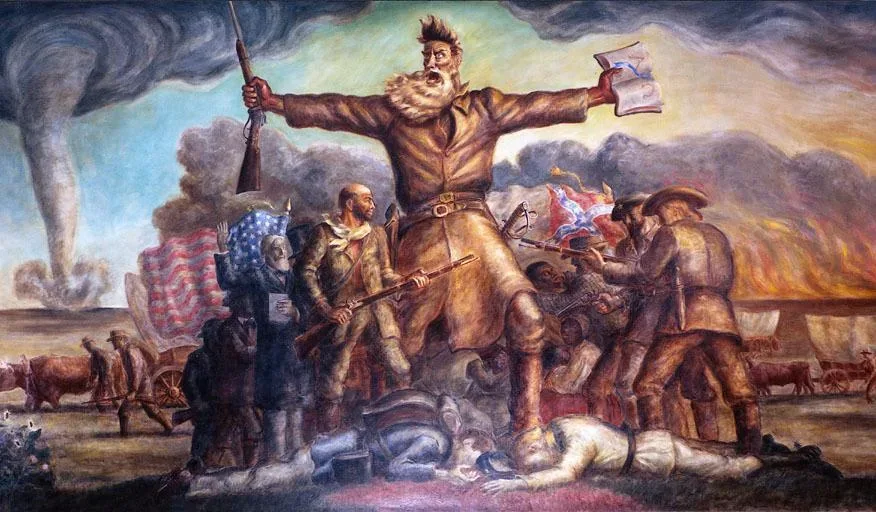
Kansas has no colonial firearms history in the Eastern sense. There were no English settlements, no colonial militias drilling on village greens. What Kansas had instead was the Kansas-Nebraska Act of 1854, which opened the territory to settlement and immediately turned it into a battlefield.
The Kansas-Nebraska Act and Armed Settlement
The Act established popular sovereignty — the idea that settlers themselves would vote to decide whether Kansas entered the Union as a slave state or a free state. What it produced in practice was an armed invasion from both sides. Pro-slavery settlers flooded in from Missouri, and free-state settlers — many of them financed by Northern abolitionists — came in from the East. Both groups came armed, and both groups used those arms.
Key events and timeline of the Bleeding Kansas period (1854-1861)
Beecher's Bibles and the Sharps Rifle
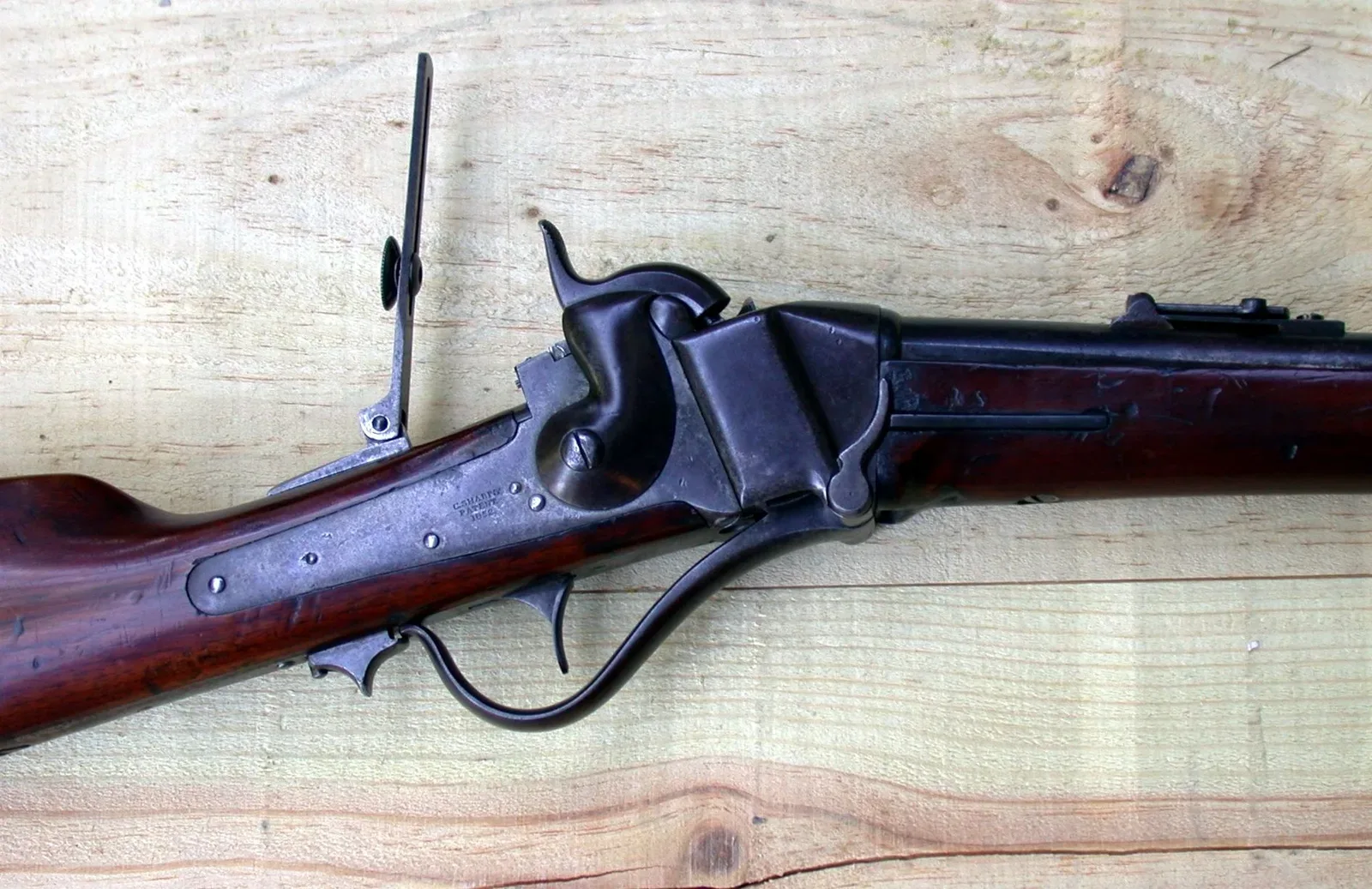
The abolitionists didn't just send settlers. They sent rifles. The New England Emigrant Aid Company, organized by Massachusetts businessman Eli Thayer, helped fund and equip free-state settlers. The Beecher's Bibles shipments — so named because Reverend Henry Ward Beecher famously declared that a Sharps rifle was worth more than a Bible for moral persuasion in Kansas — delivered crates of Sharps carbines to free-state communities, often concealed in boxes labeled as something else.
The Sharps, chambered in .52 caliber with a paper or linen cartridge, was among the most capable military arms of the 1850s. Arming Kansas settlers with it was a deliberate strategic decision.
| Date | Event | Location | Significance |
|---|---|---|---|
| May 30, 1854 | Kansas-Nebraska Act signed | Washington D.C. | Opens territory to popular sovereignty |
| 1855 | Beecher's Bibles shipments | Multiple locations | Sharps rifles sent to free-state settlers |
| May 21, 1856 | Sacking of Lawrence | Lawrence, KS | Pro-slavery forces attack free-state town |
| May 24-25, 1856 | Pottawatomie Massacre | Pottawatomie Creek | John Brown kills 5 pro-slavery settlers |
| August 30, 1856 | Battle of Osawatomie | Osawatomie, KS | Pro-slavery forces overwhelm Brown's militia |
| October 4, 1859 | Lecompton Constitution rejected | Kansas Territory | Pro-slavery constitution fails |
| July 29, 1859 | Wyandotte Constitution approved | Kansas Territory | Free-state constitution adopted |
| January 29, 1861 | Kansas statehood | Topeka, KS | Admitted as 34th state |
Escalating Violence: 1855-1856
The violence escalated through 1855 and 1856. On May 21, 1856, a pro-slavery posse sacked the free-state town of Lawrence, Kansas — burning the Free State Hotel, destroying printing presses, and looting homes. Three days later, on May 24-25, abolitionist John Brown retaliated with the Pottawatomie Massacre, where he and a small group killed five pro-slavery settlers along Pottawatomie Creek using broadswords and revolvers.
Brown's raid on Harpers Ferry, Virginia, in October 1859 was partly conceived and financed from his time in Kansas.
The Battle of Osawatomie on August 30, 1856 — in which pro-slavery forces overwhelmed Brown's outnumbered free-state militia — further cemented the territory's reputation for lethal political violence. By the time Kansas was admitted to the Union on January 29, 1861, an estimated 55 people had been killed in politically motivated violence, and the territory had developed a hardened, arms-present culture that would persist through the Civil War and into the cattle-drive era.
Path to Statehood
The Lecompton Constitution of 1857, drafted by pro-slavery forces and rejected by Kansas voters, and the subsequent Wyandotte Constitution of 1859, which Kansas voters approved as a free-state document, bookended the territorial era. The Wyandotte Constitution, which became the basis for Kansas statehood, contained no explicit right-to-arms provision — an early indicator that the new state's gun politics would remain complicated.
Civil War Era (1861–1865)edit
Kansas entered the Civil War as the newest free state, and it bled for it. The state contributed roughly 20,000 soldiers to the Union Army despite having a total population of only around 107,000 at the start of the war — a per-capita contribution rate among the highest of any Union state.
The 1st Kansas Colored Infantry, organized in August 1862, was among the first Black regiments to see combat in the Civil War — nearly two months before the Emancipation Proclamation.
- The regiment fought at the Battle of Island Mound in Bates County, Missouri, on October 29, 1862
- This engagement occurred nearly two months before the Emancipation Proclamation
- They were the first Black unit to engage Confederate forces in the war
- The unit was armed with Springfield rifle-muskets and Pattern 1853 Enfield rifles
William Quantrill's Confederate guerrilla force — which had operated in the Bleeding Kansas period — struck the most devastating blow on August 21, 1863, when approximately 450 raiders descended on Lawrence at dawn. The Lawrence Massacre resulted in the deaths of approximately 150–200 unarmed civilian men and boys. The raiders specifically targeted unarmed men, and the massacre directly led to Union General Thomas Ewing Jr.'s Order No. 11, which forcibly depopulated four Missouri border counties in retaliation.
The Lawrence Massacre hardened Kansas's hostility toward guerrilla violence and contributed to the state's postwar appetite for law, order, and — paradoxically — armed self-reliance.
Fort Leavenworth, established in 1827 on the west bank of the Missouri River, served as a critical Union supply and staging point throughout the war. The fort had been the primary supply depot for operations west of the Mississippi since before Kansas was a territory. During the Civil War it processed enormous volumes of firearms, ammunition, and ordnance for western theater operations. It remains the oldest active Army post west of the Mississippi River to this day.
19th Century: Cattle Towns, Lawmen, and the First Gun Ordinancesedit
After the Civil War, Kansas transformed almost overnight from a war-torn border state into the northern terminus of the great Texas cattle drives. The Chisholm Trail funneled Texas longhorns north to railheads at Abilene, Ellsworth, Wichita, Caldwell, and eventually Dodge City. With the cattle came Texas cowboys — young, armed, and frequently drunk after months on the trail. The cattle towns' response to this combination established some of the earliest municipal firearms regulations in the American West.
The cattle town cycle: economic necessity driving gun regulation and its eventual obsolescence
Abilene: The First Cattle Terminus
Abilene was the first major cattle terminus, developed by livestock entrepreneur Joseph McCoy beginning in 1867 when he recognized the newly completed Kansas Pacific Railroad (later Union Pacific) as the missing link between Texas cattle and Eastern markets. McCoy essentially built Abilene into a functional cow town, and by the early 1870s the combination of trail-end money and armed cowboys demanded organized law enforcement.
Wild Bill Hickok served as Abilene's town marshal from April to December 1871. Hickok enforced a gun carry prohibition within city limits — visitors were expected to check firearms at a hotel or marshal's office. He carried a pair of ivory-handled Colt Navy revolvers himself, converted to accept metallic cartridges, worn butt-forward in a sash rather than in holsters.
Hickok's tenure ended in December 1871 after he accidentally killed his own deputy, Mike Williams, during a gunfight with gambler Phil Coe. The Abilene city council subsequently declined to renew his contract and disbanded the marshal's office entirely as the cattle trade shifted south and west.
Wichita and the Earp Method
The trade moved first to Ellsworth, then to Wichita, and finally to Dodge City. Wichita's experience with the cattle trade from roughly 1872 to 1876 produced its own notable lawman: Wyatt Earp, who served as a Wichita police officer beginning in 1874. Earp enforced the city's weapons ordinance — Wichita's municipal code prohibited the carrying of firearms within city limits — and built a reputation for pistol-whipping noncompliant cowboys rather than shooting them.
This was deliberate. Dead cowboys meant trouble with Texas ranchers and disrupted the cattle trade that Wichita's merchants depended on.
Dodge City: The Ultimate Cow Town
Dodge City became the dominant cattle terminus after the Atchison, Topeka and Santa Fe Railway reached it in 1872. Dodge organized its municipal government in 1878, and historian Stephen Aron of UCLA has noted that the first ordinance the new city government passed was a prohibition on carrying firearms within city limits — a pragmatic decision by civic leaders and merchants who wanted Dodge to become a permanent, stable community rather than a transient boom town.
The sign over the Dead Line — the south side of the railroad tracks where the saloons and dance halls operated — read "Carrying of Fire Arms Strictly Prohibited."
| Town | Active Years | Railroad | Notable Lawmen | Gun Ordinance |
|---|---|---|---|---|
| Abilene | 1867-1872 | Kansas Pacific | Wild Bill Hickok (1871) | Carry prohibition in city limits |
| Ellsworth | 1871-1875 | Kansas Pacific | Various marshals | Municipal weapons ban |
| Wichita | 1872-1876 | Atchison, Topeka & Santa Fe | Wyatt Earp (1874-1876) | No firearms in city limits |
| Dodge City | 1872-1885 | Atchison, Topeka & Santa Fe | Wyatt Earp, Bat Masterson | "Carrying Fire Arms Strictly Prohibited" |
| Caldwell | 1880-1885 | Atchison, Topeka & Santa Fe | Various marshals | Standard carry restrictions |
Earp returned to prominence in Dodge as an assistant marshal from 1876 to 1879, working alongside Bat Masterson, who served as Ford County Sheriff from 1877 to 1879. Masterson's preferred weapon was a Colt Single Action Army revolver, and he reportedly ordered custom revolvers from Colt with shortened barrels — though many of the specific "Masterson specials" claimed by collectors are probably apocryphal. What is documented is that Masterson was a skilled lawman who used the threat of force more often than the application of it.
Violence Statistics vs. Hollywood Myth
Historian Robert Dykstra, in his study of Kansas cattle towns, recorded a combined 45 homicides across Wichita, Abilene, Caldwell, Ellsworth, and Dodge City between 1870 and 1885. That averages to roughly 0.6 murders per town per year — low numbers that cut against the Hollywood narrative of constant gunfights. The worst years were Ellsworth in 1873 and Dodge City in 1876, each with five killings.
| Town | Years Studied | Total Homicides | Average per Year | Peak Year (Deaths) |
|---|---|---|---|---|
| Dodge City | 1870-1885 | 16 | 1.0 | 1876 (5) |
| Wichita | 1870-1885 | 12 | 0.8 | 1874 (3) |
| Abilene | 1870-1885 | 8 | 0.5 | 1871 (2) |
| Ellsworth | 1870-1885 | 6 | 0.4 | 1873 (5) |
| Caldwell | 1870-1885 | 3 | 0.2 | 1881 (2) |
| Combined | 1870-1885 | 45 | 0.6 | Various |
Data from Robert Dykstra's "The Cattle Towns" study
These were violent places by modern standards, but they were not the free-fire zones of legend. The towns that enforced carry ordinances consistently tended to have fewer killings than mining and railroad boom towns that lacked effective law enforcement entirely.
End of the Cattle Era
The cattle drive era effectively ended with the arrival of barbed wire and the homestead farmer. By 1885, Kansas had passed the Herd Law, making it illegal to drive cattle through settled farming areas without the landowner's permission. The days of armed Texas cowboys riding into Dodge or Abilene were over, and with them went the specific social conditions that had produced both the gun carry ordinances and the famous lawmen who enforced them.
Native American Contextedit
The firearms history of Kansas cannot be told honestly without addressing the Plains Indian Wars that played out across the state's western half during the 1860s and 1870s. The Cheyenne, Arapaho, Kiowa, and Comanche nations had inhabited the Kansas plains for generations, and the post-Civil War surge of railroad construction and settlement directly threatened their territory and food supply.
The Kansas Pacific Railroad pushed west across the state through the late 1860s, bisecting the central bison range. The U.S. Army established a chain of forts to protect railroad workers and settlers: Fort Riley (1853), Fort Harker (1864), Fort Hays (1865), and Fort Dodge (1865). These posts distributed enormous quantities of firearms — primarily Springfield Model 1866 "trapdoor" rifles and later the improved Model 1873 — to cavalry and infantry units tasked with controlling the plains.
The Battle of Beecher Island in September 1868 — technically in eastern Colorado but involving Kansas-based troops — pitted a company of Army scouts armed with Spencer repeating carbines against a large Cheyenne and Sioux force. The scouts' repeating arms were a significant tactical advantage. Lieutenant Frederick Beecher was killed in the engagement, giving the battle its name.
General Philip Sheridan used Fort Hays as his operational base for the 1868-69 winter campaign against the Southern Cheyenne. The campaign's most controversial action, Lieutenant Colonel George Armstrong Custer's attack on Black Kettle's Cheyenne village on the Washita River in November 1868, was planned and supplied from Kansas. The wholesale slaughter of the Southern buffalo herds by commercial hunters operating out of Dodge City in the early 1870s — facilitated by Sharps rifles chambered in powerful cartridges like the .50-90 and .45-110 — completed the destruction of the Plains Indian way of life more thoroughly than military force alone ever could have.
20th Century: Wars, Industry & Military Installationsedit
Military Education and Fort Leavenworth
Kansas entered the 20th century as an agricultural state without significant firearms manufacturing, but its military installations kept it central to American weapons history. Fort Leavenworth remained the home of the U.S. Army Command and General Staff College, making it arguably the most important military education institution in the country. The United States Disciplinary Barracks at Leavenworth, established in 1874, added a prison component to the installation that persists today.
Fort Riley, near Junction City, became a major cavalry post and eventually the permanent home of the 1st Infantry Division — the "Big Red One." The fort processed thousands of soldiers through World War I and World War II, issuing Springfield Model 1903 rifles in the first war and M1 Garand rifles in the second. Fort Riley's role in horse cavalry training through World War I gave Kansas soldiers particular familiarity with the Colt Model 1911 pistol, which was issued to mounted troops.
The McConnell Air Force Base near Wichita, established as a B-29 training base during World War II and named for two brothers — Thomas and Edwin McConnell — both killed in the war, became a permanent installation that persists today as home to KC-135 Stratotanker refueling aircraft. Wichita's broader role as an aviation manufacturing center — Boeing, Cessna, Beechcraft, and Learjet all had major Wichita operations — gave the state an industrial identity adjacent to, though separate from, firearms production.
| Installation | Established | Primary Role | WWII Contribution |
|---|---|---|---|
| Fort Leavenworth | 1827 | Command & Staff College | Officer training, logistics |
| Fort Riley | 1853 | 1st Infantry Division home | M1 Garand rifle training |
| McConnell AFB | 1942 | B-29 training base | Bomber crew training |
| Kansas Ordnance Plant | 1942 | Ammunition production | 10,000+ workers, artillery shells |
World War II Production
Kansas had no significant commercial firearms manufacturers during the 20th century, but the Kansas Ordnance Plant at Parsons, constructed in 1942, produced enormous quantities of artillery shells and small arms ammunition throughout World War II. At peak production the plant employed over 10,000 workers and manufactured 60mm, 81mm, and 4.2-inch mortar shells, along with significant quantities of 105mm howitzer rounds.
The Parsons plant was one of the largest ordnance facilities in the Midwest and operated intermittently through the Korean War.
Federal Legislative Alignment
Federally, Kansas lawmakers generally opposed major gun control legislation through the 20th century. The state delegation voted against key provisions of the Gun Control Act of 1968, and Kansas's congressional representatives consistently aligned with the National Rifle Association's legislative positions through the 1970s, 1980s, and 1990s.
At the state level, Kansas law in the mid-20th century was relatively permissive. Open carry had never been prohibited statewide. Concealed carry, however, was illegal under Kansas law through the late 20th century — a remnant of the 19th-century cattle town ordinance tradition that had calcified into permanent state law.
Modern Era (2000–Present)edit
The 2006 Concealed Carry Law
The modern era of Kansas firearms law began in 2006 when Governor Kathleen Sebelius — a Democrat — signed HB 2528, creating Kansas's first Concealed Carry Handgun License (CCHL) program. Kansas became the 47th state to enact some form of concealed carry licensing. The law established a shall-issue framework: applicants who met objective criteria (age, background check, training) were entitled to a license without discretionary denial by law enforcement.
Constitutional Carry Revolution
The bigger shift came in 2015. Governor Sam Brownback signed SB 45 on April 2, 2015, making Kansas the sixth state in the nation to enact constitutional carry — permitless concealed carry for any Kansas resident 21 or older who could legally possess a firearm. The law took effect July 1, 2015. Brownback framed it explicitly in Second Amendment terms, and the bill passed with strong Republican majorities in both chambers of the Kansas legislature.
Kansas simultaneously retained its CCHL program for residents who wanted a permit for reciprocity purposes when traveling to other states. The dual system — constitutional carry at home, optional permit for travel — has become the standard model for permitless carry states.
Evolution of Kansas firearms law in the constitutional carry era
In 2021, the Kansas legislature lowered the constitutional carry age to 18, aligning it with the federal minimum age for long gun purchases under the Gun Control Act. The bill passed with bipartisan support, though most Democrats opposed it.
Post-Bruen Legal Environment
Kansas has no assault weapons ban, no magazine capacity limits, no red flag law, and no universal background check requirement beyond the federal NICS system. The state has a preemption law preventing local governments from enacting firearms regulations more restrictive than state law — a direct legacy of the cattle town era, when municipal gun ordinances were the norm. The Kansas preemption statute effectively makes the state's permissive firearms laws apply uniformly from Johnson County to Finney County.
The Heller (2008) and McDonald (2010) Supreme Court decisions reinforced what Kansas legislators had already been doing legislatively. The Bruen decision in 2022 further accelerated the legislative momentum — Kansas used the Bruen framework to defend its constitutional carry law in subsequent legal challenges, all of which the state successfully defeated.
Hunting Culture and Commerce
Kansas has one of the highest rates of hunting license issuance per capita in the United States, with the Kansas Department of Wildlife and Parks consistently reporting over 300,000 hunting licenses sold annually in a state with a population of roughly 2.9 million. Deer, pheasant, and turkey hunting drive significant firearms and ammunition commerce, particularly in western and central Kansas.
The Kansas State Rifle Association (KSRA) and the Kansas Firearms Coalition have been the primary advocacy organizations pushing the state's progressive firearms liberalization since the mid-2000s. Both organizations opposed any expansion of background check requirements and actively supported the 2015 and 2021 constitutional carry expansions.
Notable Figures & Manufacturersedit
The Legendary Lawmen
Wyatt Earp (1848–1929) is the most famous figure in Kansas firearms history, though he was born in Illinois and spent only a fraction of his life in the state. His tenure as a Wichita police officer (1874–1876) and Dodge City assistant marshal (1876–1879) established his reputation. Earp preferred the Colt Single Action Army in .45 Colt, and the specific revolver he carried during his Dodge City years — with a 7.5-inch barrel — is documented in period records. His approach to law enforcement was notable for favoring the pistol-whip over the gunshot, which kept the peace without generating the corpses that would invite outside scrutiny.
Bat Masterson (1853–1921) served as Ford County Sheriff and later as a Dodge City marshal. Masterson was a legitimately skilled gunfighter — he reportedly killed at least one man in a fair fight before becoming a lawman — but he was more important as an organizer and political operator than as a shooter. After leaving Kansas he became a sports journalist in New York City and a confidant of President Theodore Roosevelt.
John Brown: Controversial Figure
John Brown (1800–1859) is a more contested figure. His Kansas operations from 1855 to 1859 — including the Pottawatomie Massacre — make him central to the territorial era's firearms history whether you view him as a hero or a terrorist. Brown was a capable tactician who understood that the Sharps rifle gave free-state settlers a meaningful tactical advantage over pro-slavery opponents armed primarily with older percussion revolvers and shotguns.
Wild Bill Hickok (1837–1876) served in Abilene and remains one of the most mythologized gunfighters in American history. The documented record of his actual gunfights is considerably thinner than legend suggests — most researchers credit him with seven to ten shooting deaths over his entire career — but his Abilene tenure established important precedents for armed law enforcement on the Kansas frontier.
General James H. Doolittle trained at Fort Riley and later connections to Kansas military infrastructure, though his fame is primarily associated with the Tokyo Raid of 1942.
Manufacturing and Industry
On the manufacturing side, Kansas has not produced significant commercial firearms brands. The state's industrial economy centered on aviation, agriculture, and petroleum rather than firearms production. The closest Kansas comes to a notable firearms-related manufacturer is the Brownells distribution network, which — while headquartered in Iowa — has served Kansas FFLs as a primary parts and accessories supplier for decades. Several small custom gunsmiths operate in the Wichita and Kansas City metro areas, but none have achieved national recognition.
Current Legal Landscapeedit
Core Carry Laws
Kansas in 2026 is among the most firearms-permissive states in the country.
| Law Type | Kansas Status | Details |
|---|---|---|
| Constitutional Carry | Legal (2015) | Ages 18+, no permit required |
| Concealed Carry Permit | Optional | Available for reciprocity |
| Open Carry | Legal | Never prohibited statewide |
| Preemption | Complete | No local gun ordinances allowed |
| Castle Doctrine | Yes | No duty to retreat |
| Stand Your Ground | Yes | Anywhere legally present |
| NFA Items | Fully legal | Federal compliance required |
| Red Flag Laws | None | No legislative interest |
| Universal Background Checks | No | Federal NICS only |
| Waiting Periods | None | Immediate transfer after NICS |
Self-Defense and Use of Force
Castle Doctrine and Stand Your Ground are both codified in Kansas law. The Kansas Self Defense Act codifies a broad right to use deadly force in self-defense without a duty to retreat, in any place where a person has a legal right to be.
Prohibited Persons
Kansas follows federal law on prohibited persons — convicted felons, those adjudicated mentally ill, domestic violence misdemeanants, and others defined by 18 U.S.C. § 922(g) cannot legally possess firearms.
Federal Compliance and NFA Items
NFA items (suppressors, short-barreled rifles, short-barreled shotguns, and machine guns manufactured before May 19, 1986) are all legal to own with proper federal registration and tax payment. Kansas has no state-level NFA restrictions.
Kansas passed the Second Amendment Protection Act in 2013, which purported to exempt Kansas-made firearms from federal regulation. The act was legally unenforceable under the Supremacy Clause — federal courts have consistently held that Congress's commerce clause authority extends to all firearms regardless of state manufacture claims — but it was a significant political statement.
Background Checks and Transactions
- Kansas requires federal NICS check for licensed dealer sales
- No requirement for background checks on private party transfers
- No waiting periods of any kind
- No handgun permits required for purchase
- No mandatory storage requirements for firearms
Administration and Enforcement
The Kansas Bureau of Investigation (KBI) administers the CCHL program and processes background checks for licensed dealers. The KBI has not publicly reported significant issues with the constitutional carry framework since its 2015 implementation.
The BGC Takeedit
Kansas is about as gun-friendly as a state gets in 2026, and the culture matches the law. This isn't a state where gun ownership is a political statement — it's just Tuesday.
Farmers carry in their trucks. Hunters are out before dawn during season. The rancher in Meade County and the small businessman in Salina both own multiple firearms, and neither of them thinks much about it.
The cattle town legacy is interesting precisely because it cuts against the simple narrative that gun culture and gun regulation are opposites. Dodge City in 1878 checked your guns at the city limits not because its residents were anti-gun — everybody owned guns, as Adam Winkler has noted — but because the specific conditions of a cattle terminus town demanded order.
Those conditions are gone. The preemption law that prevents modern Kansas cities from enacting their own ordinances reflects a conscious legislative choice to not let the past repeat itself.
The political landscape is firmly Republican and firmly pro-gun at the state level. The 2015 constitutional carry bill and the 2021 age reduction passed with comfortable margins. Democrats in the Kansas legislature who represent urban districts — primarily Johnson County suburban seats and Wichita — occasionally push back on the most expansive measures, but they don't have the votes to stop much. The Johnson County suburbs have been trending modestly purple, which is worth watching, but it hasn't yet translated into gun law changes.
If you're moving to Kansas as a gun owner, the legal framework is about as clean as it gets. Buy your gun, carry your gun, hunt your land. The CCHL is worth getting for reciprocity if you travel, but you don't need it at home. The preemption law means you don't have to research city-by-city ordinances — what's legal in Dodge City is legal in Overland Park.
Constitutional carry is only as good as your actual training. Kansas doesn't require any training to carry a concealed firearm, which means the legal burden shifts entirely to you to know when you can legally use deadly force and how to handle a firearm safely.
Get trained regardless of what the law requires. The cattle town lawmen who built Kansas's firearms reputation were skilled, not just armed.
Referencesedit
- Aron, Stephen. American Confluence: The Missouri Frontier from Borderland to Border State. Indiana University Press, 2006.
- Dykstra, Robert R. The Cattle Towns: A Social History of the Kansas Cattle Trading Centers. Knopf, 1968.
- Kansas Historical Society. "Bleeding Kansas." Kansapedia. kshs.org.
- Kansas Legislature. SB 45 (2015). Constitutional carry legislation.
- Kansas Legislature. HB 2528 (2006). Concealed carry licensing act.
- Kansas Legislature. Second Amendment Protection Act (2013). KSA 50-1201 et seq.
- Winkler, Adam. Gunfight: The Battle Over the Right to Bear Arms in America. W.W. Norton, 2011.
- Smithsonian Magazine. "Gun Control Is as Old as the Old West." smithsonianmag.com, 2018.
- United States Army. Fort Leavenworth official history. army.mil.
- United States Army. Fort Riley official history. riley.army.mil.
- Kansas Department of Wildlife and Parks. Annual hunting license statistics. ksoutdoors.com.
- Kansas Bureau of Investigation. Concealed carry statistics. kbi.ks.gov.
- DeArment, Robert K. Bat Masterson: The Man and the Legend. University of Oklahoma Press, 1979.
- Rosa, Joseph G. Wild Bill Hickok: The Man and His Myth. University Press of Kansas, 1996.
- Nichols, Roger L. Black Hawk and the Warrior's Path (contextual Plains Indian history). Harlan Davidson, 1992.
Last Updated: February 24, 2026
- Quail Creek Plantation(Okeechobee, FL)
- 2aHawaii(Honolulu, HI)
- Boston Firearms(Everett, MA)
- Safeshoot(Kingston, NY)
Loading comments...