State Details
Michigan

Overview | |
|---|---|
State | Michigan (MI) |
Capital | Lansing |
Statehood | 1837 |
Population | 10,037,261 |
Gun Ownership | 40.2% |
Active FFLs | 1,647 |
Carry Laws | |
Constitutional Carry | No |
Open Carry | Yes |
CCW Permit Available | Yes |
Permit Reciprocity | 25+ states |
Self-Defense | |
Castle Doctrine | Yes |
Stand Your Ground | Yes |
Duty to Retreat | No |
Regulations | |
State Preemption | Yes |
Red Flag / ERPO | Yes |
Waiting Period | None |
Universal BGC | Yes |
NFA Items | Yes |
Assault Weapons Ban | No |
Magazine Limit | None |
Key Legislation | |
| |
Notable Manufacturers | |
| |
Michigan Firearms History: From Fort Pontchartrain to Constitutional Carry
Reference article
From The Boise Gun Club Handbook
Updated August 15, 2026. The law moved twice since this article was written. The $200 making and transfer tax on suppressors, SBRs, SBSs and AOWs was eliminated effective January 1, 2026 by the One Big Beautiful Bill Act. Then on August 5, 2026 a federal court in Silencer Shop Foundation v. ATF struck down the NFA registration and approval requirements for those same items, and that injunction took effect August 13. It covers only the plaintiffs, their members and their customers. Living in a plaintiff state does not make you covered. Machine guns and destructive devices are unchanged. Read the current guide: NFA Items in 2026: What Actually Changed.
Overviewedit
Michigan's relationship with firearms doesn't start with statehood. It starts with a cannon pointed across a half-mile of river. When Antoine de La Mothe Cadillac established Fort Pontchartrain du Détroit on July 24, 1701, his site selection was explicitly military -- he chose the spot because his guns could command the strait. Everything after that, for the next three centuries, flows from that same logic:
Whoever controls the water controls the territory, and controlling territory in Michigan has always meant being armed.
The state's firearms history runs through four distinct phases that don't map neatly onto the national story. There's the French and British colonial period where flintlocks determined which empire held the Great Lakes. There's the frontier and early statehood era where the Detroit Arsenal supplied the entire upper Midwest. There's the industrial 20th century where Michigan's manufacturing capacity fed two world wars. And there's the contemporary era where a politically divided state has been fighting over gun laws in Lansing with increasing intensity.
Four distinct phases of Michigan's firearms history, each driven by different political and economic forces
Michigan today is a study in contradictions. It has one of the strongest hunting cultures in the country -- the annual deer season opener functions as an unofficial state holiday across the northern Lower Peninsula and the Upper Peninsula. It also has Detroit, which drove some of the most aggressive gun control legislation in Midwest history. Those two Michigans have been in argument since at least 1927, and the argument isn't close to over.
French & British Colonial Era (1701–1796)edit
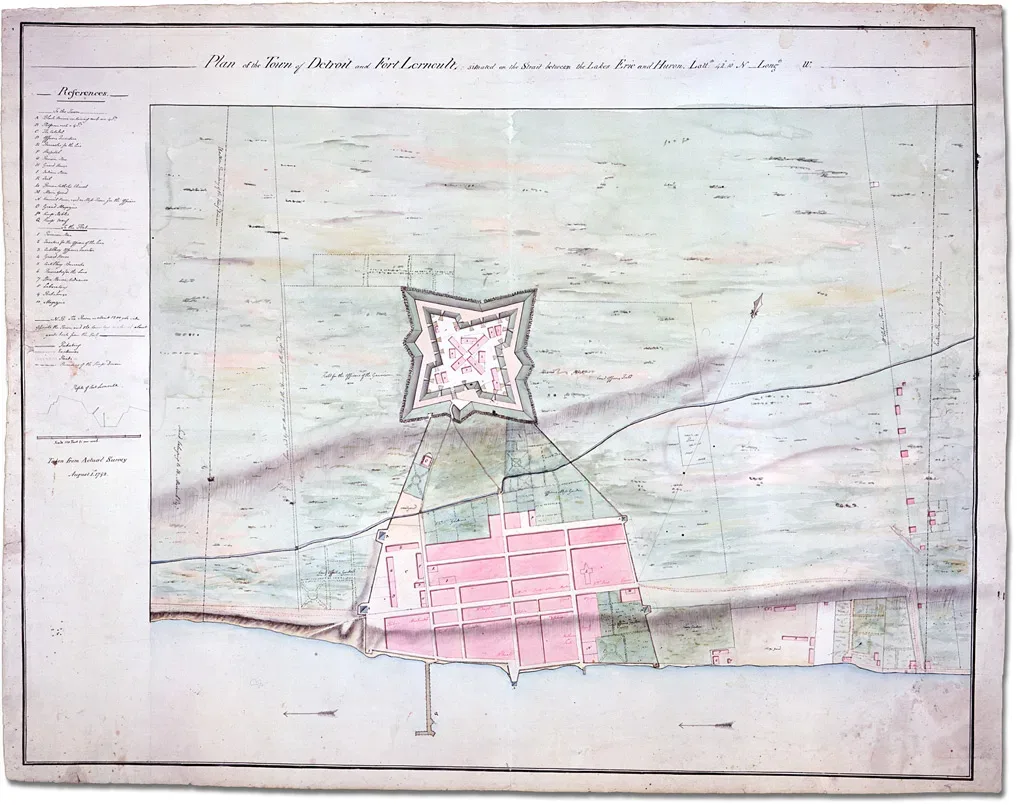
Fort Pontchartrain's Strategic Position
Cadillac's fort wasn't just a trading post with a flag. It was purpose-built as a firearms position. He placed his cannon where they could cover the river crossing, and he staffed the post with soldiers whose job was to keep British traders -- and their Indian allies -- out of Lake Huron. The Seven Years' War (1754–1763) would eventually settle the question of which European power held Michigan, but for the first six decades of Detroit's existence, the guns at Fort Pontchartrain were what kept French sovereignty alive in the region.
| Date | Event | Significance |
|---|---|---|
| July 24, 1701 | Fort Pontchartrain established | First permanent European settlement in Michigan |
| 1754-1763 | Seven Years' War | Determined British control of Great Lakes |
| May-Oct 1763 | Pontiac's Rebellion | Indigenous coalition besieges Detroit for 5 months |
| 1796 | Jay's Treaty takes effect | Britain finally transfers Michigan to United States |
Fur Trade & Firearms Exchange
The fur trade made firearms the dominant commodity in Michigan for well over a century. Flintlock muskets, powder, and shot were the primary trade goods exchanged with the Ojibwe, Ottawa (Odawa), Potawatomi, and other nations of the Great Lakes. The Anishinaabe peoples of Michigan had been acquiring European firearms since at least the mid-1600s through trade networks extending from New France, and by the time Detroit was founded, indigenous hunters and warriors throughout the region were already integrating flintlock firearms into both subsistence and warfare.
This wasn't a situation where Europeans arrived with technological superiority over an unarmed population -- it was a multi-sided arms environment where French, British, and various tribal interests all calculated based on who had powder and who didn't.
Pontiac's Rebellion
Pontiac's Rebellion (1763) demonstrated exactly how thoroughly firearms had reshaped the region's power dynamics. After Britain defeated France and took control of Michigan's forts, Odawa war leader Pontiac coordinated a multi-tribal campaign to seize British posts throughout the Great Lakes. Detroit itself was besieged from May through October 1763. The British garrison held Fort Detroit partly through superior fortification and partly through resupply by armed vessels on the river -- the same water control logic Cadillac had identified sixty years earlier. The siege ended without a British defeat, but Pontiac's campaign demonstrated that indigenous forces armed with European firearms could challenge European military control of the region for months at a time.
Britain held Michigan until Jay's Treaty took effect in 1796, more than a decade after the American Revolution technically transferred sovereignty. British troops remained at Detroit and Fort Mackinac throughout that period, and the firearms culture they maintained -- oriented toward the fur trade and military garrison life -- persisted long after the American flag went up.
Territorial & Early Statehood Era (1796–1860)edit
War of 1812 Occupation
American control of Michigan came late and was immediately tested. The War of 1812 hit Michigan harder than almost any other state. General William Hull surrendered Detroit to British General Isaac Brock on August 16, 1812, without a significant fight -- a capitulation so embarrassing that Hull was later court-martialed and sentenced to death (pardoned by President Madison due to his Revolutionary War service). The British held Detroit for over a year, and Fort Mackinac fell to a British force in July 1812 before the Americans even knew war had been declared.
Tecumseh, the Shawnee leader who allied with the British, was killed at the Battle of the Thames in October 1813 in present-day Ontario -- an engagement where Kentucky mounted riflemen under Colonel Richard Mentor Johnson played the decisive role. The death of Tecumseh effectively ended organized armed resistance to American expansion in the Great Lakes region, and Michigan's subsequent territorial growth was rapid.
Detroit Arsenal Establishment
The federal government recognized Michigan's strategic position and acted on it. The Detroit Arsenal, established at Dearborn in 1833 (the year before Michigan achieved territorial status as a fully organized territory, and four years before statehood), became the U.S. Army's primary ordnance depot for the entire Great Lakes and upper Midwest. The Arsenal manufactured and stored artillery, small arms, and ammunition for the region's military needs for decades. Its location in Dearborn -- close to the river, accessible by road from Detroit -- was chosen for the same reasons Cadillac chose his cannon position: water access and defensibility. The Arsenal remained active through the Civil War era and shaped the local economy significantly. The land it occupied would later become part of Dearborn's identity, with Arsenal Street still marking its former boundaries.
| Facility | Location | Established | Purpose |
|---|---|---|---|
| Detroit Arsenal | Dearborn | 1833 | Primary ordnance depot for Great Lakes region |
| Fort Mackinac | Mackinac Island | British era | Strategic control of Straits of Mackinac |
| Fort Detroit | Detroit | 1701 (French) | River crossing control point |
Michigan achieved statehood on January 26, 1837. The state's constitution, like most of the era, included a right to bear arms provision. The new state was simultaneously dealing with a frontier firearms culture in its vast rural territory and an increasingly commercial, proto-urban culture in Detroit and the river towns. These weren't yet in political conflict -- virtually everyone in 1837 Michigan had a gun and needed one -- but the divergence was already present in the demographics.
Upper Peninsula Addition
The Upper Peninsula, added to Michigan as compensation for losing the Toledo Strip to Ohio in 1836, brought an even more remote and firearms-dependent population into the state. UP residents hunted, trapped, and in the copper and iron mining districts that opened in the 1840s, lived in isolated communities where a gun was practical necessity, not political statement.
19th Century: Civil War & Industrial Expansionedit
Michigan's Civil War Contribution
Michigan entered the Civil War with genuine enthusiasm for the Union cause and demonstrated it in blood. The state raised more than 90,000 men for Union service -- significant for a state that had fewer than 750,000 residents at the 1860 census. Michigan's 24th Infantry became one of the most storied units in the Army of the Potomac, suffering catastrophic casualties at Gettysburg on July 1, 1863, while holding McPherson's Ridge against vastly superior Confederate numbers. The 24th Michigan was part of the Iron Brigade, which took the highest proportional casualties of any Union brigade in the war.
| Michigan Civil War Contribution | Numbers |
|---|---|
| Total men raised | 90,000+ |
| State population (1860) | <750,000 |
| Participation rate | >12% |
| 24th Michigan casualties at Gettysburg | Catastrophic (Iron Brigade) |
George Armstrong Custer
George Armstrong Custer -- a Monroe, Michigan native -- commanded Michigan Cavalry with a recklessness that produced both victories and enormous casualties. The Michigan Cavalry Brigade (1st, 5th, 6th, and 7th Michigan Cavalry) fought at Gettysburg, where they blunted J.E.B. Stuart's flanking attack on July 3, 1863. Custer's aggressive tactics were shaped partly by the frontier firearms culture of his Michigan upbringing, though his post-war career on the Plains would end at the Little Bighorn in 1876.
Industrial Foundation Building
The post-Civil War industrial expansion transformed southern Michigan, particularly Detroit, into a manufacturing center whose products would eventually reshape American firearms culture. The precision metalworking and tooling industries that grew up around Detroit in the 1870s and 1880s laid the technical foundation for the automotive industry -- and the same machining capabilities that would build engines would later build weapons components. This connection between Detroit-area manufacturing and defense production would prove decisive in both World Wars.
By the 1880s and 1890s, Michigan's firearms culture was bifurcating along lines that still define it today. The northern half of the Lower Peninsula and the entire Upper Peninsula remained deeply oriented toward hunting -- whitetail deer, black bear, waterfowl, and the small game that fed rural families through hard winters. The southern tier, anchored by Detroit, Flint, Lansing, and Grand Rapids, was urbanizing rapidly and developing a different relationship with firearms -- more oriented toward self-defense, less toward subsistence.
20th Century: Wars, Industry & Regulationedit
Michigan's role in both World Wars went far beyond sending soldiers. The state's manufacturing infrastructure made it a critical weapons production node.
World War I Production
During World War I, Michigan plants converted to war production with a speed that established the template for what would happen on a much larger scale twenty years later. Packard Motor Car Company in Detroit built Liberty aircraft engines -- a development that required the same close-tolerance machining used in firearms production. Dodge and other Detroit-area manufacturers produced military vehicles, and the region's tool-and-die shops cranked out components for everything from artillery shells to small arms.
Arsenal of Democracy
World War II transformed Michigan into what President Franklin Roosevelt called the "Arsenal of Democracy" -- a phrase he used in a December 1940 fireside chat, specifically referencing the Detroit area's production capacity.
Michigan became what President Franklin Roosevelt called the "Arsenal of Democracy" -- going from groundbreaking to first tank production in under six months.
The specifics are worth knowing. Chrysler built the Detroit Tank Arsenal in Warren, Michigan in 1941 in 180 days -- going from groundbreaking to first tank off the line in under six months. That facility produced M3 and M4 Sherman tanks throughout the war. Ford's Willow Run plant near Ypsilanti manufactured B-24 Liberator bombers at a rate that eventually hit one per hour. General Motors plants across the state produced everything from aircraft engines to M1 carbine components.
| WWII Michigan Production | Facility | Product | Notable Achievement |
|---|---|---|---|
| Detroit Tank Arsenal | Warren | M3/M4 Sherman tanks | Built in 180 days (1941) |
| Willow Run | Ypsilanti | B-24 Liberator bombers | Peak: 1 aircraft per hour |
| Chrysler plants | Various | Tank components | Multiple facilities converted |
| GM facilities | Statewide | Aircraft engines, M1 carbines | Massive production capacity |
Savage Arms had a significant Michigan connection during this period. While Savage's primary manufacturing was in Utica, New York, the company's wartime contracts for Thompson submachine guns and M1919 Browning machine guns drew on Midwest manufacturing networks including Michigan suppliers. Universal Firearms Corporation, based in Hialeah, Florida but with deep Michigan manufacturing ties, produced M1 carbine copies that became popular civilian rifles in the postwar market.
Early Gun Control (1927)
The firearms regulation story in Michigan begins seriously in 1927, when the state enacted one of the earliest handgun registration laws in the country. Michigan's 1927 Pistol Registration Act required purchasers of handguns to obtain a permit from local law enforcement before taking possession -- a system of purchase permits that remained the basic structure of Michigan handgun law for nearly a century. The 1927 law was driven by concerns about organized crime and urban violence in Detroit, which by the mid-1920s was a major hub of Prohibition-era bootlegging (its location on the river from Canada made it the primary entry point for Canadian whiskey). The connection between Prohibition, organized crime, and firearms violence in Detroit directly shaped Michigan's early gun regulation approach.
| Key Michigan Gun Laws | Year | Provision | Driver |
|---|---|---|---|
| Pistol Registration Act | 1927 | Purchase permits required | Detroit organized crime/Prohibition |
| Felony Firearm Law | 1976 | Mandatory minimums (2-5-10 years) | Detroit violent crime rates |
| "One with a gun gets you two" | 1976 | Publicity campaign | Wayne County prosecutor initiative |
1967 Detroit Riot Impact
The 1967 Detroit riot -- or rebellion, depending on your frame -- was one of the deadliest urban uprisings in American history. Forty-three people died over five days in late July 1967. The role of firearms in the event was significant: National Guard and police used rifles and shotguns during suppression, and some rioters were armed. The riot accelerated white flight from Detroit and hardened both pro- and anti-gun political positions in ways that still shape Michigan politics. Gun stores in suburban Detroit reported massive sales spikes in the weeks following the riot.
Felony Firearm Law
The 1976 felony firearm law was a direct response to Detroit's violent crime rates, which had climbed steadily through the early 1970s. Wayne County Prosecutor William Calahan championed the law, and the accompanying publicity campaign -- "One with a gun gets you two" -- was plastered on billboards throughout metropolitan Detroit. The law imposed a mandatory minimum two-year prison sentence for possessing a firearm while committing or attempting to commit any felony, with that sentence required to run consecutively (not concurrently) with the underlying felony sentence. Subsequent convictions triggered five-year and ten-year mandatory minimums. The law changed little over the following four decades, with only minor amendments -- one of which added pneumatic guns to its scope.
Whether the felony firearm law actually reduced crime is genuinely contested. Analysis of Detroit crime data from the late 1970s and 1980s does not show a clean correlation between the law's enactment and declining gun violence. What's documented is its enormous impact on Wayne County's prison population, and criminal justice reform advocates have argued for decades that its mandatory minimum structure produces disproportionate outcomes without corresponding public safety benefits.
Modern Era (2000–Present)edit
The 21st century in Michigan firearms law has been characterized by aggressive movement in both directions -- expansion of carry rights followed by sharp legislative reversals as the state's political control shifted.
Shall-Issue CPL Reform (2001)
Michigan enacted a substantially revised Concealed Pistol License (CPL) system in 2001, moving from a may-issue to a shall-issue framework. Under the new law, county-level Concealed Weapon Licensing Boards were replaced with a sheriff-administered system, and applicants who met objective criteria (age, training, background check) were entitled to a license. This was a significant liberalization -- the previous system had given local boards broad discretion to deny permits for essentially arbitrary reasons, and in practice CPL issuance had been inconsistent and often low in urban counties.
Pistol-Free Zones Debate
The 2001 CPL reform also established Michigan's pistol-free zones framework, designating specific locations where concealed carry was prohibited regardless of license status. Schools, churches, sports arenas, hospitals, and bars were among the designated zones -- a list that would become a recurring subject of legislative debate over the following two decades.
In 2012, Michigan's Republican-controlled legislature passed a bill that would have eliminated many pistol-free zones and allowed CPL holders to carry in previously restricted locations with additional training. Governor Rick Snyder vetoed it in December 2012, days after the Sandy Hook shooting in Connecticut. Snyder's veto was explicitly framed around the timing rather than a principled objection to the policy, which complicated his relationship with Michigan's gun rights community for years afterward.
| Michigan Carry Law Evolution | Year | Change | Impact |
|---|---|---|---|
| May-issue to shall-issue | 2001 | Objective CPL criteria | Consistent statewide issuance |
| Pistol-free zones established | 2001 | Specific prohibited locations | Schools, churches, bars, etc. |
| Zone elimination bill vetoed | 2012 | Would have expanded carry rights | Gov. Snyder veto post-Sandy Hook |
| Constitutional carry vetoed | 2022 | Would have eliminated CPL requirement | Gov. Whitmer veto |
Oxford & MSU Shootings
The Oxford High School shooting fundamentally changed the political temperature around firearms in Michigan. On November 30, 2021, a 15-year-old student killed four classmates and wounded seven others at Oxford High School in Oakland County. The shooter used a Sig Sauer SP2022 9mm pistol that his father had purchased four days earlier. The shooting triggered criminal charges against both the shooter's parents -- James and Jennifer Crumbley -- for involuntary manslaughter, making it one of the first cases in the country to hold parents criminally liable for a child's school shooting. Both were convicted in 2024.
The Oxford shooting, combined with Michigan State University's campus shooting on February 13, 2023 (three students killed, five wounded), created political conditions for a major legislative push. Democrats won trifecta control of Michigan state government in the 2022 elections for the first time since 1983 -- flipping the state Senate while retaining the governorship under Governor Gretchen Whitmer.
How tragic events and political change combined to drive Michigan's 2023 gun law expansion
2023 Democratic Legislation
In 2023, the new Democratic majority moved quickly. Michigan enacted:
- Universal background checks for all firearm transfers, including private sales (signed April 13, 2023)
- Safe storage requirements mandating that firearms be stored locked when minors could access them (signed April 13, 2023)
- "Red flag" (Extreme Risk Protection Order) law, allowing courts to temporarily remove firearms from individuals deemed a danger to themselves or others (signed May 22, 2023)
These three bills represented the most significant expansion of Michigan gun regulation in decades and passed along nearly straight party-line votes. The safe storage law in particular was directly tied to the Oxford case -- the Crumbley prosecution had highlighted the absence of any state requirement for secure storage.
| 2023 Michigan Gun Laws | Signed | Provision | Legislative Vote |
|---|---|---|---|
| Universal background checks | April 13 | All transfers, including private | Near party-line |
| Safe storage requirements | April 13 | Locked storage when minors present | Near party-line |
| Red flag law (ERPO) | May 22 | Court-ordered temporary removal | Near party-line |
On the other side of the ledger, constitutional carry had a complicated Michigan story. Several bills to eliminate the CPL requirement for concealed carry were introduced during Republican legislative majorities in the 2010s and early 2020s but never reached the governor's desk. When Republicans briefly held momentum in late 2022 (the lame-duck session before the new Democratic majority took over), a constitutional carry bill passed the legislature but was vetoed by Governor Whitmer in December 2022. Michigan did not ultimately adopt permitless carry.
The 2023 legislative session also saw debate over whether Michigan's CPL training requirements should be enhanced -- a position the new majority favored but which gun rights advocates argued was designed to create barriers rather than improve safety. The training requirement debate remains unresolved as of early 2026.
Hunting Culture Constant
Michigan's deer hunting culture has remained a constant through all of this political turbulence. The state consistently issues between 600,000 and 700,000 deer hunting licenses annually -- making Michigan one of the top three deer hunting states in the country by license volume. The firearm deer season (typically opening the second Saturday in November) remains the largest annual mobilization of armed citizens in the state, dwarfing any militia or political event. In the northern Lower Peninsula and the UP, the opener is treated with the social weight of a holiday -- school attendance drops, businesses close early, and the roads north of Clare fill with trucks pulling blinds and dragging coolers.
This hunting culture creates a consistent political counterweight to urban-driven gun regulation. Rural legislators from both parties have historically been reluctant to support measures perceived as restricting hunting, even when those measures are specifically targeted at urban self-defense weapons. The argument that "this doesn't affect hunters" has limited traction in Lansing when the rural caucus knows exactly how fast regulations can expand.
Notable Figures & Manufacturersedit
George Armstrong Custer (Monroe, Michigan, 1839–1876) is Michigan's most famous military firearms figure -- controversial in legacy but undeniable in historical weight. His Michigan Cavalry Brigade's performance at Gettysburg in July 1863 was a genuine tactical achievement. His subsequent career and death at the Little Bighorn made him the most famous American military casualty of the Indian Wars.
Ransom Olds and the Olds Motor Vehicle Company (Lansing) demonstrated early that Michigan's manufacturing ecosystem could apply precision production to complex mechanical assemblies -- a capability that translated directly to firearms components manufacturing during both World Wars.
Henry Ford's Willow Run facility deserves mention specifically for firearms-adjacent production: the manufacturing methods developed to produce B-24 bombers at mass scale drew on and fed back into the precision machining trades that underpin firearms manufacturing. The Ford-engineered moving assembly line for aircraft production was a direct application of automotive manufacturing logic to defense production.
Detroit Ammunition Company and various smaller Michigan arms and ammunition manufacturers operated throughout the late 19th and early 20th centuries, though none achieved the national brand recognition of Massachusetts or Connecticut manufacturers.
Olympic Arms had Michigan distribution connections, and several Michigan-based custom gunsmiths built national reputations in the latter half of the 20th century, particularly in the benchrest and precision rifle communities.
In the contemporary era, Michigan's dealer and manufacturer community is concentrated in the suburban Detroit corridor and the Grand Rapids area. The state has a healthy custom AR-15 components and accessories manufacturing sector. Additional contemporary Michigan firearms infrastructure includes:
- Custom AR-15 components and accessories manufacturing
- Regional firearms retail chains
- Active FFL dealer community in urban and rural areas
The Michigan Coalition for Responsible Gun Owners (MCRGO) was founded in 1996 and became the primary state-level gun rights advocacy organization, distinct from and sometimes in tension with the NRA's Michigan operations. MCRGO was heavily involved in drafting and lobbying for the 2001 CPL reform legislation.
Current Legal Landscapeedit
As of early 2026, Michigan's firearms law framework sits in a position shaped by the 2023 legislative session. Here's where things actually stand:
Purchase & Background Checks
Purchase requirements: Michigan requires a Pistol Purchase Permit (PPP) or a valid CPL for all handgun purchases from both dealers and private sellers. Long gun purchases from licensed dealers require a federal NICS background check.
The 2023 universal background check law extended the background check requirement to private sales of all firearms, including long guns -- a significant change from prior law.
| Michigan CPL Requirements | Requirement | Details |
|---|---|---|
| Age | 21+ | No exceptions |
| Training | 8 hours minimum | Must include live fire |
| Background check | NICS | Federal standard |
| Residency | None required | Open to out-of-state |
| Shall-issue | Yes | Objective criteria |
Concealed Carry Rules
Concealed carry: Michigan is a shall-issue state for CPLs. Applicants must be 21 or older, complete an approved safety course (minimum eight hours including live fire), pass a NICS background check, and have no disqualifying criminal history. There is no residency requirement for CPL applications. Michigan does not have permitless carry.
Prohibited Zones
Pistol-free zones: Remain in effect for schools (K-12 and universities), child care centers, sports arenas and stadiums, bars and taverns, places of worship (unless the organization permits it), hospital facilities, dormitories, casinos, and courthouses. CPL holders who enter these zones are guilty of a state civil infraction (first offense) or misdemeanor (subsequent offenses).
| Michigan Pistol-Free Zones | Location Type | CPL Exception |
|---|---|---|
| K-12 schools | All public/private | None |
| Universities | All campuses | None |
| Places of worship | Unless permitted | Organization decides |
| Bars/taverns | Alcohol-serving | None |
| Sports arenas | Professional/major | None |
| Hospitals | Medical facilities | None |
| Courthouses | All judicial buildings | None |
Red Flag & Storage Laws
Red flag law: Michigan's Extreme Risk Protection Order (ERPO) law, enacted May 2023, allows courts to temporarily remove firearms from individuals deemed a significant danger. The following parties may petition for an ERPO:
- Family members and household members
- Mental health providers
- Law enforcement officers
The petitioner must show by a preponderance of the evidence that the subject poses a significant danger. The subject has the right to a full hearing within 21 days. As of late 2025, ERPO petitions have been filed at a moderate rate, concentrated in Wayne, Oakland, and Kent counties.
Safe storage: Michigan now requires firearms to be stored with a trigger lock, in a locked container, or rendered inoperable when a minor (under 18) could reasonably access them. Violation resulting in a minor obtaining a firearm and causing injury carries felony penalties.
Open Carry & Pre-emption
Open carry: Michigan has no statute prohibiting open carry for those legally entitled to possess a firearm, making it a de facto open carry state. However, open carry in pistol-free zones is still prohibited. The intersection of open carry rights and CPL pistol-free zone restrictions has created some genuinely odd legal situations that Michigan courts have addressed inconsistently.
Pre-emption: Michigan has a state pre-emption statute that prevents local governments from enacting firearms regulations more restrictive than state law. Detroit and several other municipalities have tested this boundary over the years with varying results. The pre-emption law was strengthened in 1990 and has generally held against local ordinance challenges, though the 2023 legislative session renewed calls to revisit it.
Suppressor regulation: Michigan recognizes federally licensed NFA suppressors as legal for ownership and hunting use. Michigan explicitly legalized suppressor use for hunting in 2014, a change that put it in line with the majority of states.
NFA Items
Machine gun/NFA items: Michigan follows federal law. Lawfully registered pre-1986 machine guns, short-barreled rifles, short-barreled shotguns, and destructive devices are legal to own with proper federal licensing and tax payment. No additional state licensing beyond the federal NFA process.
The BGC Takeedit
Michigan is genuinely two states sharing a border and a legislature, and the firearms culture reflects that split more sharply than almost anywhere else in the country.
Michigan is genuinely two states sharing a border and a legislature, and the firearms culture reflects that split more sharply than almost anywhere else in the country.
If you're a hunter in Marquette County or Roscommon County, Michigan is close to paradise. The deer herd is well-managed, the public land access is excellent (the state owns over 4 million acres of public hunting land), the culture is supportive, and nobody's looking at you sideways for having a truck full of rifles in November. The UP has a firearms culture that resembles Montana more than it resembles Chicago -- practical, unsentimental, and deeply embedded in the rhythms of the season.
If you're a self-defense-oriented gun owner in metro Detroit, it's a different calculation. The CPL system works -- shall-issue since 2001 means you can get your license if you qualify, and the process is reasonably straightforward. But the 2023 legislative session served notice that the current political majority in Lansing views defensive gun ownership primarily as a public safety problem to be managed rather than a right to be protected. The red flag law and safe storage law are both reasonably structured compared to some state versions, but the political direction is clear.
The rural/urban split in Michigan gun politics is old news, but it's gotten sharper since 2022. The Oxford and MSU shootings put real emotional weight behind the gun control push -- these weren't abstract policy arguments, they were communities processing grief. That emotional context made the 2023 legislation possible in a state that hadn't moved significantly on gun law in over twenty years. Whether the pendulum swings back depends entirely on who controls Lansing after 2026.
For practical purposes: Michigan is not a restrictive state for hunters and long gun owners. It is moderately regulated for handgun owners -- the purchase permit system is an extra step that doesn't exist in most states, and the CPL requirement for concealed carry means you can't just pocket a pistol and go. The 2023 changes added friction to private sales that many rural gun owners find genuinely burdensome. The ERPO law will be tested in court -- there's a credible Second Amendment challenge to its due process structure that hasn't been fully resolved.
The honest summary: Michigan is a majority-hunting, minority-defensive-carry state where the political balance that maintained a broadly permissive regulatory environment shifted in 2022 and may or may not shift back. Gun owners here need to be paying attention to Lansing in a way that gun owners in Idaho or Texas don't.
Referencesedit
- Boles, Frank. "A Brief History of Detroit." Clarke Historical Library, Central Michigan University. https://www.cmich.edu/research/clarke-historical-library
- Michigan Legislature. "A Brief History of Michigan." Michigan Legislative Service Bureau, 1999. https://www.legislature.mi.gov
- Safe & Just Michigan. "History of the Felony Firearm Law." August 27, 2018. https://safeandjustmi.org/2018/08/27/history-of-the-felony-firearm-law/
- Wikipedia contributors. "Gun laws in Michigan." Wikipedia, The Free Encyclopedia. https://en.wikipedia.org/wiki/Gun_laws_in_Michigan
- NRA-ILA. "Michigan State Gun Laws." https://www.nraila.org/gun-laws/state-gun-laws/michigan/
- Michigan Department of Natural Resources. "Firearms and Bows." https://www.michigan.gov/dnr/managing-resources/laws/firearms
- Giffords Law Center. "Michigan Gun Laws." https://giffords.org/lawcenter/gun-laws/states/michigan/
- University of Michigan Law Review. "Handgun Prohibition and the Original Meaning of the Second Amendment." https://repository.law.umich.edu
- Everett, Franklin. Michigan and the Civil War. Lansing: Michigan Civil War Centennial Observance Commission, 1965.
- Catton, Bruce. Michigan: A Bicentennial History. New York: Norton, 1976.
- Michigan State Police, Firearms Records Unit. CPL Statistics Reports, 2001–2025.
- "2023 Michigan Firearms Laws: SB 79, HB 4138, HB 4142." Michigan Legislature. https://www.legislature.mi.gov/
Last Updated: February 24, 2026
- Quail Creek Plantation(Okeechobee, FL)
- 2aHawaii(Honolulu, HI)
- Boston Firearms(Everett, MA)
- Safeshoot(Kingston, NY)
Loading comments...