Details
Miquelet Lock

A complete flintlock assembly at the Army Museum, Waiouru — the cock's downward strike on the frizzen creates the spark shower that ignites the priming charge.
| Origins | |
|---|---|
| Invented | circa 1570 |
| Country | Spain |
| Timeline | |
| Era | Late 16th century through mid-19th century |
| Replaced By | Percussion cap ignition |
| Impact | |
| Significance | A flintlock firing mechanism with horizontal sears and one-piece battery-pan cover that provided superior reliability in wet conditions and dominated Mediterranean firearms for approximately 250 years. |
Miquelet Lock: The Mediterranean Flintlock That Outlasted Its Era
Firearms encyclopedia article
From The Boise Gun Club Handbook
Overviewedit
The miquelet lock is a type of flintlock firing mechanism used on muskets and pistols from the late 16th century through the mid-19th century, with lingering use well beyond that in certain corners of the world. According to Wikipedia, it is a modern term used by collectors and curators — not what the people who built and carried these guns actually called them.
In Spain, it went by llave de rastrillo ("rake lock") in most regions, and pany de pedrenyal ("flint-lock") in Catalonia and Valencia. The word miquelet wasn't attached to the mechanism until the 1800s.
The horizontal sears passing through the lockplate at right angles, combined with a one-piece battery and pan cover — these two features actually define a miquelet lock, not the more visible external mainspring.
Defining Characteristics
What makes it mechanically distinct is a pair of horizontal sears that pass through the lockplate at right angles, combined with a one-piece battery and pan cover. Those two features are what actually define it as a miquelet. The large external mainspring and the oversized ring on the top jaw screw are the most visually obvious traits, but per the Sons of DeWitt Colony source, those features alone don't classify a lock as a miquelet — the horizontally acting sears do.
| Feature | Miquelet Lock | French Flintlock |
|---|---|---|
| Sear arrangement | Horizontal through lockplate | Vertical internal |
| Battery/pan cover | One-piece combined | One-piece combined |
| Mainspring location | External, visible | Internal |
| Top jaw screw | Oversized ring | Standard screw |
| Field maintenance | Easy visual inspection | Requires disassembly |
| Geographic dominance | Mediterranean, Balkans, North Africa | Northern Europe, Americas |
Geographic Dominance
At its geographic peak, the miquelet was the dominant lock across:
- Spain and Portugal
- Italy and Italian city-states
- Ottoman Empire and Balkans
- Greece and Eastern Mediterranean
- North Africa (Morocco, Algeria, Tunisia)
- Russia and Ukraine
That's not a niche mechanism. That's most of the Mediterranean world and a good chunk beyond it, running on the same fundamental ignition concept for roughly 250 years.
Development Historyedit
The Algiers Catalyst
The story starts with a military disaster. In Charles V's 1541 campaign against Algiers, torrential rain and icy wind made arquebuses useless. Wind blew priming powder out of open pans. Rain soaked matchcords and wet the powder.
Wheellocks fared no better. The whole Spanish army stood there with inoperative firearms, and the campaign collapsed. According to Wikipedia, the earliest known appearance of the miquelet lock in Spain came within three decades of that catastrophe — which is about as direct a cause-and-effect as you get in the history of weapons development.
The 1541 Algiers disaster — where rain and wind rendered the entire Spanish army's firearms useless — directly catalyzed development of the weather-resistant miquelet mechanism within three decades.
Early Spanish Development
The earliest literary reference comes from poet and novelist Ginés Pérez de Hita, whose historical novel Civil Wars of Granada alludes to an escopeta de rastrillo being in common use in Xàtiva, Valencia prior to and during the Alpujarras Rebellion of 1567–1571. By 1605, Miguel de Cervantes noted in Don Quixote that in Catalonia these locks were called pedrenyals, and that long-barreled wheel lock pistols were not called by that name — meaning a distinct flint-against-steel mechanism was already established as its own category.
Estate auction records from about 1580 onward increasingly list arcabuces de rastrillo and escopeta de rastrillo, and the verb rastrillar — to comb or rake — describes exactly what a flint does to a frizzen face. The oldest surviving example that definitively qualifies as a patilla miquelet is item No. I.20 in the Real Armería in Madrid — a combination lance and double-barreled gun, origin unknown, dated almost certainly before 1600.
According to the Sons of DeWitt Colony source, the origin and initial development of the patilla took place almost certainly under royal patronage in Madrid around 1570, and by 1620 the mechanism was fully developed. It remained substantially unaltered for the next 200 years.
| Period | Development | Location | Key Event |
|---|---|---|---|
| 1541 | Motivation crisis | Algiers | Rain renders Spanish arquebuses useless |
| ~1570 | Initial development | Madrid | Royal patronage, Marquart family involvement |
| 1567-1571 | First combat use | Valencia | Alpujarras Rebellion, escopeta de rastrillo |
| 1605 | Literary reference | Catalonia | Cervantes notes pedrenyals in Don Quixote |
| 1620 | Mechanism perfected | Spain | Patilla form fully developed |
| 1701 | French influence | Madrid | Bourbon accession, llave a la moda variant |
| 1752/91 | Military reversion | Spanish Empire | Return to miquelet after French lock failures |
Spread Across the Mediterranean
The Marquart family, royal gunmakers in Madrid, is cited as almost certainly involved in refining the archaic Spanish lock into the classic patilla form. From there, the mechanism spread along trade routes — through Italian city-states, through the port of Ragusa (Dubrovnik), into Ottoman-controlled Balkan provinces, and eventually into Ottoman workshops in Istanbul. Corsair raids and the constant churn of Ottoman-European conflict also moved hardware — and ideas — across the Mediterranean rapidly.
French Influence and Military Adoption
The Bourbon accession of Felipe V in 1701 introduced French influence into Spanish gunmaking, producing the llave a la moda (Madrid lock) — essentially a French flintlock profile with the miquelet's horizontal sears retained internally. Spain briefly adopted the fully French lock for military arms under Carlos IV with the Model 1752/1757 musket, but reverted to the miquelet patilla on the Model 1752/91 after colonial authorities repeatedly complained the French lock was too fragile for field conditions.
How It Worksedit
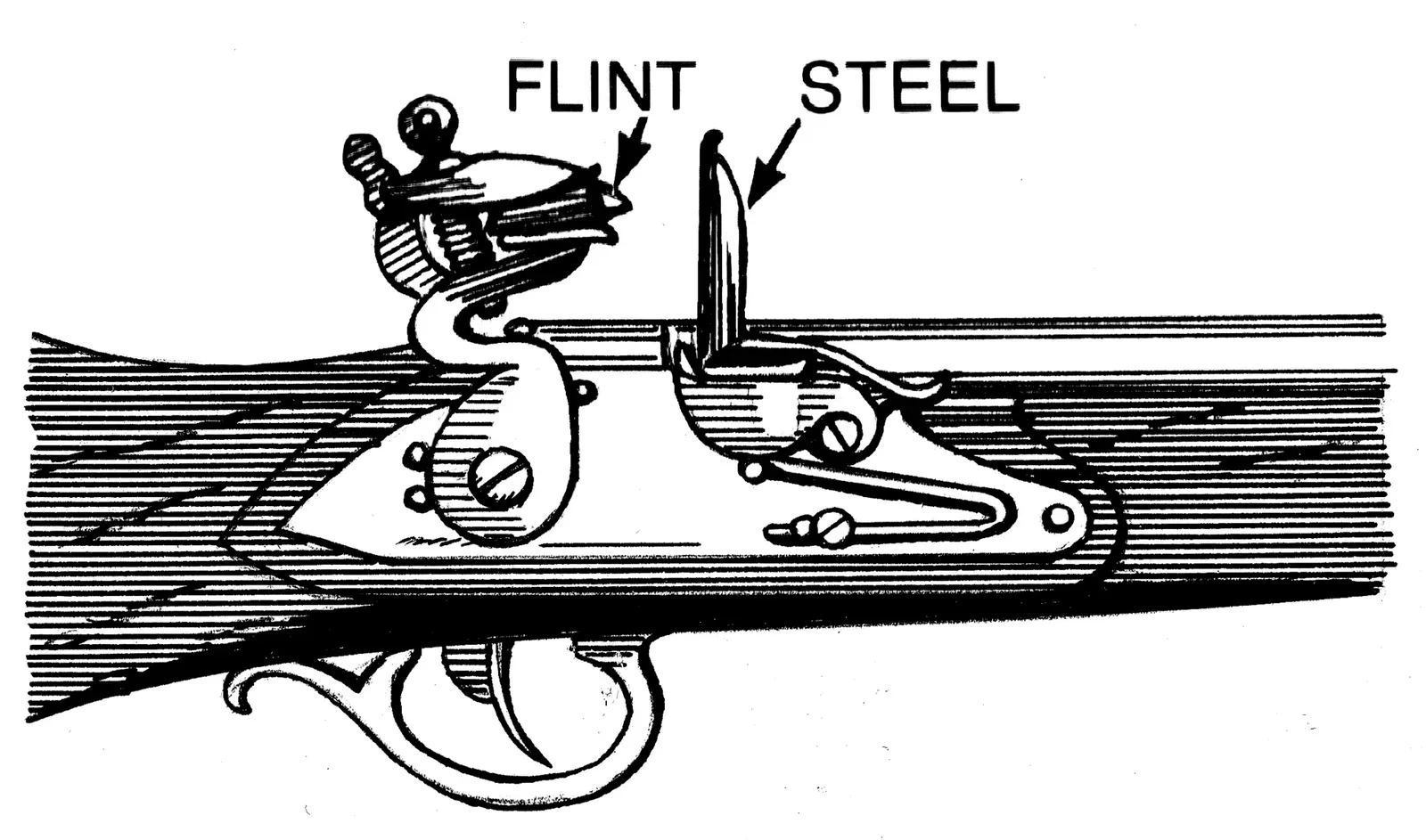
The miquelet operates on the same fundamental principle as any flintlock — flint strikes steel, sparks fall into priming powder, that flash passes through a touch hole and ignites the main charge — but the mechanical arrangement of how it gets there is what sets it apart.
Basic Components
The lockplate mounts the entire mechanism to the stock and typically features what gunsmiths called a "wasp waist" profile — narrowed to use only as much plate surface as the components require. That narrow profile meant less wood had to be removed from the stock to seat the lock, which mattered in field conditions where a cracked stock was a real problem.
The external mainspring runs along the outside of the lockplate and presses on the cock (the hammer that holds the flint). In the Spanish patilla style, it pushes up on the heel of the cock foot. In the Italian or Roman lock, it pushes down on the toe. This external placement makes the spring visible and accessible — easy to inspect, easy to replace in the field without specialized tools.
The cock itself pivots on a central screw and clamps the flint between upper and lower jaws, with the top jaw secured by a large ring screw that allowed even irregular, non-manufactured pieces of flint to be clamped securely. On isolated frontiers where knapped flints weren't available, that adjustment range was worth more than any aesthetic consideration.
The Horizontal Sear System
The defining mechanical feature — the horizontal sears — run through slots in the lockplate at right angles to the plate face. Their operation works as follows:
- Half-cock sear engages cock toe for safe carry position
- Full-cock sear holds cock back in fired position
- Trigger pull displaces half-cock sear horizontally
- Kinematic link simultaneously displaces full-cock sear
- Both sears clear cock's path for release
By the time the cock releases, both sears have cleared its path.
Frizzen Design Evolution
The frizzen (battery) serves double duty as both the striking steel that produces sparks and the cover over the priming pan. That single-piece design was the critical innovation — earlier snaphaunce mechanisms used separate pan cover and striking steel, which added complexity and a point of failure. A spring-loaded frizzen that flips open at the moment of ignition while simultaneously showering sparks into the exposed pan is elegant in its compression of two functions into one component.
Many Spanish miquelets featured a striated (grooved) frizzen face to enhance spark production. Early examples used a detachable grooved plate dovetailed and screwed to the battery, allowing the worn face to be replaced without reworking the whole frizzen. According to Wikipedia, this detachable face went out of fashion around 1660–1675, replaced by grooving cut directly into the battery face — likely because heat treatment and tempering of the battery had improved enough to make replaceable faces unnecessary.
French-influenced Madrid gunsmiths largely eliminated the grooving around 1700, but provincial Spanish smiths and North African and Ottoman lockmakers continued the practice.
Ottoman gunsmiths added one feature the Spanish original didn't include: a fastening bridge between the cock screw and the frizzen screw. This long bridle reduced torsion on the cock axis during the violence of firing and also provided surface area for the decorative inlay work that Ottoman gunmakers were known for.
Impact on Warfare & Societyedit
Military Advantages
The miquelet's military value was straightforward: it was more reliable than what came before it. A matchlock required a lit cord that could be blown out by wind or soaked by rain — the exact conditions that wrecked the Algiers campaign. A wheellock was mechanically complex, expensive, and the spring-driven wheel mechanism was vulnerable to moisture.
The miquelet's flint-on-steel ignition was simpler, more robust, and could be operated in wet conditions that would have rendered the alternatives useless. According to the Grokipedia source, a trained soldier could achieve 2–3 shots per minute under ideal conditions. That rate of fire, combined with the half-cock safety position that allowed the weapon to be carried fully primed, made it practical for the kind of irregular, fast-moving engagements that characterized much of the fighting in the Mediterranean world and Iberian frontier conflicts.
| Conflict | Period | Users | Miquelet Advantage |
|---|---|---|---|
| Alpujarras Rebellion | 1568-1571 | Catalan/Aragonese irregulars | Reliability in mountain terrain |
| Ottoman campaigns | 17th-18th c. | Janissary corps | Robust mechanism for siege warfare |
| Peninsular War | 1808-1814 | Spanish miqueletes | Quick priming for hit-and-run tactics |
| Greek Independence | 1821-1830 | Greek fighters | Locally maintainable weapons |
| Colonial conflicts | 16th-19th c. | Spanish colonists | No supply chain dependency |
Combat Deployments
The Alpujarras Rebellion (1568–1571) marked one of the earliest practical deployments of the mechanism in combat, with irregular Catalan and Aragonese mountain fighters — the miqueletes — using its reliability in the rugged terrain of southern Spain. The lock's association with these light troops was lasting enough that British soldiers in the Peninsular War (1808–1814) applied the name of those fighters to the mechanism itself, not understanding that the weapon and the unit carrying it were distinct things.
In the Peninsular War, Spanish miquelet irregulars employed the lock in hit-and-run tactics against French columns — ambushes, attacks on supply lines, engagements where mobility and quick priming mattered more than parade-ground discipline. The French, fielding standardized and well-supplied armies, still found the guerrilla campaign exhausting precisely because the fighters opposing them could operate effectively with locally maintained, locally repaired weapons that didn't depend on a functioning military supply chain.
In the Ottoman Empire, the miquelet equipped janissary corps in long-barreled tüfek muskets for siege warfare and infantry skirmishes through the 17th and 18th centuries. Ottoman adoption reflected a broader preference for robust, locally producible mechanisms over imported wheellocks. The fastening bridge the Ottomans added wasn't decorative afterthought — it was an engineering improvement responding to real field experience.
The Greek War of Independence (1821–1830) saw Greek fighters using miquelet-equipped rifles, often of Ottoman or Balkan origin. The moukhala — the Kabyle musket of North Africa — was built on the agujeta lock variant, a Catalan-developed form that became firmly established in North Africa, most likely through imitation of Spanish imports. One mechanism, filtered through geography and culture, showing up in the hands of fighters who had no contact with the Spanish gunsmiths who first worked it out.
Colonial and Civil Usage
Civilly, the miquelet was the standard arm of Spanish colonial America. The escopeta — a smoothbore long gun fitted with the patilla lock — was, according to the Sons of DeWitt Colony source, "the workhorse of New Spain." Colonists, frontier troops, traders, and landowners across the Americas carried miquelet-equipped firearms.
The lock made by Guisasola, probably in Eibar, circa 1800, represents the classic patilla style found on officer's fusils and escopetas throughout Spanish colonial territory. The gunmaking centers that produced these mechanisms became economically significant in their own right. Eibar in the Basque Country and Ripoll near Barcelona were major production hubs, with guild organizations enforcing standards across Spanish lock manufacture. That infrastructure didn't disappear when the miquelet declined — it became the foundation of Spanish and Basque arms manufacturing well into the modern era.
Modern Relevanceedit
Extended Service Life
The miquelet lock was officially obsolete by the mid-19th century, supplanted by percussion cap ignition. But "officially obsolete" and "actually gone" were very different things in much of the world. According to the Military Review source, miquelet-equipped weapons continued to be manufactured in several countries in Africa, Asia, and the Caucasus into the 20th century. That is not a short service life.
| Region | Period of Continued Use | Adaptation | Reason for Persistence |
|---|---|---|---|
| Caucasus | Into 20th century | Percussion conversions | Structural simplicity preferred |
| North Africa | Into 20th century | Moukhala muskets | Local manufacturing capability |
| Asia | Into 20th century | Regional variants | Reliability over standardization |
| Eibar, Spain | Through cartridge era | Decorative percussion locks | Craft tradition continuation |
Percussion Conversions
The transition from flint to percussion didn't always mean discarding the miquelet entirely. Gunsmiths — particularly in Eibar, the Caucasus, and Ottoman workshops — frequently converted existing miquelet locks to percussion cap ignition by removing the flint mechanism, cutting the pan, and fitting a percussion nipple to the barrel, while retaining the original lockplate and external hammer.
According to the Military Review source, the Caucasian gunsmiths' affection for the patilla's simplicity led them to use it as the structural basis for their percussion conversions, preserving the external arrangement even as the ignition chemistry changed underneath it. The sculptural tradition of percussion miquelet locks — hammers shaped as lions, dogs, fish, or mythical beasts — persisted through the cartridge era in Eibar, representing the tail end of a craft tradition that had started with the Marquart family's royal workshop in 16th-century Madrid.
Collecting and Museum Significance
For collectors and curators today, miquelet-pattern arms represent one of the most geographically diverse collecting categories in antique firearms. A Spanish patilla from colonial New Spain, a Turkish lock with its fastening bridge, a Greek tanchika musket, a Caucasian pistol with silver niello inlay, a North African moukhala — all variations on the same mechanical theme, each carrying the fingerprints of the culture that adapted it.
The Real Armería in Madrid holds what is almost certainly the oldest surviving example. The Metropolitan Museum of Art holds examples spanning the Spanish, Ottoman, and Caucasian traditions. The miquelet also occupies a specific and important position in the taxonomy of lock development. According to Wikipedia, the miquelet's combined battery and pan cover was "the final innovative link that made the 'true' flintlock mechanism possible" — meaning the French flintlock that eventually became the global standard wouldn't have gotten there without the Spanish and Italian gunsmiths who worked out the one-piece frizzen first. The miquelet was both precursor and contemporary to the so-called "true" flintlock, not simply a primitive predecessor.
The BGC Takeedit
What strikes me most about the miquelet's history isn't the mechanism itself — it's the durability. Most technologies get replaced and disappear. The miquelet got replaced by percussion ignition and then kept getting made for another half century in the Caucasus, North Africa, and Asia. That tells you something about how well it actually worked for the people using it, operating far from any supply chain that could provide them with factory percussion caps.
The horizontal sear arrangement — the thing that actually defines a miquelet — is genuinely clever. Running the sears through the lockplate at right angles keeps them accessible without disassembly, which is exactly what you want when you're a Spanish irregular in the mountains of Granada or a Caucasian fighter who can't exactly send his lock to a gunsmith. Having everything on the outside of the plate for visual inspection, combined with fewer critical internal parts than a French flintlock, means you can diagnose most problems by looking at the gun rather than taking it apart.
The irony is that the "true" flintlock — the French design that eventually pushed the miquelet out of European military service — was considered more refined and easier to mass produce, but Spanish colonial authorities kept rejecting it as too fragile. The French lock that the whole world eventually standardized on was, by field accounts from people actually using both, the less rugged option. History's a funny thing that way.
The miquelet challenges the linear narrative of firearms progress — it persisted where reliability in isolated, resource-limited conditions mattered more than keeping up with European military fashion.
That's not backwardness. That's a reasonable engineering decision.
Referencesedit
- Gls Guns(Sumner, IA)
- Bi-mart - Yakima (Fruitvale Ave)(Yakima, WA)
- New Philly Sportsman Specialities(New Philadelphia, OH)
- R&R Sports & Outdoors(Brandon, FL)
Loading comments...