Specifications
SIG MCX Spear / M7 Rifle

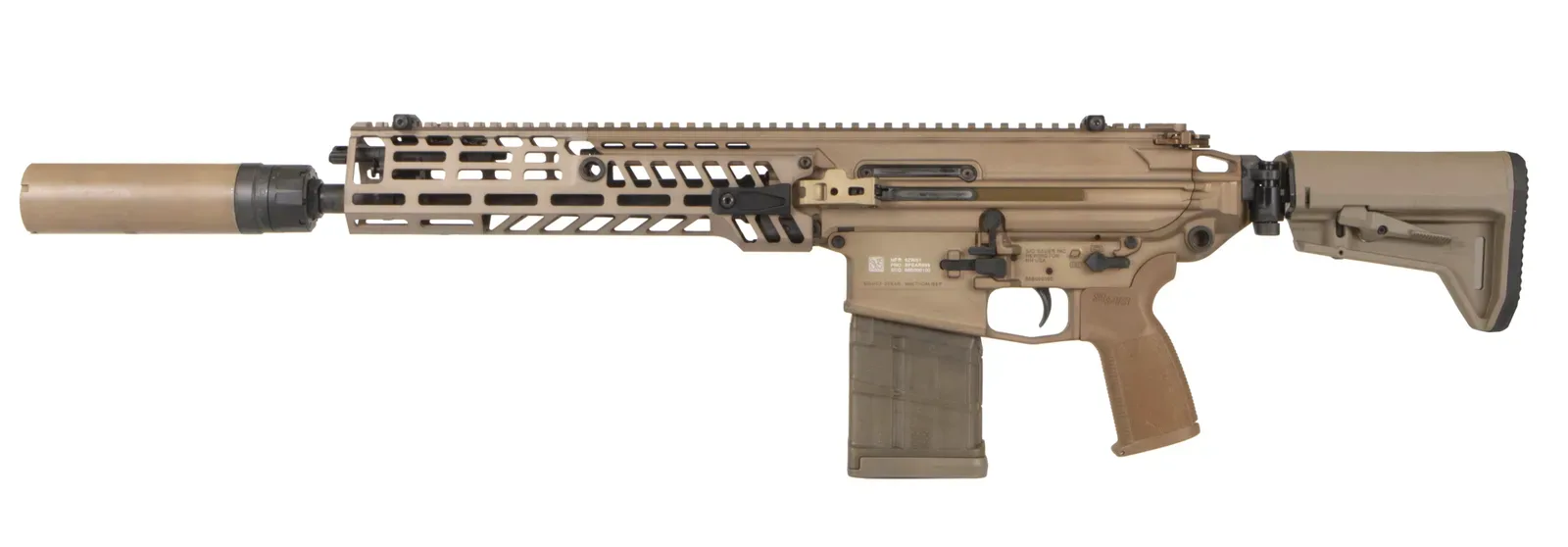
The SIG Sauer XM7 — the rifle variant that won the U.S. Army's NGSW competition in 2022, chambered in 6.8×51mm NATO.
United States Department of Defense (Public domain)
| Manufacturer | |
|---|---|
| Made By | SIG Sauer |
| Designer | SIG Sauer |
| Origin | United States |
| Specifications | |
| Caliber | 6.8×51mm (6.8×51mm Common Cartridge / .277 Fury) |
| Action | gas operated |
| Weight | 8.38 lb (3.80 kg) unloaded; 9.84 lb (4.46 kg) with suppressor |
| Production | |
| Designed | 2019 |
| Variants | |
| |
| Service Use | |
U.S. Army1st Battalion, 506th Infantry Regiment, 101st Airborne Division75th Ranger Regiment25th Infantry DivisionU.S. Special Operations Command (SOCOM) | |
SIG MCX Spear (XM7 / M7): America's Next Generation Squad Weapon
Firearms encyclopedia article
From The Boise Gun Club Handbook
Overviewedit
The SIG MCX-SPEAR, fielded by the U.S. Army as the M7 rifle (previously designated XM7, and originally XM5), is the first American service rifle to replace the M4 carbine in close combat units since the M16 family took hold in the 1960s. Chambered in 6.8×51mm Common Cartridge — commercially known as .277 Fury — it was designed by SIG Sauer in response to the Army's Next Generation Squad Weapon (NGSW) program, which formally launched in January 2019.
The 1st Battalion, 506th Infantry Regiment of the 101st Airborne Division began fielding the rifle in March 2024. Type classification — the Army's formal confirmation that a system meets its standards for operational performance, safety, and sustainment — followed in May 2025. As of January 2026, units including the 25th Infantry Division had begun fielding the M7, with fielding continuing across close combat forces.
| Specification | Details |
|---|---|
| Official Designation | M7 (previously XM7, originally XM5) |
| Manufacturer | SIG Sauer |
| Cartridge | 6.8×51mm Common Cartridge (.277 Fury) |
| Program | Next Generation Squad Weapon (NGSW) |
| First Unit Fielded | 1st Battalion, 506th Infantry Regiment |
| Fielding Start | March 2024 |
| Type Classification | May 2025 |
| Replaces | M4 carbine (close combat units only) |
The M7 is not a story about ergonomics or modularity. It is a story about what happens when the cartridge that has defined Western infantry combat for over four decades runs out of room to grow — and what comes next.
Design Historyedit
The 5.56 Problem
The roots of the M7 trace back to a blunt assessment delivered in 2017, when Lieutenant General Mick Bednarek testified before the Senate Armed Services Committee on the limits of the 5.56×45mm NATO round.
"The US is facing adversaries with L2-3 body armour that precludes our lethality… regardless of range. I think the US Army universally realizes that the 5.56 bullet can't defeat Russian body armor." — Lieutenant General Mick Bednarek, 2017
That testimony, and the Small Arms Ammunition Configuration Study that followed, formed the foundation of the NGSW program. The Army's approach was notable for its methodology — start with the threat, define the defeat requirement, then work backward to the bullet and finally the platform. As Colonel Jason Bohannan of PEO Soldier described it, the program wasn't myopically focused on body armor alone but on a range of target sets expected to persist on the battlefield for the next decade.
NGSW Competition
In September 2019, SIG Sauer submitted its designs to the competition. Their entry paired the MCX platform — already in service with U.S. SOCOM and the British Special Air Service (SAS) — with a new hybrid-case cartridge that SIG had developed to generate approximately 20–25% more barrel pressure than conventional brass-cased ammunition. That pressure increase translates directly to muzzle velocity, and velocity is what defeats modern ceramic armor at range.
SIG was not the only serious contender. Three major designs competed:
- SIG Sauer: MCX platform with hybrid-case cartridge generating 20-25% higher barrel pressure
- Textron Systems: Cased-telescoped ammunition with polymer casing for weight reduction
- Lone Star Future Weapons: Bullpup configuration with rear-mounted magazine feed
Both competitors made it to the late stages of the competition. In April 2022, the Army awarded SIG Sauer a ten-year contract — with an initial delivery order worth $20.4 million — to produce both the rifle (XM7) and the light machine gun (XM250) to replace the M4 carbine and M249 Squad Automatic Weapon respectively.
The rifle was initially designated XM5, continuing the numerical sequence from the M4. In January 2023, the Army changed the designation to XM7 to avoid a trademark conflict with Colt's M5 carbine. Operational testing was scheduled through 2024, at which point the "X" prefix would be dropped. Type classification as the M7 was confirmed in May 2025.
MCX Platform Origins
The MCX platform itself has a longer lineage. SIG introduced the original MCX in 2015. A second generation, the MCX Virtus, followed in 2018. The SPEAR represents the third generation of the MCX family, and the American Rifleman has traced the MCX's fundamental architecture to Eugene Stoner's AR-18 — a short-stroke gas-piston design contained within AR-15-style external geometry. The multi-lug rotating bolt, the short-stroke piston system, the forged alloy receivers — none of these are new ideas. What SIG assembled was a platform proven enough for SOCOM use, then scaled and hardened to handle a cartridge operating at substantially higher chamber pressures than anything previously issued to American infantry.
Technical Characteristicsedit
Basic Specifications
The M7 weighs 8.38 lb (3.80 kg) unloaded, or 9.84 lb (4.46 kg) with its suppressor attached. It runs a 13-inch cold hammer-forged barrel and achieves a muzzle velocity of approximately 3,002 feet per second (915 m/s). The action is a short-stroke gas-operated piston with a rotating bolt — the same fundamental operating system used across the MCX family — driving an SR-25 pattern magazine in 20-round standard configuration, with an optional 25-round box available.
| Specification | M7 Military | MCX-SPEAR Civilian |
|---|---|---|
| Weight (unloaded) | 8.38 lb (3.80 kg) | Similar |
| Weight (w/ suppressor) | 9.84 lb (4.46 kg) | N/A |
| Barrel Length | 13 inches | 13" or 16" |
| Muzzle Velocity | ~3,002 fps (915 m/s) | >3,000 fps (16" barrel) |
| Magazine Capacity | 20 rounds (25 optional) | 20 rounds |
| Caliber Options | 6.8×51mm only | 6.8×51mm, 7.62×51mm, 6.5 Creedmoor |
| MSRP | Government contract | ~$8,000 |
Hybrid Cartridge Technology
The 6.8×51mm hybrid cartridge is the system's defining component. The case is a brass-steel composite — the brass head interfaces with the chamber as usual, while the steel body allows the case to handle chamber pressures that would exceed the structural limits of a conventional all-brass case. According to analysis in the Wavell Room, the commercial .277 Fury variant propels a 140-grain bullet at 2,950 feet per second, generating approximately 2,706 ft-lbs (3,668 joules) of muzzle energy — more than twice the muzzle energy of a standard 5.56×45mm NATO round. The military's XM1186 general-purpose projectile is government-owned, while the hybrid case technology remains proprietary to SIG Sauer.
The platform features:
- Free-floating M-LOK handguard
- Fully ambidextrous controls
- Non-reciprocating side charging handle paired with rear charging handle
- Folding telescoping stock
- Two-position adjustable gas valve
- Suppressor standard issue — designed for normal suppressed operation
The civilian MCX-SPEAR LT is built on the same platform and is available in 6.8×51mm, with modular conversion options for 7.62×51mm and 6.5 Creedmoor, and barrel length options of 13 or 16 inches. The 16-inch civilian variant achieves muzzle velocities in excess of 3,000 fps with a 113-grain bullet. The civilian model carries an MSRP in the range that places it well above standard AR-market pricing — American Rifleman noted the MCX-SPEAR at approximately $8,000, versus $2,729 for the lighter MCX-SPEAR LT in 5.56.
Weight and Load Considerations
The weight picture deserves honest treatment. Compared to the M4A1 at 6.34 lb unsuppressed, the M7 is approximately two pounds heavier. The proposed combat load of 140 rounds in seven 20-round magazines weighs 9.8 lb — versus 7.4 lb for the M4's 210 rounds in seven 30-round magazines.
| Load Comparison | M7 | M4A1 |
|---|---|---|
| Rifle Weight | 8.38 lb | 6.34 lb |
| Combat Load | 140 rounds (7×20) | 210 rounds (7×30) |
| Ammo Weight | 9.8 lb | 7.4 lb |
| Total Weight Difference | +4 lb heavier | -4 lb lighter |
| Round Count Difference | -70 rounds | +70 rounds |
Each soldier equipped with the M7 carries about four pounds more total load with 70 fewer rounds. That is not a rounding error. It is a deliberate capability trade the Army made, calculating that the lethality and range improvements justify the burden.
"Seeing the effects we had on the targets makes up for any concerns I had initially about the increased weight." — Colonel Trevor Voelkel, 1st Brigade Commander, 101st Airborne
Combat & Field Useedit
Initial Fielding
In September 2023, the first batch of XM7s was delivered to the 101st Airborne Division and the 75th Ranger Regiment for user testing. Formal fielding to 1st Battalion, 506th Infantry Regiment began in March 2024, making it the first Army unit to carry the new system operationally.
The Army's plan is not a wholesale replacement of the M4 across all forces. The M7 is specifically allocated to close combat soldiers — infantry, cavalry scouts, combat engineers, forward observers, and combat medics. The M4 remains in service for general-purpose forces. The Army may order up to 107,000 rifles over the decade, with the contract structured to potentially include the U.S. Marine Corps and U.S. Special Operations Command if those organizations opt in.
Optics and Accessories
The XM157 Fire Control Optic — developed under a separate contract awarded to Vortex Optics subsidiary Sheltered Wings in January 2022, valued at $2.7 billion over ten years — was designed to pair with the M7. It integrates a variable magnification optic, backup etched reticle, laser rangefinder, ballistic calculator, atmospheric sensor suite, compass, intra-soldier wireless, and both visible and infrared aiming lasers. In practice, early fielding saw units equipped with a range of optics alongside or instead of the XM157:
- EOTech EXPS3 with G33 magnifier
- Vortex "Eleanor" AMG 1–10×24 LPVO
- Envision RAIL laser aiming module
- B.E. Meyers MAWL laser aiming module
This reflects the reality that large-scale procurement and unit fielding timelines rarely move in lockstep.
Testing and Evaluation
The NGSW program was tested over a 27-month prototyping and evaluation period involving hundreds of soldiers, Marines, and special operations forces. The Army's own assessment characterized both the XM7 and XM250 as providing "significant capability improvements in accuracy, range and overall lethality," noting that they "fire more lethal ammunition, mitigate recoil, provide improved barrel performance, and include integrated muzzle sound and flash reduction."
Legacy & Influenceedit
Historical Context
In a narrow historical sense, the M7 ends a run that began when the M16 entered service in the 1960s — over sixty years of American infantry organized around the 5.56×45mm cartridge and the weapons built around it.
"The current 5.56 cartridge has been maxed out from the performance perspective." — U.S. Army NGSW Program Assessment
That is a meaningful institutional admission. The broader significance, however, is the hybrid cartridge — not the rifle.
NATO Implications
As analysis in the Wavell Room argues at length, the 6.8mm caliber is something of a red herring. Intermediate calibers have been proposed and rejected within NATO circles repeatedly since before the adoption of 5.56. What is genuinely new is the SIG Sauer hybrid case technology that allows a service cartridge to generate pressure levels previously associated with magnum or heavy-barreled precision rifle ammunition — while remaining manageable in a infantry rifle that soldiers carry all day.
The NATO implications are real and unresolved. The 5.56×45mm SS109 round has been the cornerstone of NATO ammunition interoperability since 1980. The U.S. Army has now broken from that standard for its close combat forces. Whether allied nations follow, adapt, or hold to 5.56 is an open question, and one complicated by the fact that the hybrid case technology is proprietary to SIG Sauer while the U.S. military's specific projectile remains classified. Several NATO governments have recently procured new 5.56 rifles — France, Germany, the Netherlands, and the UK among them — making a near-term shift to 6.8 logistically and politically complex.
Platform Evolution
Meanwhile, SIG continues refining the platform. By September 2025, the company had unveiled an improved M7 at DSEI with a 10.5-inch barrel, lightened internal components, and a reprofiled handguard — dropping the suppressed weight from 9.84 lb to approximately 7.5 lb. The updated suppressor delays the visible heat signature under night-vision and thermal optics until after roughly 100 rounds rather than 40. At AUSA in October 2025, SIG displayed both the Product Improvement Effort (PIE) M7 with a 13.5-inch barrel and a carbine variant with a 10-inch barrel.
| M7 Variants | Barrel Length | Weight Change | Status |
|---|---|---|---|
| Baseline M7 | 13" | 9.84 lb (w/ suppressor) | Fielded 2024 |
| PIE M7 (Standard) | 13.5" | -0.7 lb reduction | Under evaluation 2025 |
| PIE M7 (Carbine) | 10" | Further reduced | Under evaluation 2025 |
| Improved M7 | 10.5" | ~7.5 lb (w/ suppressor) | Unveiled Sept 2025 |
The standard PIE M7 shaved approximately 0.7 lb from the baseline through a redesigned upper receiver, slimmer barrel, lighter internals, and the removal of the folding stock hinge. The Army was still evaluating in late 2025 whether to field the lightened standard-length rifle, adopt the carbine as the new baseline, or issue different configurations to different unit types.
The commercial MCX-SPEAR LT — a 5.56mm variant derived from lessons learned during the NGSW competition — represents SIG translating the platform architecture into a more broadly accessible civilian rifle. American Rifleman characterized the MCX family's place in a broader group of modern designs — alongside rifles like the CZ Bren 2, IWI Carmel, and HK 433 — as representing a maturation point for the gas-operated, metallic-cartridge service rifle: reliable, modular, ambidextrous, suppressor-optimized, and optics-ready from the factory.
Whether the M7 proves to be a lasting inflection point in small arms history or an expensive detour depends largely on two things: whether the Army's lethality calculus holds up in the field conditions it was designed for, and whether the weight-and-ammo trade the infantry is now carrying proves sustainable in extended operations. Those answers are still being written.
The BGC Takeedit
The M7 is the most consequential American infantry rifle decision in sixty years — and it's also the most contested, and for legitimate reasons on both sides.
The case for it is straightforward. If your primary threat is soldiers wearing ceramic armor plates, a 5.56 round is not going to cut it at anything past close range. The Army was honest about that, did the threat analysis, and built backward from the requirement. That is how procurement is supposed to work, and it almost never does. Credit where it's due.
The case against it is also straightforward. Four pounds of additional load and 70 fewer rounds is not a rounding error — that is a real operational cost that falls on the infantryman's back, literally. History has not been kind to heavier rifles and lighter ammo loads when wars drag on and logistics get ugly. The M14 was more powerful than the M16 too. The Army eventually figured out what that trade actually cost in the jungle.
The hybrid cartridge is genuinely interesting technology. More pressure from a lighter case without blowing up the rifle is not a trivial engineering achievement. Whether that translates to decisive battlefield advantage — or whether training, tactics, and the human factors of combat swamp the ballistic improvements — is a question no laboratory can fully answer.
What I'd watch is whether SOCOM and the Marines actually opt in, and whether the lighter PIE variant fixes the weight problem enough to stick. If the Army ends up quietly reverting the standard load-out to the carbine with a 10-inch barrel, that tells you something. If the 101st and 75th Rangers keep asking for more of them, that tells you something else.
For now, the M7 is the most carefully engineered answer to a real problem that American infantry has had in a generation. Whether it's the right answer is still being tested downrange.
Referencesedit
- https://en.wikipedia.org/wiki/M7_rifle
- https://www.sigsauer.com/mcx-spear-6-8-x-51.html
- https://www.armytimes.com/news/your-army/2022/04/19/army-chooses-sig-sauer-to-build-its-next-generation-squad-weapon/
- https://www.sigsauer.com/mcx-spear-sbr.html
- https://wavellroom.com/2024/09/17/nato-and-the-next-generation-squad-weapon-ngsw/
- https://www.americanrifleman.org/content/review-sig-sauer-mcx-spear-lt/
- https://www.thefirearmblog.com/blog/tfb-review-america-s-new-battle-rifle-the-sig-spear-in-6-8x51mm-44818186
Last Updated: February 27, 2026
- Gls Guns(Sumner, IA)
- Bi-mart - Yakima (Fruitvale Ave)(Yakima, WA)
- New Philly Sportsman Specialities(New Philadelphia, OH)
- R&R Sports & Outdoors(Brandon, FL)
Loading comments...