State Details
Vermont

Overview | |
|---|---|
State | Vermont (VT) |
Capital | Montpelier |
Statehood | 1791 |
Population | 647,464 |
Gun Ownership | 50.5% |
Active FFLs | 198 |
Carry Laws | |
Constitutional Carry | Yes (unrestricted) |
Open Carry | Yes |
CCW Permit Available | No |
Permit Reciprocity | N/A |
Self-Defense | |
Castle Doctrine | Yes |
Stand Your Ground | No |
Duty to Retreat | Yes |
Regulations | |
State Preemption | No |
Red Flag / ERPO | Yes |
Waiting Period | None |
Universal BGC | Yes |
NFA Items | Yes |
Assault Weapons Ban | No |
Magazine Limit | 15/10 rounds |
Key Legislation | |
| |
Notable Manufacturers | |
| |
Vermont Firearms History
Reference article
From The Boise Gun Club Handbook
Vermont Firearms Historyedit
Overviewedit
Vermont occupies a genuinely strange position in American firearms history — and strange is the right word. It's one of the most politically progressive states in the country, home to Bernie Sanders and a legislature that leans hard left, yet it carried an unbroken 220-year tradition of permitless carry that predates the U.S. Constitution itself. No permits. No registration. No serious firearms regulations — until 2018, when that streak finally ended.
That tension between Vermont's liberal political identity and its firearms permissiveness isn't a contradiction so much as a product of geography and culture. Vermont is rural. It has the second-smallest population of any state. Deer season is practically a civic institution. The gun culture here didn't come from political organizing — it came from people who needed firearms to eat and to manage land, and from a revolutionary tradition that goes back to the Green Mountain Boys and a constitution written in 1777 that explicitly protected the right to bear arms before the Bill of Rights existed.
Understanding Vermont's firearms history means understanding that the state's permissive tradition wasn't carved out by lobbyists or activists. It was just never taken away — until it was.
Colonial & Pre-Statehood Eraedit
Vermont as a political entity didn't exist before 1777. The territory that became Vermont was contested land — claimed by both the British province of New York and the province of New Hampshire — and the settlers caught in the middle were the ones who made Vermont's firearms culture what it is.
The New Hampshire Grants — the name for the disputed territory roughly corresponding to modern Vermont — drew settlers throughout the 1750s and 1760s who held land titles from New Hampshire's governor Benning Wentworth. When the British Crown ruled in New York's favor in 1764, those settlers suddenly found their titles potentially void and New York sheriffs showing up to enforce the decision.
The settlers' response was armed resistance. In 1770, Ethan Allen and members of his extended family — including his brother Ira Allen, cousins Seth Warner and Remember Baker — organized what became known as the Green Mountain Boys, operating out of the Catamount Tavern in Bennington. This wasn't a militia in the formal sense yet. It was a group of armed settlers using the threat and occasional reality of violence to prevent New York from exercising authority over land they considered their own.
When a New York sheriff led 300 militiamen into the Grants in 1771 attempting to take possession of farms, Allen and Baker met him with armed resistance and turned him back. New York's governor put bounties on Allen and his lieutenants. Allen's response was to announce they were fighting for "liberty, property, and life" — explicitly linking the Grants' cause to the broader colonial grievances with Britain. The Governor of New York, for his part, declared the Green Mountain Boys outlaws and offered rewards for their capture.
By the time the Revolutionary War began in 1775, the Green Mountain Boys were an organized armed force with several hundred members who had effectively governed the territory through force of arms for five years. They knew how to move through the Green Mountains, they were motivated, and they were already at war — just with New York rather than Britain.
On the night of May 9–10, 1775 — less than a month after Lexington and Concord — Ethan Allen led roughly 83 Green Mountain Boys and Colonel Benedict Arnold across Lake Champlain in a predawn assault on Fort Ticonderoga. The British garrison was surprised and asleep. Allen reportedly demanded the fort's surrender "in the name of the Great Jehovah and the Continental Congress." The fort fell without a shot fired. The cannon captured at Ticonderoga — hauled overland to Boston by Henry Knox in the winter of 1775–76 — forced the British evacuation of Boston in March 1776. It's not an exaggeration to say that an armed group of Vermont land speculators changed the trajectory of the Revolutionary War.
The Green Mountain Boys were subsequently authorized as a Continental Army regiment — the Green Mountain Rangers — by the Continental Congress on July 4, 1775, with Seth Warner taking command after Allen was captured in a failed attempt to take Montreal in August 1775. The regiment fought at Hubbardton on July 7, 1777 — the only Revolutionary War battle fought on Vermont soil — and at Bennington on August 16, 1777, where a force of Vermont and New Hampshire militia under General John Stark destroyed a British foraging column, a defeat that contributed directly to Burgoyne's surrender at Saratoga two months later.
Vermont declared itself an independent republic in January 1777, establishing the Vermont Republic — a functioning sovereign nation that issued its own currency, operated a postal system, and maintained its own military for fourteen years before joining the United States.
19th Century: Statehood & Expansionedit
The single most important document in Vermont's firearms legal history was written before the state even joined the Union. The Vermont Constitution of 1777 — drafted at Windsor during a constitutional convention that met while Burgoyne was invading from the north — contained Chapter I, Article 15, which read:
"That the people have a right to bear arms for the defence of themselves and the State."
This language predates the Second Amendment by fourteen years. The Vermont framers didn't copy it from the federal document — the federal document hadn't been written yet. Vermont's right-to-bear-arms provision was an original expression of the political philosophy that had animated the Green Mountain Boys: that armed citizens were the foundation of a free society, not a threat to it.
When Vermont became the 14th state on March 4, 1791, it brought that constitutional tradition with it. The state constitution contained no restrictions on carrying firearms, concealed or otherwise, and no legislature in Vermont's history saw fit to add any for over two centuries.
Throughout the 19th century, Vermont's firearms culture was entirely ordinary for a rural New England state. Hunting — particularly deer, bear, and bird hunting — was economically important in a state where farming was often marginal. The Connecticut River valley and the Champlain Valley were the agricultural centers, but the rest of the state was heavily forested terrain where subsistence hunting remained a practical supplement to farming income well into the 20th century.
Vermont's role in the Civil War was significant and deeply connected to firearms. The state sent roughly 34,000 men — an enormous proportion of its population — to fight for the Union. Vermont units were equipped primarily with Springfield Model 1861 rifles and served in some of the war's hardest fighting. The 1st Vermont Cavalry and the Vermont Brigade — comprising the 2nd through 6th Vermont Infantry regiments — built reputations as reliable, aggressive combat units.
The most remarkable Vermont action of the Civil War came on October 19, 1864, when Confederate Lieutenant General Jubal Early dispatched a raiding party of about 21 men under Lieutenant Bennett Young to St. Albans, Vermont — the northernmost land action of the Civil War. The raiders robbed three banks of approximately $208,000 and attempted to burn the town before being driven off by armed citizens and a pursuing posse. Several raiders were captured in Canada and eventually released by Canadian authorities, causing a diplomatic incident. The St. Albans Raid remains the northernmost Confederate operation of the war and a reminder that Vermont's civilian population was armed and willing to use those arms defensively.
The postwar period saw Vermont follow national patterns — returning veterans brought military firearms proficiency home, and the state's hunting culture continued without legal interference. Vermont Fish and Wildlife regulations governed hunting seasons, but the mere act of carrying a firearm generated no legal scrutiny.
20th Century: Wars, Industry & Regulationedit
Vermont sent soldiers to every major American conflict of the 20th century. The Vermont National Guard — officially the Green Mountain Boys, carrying the direct lineage of the 1775 militia — mobilized for World War I, served in the 26th Infantry Division (the Yankee Division) in France, and mobilized again for World War II. Vermont's rural population, with its hunting tradition and general firearms familiarity, produced soldiers who were already comfortable with weapons before they reached basic training.
The post-WWII period brought the most significant development in Vermont's manufacturing history relevant to firearms. In 1974, Sturm, Ruger & Co. opened a manufacturing facility in Newport, Vermont — a small city in the Northeast Kingdom, one of the most economically depressed regions of the state. The Newport plant became a major employer in a region that had few of them, and it manufactured Ruger's long guns — rifles and shotguns — for decades. The facility's presence in Vermont meant that "made in Vermont" actually applied to a significant number of American-made Ruger firearms.
Throughout the mid-20th century, Vermont maintained its constitutional carry tradition without ever making it a political issue. It simply wasn't a law that needed to be passed — it was the absence of a restrictive law. When other states began enacting concealed carry permit systems in the 1980s and 1990s, firearms rights advocates in those states began referring to "Vermont carry" or "constitutional carry" as the standard they were trying to reach. Vermont became, somewhat accidentally, the benchmark for firearms freedom — not because Vermont had done anything, but because it had never done anything restrictive.
Senator Bernie Sanders, Vermont's most prominent national political figure, had a complicated relationship with firearms legislation during his congressional career. As a House member representing Vermont's at-large district from 1991 to 2007, Sanders voted against the Brady Handgun Violence Prevention Act in 1993, voted against the Federal Assault Weapons Ban in 1994, and voted in 2005 for the Protection of Lawful Commerce in Arms Act — legislation that shielded firearms manufacturers from certain civil lawsuits. These votes reflected the political reality of representing a rural state with a strong hunting culture, not Sanders' personal ideology. They generated significant criticism from the left when he ran for president in 2016.
The latter half of the 20th century saw Vermont maintain its position as an outlier in the increasingly politicized national debate over firearms. The state had no permit-to-purchase requirement, no waiting period, no assault weapons ban, no magazine capacity limits, and no red flag law. What it also had — and this is the honest version of the story — was one of the lowest rates of firearms violence in the country. Whether that correlation reflects the constitutional carry tradition, the rural demographics, the relative economic homogeneity, or some combination is a question that firearms researchers have never fully answered.
Modern Era (2000–Present)edit
For the first seventeen years of the 21st century, Vermont's firearms laws remained essentially unchanged from what they'd been in 1791. That changed abruptly — and controversially — following the February 14, 2018 shooting at Marjory Stoneman Douglas High School in Parkland, Florida.
The Parkland shooting triggered a national legislative response, and Vermont — despite having no recent mass shooting of its own — moved faster than almost any other state. Governor Phil Scott, a Republican, pushed for and signed Act 94 on April 11, 2018, marking the first major gun legislation in Vermont history.
Act 94 was significant by any measure. It:
- Raised the minimum age to purchase firearms from 18 to 21
- Banned bump stocks
- Established a background check requirement for private sales
- Created a red flag law (Extreme Risk Protection Orders) allowing courts to temporarily remove firearms from individuals deemed a risk
- Limited magazine capacity to 10 rounds for handguns and 15 rounds for long guns
The passage of Act 94 ended Vermont's 220-year streak as the most permissive firearms jurisdiction in the United States. Gun rights advocates were furious. Gun Owners of Vermont and other groups challenged elements of the law, and the magazine capacity limits in particular drew sustained opposition. Governor Scott — a Republican who had previously won strong support from gun owners — drew accusations of betrayal from Vermont's firearms community.
The Vermont Supreme Court upheld Act 94's provisions in subsequent legal challenges. The magazine capacity limits and background check for private sales remain in effect.
In 2020, additional legislation strengthened the red flag provisions and added a 72-hour waiting period for firearm purchases — another first for Vermont. By 2022, the state that had been the national benchmark for constitutional carry had enacted some of the more substantive firearms regulations in New England.
Vermont still has no permit requirement to carry a firearm — concealed or open — so "Vermont carry" technically remains, and the state's constitutional right-to-bear-arms provision is unchanged. But the regulatory environment around purchase, magazines, and risk-based removal of firearms has shifted substantially from where it stood in 2017.
The Sturm, Ruger & Co. facility in Newport continued operating into the 2020s, though the company announced in 2023 that it would be closing the Newport plant — a significant economic blow to the Northeast Kingdom and a symbolic end to one of Vermont's most direct connections to firearms manufacturing.
Notable Figures & Manufacturersedit
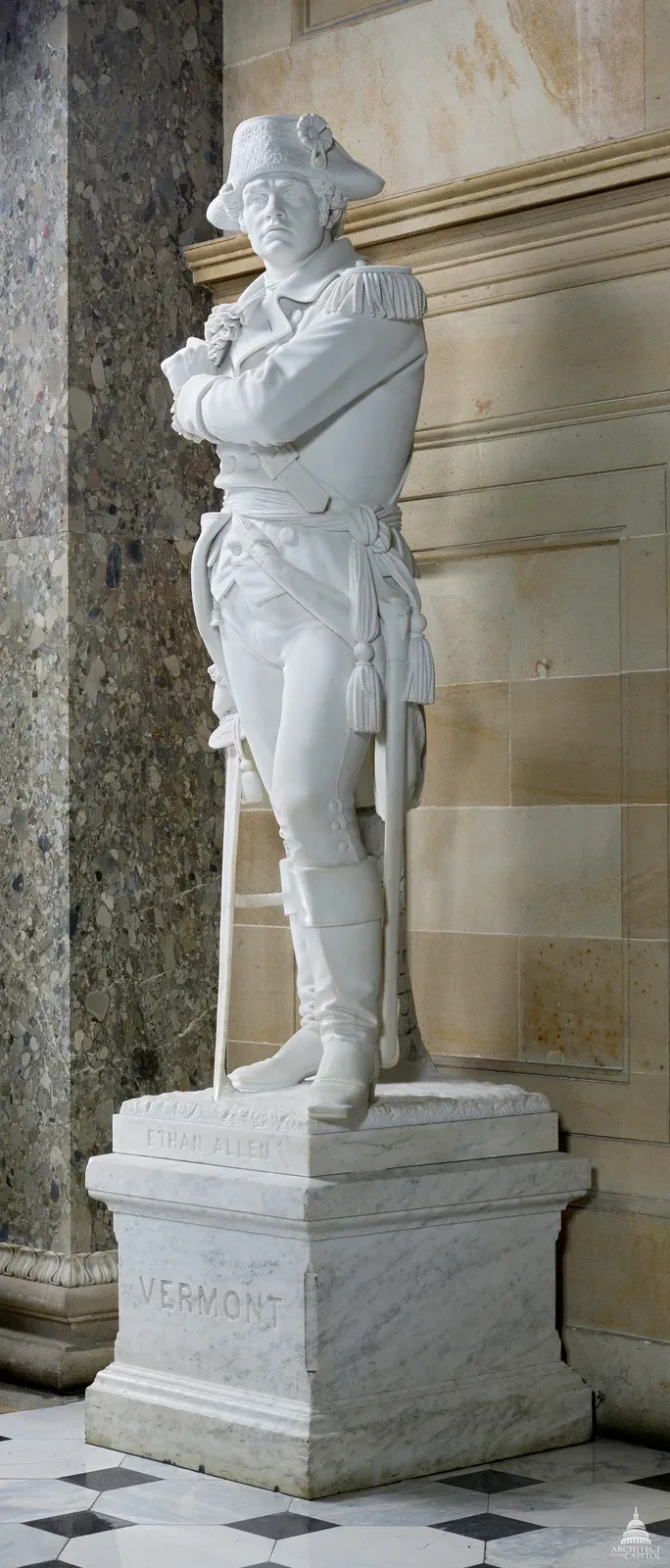
Ethan Allen (1738–1789) is the foundational figure in Vermont's firearms and political history. Born in Connecticut, Allen moved to the New Hampshire Grants in the 1760s, organized the Green Mountain Boys, and commanded the capture of Fort Ticonderoga in 1775. He spent much of the war as a British prisoner after his failed attempt to take Montreal, was exchanged in 1778, and spent his remaining years in Vermont advocating — unsuccessfully during his lifetime — for Vermont's admission to the United States. He died at his homestead on the Winooski River in 1789, two years before Vermont achieved statehood. His name lives on in the Ethan Allen Firing Range in Essex Junction, one of Vermont's prominent shooting facilities.
Seth Warner (1743–1784) commanded the Green Mountain Rangers after Allen's capture and led Vermont forces at both Hubbardton and Bennington. Less celebrated than Allen, Warner was in many respects the more effective military commander — disciplined where Allen was impulsive. Warner's regiment at Hubbardton fought a skilled rearguard action that allowed the main American force to escape, a tactically sound performance that history has somewhat overlooked in favor of Allen's more colorful exploits.
Remember Baker (1737–1775) was one of the original Green Mountain Boys captains, known for aggressive enforcement of the Boys' authority against New York settlers. He was killed in a British ambush near the Richelieu River in August 1775 during the Canadian campaign.
Matthew Lyon (1749–1822) served as a second lieutenant in the Green Mountain Boys and later became a Vermont congressman — the first man ever censured by the U.S. House of Representatives, for criticizing President John Adams. Lyon's career illustrated the Green Mountain Boys' transformation from frontier militia to political establishment.
Sturm, Ruger & Co. — while founded in Southport, Connecticut in 1949 by William B. Ruger and Alexander Sturm — established its Newport, Vermont manufacturing facility in 1974. The Newport plant produced Ruger's long guns, including the iconic 10/22 rimfire rifle and various centerfire rifles and shotguns. At its peak, the Newport facility employed several hundred workers in a region with limited economic options. The plant's closure announcement in 2023 marked the end of a 49-year manufacturing presence in Vermont.
John Dewey (1859–1952) — Vermont-born philosopher and educator — doesn't fit neatly into firearms history, but his intellectual legacy shaped the progressive tradition that eventually produced Vermont's 2018 legislation. The tension between Vermont's libertarian firearms tradition and its progressive political identity is, in part, a tension between the Green Mountain Boys' legacy and the academic and policy tradition that Dewey and his successors built.
Governor Phil Scott (Republican, 2017–present) made his mark on Vermont firearms history by signing Act 94 in 2018. Scott framed his support for the legislation in terms of public safety following Parkland, and explicitly stated that the bill wasn't perfect but represented a necessary response. His willingness to sign significant gun legislation as a Republican governor distinguished him from most of his counterparts nationally and permanently altered Vermont's firearms legal landscape.
Current Legal Landscapeedit
Vermont's current firearms laws reflect the layered result of 220 years of minimal regulation followed by a concentrated burst of legislation between 2018 and 2020.
Constitutional Carry: Vermont has no permit requirement to carry a firearm, open or concealed, for any person legally eligible to possess a firearm. This has been the case since statehood in 1791 and was not changed by Act 94 or subsequent legislation. Vermont is frequently cited as the origin state of the constitutional carry concept.
Vermont Constitution, Chapter I, Article 16 (renumbered from the original Article 15): "That the people have a right to bear arms for the defence of themselves and the State — and as standing armies in time of peace are dangerous to liberty, they ought not to be kept up; and that the military should be kept under strict subordination to and governed by the civil power."
Background Checks: Following Act 94, Vermont requires background checks for all firearm transfers, including private sales. This is conducted through a licensed dealer as an intermediary.
Minimum Purchase Age: 21 for all firearms, raised from 18 by Act 94 in 2018.
Magazine Capacity Limits: Handguns are limited to 10-round magazines; long guns to 15 rounds. Magazines manufactured before the effective date of Act 94 (October 1, 2018) are grandfathered.
Waiting Period: A 72-hour waiting period applies to all firearm purchases, enacted in 2020.
Extreme Risk Protection Orders (Red Flag Law): Courts can issue orders temporarily prohibiting firearm possession by individuals determined to pose a significant risk of harm to themselves or others. Enacted as part of Act 94 in 2018.
Bump Stocks: Prohibited under Act 94, predating the federal administrative ban.
Assault Weapons: Vermont has no state-level assault weapons ban beyond the federal law that was in effect until 2004. The AR-15 and similar platforms are legal to purchase and possess.
Suppressors: Legal to own with proper federal NFA compliance (Form 4, tax stamp). Vermont does not add state-level requirements beyond federal law.
Short-Barreled Rifles/Shotguns: Legal with proper federal NFA compliance.
Dealer Licensing: Vermont does not require a state firearms dealer license separate from the federal FFL.
Preemption: Vermont has a partial preemption statute — municipalities cannot enact firearms regulations more restrictive than state law, though this has been subject to some legal interpretation.
Hunting Regulations: Vermont Fish & Wildlife manages hunting seasons with specific regulations on legal firearms and archery equipment by season. The deer hunting season remains culturally central to Vermont life, particularly in rural areas.
The net result is a state where you can carry a firearm without any permit but cannot buy a standard-capacity pistol magazine. That combination strikes many gun owners as incoherent, and the criticism isn't entirely without merit — the 2018 legislation targeted specific features rather than the underlying carrying tradition, producing a regulatory framework that satisfies neither side of the debate completely.
The BGC Takeedit
Vermont is the most interesting case study in American firearms culture, and not for the reasons you might think.
The state that gave us the Green Mountain Boys — the armed settlers who fought the British and New York simultaneously, who wrote a right-to-bear-arms provision before the Founders had drafted the Second Amendment, who spent 220 years as the freest firearms jurisdiction in the country — is also the state that gave us Bernie Sanders, one of the most prominent figures in American progressive politics. That's not a paradox. It's the actual culture.
Vermont's firearms permissiveness was never ideological in the modern sense. It wasn't the product of NRA lobbying or Republican politics. It was the product of a rural population that never felt the need to ask permission to own the tools they used to feed their families and manage their land. The Green Mountain Boys didn't carry guns because a think tank told them the Second Amendment meant they could. They carried guns because the terrain demanded it, the situation demanded it, and nobody had ever successfully told them otherwise.
What happened in 2018 was a rupture in that tradition — and it happened fast. Phil Scott, a Republican governor in a state with a Democratic legislature, signed significant gun legislation within weeks of Parkland. Vermont had no recent mass shooting to point to. The legislation was explicitly a response to events in Florida. That's a notable fact about Vermont's political culture: the progressive majority could and did impose restrictions that the gun-owning minority — real and substantial in a state that hunts and shoots — strongly opposed.
For gun owners in Vermont today, the vibe is complicated. Constitutional carry is intact, and that matters. But the magazine limits are genuinely restrictive — you're carrying a full-size pistol with a 10-round magazine because the legislature decided that was the right number, not because the gun was designed that way. The private sale background check requirement is administratively cumbersome in a rural state where informal transfers have been common for generations. The waiting period penalizes the rural woman who decides she needs home protection now, not 72 hours from now.
And then Ruger closed the Newport plant in 2023. That's not a legal issue, but it matters culturally. The Northeast Kingdom had a major American firearms manufacturer for 49 years. It's gone now.
Vermont gun owners aren't generally the political-activist type you see in states where the fight for carry rights is active and ongoing. The hunting tradition runs deep, the constitutional carry tradition runs deeper, and most people would rather be in the woods than at a rally. But the 2018 legislation woke up a portion of that population that had previously assumed their tradition was safe — because it had been safe for 220 years.
The honest assessment: Vermont is still a good state to be a gun owner in. Constitutional carry, no state assault weapons ban, suppressors legal with proper paperwork. But it's no longer the benchmark. It's a state that made a political choice in 2018 to prioritize a particular kind of safety over a particular kind of freedom — and reasonable people can disagree about whether that trade was worth making. What they can't disagree about is that it happened, and that Vermont's firearms history was permanently altered by it.
The Green Mountain Boys would have had opinions about magazine capacity limits. Those opinions would not have been printable.
Referencesedit
- Vermont Historical Society. "Freedom & Unity: The Green Mountain Boys." Vermont Historical Society, 2021. https://vermonthistory.org/freedom-unity-green-mountain-boys/
- Wikipedia contributors. "Green Mountain Boys." Wikipedia, The Free Encyclopedia, 2024. https://en.wikipedia.org/wiki/Green_Mountain_Boys
- Halbrook, Stephen P. "The Right to Bear Arms in the First State Bills of Rights." Vermont Law Review, Vol. 10, 1985. https://guncite.com/journals/halvt.html
- The Trace. "Vermont's Long, Strange Trip to Gun-Rights Paradise." The Trace, July 2015. https://www.thetrace.org/2015/07/vermont-gun-rights-constitutional-carry/
- National Museum of the United States Army. "Ethan Allen." https://www.thenmusa.org/biographies/ethan-allen/
- Vermont General Assembly. Act 94 of 2018. An act relating to public safety and the use of firearms. Effective April 11, 2018.
- Vermont General Assembly. Act 63 of 2020. An act relating to the waiting period for the transfer of firearms. Effective July 1, 2020.
- Vermont Constitution, Chapter I, Article 16. https://legislature.vermont.gov/statutes/constitution-of-the-state-of-vermont
- Vermont Fish & Wildlife Department. Hunting regulations and season summaries. https://vtfishandwildlife.com
- Sturm, Ruger & Co., Inc. Annual reports and facility information, 1974–2023.
Last Updated: February 24, 2026
- Quail Creek Plantation(Okeechobee, FL)
- 2aHawaii(Honolulu, HI)
- Boston Firearms(Everett, MA)
- Safeshoot(Kingston, NY)
Loading comments...