State Details
Wisconsin

Overview | |
|---|---|
State | Wisconsin (WI) |
Capital | Madison |
Statehood | 1848 |
Population | 5,893,718 |
Gun Ownership | 44.4% |
Active FFLs | 1,213 |
Carry Laws | |
Constitutional Carry | No |
Open Carry | Yes |
CCW Permit Available | Yes |
Permit Reciprocity | 25+ states |
Self-Defense | |
Castle Doctrine | Yes |
Stand Your Ground | Yes |
Duty to Retreat | No |
Regulations | |
State Preemption | Yes |
Red Flag / ERPO | No |
Waiting Period | None |
Universal BGC | No |
NFA Items | Yes |
Assault Weapons Ban | No |
Magazine Limit | None |
Key Legislation | |
| |
Notable Manufacturers | |
| |
Wisconsin Firearms History: From Frontier Trade Guns to Constitutional Carry Debates
Reference article
From The Boise Gun Club Handbook
Overviewedit
Wisconsin's relationship with firearms is older than the state itself. Long before statehood in 1848, the region sat at the center of the Great Lakes fur trade, where flintlock trade guns were the currency of commerce between European traders and Native nations.
That practical relationship with firearms — tool first, symbol second — has defined Wisconsin gun culture ever since.
Today Wisconsin is a state where roughly 44 percent of adults report owning a firearm, where the November gun deer season is treated as an unofficial state holiday, and where the political conversation about guns tends to be more complicated than either coast would expect. The state has a Democratic-leaning urban corridor and a heavily Republican rural majority — and those two Wisconsins have been fighting over firearms law for decades.
Understanding how Wisconsin got here requires going back to the voyageurs, the Black Hawk War, the Civil War foundries, and the long legislative battles that eventually produced a concealed carry law in 2011.
Fur Trade & Territorial Era (Pre-1848)edit
Trade Gun Commerce
The firearms story in Wisconsin begins not with settlers but with commerce. By the early 1600s, French fur traders were pushing into the western Great Lakes, and wherever they went, trade guns followed.
Green Bay — then called La Baye — became one of the earliest and most important trading posts in the region. The Northwest Fur Company and later the American Fur Company, controlled largely by John Jacob Astor, ran operations out of Prairie du Chien and Green Bay that kept the region supplied with smoothbore fusils, powder, and shot well into the 1830s.
Key events in Wisconsin's pre-statehood firearms history
| Trading Post | Established | Primary Companies | Key Firearm Types |
|---|---|---|---|
| Green Bay (La Baye) | Early 1600s | Northwest Fur Company, American Fur Company | Hudson's Bay fusils, French trade muskets |
| Prairie du Chien | 1780s | American Fur Company (Astor) | Smoothbore fusils, trade guns |
| Fort Crawford | 1816 | U.S. Army | Model 1795/1816 muskets |
| Fort Howard | 1816 | U.S. Army | Springfield/Harpers Ferry flintlocks |
These weren't military arms in any meaningful sense. The Hudson's Bay fusil and its French equivalents were lightweight, relatively cheap trade muskets designed for Native hunters working beaver and mink country. The Ho-Chunk (Winnebago), Menominee, Ojibwe, and Potawatomi nations were active participants in this trade, not passive recipients — they evaluated, negotiated, and in some cases rejected specific firearm designs that didn't meet their needs in the field.
Military Presence & the Black Hawk War
The War of 1812 brought actual military firearms to Wisconsin soil. Fort Crawford at Prairie du Chien changed hands twice during the conflict, and Fort Howard at Green Bay was established in 1816 partly as a hedge against British influence that persisted through the fur trade networks long after the war ended. Both posts were garrisoned with standard U.S. Army flintlocks of the era — Model 1795 and Model 1816 muskets manufactured at Springfield and Harpers Ferry.
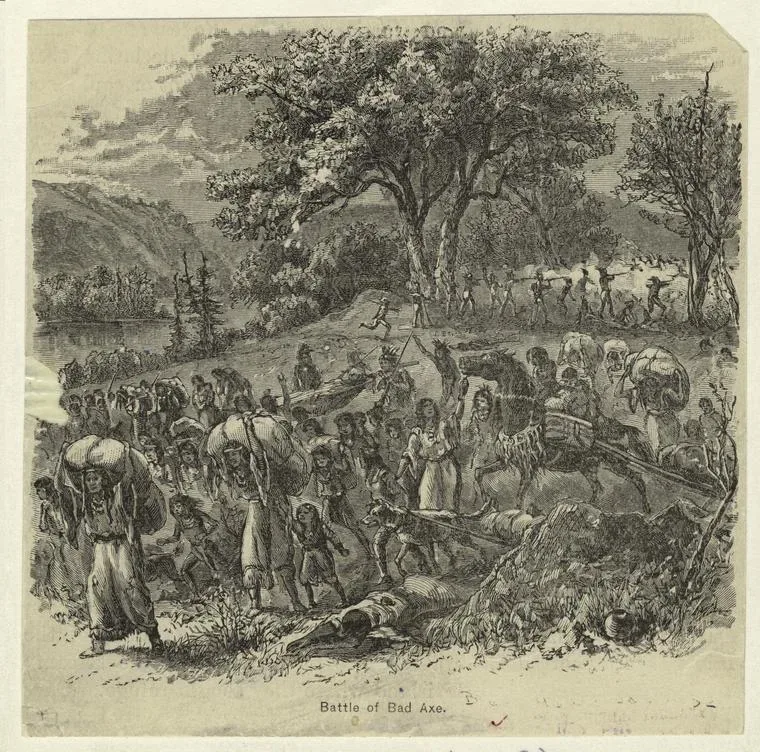
The Black Hawk War of 1832 was the defining armed conflict of the territorial period. Black Hawk, a Sauk war leader, led a band back into Illinois and into western Wisconsin in an attempt to reclaim lands ceded under the disputed 1804 Treaty of St. Louis. The campaign ended at the Battle of Bad Axe on August 1–2, 1832, near present-day Victory, Wisconsin — a brutal engagement where U.S. forces and Menominee warriors killed several hundred Sauk and Fox men, women, and children attempting to cross the Mississippi River. The steamboat Warrior used a cannon against the fleeing band before Army infantry closed in. It was the last armed resistance to American expansion in the Upper Midwest, and it opened Wisconsin to rapid settlement.
The territorial period also saw the beginnings of organized game hunting, though it was entirely unregulated. Market hunters operated throughout the forests of northern Wisconsin, and set guns — spring-loaded firearms triggered by trip wires, used to kill deer and bear overnight — were common tools of the trade. They weren't banned until 1869, and enforcement was essentially nonexistent for decades after that.
19th Century: Statehood, the Civil War & Early Regulationedit
Early Statehood & Game Management
Wisconsin became the 30th state on May 29, 1848. The original state constitution contained no explicit right to keep and bear arms — an omission that would matter considerably 160 years later when the question of carrying firearms in public came before the courts.
The 1851 deer season closure — the first regulated hunting season in Wisconsin history — established that the state intended to manage wildlife from the beginning. The initial regulation was modest: a closed season running February 1 through June 30. But it signaled an intention to treat wildlife as a managed public resource rather than an open-commons commodity, a philosophy that would eventually produce one of the most complex deer management systems in North America.
Civil War Contributions
When the Civil War broke out in 1861, Wisconsin responded with significant manpower and some manufacturing capacity.
The state eventually contributed:
- 91,379 total soldiers
- 53 infantry regiments
- 4 cavalry regiments
- Various artillery and support units
- Milwaukee as primary mustering point
- Camp Randall in Madison as processing center
Milwaukee became the primary mustering point, and Camp Randall in Madison — now a football stadium — processed tens of thousands of recruits.
Wisconsin didn't have major federal armories, but the state did see private manufacturing activity supporting the war effort. Milwaukee-area machine shops and foundries contributed components and repair work. More significantly, Wisconsin soldiers carried Springfield Model 1861 rifle-muskets and, as the war progressed, an increasing number of breech-loading rifles including Spencer repeating carbines — weapons that gave Union cavalry a decisive firepower advantage in the war's later campaigns. Wisconsin cavalry units, including the 1st Wisconsin Cavalry, were among the units fielding Spencers by 1864.
| Wisconsin Civil War Units | Notable Engagements | Primary Weapons |
|---|---|---|
| Wisconsin Iron Brigade (2nd, 6th, 7th WI Infantry) | Gettysburg, McPherson's Ridge | Springfield Model 1861 rifle-muskets |
| 1st Wisconsin Cavalry | Various cavalry actions | Spencer repeating carbines (by 1864) |
| 53 Infantry Regiments | Multiple theaters | .58-caliber Springfield muzzleloaders |
| 4 Cavalry Regiments | Western and Eastern theaters | Spencer carbines, Colt revolvers |
The Wisconsin Iron Brigade — the 2nd, 6th, and 7th Wisconsin Infantry, along with the 19th Indiana and 24th Michigan — earned a reputation as among the hardest-fighting units in the Army of the Potomac. At Gettysburg on July 1, 1863, these regiments bore the brunt of the initial Confederate assault on McPherson's Ridge, suffering catastrophic losses but buying time for the Union line to form on Cemetery Hill. The Wisconsin Iron Brigade's casualty rate at Gettysburg exceeded 60 percent. The rifles they carried — standard .58-caliber Springfield muzzleloaders — were the same ones issued to most Union infantry, but the men who used them had become exceptionally proficient through hard experience.
Post-War Hunting Expansion
Post-war, Wisconsin's hunting culture expanded rapidly as the state's population grew and railroads opened the north woods.
| Year | Regulation | Impact |
|---|---|---|
| 1851 | First deer season closure (Feb 1 - June 30) | Established state wildlife management authority |
| 1869 | Set guns banned | Eliminated spring-loaded trap firearms |
| 1876 | Hunting deer with dogs prohibited | Reduced conflicts between sport/market hunters |
| 1887 | First game wardens appointed | Two wardens at $50/month |
| 1897 | First licensing system | Resident $1, Nonresident $30, ~12,000 licenses sold |
| 1897 | First bag limit | Two deer per season |
The 1876 prohibition on hunting deer with dogs reflected growing conflicts between sport hunters and market hunters. By 1887, Wisconsin had appointed its first two game wardens — at $50 per month — and night hunting was prohibited statewide. By 1897, the state had implemented its first bag limit (two deer per season) and its first resident license fee ($1) and nonresident license fee ($30). License sales that year totaled approximately 12,000.
The late 19th century also saw the beginning of what would become a recurring tension in Wisconsin wildlife management: the deer population was crashing. By 1910, unregulated market hunting and the loss of old-growth habitat had driven deer to record low numbers statewide. The regulatory framework that exists today was built in direct response to that collapse.
20th Century: Conservation, World Wars & the Long Road to Carry Rightsedit
Conservation Era & Deer Recovery
The early 20th century in Wisconsin was dominated by the twin projects of deer population recovery and the industrialization of Milwaukee — and both had implications for firearms culture.
On the hunting side, Wisconsin swung between open seasons and closed years repeatedly between 1925 and 1934 as managers tried to let the deer herd recover.
| Closed Years | Open Years | Rationale |
|---|---|---|
| 1927, 1929, 1931, 1933, 1935 | 1928, 1930, 1932, 1934 | Deer herd recovery |
| Key Innovations | Year | Purpose |
| Buck-only season | 1915 | Protect breeding does |
| Conservation Congress | 1933 | Democratic hunter input |
| First bow season | 1934 | Expanded hunting opportunity |
| Shotgun-only counties | 1945 | Safety in agricultural areas |
There were no open seasons in 1927, 1929, 1931, 1933, and 1935 — a level of regulatory intervention that would be politically unthinkable today. The 1915 buck-only season was the first attempt to protect does and allow herd rebuilding. The Conservation Congress, established in 1933 as an advisory body to give hunters a voice in management decisions, became one of the most unusual democratic institutions in American wildlife management — county-level hearings where hunters voted on season recommendations that carried real weight with the Conservation Commission.
The 1934 first bow deer season and the 1945 introduction of shotgun-only counties (covering agricultural areas where rifle shots could travel dangerous distances across flat terrain) both reflected Wisconsin's ongoing effort to match hunting methods to specific landscapes. These rules weren't arbitrary — they came from the particular geography of a state divided between glaciated farmland in the south and lake-dotted forest in the north.
World War Contributions
During World War I, Wisconsin contributed to the national arms buildup primarily through industrial capacity. The Cutler-Hammer company in Milwaukee manufactured electrical components critical to ammunition production equipment. After the war, Olin Corporation — which owned Winchester Repeating Arms — maintained distribution relationships with Wisconsin dealers that would persist for decades.
By World War II, Milwaukee's industrial base was fully mobilized. A.O. Smith Corporation produced artillery shells. The Allis-Chalmers plant converted to military production. Wisconsin soldiers again deployed in large numbers — the 32nd Infantry Division, known as the Red Arrow Division, had been a Wisconsin-Michigan National Guard formation since World War I and served extensively in the Pacific theater, fighting at Buna in New Guinea in 1942–43 in some of the most brutal jungle combat of the war.
On the domestic firearms front, 1938 saw Wisconsin ban the use of .22 rifles and .410 shotguns for deer hunting — caliber restrictions that reflected accumulated data on wounding rates rather than any political agenda. 1945 brought mandatory red clothing for deer hunters, later updated to blaze orange in 1980, one of the earlier state mandates of that requirement.
Peak Hunting Years
The 1950 any-deer season — the first since 1919 — produced a registered kill of 167,911, a number that shocked even the managers who had been trying to grow the herd. Wisconsin led the nation in whitetail harvest for three consecutive years starting in 1949.
| Year | Harvest Record | Significance |
|---|---|---|
| 1950 | 167,911 deer | First any-deer season since 1919 |
| 1949-1951 | 3 consecutive years | Wisconsin led nation in whitetail harvest |
| 1981-1985 | New record each year | Peak: 274,302 in 1985 |
| 1962 | ~400,000 estimated population | Successful herd recovery |
| 1980s peak | ~680,000 gun licenses sold | All-time participation high |
By 1962, the statewide deer population was estimated above 400,000 animals.
The 1980s were the decade of record harvests. From 1981 through 1985, Wisconsin set a new gun deer harvest record every single year — rising from 166,673 to 274,302. This wasn't luck; it was the product of aggressive antlerless permitting, extended seasons, and the Hunter's Choice permit system introduced in 1980. 1984 added handgun deer hunting in shotgun areas, and 1988 opened handgun hunting statewide.
The Carry Rights Battle
The firearms carry question was a different story. Wisconsin had a law dating to 1872 that broadly prohibited carrying concealed weapons, and by the 20th century it had calcified into one of the most restrictive carry regimes in the country. The state had no concealed carry permit system at all — not a shall-issue system, not even a may-issue system. Carrying a concealed firearm was simply a criminal offense with narrow exceptions.
Attempts to pass concealed carry legislation began in earnest in the 1990s. Bills were introduced and killed repeatedly throughout the decade. In 1995 and again in 1997, the Wisconsin legislature passed concealed carry bills that Governor Tommy Thompson declined to sign into law despite being a Republican — a reflection of how complicated the politics were even within the party. In 1999, Thompson finally signed a modified version, but it was so restricted in scope as to be nearly meaningless for most carriers.
The real turning point came through the courts. In State v. Hamdan (2003), the Wisconsin Supreme Court ruled that the concealed carry prohibition as applied to a convenience store owner carrying a firearm for protection behind his own counter was unconstitutional as applied. The decision didn't create a right to carry broadly, but it cracked the door. In State v. Cole (2003), decided the same year, the court addressed the open carry question and acknowledged that Wisconsin's constitution — despite containing no explicit arms guarantee at the time — incorporated some right to armed self-defense.
The 140-year path from concealed carry ban to shall-issue permits
The 2011 constitutional amendment changed everything. On November 2, 2010, Wisconsin voters ratified an amendment to Article I, Section 25 of the state constitution, adding an explicit right to keep and bear arms for security, defense, hunting, recreation, or any other lawful purpose. The vote wasn't close — it passed with approximately 75 percent support. Within months, the newly elected Governor Scott Walker signed 2011 Wisconsin Act 35 into law on July 8, 2011, creating a shall-issue concealed carry permit system. After nearly 140 years, Wisconsin became the 49th state to allow concealed carry.
Modern Era (2000–Present)edit
Concealed Carry Revolution
The 2011 concealed carry law transformed Wisconsin's firearms landscape almost immediately. The Department of Justice processed the first permits in November 2011, and within a year more than 100,000 Wisconsinites had obtained licenses.
| Year | CCW Permits | Milestone |
|---|---|---|
| Nov 2011 | First permits issued | Act 35 implementation |
| 2012 | ~100,000 | First full year |
| 2020 | 400,000+ | Steady growth |
| Constitutional Amendment | Nov 2, 2010 | 75% voter approval |
| Act 35 signed | July 8, 2011 | Shall-issue system created |
| 49th state | 2011 | Only Illinois remained no-carry |
By 2020, that number had grown past 400,000 active permits.
CWD Crisis & Hunter Decline
The Chronic Wasting Disease (CWD) crisis that emerged in Wisconsin in 2001 fundamentally altered the deer hunting landscape. CWD — a prion disease fatal to deer — was first detected in the state's southwest corner in Iowa and Dane Counties.
How Chronic Wasting Disease management impacted Wisconsin hunting culture
The DNR's response was aggressive and deeply unpopular: the Eradication Zone established in 2002 required hunters to kill antlerless deer before bucks, with additional antlerless permits distributed in affected areas. The Earn-A-Buck requirement, which had briefly appeared in 1996 as a herd-control tool and been abandoned, was resurrected with much greater scope. Hunters were furious. The Conservation Congress voted overwhelmingly against the program. The political battle over CWD management lasted years and is widely credited with accelerating the decline in deer hunter numbers — from a peak of roughly 680,000 gun deer licenses sold in the 1980s, participation dropped significantly through the 2000s.
Wisconsin's Hunter Education Program, which had begun in 1967, had by the 2000s produced dramatic reductions in hunting accidents. The state went from 24 hunter fatalities in a single year (1914) to periods of multiple years without a single hunting death — a transformation driven by mandatory education, blaze orange requirements, and better firearm handling practices.
Political Polarization
The Sandy Hook shooting in December 2012 accelerated political polarization in Wisconsin just as it did nationally. Milwaukee Democratic legislators pushed for universal background checks, magazine capacity limits, and assault weapon restrictions. Republican legislative majorities blocked all of it. The 2013-2014 legislative session saw some of the most contentious firearms debates in Wisconsin history, with neither side achieving major movement.
Recent Legislative Changes
2015 brought the elimination of Wisconsin's 48-hour waiting period for handgun purchases — 2015 Wisconsin Act 117 removed a requirement that had required buyers to wait two days after a background check cleared before taking possession of a handgun. Supporters argued it was an unconstitutional burden on a constitutional right; opponents argued it reduced impulsive violence. The waiting period repeal passed along party lines.
A silencer/suppressor legalization bill passed in 2011 as part of the broader firearms law overhaul, aligning Wisconsin with the majority of states that permit NFA-regulated suppressors for hunting and sport use. Wisconsin hunters can now use suppressors during deer season — a change driven partly by hearing conservation arguments and partly by the same rural Republican coalition that passed the carry law.
The 2020-2021 COVID period drove a nationwide surge in firearm sales, and Wisconsin reflected that trend. FBI NICS background check data for Wisconsin showed a roughly 40 percent increase in checks in 2020 compared to 2019. First-time buyers accounted for a disproportionate share — an estimated 20-25 percent of purchasers nationally were buying their first firearm, and Wisconsin dealers reported similar patterns.
Constitutional carry — permitless carry — has been introduced in the Wisconsin legislature multiple times since 2017 and has not passed as of early 2026. The political math is straightforward: Republicans have supported it, Democrats have opposed it, and Governor Tony Evers (elected 2018, re-elected 2022) has made clear he would veto any such bill. Short of a Republican supermajority capable of overriding a veto, constitutional carry is not arriving in Wisconsin in the near term.
Notable Figures & Manufacturersedit
Aldo Leopold isn't primarily known as a firearms figure, but his influence on Wisconsin's hunting culture is impossible to overstate. A University of Wisconsin-Madison professor and the father of modern wildlife ecology, Leopold's 1933 book Game Management essentially created the scientific framework for regulated hunting as a conservation tool.
Leopold's philosophy — that hunters and their license fees should fund wildlife recovery — shaped how Wisconsin (and eventually every other state) manages deer, turkey, and waterfowl.
His later work, A Sand County Almanac (1949), anchored the land ethic that still defines how most Wisconsin hunters think about their relationship to the resource.
Les Voorhees and the early leadership of the Wisconsin Conservation Congress deserve recognition for institutionalizing hunter input into wildlife management. The Conservation Congress — a unique democratic body with no real equivalent in other states — gave Wisconsin hunters a formal mechanism to influence season structures and regulations through county-level votes. It's been imperfect and sometimes captured by special interests, but it's also the reason Wisconsin deer hunters feel more ownership over management decisions than hunters in most states.
On the manufacturing side, Wisconsin's most significant firearms-related industry has historically been in components and accessories rather than complete firearms. Badger Ordnance, based in Columbia, Missouri but with Wisconsin connections, is one example of the precision rifle components industry. More directly, Kahr Arms has no Wisconsin manufacturing, but Armalite had Wisconsin connections through its early history.
The more significant Wisconsin firearms industry story is in distribution and retail. Gander Mountain — a major outdoor retail chain — was headquartered in St. Paul, Minnesota but had extensive Wisconsin operations and shaped how a generation of Wisconsin hunters bought firearms. After its 2017 bankruptcy, Gander Outdoors stores continued in Wisconsin under Camping World ownership.
Gemtech, one of the older suppressor manufacturers, has no Wisconsin origins, but Wisconsin's 2011 suppressor legalization created a significant retail market for suppressor dealers in the state — particularly in the Fox Valley and Milwaukee suburban areas where demand from hunters and competitive shooters is high.
In competitive shooting, Wisconsin has produced nationally ranked USPSA and 3-Gun competitors, and the Badger Ordnance Cup precision rifle matches have drawn competitors from across the Midwest. The state's 4-H Shooting Sports program is among the larger in the Upper Midwest, with clubs in most counties.
Current Legal Landscapeedit
Constitutional Foundation
The right to keep and bear arms is protected under both the Second Amendment (incorporated to the states via McDonald v. City of Chicago, 2010) and Wisconsin's own Article I, Section 25, ratified in 2010.
Carry Laws
Concealed Carry: Wisconsin is a shall-issue state. The Wisconsin CCW license is issued by the Department of Justice.
| CCW Requirement | Details |
|---|---|
| Minimum Age | 21 years |
| Citizenship | U.S. citizen or legal permanent resident |
| Training | Firearms safety/training course required |
| Background Check | Must pass DOJ screening |
| Validity Period | 5 years |
| Reciprocity | Recognized by most states |
The license is valid for five years and is recognized by a substantial number of other states through reciprocity agreements. Wisconsin recognizes permits from most states, though specific reciprocity arrangements change — checking the DOJ's current list before traveling is mandatory.
Open Carry: Wisconsin is an open carry state with no permit required. Any person not prohibited from possessing a firearm may carry openly in most public places. Local governments cannot enact ordinances more restrictive than state law — Wisconsin Statute 66.0409 preempts local firearms ordinances, meaning Milwaukee and Madison cannot ban open carry or impose their own handgun regulations.
Waiting Periods: None. The 48-hour handgun waiting period was repealed in 2015. NICS background check required for dealer sales; no state-mandated waiting period beyond the time it takes to run the check.
Purchase & Transfer Rules
Private Sales: No background check required for private party transfers. Wisconsin does not have universal background check requirements.
Assault Weapons / Magazine Limits: None at the state level. Wisconsin has no assault weapons ban and no magazine capacity restrictions.
Suppressors: Legal with proper NFA registration (Form 4 or Form 1). Legal for hunting deer and other game.
NFA Items: Machine guns, short-barreled rifles, short-barreled shotguns, and other NFA items are legal for civilians to possess in Wisconsin with proper federal registration. No additional state tax stamp or registration required beyond federal compliance.
Restrictions & Prohibited Places
Even with a valid CCW license, carrying is prohibited in:
| Prohibited Locations | Details |
|---|---|
| Police/Correctional Facilities | All law enforcement buildings |
| Courts | Courthouses and courtrooms |
| Government Buildings | Legislative proceedings areas |
| Schools | K-12 grounds (exceptions for locked vehicles) |
| Bars/Taverns | When licensee is consuming alcohol |
| Posted Premises | Where owner prohibits carry |
Preemption: Strong. Wis. Stat. 66.0409 prohibits cities, counties, and towns from enacting firearms ordinances more restrictive than state law. This has been tested multiple times — Milwaukee repeatedly attempted to enact local regulations and was blocked each time.
Red Flag / ERPO: Wisconsin does not have an Extreme Risk Protection Order law as of early 2026. Several bills have been introduced; none have passed.
Safe Storage: No mandatory safe storage law for firearms generally, though Wisconsin does have provisions related to minors' access.
The BGC Takeedit
Wisconsin is one of the more interesting gun states to read from the outside, because the stereotype doesn't fit. It's not Texas — loud, expansive, politically uncomplicated. And it's not California — coastal urban priorities setting the agenda for rural residents who feel ignored. Wisconsin is genuinely split, and that split is real and contentious and produces legislative gridlock that frustrates both sides.
The gun culture in Wisconsin is overwhelmingly built around hunting, specifically deer. If you want to understand why Wisconsin passed a constitutional amendment protecting the right to bear arms with 75 percent of the vote, understand that a huge swath of the electorate — including many who vote Democratic in gubernatorial races — hunts deer.
The November gun opener is not a hobby in rural Wisconsin. It's a cultural institution that closes schools, empties factories, and has shaped family patterns for four generations.
Telling those people that their gun rights are under siege lands very differently than it does in, say, Houston, where the gun culture is more explicitly political.
The result is a state that's hard to legislate in either direction. Republicans have supermajorities in the legislature but can't get constitutional carry past a Democratic governor. Democrats have held the governorship repeatedly but can't get universal background checks or magazine limits past the legislature. The stalemate isn't dysfunction — it's an accurate representation of what Wisconsin actually is: a state where rural and urban gun cultures have roughly equal institutional power and neither can fully impose its preferences on the other.
For gun owners practically living in Wisconsin, it's actually a solid state. Shall-issue carry with reciprocity, no assault weapons ban, no magazine limits, suppressor-legal hunting, strong preemption preventing Milwaukee from becoming its own regulatory island — these are real wins that didn't happen by accident. They happened because Wisconsin's rural hunting culture maintained enough political weight to prevent the urbanization of firearms law even as Milwaukee and Madison grew.
The deer hunting decline is the real long-term concern. When the hunting population shrinks — whether because of CWD, changing demographics, urban sprawl eating habitat, or young people not being brought into the tradition — the political constituency for firearms-friendly law shrinks with it. The organizations working on hunter recruitment in Wisconsin understand this explicitly. The $30 nonresident license fee from 1897 and the 91,000 Civil War veterans aren't the constituency anymore. The question is whether Wisconsin can rebuild a modern constituency that keeps the political math working for the next 50 years.
For now, Wisconsin is a place where you can hunt deer with a suppressor and a handgun, carry concealed with a shall-issue permit, and still have arguments at the county Conservation Congress about whether the DNR is setting antlerless quotas too high. That's Wisconsin. It's messy and specific and genuinely its own thing.
Referencesedit
- Wisconsin Council on Forestry. Deer Impacts: Hunting Chronology. Wisconsin DNR. https://councilonforestry.wi.gov/Pages/DeerImpacts/HuntingChronology.aspx
- PBS Wisconsin. When Deer Hunting in Wisconsin Shifted from Slaughter to Sport. https://pbswisconsin.org/news-item/when-deer-hunting-in-wisconsin-shifted-from-slaughter-to-sport/
- Wisconsin Legislature. 2011 Wisconsin Act 35 (Concealed Carry). https://docs.legis.wisconsin.gov
- Wisconsin Legislature. Wisconsin Statute 66.0409 (Firearms Preemption). https://docs.legis.wisconsin.gov
- NRA-ILA. Wisconsin Gun Laws. https://www.nraila.org/gun-laws/state-gun-laws/wisconsin/
- Wisconsin Department of Justice. Concealed Carry Weapon License Program. https://www.doj.state.wi.us/dles/cib/conceal-carry
- Wisconsin Supreme Court. State v. Hamdan, 2003 WI 113.
- Wisconsin Supreme Court. State v. Cole, 2003 WI 112.
- Leopold, Aldo. Game Management. Charles Scribner's Sons, 1933.
- Leopold, Aldo. A Sand County Almanac. Oxford University Press, 1949.
- Quaife, Milo M. Wisconsin: Its History and Its People. S.J. Clarke Publishing, 1924.
- Wisconsin Historical Society. Black Hawk War. https://www.wisconsinhistory.org
- Wisconsin Historical Society. Iron Brigade. https://www.wisconsinhistory.org
- Wisconsin DNR. NR 10 — Game and Fur Animals. https://docs.legis.wisconsin.gov/code/admin_code/nr/001/10.pdf
- Game & Fish Magazine. Wisconsin's Deer Management War, Part 1. https://www.gameandfishmag.com
Last Updated: February 24, 2026
- Quail Creek Plantation(Okeechobee, FL)
- 2aHawaii(Honolulu, HI)
- Boston Firearms(Everett, MA)
- Safeshoot(Kingston, NY)
Loading comments...