State Details
Arkansas
Overview | |
|---|---|
State | Arkansas (AR) |
Capital | Little Rock |
Statehood | 1836 |
Population | 3,067,732 |
Gun Ownership | 57.2% |
Active FFLs | 1,053 |
Carry Laws | |
Constitutional Carry | Yes (2023) |
Open Carry | Yes |
CCW Permit Available | Yes |
Permit Reciprocity | 36+ states |
Self-Defense | |
Castle Doctrine | Yes |
Stand Your Ground | Yes |
Duty to Retreat | No |
Regulations | |
State Preemption | Yes |
Red Flag / ERPO | No |
Waiting Period | None |
Universal BGC | No |
NFA Items | Yes |
Assault Weapons Ban | No |
Magazine Limit | None |
Key Legislation | |
| |
Arkansas Firearms History: From Frontier Territory to Constitutional Carry
Reference article
From The Boise Gun Club Handbook
Overviewedit

Arkansas sits at a crossroads in American firearms history that most people overlook. It's not Virginia with its colonial militias, not Texas with its revolution mythology, and not Pennsylvania with its rifle-making tradition. What Arkansas offers is something more complicated and, honestly, more interesting—a state that developed one of the most legally sophisticated approaches to gun regulation in the 19th-century South, produced some of the most consequential knife-and-gun jurisprudence in American legal history, and then swung hard toward permissive carry law in the modern era.
The state's constitutional arms provision—Article 2, Section 5—reads:
The citizens of this State shall have the right to keep and bear arms, for their common defense.
That phrase "common defense" instead of "defense of themselves and the State" isn't a minor wording choice. It defined how Arkansas courts interpreted the right for well over a century and produced a body of case law that federal judges still argue about today.
Arkansas also sits at the intersection of several distinct American gun cultures: the Scots-Irish upland South tradition of the Ozarks, the Delta cotton economy with its plantation-era tensions, and the frontier violence of Indian Territory on its western border. Those three cultures didn't always agree on much, but they all involved firearms—and the political history of guns in Arkansas reflects those competing pressures at every turn.
Territorial Era & Early Statehoodedit
Before Arkansas was anything on a map, the land was Osage and Quapaw territory. Both nations had been acquiring European firearms through trade networks since the late 17th century—French traders working down from Canada and Illinois country reached the Arkansas River valley by the 1680s.
Henri de Tonti established a French post near the mouth of the Arkansas River in 1686, and the fur trade that followed put French muskets and trade guns into Native hands across the region for generations. The Quapaw, situated along the lower Arkansas River, became particularly enmeshed in French trade. By the time Spanish administration took over the region in 1762, the pattern was already set: European firearms flowed into the territory through formal trade and informal exchange, and Native nations used them both for hunting and to reshape the regional balance of power.
The Osage, dominant in the northern and western portions of what would become Arkansas, leveraged their access to firearms aggressively against neighboring nations throughout the 18th century.
| Period | Key Development | Firearms Impact |
|---|---|---|
| 1680s | French trading posts established | European muskets enter Native trade networks |
| 1762 | Spanish administration begins | Established firearms trade continues |
| 1803 | Louisiana Purchase | American territorial control begins |
| 1819 | Arkansas Territory organized | Scots-Irish settlers bring long rifle culture |
| 1820s-30s | Bowie knife prominence | Legislative attention to edged weapons |
| 1836 | Arkansas statehood | Constitutional arms provision established |
American territorial administration began after the Louisiana Purchase of 1803. Arkansas Territory was formally organized in 1819, carved out of Missouri Territory. The territorial period brought a flood of Scots-Irish settlers from Tennessee and Kentucky—people who brought long rifle culture with them.
The Kentucky rifle tradition, already evolving toward what collectors now call the Tennessee rifle, shaped the material culture of early Arkansas settlements. These weren't decorative pieces. The Ozark and Ouachita highlands demanded self-sufficiency, and a rifle was as essential as an axe.
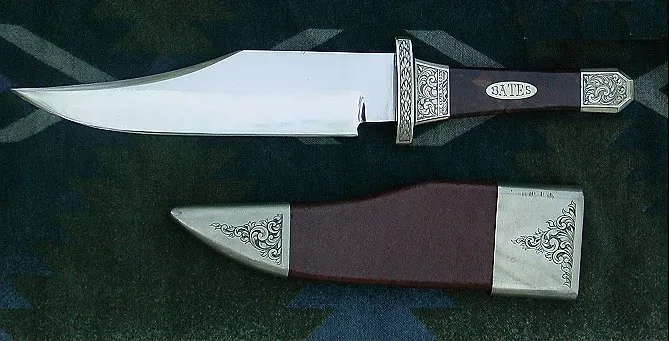
The Bowie knife enters Arkansas history during this period in a way that's more than legend. James Bowie spent significant time in Arkansas in the late 1820s, operating land speculation schemes in the territory and running in the same circles as some genuinely dangerous men. The famous Sandbar Fight of 1827 occurred on a sandbar in the Mississippi River near Natchez, Mississippi, but Bowie's connections to Arkansas were real—he had business dealings in the territory and his reputation preceded him throughout the region.
The knife design associated with his name became culturally embedded in Arkansas in ways that later produced specific legislation. By the 1830s, Arkansas merchants were advertising Bowie knives for sale, and the weapon was common enough that the territorial legislature took notice.
Arkansas achieved statehood on June 15, 1836, entering the Union as the 25th state. The original state constitution included an arms provision that would prove consequential far beyond the state's borders.
19th Century: Antebellum Law, Civil War & Reconstructionedit
Why the legal history matters: Arkansas produced two of the most-cited state court decisions on arms rights in the entire 19th century, and they came from completely different directions.
Antebellum Weapons Regulation
The antebellum period brought the first serious legislative engagement with firearms and edged weapons. The Bowie knife specifically drew legislative attention—Arkansas enacted restrictions on carrying concealed Bowie knives and similar weapons in the 1830s. The cultural logic was straightforward: dueling and "street fighting" with large knives had become a genuine public safety problem in frontier settlements, and the legislature responded.
These early restrictions were aimed primarily at concealed carry of specific weapon types, not at possession generally.
Civil War and Military Hardware
The Civil War interrupted the legal development but accelerated the proliferation of firearms throughout the state. Arkansas seceded on May 6, 1861, joining the Confederacy despite significant Unionist sentiment in the Ozark highlands. The state became a major theater of operations—the Battle of Pea Ridge in March 1862 was one of the largest engagements west of the Mississippi, involving roughly 26,000 men.
Marks' Mill (April 1864) and Jenkins' Ferry (April 1864) were part of the Camden Expedition, a Union campaign that left the state's interior deeply scarred.
The war flooded Arkansas with military-issue firearms. Springfield muskets, Enfield rifles, Colt revolvers, and captured Confederate arms circulated throughout the state in enormous quantities. When the war ended, that hardware didn't disappear—it distributed itself into an already-volatile post-war society.
Reconstruction Violence and Legal Response
Reconstruction Arkansas was genuinely violent. The Brooks-Baxter War of 1874—a disputed gubernatorial election that produced two rival claimants to the governorship, each with armed supporters—was the kind of political violence that made gun regulation feel urgent to legislators. Elisha Baxter and Joseph Brooks both had armed militias, and the conflict required President Grant's intervention to resolve. It wasn't abstract politics; people died.
The Reconstruction-era legislature attempted broad public disarmament policy, and the Arkansas Supreme Court pushed back hard.
Landmark Court Cases
The pivotal case was Wilson v. State (1878). The court reversed earlier precedent and held that the legislature's authority to regulate how weapons were carried did not give it power to criminalize carrying weapons altogether. The court's most quoted line from Wilson is worth reading straight:
If cowardly and dishonorable men sometimes shoot unarmed men with army pistols or guns, the evil must be prevented by the penitentiary and the gallows, and not by a general deprivation of a constitutional privilege.
That sentence has been cited in Second Amendment litigation into the 21st century.
The legislature's response to Wilson was characteristically creative. Taking a page directly from Tennessee's approach—Arkansas legislators had watched State v. Burgoyne (1881) in Tennessee uphold a sales ban without dissent—Arkansas enacted a two-pronged system. The public carry law was revised to permit army/navy pistols carried openly in the hand (a narrow carve-out that acknowledged the constitutional protection while restricting the most common street carry weapons). Then the legislature added a sales ban on non-army/navy pistols: it became illegal to sell, give, or transfer belt or pocket pistols that weren't army or navy models.
The sales ban was arguably more consequential than the carry restriction. It didn't just regulate where you could carry—it limited what pistols could legally enter the market at all. The "army/navy" distinction mapped onto a real price difference: military-specification revolvers like the Colt Single Action Army cost considerably more than the cheap "suicide specials" flooding the market in the 1870s and 1880s. In practice, this created a price floor that put legal handguns out of reach for much of the rural Black population.
The racial dimension of Arkansas gun law in this era is genuinely contested among historians. The Duke Center for Firearms Law scholarship notes that simplistic accounts—either dismissing these laws as straightforwardly racist or defending them as race-neutral—both miss the complexity. What's clear is that enforcement was uneven, that Black Arkansans faced the greatest practical barriers to legal armed self-defense, and that the sales ban's economic effect fell hardest on the poorest residents regardless of the legislature's stated intent.
| Case | Year | Court | Key Holding | Modern Relevance |
|---|---|---|---|---|
| State v. Buzzard | 1842 | Arkansas Supreme Court | Upheld concealed carry restrictions; "common defense" = militia focus | Cited in post-Bruen litigation for historical precedent |
| Wilson v. State | 1878 | Arkansas Supreme Court | Legislature cannot criminalize all weapon carrying | "Gallows not deprivation" quote cited in federal cases |
| State v. Burgoyne | 1881 | Tennessee Supreme Court | Upheld sales ban on non-military pistols | Model for Arkansas sales ban legislation |
The earlier case of State v. Buzzard (1842) deserves mention here. The Arkansas Supreme Court upheld concealed carry restrictions in that case, reasoning from the "common defense" language in the state constitution that the right was oriented toward collective militia service rather than individual self-defense. Buzzard became a touchstone for legal scholars arguing that some historical state courts interpreted the Second Amendment's predecessor provisions in militia-focused terms—exactly the kind of historical precedent that gets argued about in post-Bruen litigation.
20th Century: Wars, Industry & the Long Quietedit
The early 20th century in Arkansas was shaped less by gun legislation than by the twin pressures of the Great Migration and World War I. Firearms were ubiquitous in rural Arkansas—hunting was subsistence, not sport, for much of the Ozark and Delta population—but the legal and political landscape was relatively static from the 1880s through World War II.
World War I and Camp Pike
World War I pulled Arkansas men into the military in large numbers. The 87th Division, which trained at Camp Pike (now Camp Robinson) north of Little Rock, deployed to France in 1918. Camp Robinson became a permanent installation after the war—renamed Camp Joseph T. Robinson in 1937 after Arkansas Senator Joseph T. Robinson, who served as Senate Majority Leader and was Franklin Roosevelt's running mate in 1928. The installation remains active today as Camp Joseph T. Robinson, the largest National Guard training facility in the United States.
World War II Defense Manufacturing
World War II transformed Arkansas's relationship with defense manufacturing. The Arkansas Ordnance Plant at Camden came online in 1941, manufacturing artillery shells and explosives. Camden's location in Ouachita County wasn't accidental—the region had railroad access, a dispersed population (reducing bomb-target concerns), and available labor.
The plant employed thousands of Arkansans at its peak and established the defense manufacturing footprint that Camden still carries today.
| Installation/Facility | Location | Period | Primary Function | Legacy |
|---|---|---|---|---|
| Camp Pike/Robinson | North Little Rock | 1917-present | Military training | Largest National Guard facility in US |
| Arkansas Ordnance Plant | Camden | 1941-present | Artillery shells, explosives | Foundation of Camden defense corridor |
| 87th Division | Camp Pike | WWI | Infantry training | French deployment 1918 |
| 98th Division | Camp Robinson | WWII | Infantry training | Processed hundreds of thousands |
Camp Robinson served as a major training installation throughout the war, processing hundreds of thousands of soldiers through basic and advanced infantry training. The 98th Division and elements of multiple other units trained there. The practical effect was that a generation of Arkansas men became proficient with M1 Garand rifles, M1 Carbines, and Colt M1911 pistols—hardware that came home with veterans and filtered into the state's already-dense civilian gun culture.
Federal Gun Law and State Response
The National Firearms Act of 1934 and the Federal Firearms Act of 1938 imposed federal frameworks that superseded much of Arkansas's 19th-century regulatory architecture. The old army/navy pistol distinction became legally irrelevant as federal licensing and transfer requirements took hold. Arkansas's own statutes remained on the books but were increasingly overshadowed by federal law.
The post-war period in Arkansas coincided with the state's painful reckoning with civil rights. The Little Rock Central High School Crisis of 1957—Governor Orval Faubus's use of the Arkansas National Guard to block desegregation, followed by President Eisenhower federalizing the Guard and sending the 101st Airborne Division to enforce integration—put Arkansas at the center of a national confrontation in which armed force and political authority were deeply entangled. The Guard's role in that crisis, and the visible presence of military firearms in a domestic civil rights context, left marks on the state's political memory that don't map neatly onto any simple gun-rights narrative.
The Gun Control Act of 1968 passed in the wake of the King and Kennedy assassinations, and Arkansas's congressional delegation split on it in ways that reflected the state's complicated politics. The state's Democratic tradition, still dominant in 1968, was internally divided between more conservative rural representatives and the national party's direction.
Modern Era (2000–Present)edit
Arkansas entered the 21st century with a firearms culture that was deep, broad, and not particularly interested in the permission of Fayetteville or Little Rock to exercise it. The state's gun ownership rate consistently ranks among the highest in the country—estimates put it above 55% of households—and the political direction of the legislature since the 2010 Republican wave has run consistently toward expanding carry rights.
The Constitutional Carry Evolution
The major legislative development of the modern era was Act 746 of 2013. The bill amended Arkansas Code Annotated § 5-73-120 in ways that, depending on who you asked, either created constitutional carry (permitless carry) or simply clarified existing law on carrying for journey or lawful purposes. The ambiguity was genuine—the statute's language was interpreted differently by different prosecutorial offices across the state, and the Arkansas Attorney General issued opinions trying to clarify it. The practical effect was that many Arkansans began carrying without permits on the understanding that Act 746 permitted it.
The legislature cleaned up that ambiguity with Act 562 of 2017, which explicitly authorized permitless concealed carry for anyone 18 or older who could legally possess a firearm. Arkansas became one of the earlier Southern states to adopt what's now commonly called constitutional carry, joining a wave that has since expanded to over half the country.
Enhanced Carry and Location Expansions
Subsequent legislation expanded where concealed carry is permitted. Act 859 of 2017 created a process for concealed carry at churches and places of worship. Legislation in 2017 also addressed carry at polling places and university campuses—the university carry provision allowed licensed carry by faculty and staff with enhanced training, a compromise that satisfied neither side fully but passed.
The Enhanced Concealed Carry License (ECCL) program, established through Arkansas State Police, requires additional training hours and qualifies holders to carry in more locations than the standard license. It's a tiered system that's somewhat unusual nationally—Arkansas essentially has three carry tiers: no permit (constitutional carry baseline), standard Concealed Handgun Carry License (CHCL), and the enhanced license.
| Legislation | Year | Key Provision | Impact |
|---|---|---|---|
| Act 746 | 2013 | Amended carry statute | Created constitutional carry ambiguity |
| Act 562 | 2017 | Explicit permitless carry | Clear constitutional carry authorization |
| Act 859 | 2017 | Church carry process | Expanded carry locations |
| University carry | 2017 | Licensed faculty/staff carry | Compromise solution with enhanced training |
Defense Manufacturing Growth
The Camden defense corridor has grown substantially in the modern era. Aerojet Rocketdyne (now L3Harris) operates a major propulsion and munitions facility in Camden. General Dynamics Ordnance and Tactical Systems has a significant Camden presence. The cluster of defense contractors in Ouachita County makes Camden one of the most defense-manufacturing-dense small cities in the United States on a per-capita basis—a fact that doesn't get much national attention but matters enormously to the local economy and to Arkansas's relationship with federal defense policy.
Czechoslovak Group (CSG), through its Federal Premium Ammunition brand (acquired from Vista Outdoor in 2024), has maintained distribution and operational connections in Arkansas. The state has actively recruited firearms and ammunition manufacturers through the Arkansas Economic Development Commission (AEDC), which explicitly markets the state's workforce, right-to-work status, and legal environment to the industry.
Post-Bruen Legal Landscape
The Bruen decision (2022)—New York State Rifle & Pistol Association v. Bruen—sent ripples through Arkansas law even though the state's carry regime was already permissive. The historical test articulated in Bruen has renewed interest in 19th-century Arkansas jurisprudence. Cases like Buzzard and Wilson v. State are now being argued in federal courts as either supporting or undermining various gun regulations, and Arkansas's unusually well-developed 19th-century case law has made it a reference point in the post-Bruen legal landscape.
Notable Figures & Manufacturersedit
Historical Figures
James Bowie (c. 1796–1836) grew up partly in Louisiana but spent formative years in Arkansas Territory during the 1820s. His land speculation activities and his reputation for frontier violence—culminating in the Sandbar Fight—made him a figure of both admiration and concern in the territory. The knife design associated with his name became so prevalent in Arkansas that it generated specific legislation. Whether Bowie himself designed the knife or his brother Rezin Bowie gets the credit is still argued, but the cultural imprint on Arkansas is undeniable.
Chester Ashley (1790–1848), one of Arkansas's first U.S. Senators, was a central figure in the territorial and early statehood political establishment. His connections to land law and frontier governance shaped the legal environment in which early firearms regulations developed.
Patrick Cleburne (1828–1864) was perhaps the most militarily gifted Confederate general Arkansas produced. An Irish immigrant who settled in Helena, Arkansas, and practiced law before the war, Cleburne rose to command a division in the Army of Tennessee and earned the nickname "Stonewall of the West." He was killed at the Battle of Franklin in November 1864. His reputation in Arkansas is complicated—honored by some for military skill, viewed critically by others for his role as a Confederate officer. His proposal in January 1864 to emancipate and arm enslaved men in exchange for Confederate service was controversial enough that Confederate President Jefferson Davis suppressed it. The proposal put Cleburne ahead of Confederate political reality by at least a year.
Joseph T. Robinson (1872–1937), the senator for whom Camp Robinson is named, wasn't a firearms figure specifically, but his long Senate tenure (1913–1937) and position as Majority Leader meant Arkansas had substantial influence over federal legislation including early gun law discussions in the 1930s.
Modern Manufacturing
| Company | Location | Founded | Specialization | Reputation |
|---|---|---|---|---|
| Wilson Combat | Berryville | 1977 | Custom 1911s, AR platforms | National recognition |
| Nighthawk Custom | Berryville | 2004 | High-end 1911 pistols | Premium market |
| Chemring Ordnance | Camden | Post-WWII | Ammunition, ordnance | Defense contractor |
| L3Harris/Aerojet | Camden | Post-WWII | Propulsion, munitions | Major defense presence |
On the manufacturing side, Camden, Arkansas is the city that matters most. The Arkansas Ordnance Plant evolved into what is now a cluster of defense contractors. Chemring Ordnance operates in Camden manufacturing ammunition and ordnance components. BAE Systems has had presence in the Camden corridor. The concentration of propellants, explosives, and munitions manufacturing in that single mid-Arkansas city is historically rooted in World War II mobilization decisions and has never fully unwound.
Wilson Combat has no Arkansas heritage confusion—based in Berryville, Arkansas, it absolutely does. Bill Wilson founded Wilson Combat in 1977, and the company has built a substantial reputation for custom 1911 pistols and AR-platform rifles. Berryville, a small town in Carroll County in the Ozarks, isn't where you'd expect to find a nationally recognized custom gunmaker, but Wilson Combat's presence there has made it one of the more interesting small-manufacturing stories in the state. The company employs skilled gunsmiths and machinists and has been exporting Arkansas craftsmanship to competitive shooters and serious gun owners for nearly five decades.
Nighthawk Custom, also based in Berryville, produces high-end 1911 pistols and has developed a following among serious handgun enthusiasts. The fact that two nationally recognized custom pistol manufacturers operate out of the same small Ozark town—population under 6,000—says something interesting about the concentration of gunsmithing talent and culture in that corner of Arkansas.
Current Legal Landscapeedit
Arkansas's current framework is among the most permissive in the country by most measures.
Constitutional Carry Framework
Constitutional carry is in effect—no permit required to carry concealed for anyone who can legally possess a firearm and is 18 or older. The CHCL and ECCL systems remain available voluntarily, primarily because they provide reciprocity benefits in other states and exempt holders from NICS checks at point of sale.
Article 2, Section 5 of the Arkansas Constitution protects the right to keep and bear arms for common defense. No assault weapon ban, no magazine capacity restrictions, no waiting periods, no registration requirement.
The state has preemption law that prevents cities and counties from enacting firearms regulations more restrictive than state law—Little Rock and Fayetteville cannot go their own direction on guns regardless of local political preference.
| License Type | Age Requirement | Training Required | Carry Locations | Reciprocity |
|---|---|---|---|---|
| None (Constitutional) | 18+ | None | Most public places | None |
| CHCL (Standard) | 21+ | Basic course | Standard permitted locations | Many states |
| ECCL (Enhanced) | 21+ | Additional training | Expanded locations | Most states |
Key Current Statutes
- Ark. Code Ann. § 5-73-120 — The primary carry statute, as amended by Act 746 (2013) and Act 562 (2017)
- Ark. Code Ann. § 5-73-103 — Prohibited persons (felony conviction, adjudicated mental illness, involuntary commitment)
- Ark. Code Ann. § 5-73-204/205 — Machine gun regulations, including the unusual "offensive or aggressive purpose" standard
- Ark. Code Ann. § 5-73-307 — Concealed carry license database maintained by Arkansas State Police, with explicit prohibition on using it as a firearms registration system
The Castle Doctrine is codified in Arkansas law. Stand Your Ground principles are embedded in the state's self-defense statutes, though Arkansas doesn't use that specific phrase in its code. Defensive force without duty to retreat is recognized.
Open carry is legal in Arkansas without a permit. The state does not require a permit to purchase, does not require registration, and does not require background checks for ammunition.
Location Restrictions and Exceptions
Some location restrictions apply. Firearms are prohibited in:
- Police stations and detention facilities
- Courthouses and courtrooms
- The State Capitol grounds (with limited exceptions)
- Schools (with specific exceptions for licensed staff under enhanced carry provisions)
- Bars (partial restriction based on primary purpose of the establishment)
The enhanced carry license permits carry in some locations—including churches that have adopted a security plan and certain government buildings—that are off-limits to standard licensees.
Machine gun possession is technically legal under state law if not for "offensive or aggressive purposes," though federal NFA requirements govern practically. Arkansas's machine gun statute has an unusual provision: possession by an unnaturalized foreign national or by someone with a violent felony conviction creates a legal presumption of offensive/aggressive purpose—an unusual drafting choice that reflects the statute's age.
The Arkansas State Police administers the concealed carry license program and publishes reciprocity information. Arkansas's CHCL is recognized by a large number of states, and Arkansas recognizes permits from all states that meet minimum standards.
The BGC Takeedit
Arkansas is a gun state in the same way it's a hunting state—it's not a political identity as much as it's just what people do.
Arkansas is a gun state in the same way it's a hunting state—it's not a political identity as much as it's just what people do.
You go to a gun store in Jonesboro or Fort Smith or Mountain Home, and the guy behind the counter isn't wearing his politics on his sleeve. He's just working. His customers are farmers, retired military, teachers, nurses, hunters, and competitive shooters. The gun culture here predates the culture war by about two hundred years.
What's interesting about Arkansas specifically is the legal history. People who pay attention to Bruen and the ongoing Second Amendment litigation know that Arkansas produced some of the most important 19th-century arms cases in the country. Buzzard and Wilson get cited in federal briefs today. The state's 19th-century legislature—not exactly a libertarian body—crafted a genuinely sophisticated regulatory system that contemporary scholars still argue about. That's not nothing.
The Berryville custom gun cluster—Wilson Combat and Nighthawk Custom operating out of the same small Ozark town—is one of those quietly impressive things that doesn't get enough attention. These aren't assembly operations. They're craft manufacturing shops producing pistols that gunsmiths in other states aspire to build. The fact that it happened in the Arkansas Ozarks, not in a gun-industry hub, says something about the talent pool that grew up in that culture.
The Camden defense corridor is the other story that gets undersold. That city has been making things that explode since 1941 and hasn't stopped. The concentration of propellants, ordnance, and munitions manufacturing in one mid-Arkansas town is remarkable, and it's directly tied to decisions made during World War II mobilization. The economic gravity of that industrial base keeps Arkansas relevant in federal defense contracting in ways that have nothing to do with its congressional delegation's seniority.
For gun owners thinking about Arkansas: it's a clean environment. Constitutional carry, no registration, no AWB, no magazine limits, strong preemption. The ECCL is worth getting if you travel—the enhanced training is reasonable and the reciprocity benefit is real. Camp Robinson puts a significant military culture adjacent to the civilian gun culture, which matters for training resources and for the general cultural fluency around firearms that comes with a large Guard installation.
The honest tension in Arkansas gun politics right now is between the legislature's direction—which has been consistently expanding carry rights for fifteen years—and public health data showing Arkansas has one of the higher gun death rates in the country, with suicide accounting for a majority of those deaths. That's not a simple policy argument. It involves mental health infrastructure, rural geography, economic stress, and social isolation in ways that gun law alone doesn't address. Arkansas lawmakers on both sides of that debate are generally aware of the complexity, even if the public argument rarely reflects it.
Bottom line: Arkansas is a genuine gun state with a more sophisticated legal and manufacturing history than it usually gets credit for. The frontier mythology is real, but so is the courtroom history and the industrial base. Both deserve attention.
Referencesedit
-
Rivas, Brennan Gardner. "The Problem with Assumptions: Reassessing the Historical Gun Policies of Arkansas and Tennessee." Duke Center for Firearms Law, January 20, 2022. https://firearmslaw.duke.edu
-
State v. Buzzard, 4 Ark. 18 (1842).
-
Wilson v. State, 33 Ark. 557 (1878).
-
State v. Burgoyne, 75 Tenn. 173 (1881).
-
NRA-ILA. "Arkansas State Gun Laws and Regulations Explained." Updated September 5, 2025. https://www.nraila.org/gun-laws/state-gun-laws/arkansas/
-
Arkansas Economic Development Commission. "Firearms and Ammunition Manufacturing in Arkansas." https://www.arkansasedc.com/why-arkansas/key-industries/firearms
-
Arkansas Code Annotated §§ 5-73-101 through 5-73-320 (Weapons statutes).
-
Arkansas Constitution, Article 2, Section 5.
-
Act 746 of 2013, Arkansas General Assembly.
-
Act 562 of 2017, Arkansas General Assembly.
-
New York State Rifle & Pistol Association v. Bruen, 597 U.S. 1 (2022).
-
Giffords Law Center. "Arkansas Gun Laws: A Complete Guide." https://giffords.org/lawcenter/gun-laws/states/arkansas/
-
Spitzer, Robert J. "Understanding Gun Law History after Bruen." Fordham Urban Law Journal, 2023.
-
U.S. Army. Camp Joseph T. Robinson Historical Records. Arkansas National Guard.
-
Arkansas Ordnance Plant historical records, Ouachita County, Arkansas. WWII-era industrial mobilization documentation.
Last Updated: February 24, 2026
- Quail Creek Plantation(Okeechobee, FL)
- 2aHawaii(Honolulu, HI)
- Boston Firearms(Everett, MA)
- Safeshoot(Kingston, NY)
Loading comments...