Details
Battle of Cerignola (1503)
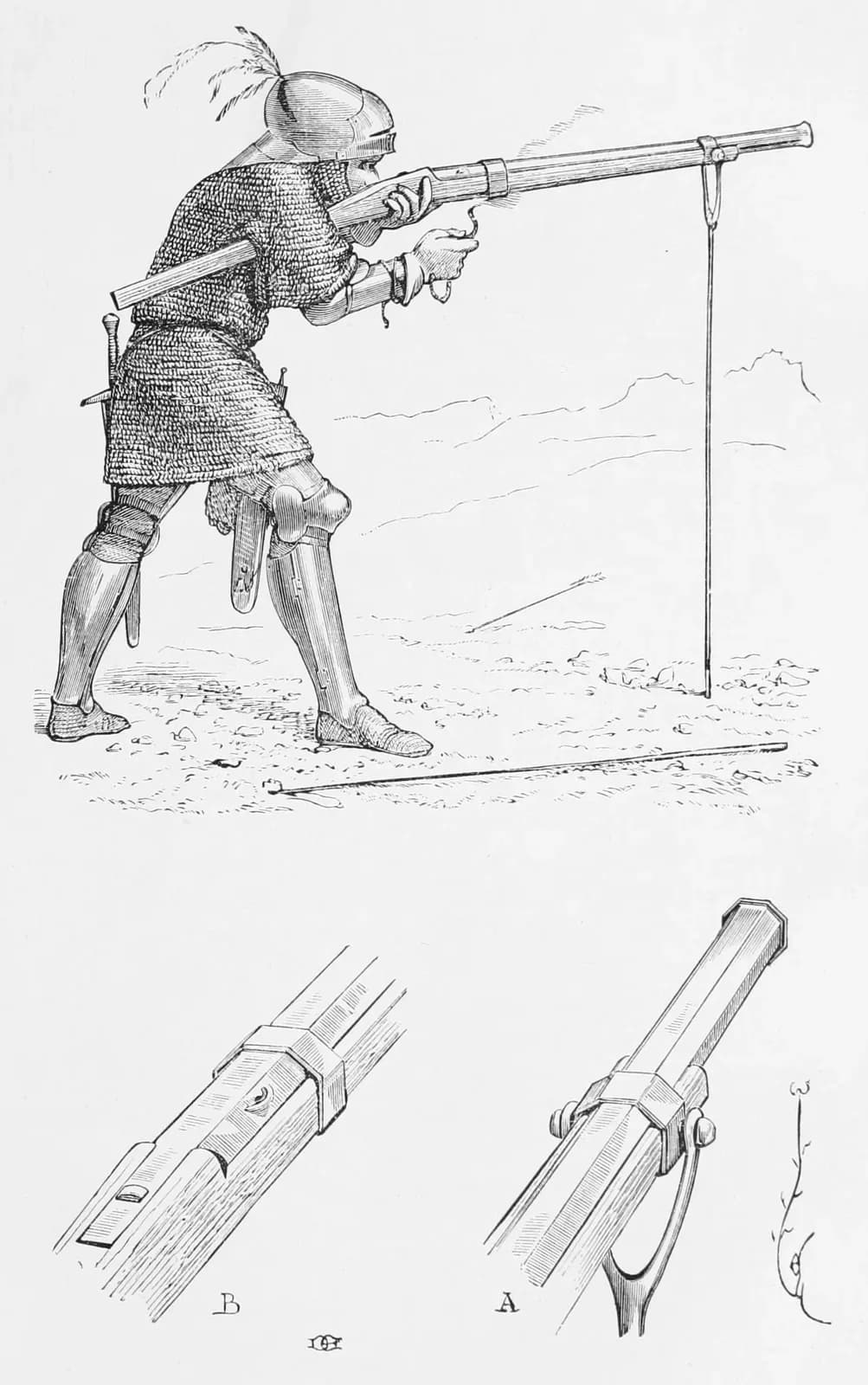
A detailed arquebus diagram from Viollet-le-Duc's encyclopedic reference — the kind of technical documentation that helped standardize matchlock design across Europe.
| Battle Details | |
|---|---|
| Date | April 28, 1503 |
| Location | Cerignola, Apulia, Kingdom of Naples |
| Belligerents | Spain vs France |
| Spanish Commander | Gonzalo Fernández de Córdoba |
| French Commander | Louis d'Armagnac, Duke of Nemours |
| Spanish Forces | Approximately 9,000 men including 1,000 arquebusiers, 2,000 Landsknecht pikemen, 700 men-at-arms, 800 light cavalry, 20 cannons |
| French Forces | Comparable size including 650 heavy gendarmes, 1,100 light horse, 3,500 Swiss infantry, 2,500-3,500 French infantry, 40 cannons |
| Result | Spanish victory; French lost 2,000-4,000 men; Spanish lost around 500 |
| Legacy | |
| Firearms Significance | First major European battle won primarily by small arms fire, establishing arquebusiers as decisive battlefield weapons and marking the end of medieval warfare. |
Battle of Cerignola (1503): The Day Small Arms Changed Everything
Firearms encyclopedia article
From The Boise Gun Club Handbook
Overviewedit
On April 28, 1503, two professional armies met outside the town of Cerignola in Apulia, in what was then the Kingdom of Naples—roughly 80 kilometers west of Bari. The Spanish force, commanded by Gonzalo Fernández de Córdoba (known to history as El Gran Capitán), numbered around 9,000 men. Across from them stood a French army of comparable size, built around elite armored cavalry and Swiss mercenary pikemen, led by Louis d'Armagnac, Duke of Nemours.
What happened next rewrote the rules of European warfare. The French attacked into prepared Spanish positions anchored by a ditch and defended by arquebusiers. The result was decisive:
- French cavalry charges collapsed against prepared positions
- Swiss pikemen—Europe's most feared infantry—were shredded on the flanks
- Duke of Nemours killed, almost certainly by arquebus fire
- French losses: 2,000-4,000 men
- Spanish losses: ~500 men
Cerignola is considered the first major European battle won primarily by small arms fire. It's the moment the medieval battlefield died.
Background & Contextedit
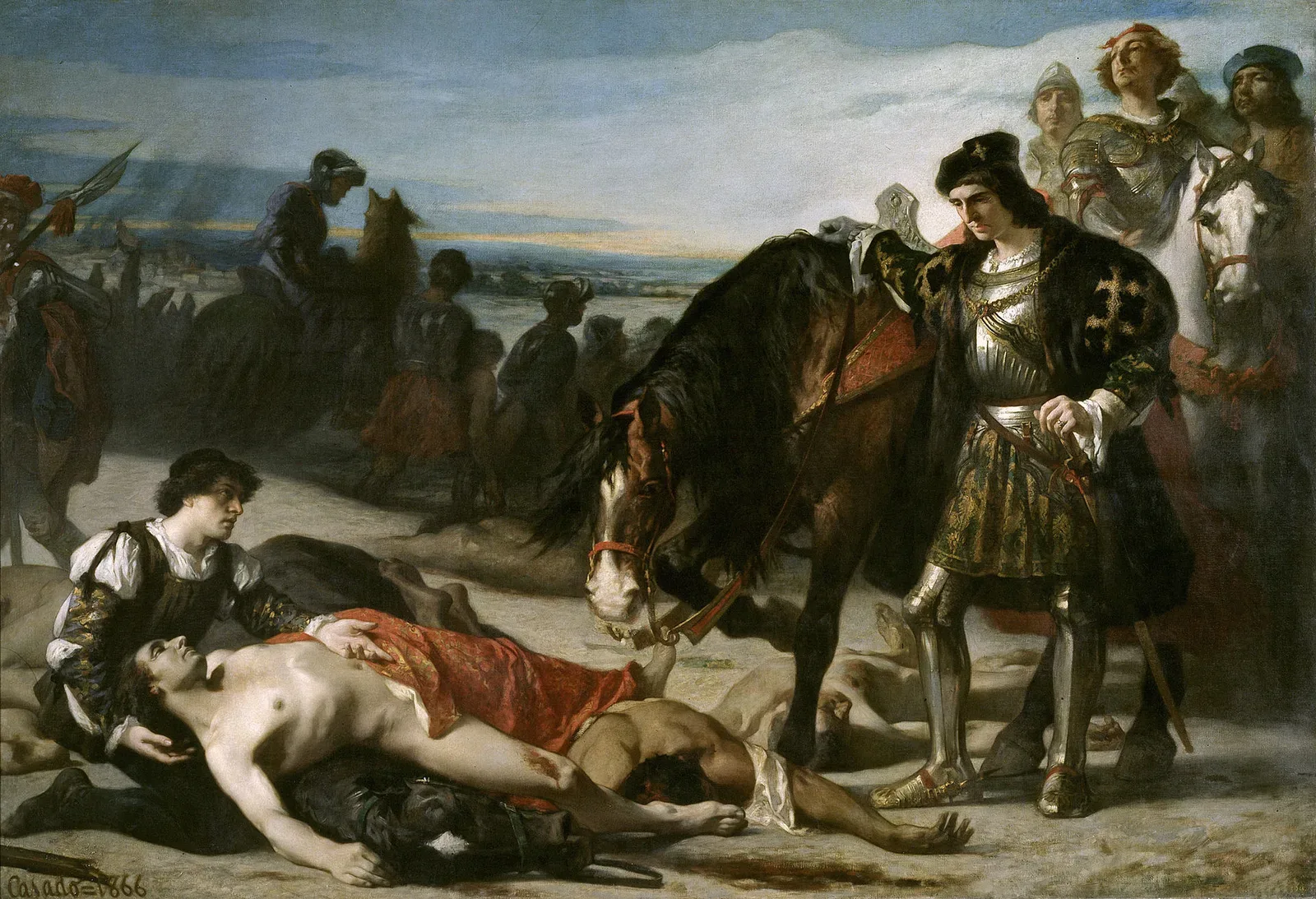
The battle grew out of the Third Italian War, reignited in late 1502 over disputes stemming from the Treaty of Granada, a secret agreement signed November 11, 1500. Under that treaty, Louis XII of France was to assume the throne of Naples—but France and Spain quickly fell into conflict over which territories belonged to whose sphere of control. Southern Italy became the proving ground.
Treaty of Granada & Third Italian War
Timeline of events leading to the Battle of Cerignola
Fernández de Córdoba had history with the French and Swiss in Italy. According to WarHistory.org, he had been beaten by a Franco-Swiss army at Seminara in 1495. He spent the years that followed adjusting his strategy—using the same methods that had worked during Spain's long Reconquista: gradual erosion of enemy positions, blockading garrisons, and avoiding open-field engagements where his army would be at a disadvantage. He didn't seek a decisive pitched battle until the terrain and conditions favored him.
Spanish Military Reforms
By 1503 he had also rebuilt the Spanish army's structure. His infantry were organized into units called coronelías—the direct predecessor of the famous tercios that would define Spanish military power for the next century. Where the old Spanish army, like the French, had centered on cavalry, these new formations combined pikes, arquebuses, and swords into integrated units capable of operating independently. The arquebus was no longer a supporting arm. It was becoming the point of the spear.
The French army that marched to meet him was no rabble. It was a professional force built on the Ordonnance reforms—heavy armored cavalry organized into the Compagnies d'ordonnance, backed by Swiss mercenary pikemen whose reputation for shock assault was essentially unmatched in Europe at the time. They also had 40 cannons, outnumbering the Spanish artillery. On paper, they held most of the advantages.
Forces & Weaponsedit
Army Compositions
| Force | Spanish Army | French Army |
|---|---|---|
| Heavy Cavalry | 700 men-at-arms | 650 heavy gendarmes |
| Light Cavalry | 800 light cavalry (jinetes) | 1,100 light horse |
| Infantry | 1,000 arquebusiers<br>2,000 Landsknecht pikemen<br>1,000+ other infantry | 3,500 Swiss infantry<br>2,500-3,500 French infantry |
| Artillery | 20 cannons | 40 cannons |
| Total Strength | ~9,000 men | ~9,000+ men |
| Commander | Gonzalo Fernández de Córdoba | Louis d'Armagnac, Duke of Nemours |
Matchlock Arquebus Technology
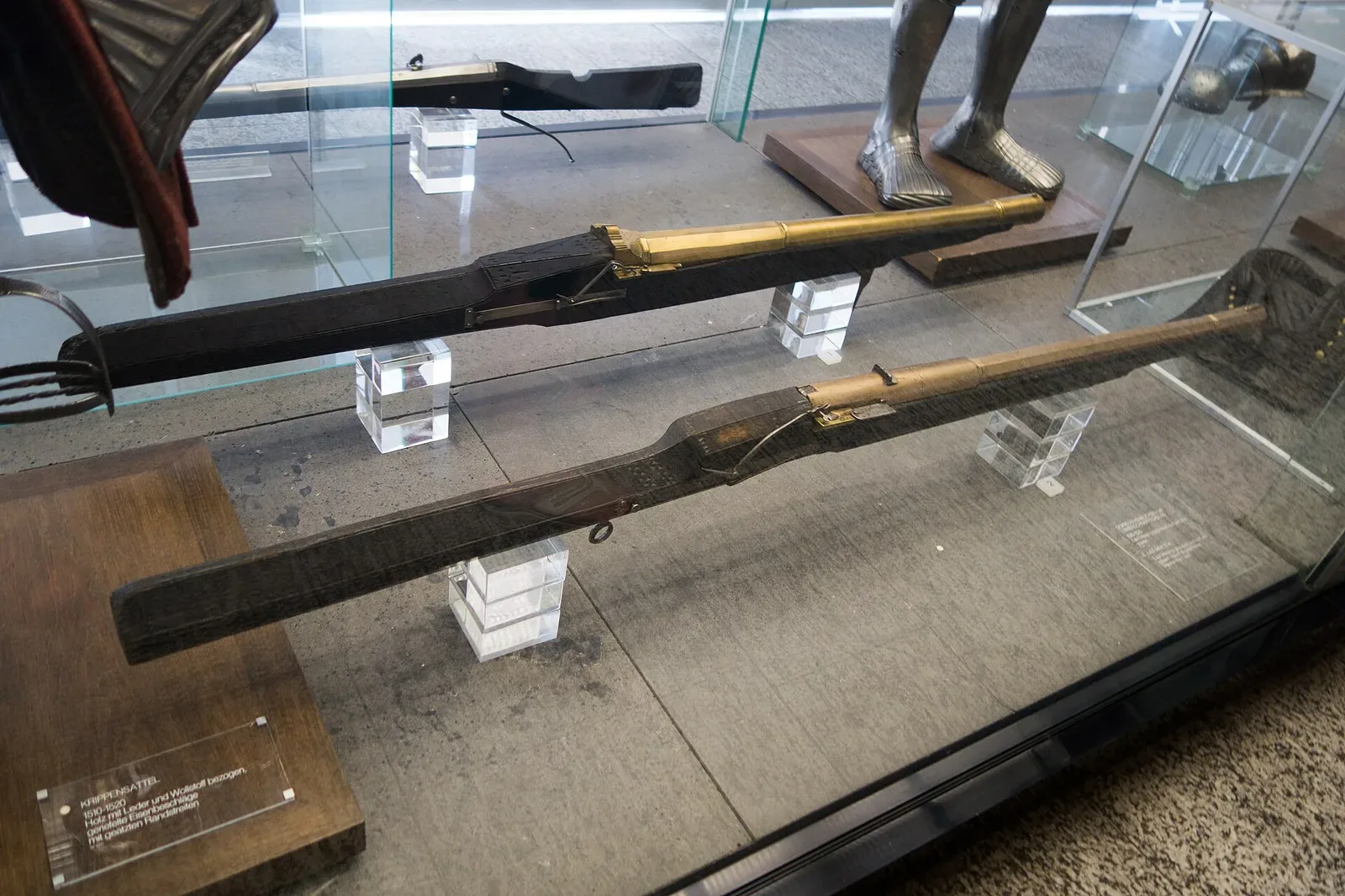
The arquebus at this point in history was a matchlock firearm—the culmination of roughly two centuries of handgonne development. Per WarHistory.org, the matchlock used a trigger releasing a spring-mounted sear that dropped a burning match holder into the priming pan, igniting the priming charge and then the main powder charge.
Larger versions were steadied on a forked staff. A writer named Humfrey Barwick, writing later in the 16th century, estimated an arquebus took about 40 seconds to load and fire, with an effective volley range of 240 yards—though he personally claimed he could hit a standing man at 120 yards. Rate of fire was slow, but the weapon's penetration against armor exceeded what a bow or crossbow could deliver.
| Weapon Specification | Matchlock Arquebus |
|---|---|
| Ignition System | Spring-mounted sear drops burning match into priming pan |
| Reload Time | ~40 seconds |
| Effective Range | 240 yards (volley fire) |
| Accurate Range | 120 yards (individual targeting) |
| Armor Penetration | Superior to bow/crossbow |
| Support Required | Forked staff for larger variants |
| Weather Sensitivity | High (exposed match and priming pan) |
The Spanish also fielded jinetes—light cavalry used to screen the front and pursue a broken enemy—and heavier cavalry under the Italian condottiero Prospero Colonna, held in reserve.
French Military Structure
The Landsknecht pikemen under Hans von Ravenstein formed the hard core of the defensive line behind the ditch. The French strength was their gendarmes: heavily armored cavalry that had dominated European battlefields for generations. Swiss pikemen operated in tight, disciplined formations built around momentum and mass—their "push of pike" had broken armies across Europe for two centuries. At Cerignola, neither would be enough.
The Battleedit
Spanish Defensive Preparations
Fernández de Córdoba chose his ground deliberately. He positioned his army on the heights outside Cerignola, in a vineyard, and put his men to work before the French arrived. A ditch was dug across the front of the Spanish position, reinforced with sharpened stakes. The arquebusiers took position behind it. The Landsknecht pikemen formed up behind them. The 20 Spanish cannons were placed on top of the hill with a clean view of the entire field. Light cavalry screened the front; Colonna's heavy horse waited in reserve.
French Cavalry Assaults
The French, according to WarHistory.org, attacked without properly scouting the Spanish position. It cost them immediately. The battle opened with two charges by French heavy cavalry against the Spanish center. Both were broken by Spanish artillery and arquebus fire.
A third assault aimed at the Spanish right flank ran directly into the ditch—cavalrymen and horses tumbling into it—and was thrown back by another storm of fire from the arquebusiers. Nemours was killed in these exchanges, hit by arquebus fire, making him possibly the first European general killed in action by small-arms fire.
Swiss Pike Attack
With the cavalry repulsed and their commander dead, the Swiss pikemen—now under Chandieu—moved forward without waiting for the French rearguard and artillery to come up. It was an aggressive, arguably impulsive decision, and it proved fatal.
Fernández de Córdoba saw what was coming. He pulled his arquebusiers back from the center to the flanks and moved the Landsknecht pikemen up to hold the ditch line. When the Swiss hit, they ran into pike resistance in front while the repositioned arquebusiers tore into their flanks. Spanish light cavalry harassed them from the sides. Chandieu was killed. The Swiss formations, joined by Gascon infantry, could not break through and were driven back with heavy casualties.
Battle sequence showing the tactical phases that led to Spanish victory
Spanish Counterattack
At that point Fernández de Córdoba launched his counterattack. Spanish and German infantry pushed forward. The Spanish heavy cavalry came out of reserve. Mounted arquebusiers—an innovative use of firepower on horseback—surrounded the remaining French gendarmes and routed them. The Swiss, to their credit, managed a relatively organized retreat. The French rearguard under Yves d'Alègre, arriving too late to affect the battle, saw the destruction and ordered a withdrawal. The Spanish jinetes pursued.
There is one notable near-disaster on the Spanish side: the gunpowder reserve exploded during the battle, disorienting Spanish troops. Fernández de Córdoba reportedly told his men, "Good sign, friends, those are the lights of victory." Whether or not that was his actual reaction, the battle was already decided before the powder went up.
Aftermath & Honors
After the fighting ended, Fernández de Córdoba ordered three long trumpet tones sounded and directed his troops to pray for all the fallen—French and Spanish alike. This toque de oracion, or call to prayer, was reportedly the first instance of this practice, later adopted by most Western armies. He also had the body of Nemours recovered and gave him a military funeral.
The defeated French retreated to the fortress of Gaeta, north of Naples. De Córdoba attempted to storm it but failed; the French held out, supplied by sea. Unable to take Gaeta and wary of French reinforcements, he pulled back to Castellone, about 8 kilometers south. Naples itself fell to Córdoba on May 13, per WarHistory.org.
Firearms Significanceedit
Tactical Innovation
Cerignola sits at a hinge point in the 800-year history of firearms. Hand-held gunpowder weapons had existed in Europe for roughly two centuries by 1503—but up to this point, they had been supporting players, not battle-winners. Cannon had cracked open castle walls. Early handgonnes had found their way onto battlefields. But the dominant forces were still armored cavalry and disciplined pikemen.
Cerignola changed the accounting. The arquebus didn't win that battle by being used en masse in an open field. It won because Fernández de Córdoba understood what his weapons could and couldn't do, and built his entire tactical plan around maximizing their strengths.
How terrain and firearms combined to create a new tactical paradigm
The ditch wasn't just an obstacle—it was a force multiplier. It stopped cavalry momentum, funneled attackers into kill zones, and gave arquebusiers the time they needed to reload in the face of charging men. The terrain and the firearm worked together in a way that hadn't been systematically applied before at this scale.
Gonzalo de Córdoba had raised the infantry soldier armed with a handgun to the status of the most important fighting man on the battlefield—a status he was to retain for over 400 years. —Field Marshal Bernard Montgomery, 1983
End of Swiss Dominance
The battle also marked the beginning of the end for Swiss mercenary dominance. Per WarHistory.org, Cerignola handed the Swiss their first battle loss in 200 years. The pike formations that had seemed nearly unstoppable—tight, disciplined, devastating in a frontal assault—had no answer for flanking arquebus fire. The Swiss didn't disappear from European armies overnight, but Cerignola established the template that would eventually render them obsolete: keep them pinned in front with pikes, kill them from the sides with firearms.
Birth of the Tercio
The formation that emerged from this thinking—the Spanish tercio—combined arquebusiers and pikemen into a single integrated unit that could generate fire, absorb charges, and counterattack. It wasn't finalized in form at Cerignola, but the battle demonstrated the concept worked. Spanish tercios anchored European battlefields for the next 140 years, until the Battle of Rocroi in 1643.
| Battle | Date | Significance |
|---|---|---|
| Cerignola | 1503 | First major European battle won by small arms; ended Swiss invincibility |
| Nagashino | 1575 | Japanese parallel: Oda Nobunaga used massed arquebusiers vs. Takeda cavalry |
| Rocroi | 1643 | End of Spanish tercio dominance (140 years after Cerignola) |
Historians often compare Cerignola to the Battle of Nagashino in Japan in 1575, where Oda Nobunaga used massed arquebusiers firing in rotation behind prepared field works to destroy Takeda cavalry—a nearly identical tactical concept, arrived at independently, seven decades later.
Weapon Evolution
The matchlock arquebus itself was not the endpoint. It was a step. The weapon had real limitations: slow to reload, sensitive to weather through its exposed match and priming pan, and requiring a lit slow match at all times—which created its own logistical and safety problems. Larger variants were already being called muskets, a term that would come to define the next generation. The wheel-lock and eventually the flintlock would follow, each solving some of the matchlock's problems. But the trajectory was set at Cerignola. Firearms were now decisive weapons, not supplementary ones.
The BGC Takeedit
Cerignola is the kind of battle that gets treated as a historical footnote when it deserves to be treated as a founding document. If you want to understand why firearms developed the way they did over the following four centuries—why armies invested in more arquebusiers, then musketeers, then rifles—this is the proof-of-concept battle that started that investment.
What Fernández de Córdoba figured out wasn't just "guns are good." It was that guns deployed correctly behind prepared terrain could defeat forces that had every other conventional advantage: numbers, cavalry, battlefield reputation. The French had more artillery. They had the Swiss, who were the closest thing the 16th century had to a guaranteed win. They attacked anyway, without scouting, against a position specifically designed to kill them with firearms.
Volume and position beat individual performance, a principle that runs through firearms tactics all the way to the present.
That's not a story about one weapon being better than another. It's a story about one commander understanding his weapons deeply enough to make them fight above their weight. The 40-second reload time matters here too. Critics of early firearms always point to rate of fire as the limiting factor, and they're right—one arquebusier reloading is a problem. A thousand arquebusiers firing in rotation from behind a ditch is a different calculation entirely. Cerignola proved the math.
For anyone who studies the long arc of how personal firearms evolved—from handgonnes to matchlocks to flintlocks to percussion caps to cartridge arms—Cerignola is the moment the argument was settled. Not by theory. By bodies.
Referencesedit
- Gls Guns(Sumner, IA)
- Bi-mart - Yakima (Fruitvale Ave)(Yakima, WA)
- New Philly Sportsman Specialities(New Philadelphia, OH)
- R&R Sports & Outdoors(Brandon, FL)
Loading comments...