State Details
New Hampshire

Overview | |
|---|---|
State | New Hampshire (NH) |
Capital | Concord |
Statehood | 1788 |
Population | 1,402,054 |
Gun Ownership | 41.1% |
Active FFLs | 317 |
Carry Laws | |
Constitutional Carry | Yes (2017) |
Open Carry | Yes |
CCW Permit Available | Yes |
Permit Reciprocity | 30+ states |
Self-Defense | |
Castle Doctrine | Yes |
Stand Your Ground | Yes |
Duty to Retreat | No |
Regulations | |
State Preemption | Yes |
Red Flag / ERPO | No |
Waiting Period | None |
Universal BGC | No |
NFA Items | Yes |
Assault Weapons Ban | No |
Magazine Limit | None |
Key Legislation | |
| |
Notable Manufacturers | |
| |
New Hampshire Firearms History
Reference article
From The Boise Gun Club Handbook
Overviewedit
New Hampshire doesn't just have a motto that sounds like something a gun owner would put on a bumper sticker — the state has actually lived it. "Live Free or Die" isn't marketing copy. It came from General John Stark, the state's most celebrated soldier, and it reflects a political culture that predates the republic itself.
New Hampshire was the first of the thirteen colonies to adopt a state constitution, doing so on January 5, 1776 — six months before the Declaration of Independence. That instinct toward self-governance, suspicion of centralized authority, and insistence on individual rights has shaped how the Granite State has approached firearms from the muskets at Fort William & Mary to the Sig Sauer pistols manufactured in Newington today.
The state sits in a genuinely interesting position in the American firearms story. It's geographically New England but politically distinct from its neighbors — more libertarian than liberal, more skeptical of regulation than Massachusetts or Vermont have traditionally been. It has produced one of the most consequential handgun manufacturers in the country, passed constitutional carry in 2017, and enshrined an individual right to keep and bear arms in its own constitution four decades before that. The history behind all of that is worth knowing.
Colonial & Revolutionary Eraedit
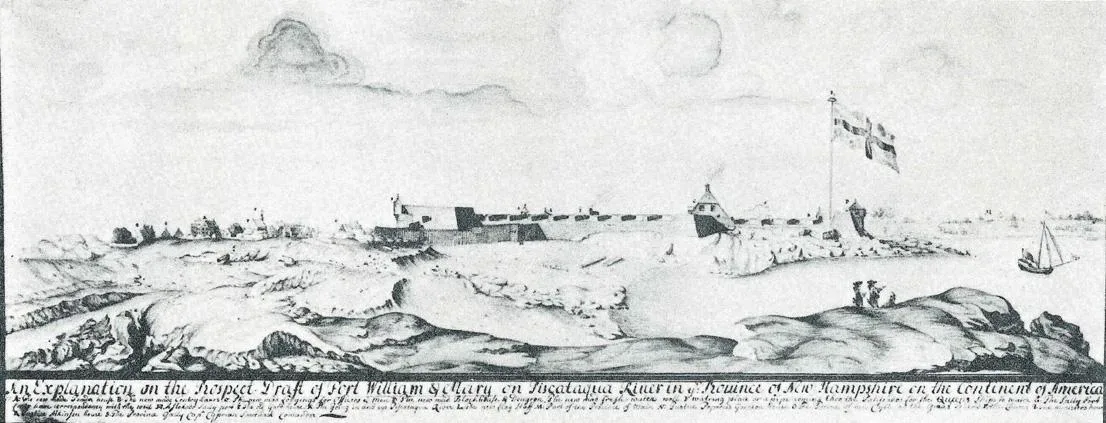
The shot heard 'round the world was fired at Lexington and Concord in April 1775. But New Hampshire's armed defiance of the Crown started months earlier — and it started with a raid.
In December 1774, Paul Revere rode 55 miles from Boston to Portsmouth to warn that British regulars were coming to seize the gunpowder and cannons stored at Fort William & Mary at New Castle, near Portsmouth Harbor. On December 14, 1774 — more than four months before Lexington — a group of New Hampshire patriots under John Sullivan stormed the fort, overwhelmed the small British garrison, and hauled off approximately 100 barrels of gunpowder. The following day, a second group returned and removed cannon and small arms. Some of that gunpowder made it to the colonial forces at the Battle of Bunker Hill in June 1775. The Fort William & Mary raid is one of the earliest armed acts of rebellion against the British Crown in colonial America, and it happened in New Hampshire.
Key events in New Hampshire's Revolutionary War period, showing early armed resistance and constitutional development
Pre-Revolutionary Conflicts
The colonial militia tradition in New Hampshire ran deep before the Revolution. The colony faced persistent conflict along its northern and western frontiers — with French-allied Native tribes during King Philip's War (1675–1676), King William's War (1689–1697), Queen Anne's War (1702–1713), and the French and Indian War (1754–1763). Towns were required to maintain armed men, and the frontier experience meant firearms were practical tools before they were political symbols. The Abenaki people, who occupied much of what is now northern and western New Hampshire, engaged in sustained armed conflict with English settlers throughout the late 17th and early 18th centuries — conflicts that kept the colony in a near-constant state of militia readiness.
| Conflict | Years | New Hampshire Role |
|---|---|---|
| King Philip's War | 1675–1676 | Colonial militia frontier defense |
| King William's War | 1689–1697 | Armed conflict with French-allied tribes |
| Queen Anne's War | 1702–1713 | Continued frontier militia operations |
| French and Indian War | 1754–1763 | Major participation, trained future Revolutionary leaders |
| Fort William & Mary Raid | Dec 14-15, 1774 | First armed rebellion against Crown |
| Revolutionary War | 1775–1783 | Troops to all major northern engagements |
Revolutionary War Service
When the Revolution came, New Hampshire contributed significantly. The state sent troops to nearly every major engagement in the northern theater. John Stark emerged as the defining military figure — a veteran of the French and Indian War and Rogers' Rangers who commanded New Hampshire forces at Bunker Hill, served under Washington at Trenton and Princeton, and won the Battle of Bennington in 1777. Bennington is the engagement for which he's best remembered: a strategic victory that helped set up the American triumph at Saratoga. Stark resigned his Continental Army commission at one point rather than accept a subordinate position — a very on-brand New Hampshire move — and served instead as a militia colonel on his own terms. In 1809, at 81 years old, too ill to attend a Bennington reunion, he sent a toast by letter: "Live free or die: Death is not the worst of evils." That line eventually became the official state motto in 1945.
Live free or die: Death is not the worst of evils. — General John Stark's toast, 1809, which became New Hampshire's state motto in 1945
Constitutional Foundations
New Hampshire's Provincial Congress drafted the first American state constitution between December 21, 1775 and January 5, 1776. The document created a bicameral legislature and established popular elections. It didn't include a formal bill of rights — that would come later — but it referenced the people's "natural and constitutional rights and privileges," understood at the time to include the common law right to armed self-defense. The Constitution of 1784, which replaced the 1776 document and remains in force today (heavily amended), formed the basis for New Hampshire's ongoing legal framework, including eventual explicit protections for firearms.
19th Century: Statehood, Industry & Conflictedit
Industrial Development
New Hampshire entered the 19th century as a manufacturing state in the making. The Merrimack River valley became an industrial corridor, with textile mills anchoring cities like Manchester and Nashua. That industrial capacity didn't translate directly into major arms manufacturing in the way that Connecticut and Massachusetts did — New Hampshire was never home to a Colt or a Springfield Armory — but the state participated in the broader New England arms trade and supplied troops and materials through both the War of 1812 and the Civil War.
The War of 1812 produced little glory for New Hampshire specifically, though the state's militia mobilized and the war reinforced the national conversation about the reliability of state militias versus federal forces. That tension — between federal military authority and state or individual arms-bearing — would run through American political life for the next two centuries.
Civil War Participation
The Civil War was complicated in New Hampshire. Historians note that the war was unpopular in significant segments of the state's population — not because New Hampshirites favored slavery, but because the conflict came to represent federal centralization and abolitionist politics that sat uneasily with the state's conservative, individualistic temperament. Nevertheless, New Hampshire fielded 18 infantry regiments, 1 cavalry regiment, and various artillery and specialized units. Approximately 33,000 New Hampshire men served in Union forces. The 5th New Hampshire Infantry was one of the most decorated regiments in the Army of the Potomac, suffering the highest number of battlefield deaths of any regiment in the Union Army. Colonel Edward Cross led the 5th until his death at Gettysburg in July 1863.
| Unit | Type | Notable Service |
|---|---|---|
| 5th New Hampshire Infantry | Infantry Regiment | Highest battlefield deaths of any Union regiment |
| 18 Infantry Regiments | Infantry | Various Army of the Potomac service |
| 1 Cavalry Regiment | Cavalry | Mobile operations |
| Artillery Units | Artillery | Support operations |
| Total Personnel | ~33,000 men | Served in Union forces |
Concord served as a staging and mustering point for New Hampshire forces. The state armory managed weapons distribution through the conflict, though New Hampshire relied heavily on federal-issue arms — Springfield Model 1861 rifle-muskets and later breech-loading rifles — rather than state-manufactured weapons.
Postwar Gun Culture
Postwar, New Hampshire's gun culture continued along practical lines. Hunting — deer, bear, and waterfowl — was central to rural life across the state's vast forested interior. The White Mountains and Connecticut River valley regions remained sparsely populated and heavily wooded, and firearms were everyday tools for subsistence and predator control. The political arguments over arms regulation that began to emerge in the late 19th century in urban industrial states largely passed New Hampshire by — the state was too rural and too individualistic for the urban gun-control impulse to take hold.
20th Century: Wars, Industry & the Modern Frameworkedit
World Wars Era
New Hampshire's 20th century firearms story runs through two world wars, a gradual shift in the state's political identity, and the arrival of what would become its most significant modern manufacturer.
During World War I, New Hampshire contributed troops through the 26th Division (the Yankee Division), a New England National Guard formation that saw extensive combat in France. The state's industrial base supported war production broadly, though again not through major dedicated small arms manufacturing. Portsmouth Naval Shipyard — technically located in Kittery, Maine, but administered through Portsmouth — became a critical military installation that would define the region's relationship with federal defense spending throughout the 20th century.
World War II unified the state in a way the Civil War had not. New Hampshire men served across every branch and theater. The Portsmouth Naval Shipyard ramped up submarine construction and repair, becoming one of the most productive submarine facilities on the East Coast. The state's National Guard units were federalized and deployed. Rationing, war bond drives, and civilian mobilization reached even the most remote Granite State towns. Historians note that WWII gave New Hampshire "a sense of purpose and unity" that its strong individualism occasionally worked against in peacetime.
Mid-Century Regulations
The postwar decades brought the National Firearms Act of 1934 and Gun Control Act of 1968 into New Hampshire's legal landscape, as they did everywhere. New Hampshire complied with federal minimums but resisted going further. The state legislature's general posture through the mid-20th century was to leave firearms largely unregulated beyond what Washington required. Permit requirements for carrying existed — a pistol/revolver license was required for concealed carry under RSA 159:6, administered through local police chiefs — but the licensing process was relatively permissive by New England standards.
The cultural divide between New Hampshire and its southern New England neighbors sharpened in the latter half of the 20th century. Massachusetts and Connecticut moved toward stricter firearms regulation. New Hampshire did not. The Free State Project, a libertarian migration effort that selected New Hampshire as its target state in 2003, reflected something that was already true about the Granite State's political DNA — it was already functioning as a low-regulation haven relative to its neighbors.
Sig Sauer Arrives
The most consequential development for New Hampshire's modern firearms industry came in 1990, when Sig Sauer — the American subsidiary of the Swiss-German Schweizerische Industrie-Gesellschaft — relocated its U.S. headquarters from Tysons Corner, Virginia to Newington, New Hampshire. Sig's SIGARMS operation had been importing and distributing European-manufactured Sig pistols since the early 1980s. The move to Newington began a gradual transition toward domestic manufacturing.
Through the 1990s and 2000s, Sig Sauer's Newington facility grew from an import and distribution operation into a full manufacturing campus. The 1994 Federal Assault Weapons Ban passed during this period. New Hampshire did not layer additional state restrictions on top of the federal ban, and when the federal ban sunset in 2004 without renewal, New Hampshire's market for semi-automatic rifles returned to its pre-ban status without state legislative interference.
Modern Era (2000–Present)edit
Manufacturing Growth
The 21st century has been, on balance, a good era for New Hampshire gun owners — and Sig Sauer has been at the center of it.
By the early 2000s, Sig Sauer's Newington facility had become a genuine manufacturing operation. The company's growth through the 2000s and 2010s was substantial. When the U.S. Army ran its Modular Handgun System competition to replace the Beretta M9, Sig Sauer's P320 won — a contract awarded in January 2017 worth a potential $580 million. The military-designated M17 and M18 variants are produced at Newington. That contract made Sig Sauer's New Hampshire operation the supplier of the standard sidearm for the United States Army, Air Force, Marine Corps, and Coast Guard. It's a significant thing for a state not historically associated with arms manufacturing.
| Year | Milestone | Impact |
|---|---|---|
| 2003 | State preemption law (RSA 159:26) | Prevented local firearms restrictions |
| 2017 | Constitutional carry (HB 582) | Eliminated concealed carry permit requirement |
| 2017 | Sig Sauer M17/M18 contract | $580M U.S. military sidearm contract |
| 2017-2018 | P320 trigger controversy | Voluntary upgrade program implemented |
| 2020-2021 | Nationwide purchase surge | High demand reflected in NH NICS checks |
The M17 and M18 variants supply:
- U.S. Army standard sidearm (M17/M18 variants)
- Air Force, Marine Corps, Coast Guard adoption
- Manufactured at Newington facility
- Contract value: potential $580 million
Sig Sauer has also operated a shooting range, training facility, and — as of the early 2020s — an Academy in Epping, New Hampshire, offering professional firearms training to law enforcement, military, and civilian customers. The company is one of the larger private employers in the Seacoast region.
Constitutional Carry Achievement
On the legislative side, 2017 was the pivotal year. HB 582, signed by Governor Chris Sununu on February 22, 2017, eliminated the requirement for a license to carry a concealed loaded pistol or revolver in New Hampshire. The state joined a growing list of constitutional carry jurisdictions. The existing pistol/revolver license under RSA 159:6 was not eliminated — it remains available for reciprocity purposes with other states — but it became optional for in-state carry. The bill passed both chambers of the Republican-controlled legislature and was signed quickly. Opposition came primarily from Democratic legislators and law enforcement groups who argued the permit process provided a useful background check mechanism, but proponents noted that a federal NICS check already applied to retail firearm purchases.
Recent Developments
The P320 trigger safety controversy of 2017–2018 created some turbulence for Sig Sauer. Reports emerged that the P320 could discharge without a trigger pull under certain impact conditions. Sig issued a voluntary upgrade program rather than a formal recall, and the company maintained that the pistol met military drop-safety standards. The episode generated litigation and significant media coverage — some of it focused specifically on the Newington facility — but did not materially alter the Army contract or the company's New Hampshire manufacturing footprint.
New Hampshire's political environment in the 2020s has remained generally favorable to gun owners. The legislature has periodically considered and rejected measures that would have added permit requirements or expanded prohibited-person categories beyond federal law. The Free State Project migration continued to add libertarian-leaning residents, reinforcing the state's existing political tendencies. The 2020–2021 period saw the nationwide surge in firearm purchases reflected in New Hampshire as well — background check volume through the FBI's NICS system spiked, and local gun stores reported sustained high demand.
Red flag law proposals — formally Extreme Risk Protection Orders — have been introduced in the New Hampshire legislature and have not passed as of early 2026. The state does not have an ERPO statute. This puts New Hampshire in a distinct minority among northeastern states; Maine passed a red flag law in 2023, and Vermont enacted one in 2018.
Notable Figures & Manufacturersedit
John Stark (1728–1822) is the unavoidable figure in any discussion of New Hampshire and firearms. Born in Londonderry, he became one of the most effective militia and Continental officers of the Revolution. His experience as a Rogers' Rangers scout in the French and Indian War made him a genuinely skilled wilderness fighter before he ever faced a British regular in open battle. The "Live Free or Die" toast — written in 1809, adopted as state motto in 1945 — is inseparable from the state's identity, and by extension from its approach to individual liberty and arms-bearing.
Evolution of New Hampshire's modern firearms manufacturing, centered on Sig Sauer's growth
Franklin Pierce (1804–1869), the only U.S. president from New Hampshire, served as a brigadier general in the Mexican-American War before his presidency. Pierce's military service brought him into contact with the evolving U.S. Army small arms of the era — the Model 1841 Mississippi Rifle and early percussion-cap technology. His presidency (1853–1857) predated the Civil War's firearms innovations but coincided with the period when American arms manufacturing was rapidly industrializing.
Alan Shepard (1923–1998), born in East Derry, was the first American in space. His New Hampshire connection is tangential to firearms history, but he's worth noting as the state's most famous 20th-century figure with a military background — a Naval aviator with extensive weapons systems training.
Sig Sauer remains the state's defining modern firearms manufacturer. The company's Newington campus encompasses manufacturing, engineering, and their SIGTAC ammunition line. Employment at the facility has been reported in the range of 1,500–2,000 workers, making it a significant economic presence in Rockingham County. The M17/M18 production contract with the U.S. military is the single largest government arms contract associated with a New Hampshire manufacturer in the state's history.
Smith & Wesson (headquartered in Springfield, Massachusetts) has no direct New Hampshire manufacturing presence, but the broader New England firearms ecosystem — distributors, gunsmiths, retailers — operates across state lines and includes significant New Hampshire participation. Sturm, Ruger & Co. operated a manufacturing facility in Newport, New Hampshire for decades, producing pistols, revolvers, and rifles at that location. The Newport facility has been a significant employer in Sullivan County, one of the state's more economically challenged regions.
Current Legal Landscapeedit
New Hampshire's firearms laws are among the least restrictive in the Northeast, and deliberately so.
Constitutional Framework
Article 2-a, adopted by voters in 1982, reads: "All persons have the right to keep and bear arms in defense of themselves, their families, their property and the state." This was a citizen-initiated amendment, added 191 years after the state's first constitution. Part 1, Article 2-a of the New Hampshire Constitution predates the U.S. Supreme Court's District of Columbia v. Heller (2008) decision by 26 years and is more explicit than the Second Amendment in naming individual self-defense as a purpose.
Carry Laws
Constitutional Carry: Since 2017, no license is required to carry a concealed loaded handgun in New Hampshire. Open carry has long been legal without a permit. The optional pistol/revolver license under RSA 159:6 is issued by the local chief of police and costs $10 for residents, valid for five years. Most gun owners maintain it for out-of-state reciprocity.
Preemption: New Hampshire has state preemption of local firearms ordinances under RSA 159:26, enacted in 2003. Cities and towns cannot pass firearms regulations more restrictive than state law. This prevents the patchwork of local ordinances seen in some other states.
Background Checks: New Hampshire uses the federal NICS system for retail purchases. There is no state-level point-of-contact system and no universal background check requirement for private sales beyond what federal law requires (which, for long guns transferred between private parties in the same state, is currently nothing).
Prohibited Locations & Restrictions
Carrying is prohibited in:
- Courthouses and federal buildings
- School zones (federal law compliance)
- Certain other specified state locations
- No blanket prohibition in restaurants, churches, or most public spaces
NFA Items: New Hampshire permits ownership of suppressors, short-barreled rifles, short-barreled shotguns, and machine guns (manufactured before May 19, 1986) in compliance with federal NFA requirements. Suppressor ownership is relatively common in the state — hunting with suppressors is legal, and the state's rural character makes suppressor use practical for controlling noise on private property.
Age Requirements: 18 for long guns, 21 for handguns, consistent with federal law. No state additions.
Red Flag Laws: None. New Hampshire does not have an Extreme Risk Protection Order statute as of early 2026.
"Stand Your Ground": New Hampshire's self-defense statutes under RSA 627 include a duty to retreat that applies in some circumstances — the state is not a pure stand-your-ground jurisdiction, but the castle doctrine is well-established. There is no duty to retreat from one's dwelling or from any place where one has a right to be if facing imminent deadly force in certain circumstances. The law is more nuanced than a simple yes/no on stand-your-ground, and case law has shaped how prosecutors and courts apply it.
| Legal Aspect | New Hampshire Status | Details |
|---|---|---|
| Constitutional Carry | Yes (2017) | No permit required for concealed carry |
| Open Carry | Legal | No permit required |
| State Preemption | Yes (2003) | Local restrictions prohibited |
| Background Checks | Federal NICS only | No universal background check |
| NFA Items | Legal | Suppressors, SBRs, machine guns permitted |
| Red Flag Laws | None | No ERPO statute |
| Stand Your Ground | Modified | Castle doctrine established, duty to retreat in some circumstances |
The BGC Takeedit
New Hampshire is one of the most gun-friendly states in the Northeast, and that's not an accident — it's a feature of the political culture that the state has maintained deliberately against significant regional pressure.
New Hampshire's approach to firearms regulation reflects a genuine political philosophy that predates the modern gun-rights movement — it's rooted in Revolutionary-era suspicion of centralized authority and frontier self-reliance.
The "Live Free or Die" thing is real. It's not just a slogan. The state's approach to firearms regulation reflects a genuine political philosophy that predates the modern gun-rights movement — it's rooted in the same Revolutionary-era suspicion of centralized authority that led New Hampshire to be the first colony to adopt a constitution, and the same frontier self-reliance that kept the militia tradition alive through a century and a half of border conflicts.
When voters added Article 2-a to the state constitution in 1982, they weren't responding to a political moment — they were codifying something that was already culturally settled. For gun owners, the practical picture is good. Constitutional carry since 2017, statewide preemption since 2003, no assault weapons ban, no magazine capacity limits, no red flag law, and a firearms industry employer (Sig Sauer) that manufactures the U.S. military's standard sidearm in Newington.
The regulatory floor is federal minimums, and the legislature has shown little appetite for going higher. The tension worth noting is geographic. Southern New Hampshire — particularly Hillsborough and Rockingham counties — has experienced significant population growth from Massachusetts migrants, and voting patterns in those areas have shifted noticeably. Manchester and Nashua lean Democratic in state and federal elections.
The legislature has remained Republican-controlled often enough to block major firearms bills, but the political math is not static. The Free State Project migration has injected a committed libertarian bloc into the electorate, and that bloc has been consistently reliable on firearms issues — sometimes to the frustration of mainstream Republicans who find the movement's maximalism politically inconvenient. The range culture in New Hampshire is healthy. Private clubs, state-managed shooting ranges through NH Fish & Game, and Sig Sauer's Epping Academy facility all contribute to an active shooting community. Hunting — particularly deer season in November — remains a genuine cultural institution across rural New Hampshire, and the overlap between hunting culture and the broader gun-rights community is substantial.
If you're a gun owner considering New Hampshire, the state is doing most things right from a legal standpoint. The cost of living — particularly housing — in the Seacoast and southern tier is high and has gotten worse in the post-2020 period, but the regulatory environment for firearms ownership is about as permissive as you'll find in New England.
Referencesedit
- New Hampshire Constitution, Part 1, Article 2-a (1982)
- RSA 159 (New Hampshire Firearms Statutes)
- RSA 159:6 (Pistol/Revolver License)
- RSA 159:26 (State Preemption, 2003)
- HB 582, New Hampshire General Court (2017) — Constitutional Carry
- Wooley v. Maynard, 430 U.S. 705 (1977)
- District of Columbia v. Heller, 554 U.S. 570 (2008)
- New Hampshire Historical Society — General John Stark
- State Court Report: "The Story of the First State Constitution" (January 5, 2026)
- The Dartmouth: "Live Free or Die! New Hampshire at 250" (January 5, 2026)
- Wikipedia: "Live Free or Die" — State Motto History
- U.S. Army Modular Handgun System Contract Award (January 2017)
- NH Fish & Game Department — Hunting and Range Regulations
- Sig Sauer Corporate History — Newington, NH Campus
- National Archives — New Hampshire Civil War Regimental Records
- Fort William & Mary Historical Records, December 1774
Last Updated: February 24, 2026
- Quail Creek Plantation(Okeechobee, FL)
- 2aHawaii(Honolulu, HI)
- Boston Firearms(Everett, MA)
- Safeshoot(Kingston, NY)
Loading comments...