State Details
North Carolina
Overview | |
|---|---|
State | North Carolina (NC) |
Capital | Raleigh |
Statehood | 1789 |
Population | 10,698,973 |
Gun Ownership | 45.6% |
Active FFLs | 2,085 |
Carry Laws | |
Constitutional Carry | Yes (2023) |
Open Carry | Yes |
CCW Permit Available | Yes |
Permit Reciprocity | 36+ states |
Self-Defense | |
Castle Doctrine | Yes |
Stand Your Ground | Yes |
Duty to Retreat | No |
Regulations | |
State Preemption | Yes |
Red Flag / ERPO | No |
Waiting Period | None |
Universal BGC | No |
NFA Items | Yes |
Assault Weapons Ban | No |
Magazine Limit | None |
Key Legislation | |
| |
Notable Manufacturers | |
| |
North Carolina Firearms History
Reference article
From The Boise Gun Club Handbook
Updated August 15, 2026. The law moved twice since this article was written. The $200 making and transfer tax on suppressors, SBRs, SBSs and AOWs was eliminated effective January 1, 2026 by the One Big Beautiful Bill Act. Then on August 5, 2026 a federal court in Silencer Shop Foundation v. ATF struck down the NFA registration and approval requirements for those same items, and that injunction took effect August 13. It covers only the plaintiffs, their members and their customers. Living in a plaintiff state does not make you covered. Machine guns and destructive devices are unchanged. Read the current guide: NFA Items in 2026: What Actually Changed.
Overviewedit
North Carolina sits in a peculiar spot in American firearms history—it's a state that produced some of the most significant armed resistance events before the Revolution, sent riflemen who changed the outcome of the Southern Campaign, manufactured weapons for the Confederacy, and then spent most of the 20th century carrying some of the more restrictive handgun laws in the Southeast. That tension between a deep firearms heritage and a regulatory framework built on post-Reconstruction racial politics defined the state for over a century. As of 2023, that chapter closed.
The Tar Heel State's gun culture runs through its geography:
- The western mountains produced the Overmountain Men—frontier riflemen who understood their weapons as tools of daily survival and political resistance
- The eastern coastal plain developed a plantation economy that shaped early firearms regulation in ways that had nothing to do with public safety
- The Piedmont sat between both worlds and produced its own friction, most memorably at the Battle of Alamance Creek in 1771
All of it matters to understanding where North Carolina stands today.
Colonial & Frontier Eraedit
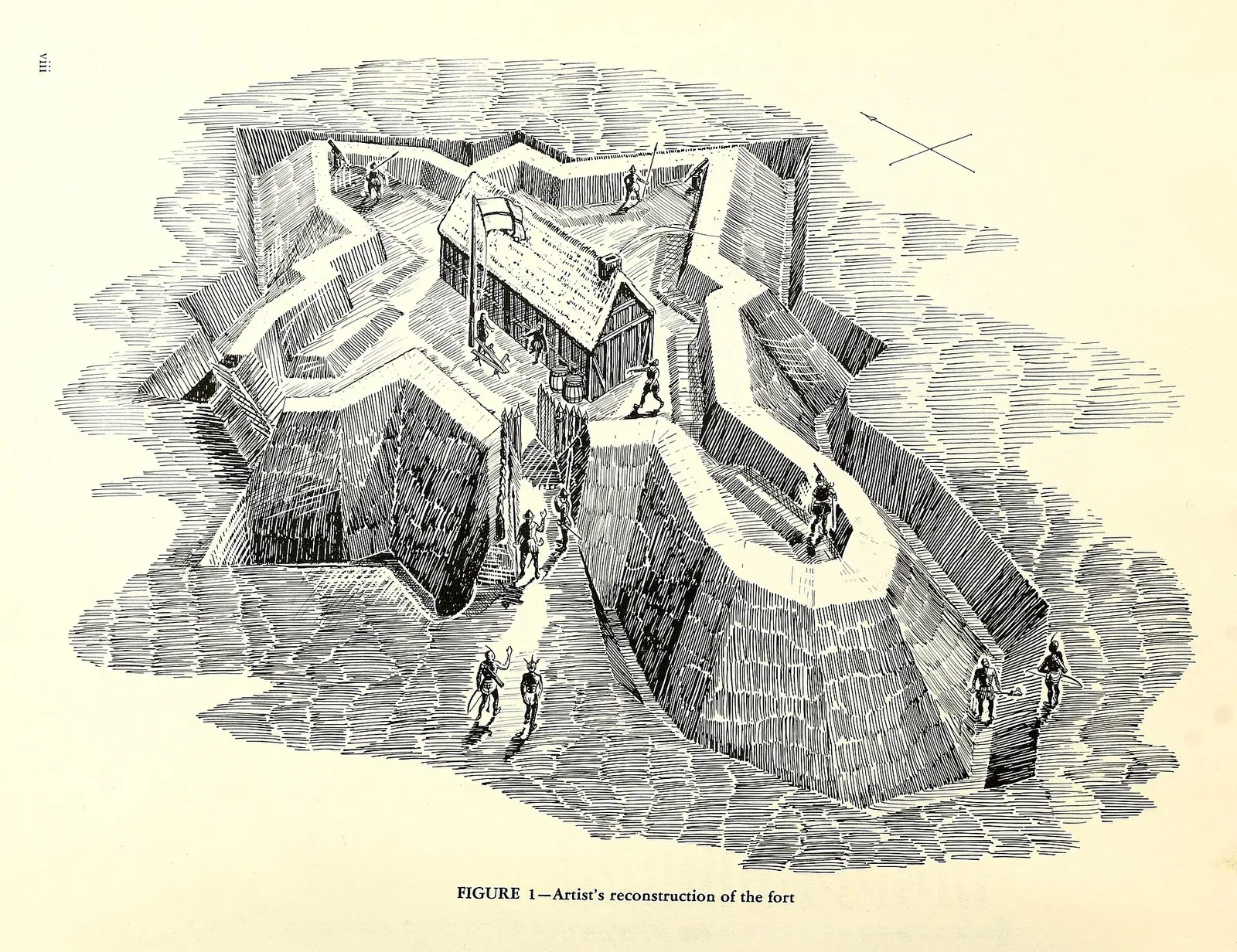
The original English settlement at Roanoke Island in 1585 brought firearms to the Carolina coast—matchlock muskets and arquebuses that the colonists carried against a landscape they didn't understand and among people they couldn't reliably predict. The Lost Colony of 1587 disappeared before leaving much of a firearms record, but Sir Walter Raleigh's expeditions established the precedent that would hold for the next two centuries in Carolina:
Arms were survival equipment, not sporting goods—a principle that defined the Carolina frontier for two centuries.
Early Settlement and the Tuscarora War
By the early 1700s, the Tuscarora War (1711–1715) illustrated exactly how consequential firearms access was on the Carolina frontier. The Tuscarora people, armed partly through trade with both English and competing European interests, conducted raids on frontier settlements that killed hundreds of colonists. The colonial response drew militia from both North and South Carolina, and the war ended with the Tuscarora largely broken as a military force in the region. Colonial Governor Edward Hyde and later Thomas Pollock organized the militia response—an early example of how North Carolina's colonial government understood armed citizens as a defensive necessity, not a threat.
| Event | Date | Key Figures | Firearms Significance |
|---|---|---|---|
| Tuscarora War | 1711-1715 | Gov. Edward Hyde, Thomas Pollock | Established militia response doctrine; demonstrated importance of firearms parity |
| Regulator Movement | 1768-1771 | Herman Husband, Gov. William Tryon | Legal protest escalated to armed resistance |
| Battle of Alamance Creek | May 16, 1771 | Gov. Tryon vs. Regulators | 1,100 militia with artillery vs. 2,000-3,000 armed settlers |
| Political Aftermath | 1771-1775 | Robert Howe, Piedmont settlers | Created east-west tension affecting Revolutionary allegiances |
The Regulator War and Alamance Creek
The Regulator War of 1768–1771 is worth spending real time on because it's one of the most misunderstood pre-Revolutionary events in American history. Backcountry settlers in Orange, Anson, Rowan, and Mecklenburg Counties organized as Regulators—not to overthrow the colonial government, but to protest corrupt local officials who were shaking them down through inflated fees, fraudulent taxes, and rigged court proceedings. Herman Husband, a Quaker farmer and assembly member, became one of their primary voices.
The Regulators tried legal channels first: petitions, lawsuits, elections. When those failed, they got disruptive.
What made the Regulator confrontation a firearms history event was the Battle of Alamance Creek on May 16, 1771. Governor William Tryon marched roughly 1,100 eastern militia into the Piedmont with six swivel guns and two brass cannons. Between two and three thousand Regulators camped on the west bank. Tryon demanded they surrender their arms and their leaders. They refused. The cannons opened up just before noon.
The Regulators fought from cover for two hours before their ammunition gave out and Tryon's militia set the woods on fire around them. Nine of Tryon's men died; somewhere between nine and twenty Regulators were killed. Six captured Regulators were hanged in Hillsborough on June 19, 1771. Tryon left for a promotion in New York days later.
The political fallout shaped North Carolina's entry into the Revolution in a complicated way. Many Piedmont settlers who'd been on the receiving end of Patriot leaders' militia—Robert Howe commanded Tryon's artillery at Alamance and later became a Continental major general—had little appetite for joining those same men's revolution. The burned child dreads the fire, as one Piedmont resident wrote after Lexington and Concord. This tension between eastern and western Carolina, between establishment Patriots and backcountry skeptics, ran through the entire Revolutionary period.
Revolutionary War Eraedit
The Battle of Kings Mountain
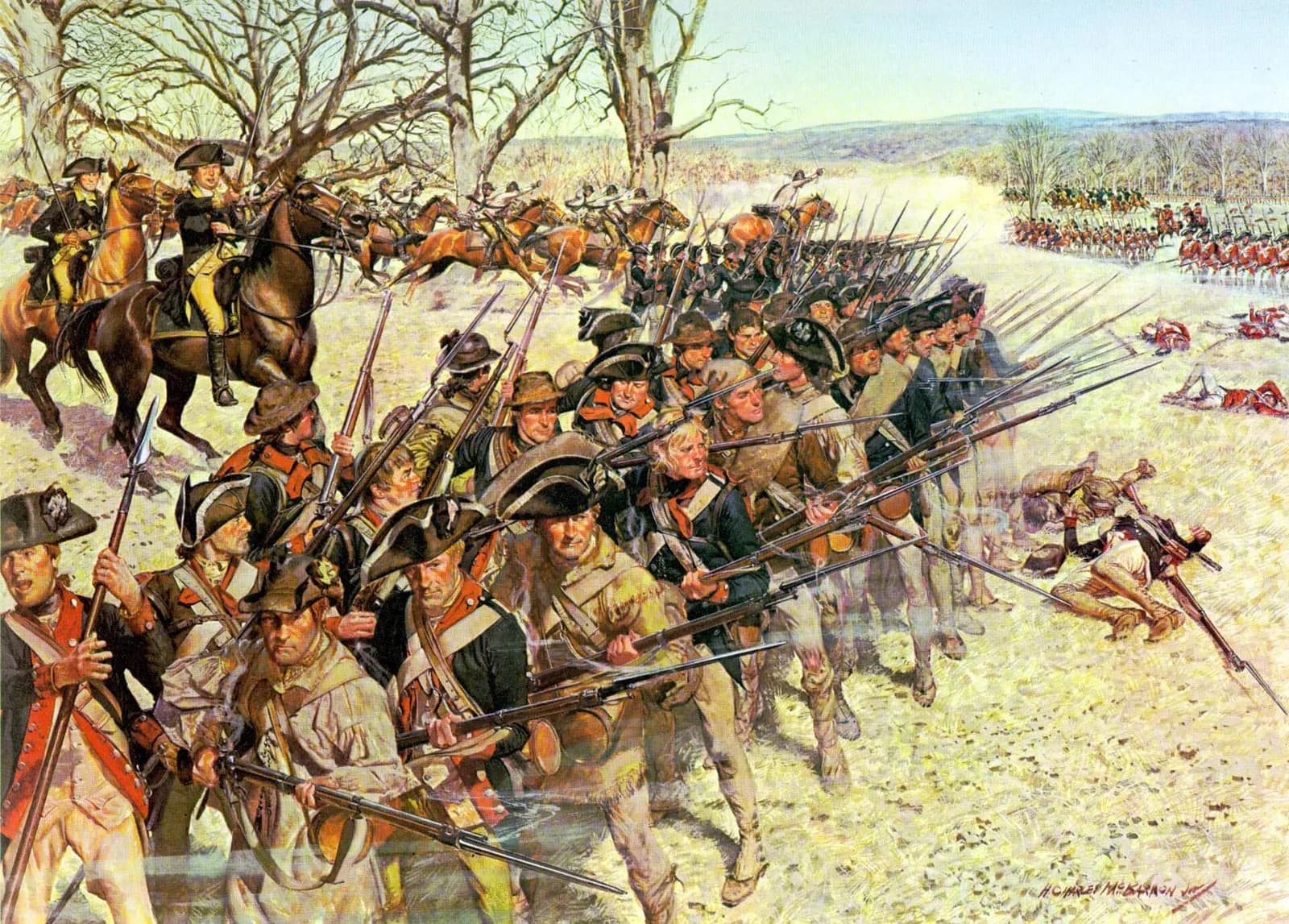
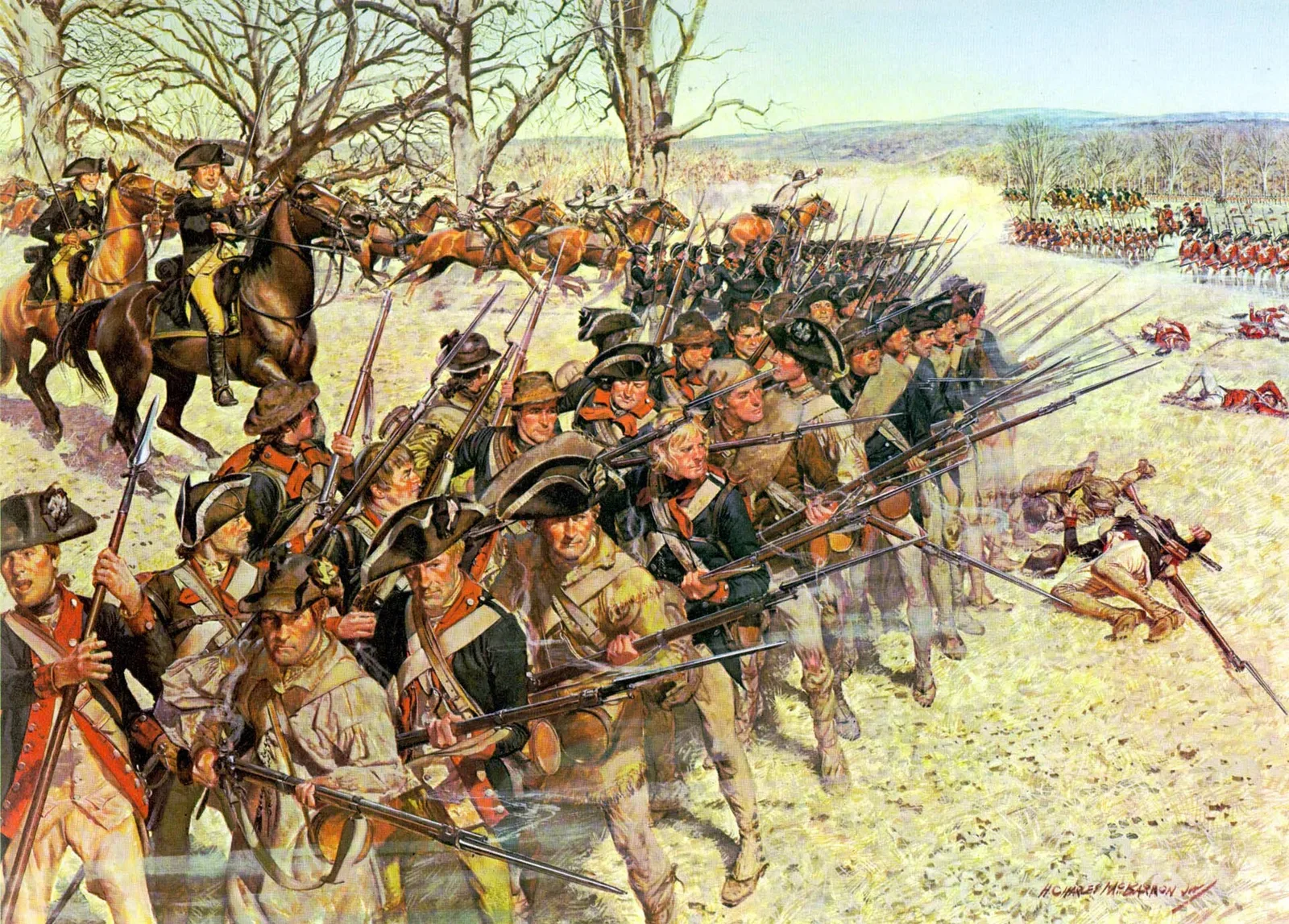
North Carolina's most decisive contribution to the Revolution happened at the Battle of Kings Mountain on October 7, 1780—and it was almost entirely a rifle fight. Colonel Patrick Ferguson, a British officer who had actually invented a breech-loading rifle, commanded roughly 1,100 Loyalist militiamen on a rocky hilltop in what is now York County, South Carolina, just across the state line. Ferguson made the mistake of threatening the Overmountain Men—backcountry settlers from what is now Tennessee, Virginia, and western North Carolina—telling them to lay down their arms or he would march his forces over the mountains and destroy them.
They came to him instead. Around 1,800 frontier riflemen assembled at Sycamore Shoals in present-day Tennessee under commanders including Colonel Isaac Shelby, Colonel John Sevier, and Colonel Benjamin Cleveland of Wilkes County, North Carolina. They marched to Kings Mountain carrying their personal long rifles—Pennsylvania-style rifles that were accurate well beyond the effective range of Ferguson's smoothbore muskets.
| Battle of Kings Mountain | Details |
|---|---|
| Date | October 7, 1780 |
| British Force | 1,100 Loyalist militia under Col. Patrick Ferguson |
| Patriot Force | ~1,800 Overmountain Men (riflemen) |
| Key Commanders | Col. Isaac Shelby, Col. John Sevier, Col. Benjamin Cleveland |
| Primary Weapons | British: smoothbore muskets / Patriots: Pennsylvania-style long rifles |
| Duration | 65 minutes |
| Outcome | Ferguson killed, entire British force eliminated |
| Strategic Impact | Ended British left flank in Southern Campaign |
The battle lasted 65 minutes. Ferguson's men could defend against a frontal assault on open ground, but the Overmountain Men fought like hunters—from tree to tree, moving uphill, shooting from cover. Ferguson was killed; his entire force was killed, captured, or scattered. The British lost their entire left flank in the Southern Campaign, and Lord Cornwallis abandoned his planned invasion of North Carolina.
Kings Mountain was decided by riflemen using personally owned weapons, fighting without Continental Army support, because they understood those rifles from years of daily use.
Arms Manufacturing and Support
North Carolina also had significant arms manufacturing activity during the Revolution, though nothing approaching the organized arsenals that would come later. The Moravian settlements at Salem (now Winston-Salem) provided gunsmithing and metalwork that supported militia forces in the Piedmont. Individual gunsmiths throughout the backcountry repaired and built weapons under contract—a decentralized manufacturing model that matched the state's geography.
19th Century: Statehood & Expansionedit
Early Statehood and Legal Precedents
North Carolina entered the 19th century with a firearms culture split along geographic and economic lines. Western mountain communities maintained the frontier rifle tradition—functional, utilitarian, built on makers like the family gunsmiths operating throughout the Appalachian foothills. The eastern plantation economy increasingly viewed armed Black residents, both enslaved and free, as a threat to social order, and that fear drove some of the earliest state-level firearms restrictions.
North Carolina's 1840 State v. Huntly case established one of the earlier American judicial interpretations of armed carry. The North Carolina Supreme Court held that carrying weapons in a manner that caused public terror could be restricted, even while acknowledging a right to bear arms—an early example of the state courts grappling with where individual rights ended and public safety claims began.
Civil War Production and the Fayetteville Arsenal
The antebellum period also brought the Fayetteville Arsenal and Armory. The U.S. government established the facility in Fayetteville in 1838, and it became one of the federal government's significant ordnance installations in the South before the Civil War. The armory produced Model 1817 Common Rifles and served as a repair and storage facility for federal arms throughout the pre-war period. When North Carolina seceded in May 1861—the last of the original Confederate states to do so—the arsenal immediately became a Confederate facility.
North Carolina's secession vote on May 20, 1861, came under significant political pressure after Fort Sumter and Lincoln's call for troops. The state had actually voted against secession in February 1861; the changed vote reflected the reality that staying in the Union meant fighting against neighboring states. Whatever the politics, the state's manufacturing capacity and its soldiers became significant Confederate assets.
The Fayetteville Arsenal under Confederate control produced one of the more historically interesting rifles of the Civil War: the Fayetteville Rifle. Confederate forces had captured roughly 37,000 U.S. Model 1841 Mississippi Rifles and the machinery to produce them when they took the armory. Using that machinery—and some captured equipment from Harpers Ferry—the armory produced approximately 10,000 Fayetteville Rifles between 1862 and 1865. These were essentially Confederate-manufactured copies of the Model 1841, fitted with the Harpers Ferry-pattern lock and saber bayonet lug. They're among the more collected Confederate long arms today.
| Fayetteville Arsenal Production | Specifications |
|---|---|
| Established | 1838 (U.S. federal facility) |
| Confederate Control | May 1861 - March 1865 |
| Primary Product | Fayetteville Rifle (Confederate copy of Model 1841 Mississippi Rifle) |
| Total Production | ~10,000 rifles (1862-1865) |
| Key Features | Harpers Ferry-pattern lock, saber bayonet lug |
| Manufacturing Base | Captured U.S. Model 1841 machinery + Harpers Ferry equipment |
| Fate | Destroyed by Sherman's forces, March 1865 |
General William T. Sherman's forces captured and burned much of Fayetteville in March 1865, destroying the armory in the process. The Battle of Bentonville in March 1865—the largest Civil War battle fought on North Carolina soil—ended Confederate General Joseph Johnston's ability to resist Sherman's march. Johnston surrendered to Sherman at the Bennett Place near Durham on April 26, 1865, in the largest single surrender of Confederate forces in the war.
Reconstruction and the Rise of Restrictions
Reconstruction brought the Black Codes and then more formally codified restrictions. North Carolina's 1870 Constitution included an arms-bearing provision, but the post-Reconstruction period saw the Redeemer Democrats systematically undercut the ability of Black citizens to exercise it. The Wilmington Massacre of 1898—more accurately a coup d'état than a massacre—saw white supremacist mobs overthrow the legitimately elected biracial Fusionist government of Wilmington, kill an estimated 60-plus Black residents, and drive hundreds more from the city. The mob systematically disarmed the Black community before and during the attack.
The Wilmington Massacre of 1898 was state-sponsored terrorism that set the tone for firearms policy in North Carolina for decades.
20th Century: Wars, Industry & Regulationedit
The Jim Crow Permit System
The Pistol Purchase Permit system that defined North Carolina gun law for most of the 20th century came directly out of that post-Reconstruction racial framework. The 1919 Uniform Machine Gun Act and Pistol Permit Law required any North Carolina resident to obtain a permit from their county sheriff before purchasing a handgun. On paper it applied to everyone. In practice, throughout the Jim Crow era, sheriffs in most counties issued permits to white residents routinely and denied them to Black residents based on nothing but race.
No serious historian disputes this origin.
| NC Pistol Purchase Permit System (1919-2023) | Details |
|---|---|
| Legal Framework | 1919 Uniform Machine Gun Act and Pistol Permit Law |
| Stated Purpose | Public safety and regulation |
| Actual Implementation | Discriminatory enforcement during Jim Crow era |
| Authority | County sheriffs (discretionary approval) |
| Application | Universal requirement for handgun purchases |
| Duration | 104 years |
| Repeal | Senate Bill 41 (March 2023) |
The permit system survived because it was superficially race-neutral on its face and because it provided local law enforcement with discretionary gatekeeping power that many sheriffs' associations actively defended. It stayed on the books for 104 years.
Military Installations and World Wars
North Carolina's contribution to both World Wars came primarily through its soldiers rather than its manufacturing sector—the state lacked the heavy industrial base of the Midwest or Northeast. However, Fort Bragg (established 1918 as Camp Bragg, named after Confederate General Braxton Bragg) grew into one of the largest military installations in the United States. Located outside Fayetteville, Fort Bragg became home to the 82nd Airborne Division, the XVIII Airborne Corps, and eventually U.S. Army Special Operations Command. The base represents the most significant ongoing military-firearms connection in the state's history.
Camp Lejeune, established in 1941 near Jacksonville, brought the Marine Corps to North Carolina's coastal plain. The Marines' relationship with the M1 Garand during World War II, the M14 and then M16 in Vietnam, and the full evolution of small arms doctrine through the late 20th century all played out in training on North Carolina soil. The state's military installations shaped a significant portion of the population's direct relationship with firearms—veterans returning from Bragg and Lejeune to communities throughout North Carolina formed a substantial part of the state's firearms culture through the postwar decades.
Federal Gun Control and State Response
The National Rifle Association's influence in North Carolina grew substantially through the postwar period. State-level NRA-affiliated rifle and pistol clubs proliferated, and the organization's hunter safety programs became embedded in the state's Department of Natural Resources. By the 1970s, the NRA had moved from its earlier emphasis on marksmanship and safety toward explicit political advocacy, and North Carolina's congressional delegation—still dominated by conservative Democrats through most of this period—reflected mixed positions on federal gun legislation.
Senator Jesse Helms, who served from 1973 to 2003, became one of the Senate's most reliable votes against any federal firearms restrictions. Helms blocked or opposed legislation that would have added to the Gun Control Act of 1968's framework repeatedly through his tenure. His counterpart Senator Sam Ervin, who served until 1974 and is better known for his role in the Watergate hearings, also consistently opposed federal gun control measures, framing opposition in civil liberties terms that resonated with his constitutional focus.
The 1968 Gun Control Act itself—passed in the wake of the King and Kennedy assassinations—applied nationally and changed the regulatory landscape for North Carolina dealers and buyers alike, adding the federal dealer licensing requirements and the prohibited-person framework that remains in place today. North Carolina's permit system continued operating alongside the new federal background check requirements, creating a dual layer for handgun purchases that would persist for another 55 years.
Modern Era (2000–Present)edit
Political Realignment and Castle Doctrine
North Carolina's political realignment from a competitive Southern state to a reliably Republican-controlled legislature defined the firearms policy arc of the 21st century. Democrats had controlled the state legislature continuously since Reconstruction; Republicans took the state House in 2010 and the Senate in 2012, and those majorities held through a series of increasingly partisan redistricting battles. That shift translated directly into pro-gun legislation.
The Castle Doctrine was codified in North Carolina under G.S. 14-51.2 and G.S. 14-51.3, establishing a presumption of reasonable fear when a person uses force against someone who unlawfully enters their home, vehicle, or workplace. The legislation passed in 2011, part of a broader wave of Castle Doctrine and Stand Your Ground laws moving through Republican-controlled Southern legislatures in the post-District of Columbia v. Heller (2008) environment.
Supreme Court Decisions and Constitutional Pressure
Heller itself had direct relevance to North Carolina's regulatory posture. The Supreme Court's 2008 decision establishing an individual right to keep and bear arms under the Second Amendment, followed by McDonald v. City of Chicago (2010) incorporating that right against the states, gave gun rights advocates in North Carolina a legal foundation to challenge the permit system and other restrictions. The permit system survived initial challenges partly because it was framed as a point-of-sale requirement rather than a ban, but the political support for it eroded steadily.
New York State Rifle & Pistol Association v. Bruen (2022) changed the constitutional landscape further. The Supreme Court's text-history-tradition test for evaluating firearms regulations made the 1919 permit system harder to defend—a law with openly racist origins didn't fit well into any historical tradition of permissible regulation. The legal and political pressure converged.
The End of the Permit System
In March 2023, the Republican-controlled North Carolina General Assembly passed Senate Bill 41, repealing the 1919 pistol purchase permit law. Governor Roy Cooper, a Democrat, vetoed the bill. The legislature overrode the veto—with enough Democrats joining Republicans to reach the required threshold. The permit system was gone after 104 years.
S.B. 41 did not establish constitutional carry—permitless carry of concealed handguns. North Carolina still requires a Concealed Handgun Permit (CHP) to carry concealed, issued through county sheriffs under G.S. 14-415.10 through G.S. 14-415.27. The permit requires a safety course, a background check, and a $90 fee. North Carolina is a shall-issue state: if you meet the statutory requirements, the sheriff must issue the permit. As of early 2026, permitless concealed carry has not passed the legislature, though bills have been introduced.
The Fort Bragg renaming process—Congress mandated the renaming of bases honoring Confederate officers in the National Defense Authorization Act of 2020—resulted in the installation being redesignated Fort Liberty on June 2, 2023. The name change generated significant backlash in the local military community and among veterans, though it had no direct effect on firearms policy. because it reflects the ongoing tension between North Carolina's Confederate memorial culture and the demographic realities of an increasingly diverse military community.
North Carolina's preemption law under G.S. 14-409.40 prevents cities and counties from enacting firearms ordinances stricter than state law. This has been tested repeatedly—Charlotte, Durham, and Raleigh have all at various points sought to enact local restrictions that ran into the preemption statute. The preemption framework keeps North Carolina's gun laws relatively uniform across its 100 counties, which matters in a state with significant urban-rural demographic variation.
Notable Figures & Manufacturersedit
James Johnston Pettigrew commanded North Carolina troops during Pickett's Charge at Gettysburg—technically more of Pettigrew's Charge given that a majority of the men were from his command. This is tangential to manufacturing but central to the state's Civil War firearms legacy.
Henry Berry Lowry led the Lowry Band in Robeson County from 1864 through the early 1870s—a guerrilla resistance group composed of Lumbee people, freedmen, and white outlaws who evaded both Confederate and federal authorities through a combination of swamp terrain knowledge and consistent access to firearms. Lowry's ability to keep his band armed despite active pursuit across nearly a decade remains one of the more remarkable small-arms logistics stories in the state's history. He disappeared in 1872 and was never captured.
Remington Arms doesn't have deep North Carolina roots, but the broader sporting arms and ammunition market has always had significant retail and distribution infrastructure in the state given the population's hunting culture. White-tailed deer hunting alone—North Carolina consistently ranks among the top ten states by deer harvest—sustains a large firearms retail sector.
Bushmaster Firearms International operated a facility in Ilion, New York rather than North Carolina, but its weapons became central to North Carolina legislative debates after Sandy Hook in 2012 and The Battery Park City assault-style rifle ban discussions. The state legislature consistently rejected proposals for assault weapons restrictions.
Daniel Defense, headquartered in Black Creek, Georgia, has significant dealer and customer presence in North Carolina but no in-state manufacturing. The AR-platform market in the state is dominated by national manufacturers with strong retail representation through dealers concentrated in the Triad (Greensboro-Winston-Salem-High Point), Charlotte, and Triangle (Raleigh-Durham-Chapel Hill) metro areas.
For genuine in-state manufacturing, the story is smaller-scale. Custom gunsmithing operations throughout the western mountain counties—particularly in Watauga, Ashe, and Surry Counties—maintain the tradition of individual craftsmen building and repairing rifles, a direct continuation of the frontier gunsmith culture. They're not household names, but they represent the authentic thread of North Carolina's firearms manufacturing heritage.
Wilson Combat has a dealer network in North Carolina but operates out of Berryville, Arkansas. Nighthawk Custom is similarly external. The high-end 1911 and precision rifle market in North Carolina is served almost entirely by out-of-state manufacturers through local dealers.
The North Carolina Military History Museum in Fayetteville and the Museum of the Cape Fear Historical Complex both maintain collections that include significant firearms artifacts from the colonial through Civil War periods, including documented Fayetteville Rifles. The North Carolina Museum of History in Raleigh holds additional material from the Revolutionary period, including arms associated with the Kings Mountain campaign.
Current Legal Landscapeedit
Core Requirements and Permits
Handgun Purchase: No permit required as of March 2023. Federal background check (NICS) through a licensed dealer applies to all retail sales. Private party sales have no state-mandated background check requirement.
| Requirement | Current Status | Authority | Cost |
|---|---|---|---|
| Handgun Purchase | No permit required (as of March 2023) | Federal NICS check only | Standard FFL transfer fee |
| Concealed Carry | Concealed Handgun Permit required | County sheriff (shall-issue) | $90 (5-year validity) |
| Open Carry | No permit required | N/A | Free |
| Safety Course | Required for CHP only | Certified instructors | Varies by provider |
| Background Check | All retail sales | Federal NICS system | Included in purchase |
| Private Sales | No state requirement | N/A | N/A |
Carry Laws and Reciprocity
Concealed Carry: Shall-issue Concealed Handgun Permit required. Sheriff-issued. Requires a firearms safety course from a certified instructor, a background check, and payment of the $90 fee. Valid for five years, renewable. North Carolina honors permits from all states that honor North Carolina's permit—a reciprocity list maintained by the North Carolina Department of Justice that currently covers the majority of U.S. states.
Open Carry: Legal without a permit for anyone legally entitled to possess a firearm. No state statute prohibits open carry in most public locations, though specific restrictions apply to:
- Courthouses and law enforcement facilities
- State Capitol grounds
- Schools and educational facilities
- Any location with posted prohibition notices
Assault Weapons: No state-level ban. North Carolina has no magazine capacity restrictions. Suppressors are legal with proper NFA paperwork and compliance with federal law.
Castle Doctrine / Stand Your Ground: Codified under G.S. 14-51.2 and 14-51.3. No duty to retreat when in a location you have a legal right to be. The Castle Doctrine presumption applies to home, vehicle, and workplace intrusions.
Preemption: G.S. 14-409.40 preempts local ordinances stricter than state law. Cities cannot enact their own assault weapons bans, magazine limits, or purchase restrictions.
Red Flag / ERPO: North Carolina does not have an Extreme Risk Protection Order law as of early 2026. Bills have been introduced in the General Assembly but have not advanced out of committee under Republican leadership.
Background Check Gaps: Private sales remain unregulated at the state level. The repeal of the purchase permit system removed what was, in practice, the only point-of-sale requirement for private handgun transfers. This has become a focal point for gun control advocates in the state.
Firearms in Vehicles: A loaded handgun may be carried in a vehicle without a permit as long as it's in a closed container. With a CHP, you can carry it on your person. This is a common point of confusion for new residents.
NFA Items and Federal Compliance
| Item/Activity | North Carolina Status | Federal Requirements |
|---|---|---|
| Suppressors | Legal | NFA compliance, no tax stamp fee |
| Short-Barreled Rifles | Legal | NFA compliance, no tax stamp fee |
| Short-Barreled Shotguns | Legal | NFA compliance, no tax stamp fee |
| Machine Guns | Legal (pre-1986) | NFA compliance + $200 tax stamp |
| Assault Weapons | No state restrictions | Federal regulations only |
| Magazine Capacity | No state limits | Federal regulations only |
NFA Items: North Carolina allows ownership of NFA-regulated items—suppressors, short-barreled rifles, short-barreled shotguns, and machine guns manufactured before May 19, 1986—subject to federal NFA compliance and the ATF approval process. The $200 tax stamp now applies only to machine guns and destructive devices. The state has no additional restrictions on top of the federal framework.
The North Carolina Sheriffs' Association opposed the 2023 repeal of the purchase permit law, arguing it removed a tool for local law enforcement to deny permits to people with domestic violence histories or mental health adjudications who might slip through the federal background check system. Gun rights advocates responded that the federal NICS system catches those same disqualifiers and that the sheriff's discretionary authority was an unconstitutional prior restraint with a documented history of discriminatory application. Both arguments have real merit; the legislature sided with the gun rights position.
The BGC Takeedit
North Carolina is a state that's been fighting with itself over firearms for 250 years, and that fight isn't settled.
The western mountains are as gun-culture as anywhere in the country. Deer season in Ashe County or Cherokee County is a serious thing—kids grow up handling rifles, hunting ethics get passed down in the same conversation as firearm safety, and a CHP is considered practical carry documentation rather than a political statement. That culture is genuine and deep.
The urban Triangle and Charlotte metro areas have imported a significant population of transplants from the Northeast and Midwest who carry different attitudes about firearms, and those attitudes show up in local politics even when they can't translate into local ordinances due to preemption. Durham has been particularly vocal about wanting different gun laws than what Raleigh hands down. That tension isn't going away as the state's population grows.
The repeal of the 1919 permit law was the right call on the merits—not because gun rights advocates pushed for it, but because the law's origins were indefensible and its practical operation was built on discretionary gatekeeping that had no place in a shall-issue state. The sheriffs' concern about filling NICS gaps is real but doesn't justify keeping a structurally racist system running for another decade while waiting for federal background check reform.
The honest assessment for a gun owner considering North Carolina: the legal environment is solid and getting better. Shall-issue concealed carry, no assault weapons restrictions, Castle Doctrine with no duty to retreat, strong preemption, and a legislature that has shown willingness to act against restrictions it views as unconstitutional. The courts are processing Bruen challenges that may further loosen the remaining carry restrictions.
The cultural environment is bifurcated. Western North Carolina and the rural Piedmont are deeply pro-gun. The urban cores are not, and they're growing. State politics will be contested for the foreseeable future—North Carolina has been a genuine swing state at the presidential level for several cycles, and the legislative maps are under ongoing redistricting litigation.
For range culture specifically: Charlotte, the Triad, and the Triangle all have strong range infrastructure with both public and private facilities. Shoot 360 expanded into the state. Independent ranges in the rural counties tend to be no-frills and welcoming. IDPA and USPSA club activity is concentrated in the urban metros but accessible. Long-range precision shooting has a solid footprint in the central and western counties where the terrain supports it.
If you're here, the history is worth knowing—because North Carolina's firearms story is fundamentally about who gets to be armed and who decides. That question has been answered differently in different eras, and the answers haven't always been honest. The current era is the most legally equitable the state has had. Whether it holds depends on whether the political balance does.
Referencesedit
- American Battlefield Trust. "The Regulator War." battlefields.org. Accessed 2026.
- Bassett, John Spencer. The Regulators of North Carolina (1765–1771). American Historical Association, 1895. Reprinted at docsouth.unc.edu.
- NCpedia. "Regulator Movement." ncpedia.org. Accessed 2026.
- North Carolina General Assembly. Senate Bill 41 (2023) — Repeal of Pistol Purchase Permit Law. ncleg.gov.
- North Carolina General Statutes §§ 14-51.2, 14-51.3 (Castle Doctrine); § 14-409.40 (Preemption); §§ 14-415.10–14-415.27 (Concealed Handgun Permit).
- North Carolina Department of Justice. Concealed Handgun Permit Program. ncdoj.gov.
- North Carolina Museum of History. Colonial and Revolutionary Era Arms Collections. ncmuseumofhistory.org.
- Museum of the Cape Fear Historical Complex. Fayetteville Arsenal and Civil War Collection. ncdcr.gov.
- District of Columbia v. Heller, 554 U.S. 570 (2008).
- McDonald v. City of Chicago, 561 U.S. 742 (2010).
- New York State Rifle & Pistol Association, Inc. v. Bruen, 597 U.S. 1 (2022).
- State v. Huntly, 25 N.C. 418 (1843).
- Cecelski, David S., and Timothy B. Tyson, eds. Democracy Betrayed: The Wilmington Race Riot of 1898 and Its Legacy. University of North Carolina Press, 1998.
- Frassetto, Mark Anthony. "Gun Law History in the United States and Second Amendment Rights." Duke University School of Law. scholarship.law.duke.edu.
Last Updated: February 24, 2026
- Quail Creek Plantation(Okeechobee, FL)
- 2aHawaii(Honolulu, HI)
- Boston Firearms(Everett, MA)
- Safeshoot(Kingston, NY)
Loading comments...