Details
Picatinny Rail (MIL-STD-1913)

M16 evolution from A1 through A4 — each variant incorporated Picatinny rails, transforming the platform from fixed optics to modular accessory systems.
| Origins | |
|---|---|
| Invented | 1995 |
| Inventor | Richard Swanson (A.R.M.S.), Gary Houtsma (Picatinny Arsenal) |
| Country | United States |
| Timeline | |
| Era | Late 20th century |
| Replaced By | KeyMod (2012), M-LOK (2014) |
| Impact | |
| Significance | Standardized rail system that provides universal accessory mounting for firearms, replacing proprietary systems and enabling modular weapon configurations across military and civilian platforms. |
Picatinny Rail (MIL-STD-1913): The Standard That Changed How Firearms Are Built
Firearms encyclopedia article
From The Boise Gun Club Handbook
Overviewedit
The Picatinny rail — formally designated MIL-STD-1913 and sometimes called the 1913 rail or Pic rail — is an American rail integration system that provides a standardized mounting platform for firearm accessories. Named after Picatinny Arsenal in New Jersey, it forms part of the NATO standard STANAG 2324. What started as a mounting solution for telescopic sights on large-caliber rifles eventually expanded into the universal interface you now find on everything from anti-materiel rifles to semi-automatic pistol frames — and, for what it's worth, paintball guns and airsoft replicas.
The rail itself is elegantly simple: a strip undercut to form a flattened T with a hexagonal cross-section, interrupted by evenly spaced cross-slots that let accessories slide in from either end and lock down.
The Standard Dimensions
| Specification | Imperial | Metric |
|---|---|---|
| Locking slot width | 0.206 inches | 5.23 mm |
| Slot center spacing | 0.394 inches | 10.01 mm |
| Slot depth | 0.118 inches | 3.00 mm |
Three numbers define the Picatinny rail — hold the tolerances, and your accessory fits. Drift from them, and you've got a different rail entirely.
Development Historyedit
To understand why the Picatinny rail exists, you have to understand what it replaced — and why that replacement was overdue.
The Weaver Problem
William Ralph Weaver of Weaver Optics developed the Weaver rail mount to give shooters a way to attach the company's scopes to rifles. The system used flat dovetail rails with crosswise slots 0.180 inches wide. It worked, and it caught on widely in both the civilian market and with military evaluators who were looking for something better than proprietary scope mounts.
But the Weaver system had a fatal flaw for any organization that needed to standardize equipment across thousands of weapons: the spacing between slots was never consistent. A scope or set of rings that fit one Weaver-railed rifle might not drop onto another.
For a hunter swapping one gun, variable spacing is an annoyance. For military logistics, it's a serious problem.
Standardization Effort
In the early 1980s, A.R.M.S. (Atlantic Research Marketing Systems) began working on standardizing the Weaver rail concept. Richard Swanson of A.R.M.S. led that research and development effort. Picatinny Arsenal, which functions as a contracting office for small arms design, requested Swanson's help in developing the rail — but the Arsenal did not draft blueprints or pursue a patent. Swanson did both. He acquired the patent for the rail in 1995.
On the government side, Gary Houtsma, an engineer at Picatinny Arsenal, took the standardized rail concept through the military's testing and evaluation process and established what became the military standard.
| Event | Date | Key Players | Outcome |
|---|---|---|---|
| A.R.M.S. begins standardization | Early 1980s | Richard Swanson, A.R.M.S. | Development of standardized Weaver concept |
| Patent acquired | 1995 | Richard Swanson | Legal protection for rail design |
| MIL-STD-1913 adopted | February 3, 1995 | U.S. Military, Gary Houtsma | Official military standard |
| M16A2E4/M4E1 type classification | December 1994 | U.S. Military | Rail-equipped variants approved |
| STANAG 4694 approved | May 8, 2009 | NATO, Industry partners | International metric standard |
Evolution from Weaver system to international NATO standard
Patent and Legal Battles
The two threads — Swanson's patented design and Houtsma's standardization work — converged into MIL-STD-1913. According to Firefield, the U.S. Military formally adopted the Picatinny rail on February 3, 1995. Per Hi-Lux Optics, that same year saw adoption across the various branches of the military.
The specifications for what became the railed M16A2E4 and M4E1 — essentially the M16A2 and M4 modified with new upper receivers where rails replaced handguards — received type classification in December 1994, just ahead of the formal standard adoption.
Patent litigation followed. Swanson pursued civil cases against both Colt and Troy Industries over rail mounting systems that courts found to be nearly identical to the MIL-STD-1913. In the Troy case, A.R.M.S. and Swanson won a $1.8 million judgment.
International Adoption
A metric-upgraded version of the 1913 rail — the STANAG 4694 NATO Accessory Rail — was developed in conjunction with Aimpoint, Beretta, Colt, FN Herstal, and Heckler & Koch, and approved by the NATO Army Armaments Group (NAAG), Land Capability Group 1 Dismounted Soldier (LCG1-DS) on May 8, 2009.
How It Worksedit
Mechanical Operation
How MIL-STD-1913 mounting system achieves repeatable positioning
The geometry of the Picatinny rail does most of the work. The flattened-T cross-section means an accessory's mounting clamp engages from underneath, locking into the square-bottomed cross-slots. Those slots are what give the system its repeatability — when you torque your mount down into a specific slot, it sits in the same place every time you reinstall it. That matters enormously for optics that need to return to zero after being removed.
| Feature | Picatinny (MIL-STD-1913) | Weaver | Compatibility |
|---|---|---|---|
| Slot width | 0.206 inches | 0.180 inches | Weaver fits on Picatinny |
| Slot shape | Square-bottomed | Rounded | Picatinny won't fit Weaver |
| Spacing | Standardized 0.394" | Variable | Picatinny ensures repeatability |
| Market dominance | 2012+ standard | Legacy system | Most new rails are MIL-STD-1913 |
The Weaver rail uses rounded slots and narrower dimensions (0.180-inch slot width versus the Picatinny's 0.206 inches). Because the Picatinny slots are wider, a Weaver-compatible accessory will fit onto a MIL-STD-1913 rail. The reverse is generally not true — a Picatinny mount dropped onto a Weaver rail won't lock properly because the Weaver slots are too narrow. As of May 2012, most mounting rails produced commercially are cut to MIL-STD-1913 standards.
Many accessories secure to the rail with a single spring-loaded retaining pin, which is about as fast as attachment gets in the field. The system was designed from the start to handle heavy optics under recoil, which is why it tolerates the abuse of larger-caliber rifles without losing zero.
Material Considerations
Rails are typically machined from aluminum or steel:
- Aluminum — lighter weight, less expensive, suitable for most applications
- Steel — handles heavy sustained use, more durable under extreme conditions, adds weight
- Polymer — less common, used in specific lightweight applications
Impact on Warfare & Societyedit
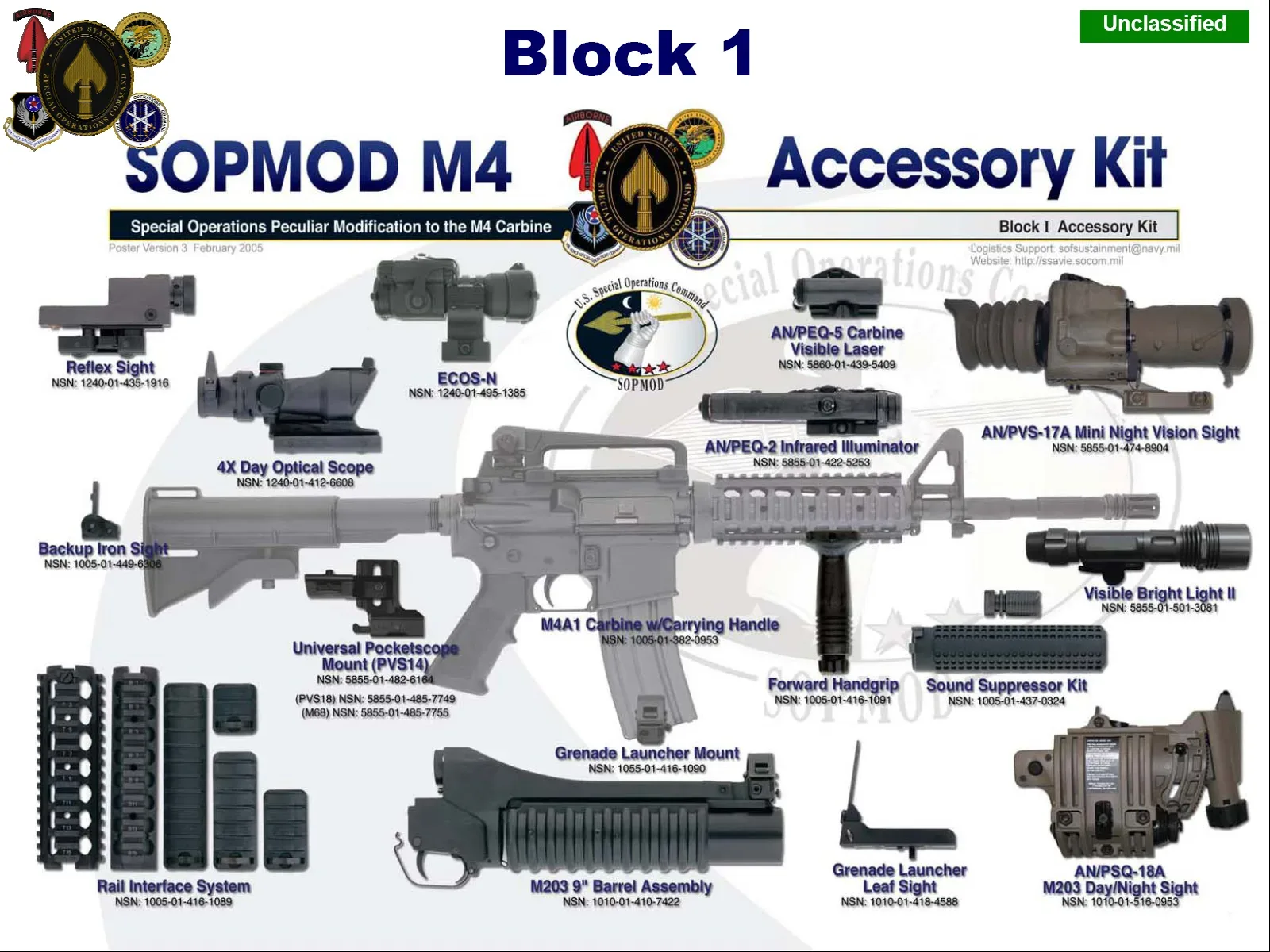
Before MIL-STD-1913, every manufacturer's mounting solution was essentially proprietary. A scope mount from one maker might not work with rings from another. More critically, military forces couldn't standardize their accessories across weapons platforms — meaning a unit's collection of optics, lights, and lasers was a patchwork of compatibility nightmares.
The Picatinny rail solved the compatibility nightmare by establishing a common interface that any manufacturer could build to.
Military Standardization
Because the standard was public and the dimensions fixed, a cottage industry of accessory makers could design products knowing they'd fit any rail-equipped platform. This created a competitive market for optics, lights, foregrips, bipods, laser aiming devices, and night-vision mounts — all of which could move freely between rifles, carbines, and pistols as mission needs changed.
The modular approach that defines modern military small arms loadouts — swapping a magnified optic for a red dot, adding a light for a room-clearing operation, removing the bipod before a fast movement — only works because everything connects to the same standard interface. Examples include:
- Swapping magnified optics for red dots based on mission requirements
- Adding lights for room-clearing operations
- Removing bipods before fast movement phases
- Integrating night-vision and thermal devices onto standard rifles
The rail's reach extended beyond rifles quickly. Per Wikipedia, 1913 rails and accessories have replaced iron sights in the design of many modern firearms and now appear on the undersides of semi-automatic pistol frames and grips. The integration of night-vision and thermal imaging devices onto standard infantry rifles — technology that fundamentally shifted the balance of night combat — depended on having a reliable, standardized mounting platform capable of holding sensitive electronics under recoil.
Civilian Market Adoption
Civilian adoption followed the military curve closely. Manufacturers like Ruger incorporated MIL-STD-1913 rails into production firearms such as the Mini-14 Ranch Rifle. Once the AR-15 platform exploded in popularity with civilian shooters, the Picatinny rail went with it — because the military M4/M16 configuration that the civilian AR copies was already built around 1913 rails on the upper receiver.
Global Reach
The international reach of the standard is difficult to overstate. Picatinny rails are, according to Foreseen Optics, the most widely used rail system globally, compatible with nearly all modern firearms including sniper rifles, assault rifles, handguns, and light machine guns. Platforms like the AR-15, M4, M16, and SR-25 use the rail as their primary accessory interface. The STANAG 4694 adoption in 2009 embedded a metric-equivalent version of the standard into NATO doctrine, ensuring interoperability across allied forces.
Modern Relevanceedit
The 1913 rail has serious competition now — specifically from KeyMod and M-LOK — and that competition is worth understanding because it illustrates both the rail's strengths and its limitations.
KeyMod Challenge
KeyMod was developed by Eric Kincel at VLTOR Weapon Systems, in collaboration with Noveske Rifleworks founder John Noveske. The KeyMod system, whose specs have been public since July 2012, uses a key-slot system that eliminates the need for continuous rail sections, reducing weight and ditching the notorious "cheese grater" feel of a full Picatinny handguard. Accessories mount directly to the handguard without intermediary rail segments.
M-LOK Evolution
M-LOK (Modular Lock) was released by Magpul Industries in 2014 as an evolution of their MOE system. It uses T-nuts and screws to clamp accessories, works with polymer handguards (a KeyMod weakness), and allows accessories to mount from either the front or rear of the slot. Critically, USSOCOM chose M-LOK over KeyMod after rigorous drop testing, which carries weight in the tactical community.
Magpul licenses M-LOK for free but requires manufacturers to obtain permission and follow precise specifications — it is not fully open-source the way KeyMod is.
| System | Developer | Release | Key Features | Adoption |
|---|---|---|---|---|
| Picatinny (MIL-STD-1913) | Richard Swanson/A.R.M.S. | 1995 | Continuous rail, proven durability | Military standard, optics mount |
| KeyMod | Eric Kincel/VLTOR | 2012 | Direct attachment, open-source | Weight-conscious builds |
| M-LOK | Magpul Industries | 2014 | T-nut system, polymer compatible | USSOCOM adopted, handguard standard |
Market segmentation between upper receiver (optics) and handguard (accessories) mounting
Market Segmentation
Both alternatives reduce weight and allow accessories to attach directly to the handguard surface rather than to a rail clamped onto the handguard. On a rifle where a shooter only needs a light at the 9 o'clock position and a sling point, running a full Picatinny quad-rail just to accommodate those two accessories adds unnecessary weight and bulk.
That said, the Picatinny rail's position as the default interface for optics on the upper receiver of most modern rifles is not seriously threatened. The upper receiver rail — where your primary optic lives — still runs MIL-STD-1913 on the vast majority of production rifles.
KeyMod and M-LOK compete primarily on handguards, where weight matters more and the accessory mix is more varied. The rail that holds your LPVO or red dot is almost certainly still a 1913.
Beyond Rifles
The Picatinny rail also shows up well outside the rifle world at this point. It appears on:
- Crossbows and anti-materiel rifles
- Semi-automatic pistols
- Paintball markers and airsoft platforms
- Foam dart blasters and gel blasters
The standard jumped the fence from military hardware to recreational equipment so completely that it now defines what "accessory mount" means to an entire generation of shooters who never thought twice about it.
The BGC Takeedit
The Picatinny rail is one of those infrastructure-level developments that nobody outside the industry notices — which is exactly the sign that it worked.
When a standard becomes invisible because it just functions, that's the definition of success.
What's underappreciated about the rail's history is the patent story. Picatinny Arsenal got the naming rights; Richard Swanson and A.R.M.S. did the actual design work and held the patent. That's a common dynamic in government contracting — the institution gets the credit, the contractor gets the legal instrument. The $1.8 million judgment against Troy at least put some concrete acknowledgment behind who actually designed the thing.
The competition from M-LOK is real and probably warranted on handguards. A full quad-rail is a relic for anyone not running four accessories simultaneously, and most shooters aren't.
But the argument that M-LOK is "replacing" Picatinny misses where the 1913 rail actually lives — on top of the receiver, holding your optic. That part of the standard isn't going anywhere. Every major optic manufacturer designs to MIL-STD-1913 dimensions because that's where the market is and has been for thirty years.
If you're building out a rifle and debating rail systems, the honest answer is: run M-LOK or KeyMod on your handguard if weight matters to you, and stop worrying about what's on your upper receiver because it's already a 1913 rail and your optic already fits it. The debate that consumes a lot of online forum space is mostly about the handguard — which is a legitimate choice, but a narrower one than the rhetoric suggests.
Gary Houtsma and Richard Swanson solved a real problem in an unglamorous way: they picked precise numbers, held to them, and let the market figure out the rest. Thirty years on, you can buy a scope ring from any manufacturer on earth and it'll drop onto any 1913 rail on any firearm. That's not a small thing.
Referencesedit
- https://en.wikipedia.org/wiki/Picatinny_rail
- https://hi-luxoptics.com/blogs/history/history-of-the-picatinny-rail
- https://daggerdefense.com/blogs/news/the-history-of-the-picatinny-rsil-system
- https://wooxstore.com/blogs/woox-journal/exploring-the-picatinny-rail-design-history-and-application
- https://firefield.com/blogs/news/a-history-and-evolution-of-mounts-and-rails-picatinny-keymod-and-m-lok
- https://www.foreseenoptics.com/global-overview-of-four-major-rail-systems-applications-and-future-prospects
Last Updated: February 27, 2026
- Gls Guns(Sumner, IA)
- Bi-mart - Yakima (Fruitvale Ave)(Yakima, WA)
- New Philly Sportsman Specialities(New Philadelphia, OH)
- R&R Sports & Outdoors(Brandon, FL)
Loading comments...