State Details
South Dakota

Overview | |
|---|---|
State | South Dakota (SD) |
Capital | Pierre |
Statehood | 1889 |
Population | 919,318 |
Gun Ownership | 58.6% |
Active FFLs | 436 |
Carry Laws | |
Constitutional Carry | Yes (2019) |
Open Carry | Yes |
CCW Permit Available | Yes |
Permit Reciprocity | 36+ states |
Self-Defense | |
Castle Doctrine | Yes |
Stand Your Ground | Yes |
Duty to Retreat | No |
Regulations | |
State Preemption | Yes |
Red Flag / ERPO | No |
Waiting Period | None |
Universal BGC | No |
NFA Items | Yes |
Assault Weapons Ban | No |
Magazine Limit | None |
Firearms Freedom Act | Yes |
Key Legislation | |
| |
South Dakota Firearms History
Reference article
From The Boise Gun Club Handbook
Overviewedit
South Dakota doesn't have a firearms history — it has several, layered on top of each other like geological strata, and none of them are simple. You've got thousands of years of Indigenous weapon culture before a European ever set foot on the northern Plains. You've got the fur trade era, when guns became one of the most consequential trade goods in the hemisphere. You've got the Black Hills Gold Rush, Deadwood, Wild Bill Hickok, the Great Sioux War, and the single most notorious cavalry massacre in American history.
Then you move into the 20th century and find a state that sent sons to both World Wars, watched the American Indian Movement arm up at Wounded Knee in 1973, and eventually became one of the earlier states to codify constitutional carry.
Through all of it, the firearm in South Dakota was never just a tool. It was a statement about who owned the land, who could protect themselves on it, and what kind of future was being built — or destroyed — out on the Plains.
That tension hasn't gone away. It's just quieter now, settled into the culture of pheasant camps and deer seasons and a state legislature that has been reliably pro-gun for decades.
Pre-Territorial Era: The Lakota and the Arrival of the Gunedit
The first humans arrived in what is now South Dakota more than 11,000 years ago. The Oceti Sakowin — the Seven Council Fires, more commonly called the Sioux — arrived on the northern Plains in the 1700s, migrating south and west from the headwaters of the Mississippi River.
The Lakota (Teton), Dakota (Santee), and Nakota (Yankton) divisions each occupied different parts of the territory and had distinct but related cultures built around bison hunting, warfare, and mobility.
Indigenous Weapons Technology
Before European contact, Plains warfare was conducted with bows, lances, war clubs, and shields. The bow in particular was a sophisticated instrument — a short, recurved design well-suited to mounted combat that skilled warriors could use to fire multiple arrows in the time it took a musket-armed soldier to reload once. This wasn't a technological inferiority; it was a different technology optimized for different conditions.
| Technology | Indigenous | European Trade |
|---|---|---|
| Primary Weapons | Recurved bows, lances, war clubs | Northwest Trade Gun (flintlock) |
| Range | 100+ yards effective | 50-75 yards effective |
| Rate of Fire | 6-8 arrows/minute | 1-2 shots/minute |
| Mounted Combat | Optimized for horseback | Difficult to reload mounted |
| Ammunition | Self-manufactured arrows | Dependent on trade supply |
| Weather Reliability | High | Poor (flintlock ignition) |
The Fur Trade Revolution
The French brothers Louis-Joseph and François Sieur de la Vérendryes reached what is now South Dakota in 1742, claiming the territory for France and opening the door to the fur trade that would reshape the entire region. European and later American traders quickly understood that firearms were the single most sought-after trade commodity among Plains tribes. The Northwest Trade Gun — a smoothbore flintlock musket produced in large quantities specifically for the Indian trade — flooded into the Plains through fur trading networks throughout the late 18th and early 19th centuries.
Timeline showing the convergence of horse and gun technology that made the Lakota the dominant Plains power
Armed Lakota Dominance
The Lakota acquired horses through trade networks from the south before they acquired guns from networks to the north and east, and the combination changed everything. A Lakota warrior on horseback with a trade gun and a bow was not an underarmed opponent. By the time the Lewis and Clark Expedition passed through South Dakota in 1804, the Teton Lakota were the dominant military power on the northern Plains — armed, mounted, and confident enough to briefly detain the expedition near present-day Pierre in a confrontation that came close to open violence.
Fort Pierre was established as a fur trading post in 1817 on the Missouri River and became the oldest continuously occupied white settlement in South Dakota. The American Fur Company operated there for decades, and the trade in beaver pelts, bison robes, and other goods was inseparable from the trade in gunpowder, lead, and firearms. By the 1830s and 1840s, guns had become so embedded in Plains Indian warfare and hunting that access to ammunition was as strategically significant as access to horses.
The smallpox epidemics of 1837 and 1856 devastated the Arikara (Sahnish) population in South Dakota, weakening a tribe that had been one of the Lakota's primary rivals and shifting the balance of power further toward the Sioux. By mid-century, the Lakota were at the height of their territorial reach and military capability — a fact the U.S. Army would spend the next forty years trying to reverse.
The Territorial Era: Gold, Treaties, and the Great Sioux Waredit
Dakota Territory was organized in 1861, encompassing what would become both Dakotas along with parts of Wyoming and Montana. At that point, fewer than 5,000 white settlers lived in the entire region. The Homestead Act of 1862 and the arrival of rail lines in the 1870s began to change those numbers, but the real detonator was gold.
Treaty Violations and Gold Rush
| Event | Date | Significance |
|---|---|---|
| Dakota Territory Organized | 1861 | ~5,000 white settlers in region |
| Homestead Act | 1862 | Accelerated westward settlement |
| Fort Laramie Treaty | 1868 | Guaranteed Lakota rights to Black Hills |
| Custer Black Hills Expedition | 1874 | Confirmed gold, violated treaty |
| Government Ultimatum | Jan 31, 1876 | All Lakota ordered to reservations |
| Battle of Little Bighorn | June 25-26, 1876 | Custer's 7th Cavalry destroyed |
The Treaty of Fort Laramie of 1868 — signed by Lakota leaders and General William T. Sherman — guaranteed the tribe's rights to the Black Hills and established the Great Sioux Reservation across a large portion of western South Dakota. The Black Hills, known to the Lakota as He Sapa, were sacred ground. The treaty was explicit: no whites without tribal permission.
In the summer of 1874, General George Armstrong Custer led an expedition of roughly 1,000 soldiers into the Black Hills — a direct violation of the 1868 treaty — and confirmed the presence of gold. The news hit the eastern press by August. By the following spring, the Black Hills were flooded with miners, and the federal government's attempts to purchase the land from the Lakota went nowhere. The Lakota weren't selling He Sapa.
The Commissioner of Indian Affairs ordered all Lakota onto reservations by January 31, 1876 — an ultimatum that nomadic bands had no realistic way to comply with even if they'd wanted to. The Army's response was to send columns into the field to force compliance. The result was the Great Sioux War of 1876, the most significant armed conflict ever fought on South Dakota soil.
The Great Sioux War
The war produced the most famous Native American military victory in U.S. history. On June 25–26, 1876, at the Battle of the Little Bighorn in present-day Montana, a combined force of Lakota and Cheyenne warriors under leaders including Sitting Bull and Crazy Horse destroyed Custer's 7th Cavalry — killing Custer and 268 of his men. The Army's Springfield Model 1873 "Trapdoor" carbines, which were prone to overheating and case extraction failures during sustained fire, performed poorly at the Little Bighorn. Some accounts from survivors suggest warrior firepower — including repeating Winchesters held by some fighters — contributed to the rout, though the tactical and numerical situation was the primary factor.
The cascade from treaty violation to armed conflict that defined the 1870s in South Dakota
The Army ultimately prevailed through attrition, pursuing Lakota bands through the winter of 1876–77 until starvation and exhaustion forced most onto reservations. The Black Hills were confiscated. Crazy Horse surrendered at Fort Robinson in Nebraska in May 1877 and was bayoneted by a soldier four months later. Sitting Bull fled to Canada before eventually returning to the Standing Rock Agency in 1881.
Deadwood: Law by Gunfire
Deadwood — the gold camp that sprang up illegally in the Black Hills in 1876 — deserves its own chapter in South Dakota's armed history. The town existed outside federal law for its first years, which made personal firearms the primary law enforcement mechanism. Wild Bill Hickok arrived in Deadwood in the summer of 1876 carrying a pair of Colt Single Action Army revolvers, which he reportedly preferred to carry with the hammers resting on empty chambers for safety.
He was shot from behind on August 2, 1876, while playing poker at Nuttall & Mann's Saloon — killed by Jack McCall with a single shot from a double-action revolver, holding what became known as the "dead man's hand" of aces and eights.
Calamity Jane — Martha Jane Canary — was a fixture of the Deadwood era, variously employed as a scout, teamster, and showwoman. Her documented skill with firearms was real, though her frontier resume was heavily embellished over time. Seth Bullock, appointed Deadwood's first sheriff in 1876, brought more conventional law enforcement order to the town and later became a close friend of Theodore Roosevelt. The firearms culture of Deadwood was simultaneously practical and theatrical — guns solved real problems and also performed social functions about status and danger that the town's mythology preserved for generations.
19th Century: Statehood, Expansion, and Wounded Kneeedit
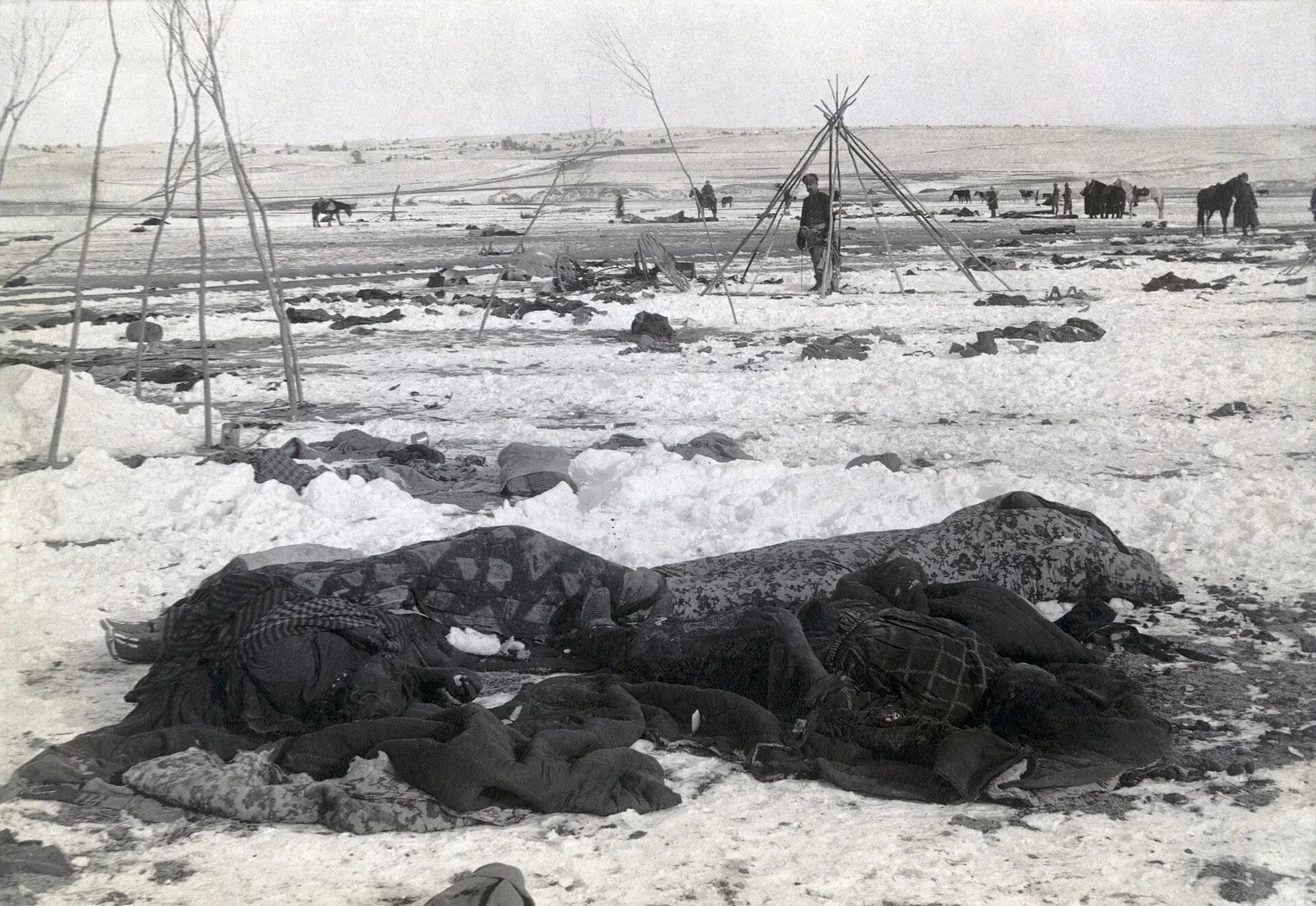
South Dakota entered the Union on November 2, 1889, admitted simultaneously with North Dakota as the 39th and 40th states. The circumstances of admission were deliberately designed to split Democratic and Republican electoral advantages, which is why both states came in on the same day. South Dakota's constitution, ratified that year, contained no specific right to keep and bear arms provision beyond what the Second Amendment provided — the state wouldn't add its own constitutional language until later.
| Location | Date | Event | Casualties |
|---|---|---|---|
| Standing Rock Agency | Dec 15, 1890 | Sitting Bull killed during arrest | Several police/tribal members |
| Wounded Knee Creek | Dec 29, 1890 | 7th Cavalry massacre | 250+ Lakota, 25 soldiers |
| Congressional Recognition | 1890-present | 20 Medals of Honor awarded | Ongoing rescission efforts |
The year after statehood brought the most catastrophic single act of armed violence in South Dakota's recorded history. Ghost Dance spiritualism had spread rapidly through the Lakota reservations in 1889–1890, a religious movement that promised spiritual renewal and the return of the bison. Army commanders and Indian agents interpreted it as a prelude to armed uprising. Sitting Bull was killed on December 15, 1890, at the Standing Rock Agency during a botched arrest attempt by Indian police — a chaotic confrontation in which several police and tribal members died in close-range gunfire.
Two weeks later, on December 29, 1890, the 7th Cavalry — Custer's old regiment — intercepted a band of Big Foot's Miniconjou Lakota at Wounded Knee Creek on the Pine Ridge Reservation. Soldiers were attempting to disarm the band when a shot was fired — by whom and under what circumstances remains disputed. What followed was not a battle. It was a massacre.
- Four Hotchkiss mountain guns positioned on surrounding ridge
- Hundreds of cavalry rifles in crossfire pattern
- More than 250 Lakota civilians killed
- 25 soldiers killed, many from friendly fire
- 20 Medals of Honor controversially awarded
The Army awarded 20 Medals of Honor to participants in the Wounded Knee Massacre — awards that remain controversial and have been the subject of repeated Congressional efforts to rescind them, including a 2019 bill introduced by South Dakota's own Representative Dusty Johnson.
The reservation system that followed functionally disarmed the Lakota population as a matter of policy. Indian agents on the Great Sioux Reservation worked systematically to confiscate firearms, limiting hunting and self-defense capability. This context matters for understanding why the Wounded Knee occupation of 1973 carried such loaded symbolism — guns on that ground meant something specific.
20th Century: Wars, Hunting Culture, and Wounded Knee 1973edit
South Dakota's armed history in the first half of the 20th century is largely the story of men leaving for wars and coming back changed, or not coming back at all. The state sent roughly 32,000 men into World War I — significant for a population of under 600,000.
World War II drew over 64,000 South Dakotans into service. The military experience with firearms during this period was, for many veterans, exactly what SDPB documentarian Brian Gevik found when he interviewed WWII veterans for Heritage of Arms — the guns were tools, nothing more, and most of those men had no particular attachment to them once they came home.
Military Service and Veterans
Ellsworth Air Force Base, established near Rapid City in 1942 as Army Air Base Rapid City, became one of South Dakota's most significant military installations and remains active today as home to B-21 Raider operations. The base brought a sustained military presence to western South Dakota that shaped the region's economy and culture for generations.
Pheasant Culture Emerges
The state's civilian gun culture in the mid-20th century was built primarily around hunting — deer, waterfowl, and increasingly pheasant. Ring-necked pheasants were introduced to South Dakota in the late 19th century and by the mid-20th century had established populations so dense that the state became the pheasant hunting capital of North America. This wasn't a minor thing. South Dakota's pheasant season routinely drew over 100,000 out-of-state hunters annually by the latter decades of the century, generating hundreds of millions of dollars in economic activity and cementing a gun culture oriented around shotguns, walking cornfield edges, and October weekends that had nothing to do with politics.
The Federal Firearms Act of 1938 and the Gun Control Act of 1968 applied to South Dakota like everywhere else, but the state had no particular legislative response to either. South Dakota wasn't interested in adding restrictions on top of the federal floor, and it didn't.
The 1973 Wounded Knee Occupation
The most consequential armed confrontation of South Dakota's 20th century came not from a war but from within. On February 27, 1973, members of the American Indian Movement (AIM) — led by Russell Means and Dennis Banks — occupied the town of Wounded Knee on the Pine Ridge Reservation, taking several hostages and establishing a defensive perimeter. The occupation was triggered by frustration with Oglala Sioux Tribal Council Chairman Richard Wilson and the Bureau of Indian Affairs, which AIM accused of corruption and complicity in violence against tribal members.
| Conflict | Duration | Participants | Outcome |
|---|---|---|---|
| AIM Occupation | Feb 27 - May 8, 1973 | 200+ AIM members vs 300+ federal officers | 2 AIM killed, 1 marshal wounded |
| Federal Response | 71 days | FBI, U.S. Marshals, APCs | Negotiated withdrawal |
| Legal Aftermath | 1973-1974 | Russell Means, Dennis Banks trials | Charges dismissed (prosecutorial misconduct) |
The FBI and U.S. Marshals Service surrounded the occupied village with armored personnel carriers, automatic weapons, and eventually more than 300 federal officers. AIM occupiers were armed with hunting rifles, shotguns, and some military-surplus weapons smuggled through the federal perimeter. Daily firefights were common. Two AIM members — Frank Clearwater and Lawrence Lamont — were killed by gunfire during the 71-day siege. A federal marshal was seriously wounded. The occupation ended on May 8, 1973, when AIM negotiated a withdrawal based on federal promises to review the 1868 Fort Laramie Treaty — promises the government largely didn't keep.
The legal aftermath stretched for years. Russell Means and Dennis Banks were tried on federal charges stemming from the occupation. Judge Fred Nichol dismissed the case in 1974, citing prosecutorial misconduct. The Wounded Knee occupation didn't change federal Indian policy in any lasting way, but it became a defining moment for the American Indian Movement and a reference point for every subsequent discussion of armed resistance and treaty rights in South Dakota.
The Brady Handgun Violence Prevention Act of 1993 introduced the federal background check system that South Dakota complied with, and the Federal Assault Weapons Ban of 1994 applied for its 10-year term without the state adding any supplemental restrictions. When the federal ban expired in September 2004, South Dakota made no move to replace it at the state level.
Modern Era (2000–Present)edit
South Dakota entered the 21st century as a reliably conservative, gun-friendly state that had never shown much appetite for restrictions beyond what federal law required. The legislature's posture was consistently permissive, and the gun-owning public — which by most estimates represents a substantial majority of South Dakota households — wasn't pushing for change in either direction.
Concealed carry in South Dakota required a permit through most of the modern era, administered through county sheriff's offices. The process was relatively straightforward by most states' standards — South Dakota was not a "may issue" state where authorities could deny permits at their discretion. Training requirements existed but weren't onerous.
Constitutional Carry Adoption
The shift to constitutional carry — permitless carry for those legally allowed to possess firearms — came in 2019, when Governor Kristi Noem signed HB 1094 into law on January 31 of that year. The bill passed the South Dakota Legislature without a major public fight. South Dakota became the 14th state to adopt constitutional carry, and notably, Noem signed the bill on her first day in office — it was a statement as much as a policy decision.
South Dakota's transition from permitted to permitless concealed carry
South Dakotans who want to carry concealed can still obtain a permit for reciprocity purposes with other states, but no permit is required to carry concealed within South Dakota.
South Dakota also passed preemption legislation that prevents cities and counties from enacting firearms ordinances stricter than state law. This means Sioux Falls and Rapid City — the state's two largest cities — operate under the same rules as Mobridge or Winner.
The Bruen decision (New York State Rifle & Pistol Association v. Bruen, 2022) had limited practical impact on South Dakota because the state was already permissive. The decision's historical test for evaluating firearms regulations was, in some ways, a framework that validated what South Dakota had been doing by default.
Hunting as Economic Engine
Pheasants Forever has been held in Sioux Falls and draws tens of thousands of attendees. The shotgun culture built around pheasant hunting produces a gun-owning demographic that is broad, multigenerational, and largely apolitical about it — people who grew up walking corn stubble with a 20-gauge aren't making identity statements, they're just hunting.
Deer hunting — both whitetail in the east and mule deer in the west — adds another substantial layer. Custer State Park in the Black Hills hosts managed hunts and is one of the more unusual public hunting experiences in the country, with bison and burros sharing the landscape with hunters pursuing deer and elk.
The Days of '76 Museum in Deadwood, the 1881 Courthouse Museum in Custer, the W.H. Over Museum at the University of South Dakota in Vermilion, and the Siouxland Heritage Museums in Sioux Falls all maintain notable firearms collections documenting the state's history. The W.H. Over Museum's collection includes a punt gun — a massive waterfowl hunting weapon mounted on a small boat, used for commercial market hunting before such weapons were banned state by state beginning in the 1860s. These weren't sporting arms; one discharge could kill dozens of ducks in a single shot. Their prohibition was among the earliest firearms-specific regulations in American history.
Notable Figures & Manufacturersedit
Wild Bill Hickok (James Butler Hickok) remains the most famous armed figure associated with South Dakota, though his career spanned much of the central Plains. His death in Deadwood on August 2, 1876, cemented the town's mythology and produced the "dead man's hand" legend that survives in poker vocabulary to this day. Hickok's preferred sidearms were Colt Single Action Army revolvers.
- Preferred Colt Single Action Army revolvers
- Carried butt-forward in sash for cross-draw
- Could execute draw with either hand
- Killed August 2, 1876, holding 'dead man's hand'
Calamity Jane (Martha Jane Canary) was documented in Deadwood contemporaneous records as a capable shooter, though her legend significantly outpaced her actual frontier resume. She was, by multiple accounts, a skilled markswoman with rifle and pistol, and she participated in various Army scouting activities in the Dakota Territory in the 1870s.
Seth Bullock served as Deadwood's first sheriff beginning in 1876 and brought genuine law enforcement authority to a town that had operated on pure armed self-interest. His later friendship with Theodore Roosevelt — who had ranched in the Dakotas in the 1880s — produced the only monument to Roosevelt built during the president's lifetime, erected in the Black Hills by Bullock and a group of Rough Riders veterans.
Sitting Bull (Tatanka Iyotake) was one of the most consequential figures in the history of armed resistance to U.S. expansion on the northern Plains. After the Great Sioux War, he led his band to Canada rather than submit to reservation confinement, returning in 1881. He was killed at Standing Rock in December 1890 in the spiral of violence that ended at Wounded Knee two weeks later.
Crazy Horse (Tashunka Witko) was the Oglala Lakota war leader most directly responsible for the tactical defeat of Custer at the Little Bighorn. He surrendered at Fort Robinson, Nebraska, in May 1877 and was killed four months later during a disputed confrontation with soldiers. The Crazy Horse Memorial in the Black Hills — begun by sculptor Korczak Ziolkowski in 1948 and still under construction — is the largest mountain carving in the world and sits on what was once Lakota treaty land.
Russell Means and Dennis Banks led the 1973 Wounded Knee occupation and became the most prominent public faces of the American Indian Movement. Both were South Dakotans by connection if not always by birth, and both spent years in legal battles stemming from their activities in the state.
On the manufacturing side, South Dakota has not been a significant center of firearms production. There are no major firearms manufacturers headquartered in the state, and no historic arsenals or military production facilities that shaped the industry. The state's contribution to firearms history runs through culture, conflict, and policy rather than production.
Current Legal Landscapeedit
South Dakota is among the more permissive states in the country for firearms ownership and carry. Here's where things stand:
| Category | South Dakota Law | Notes |
|---|---|---|
| Concealed Carry | Constitutional carry (2019) | No permit required 18+ |
| Permits Available | Enhanced & Regular | For reciprocity purposes |
| Background Checks | Federal NICS only | No universal requirement |
| Preemption | Complete state preemption | No local restrictions |
| Castle Doctrine | Yes (SDCL 22-18-4) | No duty to retreat |
| Assault Weapons | No restrictions | No magazine limits |
| Red Flag Laws | None | No ERPO statute |
Permit system still exists for those who want it. South Dakota issues Enhanced Permits and Regular Permits for concealed carry. The Enhanced Permit requires a live-fire training component and is recognized by more states for reciprocity. The Regular Permit has lighter requirements. Both are processed through county sheriffs.
Preemption is in place statewide. No local government can enact firearms ordinances more restrictive than state law. Sioux Falls cannot impose magazine limits or additional carry restrictions.
Castle Doctrine applies in South Dakota. There is no duty to retreat in a place where a person has a legal right to be. SDCL 22-18-4 codifies the right to use force, including deadly force, in defense of self or others under appropriate circumstances.
Background checks follow the federal NICS system. South Dakota does not operate its own background check system and has no universal background check law extending to private sales beyond the federal requirement for licensed dealers.
No assault weapons ban. No magazine capacity limits. No red flag law as of this writing — South Dakota has not enacted an Extreme Risk Protection Order (ERPO) statute.
Minimum age for handgun purchase from a dealer is 21 under federal law. South Dakota does not impose stricter state-level age requirements.
Hunting regulations are administered by the South Dakota Game, Fish and Parks department. Pheasant season typically opens the third Saturday of October. Specific weapon restrictions for various seasons (bow, muzzleloader, rifle) follow standard patterns. The state's pheasant population — while subject to annual variation based on winter severity and agricultural conditions — consistently supports one of the highest-density upland hunting opportunities in North America.
The state's political environment makes significant gun restriction legislation essentially non-viable at the state level. Republicans hold commanding supermajorities in both chambers of the South Dakota Legislature, and the state's congressional delegation has been uniformly supportive of Second Amendment positions.
- Senator John Thune - NRA A rating
- Senator Mike Rounds - NRA A rating
- Representative Dusty Johnson - NRA A rating
The BGC Takeedit
South Dakota is one of those states where the gun culture runs so deep that it's almost invisible — it's just part of the furniture. You don't argue about it at Thanksgiving because everyone at the table hunts. The pheasant season is a bigger deal than most political events.
Grandkids get .22s for Christmas. Nobody thinks of that as a statement.
What makes South Dakota genuinely interesting as a firearms history is the weight of what happened here.
Two of the most significant armed confrontations in American history — the Wounded Knee Massacre in 1890 and the AIM occupation in 1973 — happened on the same piece of ground in western South Dakota. Those two events, separated by 83 years and connected by the same land and the same unresolved grievances, give South Dakota a firearms history that's genuinely complicated.
The gold rush guns, the frontier law enforcement of Deadwood, Wild Bill getting shot in the back at poker — that's the part of the history that gets romanticized. The Treaty of Fort Laramie being violated at gunpoint, the systematic disarmament of reservation populations, the Hotchkiss guns on the ridge at Wounded Knee — that's the part that gets handled more carefully in the state's museums and less carefully in the political conversation.
For gun owners actually living and hunting in South Dakota today, the legal environment is about as good as it gets. Constitutional carry since 2019, no local preemption escape hatches, no magazine restrictions, no red flag law. The state has never shown interest in being a laboratory for gun control policy, and it's not going to start. Governor Noem signed constitutional carry on her first day in office as a deliberate signal, not an afterthought.
The pheasant culture is real and it matters. This isn't a state where gun ownership is primarily about politics or identity performance — it's about October, and dogs working the cattails, and a limit of roosters before noon.
That's a durable culture, connected to land use and agriculture and seasonal rhythms that don't change much with the political winds. It's probably the healthiest version of gun culture you'll find anywhere in the country — practical, traditional, and mostly unconcerned with whatever's happening in Washington.
The tension between that settled hunting culture and the complicated history of firearms on Lakota land doesn't get resolved, because it can't. Both things are true simultaneously, which is exactly what makes South Dakota's firearms history worth understanding rather than just celebrating.
Referencesedit
- SDPB. "The History of Guns in South Dakota." South Dakota Public Broadcasting, April 27, 2021. https://www.sdpb.org/news-and-information/2021-04-27/the-history-of-guns-in-south-dakota
- SDPB. Heritage of Arms (documentary). South Dakota Public Broadcasting, 2021. https://www.youtube.com/watch?v=3bekYEELwrI
- HISTORY.com Editors. "South Dakota — Mount Rushmore, Gold Rush & Wounded Knee Massacre." HISTORY, last updated May 28, 2025. https://www.history.com/articles/south-dakota
- South Dakota Magazine. "The Weapon and the Warrior." https://www.southdakotamagazine.com/weapon-and-the-warrior
- SDPB Heritage of Arms. "The Firearms of Deadwood, South Dakota." YouTube. https://www.youtube.com/watch?v=z7hXa9XykQM
- South Dakota Legislature. HB 1094 (2019). Constitutional Carry Act. https://sdlegislature.gov
- South Dakota Codified Laws § 22-18-4. Use of Force in Defense of Person.
- New York State Rifle & Pistol Association v. Bruen, 597 U.S. 1 (2022).
- Utley, Robert M. The Lance and the Shield: The Life and Times of Sitting Bull. Henry Holt, 1993.
- Greene, Jerome A. American Carnage: Wounded Knee, 1890. University of Oklahoma Press, 2014.
- Smith, Rex Alan. Moon of Popping Trees: The Tragedy at Wounded Knee and the End of the Indian Wars. University of Nebraska Press, 1981.
- Matthiessen, Peter. In the Spirit of Crazy Horse. Viking, 1983.
- South Dakota Game, Fish and Parks. Pheasant Hunting Regulations. https://gfp.sd.gov
Last Updated: February 24, 2026
- Quail Creek Plantation(Okeechobee, FL)
- 2aHawaii(Honolulu, HI)
- Boston Firearms(Everett, MA)
- Safeshoot(Kingston, NY)
Loading comments...