State Details
Utah

Overview | |
|---|---|
State | Utah (UT) |
Capital | Salt Lake City |
Statehood | 1896 |
Population | 3,417,734 |
Gun Ownership | 46.8% |
Active FFLs | 1,061 |
Carry Laws | |
Constitutional Carry | Yes (2021) |
Open Carry | Yes |
CCW Permit Available | Yes |
Permit Reciprocity | 37+ states |
Self-Defense | |
Castle Doctrine | Yes |
Stand Your Ground | Yes |
Duty to Retreat | No |
Regulations | |
State Preemption | Yes |
Red Flag / ERPO | No |
Waiting Period | None |
Universal BGC | No |
NFA Items | Yes |
Assault Weapons Ban | No |
Magazine Limit | None |
Firearms Freedom Act | Yes |
Key Legislation | |
| |
Notable Manufacturers | |
| |
Utah Firearms History
Reference article
From The Boise Gun Club Handbook
Updated August 15, 2026. The law moved twice since this article was written. The $200 making and transfer tax on suppressors, SBRs, SBSs and AOWs was eliminated effective January 1, 2026 by the One Big Beautiful Bill Act. Then on August 5, 2026 a federal court in Silencer Shop Foundation v. ATF struck down the NFA registration and approval requirements for those same items, and that injunction took effect August 13. It covers only the plaintiffs, their members and their customers. Living in a plaintiff state does not make you covered. Machine guns and destructive devices are unchanged. Read the current guide: NFA Items in 2026: What Actually Changed.
Overviewedit
Utah's relationship with firearms is not incidental to its history — it's structural. The state was settled by people who crossed a continent armed, organized a territorial militia that rivaled standing armies, produced the most prolific firearms inventor who ever lived, and has spent the modern era consistently at the front of the national conversation on gun rights.
You can trace a direct line from Jonathan Browning repairing rifles for Mormon pioneers in 1852 to his son John Moses Browning designing the M2 .50-caliber machine gun in a workshop four blocks from where Jonathan's shop stood — a weapon that is still in production and still in active military service nearly a century later.
That kind of continuity is not an accident. It reflects a culture that has treated the firearm as a practical tool, a community asset, and a political symbol simultaneously.
Utah is also not a simple story. The same territorial militia that armed settlers against genuine threats carried out the Mountain Meadows Massacre in 1857. The same religious community that celebrated self-reliance was occasionally disarmed by federal troops. The politics of guns in Utah have always been tangled up with questions of sovereignty, identity, and the relationship between the state and the federal government — questions that are still very much alive.
Pre-Territorial Era: The Mormon Exodus and Armed Settlementedit
Armed Migration and Settlement
Before Utah was a territory, it was a destination — and getting there required being armed.
The Latter-day Saint exodus from Illinois and Iowa beginning in 1846 was one of the largest organized civilian migrations in American history, and it was a military operation in everything but name. Brigham Young organized the emigrating Saints into companies with assigned captains, and firearms were treated as essential equipment alongside oxen and flour. The need for weapons was not theoretical: the expulsion from Nauvoo, Illinois had involved actual armed conflict, and the overland route crossed territory where hostile encounters with both Native peoples and opportunistic bandits were real possibilities.
| Event | Year | Significance |
|---|---|---|
| Mormon Exodus begins | 1846 | Organized migration requiring military-style preparation |
| Jonathan Browning remains in Illinois | 1846 | Arms successive wagon trains instead of emigrating |
| Jonathan Browning reaches Utah | 1852 | Establishes gunsmithing operation in Ogden |
| Walker War | 1853–1854 | First major armed conflict in territory |
| Black Hawk War | 1865–1872 | Extended conflict demonstrating firearms' centrality |
Jonathan Browning's Role
Jonathan Browning was central to this preparation. A gunsmith of considerable skill who had operated shops in Quincy and then Nauvoo, Illinois, Jonathan was asked by Brigham Young in 1846 to remain behind specifically to arm the emigrating companies rather than march with the first wave. He spent the next several years fabricating and repairing firearms for successive wagon trains, including his own distinctive harmonica rifle — a repeating muzzleloader using a sliding bar with multiple charge holes — before finally making the trek himself in 1852 and settling in Ogden.
Native American Relations and Trade
The firearms arriving with the Mormon pioneers in the late 1840s and early 1850s were a practical mix:
- Percussion-cap rifles
- Shotguns
- Pistols
- Scattered older flintlock arms
Nothing exotic. What mattered was that they worked, could be maintained in the field, and that the community had people who knew how to keep them running. Jonathan Browning was the most important of those people in northern Utah.
The Ute, Shoshone, Goshute, and Navajo nations already inhabited the territory the LDS settlers were moving into, and the firearms dynamic between those groups and the arriving settlers was complicated from the start. Trade in arms was occurring — sometimes sanctioned, sometimes explicitly prohibited by territorial law. Brigham Young as territorial governor would periodically attempt to restrict arms sales to Native groups, though enforcement was inconsistent and the trade continued through various channels. The Walker War (1853–1854) and the Black Hawk War (1865–1872) both demonstrated that firearms were central to the conflicts over land and resources that defined Utah's early territorial years, with both sides acquiring weapons through whatever means were available.
Territorial Era: The Nauvoo Legion, Camp Floyd, and Federal Tensionedit
The Nauvoo Legion
Utah Territory was organized in 1850, and almost immediately the question of who controlled armed force within its borders became a serious political problem.
The Nauvoo Legion — the Utah Territorial Militia — was not a typical frontier home guard. At its peak in the mid-1850s, it was estimated to number between 5,000 and 8,000 organized men, making it one of the largest military forces in the American West and arguably the largest militia in the United States at the time. It was equipped with artillery, organized into brigades and regiments, and directly commanded by Brigham Young in his capacity as territorial governor. The federal government in Washington viewed this with considerable alarm — a quasi-independent armed force in a territory with openly separatist political rhetoric was not something the Buchanan administration was inclined to tolerate.
| Military Force | Peak Size | Period | Role |
|---|---|---|---|
| Nauvoo Legion | 5,000–8,000 | 1850s | Utah Territorial Militia |
| Johnston's Army | 5,500 | 1857–1858 | Federal force sent to Utah |
| Camp Floyd garrison | 3,500 | 1858–1861 | Largest peacetime U.S. military installation |
The Utah War 1857–1858
The Utah War of 1857–1858 was the result. President James Buchanan dispatched roughly 2,500 U.S. Army troops — later expanded to around 5,500 — under General Albert Sidney Johnston's Army to install a federally appointed governor and assert control over the territory. The Nauvoo Legion conducted a harassing campaign through the winter of 1857–1858, burning supply wagons, running off cattle, and using knowledge of the terrain to delay the Army's advance without engaging in pitched battle.
Robert T. Burton and Lot Smith led the irregular operations that destroyed three federal supply trains in October 1857, an effective if technically treasonous campaign that bought time for negotiation.
Camp Floyd and Military Surplus
The resolution was largely peaceful — Buchanan issued a general pardon, Young stepped down as governor, and the Army marched through Salt Lake City without incident in June 1858. But the Army's presence produced a lasting consequence: Camp Floyd, established 44 miles southwest of Salt Lake City in Cedar Valley, became the largest peacetime military installation in American history, housing up to 3,500 troops at its peak. It also became an enormous source of surplus military equipment.
When the Civil War broke out in 1861 and Johnston's forces were recalled east, Camp Floyd was abandoned and the federal government sold off millions of dollars in military stores — weapons, ammunition, wagons, livestock — at a fraction of their value. Utah settlers bought heavily. The territory's civilian armament increased substantially as a direct result.
Mountain Meadows Massacre
The Mountain Meadows Massacre of September 11, 1857, cannot be separated from this context. Members of the Nauvoo Legion, operating under disputed orders and in coordination with local Paiute men, attacked and killed approximately 120 emigrants from the Fancher-Baker wagon train from Arkansas in southern Utah. The attack was carried out under a flag of truce, with the militiamen concealing their identity initially before the killing was done at close range.
The firearms used were militia weapons — the same guns that had been prepared and maintained for community defense. John D. Lee was the only person ever tried and executed for the massacre, shot by firing squad at Mountain Meadows in 1877. The full chain of command and the extent of authorization from territorial leadership remains disputed by historians.
The territorial period also saw the beginning of the Browning Arms story in earnest. Jonathan Browning established his gunsmithing shop in Ogden in 1852 and operated it until his death in 1879. The shop was a working firearms facility serving the civilian population of northern Utah — repairs, custom work, and modest production. His son John Moses, born January 23, 1855, grew up at that workbench.
19th Century: Statehood, the Browning Dynasty, and Winchesteredit
Path to Statehood
Utah's path to statehood was longer and more contentious than almost any other territory, primarily because of the LDS Church's practice of polygamy and ongoing federal suspicion of the territory's political independence. Utah was not admitted as a state until January 4, 1896 — a 46-year wait from territorial organization, during which the Enabling Act required the state constitution to prohibit polygamy and various federal restrictions on LDS institutional power were enforced.
John Moses Browning's Rise
In the meantime, Ogden was producing one of the most consequential figures in American industrial history.
John Moses Browning began designing firearms seriously in the late 1870s. By 1878, he and his brothers had established the Browning Brothers operation in Ogden, initially in their father's old shop and then in a purpose-built brick factory on the same block. In 1879, John filed for his first patent — a single-shot falling-block rifle of his own design. He and his brothers produced around 600 of these rifles in Ogden before the operation caught the attention of the Winchester Repeating Arms Company.
| Browning Design | Year | Manufacturer | Significance |
|---|---|---|---|
| Browning Single Shot | 1878 | Browning Brothers | First patented design |
| Winchester Model 1886 | 1886 | Winchester | First major Winchester-Browning collaboration |
| Winchester Model 1894 | 1894 | Winchester | Best-selling sporting rifle in American history |
| Auto-5 Shotgun | 1902 | FN/Remington | First successful semi-auto shotgun |
| Colt Model 1911 | 1911 | Colt | U.S. military standard sidearm |
| BAR | 1917 | Colt/Winchester | Primary U.S. light machine gun WWI-Korea |
| M2 Machine Gun | 1921 | Various | Still in production and military service |
The Winchester Partnership
In early 1883, T. G. Bennett, Winchester's vice president, was shown a Browning Single Shot in New Haven, got on a train to Ogden, and concluded a deal with John and Matt Browning in a single meeting for $8,000 — then caught the next train back east. It was the start of a design relationship that would run until 1902, and during those 19 years, every rifle and shotgun Winchester introduced was a Browning design.
The list includes:
- Model 1886
- Model 1887 shotgun
- Model 1890 pump-action .22
- Model 1892
- Model 1894
- Model 1895
Breaking with Winchester
Browning did not move to Connecticut. He stayed in Ogden, working at his bench, producing prototypes with his brothers, and shipping designs east by rail.
The Winchester relationship ended in 1902 over a dispute about the Auto-5 semi-automatic shotgun. Browning wanted royalties on each unit sold rather than a flat patent purchase price — a reasonable ask for a design that would sell in the millions. Winchester declined. Browning took the design to Fabrique Nationale in Liège, Belgium, and to Colt in Hartford for his pistol work. FN produced the Auto-5 beginning in 1902; it remained in production for nearly a century.
Military Designs and Legacy
His subsequent output at the Ogden shop included the designs for the Colt Model 1911 pistol (patented 1911, adopted as the U.S. military's standard sidearm), the Browning Automatic Rifle (BAR, 1917), and the M2 .50-caliber heavy machine gun — a weapon still manufactured and deployed by militaries around the world. He held 128 patents total at his death in Liège on November 26, 1926, while working on what became the Browning Hi-Power pistol.
Ogden's gun culture during this period was not limited to the Browning operation. The Ogden Rifle Club, organized in the early 1880s by a group that included Browning brothers and a pair of European shooting enthusiasts — German physician Dr. A. L. Ulrich and Professor H. R. Ring — provided a competitive shooting environment that directly influenced John Moses's experimental work. Several of his early mechanism designs were tested and refined at club matches.
20th Century: Wars, Military Presence, and the Rise of Utah Gun Cultureedit
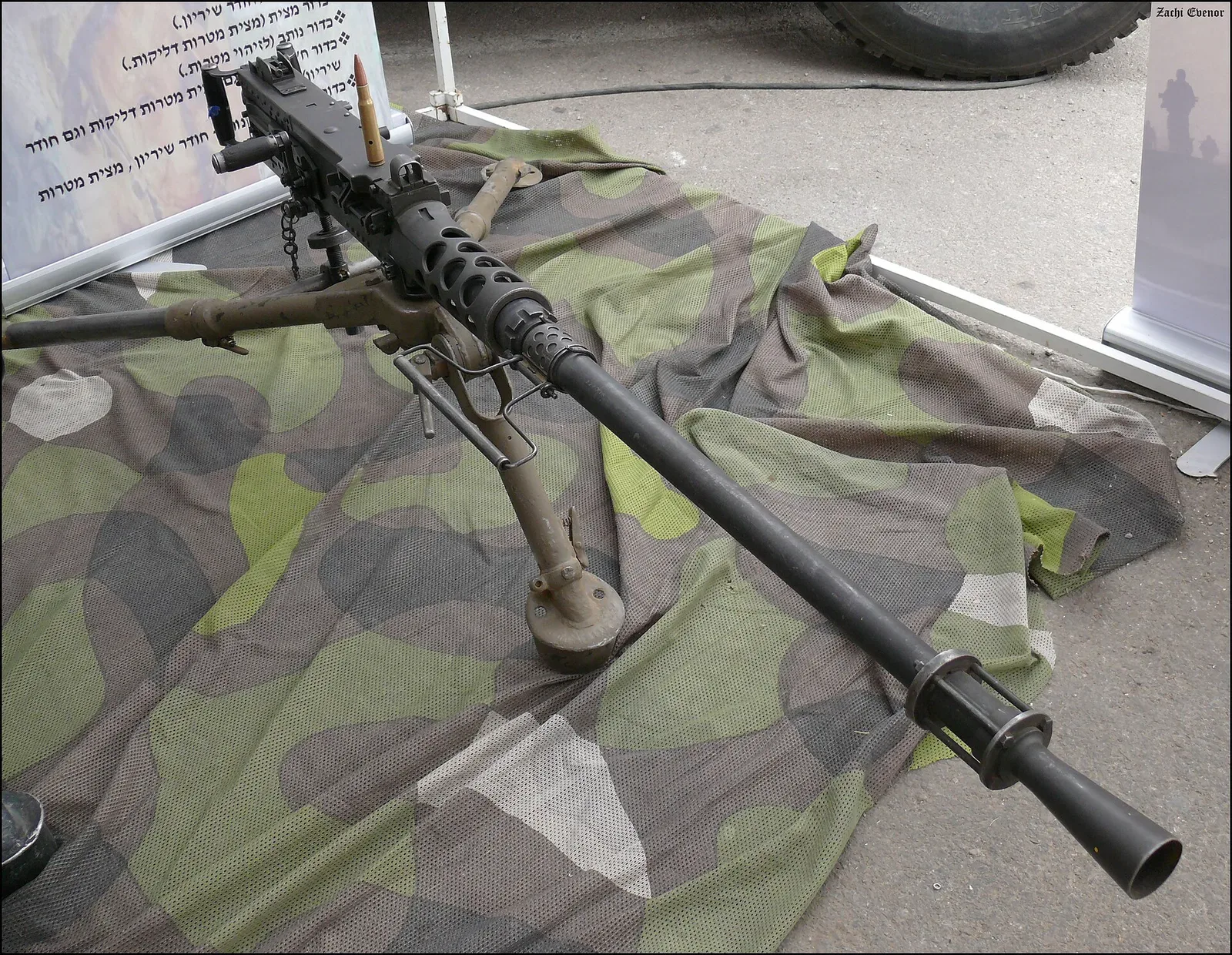
Browning Weapons in Global Warfare
Utah sent a disproportionate share of its population into both World Wars, and the weapons those soldiers carried were in several cases designed by a man who had grown up within walking distance of the state capitol.
- M1911 pistol — standard U.S. sidearm through Vietnam
- M1917 Browning machine gun — primary WWI medium machine gun
- M1919 variants — remained in service through Korea
- Browning Automatic Rifle — equipped U.S. infantry squads
- M2 heavy machine gun — continuous service since 1933
The M1911 pistol was the standard U.S. sidearm through both World Wars, Korea, and Vietnam. The M1917 Browning machine gun and M1919 variants were the primary medium machine guns of the American Expeditionary Forces in France and remained in service through Korea. The BAR equipped U.S. infantry squads in both World Wars. The M2 — still in production at plants including one operated by General Dynamics — has been in continuous service since 1933. Utah's most famous arms designer outfitted the American military for most of the 20th century.
Military Installations
| Installation | Established | Primary Function | Peak Employment |
|---|---|---|---|
| Hill Air Force Base | 1940 | Logistics & maintenance | Tens of thousands (WWII) |
| Dugway Proving Ground | 1942 | Chemical/biological & weapons testing | Classified |
| Tooele Army Depot | 1942 | Ammunition & chemical weapons storage | Several thousand |
Dugway Proving Ground, established in 1942 in Tooele County, became one of the Army's primary testing facilities for chemical and biological agents but also conducted extensive conventional weapons testing. The facility's remote location — a vast basin in the Great Salt Lake Desert — made it suitable for munitions work that required distance from civilian populations. It remains an active installation covering more than 800,000 acres.
Hill Air Force Base, established in 1940 near Ogden, became a major logistics and maintenance depot for the Air Force and houses the Ogden Air Logistics Complex, one of the largest Air Force logistics operations in the United States. During World War II, the base employed tens of thousands of civilian workers, many of them Utah women, maintaining and overhauling aircraft and related equipment. Hill remains the largest employer in Utah.
Tooele Army Depot, established in 1942 in Tooele County, became a major storage and maintenance facility for conventional ammunition and chemical munitions. At various points in the Cold War era, it held one of the largest stockpiles of chemical weapons in the U.S. inventory. The depot's Chemical Agent Disposal Facility completed destruction of its chemical weapons stockpile in 2012 under the Chemical Weapons Convention program.
Postwar Gun Culture Development
The postwar period in Utah saw the same suburban expansion of gun ownership that occurred nationally, but with a distinctly Utah character. Hunting — deer, elk, pronghorn, and upland birds — was (and remains) a major part of rural Utah culture, and the LDS Church's general cultural conservatism was aligned with private firearms ownership as a matter of self-reliance rather than political ideology.
By the time the national gun debate started heating up in the late 1960s following the Gun Control Act of 1968, Utah's population was already broadly skeptical of federal firearms regulation as a category. The 1968 Gun Control Act applied to Utah as to every other state — dealer licensing, prohibited persons categories, the interstate transfer framework. Utah complied. But the political reaction within the state was notable: the GCA reinforced existing suspicion of federal overreach and accelerated the alignment of Utah's gun culture with explicit political advocacy rather than simple tradition.
Modern Era (2000–Present)edit
Utah entered the 21st century with a gun culture that was well-organized, politically cohesive, and increasingly willing to use the state legislative process as an active tool rather than a defensive one.
The state had passed one of the earliest concealed carry permit systems in the country, and Utah's permit became notable for a specific reason: it was (and remains) valid in more other states than nearly any other permit in the country.
Utah's National Concealed Carry Permit
Utah's Bureau of Criminal Identification issues non-resident permits, and Utah permit holders — including large numbers of people who have never set foot in the state — number in the hundreds of thousands. The permit became a de facto national carry document for people in states with restrictive laws, processed by BCI through a mail-in application system.
Constitutional Carry and Preemption
In 2021, Utah enacted HB 60, signed by Governor Spencer Cox, which extended permitless carry to all persons 21 and over who are legally eligible to possess a firearm. This made Utah a constitutional carry state in the full practical sense — no permit required to carry concealed or openly in most public spaces. The state had progressively loosened its carry laws through the 1990s and 2000s; 2021 was the culmination of that trajectory.
Utah has also been active in preemption — state law prohibits local governments from enacting firearms ordinances more restrictive than state law. Salt Lake City, the state's largest and most politically liberal municipality, has repeatedly chafied against this restriction. In 2019, Salt Lake City Mayor Jackie Biskupski backed a proposed red flag law at the state level; it did not pass. The tension between the urban Wasatch Front and the rural and suburban rest of the state on firearms issues mirrors the broader political geography of the state.
The Trolley Square Incident
The Trolley Square shooting in Salt Lake City was a significant event in the modern era. On February 12, 2007, Sulejman Talovic, an 18-year-old Bosnian refugee, opened fire in the Trolley Square shopping mall, killing five people before being confronted and contained by an off-duty Ogden police officer, Kenneth Hammond, who was carrying his service weapon while off duty. Hammond engaged Talovic and kept him occupied until on-duty officers arrived and killed Talovic.
The incident became a recurring reference point in Utah's gun policy debates — cited by gun rights advocates as evidence that armed citizens (or off-duty officers) can interrupt mass casualty events before law enforcement response.
Campus Carry Victory
Utah passed a school carry provision in 2012 that explicitly protects the right of concealed carry permit holders to carry on public college and university campuses. The University of Utah had attempted to ban carry on campus through its own policy, which the Utah Supreme Court struck down in University of Utah v. Shurtleff (2006), holding that the university's policy conflicted with state preemption law. The Legislature subsequently codified campus carry rights explicitly.
The Browning Arms Company continues to operate with its headquarters in Morgan, Utah — about 25 miles east of Ogden. The company is now a wholly owned subsidiary of FN Herstal (Groupe Herstal), the Belgian firearms manufacturer that has been the primary manufacturer of Browning-designed weapons for over a century. The John M. Browning Firearms Museum at Union Station in Ogden holds the factory collection — over 100 prototype and production firearms representing Browning's design career — and remains one of the most substantive firearms museums in the United States.
Notable Figures & Manufacturersedit
Jonathan Browning (1805–1879) deserves his own line before his son gets the spotlight. He was a trained gunsmith who apprenticed in Nashville in 1824, operated shops in Quincy and Nauvoo, Illinois, and made the overland journey to Utah in 1852 after years of arming Mormon emigrant trains. His harmonica rifle — a horizontal sliding bar repeater — was an original design of genuine mechanical ingenuity. He established the Ogden shop that became the foundation of a firearms dynasty.
John Moses Browning (1855–1926) is the most important firearms designer in American history. That is not opinion — it's a count of patents, adopted military weapons, and production volume. His 128 patents include the mechanisms underlying the M1911 pistol, the M2 heavy machine gun, the Auto-5 shotgun, the Browning Hi-Power, the BAR, the Winchester Model 1894, and dozens of others. He designed weapons adopted by the U.S. military, the Belgian military, multiple European armies, and virtually every major commercial firearms manufacturer operating in his era. He did most of this work in Ogden, Utah.
Val A. Browning (1895–1994), John Moses's son, continued the family's involvement with Browning Arms and FN after his father's death. He was instrumental in completing and refining some of John's final designs and in maintaining the commercial relationships that kept Browning Arms viable as a business through the mid-20th century.
Matthew Sandefur Browning (1859–1923), John Moses's brother and co-founder of Browning Brothers, handled much of the business and manufacturing side of the operation, allowing John to focus on design. Matt was a first-class gunsmith in his own right and served as primary model maker on John's designs.
Lot Smith (1830–1892) commanded the Nauvoo Legion irregulars who destroyed Johnston's Army supply wagons in October 1857, burning the Simpson's Hollow supply train in what is now southwestern Wyoming and running off cattle from a second train. It was tactically effective frontier raiding, and Smith executed it without significant casualties on either side. He later served in the Arizona Territory as a settler and was killed in a dispute with Navajo men in 1892.
Robert T. Burton (1821–1907) served as a senior Nauvoo Legion officer during the Utah War and was involved in the operations against Johnston's supply lines. He remained a prominent figure in Utah's territorial and early statehood civic life.
Browning Arms Company (founded 1878, headquartered Morgan, Utah) remains the most historically significant firearms-related company founded in Utah. Currently a subsidiary of FN Herstal, it markets sporting arms under the Browning name — the X-Bolt and A-Bolt bolt-action rifles, the BPS pump-action shotgun, the Citori over-under shotgun, the Buck Mark pistol — manufactured by Miroku in Japan and FN facilities in Belgium and the United States.
O.F. Mossberg & Sons has no Utah manufacturing presence, but Utah-based distribution and the broader Intermountain West market have made Mossberg's pump-action shotguns a fixture of Utah gun culture from the hunting camp to the home. This is a cultural note, not a manufacturer attribution.
Current Legal Landscapeedit
Utah's firearms laws are among the most permissive in the country, and they reflect a consistent legislative philosophy: the default is that eligible adults can own and carry firearms, and restrictions are the exception requiring specific justification.
Constitutional Carry: Since 2021 (HB 60), Utah allows permitless concealed carry for persons 21 and older who are legally eligible to possess a firearm. Open carry has been broadly legal for much longer.
Concealed Firearm Permit (CFP): Utah still issues permits through the Bureau of Criminal Identification, and there are significant reasons to get one even under constitutional carry. A Utah CFP is recognized in approximately 36 other states as of 2026, making it one of the most broadly honored permits in the country. Non-resident permits are available by mail application, which is why hundreds of thousands of out-of-state residents hold Utah permits.
Preemption: Utah Code § 76-10-500 et seq. establishes complete state preemption of firearms regulation. No county, city, or political subdivision can enact firearms ordinances more restrictive than state law. This has been consistently enforced, including against the University of Utah's attempted campus carry ban (struck down in University of Utah v. Shurtleff, 2006).
Campus Carry: Legal on public college and university campuses under state preemption. Private institutions may prohibit carry on their property.
Suppressor Ownership: Legal under federal NFA compliance (Form 4, $200 tax stamp, 8–12 month wait as of 2026). Utah has no additional state-level restrictions on suppressors.
NFA Items: Short-barreled rifles, short-barreled shotguns, and machine guns (pre-1986) are legal under federal compliance. Utah imposes no additional state restrictions.
Red Flag Laws: None. Utah does not have an Extreme Risk Protection Order law. Multiple attempts to pass one at the state level have failed in the Legislature.
Background Checks: Federal NICS applies to all dealer transfers. Utah does not require background checks for private party transfers.
Magazine Restrictions: None. Standard and extended capacity magazines are unrestricted.
Assault Weapons Restrictions: None. Utah has no assault weapons or features ban.
Prohibited Locations: Standard restricted locations include courts, correctional facilities, law enforcement facilities, portions of airports, and certain government buildings. Churches and houses of worship may post prohibitions under Utah Code § 76-10-530.
| Legal Category | Utah Status | Details |
|---|---|---|
| Constitutional Carry | Legal (21+) | No permit required since 2021 |
| Concealed Carry Permit | Available | Honored in ~36 states |
| Open Carry | Legal | Broadly permitted |
| Campus Carry | Legal | Public colleges/universities |
| Suppressors | Legal | Federal NFA compliance required |
| Machine Guns | Legal | Pre-1986, Federal NFA compliance |
| Magazine Capacity | Unrestricted | No state limits |
| Assault Weapons | Unrestricted | No state ban |
| Private Transfers | Unrestricted | No background check requirement |
| Red Flag Laws | None | No ERPO laws |
The political trajectory is consistent and unlikely to reverse under current demographic conditions. The Utah Legislature is supermajority Republican, and gun rights enjoy broad popular support that crosses party lines in rural areas. Salt Lake County's increasingly Democratic-leaning politics have not yet translated into statewide legislative power sufficient to shift the framework.
The BGC Takeedit
Utah is about as gun-friendly as it gets in the continental United States, and it's been that way for a long time — not because of recent legislative fashion but because of genuine cultural continuity going back to the pioneer era.
If you're moving to Utah, or just visiting with a firearm, the practical situation is straightforward: constitutional carry for anyone 21 and eligible, robust preemption that keeps the rules consistent across the state, and a permit that functions as a de facto national carry license if you want one.
The process is clean, BCI is competent, and the cost is reasonable. Get the permit even if you don't strictly need it in Utah — the reciprocity is worth it.
John Moses Browning is arguably the most important person ever born in Utah in terms of global impact, and the state's gun culture has the receipts to prove that claim.
The culture on the ground is comfortable with guns without being performative about it. Hunting is huge — deer and elk tags are serious business here, and the state's game management is generally well-regarded. There's a strong practical shooting community along the Wasatch Front, including USPSA, IDPA, and 3-gun. The range infrastructure is decent, though popular public ranges like the Hobble Creek Canyon shooting area get crowded on weekends. Several commercial facilities in the Salt Lake–Provo corridor are well-maintained.
The Browning legacy is real and locals know it. The museum at Union Station in Ogden is worth your afternoon — not just for the guns but for the historical context of what it meant to build a high-end design operation in a frontier town in the 1880s.
The one honest tension in the state is geographic. Salt Lake City proper and the university communities lean hard left by Utah standards, and you'll encounter occasional awkwardness in those environments around guns — nothing legally actionable given preemption, but culturally noticeable. Outside the urban core, especially in Utah County, Davis County, and anything east or south of the Wasatch Front, it's uniform gun-friendly territory.
For gun owners, Utah is an easy state to live in. The law is on your side, the culture is aligned, and the history is legitimate rather than manufactured. That's a combination that's harder to find than it sounds.
Referencesedit
- Browning, John Moses. Browning Family History Timeline. Browning Arms Company. browning.com.
- Browning Arms Company. Wikipedia. en.wikipedia.org/wiki/Browning_Arms_Company.
- Utah History Encyclopedia. Browning Arms Company. Utah Education Network. uen.org.
- ASME. Browning Firearms Collection, Ogden, Utah 1878–1926 — ASME Historic Mechanical Engineering Landmark Designation. asme.org.
- University of Wyoming, American Heritage Center. The Browning Legacy. Firearms Research Center. firearmsresearchcenter.org.
- Ogden City. Browning Firearms Museum, Union Station. ogdencity.gov.
- University of Utah v. Shurtleff, 2006 UT 51, 144 P.3d 1109 (Utah Supreme Court, 2006).
- Utah Code Annotated § 76-10-500 through § 76-10-532 (Weapons and Firearms).
- Utah Code Annotated § 53-5-704 (Concealed Firearm Permit).
- Utah HB 60, 2021 General Session (Permitless Carry).
- MacKinnon, James R. At Sword's Point: A Documentary History of the Utah War to 1858. University of Oklahoma Press, 2008.
- Bagley, Will. Blood of the Prophets: Brigham Young and the Massacre at Mountain Meadows. University of Oklahoma Press, 2002.
- Kenney, Scott G. Wilford Woodruff's Journal. Signature Books, 1983–1985.
- Arrington, Leonard J. Brigham Young: American Moses. University of Illinois Press, 1986.
- Utah Department of Public Safety, Bureau of Criminal Identification. Concealed Firearm Permit Statistics, 2025. bci.utah.gov.
- Miller, David. The History of Browning Firearms. Globe Pequot Press, 2008.
- Browning, John. A Soldier of God: The Life of Jonathan Browning. Privately published, 1862 (reprinted).
Last Updated: February 24, 2026
- Quail Creek Plantation(Okeechobee, FL)
- 2aHawaii(Honolulu, HI)
- Boston Firearms(Everett, MA)
- Safeshoot(Kingston, NY)
Loading comments...