Specifications
Henry Rifle (Model 1860)

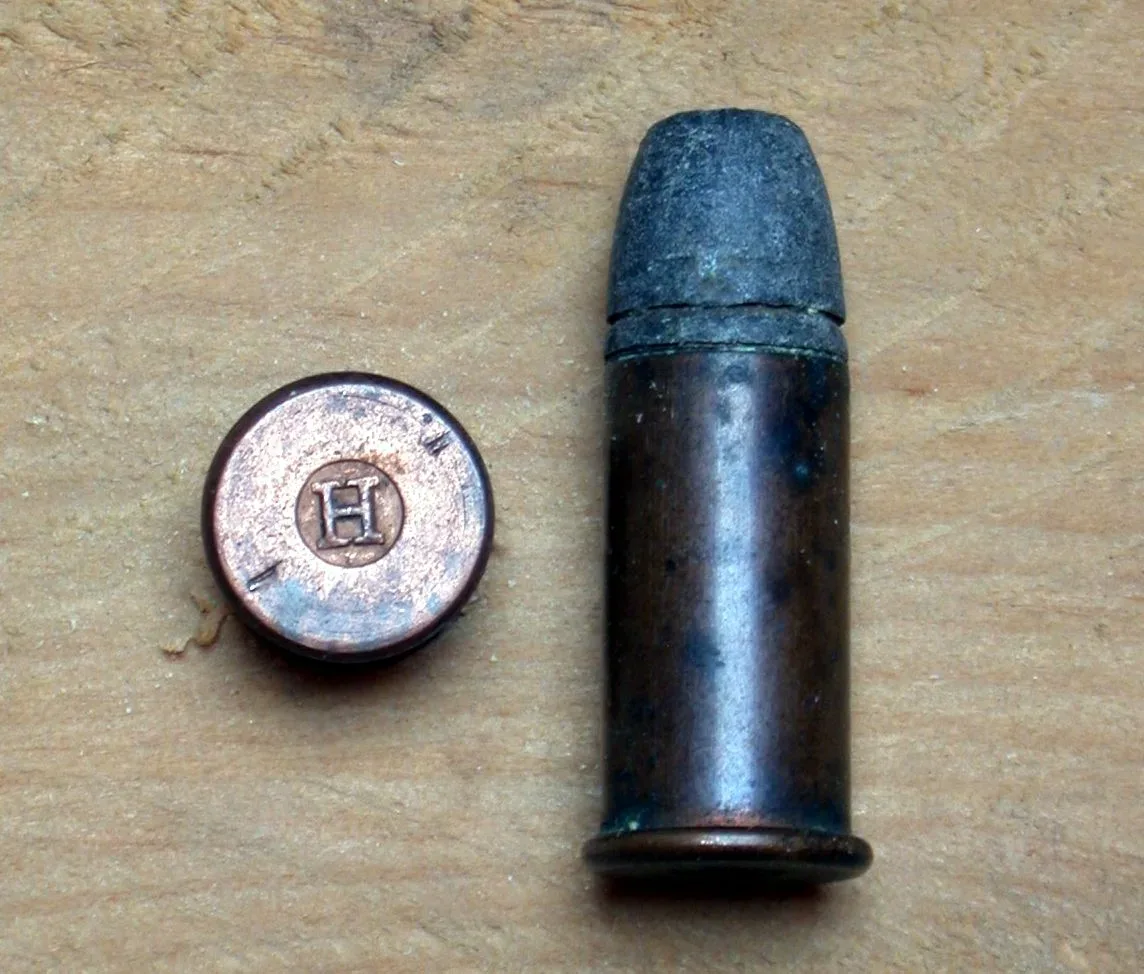
The .44 Henry rimfire — the original cartridge for Spencer and Henry rifles, featuring a flat nose to prevent detonation in tubular magazines.
Hmaag (CC BY-SA 3.0)
| Manufacturer | |
|---|---|
| Made By | New Haven Arms Company |
| Designer | Benjamin Tyler Henry |
| Origin | United States |
| Specifications | |
| Caliber | .44 Henry rimfire |
| Action | lever action |
| Weight | 9 lbs 4 oz |
| Production | |
| Designed | 1860 |
| Variants | |
| |
| Service Use | |
Union Army (Civil War)Sherman's Western troops7th CavalryLakota warriorsDakota warriorsNorthern Cheyenne warriorsArapaho warriorsBenito Juárez's forcesFrench 23rd Infantry RegimentJapanese forces (Boshin War and Satsuma Rebellion) | |
Henry Rifle (Model 1860)
Firearms encyclopedia article
From The Boise Gun Club Handbook
Overviewedit
The Henry rifle — formally the Model 1860 Henry — is a 15-round, .44 caliber rimfire lever-action repeater designed by Benjamin Tyler Henry and manufactured by the New Haven Arms Company between 1860 and 1866. Approximately 14,000 were built. That's a small production run by any measure, but the rifle's influence on American history is wildly disproportionate to those numbers.
In a war where the average infantryman was loading a muzzle-loading Springfield and squeezing out three rounds per minute on a good day, a soldier with a Henry could put 15 rounds downrange before his opponent reloaded once. That wasn't a marginal advantage — it was a different category of violence.
The Henry didn't win the Civil War, but it demonstrated something the entire firearms world was forced to reckon with: the era of the single-shot military rifle was ending.
Everything that followed — the Winchester, the Model 1873, the whole lineage of American lever guns — traces directly back to this rifle and the man who designed it.
Design Historyedit
Benjamin Tyler Henry was born on March 22, 1821, in Claremont, New Hampshire. He apprenticed as a gunsmith and eventually worked his way up to shop foreman at the Robins & Lawrence Arms Company in Windsor, Vermont, where he worked alongside Horace Smith and Daniel B. Wesson on an early design called the "Volitional Repeater." That work planted the seeds of what the Henry would eventually become.
Early Development (1854-1857)
In 1854, Smith and Wesson partnered with investor Courtlandt Palmer and continued developing the mechanism, producing the Smith & Wesson Lever Pistol and a new Volcanic cartridge. The operation went through a series of reorganizations — Smith & Wesson Company became the Volcanic Repeating Arms Company in 1855, with new investors including Oliver Winchester.
| Year | Company | Key Event |
|---|---|---|
| 1854 | Smith & Wesson | Henry works on "Volitional Repeater" |
| 1855 | Volcanic Repeating Arms | Smith & Wesson reorganize with new investors |
| 1856 | - | Winchester forces company into insolvency |
| 1857 | New Haven Arms Company | Winchester reorganizes, hires Henry as superintendent |
| 1860 | New Haven Arms Company | Henry receives patent (October 16) |
| 1862 | New Haven Arms Company | First rifles reach soldiers (mid-year) |
| 1866 | Winchester Repeating Arms | Production ends, company renamed |
Winchester eventually forced the company into insolvency in late 1856, took over ownership, moved the plant to New Haven, Connecticut, and reorganized it as the New Haven Arms Company in April 1857. Henry was hired as plant superintendent.
Corporate evolution from concept to production
Production Era (1860-1866)
The Henry rifle was a direct evolution of the earlier Volition and Volcanic designs — Henry took what those guns had attempted and made it work reliably. After three years of design work, he received his patent on October 16, 1860. The result was a 16-shot (15 in the magazine, one in the chamber) .44 Henry rimfire breech-loading lever-action rifle using copper, later brass, rimfire cartridges loaded with a 216-grain bullet over 25 grains of black powder.
The timing was either fortunate or catastrophic depending on your perspective. The Civil War was already burning when the first Henry rifles reached soldiers' hands in mid-1862. Production was slow to ramp — only 900 rifles were manufactured between the summer and October of 1862.
By 1864, output had climbed to 290 per month, bringing the total to 8,000 at that point. The final production run ended in 1866 at approximately 14,000 units.
At $40 to $50 per rifle — roughly $1,250 to $1,500 in 2020 dollars, according to Uberti's historical notes — the Henry was not cheap. The government balked. Military traditionalists raised concerns about ammunition expenditure, and the logistics office noted that a .44 rimfire cartridge cost four times what a single-shot rifled musket round cost. The U.S. government ultimately purchased just 1,731 standard rifles during the war. The Commonwealth of Kentucky purchased an additional 50.
Soldiers didn't wait for the bureaucracy. Over 10,000 Henrys saw Civil War service, with the bulk of that difference made up by men who bought the rifles themselves — many using their 1864 reenlistment bounties. Most of these privately armed soldiers were associated with Sherman's Western troops.
Technical Characteristicsedit
Operating Mechanism
The Henry's operating mechanism was a toggle-joint lever action. Pushing the lever down ejected the spent cartridge and cocked the hammer. A spring in the tubular magazine forced the next round into the follower position; locking the lever back up chambered the fresh round and closed the breech.
Henry rifle lever-action operating cycle
Loading System Limitations
Loading was the rifle's most distinctive and most frustrating procedure. To charge the 15-round tubular magazine, the shooter had to move the cartridge follower along a slot to the top of the magazine tube, pivot it to the right to open the front end, pivot the top portion of the tube back, and then release the spring-loaded follower. It worked, but it was not fast under pressure and required both hands completely off the rifle.
The open-tube magazine design was a structural vulnerability. Dust, mud, and debris could enter and cause malfunctions. The metal tube also heated up during sustained fire, making the rifle uncomfortable to hold without gloves. Modern testing has found the Henry slightly more reliable than the Spencer rifle of the same era, but the Spencer's closed-loading-gate system was more soldier-proof in rough field conditions. The Spencer's relative durability — compared to the Henry's acknowledged fragility — was a significant factor in the Henry's limited official military adoption.
Military Adoption Issues
Two other shortcomings hurt the Henry's standing with the Army:
- Hammer rested directly on cartridge rim — impact on exposed hammer could fire chambered round
- Could not mount bayonet — violated infantry doctrine requirements
- Open magazine vulnerable to dust, mud, debris causing malfunctions
- Metal tube heated during sustained fire, uncomfortable without gloves
| Specification | Value |
|---|---|
| Caliber | .44 Henry rimfire |
| Action | Lever-action, breech-loading |
| Magazine | 15-round tubular |
| Barrel Length | 24 inches |
| Overall Length | 44.75 inches |
| Weight | 9 lbs 4 oz |
| Powder Charge | 26–28 grains black powder |
| Bullet Weight | 216 grains |
| Manufacturer | New Haven Arms Company |
| Production Period | 1860–1866 |
| Total Production | ~14,000 units |
Combat & Field Useedit
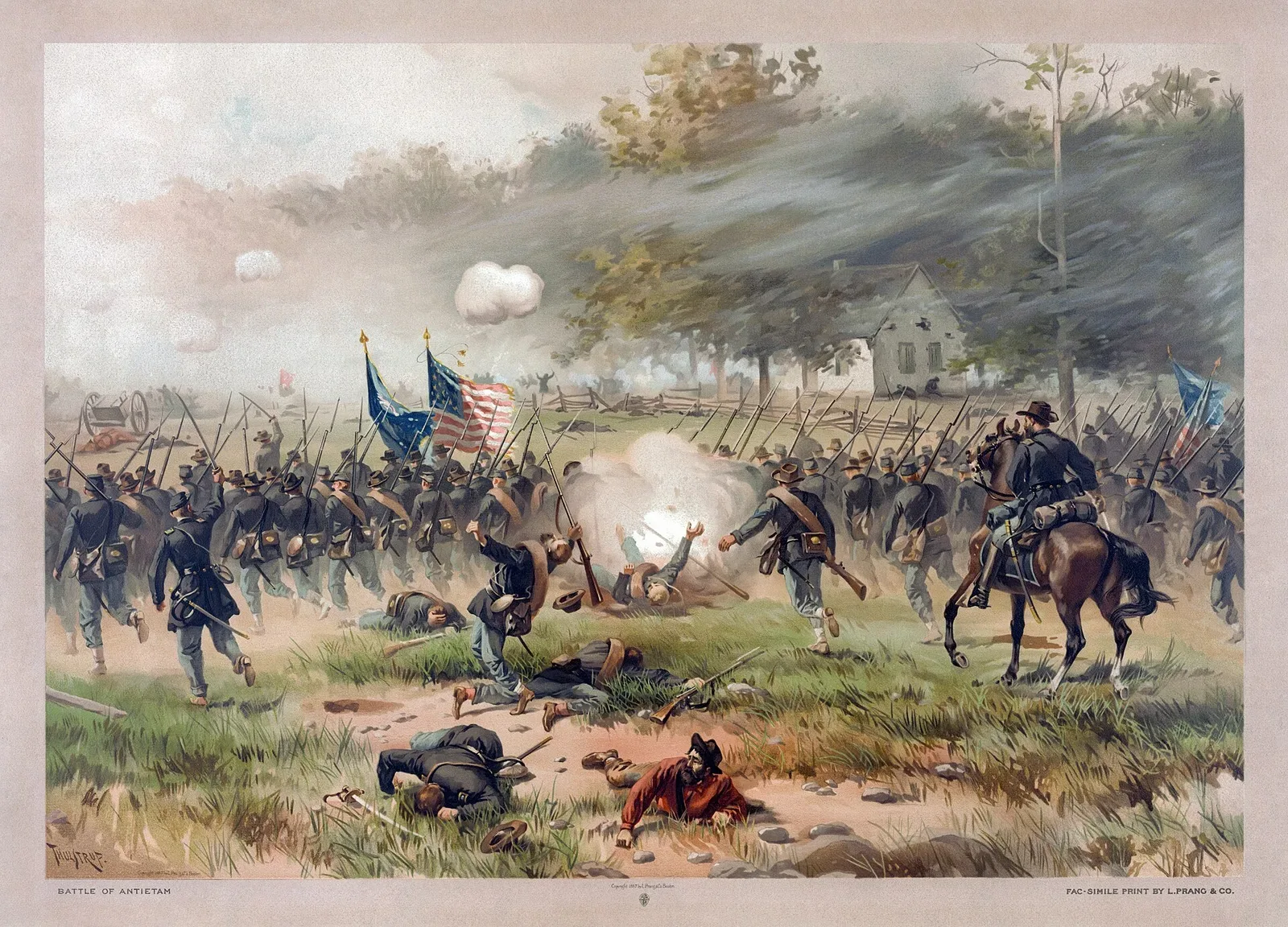
The Henry's combat record is anchored by a handful of engagements that illustrated both its potential and its limitations.
Civil War Service
In the Civil War, the rifle's firepower advantages were most effectively used in defensive positions and by mobile units rather than conventional infantry lines. Scouts, skirmishers, flank guards, and raiding parties were the Henry's natural home — situations where volume of fire at close range mattered more than the long-range accuracy of a Springfield. Standard infantry tactics of the period simply hadn't been developed to exploit a rifle that could sustain 10 or more rounds per minute.
Key Engagements
At Allatoona Pass, Major William Ludlow credited a company of 16 Henry-armed soldiers with repelling the Confederate assault on the fort.
What saved us that day was the fact that we had a number of Henry rifles. This company of 16 shooters sprang to the parapet and poured out such a multiplied, rapid and deadly fire, that no men could stand in front of it. — Major William Ludlow, Allatoona Pass
At the Battle of Franklin in 1864, two Henry-armed Union regiments contributed to a successful defense against large Confederate attacks. The Confederate soldiers they faced were armed primarily with single-shot rifles — the firepower disparity was decisive in close-range fighting.
Confederate Colonel John Mosby, raider and guerrilla commander, encountered the Henry against his own forces and gave it the description that followed the rifle for the rest of its existence:
That damned Yankee rifle that can be loaded on Sunday and fired all week. — Confederate Colonel John Mosby
Confederate troops who captured Henry rifles had no reliable way to resupply the proprietary .44 rimfire cartridges, which effectively prevented any widespread Confederate adoption. Some Confederate units in Louisiana, Texas, and Virginia used Henrys, and the personal bodyguards of Confederate President Jefferson Davis were known to carry them — but the ammunition logistics problem kept it from spreading further.
Firearms historian Herbert G. Houze put a number on what that rate of fire meant in practice: one man with a Henry was the equivalent of 14 or 15 men with single-shot guns.
At Vicksburg, a sharpshooter named Edward Downs of the 20th Ohio Volunteer Infantry Regiment bought a Henry rifle from a steamboat captain for $65 — equivalent to roughly $1,700 today — just before the battle. The transaction was entirely private. That kind of individual initiative, soldier buying rifle out of pocket because he judged it worth the cost, characterized most of the Henry's Civil War service.
| Conflict | Year | Users | Notable Engagements |
|---|---|---|---|
| American Civil War | 1862-1865 | Union forces, Sherman's troops | Allatoona Pass, Franklin, Vicksburg |
| Battle of Little Bighorn | 1876 | Native American warriors | 170+ warriors vs. Custer's 7th Cavalry |
| Second Franco-Mexican War | 1861-1867 | Juárez's forces | Obtained via gun runners |
| January Uprising | 1863-1864 | Polish insurgents | Theoretical use |
| Franco-Prussian War | 1870-1871 | French forces | Paul Garnier d'Aubin confirmed |
| Boshin War/Satsuma Rebellion | 1868-1877 | Japanese forces | Limited documentation |
Post-War Conflicts
The rifle's post-war story is defined by the Battle of Little Bighorn in June 1876. Lakota, Dakota, Northern Cheyenne, and Arapaho warriors armed with Henry and Winchester repeaters defeated Lieutenant Colonel George Armstrong Custer and elements of the 7th Cavalry. According to Wikipedia's sourced account, more than 170 Native American warriors were armed with Henry and Winchester repeaters, while U.S. Army troops had very few. The engagement is one of the most documented examples of repeating-rifle firepower changing the outcome of a military engagement in American history.
Beyond North America, the Henry saw use in a surprising range of conflicts. Benito Juárez's forces obtained Henry rifles from gun runners during the war against the French — the Second Franco-Mexican War. The rifle is theorized to have been used in the January Uprising in Poland; a confirmed user was Paul Garnier d'Aubin, an officer of the French 23rd Infantry Regiment. Henry rifles were also used during the Boshin War and Satsuma Rebellion in Japan, and during the Franco-Prussian War.
Legacy & Influenceedit
Winchester Evolution
The Henry's most direct legacy is the company and the rifle that replaced it. As production wound down, Oliver Winchester began planning the Henry's successor. The Winchester Model 1866 — designed around the same .44 rimfire cartridge as the Henry but with a loading gate on the right side of the receiver (invented by Winchester employee Nelson King) and a wooden forearm — corrected the Henry's most glaring mechanical problems. With the Model 1866's introduction, the New Haven Arms Company was renamed the Winchester Repeating Arms Company.
Design lineage from Henry to modern lever-actions
Benjamin Tyler Henry's Fate
The personal story behind that transition is bitter. In 1864, Benjamin Tyler Henry grew frustrated with what he considered inadequate compensation and attempted to have the Connecticut legislature transfer ownership of New Haven Arms to him. Winchester returned from Europe, blocked the move, and reorganized the company.
Henry left and worked as an individual gunsmith until his death on June 8, 1898 — outliving the company that bore his name in everything but legal title, working in relative obscurity while Winchester built an empire on the foundation he had designed.
The broader influence of the Henry extends well past Winchester. The lever-action repeating rifle became a distinctly American class of firearm, and the Henry's 1860 patent is the point of origin. John Browning's later improvements to lever-action mechanisms — which produced the Winchester Models of 1886, 1892, and 1894 — built on the conceptual framework the Henry established. The tubular magazine under the barrel, the lever cycling the action, the brass receiver on early examples — these became the visual and mechanical grammar of the American lever gun.
For collectors, original Civil War-era Henry rifles now sell for up to $250,000 at auction, according to Henry Repeating Arms. The serial number 9 example — a presentation model — is held in the Autry Museum collection. The rifle's scarcity and historical significance have made it one of the most valued American martial arms.
Modern Production and Collecting
| Manufacturer | Model | Caliber | Key Features | Target Market |
|---|---|---|---|---|
| A. Uberti | 1860 Henry Replica | .44-40 Winchester, .45 Colt | 24.5" octagonal barrel, brass/case-hardened receiver | Cowboy Action, Reenactors |
| Henry Repeating Arms | Modern Henry | Various | Steel barrel, updated internals | General shooting |
| Henry Repeating Arms | H011 New Original | .44-40/.45 Colt | Hardened brass receiver, 1860 patterns | Collectors, N-SSA competition |
A. Uberti produces near-exact copies chambered in .44-40 Winchester and .45 Colt rather than the original .44 Henry rimfire (which is no longer commercially available), with 24.5-inch octagonal barrels, brass or case-hardened receivers, and A-grade walnut stocks. Henry Repeating Arms (a company unrelated to Benjamin Tyler Henry) produces a modernized version with brass receiver and American walnut stock but with a modern steel barrel and updated internal components, as well as an "H011 New Original Henry" built to the 1860 patterns with a hardened brass receiver.
Replicas are popular among Cowboy Action Shooters, Civil War reenactors, and competitors in the North-South Skirmish Association (N-SSA), which approves the Uberti reproduction for its target shooting competitions.
The BGC Takeedit
The Henry rifle is one of those weapons where the gap between historical importance and popular recognition is genuinely puzzling. Most people who know anything about American firearms history have heard of the Winchester Model 1873 — the so-called "rifle that won the West." Far fewer can tell you that the 1873 wouldn't exist without the 1860 Henry, or that the man who designed it got pushed out before he could see the full impact of what he'd built.
What makes the Henry remarkable isn't just the mechanism — it's the context. Put yourself in 1862. The standard infantry weapon is a muzzle-loader. Loading it correctly under stress is a trained skill. Three rounds per minute is considered respectable. Now some guy in your unit pulls out a brass-receiver rifle and puts 15 rounds downrange in the time it took you to reload twice. That is a genuinely disorienting change in what a single soldier can do.
The military bureaucracy's resistance to it — worries about ammo waste, cost per cartridge, inability to mount a bayonet — looks comically short-sighted in retrospect, but those were real institutional concerns in a war being fought with 18th-century logistics assumptions.
The Army absorbed that lesson and moved aggressively toward repeating arms afterward. It took a catastrophic loss to make the point the Henry had been demonstrating since Allatoona Pass.
The Little Bighorn angle is the one that doesn't get enough attention in the Henry's story. The rifle's advocates spent the Civil War arguing that repeating firepower changes tactical outcomes. Custer's defeat in 1876 proved it, definitively, with the Americans on the wrong end of the equation for once.
As for Benjamin Tyler Henry himself — he built the rifle, got maneuvered out of the company by a better-connected businessman, and spent his last decades as a gunsmith while Oliver Winchester put his name on everything. There's no indication Henry ever received meaningful recognition or compensation proportional to what his design produced. The founding patent of the American lever-action repeating rifle bears his name. The company it built does not.
Referencesedit
- https://en.wikipedia.org/wiki/Henry_rifle
- https://www.henryusa.com/about-us/henry-history/
- https://www.uberti-usa.com/cartridge-rifles/1860-henry-rifle
- https://www.relativearms.com/post/history-of-the-henry-rifle
- https://www.henryusa.com/firearm/h11-new-original-henry-rifle/
- https://en.wikipedia.org/wiki/Benjamin_Tyler_Henry
Last Updated: February 27, 2026
- Gls Guns(Sumner, IA)
- Bi-mart - Yakima (Fruitvale Ave)(Yakima, WA)
- New Philly Sportsman Specialities(New Philadelphia, OH)
- R&R Sports & Outdoors(Brandon, FL)
Loading comments...