Specifications
ArmaLite AR-10
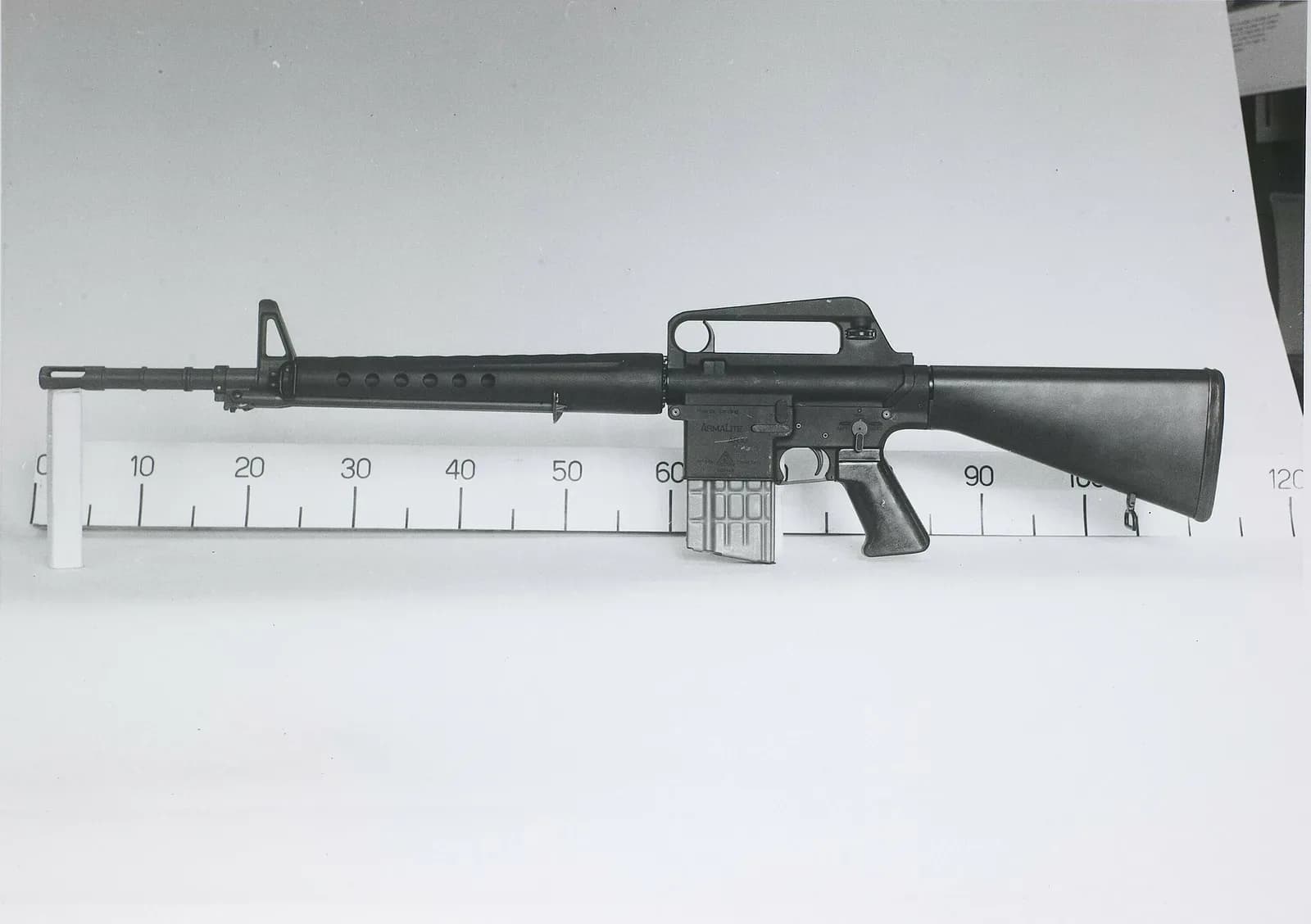
The original ArmaLite AR-10 (1956) — Eugene Stoner's .308 Winchester design that established the direct-impingement system later adopted in the AR-15.
Fotoafdrukken Koninklijke Landmacht (CC BY-SA 4.0)
| Manufacturer | |
|---|---|
| Made By | ArmaLite |
| Designer | Eugene Stoner |
| Origin | United States |
| Specifications | |
| Caliber | 7.62×51mm NATO |
| Action | gas operated |
| Weight | 6.85 pounds |
| Production | |
| Designed | 1955 |
| Variants | |
| |
| Service Use | |
SudanPortugalPortuguese paratrooper battalions (Caçadores Páraquedistas)CubaDominican Republic revolutionaries | |
ArmaLite AR-10: The Rifle That Built the AR Family
Firearms encyclopedia article
From The Boise Gun Club Handbook
Overviewedit
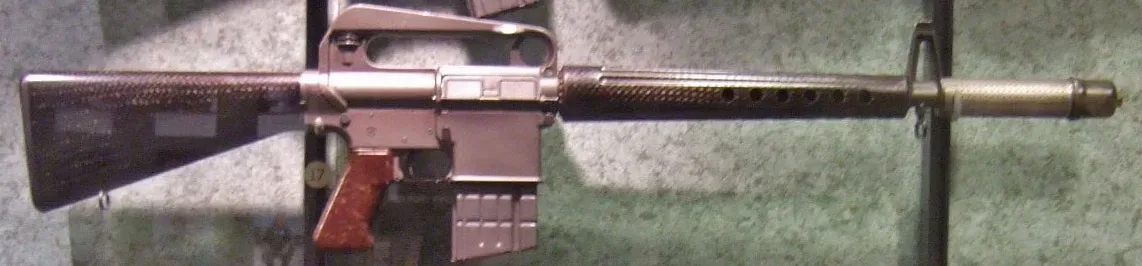
The ArmaLite AR-10 is a 7.62×51mm NATO battle rifle designed by Eugene Stoner in the mid-1950s at ArmaLite, then a small division of the Fairchild Engine and Airplane Corporation. It weighed approximately 6.85 pounds empty — more than a pound lighter than competing infantry rifles of the era — and introduced a combination of straight-line stock geometry, aircraft-industry materials, and a novel direct impingement system that had no real precedent in military small arms.
The AR-10 never became a major military service rifle. Fewer than 10,000 were built across its entire production run.
But that number badly undersells what the rifle actually accomplished. The AR-10 is the direct ancestor of the AR-15, which became the M16, which became the M4 carbine — the standard U.S. infantry rifle for the last six decades. Every AR-pattern rifle in circulation today traces its DNA back to Stoner's work in a 1,000-square-foot machine shop in Hollywood, California.
Understanding the AR-10 means understanding how the most influential rifle platform in modern history got its start — and why it almost didn't survive long enough to matter.
Design Historyedit
ArmaLite began not as a firearms manufacturer but as a research-and-development operation. According to Wikipedia, the company incorporated on October 1, 1954, as a subdivision of Fairchild, founded by George Sullivan, patent counsel for Lockheed Corporation. The setup was explicit from the start: ArmaLite would develop designs and sell or license them to actual manufacturers. As late as 1956, the entire company had nine employees.
Sullivan met Stoner while testing the ArmaLite AR-5 survival rifle prototype at a local shooting range. Stoner, a former U.S. Marine Corps armorer and ordnance officer with no formal engineering degree, had already been developing his own small arms concepts independently. Sullivan hired him as ArmaLite's chief design engineer.
Key milestones in AR-10 development from concept to production
Early Prototypes and Patents
According to American Rifleman, Stoner's path to the AR-10 began with an earlier design he called the M-8 — later designated the X-01 — chambered in .30-06. That rifle already featured the in-line stock profile, rotating bolt, and direct impingement system that would define the AR family. The X-01 used stamped steel and wooden furniture, but it weighed just under 8 pounds — respectable for a .30-06 rifle at the time.
Over the next several years, successive prototypes — the X-02 and X-03 — moved the design toward forged aluminum receivers and fiberglass composite furniture. The X-02 was the first to be chambered in the new 7.62×51mm T65 round. The X-03 introduced the forged carrying handle that would become a signature feature of the AR family. By the time the design was rechristened the AR-10A, it featured the now-familiar hinged upper and lower receiver layout with separate buffer assembly, and a non-reciprocating charging handle positioned inside the carrying handle.
| Model/Prototype | Year | Key Features | Chambering |
|---|---|---|---|
| M-8 (X-01) | 1954-1955 | Stamped steel, wood furniture, in-line stock | .30-06 |
| X-02 | 1955 | First forged aluminum receivers, fiberglass furniture | 7.62×51mm T65 |
| X-03 | 1955-1956 | Forged carrying handle, refined mechanics | 7.62×51mm T65 |
| AR-10A | 1956 | Hinged receiver layout, non-reciprocating charging handle | 7.62×51mm NATO |
| Hollywood Model | 1957 | ~50 production rifles for sales demonstrations | 7.62×51mm NATO |
Stoner patented the aluminum "waffle" magazines (U.S. Patent #2,903,809) in 1956, and his direct impingement and rotating bolt concept received U.S. Patent #2,951,424 — filed in 1956 and granted in 1960. The patent language is worth noting: Stoner described his system as "a true expanding gas system instead of the conventional impinging gas system," and the design is more precisely understood as using the bolt carrier as a movable cylinder and the bolt itself as a stationary piston — eliminating the conventional gas cylinder, piston, and actuating rod that other designs required.
The first prototypes of the 7.62mm AR-10 emerged between 1955 and early 1956. In the fall of 1956, ArmaLite submitted two hand-built rifles — based on the fourth prototype — to Springfield Armory for U.S. Army trials. The AR-10 was competing directly against Springfield Armory's T44 (essentially an updated M1 Garand in 7.62mm) and Fabrique Nationale's T48 FAL.
Military Trials and the Barrel Disaster
Initial impressions from Springfield Armory test staff were favorable. The AR-10 prototype weighed just 6.85 pounds empty — and some testers called it the best lightweight automatic rifle they had evaluated. Then the barrel failed.
George Sullivan had insisted on fitting the test rifles with an experimental composite barrel — aluminum swaged around a thin rifled liner of stainless steel. Stoner objected vehemently. During a torture test at Springfield Armory in early 1957, the composite barrel on test rifle No. 1002 burst after 5,564 rounds. The rifle's operator was not injured, but the damage to ArmaLite's credibility was severe.
The AR-10 was declared "not satisfactory as a military rifle" and would take "five years or more to take it through tests to adoption" — Springfield Armory, February 1957
ArmaLite fabricated a replacement steel barrel within a week and resumed testing, but Springfield Armory's final report, published in February 1957, declared the AR-10 "not satisfactory as a military rifle" and advised that it would take "five years or more to take it through tests to adoption."
The U.S. Army selected the T44, which entered production as the M14 rifle in 1957. ArmaLite objected — correctly, in retrospect — but the institutional momentum behind the M14 was insurmountable. The Army urgently needed to replace the M1 Garand, and it wasn't going to do so with a brand-new design that had just visibly failed under test conditions, regardless of the reason for that failure.
In March 1956, before the barrel failure, the U.S. Army Ordnance Corps had actually approached ArmaLite with an offer to acquire the AR-10's development and production rights, with royalties going back to ArmaLite. According to American Rifleman, ArmaLite declined — fearing the Army would use the acquisition to bury the design. That decision almost certainly contributed to the institutional hostility that followed.
International Licensing
With the U.S. market closed, ArmaLite pivoted to international sales. In 1957, ArmaLite completed approximately 50 production rifles at its Hollywood workshop — later known as the Hollywood model — for use as demonstrators by sales agents, including the prominent arms dealer Samuel Cummings. The rush to finish these rifles introduced a defect: some units were assembled with improperly machined barrel extensions. This flaw went undetected until a bolt lug failed while General Anastasio Somoza was personally conducting an endurance test for a Nicaraguan order of 7,500 rifles. The lug sheared off and flew past Somoza's head. Nicaragua canceled the entire order.
On July 4, 1957, Fairchild-ArmaLite sold a five-year manufacturing license to the Dutch arms manufacturer Artillerie Inrichtingen (A.I.). A.I. had the factory capacity that ArmaLite lacked, and access to the European NATO market that ArmaLite's salesmen had been working to crack. The partnership made sense on paper. In practice, converting the design to metric dimensions, resolving manufacturing issues inherited from the Hollywood prototypes, and building production tooling from scratch created delays that frustrated Fairchild throughout the relationship.
Technical Characteristicsedit
Gas System Innovation
The AR-10 is a gas-operated, magazine-fed, air-cooled rifle using a rotating bolt with a locking mechanism that engages a barrel extension rather than the receiver itself. This is a critical detail: by locking into the barrel extension, the design allows the receiver to be made from lightweight forged aluminum without compromising the structural integrity of the bolt lockup. The receiver doesn't need to handle the locking stress — the barrel extension does.
Stoner's gas system works differently from most gas-operated rifles of the era. Conventional designs divert combustion gases from a barrel port to a piston and cylinder adjacent to that port, which then drives a separate operating rod. In the AR-10, gas travels from a port near the middle of the barrel through a steel tube all the way back to the receiver, where it enters a chamber inside the bolt carrier between the rear of the bolt and the bolt carrier interior. The bolt is fitted with piston rings to contain the gas. Once pressure drives the bolt carrier rearward a short distance, excess gas vents through holes in the carrier's side. The bolt and carrier themselves serve the separate functions of piston and cylinder — no operating rod, no separate gas cylinder. This arrangement saved weight and moved the reciprocating mass in line with the bore, which reduced muzzle climb and improved inherent accuracy.
Stoner's direct impingement system vs. conventional gas-operated mechanisms
The straight-line stock geometry reinforced this. By placing the stock axis in line with the barrel rather than dropping below it, the AR-10 channeled recoil forces straight back into the shooter's shoulder rather than rotating the muzzle upward. This made full-automatic fire substantially more controllable than competing designs. The elevated sights — mounted on a forged carrying handle — compensated for the high bore axis that this geometry required.
Materials and Construction
The receiver is forged and machined aluminum. The stock, handguards, and pistol grip are fiberglass-reinforced phenolic composite with a rigid plastic foam core — materials common in the aircraft industry but essentially unheard of in military small arms at the time. Fairchild's background in aerospace manufacturing directly enabled these choices.
The standard magazine was a 20-round aluminum "waffle" design — the pressed-in corrugations added rigidity to the lightweight magazine body. According to Wikipedia, all AR-10s produced under both ArmaLite and A.I. used these magazines, which were originally intended to be disposable after emptying in combat.
| Specification | Value |
|---|---|
| Caliber | 7.62×51mm NATO / .308 Winchester |
| Action | Gas-operated, rotating bolt (Stoner system) |
| Weight | 3.29–4.05 kg (7.25–8.9 lb) unloaded |
| Overall Length | 1,050 mm (41.3 in) |
| Barrel Length | 528 mm (20.8 in) |
| Rate of Fire | 700 rounds/min (full-auto) |
| Muzzle Velocity | 820 m/s (2,690 ft/s) |
| Effective Range | 600 m (660 yd); 700 m with optic |
| Feed System | 20-round detachable aluminum magazine |
Production Variants
A.I.'s production fell into three identifiable variants. The Sudanese model — named for the first major sale — used a lightweight fluted steel barrel with a prong-style flash suppressor, fiberglass furniture, bayonet lug, and sight graduations in Arabic. It weighed 3.3 kg (7.3 lb) with an empty magazine. The Transitional model incorporated incremental improvements including removable plastic/metal handguards. The Portuguese model was the most refined variant: heavier chrome-lined barrel, wider bolt lugs, stronger extractor, simplified three-position gas regulator, and a cocking handle with forward bolt assist. It also offered an optional bipod and telescopic sight mounting capability.
| Variant | Weight | Barrel | Key Features | Primary User |
|---|---|---|---|---|
| Sudanese Model | 3.3 kg (7.3 lb) | Fluted steel, prong flash suppressor | Arabic sight graduations, bayonet lug | Sudan (1958) |
| Transitional Model | ~3.5 kg | Standard steel | Removable handguards, refined mechanics | Various exports |
| Portuguese Model | 4.05 kg (8.9 lb) | Chrome-lined, heavier profile | 3-position gas regulator, forward assist | Portugal (1960) |
The AR-10's design drew on several established concepts:
- Hinged receiver system (Johnson semiautomatic rifle)
- Straight-line stock concept (German FG 42, MG 13)
- Ejection port cover (German StG 44)
- Bolt locking mechanism (M1941 Johnson rifle, Browning Remington Model 8)
What Stoner did was synthesize these existing ideas with aircraft-industry materials and a genuinely novel gas system into a coherent package that weighed less than anything comparable.
One thing the Stoner system gave up was adjustability. The gas port is not adjustable, making the system ammunition-specific. This became a recurring operational consideration — particularly when the AR-15 derivative was fielded in Vietnam with the wrong propellant — but on the AR-10 itself, shooting standardized 7.62×51mm NATO ammunition, it was rarely a problem in service.
Combat & Field Useedit
African and Colonial Service
The AR-10 saw its first major combat use in the hands of Sudanese forces after Sudan purchased approximately 2,500 rifles in 1958 for $225 per rifle including cleaning kit and four magazines. The Sudanese models were issued to elite units and saw action in frequent clashes with guerrilla forces and conflicts with neighboring countries. Captured rifles turned up in service with various African and colonial armies, police units, and guerrilla organizations. The AR-10 remained with Sudanese Special Forces until 1985.
The most substantial and best-documented combat use came through Portugal. It is believed that approximately 4,000–5,000 Portuguese model AR-10s were produced, nearly all sold to the Portuguese National Defense Ministry through Brussels-based arms dealer SIDEM International in 1960. The rifle was officially adopted by the Portuguese paratrooper battalions — the Caçadores Páraquedistas — and saw extensive service in counter-insurgency campaigns in Angola, Portuguese Guinea, and Mozambique throughout the 1960s and into the 1970s.
| Country/Force | Quantity | Year | Primary Use | Service Period |
|---|---|---|---|---|
| Sudan | ~2,500 | 1958 | Elite units, border conflicts | 1958-1985 |
| Portugal | 4,000-5,000 | 1960 | Paratroopers (colonial wars) | 1960-1975 |
| Cuba | 100 | 1959 | Revolutionary transfer to Dominican rebels | 1959 |
| KLM Airlines | ~30 (carbines) | ~1958 | Arctic survival kit (polar bear protection) | Unknown |
Portuguese Paratroopers
U.S. Army tests at Aberdeen Proving Ground in November 1960 documented AR-10 accuracy averaging 10-shot groups of 2.0 inches at 100 yards with service ammunition, with some rifles grouping into 25mm (1 inch) at 100 meters. Portuguese paratroopers confirmed these results under field conditions.
It was a good combat weapon that never failed me; a bit too long for house-to-house work or really heavy brush, but great for 400–800 meters, in the flats — and really nice on the body, after wandering around 12–14 hours looking for bad guys.
The paratroopers also used A.I.-modified upper receivers to mount 3× and 3.6× telescopic sights for designated marksman roles, engaging individual targets at extended ranges in open terrain. The AR-10's gas cutoff design allowed it to fire Energa rifle grenades without adjusting the gas system — and the self-loading action would eject spent blank shells and chamber the next one, allowing multiple grenades to be launched in rapid succession. The recoil from grenade use was hard on stocks; some rifles were eventually retrofitted with all-metal buttocks to handle the strain.
By the early 1970s, hard service had made spare parts scarce. Field-expedient wooden stocks replaced damaged fiberglass furniture on some rifles. Despite this, Portuguese paratroopers continued to favor the AR-10 over the heavier Heckler & Koch G3-pattern rifles that gradually replaced it — a preference driven by the AR-10's lighter weight, accuracy, and easier maintenance. A few Portuguese AR-10s remained in service as late as 1975 during the decolonization emergency in Portuguese Timor (now East Timor).
Unusual Applications
The AR-10 also appeared in other, more unusual contexts. Cuba's Batista government ordered 100 Transitional model rifles in 1958. The shipment arrived in Havana, but Fidel Castro's forces took control of the country in December 1958 before the rifles could be issued. In 1959, arms dealer Sam Cummings traveled to Havana at Castro's invitation. Fidel, his brother Raúl, and Che Guevara test-fired the AR-10 outside Havana. Castro paid for all 100 rifles.
[Castro] would have been out of the Sierra Maestra two years earlier if he had enough of them.
Castro subsequently transferred the rifles to a group of Communist revolutionaries from the Dominican Republic. In June 1959, approximately 150 rebels invaded the Dominican Republic by sea while 63 more arrived by parachute. The Dominican Army defeated the incursion. AR-10 rifles from the Batista shipment were found on the bodies of the dead guerrillas.
KLM Royal Dutch Airlines purchased a small number of AR-10 carbines as part of an Arctic survival kit carried on transpolar flights — specifically to stop large predators, including polar bears. A.I. developed the 16-inch-barreled carbine variant in response to that request, with approximately 30 produced.
The AR-10 was evaluated by West Germany (which chose the G3), Austria and the Netherlands (both chose the FAL), Italy (chose the Beretta BM-59), and Finland (where even a 7.62×39mm rechambered variant lost to an AK-47 clone). The reasons varied by country — cost, quality control issues, political considerations — but the AR-10 consistently found itself outmaneuvered by bureaucratic and diplomatic forces as much as by technical shortcomings.
Dutch export restrictions eventually cut off further sales to Portugal, and by 1960, Artillerie Inrichtingen had decided to exit the small arms business entirely. All AR-10 parts inventories, tooling, and prototypes were sold or scrapped. The barrel tooling was sold to Israel sometime in the early 1960s. All production records, design drawings, and manuals then in inventory were discarded — a loss that would complicate later attempts to produce accurate reproductions.
Legacy & Influenceedit
The AR-15 Connection
The AR-10's most consequential contribution to firearms history had nothing to do with the AR-10 itself. In 1957, General Willard Wyman, commander of the Continental Army Command, provided the catalyst for ArmaLite to rechamber their design in a small-caliber, high-velocity round. The U.S. Army's CONARC requirement called for a six-pound, .22-caliber select-fire rifle accurate to 500 yards. ArmaLite engineers Robert Fremont and L. James Sullivan — with Stoner's eventual involvement — used the AR-10 as the structural and mechanical template for what became the ArmaLite AR-15, completed as a firing prototype in 1958.
In 1959, with financial difficulties mounting and production capacity never adequate to meet demand, ArmaLite sold the rights to both the AR-10 and AR-15 to Colt's Manufacturing Company. According to American Rifleman, the price was $75,000 plus a 4.5 percent royalty on all future production.
The AR-10's design lineage through military and civilian rifle development
Colt focused its energy on the AR-15, which — after the charging handle was relocated from beneath the carrying handle to the rear of the receiver and the caliber changed to 5.56×45mm NATO — became the M16 rifle, the standard U.S. service rifle for decades. The M16's descendant, the M4 carbine, remains the primary U.S. military infantry rifle.
Modern Resurrection
Stoner left ArmaLite in 1961. In 1993, he revisited the 7.62mm concept while working with Knight's Armament Company in Vero Beach, Florida, producing the SR-25 — the designation arrived at by adding 10 and 15 together. The U.S. Special Operations Command adopted the SR-25 as the Mk11 Mod 0 sniper rifle, and it later evolved into the M110 SASS, replacing the U.S. Army's bolt-action M24. The AR-10 concept, a generation removed, had found its way into the hands of U.S. military snipers after all.
In 1995, former Army Ordnance officer Mark Westrom, owner of Eagle Arms, purchased the ArmaLite brand and reintroduced the AR-10B series. The AR-10B was not built from original AR-10 drawings — those had been discarded when A.I. shut down — but was instead based on the AR-15A2 with components scaled up or redesigned for 7.62×51mm. The prototype was built using computer analysis and a Knight's Armament SR-25 upper receiver assembly. ArmaLite subsequently introduced the AR-10A model in 2012, reverting to the original magazine pattern (also called the SR-25 pattern) rather than the M14-derived magazines used on the AR-10B.
ArmaLite holds a U.S. trademark on the name "AR-10," registered in October 2002. This has become a persistent source of confusion in the market. Numerous other manufacturers produce 7.62×51mm NATO rifles based loosely on the AR-10 design:
- DPMS (LR-308 pattern)
- Smith & Wesson (M&P10)
- Ruger (SR-762)
- SIG Sauer (716 series)
- Heckler & Koch (HK417)
- Lewis Machine and Tool (L129A1)
None of these can legally call their product an AR-10. They're large-frame AR-pattern rifles, but the AR-10 name belongs to ArmaLite. Parts compatibility between the ArmaLite AR-10B and DPMS-pattern rifles is limited in ways that don't exist within the standardized AR-15 ecosystem.
The AR-10's design influence also shows up outside the direct lineage. The rotating bolt locking concept, the straight-line stock geometry, the use of lightweight non-traditional materials, and the modular hinged receiver — all of these propagated through the firearms industry in ways that reshaped how military and civilian rifles are designed and manufactured. Melvin M. Johnson Jr., who served as a consultant to ArmaLite and whose rotary bolt design influenced the AR-10, had himself drawn on Browning's earlier work. Stoner drew on Johnson, the FG 42, the StG 44, and the Swedish Ljungman. The AR-10, in turn, fed the AR-15, which fed the M16, which fed the M4, which fed every AR-pattern rifle in production today. That's not a metaphor — it's a literal design lineage.
Fewer than 10,000 rifles. Enormous consequences.
The BGC Takeedit
The AR-10 is one of those guns where the story is better than the gun itself — at least as a piece of cold history. Nine guys in a Hollywood machine shop, using materials borrowed from the aircraft industry, produced a rifle that the U.S. Army rejected and that barely broke 10,000 total units.
By any conventional measure of commercial success, the AR-10 was a failure.
Pull the AR-10 out of the timeline and the AR-15 doesn't exist, the M16 doesn't exist, the M4 doesn't exist, and the entire AR-pattern platform doesn't exist in any recognizable form.
Except that it wasn't. The AR-10 is the skeleton key. That's a pretty significant legacy for a rifle that lost its primary competition because its president insisted on a barrel design the chief engineer explicitly told him wouldn't work.
The composite barrel story deserves its own footnote in the history of what happens when a manager overrules his engineer. Stoner was right. Sullivan's "Sullaloy" barrel was a disaster. The rifle lost the most important military contract of the postwar era as a direct result. And then, somehow, the underlying design survived anyway — because what Stoner built around that flawed barrel was genuinely that good.
The Portuguese paratroopers knew it. The French Foreign Legion soldiers who got their hands on a few in Chad knew it. The fact that troops who'd used the FAL and the G3 preferred the AR-10 when they could get it tells you something real about how the rifle handled in the field.
For the modern shooter, the AR-10 platform — whatever manufacturer's version you're looking at — remains the practical answer when .308 or 6.5 Creedmoor power is needed in a familiar, ergonomic package. The platform has gaps (parts compatibility between manufacturers is messier than the AR-15 world), but the underlying mechanics Stoner developed in the 1950s are as sound now as they were then. The fact that the U.S. military eventually adopted the SR-25/M110 — Stoner's own second crack at the same concept — is about as clean a vindication as you get in this business.
Referencesedit
- ArmaLite AR-10 — Wikipedia
- A Brief History of the AR-10, the AR-15's 'Big Brother' — NRA Blog
- The AR-10 Story — American Rifleman
- What Is An AR-10 Battle Rifle? — Widener's
- Armalite AR-10 Semi-Automatic Rifle — NRA Museums
- ArmaLite AR-10® is the Only AR-10 — AR308.com
Last Updated: February 27, 2026
- Gls Guns(Sumner, IA)
- Bi-mart - Yakima (Fruitvale Ave)(Yakima, WA)
- New Philly Sportsman Specialities(New Philadelphia, OH)
- R&R Sports & Outdoors(Brandon, FL)
Loading comments...