Quick Reference
Choosing Your First Handgun

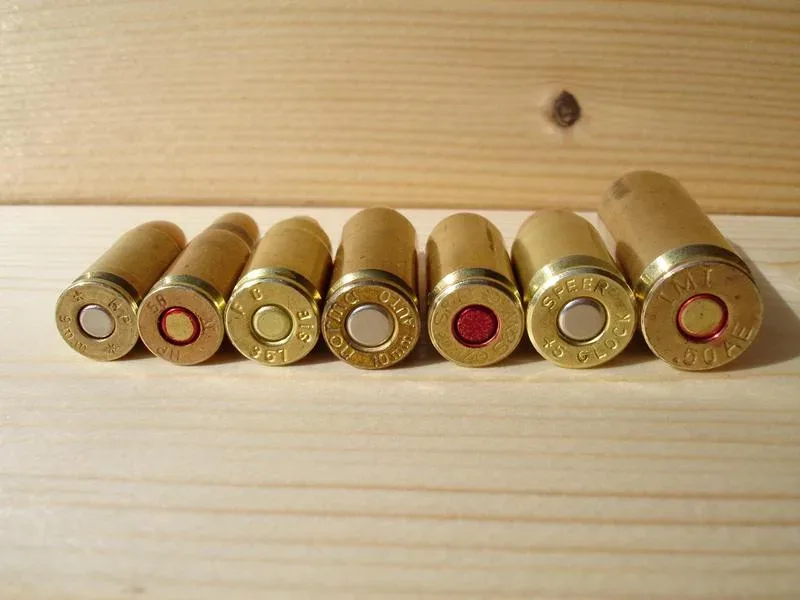
Photo by Daderot (CC0)
| Time & Effort | |
|---|---|
Read Time | 10 min read |
Equipment Needed | |
| |
| Prerequisites | |
| |
Safety | |
| |
Key Takeaways | |
| |
Related Topics | |
| |
Choosing Your First Handgun
cutting through opinions to find what works
From The Boise Gun Club Handbook
The gun counter has forty handguns in the case. The guy behind it is asking what you want. You're not sure yet—that's why you're here.
Your first handgun needs to do three things: fit your hand, go bang every time, and not punish you for practicing. Everything else is negotiable.
- Reality check: The internet will tell you that you need a $1,200 race gun or some compact 9mm that's "perfect for everyone." You don't, and it isn't.
- Your actual mission: Learn how handguns work, build fundamental skills, and figure out what you actually need from a defensive firearm
What You're Actually Choosingedit
You need to pick a caliber, an action type, and a size. Those three decisions narrow your options from hundreds to maybe five or six guns worth handling.
Decision tree for first handgun selection - follow the recommended path to narrow hundreds of options to 4-5 viable choices
Caliber Selection
Caliber first—get a 9mm. Not a .45 ACP because your uncle carried one in Desert Storm. Not a .380 because someone told you it kicks less. Not a .40 S&W because those were popular in 2003.
9mm is cheaper to shoot, holds more rounds, has less recoil than the bigger calibers, and stops threats just fine. You'll practice more because ammunition costs half what .45 costs.
Outdoor Life's testing confirms what most instructors already know—beginners shoot 9mm better because they're not flinching.
Action Type Considerations
Action type second—striker-fired pistol. Not a 1911 with a single-action trigger and a grip safety and a thumb safety and an 80-degree learning curve. Not a double-action/single-action with a 12-pound first trigger pull and a 4-pound second pull.
A striker-fired gun has the same trigger pull every time, no external hammer to snag, and typically one safety lever or none. Glock popularized this design in the 1980s. Now everyone makes them.
Size Requirements
Size third—depends on your mission. A full-size gun like a Glock 17 or Sig P320 is easier to shoot accurately, holds more ammunition, and has less felt recoil. A compact Glock 19-sized gun does all that reasonably well and conceals better.
A subcompact like the Glock 43X or Sig P365 hides easily but snaps harder and gives you less to hold onto. Your first gun should probably be full-size or compact. You can always buy a smaller one later.
| Decision Factor | Best Choice for Beginners | Why |
|---|---|---|
| Caliber | 9mm | Cheaper ammo, less recoil, adequate stopping power, more capacity |
| Action Type | Striker-fired | Same trigger pull every time, fewer controls to learn |
| Size | Full-size or Compact | Easier to shoot accurately, better recoil management |
The Short Listedit
These handguns show up in every "first handgun" article because they actually work—not because they're sexy or featured in movies.
Glock 19—the Toyota Camry of handguns. Boring, reliable, parts and holsters everywhere, and it fits most people's hands well enough. Holds 15 rounds. Used by half the police departments in America.
The grip texture feels like skateboard tape, but the trigger is predictable. Every instructor knows how to teach on a Glock. If you decide guns aren't for you, you'll get most of your money back selling it. Pew Pew Tactical rates this as their top beginner choice for exactly these reasons.
Sig Sauer P320—modular excellence. The Army picked a version of this as the M17. Modular design means you can swap the frame size and grip later without buying a whole new gun.
Smoother trigger than a Glock out of the box, slightly better ergonomics for smaller hands. Costs more but completely reliable and supported everywhere.
Smith & Wesson M&P 9 M2.0—underrated value. Similar to the Glock in almost every way but with better ergonomics and a better trigger. Comes with four different backstraps so you can adjust grip size. Costs less than a Glock, which makes no sense, but here we are.
CZ P-10 C—cleanest trigger of the bunch. CZ has been making guns since 1936 and they know what they're doing. The grip angle works well for people who've shot 1911s. Slightly less common than the others, but any decent gun shop will have holsters and parts.
Those four cover 80% of what a new shooter should consider. You could look at the Walther PDP or Springfield XD-M, but you're splitting hairs at that point.
| Model | Capacity | Key Advantages | Typical Price |
|---|---|---|---|
| Glock 19 | 15+1 | Most common, reliable, easy resale | $550-600 |
| Sig P320 | 17+1 | Modular design, military adoption | $600-700 |
| S&W M&P 9 M2.0 | 17+1 | Best value, adjustable backstraps | $450-500 |
| CZ P-10 C | 15+1 | Superior trigger, excellent ergonomics | $500-550 |
Actually Holding the Thingedit
Go to a gun shop. Handle all of them. The right handgun is the one that feels right in your hand, not the one some guy on YouTube says is "objectively superior."
The right handgun is the one that feels right in your hand, not the one some guy on YouTube says is "objectively superior."
Essential Fit Checks
- Grip size: Your trigger finger should reach the trigger without stretching—the web of your hand should sit high on the backstrap
- Control reach: You should hit the magazine release and slide stop without shifting your grip
- Trigger contact: Your finger should contact the trigger between the pad and first joint, not the joint or fingertip
- Sight alignment: You should see the front sight clearly without craning your neck
- Weight reality: A loaded Glock 19 is about 30 ounces—if it feels heavy in the shop, it'll feel worse after 100 rounds
Rent Before You Buyedit
Most ranges rent handguns. Twenty bucks plus ammunition gets you a half-hour with a gun you're considering. This is the cheapest mistake insurance you can buy.
Rent the Glock 19, shoot 50 rounds. Then rent the Sig P320 or M&P and shoot 50 rounds. You'll know pretty quickly which one you prefer—your hands will tell you things the internet can't.
Warning Signs to Avoid
- Slide bite: The slide cuts your hand during recoil
- Mag dump: Magazine release hits your palm and drops the magazine
- Low-left hits: Usually means the grip is too big for right-handed shooters
- Flinch development: Getting worse, not better, after 30 rounds
If you're experiencing any of these, try a different gun. Don't convince yourself you'll "get used to it."
New vs. Usededit
Buy new for your first handgun. Yes, used Glocks are everywhere for $100 less. But you don't yet know how to inspect a used gun for problems or identify someone's botched trigger job from YouTube University.
New guns come with a warranty, manual, and test-fired cases proving they work. After you've owned a gun for a year and shot a few thousand rounds, buy used all you want.
What Comes With Itedit
You need more than the handgun. Budget for these essentials:
| Essential Item | Purpose | Budget Range |
|---|---|---|
| Practice Ammo | 500 rounds FMJ for training | $150-200 |
| Defensive Ammo | 50 rounds hollow-point | $40-60 |
| Electronic Ear Muffs | Hearing protection | $50-80 |
| Safety Glasses | Eye protection | $10-20 |
| Hard Case | Legal transport | $20-30 |
| Basic Training Course | Professional instruction | $75-200 |
| Total Additional Cost | Beyond the firearm | $345-590 |
Gun University recommends establishing a practice baseline before you carry, which means burning through several hundred rounds.
What Not to Buy Firstedit
These are excellent guns that make terrible first guns:
- Subcompact 9mms: Sig P365 and Glock 43X are great carry guns, terrible learning guns—short sight radius, snappier recoil, less grip
- 1911s in .45 ACP: Beautiful guns with thumb safeties, grip safeties, 8-round capacity, and expensive ammunition—learn the basics first
- Revolvers: Despite grandpa's advice, they hold 5-6 rounds, reload slowly, and have heavy trigger pulls
- .22 LR as your only gun: Cheap to shoot but won't teach recoil management and inadequate for defense
After You Buy Itedit
Take it to the range within a week. Shoot 100 rounds minimum—you should keep all shots on a paper plate at 7 yards by session's end. If you can't, something's wrong with your fundamentals or the gun.
Timeline for building competence with your first handgun - structured progression from purchase to proficiency
Building Competence
- Clean it after every trip for the first few months—teaches you how it works
- Read the actual manual—learn field-stripping, recommended ammunition, and every control
- Dry-fire at home—ten minutes three times weekly builds more skill than monthly range trips
- Watch local matches—find IDPA or USPSA clubs and see how people actually use handguns under pressure
Your first handgun is a learning tool. It teaches you what you like, what you don't, and what you need from a defensive firearm.
A Glock 19, Sig P320, or M&P 9 will do all of that without letting you down. Now go handle some guns and figure out which one fits.
See Alsoedit
- Cash America Pawn(BRYAN, TX)
- R&R Sports & Outdoors(Brandon, FL)
- Bi-mart - Yakima (Fruitvale Ave)(Yakima, WA)
- New Philly Sportsman Specialities(New Philadelphia, OH)
Loading comments...