State Details
Ohio

Overview | |
|---|---|
State | Ohio (OH) |
Capital | Columbus |
Statehood | 1803 |
Population | 11,785,935 |
Gun Ownership | 40.0% |
Active FFLs | 1,802 |
Carry Laws | |
Constitutional Carry | Yes (2022) |
Open Carry | Yes |
CCW Permit Available | Yes |
Permit Reciprocity | 36+ states |
Self-Defense | |
Castle Doctrine | Yes |
Stand Your Ground | Yes |
Duty to Retreat | No |
Regulations | |
State Preemption | Yes |
Red Flag / ERPO | No |
Waiting Period | None |
Universal BGC | No |
NFA Items | Yes |
Assault Weapons Ban | No |
Magazine Limit | None |
Key Legislation | |
| |
Notable Manufacturers | |
| |
Ohio Firearms History: From the Northwest Territory to Constitutional Carry
Reference article
From The Boise Gun Club Handbook
Overviewedit
Ohio sits at the intersection of American industrial history and frontier tradition in ways that shaped the country's relationship with firearms as much as any state east of the Mississippi. It was carved out of the Northwest Territory through armed conflict, industrialized weapons manufacturing during the Civil War, produced some of the most recognizable names in American shooting culture, and spent over a century under some of the stricter concealed carry laws in the Midwest before pivoting hard toward gun-owner rights in the 21st century.
The arc here isn't a straight line. Ohio banned concealed carry in 1859 and held that prohibition in place for 144 years. Then, between 2004 and 2022, it dismantled most of that framework piece by piece. Today it's a permitless carry state with no assault weapon ban, no magazine restrictions, and a firearms culture that leans strongly toward rural conservatism outside its urban centers.
Understanding how Ohio got here requires going back to a time when the land that would become the state was one of the most violently contested pieces of real estate in North America.
Pre-Statehood: The Northwest Territory Eraedit
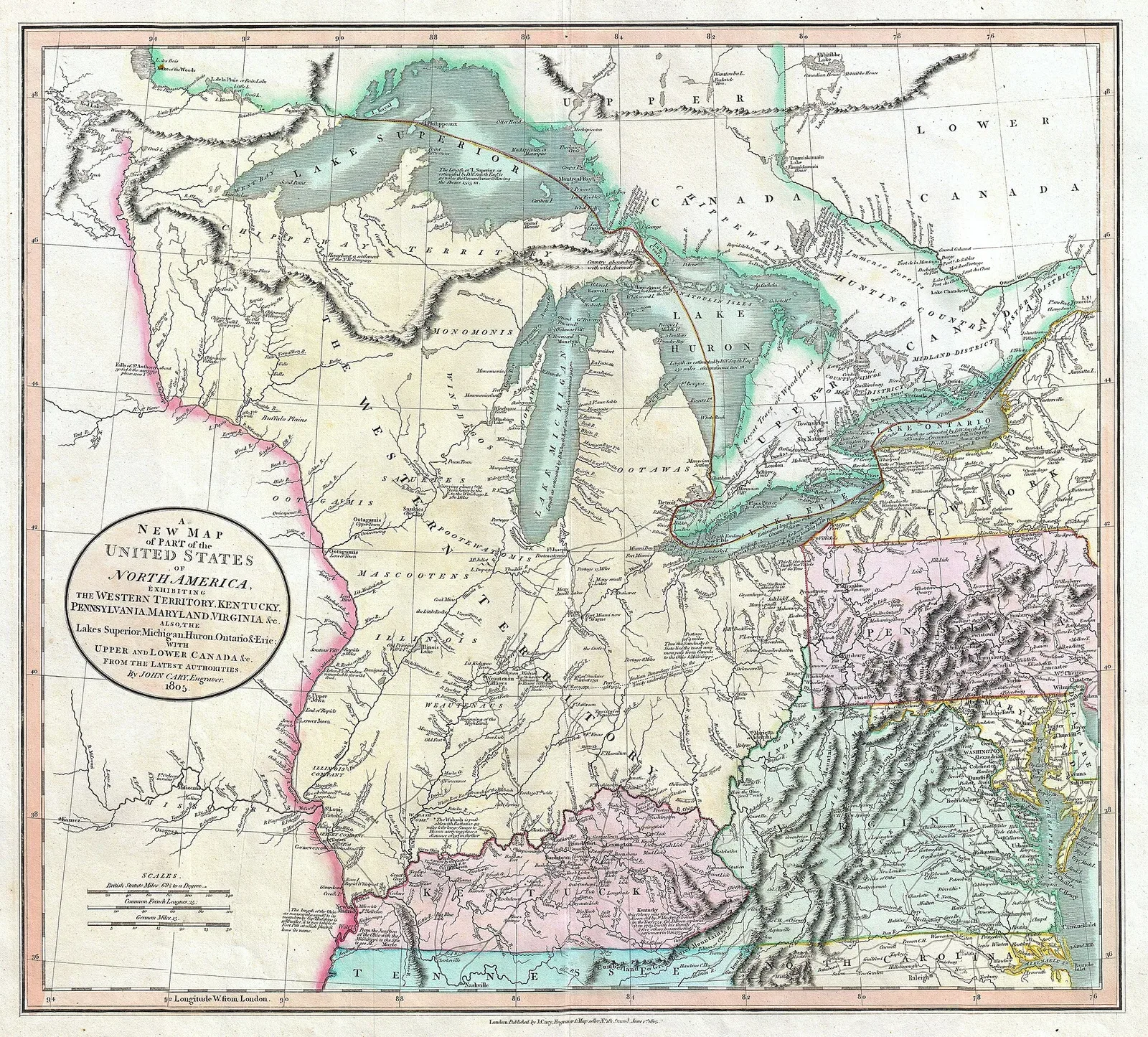
Before Ohio was Ohio, it was the Northwest Territory — and the firearm was not an accessory, it was the reason some people survived long enough to plant crops. The Ordinance of 1787 organized the territory, but it didn't pacify it. The Ohio Country had been a contested zone between British-aligned Native confederacies and American settlers for decades, and that conflict came to a head in the early 1790s in some of the worst military disasters the young United States ever suffered.
Military Disasters and Lessons
General Arthur St. Clair's defeat on November 4, 1791 — near present-day Fort Recovery in Mercer County — remains the single largest defeat of a U.S. Army force by Native Americans in American history. His force of roughly 1,400 men was ambushed by a Western Confederacy led by Miami chief Little Turtle and Shawnee war chief Blue Jacket, suffering over 600 killed and 280 wounded.
The firearms of the era — smoothbore flintlock muskets — were notoriously unreliable in wet conditions, and the poorly trained militia broke under fire. The disaster directly prompted Congress to fund and reorganize what became the Legion of the United States under General "Mad" Anthony Wayne.
| Battle/Event | Date | Location | Outcome | Significance |
|---|---|---|---|---|
| St. Clair's Defeat | Nov 4, 1791 | Fort Recovery area | Catastrophic U.S. loss | 600+ killed, worst defeat by Native Americans |
| Battle of Fallen Timbers | Aug 20, 1794 | Near Maumee | U.S. victory | Ended large-scale Native resistance |
| Treaty of Greenville | 1795 | Greenville | Diplomatic resolution | Opened most of Ohio to settlement |
| Battle of Lake Erie | Sep 10, 1813 | Lake Erie | U.S. naval victory | Secured northern frontier |
Wayne's Victory and Settlement
Wayne spent two years training his force at Legionville, Pennsylvania, then moved into Ohio. His victory at the Battle of Fallen Timbers on August 20, 1794, near present-day Maumee, effectively ended large-scale Native resistance in the territory. The Treaty of Greenville in 1795 opened most of Ohio to American settlement. The rifle — particularly the Pennsylvania-Kentucky long rifle carried by frontiersmen and some militia — had proven its worth in the hands of skilled shooters even when the musket-equipped regular army struggled.
Forts constructed during this period served as armed depots as much as defensive positions:
- Fort Washington (present-day Cincinnati)
- Fort Hamilton
- Fort Jefferson
- Fort Recovery
- Fort Defiance
The supply and maintenance of firearms at these installations established early patterns of military logistics in the territory that would carry forward into statehood.
Tecumseh and his brother Tenskwatawa (the Prophet) made one more significant attempt to organize Native resistance in the years leading up to the War of 1812, with Prophetstown (across the border in present-day Indiana) as their base. Ohio settlers remained heavily armed throughout this period, and Governor Return Jonathan Meigs mobilized Ohio militia extensively during the War of 1812. Commodore Oliver Hazard Perry's victory at the Battle of Lake Erie on September 10, 1813 — with ships built at Erie, Pennsylvania but crewed in part by Ohio men — secured the northern frontier.
The military progression that secured Ohio for American settlement through superior firearms tactics and training
19th Century: Statehood, Law, and Civil War Industryedit
Ohio entered the Union on March 1, 1803, as the 17th state. (There's a historical footnote worth knowing: Congress didn't formally ratify Ohio's statehood until 1953, retroactive to 1803 — a bureaucratic oversight that lasted 150 years.)
Early Statehood and the 1859 Ban
The state's Article I, Section 4 of its constitution guaranteed:
The people have the right to bear arms for their defense and security; but standing armies, in time of peace, are dangerous to liberty, and shall not be kept up; and the military shall be in strict subordination to the civil power.
That language has survived to the present day.
Early statehood Ohio was a heavily armed frontier society. The Black Hawk War of 1832 drew Ohio volunteers, and the state's militia system was active enough that firearms ownership was practically assumed among adult men. The Ohio State Penitentiary in Columbus, opened in 1834, was among the first institutions in the state to grapple formally with weapons possession in an institutional context.
Then came 1859 — a pivotal year. Ohio enacted a blanket prohibition on carrying concealed weapons. The law predated the Civil War and reflected the anxieties of a rapidly urbanizing state dealing with saloon violence and social disorder. It was also shaped in part by the volatile national atmosphere around John Brown's raid on Harper's Ferry that same year — Brown had significant Ohio connections, having lived in Hudson, Ohio and recruited supporters throughout the state's abolitionist networks. The concealed carry ban would remain on the books, in various forms, for over 140 years.
Civil War Mobilization
When the Civil War began in 1861, Ohio mobilized faster and more effectively than almost any other Northern state. Governor William Dennison pushed Ohio to the front of Union war preparation, and the state ultimately contributed over 320,000 soldiers to the Union cause — more than any other state in proportion to its eligible male population at the time, by some measures.
| Ohio Civil War Contribution | Details |
|---|---|
| Total Soldiers Provided | 320,000+ (highest per capita ratio) |
| Key Military Facilities | Columbus Arsenal, Ohio State Arsenal |
| Ohio-Born Civil War Presidents | Grant, Hayes, Garfield, Harrison, McKinley |
| Primary Weapons Issued | Springfield Model 1861 rifle-muskets |
| Notable Unit | 37th Infantry Division |
The Columbus Arsenal, established in 1861 at the corner of what is now Broad and the current site of COSI Columbus, became a major distribution and storage facility for small arms and ordnance. It received, repaired, and issued thousands of Springfield Model 1861 rifle-muskets and other weapons to Ohio volunteer regiments. The Ohio State Arsenal on South Fourth Street in Columbus operated in parallel as the state's official military supply depot.
Kenyon College graduate and Ohio attorney Rutherford B. Hayes served as a combat officer throughout the war, rising to brevet major general — a biography that reflected how thoroughly Ohio's professional class was integrated into the war. Ohio produced five presidents who served in the Civil War:
- Rutherford B. Hayes
- James Garfield
- Benjamin Harrison
- William McKinley
- Ulysses S. Grant
The last of these, Grant, commanded all Union armies.
Grant's relationship with Ohio firearms culture is worth noting specifically. He grew up in Point Pleasant and Georgetown, Ohio, in a family with modest means. His father Jesse Grant ran a tannery, and young Ulysses was known as a skilled horseman but not a particularly enthusiastic hunter or marksman in the way frontier mythology often demanded. His military genius ran toward logistics and determination, not individual marksmanship — a useful reminder that Ohio's Civil War contribution was as much organizational as it was about individual gun skill.
On the manufacturing side, Dayton and the Miami Valley region developed significant metalworking capacity during the war years that would later feed directly into the firearms and precision manufacturing industries. The region's machine tool infrastructure — which would eventually produce everything from National Cash Register machines to Wright Brothers aircraft components — had its roots partly in wartime production demands.
Post-War Shooting Culture
Post-Civil War Ohio saw the rise of trap shooting and exhibition shooting as legitimate sporting and entertainment pursuits. The state's flat agricultural landscape and strong German-immigrant hunting culture in the southwestern counties made it fertile ground. And one name from this era towers above all others in American shooting history.
Phoebe Ann Mosey, born August 13, 1860, in Darke County, Ohio — better known as Annie Oakley — began shooting to help feed her family after her father's death left them destitute. She was hunting and selling game to Cincinnati hotels by her early teens, and her accuracy was precise enough that she reportedly paid off the mortgage on her family's farm through her earnings. Her famous shooting match against traveling marksman Frank Butler in Cincinnati in 1875 — which she won, and which led to their marriage — launched one of the most remarkable careers in American entertainment history. Oakley's skill with a rifle and shotgun, demonstrated in Buffalo Bill's Wild West shows across the United States and Europe, did more to embed the image of the American sharpshooter in global popular culture than almost any other single individual. Her home county still celebrates her legacy, and the Annie Oakley Foundation in Greenville, Ohio continues to operate.
20th Century: Wars, Industry, and the Long Concealed Carry Freezeedit
Ohio entered the 20th century as one of the most industrialized states in the nation, and that industrial capacity had direct implications for firearms and military production. Springfield, Ohio — not to be confused with the federal armory in Springfield, Massachusetts — developed significant manufacturing capacity in precision machining and metalwork. The broader Dayton corridor became a center for what would later be called defense manufacturing.
World War I and Industrial Expansion
World War I drew heavily on Ohio's industrial base. The Wright-Patterson Air Force Base complex near Fairborn (then known as Wilbur Wright Field and Fairfield Aviation General Supply Depot) became one of the most important military logistics centers in the country, a status it has maintained ever since. Ohio plants contributed to small arms ammunition production throughout the war, and the state's National Guard units — reorganized under the National Defense Act of 1916 — deployed to France as part of the 37th Infantry Division, nicknamed the "Buckeye Division."
Camp Perry and Competitive Shooting
The interwar period saw Ohio become central to the development of American competitive shooting. The Camp Perry National Matches, held annually at Camp Perry on the shores of Lake Erie near Port Clinton, Ohio, became the premier national rifle and pistol competition in the United States. The National Rifle Association and the Civilian Marksmanship Program (originally the National Board for the Promotion of Rifle Practice) made Camp Perry their national home. The matches began in 1907 and have continued with only brief interruptions for the World Wars. Camp Perry is, without exaggeration, the most significant location in American competitive shooting history — and it's in Ohio.
World War II Production
The M1 Garand — the primary U.S. service rifle of World War II — was not manufactured in Ohio, but Ohio's industrial plants contributed to the broader production ecosystem. Remington Arms operated a significant ammunition plant, and Ohio manufacturers supplied components throughout the war. The 37th Infantry Division again deployed in World War II, this time to the Pacific theater, fighting through the Philippines campaign.
| Facility | Location | Era | Peak Employment | Primary Products |
|---|---|---|---|---|
| Camp Perry | Port Clinton | 1907-present | N/A | National shooting competitions |
| Ravenna Arsenal | Portage County | 1941-2000s | 10,000+ | Artillery ammunition, small arms cartridges |
| Wright-Patterson AFB | Fairborn | 1917-present | Classified | Military logistics, aviation |
| Defense Industry Plant 8 | Ravenna | 1941-1945 | 10,000+ | WWII ammunition production |
Defense Industry Plant 8 at Ravenna Arsenal in Portage County, established in 1941, became one of the largest ammunition manufacturing and storage facilities in the country. At its wartime peak, the Ravenna Arsenal employed over 10,000 workers and produced hundreds of millions of rounds of artillery ammunition and small arms cartridges. The facility remained active through the Cold War and Korea, and portions of it were eventually converted to the Portage County business and industrial park that exists today — though the Army retained portions of the property.
The Concealed Carry Standoff
Korea and Vietnam saw Ohio-native soldiers and continued production from Ohio facilities, but the most significant domestic firearms development in mid-century Ohio was actually legislative inertia. The 1859 concealed carry ban remained in place. Ohio was not updating its framework to allow permit-based concealed carry the way neighboring states like Indiana (which had a permit system dating to 1935) had done. By the 1980s and 1990s, as the national shall-issue concealed carry movement gained momentum — fueled by Florida's landmark 1987 shall-issue law — Ohio stood out as an increasingly isolated holdout among Midwestern states.
The political dynamics were straightforward: Ohio's major urban centers — Cleveland, Columbus, Cincinnati, Toledo, Dayton — leaned Democratic and were skeptical of expanded carry rights. Rural Ohio, which is most of the state's geography if not its population, was strongly in favor. The legislative standoff persisted through the 1990s despite repeated attempts to pass shall-issue legislation.
In 1999, following the Columbine shooting, Ohio's debate briefly shifted toward restriction rather than expansion. Cleveland and other cities pursued local ordinances, creating a patchwork that gun-rights advocates found particularly objectionable.
Modern Era (2000–Present)edit
The modern era of Ohio firearms law is essentially the story of a state dismantling a 19th-century prohibition framework piece by piece over two decades.
| Year | Legislation | Governor | Key Provisions |
|---|---|---|---|
| 2004 | Senate Bill 9 | Bob Taft | First-ever concealed carry permits |
| 2006 | House Bill 347 | Bob Taft | Strengthened preemption |
| 2008 | Senate Bill 184 | Ted Strickland | Castle Doctrine |
| 2018 | House Bill 228 | John Kasich | Stand-your-ground, burden shift |
| 2022 | Senate Bill 215 | Mike DeWine | Constitutional carry |
The 2004 Breakthrough
The dam broke in 2004. After years of failed attempts, the Ohio General Assembly passed Senate Bill 9, establishing Ohio's first-ever licensed concealed handgun carry system. Governor Bob Taft signed it into law on January 8, 2004, effective April 8, 2004. The law created a shall-issue permit system administered through county sheriffs, required a training course, and established rules for carrying in vehicles — the vehicle carry rules were notably complex and generated significant enforcement confusion in the early years.
The vehicle carry provisions became a recurring source of controversy. Under the original 2004 law, a license holder transporting a loaded handgun in a vehicle was required to keep it in plain sight or in a closed case, bag, or box — and was required to notify law enforcement of the weapon during any stop. The notification requirement stayed in place through multiple revisions.
Preemption and Castle Doctrine
Preemption became the next major battleground. Ohio had a partial preemption law, but cities including Cleveland had passed ordinances more restrictive than state law — particularly around assault weapon definitions and magazine capacity. In 2006, the Ohio General Assembly passed House Bill 347, strengthening state preemption of local firearms ordinances. Cleveland challenged the law, and the resulting litigation went to the Ohio Supreme Court. In Cleveland v. State (2010), the Ohio Supreme Court upheld the preemption statute, striking down Cleveland's local gun ordinances. That decision effectively ended the era of patchwork municipal firearms regulation in Ohio.
The Castle Doctrine was codified in 2008 through Senate Bill 184, signed by Governor Ted Strickland. The law removed the common-law duty to retreat when a person is in their home and faces a threat, established a presumption of reasonable belief of danger when an intruder unlawfully enters a residence, and extended certain protections to vehicles. It did not create a blanket stand-your-ground doctrine for public spaces — that distinction matters and occasionally gets blurred in coverage.
Stand Your Ground and Burden Shifts
Stand Your Ground for public spaces came later, through House Bill 228, signed by Governor John Kasich in December 2018. HB 228 shifted the burden of proof in self-defense cases from the defendant (who previously had to prove self-defense by a preponderance of the evidence) to the prosecution. This was a significant procedural change that brought Ohio in line with most other states. The bill also expanded where license holders could carry and addressed several administrative issues with the permit system.
The Dayton Shooting Response
The Dayton mass shooting on August 4, 2019 — in the Oregon District entertainment district — killed 9 people and wounded 27 others in roughly 30 seconds before the shooter was killed by responding police officers. It was the deadliest mass shooting in Ohio history. Governor Mike DeWine initially proposed a package of measures including expanded background checks and a "red flag" law (Extreme Risk Protection Orders). The legislature passed some of DeWine's proposals and rejected others — House Bill 99 (2022) eventually addressed school safety personnel arming, and various other measures moved through, but the red flag proposal did not advance through the Republican-controlled legislature.
Constitutional Carry Achievement
The most significant legislative development of the modern era came in 2022. Senate Bill 215, signed by Governor DeWine on June 13, 2022, and effective September 9, 2022, established constitutional carry — permitless carry for anyone 21 or older who is legally permitted to possess a firearm under state and federal law. Ohio joined the then-growing list of constitutional carry states (23 states had such laws at the time). The permit system was not abolished; it remained available for those who wanted it, primarily for reciprocity purposes when carrying in other states.
SB 215 also eliminated the requirement to notify law enforcement of a carried weapon during a traffic stop unless the officer asks — one of the most contentious provisions of the 2004 law from a practical standpoint. Law enforcement organizations were divided on the change.
Ohio's modern regulatory posture as of 2025-2026: no assault weapon ban, no magazine capacity restrictions, no bump stock ban at the state level (though federal status applies), no permit required to purchase, no registration, constitutional carry for those 21 and older who may legally possess firearms, a sheriff-issued permit system still available for reciprocity, and a preemption framework that prevents municipalities from going their own direction.
Timeline showing Ohio's rapid transformation from concealed carry prohibition to constitutional carry in just 18 years
Notable Figures & Manufacturersedit
Historical Figures
Annie Oakley (Darke County, 1860–1926) is the most globally recognized figure in American shooting history, full stop. Her technical skill — she could reportedly split a playing card edge-on at 30 paces, shoot a dime tossed in the air, and put multiple holes in an ace of spades before it hit the ground — was documented repeatedly under competitive conditions, not just in performance settings. Her influence on American perceptions of marksmanship, on the role of women in shooting sports, and on the international image of the American gunfighter cannot be overstated.
Ulysses S. Grant (Point Pleasant, 1822–1885) is not primarily known as a firearms figure, but his role as commanding general of the Union Army and later as president during the early debates over Reconstruction-era gun rights (including enforcement of the Fourteenth Amendment against groups like the Ku Klux Klan that were using firearms to terrorize Black citizens) makes him relevant to any serious treatment of firearms history and policy.
Camp Perry Institution
The Camp Perry National Matches deserve recognition as an institution rather than an individual. Operating continuously since 1907 at the Ohio National Guard facility on Lake Erie, Camp Perry hosts the National Trophy Rifle and National Trophy Pistol matches, the NRA High Power Rifle championships, the Long Range Championships, and numerous other events. The Civilian Marksmanship Program, headquartered in Anniston, Alabama, operates its North Store at Camp Perry and has sold thousands of surplus M1 Garands, M1 Carbines, and other CMP-eligible firearms to qualified buyers through the Ohio facility. For competitive shooters, Camp Perry is a pilgrimage site.
Modern Manufacturers
Kahr Arms established its Ohio manufacturing operations in Worcester, Massachusetts originally but expanded Ohio-area production as part of its parent company Auto-Ordnance (maker of the Thompson submachine gun reproductions) and Magnum Research consolidation under the Kahr Firearms Group. The company's Ohio connections are less direct than its Pennsylvania and Massachusetts roots, but it warrants mention in the context of Midwestern firearms manufacturing.
Nighthawk Custom, while based in Berryville, Arkansas, draws extensively from Midwestern precision manufacturing traditions that Ohio helped establish. More directly Ohio-based, Heizer Defense has had manufacturing relationships with Ohio precision shops.
The Ohio Ordnance Works in Chardon, Ohio (Geauga County) is one of the more distinctive Ohio firearms manufacturers operating today. Founded by Robert Landies, Ohio Ordnance Works manufactures semi-automatic versions of historically significant machine guns — including the BAR (Browning Automatic Rifle) Model 1918A3-SLR and the HCAR (Heavy Counter Assault Rifle) — for the civilian and law enforcement markets. Their work occupies a specific niche: historically faithful semi-auto reproductions of weapons that are otherwise either unavailable or extremely expensive as transferable NFA items.
WB Defense and several other small Ohio-based manufacturers have emerged in the AR-platform and precision rifle space, reflecting the broader national trend toward distributed small-arms manufacturing.
The Ravenna Arsenal (also known as the Portage County facility, later managed as General Dynamics Ordnance and Tactical Systems under various contracts) remained a significant ammunition and ordnance production site into the 21st century, producing artillery rounds and other military ordnance.
Current Legal Landscapeedit
Ohio's firearms laws as they stand in early 2026 reflect the substantial rightward shift the state made between 2004 and 2022.
Carry Laws
| Legal Category | Ohio Status | Notes |
|---|---|---|
| Constitutional Carry | ✓ Yes (21+) | Since Sept 9, 2022 |
| Concealed Carry Permits | ✓ Available | Still issued for reciprocity |
| Castle Doctrine | ✓ Yes | No duty to retreat in home |
| Stand Your Ground | ✓ Effectively | Via burden of proof shift |
| Assault Weapon Ban | ✗ No | No state-level restrictions |
| Magazine Limits | ✗ No | No capacity restrictions |
| Red Flag Laws | ✗ No | Proposed but not enacted |
| Preemption | ✓ Strong | Municipalities cannot restrict |
Constitutional Carry: In effect since September 9, 2022, under SB 215. Any Ohio resident 21 or older who can legally possess a firearm may carry a concealed handgun without a permit. The 21-year minimum is significant — Ohio did not extend permitless carry to the 18-20 age group.
Concealed Handgun License (CHL): Still available through county sheriffs. Requires a competency course, background check, and fee. Primary practical reason to get one: reciprocity with other states that recognize Ohio permits but not necessarily permitless carry from Ohio.
Vehicle Carry: Under SB 215, the notification requirement during traffic stops was modified. A license holder or permitless carrier is no longer required to proactively inform an officer of a carried weapon, but must truthfully answer if asked.
Self-Defense Framework
Castle Doctrine: Codified since 2008. No duty to retreat in the home. Presumption of reasonable fear when an intruder unlawfully enters.
Stand Your Ground: The 2018 HB 228 shift in self-defense burden of proof functions as Ohio's version of stand-your-ground in a practical evidentiary sense, though it's not framed that way in the statute.
Regulatory Categories
Dangerous Ordnance: Ohio's specific regulatory category covers:
- Automatic firearms
- Sawed-off rifles and shotguns
- Zip guns
- Suppressors (with special licensing)
Suppressors are not treated as simple accessories — they fall under Ohio's dangerous ordnance definition and require compliance with both federal NFA rules and Ohio's separate licensing framework, which is administered through county sheriffs.
Other Prohibitions: No assault weapon ban. No magazine capacity restriction. No bump stock ban at the state level. No red flag law (ERPO) as of early 2026, despite Governor DeWine's post-Dayton push.
Preemption: Strong. Cleveland v. State (2010) settled the question of municipal ordinances. Local governments cannot enact firearms regulations more restrictive than state law.
School Carry: House Bill 99 (2022) allows school districts to authorize certain staff to carry firearms after completing a training program. Districts make their own decisions; there is no statewide mandate either way.
Background Checks: Ohio uses the federal NICS system. No state-level universal background check requirement for private sales.
Constitutional Provision: Article I, Section 4 — the right to bear arms language — has been part of Ohio's constitution since statehood. It has consistently been interpreted by Ohio courts as a individual right, though with the "standing armies" language reflecting 18th-century concerns about military power that are more historical curiosity than current legal issue.
The BGC Takeedit
Ohio is a study in contrasts that doesn't resolve neatly into a bumper sticker.
If you're a gun owner, the practical situation in Ohio today is genuinely good. Constitutional carry, strong preemption, no magazine bans, no assault weapon definitions, and a permit system that's still available when you need it for travel. The Camp Perry matches remain the best open-secret in American shooting sports — if you haven't shot the National Matches or just gone to walk the line and watch, you're missing something. The CMP store alone is worth the trip if you're in the market for a service-grade Garand.
But Ohio has a complicated political geography that the simple rural/urban split doesn't fully capture. The state has been trending Republican at the statewide level — DeWine, a Republican, signed constitutional carry even after using the Dayton shooting to push for red flag laws that his own party's legislature wouldn't advance. That tells you something about where the political weight sits.
Ohio Republicans are not unified on every gun issue (DeWine's ERPO push was real, not performative), but the legislature has been consistently resistant to new restrictions. The cities are a different story. Cleveland, Columbus, and Cincinnati have active gun violence prevention advocacy communities, and the numbers underlying their concern are real. Franklin County (Columbus) and Cuyahoga County (Cleveland) have some of the highest firearm homicide rates in the state. The political response to those numbers has been largely stymied at the state level by preemption and legislative dynamics, which generates genuine frustration in those communities.
Annie Oakley's home state banning concealed carry in 1859 and keeping that ban until 2004 is the kind of historical irony that's hard to script.
The 144-year prohibition wasn't ideological consistency — it was a 19th-century saloon ordinance that survived through legislative inertia and urban political coalitions long past the point where most comparable states had moved on. The rapid expansion of gun rights from 2004 through 2022 wasn't a revolution so much as a long-overdue catching up with the actual culture of most of the state.
For gun owners thinking about Ohio as a place to live or visit: the legal environment is permissive, the shooting culture is strong, the Camp Perry infrastructure is unmatched, and the hunting in the southern and eastern counties is legitimate. The political climate is stable for gun rights in the near term given current legislative composition, but anyone paying attention knows that Columbus is growing fast and the demographic math is shifting.
The Dayton shooting in 2019 remains a live wound in the state's psyche. Nine people killed in 30 seconds before police stopped the shooter — that's a story about both the horror of what happened and the effectiveness of a rapid law enforcement response. How Ohio chooses to metabolize that event politically is still being worked out. The red flag debate isn't over; it's just paused.
For now, Ohio is a gun-friendly state with a serious competitive shooting tradition, a legitimate industrial and military history in firearms, and a legal landscape that would have been unrecognizable to gun owners in 2000. That's not nothing.
Referencesedit
- Ohio Revised Code § 2923 — Conspiracy, Complicity, and Weapons Control provisions, including dangerous ordnance definitions at § 2923.11 and unlawful possession at § 2923.17
- NRA-ILA Ohio Gun Laws Summary — nraila.org (updated October 2025)
- Ohio Senate Bill 215 (134th General Assembly, 2022) — Constitutional carry legislation signed June 13, 2022
- Ohio House Bill 228 (132nd General Assembly, 2018) — Stand-your-ground/burden of proof shift, signed December 2018
- Ohio Senate Bill 184 (127th General Assembly, 2008) — Castle Doctrine, signed March 2008
- Ohio Senate Bill 9 (125th General Assembly, 2004) — Original concealed handgun license law, signed January 8, 2004
- Ohio House Bill 347 (126th General Assembly, 2006) — Preemption strengthening legislation
- Cleveland v. State, 128 Ohio St.3d 135 (2010) — Ohio Supreme Court preemption ruling
- Camp Perry National Matches — Civilian Marksmanship Program, TheCMP.org
- Annie Oakley Foundation — Greenville, Ohio; annieoakleyfoundation.org
- Ohio History Connection — Columbus Arsenal records and Civil War–era Ohio military history
- Ohio National Guard Historical Collection — Camp Perry and 37th Infantry Division records
- Ravenna Arsenal Historical Records — U.S. Army and General Dynamics facility documentation
- Ohio Constitutional Convention Records (1802) — Article I, Section 4 origins
- "How Have Ohio Gun Laws Changed in 20 Years" — Columbus Dispatch, May 18, 2023
- Winkler, Adam. Gunfight: The Battle Over the Right to Bear Arms in America. W.W. Norton, 2011 — contextual historical reference
- Civilian Marksmanship Program Annual Reports — Camp Perry operations and surplus firearm sales data
Last Updated: February 24, 2026
- Quail Creek Plantation(Okeechobee, FL)
- 2aHawaii(Honolulu, HI)
- Boston Firearms(Everett, MA)
- Safeshoot(Kingston, NY)
Loading comments...