State Details
Indiana
Overview | |
|---|---|
State | Indiana (IN) |
Capital | Indianapolis |
Statehood | 1816 |
Population | 6,862,199 |
Gun Ownership | 39.8% |
Active FFLs | 1,168 |
Carry Laws | |
Constitutional Carry | Yes (2022) |
Open Carry | Yes |
CCW Permit Available | Yes |
Permit Reciprocity | 36+ states |
Self-Defense | |
Castle Doctrine | Yes |
Stand Your Ground | Yes |
Duty to Retreat | No |
Regulations | |
State Preemption | Yes |
Red Flag / ERPO | Yes |
Waiting Period | None |
Universal BGC | No |
NFA Items | Yes |
Assault Weapons Ban | No |
Magazine Limit | None |
Key Legislation | |
| |
Indiana Firearms History: From Frontier Territory to Constitutional Carry
Reference article
From The Boise Gun Club Handbook
Overviewedit
Indiana sits in an interesting position in the American firearms story. It's not the first state people think of when they picture gun culture — that conversation usually goes to Texas or Appalachia — but Indiana has been quietly shaping its own firearms legal tradition since before it was a state.
The Hoosier relationship with guns runs from Northwest Territory frontier survival through Civil War manufacturing, World War II industrial contribution, and a modern legislative arc that produced some genuinely unusual outcomes: Indiana is one of the few places on earth with both a red flag law and constitutional carry on the books simultaneously.
That combination isn't an accident or a contradiction. It reflects a state that has been pragmatic rather than ideological about firearms policy across two centuries — sometimes stricter than you'd expect, sometimes more permissive, but rarely following the exact same script as its neighbors. Understanding how Indiana got here requires going back to the mud and gunpowder of the early frontier.
Territorial & Pre-Statehood Era (Pre-1816)edit
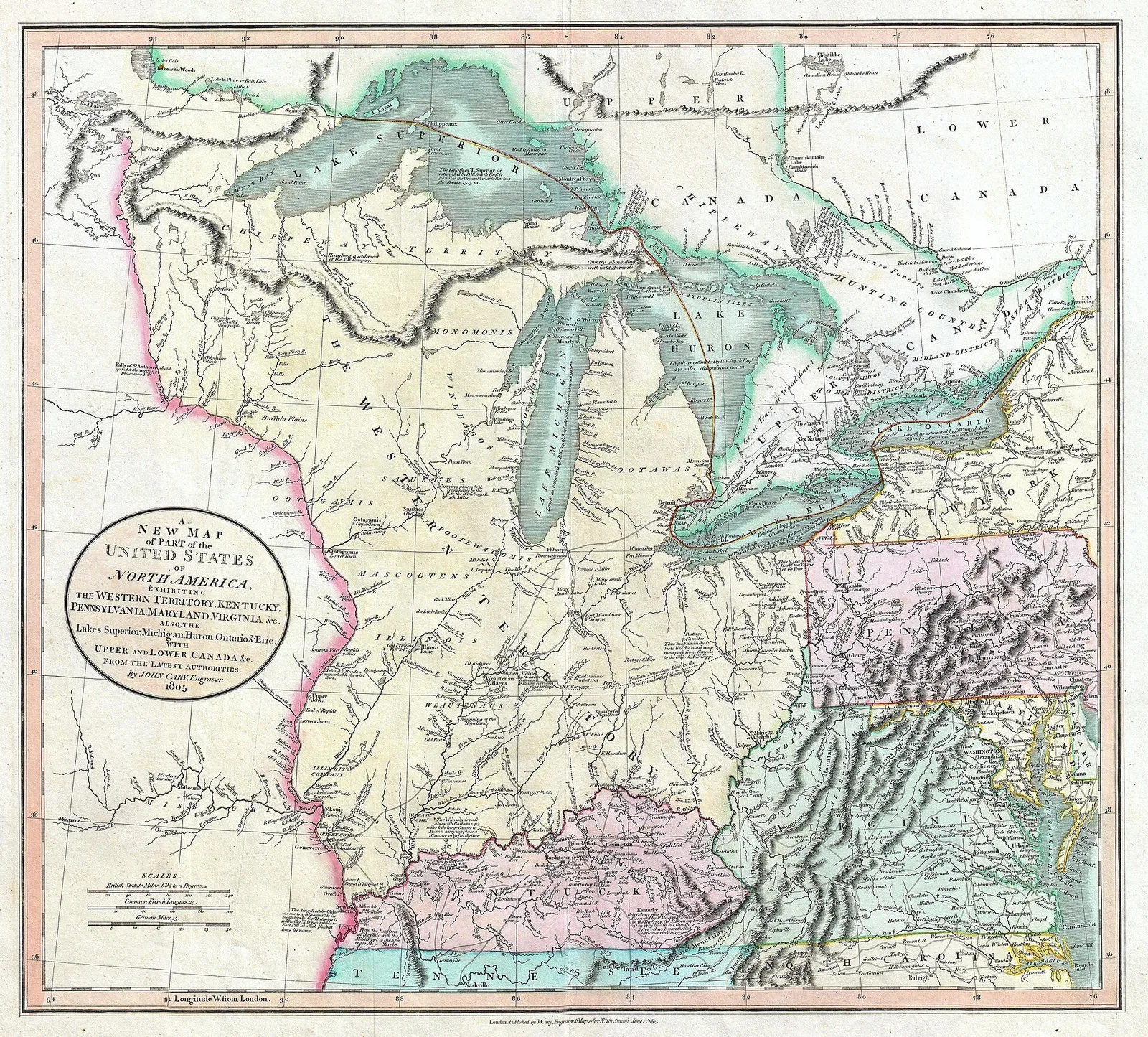
The land that became Indiana was formally organized as the Indiana Territory in 1800, carved out of the old Northwest Territory established by the Ordinance of 1787. Before that, it was contested ground — French traders and trappers had operated throughout the region since the 1600s, and the Miami Confederacy, Potawatomi, Delaware, and Shawnee nations had been trading, fighting, and negotiating over this territory for generations.
Key events in pre-statehood Indiana firearms history
French and Indigenous Firearms Trade
Firearms arrived in the Indiana region well before European settlement. French fur traders brought flintlock muskets and trade guns into the Great Lakes and Wabash River corridor in the late 17th and early 18th centuries. The Miami Confederacy and neighboring nations quickly integrated trade guns into both hunting and warfare.
By the time of the French and Indian War (1754–1763), indigenous fighters in present-day Indiana were as well-armed as their European counterparts — often better supplied with practical frontier arms than the line infantry they faced. British control following 1763 didn't change the basic dynamic.
The Proclamation of 1763 attempted to restrict settlement west of the Appalachians, but it was largely ignored by settlers pushing into Kentucky and the Ohio Valley. Firearms followed settlement pressure, and by the 1770s and 1780s, the Indiana territory was a genuine military frontier.
Revolutionary War Period
Fort Vincennes — the French post that became Fort Sackville under British control — was the scene of one of the most consequential frontier military actions in the region. In February 1779, George Rogers Clark led his Virginia militia on a legendary winter march through flooded Illinois bottomland and captured the fort from British Lieutenant Governor Henry Hamilton.
Clark's force was armed with the standard mix of Pennsylvania/Kentucky long rifles and military muskets of the era. The victory gave the new United States a credible claim to the Northwest Territory in the 1783 Treaty of Paris.
Battle of Tippecanoe
The Battle of Tippecanoe in November 1811 was the other defining pre-statehood firearms event in Indiana. General William Henry Harrison, then governor of the Indiana Territory, led roughly 1,000 U.S. Army regulars and militia against the Prophet's Town settlement near present-day Battle Ground, Indiana. Tenskwatawa (the Prophet) launched a pre-dawn attack on Harrison's camp that was ultimately repulsed.
The battle effectively broke the pan-tribal confederation that Tecumseh had been building and cleared the final major obstacle to American settlement of Indiana. Harrison's men were armed with the Model 1795 Springfield musket and a variety of militia long rifles — the same pattern of mixed regular and frontier arms that characterized American military operations of the period.
Statehood & the 19th Century (1816–1899)edit
Early Constitutional Framework
Indiana entered the Union on December 11, 1816, as the 19th state. Its first constitution, adopted that same year, included explicit firearms language:
"The people have a right to bear arms for the defense of themselves, and the state; and that the military shall be kept in strict subordination to the civil power." — Indiana Constitution of 1816
That's worth noting — Indiana's founders specifically included self-defense, not just collective militia service, as a justification for the right. That phrasing predates a lot of modern Second Amendment jurisprudence by nearly two centuries.
Concealed Carry Restrictions
The early Indiana legislature took a nuanced approach almost immediately. In 1831, Indiana banned concealed carry of firearms — one of the earliest such laws in the country. The ban was modeled partly on a similar Kentucky statute, and the stated rationale at the time centered on reducing dueling, which was a genuine social problem in frontier society. The law exempted travelers.
| State | Year | Concealed Carry Ban | Court Decision |
|---|---|---|---|
| Kentucky | 1813 | Enacted | Struck down in Bliss v. Commonwealth (1822) |
| Indiana | 1831 | Enacted | Upheld in State v. Mitchell (1833) |
| Tennessee | 1821 | Enacted | Various interpretations |
When the law was challenged, the Indiana Supreme Court upheld it in State v. Mitchell (1833). The decision was notably terse — one sentence: "It was held in this case, that the statute of 1831, prohibiting all persons, except travelers, from wearing or carrying concealed weapons, is not unconstitutional." This stood in contrast to the Bliss v. Commonwealth decision in Kentucky, which had struck down a similar law in 1822. Indiana's court held the line. The concealed carry ban would remain in various forms for most of the next 190 years.
Even with that restriction, open carry remained legal throughout the 19th century, and firearms were simply part of Indiana life. The state's geography — bordered by the Ohio River to the south, with significant agricultural interior — meant hunting was a practical necessity well into the late 1800s. Deer, wild turkey, and waterfowl were abundant throughout the Wabash River drainage, and most farm households maintained working firearms.
Self-defense jurisprudence developed in parallel. In 1893, Jackson Plummer v. State of Indiana established an important precedent: Plummer was found not guilty of manslaughter after killing a law enforcement officer who had used unlawful force against him while he was walking home. The court recognized a right of self-defense against unlawful government force — a principle that would resurface in contentious form over a century later.
Civil War Impact
The Civil War pulled Indiana deeply into the national firearms story. Indiana contributed roughly 208,000 soldiers to the Union cause — the eighth-largest contribution of any state. The Indiana Legion, the state's home guard militia, was established in 1861 specifically to defend against Confederate incursion after General John Hunt Morgan's cavalry raid sliced through southern Indiana in July 1863.
Morgan's Raid was the deepest Confederate penetration into northern territory during the war — Morgan's men reached as far as Harrison County and Switzerland County along the Ohio River before being driven back and eventually captured in Ohio. The raid mobilized Indiana civilians with whatever arms they had at hand and underscored the state's vulnerability along its southern border.
Post-Civil War Indiana saw the familiar pattern of surplus military arms filtering into civilian hands — Springfield .58 caliber rifle-muskets, converted Sharps carbines, and eventually the first wave of Winchester lever-action rifles and Colt Single Action Army revolvers reaching the Indiana market through hardware stores and mail order. The state's economy was transitioning from frontier agriculture to mixed farming and early industry, and firearms remained working tools rather than collector items for most Hoosiers.
The 1851 constitution — still in effect today — retained the arms language with slight rewording: "The people shall have a right to bear arms, for the defense of themselves and the State." The military subordination clause was separated into its own section. Indiana courts interpreted this through the 19th century as permitting reasonable regulation while protecting the core right.
20th Century: Wars, Industry & Regulation (1900–1999)edit
Indiana's manufacturing capacity made it a significant contributor to American military arms production in both World Wars, though the state's role tends to be overshadowed by Ohio, Pennsylvania, and New England in most accounts.
World War I Production
During World War I, Indiana's industrial base — concentrated in Indianapolis, South Bend, Fort Wayne, and Gary — shifted to war production. Allison Engineering in Indianapolis (later Allison Division of General Motors) was primarily an engine manufacturer, but the broader Indiana metalworking and machining infrastructure contributed components to weapons programs throughout the war. The Indiana Steel & Wire Company and various smaller manufacturers produced materials essential to ordnance production.
World War II Manufacturing
World War II brought the most direct connection between Indiana industry and firearms manufacturing. Winchester Repeating Arms established production relationships with Indiana subcontractors. Marlin Firearms had production arrangements with Midwest manufacturers. More significantly, Chrysler's Indiana plants and the massive Allison aircraft engine facility in Indianapolis were part of the larger industrial mobilization.
The Charlestown Powder Plant — actually located in Clark County, Indiana, just north of Louisville — was built in 1940 specifically to produce smokeless powder for military ammunition and became one of the largest powder production facilities in the United States during the war. At peak production, it employed over 10,000 workers.
| Facility | Location | Peak Employment | Primary Product |
|---|---|---|---|
| Charlestown Powder Plant | Clark County | 10,000+ | Smokeless powder for military ammunition |
| Camp Atterbury | Edinburgh | Training facility | Processed hundreds of thousands of soldiers |
| Allison Division | Indianapolis | Major facility | Aircraft engines (war production) |
Camp Atterbury, established in 1942 near Edinburgh, Indiana, became one of the largest Army training installations in the Midwest, processing hundreds of thousands of soldiers through basic training and weapons qualification. After the war, it transitioned to the Indiana National Guard and remains an active installation today as Camp Atterbury Joint Maneuver Training Center.
Post-War Legislative Development
On the legislative side, Indiana generally followed the national pattern through the mid-20th century without dramatic local innovation. The 1934 National Firearms Act and 1968 Gun Control Act applied federally, and Indiana's state laws remained relatively minimal — no registration requirement, no permit to purchase, basic prohibitions on felons possessing firearms.
The concealed carry landscape began to shift in the 1970s. Indiana moved toward a shall-issue licensing framework, meaning that authorities had to issue a carry license to any applicant who met the objective legal requirements — a significant departure from the discretionary "may-issue" systems in states like California and New York. This was ahead of the national shall-issue wave that followed Florida's 1987 law.
Self-defense law also developed during this period. 1977 marked Indiana's first codification of what RAND would later classify as castle doctrine — protecting a person's right to use force against unlawful entry into their dwelling. The law was more limited than what would come later, focused on the home rather than any place a person had a right to be.
The 1990s brought the federally mandated Brady background check system (effective 1994) and assault weapons ban (1994–2004) into Indiana gun stores, but the state did not add its own restrictions on top of federal law. Indiana's legislature during this period was functionally split — the state had genuine competitive elections through the 1990s — but there was no serious push for state-level restrictions beyond what federal law required.
Modern Era (2000–Present)edit
The 21st century produced Indiana's most significant and, in some ways, most unusual firearms legislation — a combination that puts the state in a category almost by itself nationally.
The Jake Laird Law
On June 16, 2004, Kenneth Anderson shot his mother and then four Indianapolis Metropolitan Police Department officers, killing Patrolman Timothy "Jake" Laird. The tragedy had a specific detail that drove the subsequent legislation: Anderson had recently been taken to a hospital under an emergency psychiatric detention, and firearms had been temporarily removed from his home — then returned to him. The returned guns were used in the murders.
How Indiana's red flag law originated from a specific tragedy
Indiana's response was Public Law 179 of 2005, commonly known as the Jake Laird Law — a red flag law that allowed law enforcement to petition a court for the removal of firearms from someone deemed to pose an imminent risk of harm. Connecticut had passed the first red flag law in the country in 1999.
Indiana became the second state with a red flag law in 2005 — eleven years before it became a national progressive priority. This wasn't ideology; it was a response to a specific Indiana tragedy.
Indiana became the second state to enact such a law in 2005 — and then the country largely moved on for a decade. It wasn't until after the 2018 Parkland shooting that the broader national red flag conversation caught fire, with 17 more states passing similar laws between 2018 and 2022.
The political context here is worth sitting with. Indiana was, and remains, a Republican-dominated state at the legislative level. A Republican-led Indiana legislature passed what is functionally a red flag law eleven years before it became a national progressive priority. That's not spin — it's just the specific history of how the Jake Laird murder moved the political needle in a way that abstract policy arguments couldn't.
Self-Defense Law Evolution
Self-defense law moved in a different direction in 2006 when Indiana joined 12 other states that year in upgrading from castle doctrine to a full stand-your-ground framework, following Florida's 2005 lead. The law eliminated the duty to retreat in any location where a person had a legal right to be.
In 2011, the Indiana Supreme Court handed down Barnes v. State of Indiana, which created immediate controversy. The court ruled that Richard Barnes did not have a statutory right to resist police officers entering his home — even if the entry was unlawful — and further that the jury should not have been informed of any common-law right to defend one's home against unlawful police entry. The ruling effectively said: you can't use the self-defense statute as a defense when you resist police, even cops acting illegally.
The Barnes case legislative override sequence
The backlash was fast. The Indiana General Assembly amended the stand-your-ground law in 2012 specifically to address Barnes v. State, adding language allowing "reasonable force" to resist law enforcement engaged in "unlawful entry" of a home, vehicle, or property. It's a rare case of a legislature directly overriding a Supreme Court self-defense ruling within a year.
Constitutional Carry Achievement
The trajectory toward constitutional carry was, in retrospect, predictable. Indiana's carry licensing system had been shall-issue for years. The legislative majority was increasingly aligned with the national Republican position on permitless carry.
House Enrolled Act 1296, signed by Governor Eric Holcomb and effective July 1, 2022, eliminated the permit requirement for carry by any person 18 or older who is not legally prohibited from possessing a firearm. Indiana became the 24th state with permitless carry — following a wave that included Iowa (2021), Tennessee (2021), and Texas (2021).
| Year | Event | Type | National Context |
|---|---|---|---|
| 2005 | Jake Laird Law | Red flag statute | 2nd state nationally (after Connecticut 1999) |
| 2006 | Stand Your Ground | Self-defense expansion | Following Florida's 2005 lead |
| 2011 | Barnes v. State | Court ruling | Restricted resistance to unlawful police entry |
| 2012 | Legislative Override | Statute amendment | Restored right to resist unlawful entry |
| 2022 | Constitutional Carry | Permitless carry | 24th state to enact |
The state-issued License to Carry a Handgun didn't disappear with HEA 1296 — it remains available as an optional credential, useful primarily for interstate reciprocity in states that require a permit from the carrier's home state.
Since 2022, Indiana's legal landscape has been stable. The state has no assault weapons ban, no magazine capacity restrictions, no waiting period, no ghost gun regulations, and no bump stock prohibition. Machine guns legal under federal law (NFA-registered pre-1986 specimens) are legal in Indiana. The state expressly prohibits government entities from maintaining any registry of privately owned firearms or their owners under Ind. Code Ann. § 24-5-27.5.
One notable recent legislative thread involves firearms industry immunity. Indiana law prohibits civil actions against firearms or ammunition manufacturers, trade associations, or sellers for harms caused by the criminal or unlawful use of their products — a state-level analog to the federal PLCAA (Protection of Lawful Commerce in Arms Act) of 2005. Indiana's immunity statute reflects the legislature's consistent position that liability for criminal misuse belongs with the criminal, not the supply chain.
Notable Figures & Manufacturersedit
William Henry Harrison looms largest in Indiana's pre-statehood firearms history. His victory at Tippecanoe in 1811 defined the final chapter of indigenous resistance to American settlement in Indiana and launched the political career that eventually took him to the presidency in 1841. His use of mixed regulars and militia — and the tactical debate about whether his camp's defensive positioning that night was sound — remains studied in military history curricula.
George Rogers Clark, though a Virginia native by origin, conducted the most consequential military firearms operation in what became Indiana when he took Fort Sackville in 1779. A memorial to Clark stands in Vincennes today, and the George Rogers Clark National Historical Park marks the site.
On the industrial side, Indiana's contribution to firearms manufacturing is more diffuse than states with dedicated armory traditions like Springfield, Massachusetts or Ilion, New York. The Charlestown Powder Plant (Clark County) was arguably Indiana's single biggest direct contribution to American firearms infrastructure, producing smokeless powder at enormous scale during WWII. The facility later became the Indiana Army Ammunition Plant and continued defense production through the Cold War era.
Kimber of America has manufacturing operations in Troy, Alabama, but Kimber's presence and dealer network in Indiana reflect the state's strong handgun market. More relevant locally: Indy Arms Company and various Indiana-based custom gunsmiths have built regional reputations, though none have achieved the national manufacturing profile of a Colt or Ruger.
Dan Wesson Firearms — founded by the grandson of Daniel B. Wesson of Smith & Wesson fame — had a significant chapter of its history connected to Midwest distribution and dealer relationships, though its primary manufacturing was in New York. The broader Indiana gun retail and custom market has been robust enough to support multiple multi-location dealers and competitive shooting infrastructure.
The Indiana National Guard and Camp Atterbury deserve mention in any discussion of the state's firearms institutional infrastructure. Camp Atterbury processed prisoner-of-war internees during WWII (over 12,000 German and Italian POWs) and has served as a National Guard training center continuously since. The Muscatatuck Urban Training Center near Butlerville, Indiana, operated by the Indiana National Guard, is one of the most sophisticated urban warfare training facilities in the United States — built in the footprint of a former state hospital and used by military, law enforcement, and first responder units nationwide.
Current Legal Landscapeedit
Indiana's current firearms legal framework is among the most permissive in the country, with a few specific exceptions that reflect the state's pragmatic rather than purely ideological approach.
Core Legal Framework
Constitutional Provision: Article 1, Section 32 — "The people shall have a right to bear arms, for the defense of themselves and the State."
Carry: Permitless carry for anyone 18+ not legally prohibited, effective July 1, 2022. Open carry is legal. Optional License to Carry a Handgun available for reciprocity purposes.
Purchase: No permit required to purchase rifles, shotguns, or handguns. No waiting period. No registration. Holders of a valid Indiana License to Carry a Handgun are exempt from the federal NICS check at point of sale under the ATF Brady exemption chart.
Hardware Restrictions:
| Category | Status | Details |
|---|---|---|
| Assault Weapons | No ban | All configurations legal |
| Magazine Capacity | No restrictions | Standard capacity legal |
| Suppressors | Legal | Federal NFA compliance required |
| Machine Guns | Legal | Pre-1986 NFA registry only |
| Bump Stocks | No prohibition | Legal under state law |
| Ghost Guns | No regulations | No state restrictions |
Prohibited Places
Prohibited Places under current Indiana law include:
- Commercial or charter aircraft
- Airport secure areas (past security checkpoints)
- Riverboat gambling operations
- Indiana State Fairgrounds during the annual state fair
- School property (with specific exemptions)
- Correctional facilities
- Court facilities
- Polling places on election day
- Certain port areas
Special Provisions
Red Flag / ERPO: The Jake Laird Law (2005) allows law enforcement to petition for emergency firearms removal. A court hearing follows, and the person may petition for return after 180 days.
Stand Your Ground: No duty to retreat in any location where a person has a legal right to be. Post-Barnes amendment (2012) explicitly includes reasonable force against unlawful law enforcement entry.
Firearms Industry Immunity: Civil suits against manufacturers, trade associations, and sellers for criminal misuse of their products are barred under Indiana statute.
NFA Items: Indiana is compliant with federal NFA processes. State law enforcement must issue certification for NFA item transfers within 15 days of a completed request (shall-issue standard for NFA certification).
Preemption: Indiana has broad state preemption of local firearms ordinances, meaning cities like Indianapolis cannot enact gun regulations stricter than state law. This has been a consistent legislative priority and has prevented the urban-rural regulatory patchwork seen in states like California and Illinois.
The BGC Takeedit
Indiana is a gun-friendly state that doesn't feel the need to shout about it. That's probably the most accurate one-sentence summary.
Indiana is a gun-friendly state that doesn't feel the need to shout about it. The combination of constitutional carry with a functional red flag law makes it one of the more intellectually interesting states to watch.
The political reality is that Indiana went from swing-state to reliably Republican at the state level through the 2000s, and the firearms legislation followed that trajectory. Constitutional carry, shall-issue NFA certification, no restrictions on hardware, strong preemption — the legislative checklist is essentially complete from a gun-rights perspective. If you're moving to Indiana from a restrictive state, the adjustment is going to feel like exhaling.
But the red flag law is real, it predates the national conversation by over a decade, and it has bipartisan roots that make it genuinely durable. The Jake Laird Law didn't pass because Indiana Democrats forced it through — it passed because the murder of a cop with guns that had been temporarily seized and then returned was a specific, concrete, Indiana problem, and the legislature responded to it. That's different from the abstract red flag debates playing out in state capitals after Parkland. Hoosiers who want to litigate whether the Jake Laird Law is constitutional or good policy can do that — but they should understand why it exists and who it's named after.
The Barnes v. State episode is worth understanding if you're going to live and carry in Indiana. The 2011 decision, the legislative response in 2012, and the current stand-your-ground framework reflect a state that takes self-defense rights seriously enough to amend statutes when courts get it wrong — in the legislature's view. The current law is about as strong as stand-your-ground gets anywhere in the country.
For actual gun culture on the ground, Indiana has a healthy competitive shooting scene built around USPSA, IDPA, three-gun, and traditional bullseye competition. The Ben Davis Sportsman's Club near Indianapolis, Eagle Creek Pistol Range, and various club ranges throughout the state support active shooting communities. Deer hunting is deeply embedded in the culture — Indiana DNR typically issues over 100,000 deer harvest reports annually, and opening weekend of firearms season is a genuine cultural event in rural counties.
The urban-rural divide exists, as it does everywhere. Indianapolis and Bloomington have populations with more ambivalent attitudes toward firearms, and the occasional push from Marion County officials for local regulations gets consistently blocked by state preemption. That preemption isn't going away — it's been a legislative priority precisely because the legislature doesn't trust urban governments to stay within state standards.
Bottom line for anyone considering Indiana as a place to live, shoot, or do business in the firearms space: the legal environment is solid, the culture is unpretentious, and the combination of constitutional carry with a functional red flag law makes it one of the more intellectually interesting states to watch for anyone tracking where American firearms law is actually headed. It's not performing for the cameras. It's just Indiana.
Referencesedit
- Indiana Constitution, Article 1, Section 32. Indiana General Assembly. in.gov.
- Indiana Constitution of 1816, Bill of Rights. Indiana State Archives.
- State v. Mitchell, Indiana Supreme Court (1833).
- Jackson Plummer v. State of Indiana, Indiana Supreme Court (1893).
- Richard Barnes v. State of Indiana, Indiana Supreme Court (2011).
- House Enrolled Act 1296 (2022). Indiana General Assembly. iga.in.gov.
- Indiana Code Ann. §§ 35-47-2-3, 14-16-1-23 (Permitless Carry, effective July 1, 2022).
- Indiana Code Ann. § 35-47-8.5 (NFA State Certification).
- Indiana Code Ann. § 24-5-27.5 (Registry Prohibition).
- Indiana Code Ann. § 35-47-5-11.5 (Armor-Piercing Ammunition).
- Public Law 179 of 2005 (Jake Laird Law / Indiana Red Flag Statute). Indiana General Assembly.
- NRA-ILA. "Indiana Gun Laws." nraila.org. Updated September 8, 2025.
- Giffords Law Center. "Gun Industry Immunity Laws in Indiana." giffords.org.
- Indiana Attorney General. "Gun Owners' Bill of Rights." in.gov.
- Sells, Jack. "Indiana's Unique Legislative History with Guns." The Statehouse File. thestatehousefile.com. 2022.
- Cramer, Clayton E. Concealed Weapon Laws of the Early Republic. Praeger, 1999.
- RAND Corporation. "The Science of Gun Policy: State Law Typology — Stand Your Ground." rand.org.
- Everytown for Gun Safety Research. "Red Flag Laws: State-by-State." everytown.org.
- U.S. National Park Service. George Rogers Clark National Historical Park. nps.gov.
- Indiana Army Ammunition Plant (Charlestown). U.S. Army. globalsecurity.org historical records.
- Indiana National Guard. Camp Atterbury Joint Maneuver Training Center. in.ng.mil.
- Indiana DNR. Annual Deer Harvest Reports. in.gov/dnr.
Last Updated: February 24, 2026
- Quail Creek Plantation(Okeechobee, FL)
- 2aHawaii(Honolulu, HI)
- Boston Firearms(Everett, MA)
- Safeshoot(Kingston, NY)
Loading comments...