Specifications
StG 44 (Sturmgewehr 44)

The StG 44 in 7.92×33mm Kurz — the world's first mass-produced assault rifle, combining rifle range with submachine gun handling.
Armémuseum (The Swedish Army Museum) (CC BY-SA 4.0)
| Manufacturer | |
|---|---|
| Made By | Steyr-Daimler-Puch |
| Designer | Hugo Schmeisser |
| Origin | Germany |
| Specifications | |
| Caliber | 7.92x33mm Kurz |
| Action | gas operated |
| Weight | 10.2 lbs |
| Production | |
| Designed | 1942 |
| Variants | |
| |
StG 44 (Sturmgewehr 44): The First Assault Rifle
Firearms encyclopedia article
From The Boise Gun Club Handbook
Overviewedit
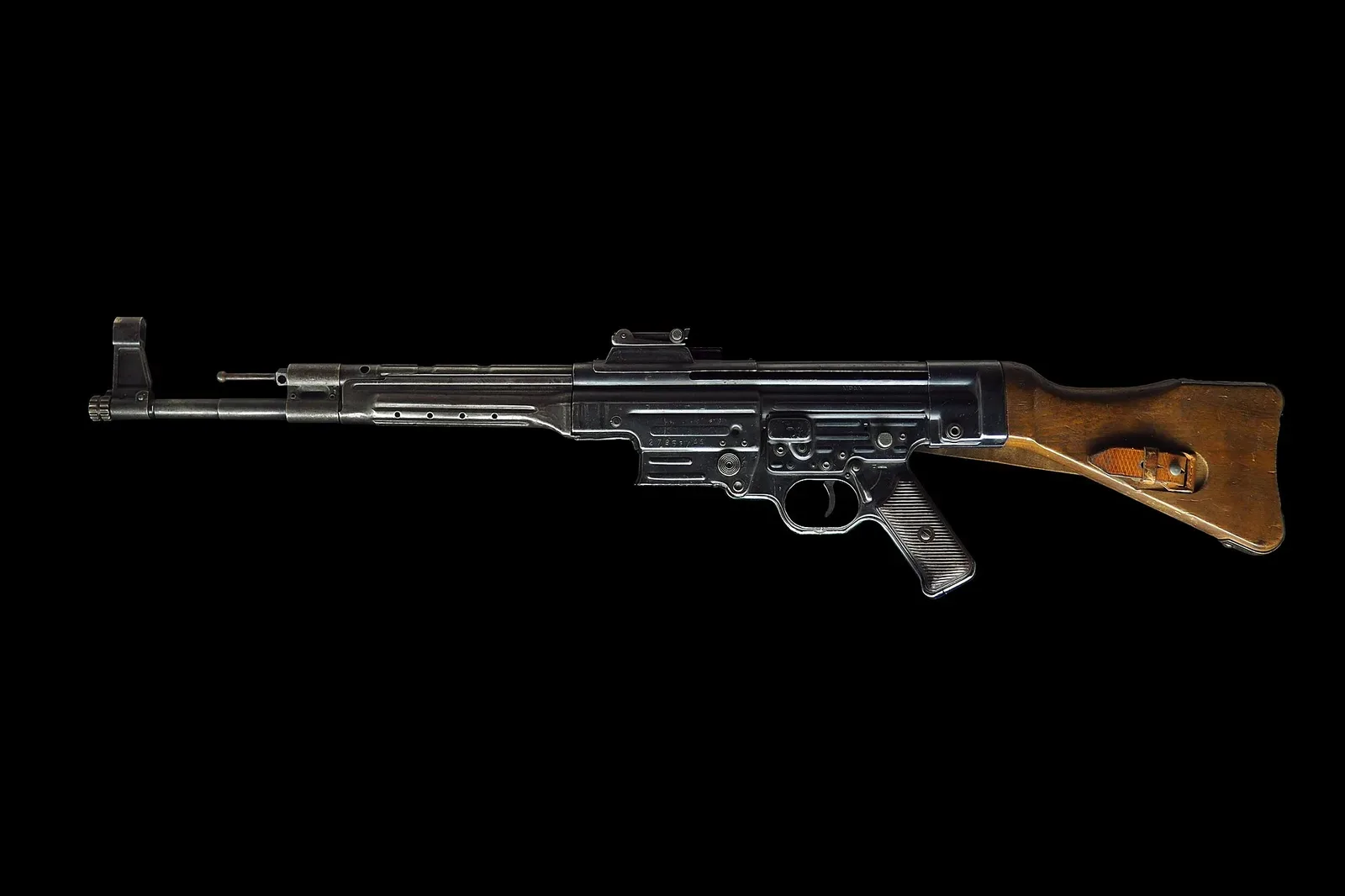
The Sturmgewehr 44 — StG 44 — didn't just change the way soldiers fought in World War II. It changed the vocabulary. Every time someone uses the phrase "assault rifle," they're using a name that traces directly back to this weapon.
The concept it embodied — an intermediate-caliber, magazine-fed, selective-fire carbine light enough for an infantryman to control on full-auto — became the template for essentially every military rifle built in the seventy-plus years since.
The gun arrived too late and in too few numbers to alter the outcome of the war it was designed to win. But the idea it represented outlasted the regime that produced it, and you can trace a clear line from its curved 30-round magazine to the AK-47, the M-16, and every derivative in between.
Design Historyedit
The story starts not with the StG 44 itself but with the problem it was built to solve.
The Infantry Problem
By the early years of World War II, German planners had recognized a mismatch between their standard infantry weapons and the realities of modern combat. The Karabiner 98K — a bolt-action rifle firing the 7.92x57mm cartridge — was accurate at distances soldiers rarely actually engaged. The MP-38 and MP-40 submachine guns were handy in close quarters but chambered in 9mm pistol ammunition with limited range and penetrating power.
Neither weapon was right for the kind of fluid, short-to-medium range fighting that dominated the Eastern Front.
The solution, as researchers and tacticians understood it, was an intermediate cartridge — something between the full-power rifle round and the pistol round. Per the RAND Corporation's analysis, smaller, less powerful ammunition meant a lighter, smaller gun that was easier to control on automatic fire, with the added benefit of allowing soldiers to carry more rounds into the fight. The ammunition couldn't be as weak as a pistol round — it had to remain lethal and reasonably accurate at useful distances — but it didn't need to reach out to 800 meters either.
The tactical problem that drove StG 44 development
Schmeisser's Solution
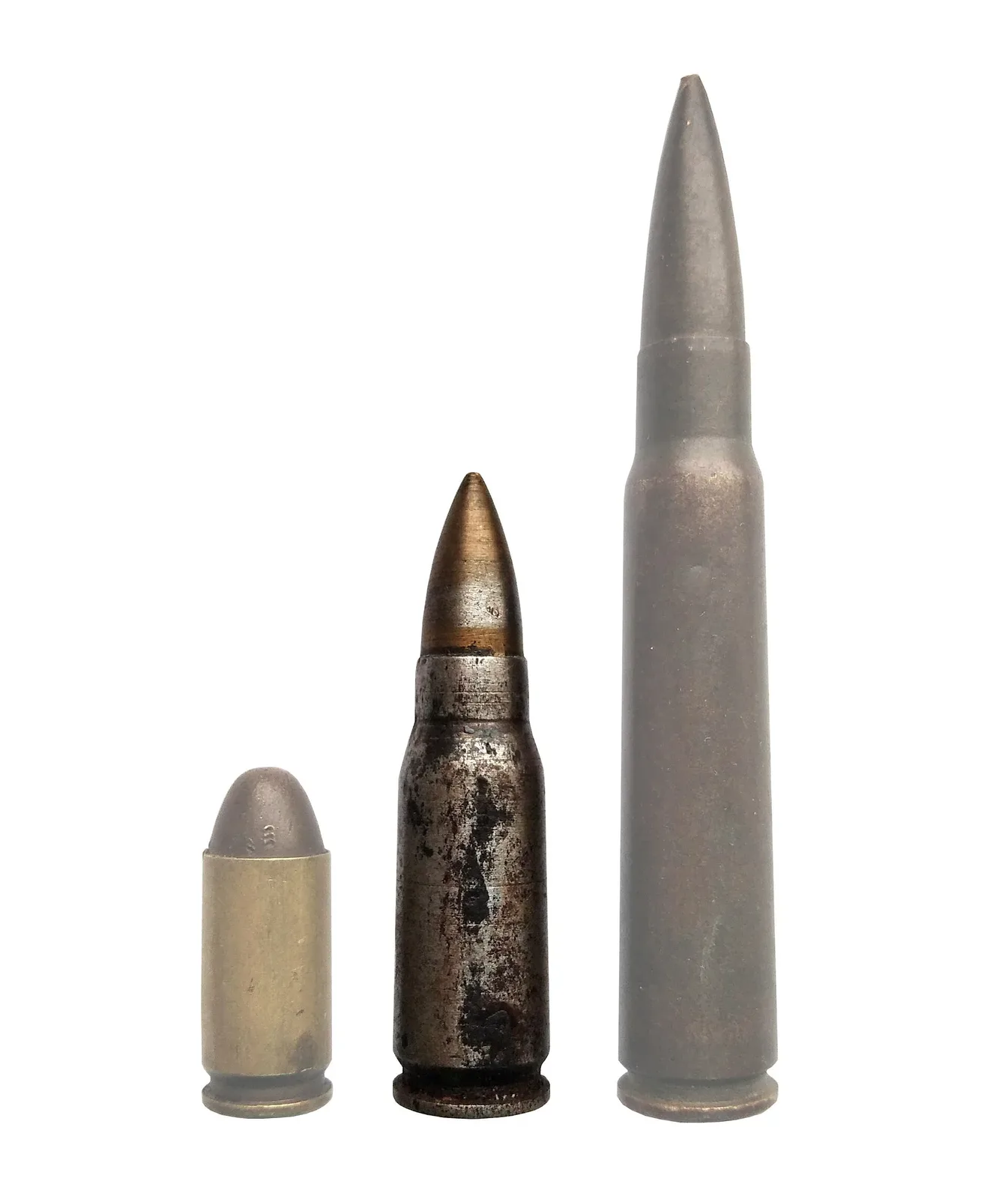
Hugo Schmeisser, a veteran German arms designer, began work on this problem in the early 1940s. The cartridge his design was built around was the 7.92x33mm Kurz — same bullet diameter as the standard German service round, but with a case shortened from 57mm to 33mm. Less powder behind the bullet meant less recoil, which meant controllable automatic fire.
According to Recoil Magazine, the Kurz cartridge also incorporated more taper than conventional rifle rounds because it was designed for steel cases — brass was in short supply, and steel is less elastic than brass. That extra taper is precisely why the magazine had to curve. That curved magazine, in turn, became one of the most recognizable visual features of the assault rifle class for the next eight decades.
Schmeisser's first attempt at the concept was the Maschinenkarabiner 1942, or MKb 42 — literally "machine carbine." It was a gas-operated, selective-fire design capable of both semi-automatic and full-automatic fire. Two competing versions were tested, and it was the MKb 42(H), developed by German arms maker Haenel, that won out. Approximately 50 prototypes went to the Eastern Front for field evaluation.
Political Obstacles and Workarounds
There was, however, a problem at the top. According to widely circulated accounts reported by Recoil Magazine, Adolf Hitler opposed the development of a new rifle platform entirely, believing the military needed more submachine guns rather than a new class of weapon. The Waffenamt — the German Armament Office — found a workaround: they simply re-designated the MKb 42 as the Maschinenpistole 43, or MP-43. The name made it sound like a successor to the MP-38/40 rather than an entirely new design.
I've heard those stories that it was put into production without Hitler's knowledge. The designers did the tap dance and that was enough to get the gun green lit. — Captain Dale Dye, USMC (Retired)
Hitler eventually discovered the deception. But after demonstrations and field reports, he allowed further evaluation. In April 1944, the weapon was officially re-designated MP-44. Then, according to accounts cited by both Recoil Magazine and RAND, came the moment that named a weapon class. During a July 1944 meeting of army commanders, officers from the Eastern Front demanded more of the new rifles. After a demonstration, Hitler was reportedly impressed — and the popular account holds that he personally insisted the weapon be called a Sturmgewehr, or "storm rifle" — a word that translated into English as "assault rifle." The weapon became the StG 44, and the terminology has been in use ever since.
| Development Timeline | Designation | Key Changes |
|---|---|---|
| Early 1942 | MKb 42 (H) | Initial prototype, 50 units to Eastern Front |
| 1943 | MP-43 | Renamed to bypass Hitler's opposition |
| April 1944 | MP-44 | Official redesignation after Hitler's approval |
| July 1944 | StG 44 | Final designation after Hitler coined "Sturmgewehr" |
Per the specifications confirmed across sources, the StG 44 was manufactured with a stamped steel receiver — a production approach that kept costs down and simplified manufacturing — combined with wooden furniture. The designer was Hugo Schmeisser, and production was handled in part by Steyr-Daimler-Puch, running from 1943 through 1945.
Technical Characteristicsedit
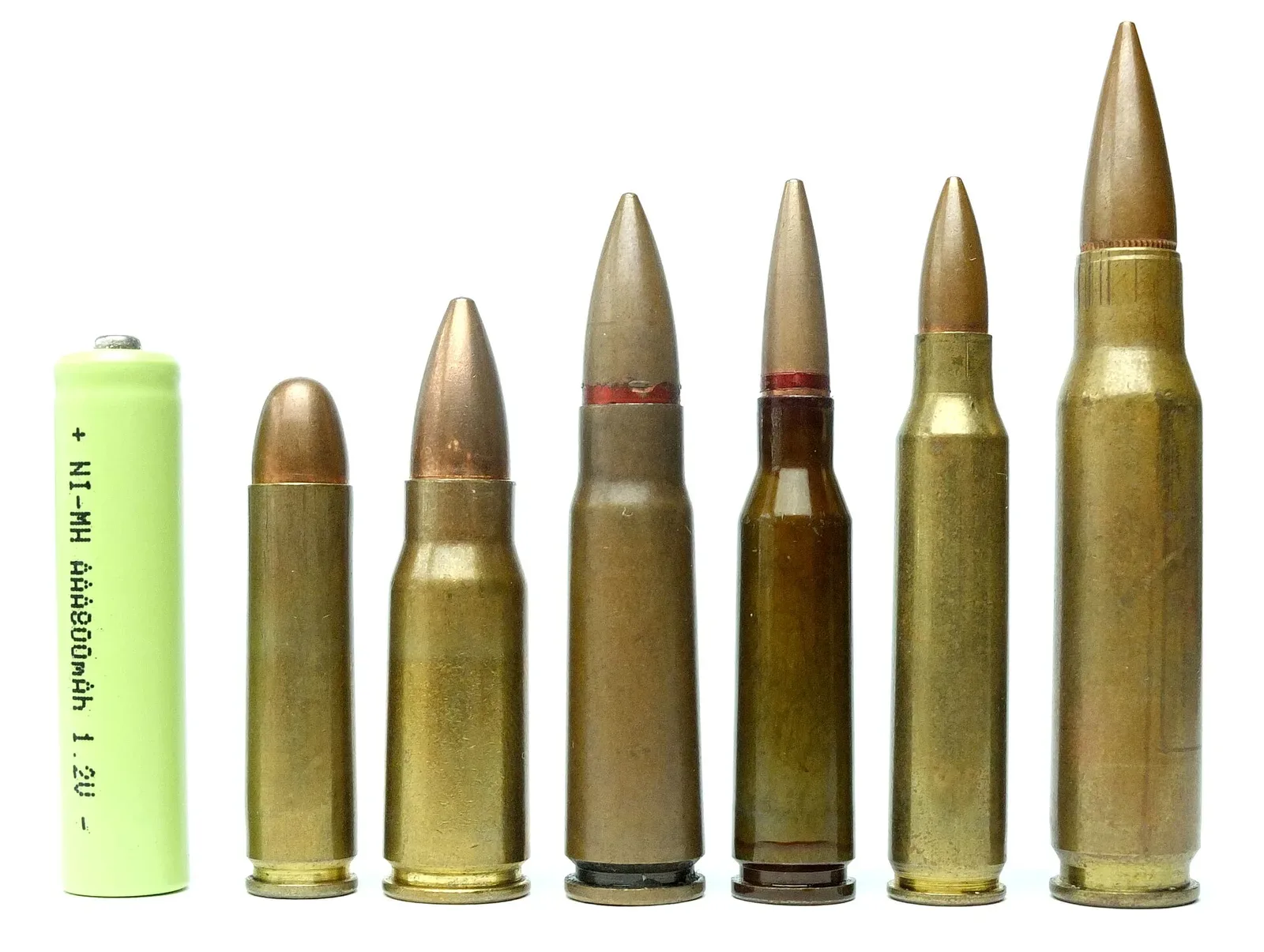
The StG 44's core specifications place it clearly in context against the weapons it was meant to replace and the weapons it inspired.
Specifications Comparison
| Specification | StG 44 | Karabiner 98K |
|---|---|---|
| Caliber | 7.92x33mm Kurz | 7.92x57mm |
| Magazine Capacity | 30 rounds | 5 rounds |
| Barrel Length | 16.5 inches | ~24 inches |
| Weight | 10.2 lbs | ~8.6 lbs |
| Fire Modes | Semi / Full-Auto | Bolt-Action |
| Muzzle Velocity | 2,247 ft/sec | ~2,800 ft/sec |
| Rate of Fire | 500–600 rpm | N/A |
| Overall Length | 37 inches | ~43 inches |
The comparison with the 98K tells the operational story. The StG 44 was actually heavier — a point soldiers noted, particularly those transitioning from the lighter MP-40. But it offered six times the magazine capacity, a barrel half a foot shorter, and the ability to put rounds downrange at 500–600 per minute on full-auto. Per RAND, the 98K wasn't even semi-automatic. The StG 44's muzzle velocity was lower — 2,247 feet per second versus roughly 2,800 for the 98K — which meant less accuracy and punch at extreme range. But the Germans understood the tradeoff was worth it. As RAND put it, they "understood that the StG 44 was deadly enough."
How the intermediate cartridge drove design characteristics
Key Design Features
The gas-operated action used a long-stroke piston with a closed tilting bolt. The selective-fire mechanism gave individual soldiers the ability to shift between semi-automatic for aimed fire at distance and full-automatic for suppression at close range — a capability no standard infantry rifle of the period offered. The effective firing range reached approximately 600 meters, according to the weapon's specifications.
The stamped steel receiver was significant beyond just the StG 44's own production. It pointed toward a manufacturing philosophy — cheaper and faster to produce than machined receivers — that would define postwar assault rifle design, the AK-47's stamped receiver being the most obvious example.
Combat & Field Useedit
The StG 44 went to the Eastern Front first, issued to German forces facing the Soviet PPSh-41 — the most-produced submachine gun of World War II.
Eastern Front Deployment
The PPSh-41's high rate of fire and reliability in extreme cold made it a formidable close-quarters weapon, and German infantry needed something that could match its volume of fire while remaining effective at longer distances. The Kurz cartridge's controllability in automatic fire and the weapon's 30-round magazine made the StG 44 a credible answer.
Soldiers who received it had to adjust. Captain Dye noted that for men coming from the 98K, the curved magazine was unfamiliar and the weapon felt unwieldy at first. For those used to the MP-40's lighter profile, the StG 44's 10-plus pounds was a step up in carry weight.
- Curved magazine was unfamiliar to soldiers used to the 98K
- 10+ pound weight was heavier than the MP-40
- Soldiers quickly adapted to the new weapon system
Production Limitations
Despite soldiers' positive reception, the weapon's broader impact on the war was limited by one unavoidable fact: it arrived too late and in too few numbers.
| Production & Service Data | StG 44 | Context |
|---|---|---|
| Production Period | 1943-1945 | Late war introduction |
| Total Produced | ~500,000 | Insufficient for rifle replacement |
| Service Life | 1943-1962 | Continued post-war use |
| Cartridge Types in German System | 3 (9mm, 7.92x57mm, 7.92x33mm) | Logistical complexity vs. US (2 cartridges) |
Approximately 500,000 were produced across the 1943–1945 production run. Alex Cranmer, firearms expert and vice president of International Military Antiques, was direct on the point:
First of all it arrived too late. Had it replaced the 98K in 1938, could it have changed the outcome of the war? Perhaps, but the reality is that Hitler bit off more than he could chew. No amount of StG 44s were going to stop overwhelming Russian infantry pushing from the east while the largest amphibious invasion force in history landed in the west. — Alex Cranmer, International Military Antiques
The weapon also created a logistical headache the Germans could not afford. The U.S. Army ran effectively on two cartridges: the .30-caliber round that fed the M1 Garand, the BAR, and the Browning machine gun, and the .45 ACP that fed the Colt 1911, the Thompson, and the M3. The Germans, by introducing the 7.92x33mm Kurz, now had three calibers in the system — the 9mm for pistols and submachine guns, the 7.92x57mm for the 98K and machine guns, and now the Kurz for the StG 44. Captain Dye put it plainly: "What they brought out was the right round. But it only created ammunition issues for the Germans."
When the Germans could get the weapon forward in quantity, it performed. But "could get it forward" was increasingly the problem as Allied forces closed on Germany from both directions in 1944 and 1945.
Post-War Service
The StG 44 remained in service beyond 1945. According to Recoil Magazine, the East German military used it through the 1950s, and the weapon remained in service until 1962, per specifications data. Thousands of StG 44s dispersed across the postwar world — and according to Recoil Magazine, approximately 5,000 may have appeared in a weapons cache in Syria, reportedly in use by Syrian rebels.
Legacy & Influenceedit
The StG 44's place in the history of firearms rests on two distinct contributions: what it proved conceptually, and what it may have directly influenced.
Conceptual Impact
The StG 44 demonstrated that an intermediate cartridge in a selective-fire, magazine-fed carbine could give infantry soldiers everything they actually needed in combat — sufficient range, sufficient lethality, controllable automatic fire, and meaningful magazine capacity — in a package a single soldier could manage. Every military force that observed it came to the same conclusion.
The question wasn't whether the concept was right. The question was how to build their own version.
The Soviets moved fastest. They were well-positioned to evaluate the StG 44 — they'd faced it across the Eastern Front and captured large numbers of them. Per RAND, the Soviets developed the AK-47 in direct response to their impression of the StG 44's capabilities. The British pursued the EM-2 with an even smaller cartridge (.280 caliber, 7x33mm). The United States initially resisted the intermediate cartridge concept, forcing NATO to adopt a modified version of the full-power 7.62x63mm round rather than the British intermediate option — a decision that eventually gave way to the 5.56x45mm and the M-16 as the operational demands of Vietnam made the case the Germans had already made in the 1940s.
| Assault Rifle Evolution | Cartridge | Influenced By StG 44 |
|---|---|---|
| AK-47 (Soviet) | 7.62x39mm | Direct response to StG 44 experience |
| EM-2 (British) | .280/7x33mm | Adopted intermediate concept |
| M-16 (US) | 5.56x45mm | Eventually accepted intermediate approach |
| Modern Military Rifles | Various intermediate | All follow StG 44 template |
The AK-47 Connection
The more contested question is the AK-47's specific relationship to the StG 44. Cranmer addressed it directly:
Most people believe that the AK-47 is the direct descendant of the StG-44. It is not. The mechanism is very different. Were the Russians — including Kalashnikov — influenced by the idea of the MP44? Almost certainly. — Alex Cranmer
The mechanism question is real — the two guns operate differently internally. But the circumstantial evidence around Hugo Schmeisser's postwar years adds a layer that's harder to dismiss. After Germany's defeat, Schmeisser was taken by Soviet forces and reportedly compelled to work for the Red Army. According to Recoil Magazine, he reportedly contributed to AK-47 development during this period. Captain Dye noted: "The guns are closer in design than some people might suggest." Whether Schmeisser's direct contribution was substantial or marginal remains a matter of historical debate — but the fact that the man who designed the StG 44 spent years inside the Soviet arms development program while the AK-47 was being developed is not a coincidence historians can comfortably ignore.
The broader lineage is clear regardless of how the Schmeisser question resolves. The StG 44 established the operational concept, proved the intermediate cartridge's viability under combat conditions, and — through the name Hitler gave it — defined the terminology that armies and legislatures and journalists still use today. Per RAND, virtually all the world's armies now carry assault rifles, most of which are variants of the AK-47 or the AR-15. Both trace their conceptual DNA to the problem the StG 44 solved.
Timeline showing StG 44's influence on modern assault rifle development
Modern Collecting and Media
The StG 44 remained in service in various militaries until 1962. Production numbers reached approximately 500,000. Surviving examples are scarce, particularly in operable condition. A fully transferable example in the United States has sold for $30,000 or more at military collectible shows — plus the standard $200 NFA transfer fee. Semi-automatic reproductions have sold for approximately $2,000, and German Sport Guns (GSG) produces a .22LR version that replicates the external appearance of the wartime gun, available for around $500.
| Modern Availability & Pricing | Type | Price Range |
|---|---|---|
| Fully Transferable Original | NFA Item | $30,000+ plus $200 transfer |
| Semi-Auto Reproduction | Modern Manufacture | ~$2,000 |
| .22LR Version (GSG) | Training/Recreation | ~$500 |
The StG 44 has made periodic appearances in film and media. According to Recoil Magazine, it first appeared on screen in the 1948 Czechoslovakian war film The White Darkness, followed by the 1951 West German/American production Decision Before Dawn — nominated for Best Picture at the 1952 Academy Awards — where examples on screen were reportedly actual wartime-produced weapons rather than props. The 1965 film Battle of the Bulge included the rifle despite numerous historical inaccuracies in the production. More recently, the weapon appeared prominently in the 2014 film Fury, wielded by Brad Pitt's character Staff Sergeant Don "Wardaddy" Collier — an appearance Recoil Magazine noted was logistically questionable given the weapon's size relative to tank crew quarters and the relative scarcity of Kurz ammunition compared to MP-40 magazines, but appreciated by firearms enthusiasts.
The BGC Takeedit
The StG 44 is one of those weapons where the historical significance and the mythology have become almost inseparable, and it's worth keeping them sorted.
The mythology says it was a wonder weapon that could have won the war if only Germany had built it sooner and in greater numbers. The reality — backed by every serious analyst quoted in the sources — is that no rifle, however well-designed, was going to reverse the strategic situation Germany faced by 1943 or 1944.
The logistics problem the StG 44 created by introducing a third cartridge into an already strained supply system is probably the weapon's most underappreciated negative. The right gun at the wrong time, in insufficient numbers, creating new headaches while solving old ones.
What the mythology gets right is the conceptual importance. The StG 44 proved something that armies had been arguing about theoretically, and it proved it in the most demanding possible environment. The intermediate cartridge worked. Selective-fire worked. High-capacity detachable magazines worked. The question of whether it "influenced" the AK-47 in any direct mechanical sense is interesting but almost beside the point — the AK-47 is the answer to the same question the StG 44 answered, developed by people who had firsthand experience with the StG 44 and, if the historical record is accurate, with at least some input from the man who designed it.
If you want to understand why every military rifle built since 1950 looks essentially the same in its operating concept — intermediate cartridge, detachable box magazine, selective fire — you have to start here. The StG 44 is where that conversation begins.
Thank goodness hundreds of thousands weren't pumped out earlier in the war. That would have cost a whole lot more American lives even if it wouldn't have affected the outcome. — Captain Dale Dye
That's about right. Great weapon. Wrong side. Right concept. Everything that came after proves the point.
Referencesedit
- Recoil Magazine — "Sturmgewehr – the First Assault Rifle" (June 19, 2016): https://www.recoilweb.com/sturmgewehr-the-first-assault-rifle-100907.html
- RAND Corporation — "A Brief History of the Assault Rifle" (June 30, 2016): https://www.rand.org/pubs/commentary/2016/06/a-brief-history-of-the-assault-rifle.html
- Shooting Range Prague — StG44 Arsenal Entry: https://shootingrangeprague.com/arsenal/STG44
Last Updated: February 27, 2026
- Gls Guns(Sumner, IA)
- Bi-mart - Yakima (Fruitvale Ave)(Yakima, WA)
- New Philly Sportsman Specialities(New Philadelphia, OH)
- R&R Sports & Outdoors(Brandon, FL)
Loading comments...